Showing posts with label Stanley Tucci. Show all posts

8/21/2015

Blu-ray Review: A Little Chaos (2014)


Now Available to Own   


Photo Slideshow   


For his sophomore feature as a director following his work on the acclaimed 1997 character-driven indie sleeper The Winter Guest (which starred his Sense and Sensibility screenwriter and costar Emma Thompson), Alan Rickman called upon another Sense collaborator in the form of Kate Winslet, with whom he hadn’t worked since they were cast as onscreen love interests in Ang Lee’s beloved ’95 classic.


Playing a poor but talented widow with a flair for architectural design, Winslet shines in Rickman's female-centric revisionist period picture that weaves a rich wish-fulfillment narrative about love, loss, gender, and gardening in the time of French King Louis XIV's court at Versailles.

A self-proclaimed "clay kicker" known for thinking outside-of-the-box – which we gather has been a constant requirement in her life as an intelligent woman of independent mind rather than independent means – after Winslet's gardening savant comes up with an ingenious way to conserve and incorporate water into the burgeoning garden design, she's invited to work alongside a master in the field, portrayed by Matthew Schoenaerts.


A victim of timing, while their natural chemistry is easily apparent, their love story takes awhile to bloom. And although she’s challenged by her own self-doubt as well as outside forces hoping to bring Winslet down professionally and personally, thanks to the film’s largely jovial tone and some amusing if half-baked supporting characters and subplots, we're never in doubt that our heroine will succeed by the film's end.

Infused with an intentionally modernist sensibility given its progressive treatment of gender roles and sexuality in all manner of male/female relationships, the lovingly crafted historical dramedy plays well to its target audience of Anglophiles whose DVRs are full of Masterpiece Theatre productions and female-centric series such as Call the Midwife.


And although the admittedly feminist fairy-tale arc makes an overt misstep as our intelligent widower finds herself finally able to let go of guilt only after a man tells her something isn't her fault, all in all, it's easy to forgive since overwhelmingly the film's heart is in the right place.

Overstuffed with talent – by trying to make room for all of its immensely talented cast of characters (including Rickman as the King and Stanley Tucci as his brother, the Marquus), Chaos loses us here and there with scenes that pull focus from the main journey undertaken by our heroine.

Augmented by the beautiful cinematography from Winslet's gifted Eternal Sunshine of the Spotless Mind director of photography Ellen Kuras, while eventually it guides us back into Winslet's storyline thanks to the strong hand of Rickman, overall A Little Chaos may be best remembered as a lovely, decorative diversion much like the palace gardens themselves.

Lacking the roots and depth of a more sophisticated plotline, the nonetheless amiable, earnest effort from scripters Alison Deegan, Jeremy Brock, and Alan Rickman is like a lovely bouquet of wildflowers that quickly charms but loses its hold on us much too soon.

Featuring a standout score from Peter Gregson that matches the power of Kuras' hypnotic images, the newly released to Blu-ray feature ends on a high note for all in a showstopper of a finale that pulls back from a small garden party to gradually reveal the magnificent magnitude of the maze-like creation of interlocking gardens in one single breathtaking shot.

A welcome return to filmmaking for Rickman, although Little doesn't have as big of an impact as it might have with a sharper script, staggering moments like that closing sequence as well as his all-around skill with actors make us hope we won't have to wait another two decades for the talented actor to direct once again.


Bookmark and Share

Text ©2015, Film Intuition, LLC; All Rights Reserved. http://www.filmintuition.com Unauthorized Reproduction or Publication Elsewhere is Strictly Prohibited and in violation of the Digital Millennium Copyright Act.  FTC Disclosure: Per standard professional practice, I may have received a review copy of this title in order to voluntarily decide to evaluate it for my readers, which had no impact whatsoever on whether or not it received a favorable or unfavorable critique.

12/26/2013

Blu-ray Review: Percy Jackson: Sea of Monsters (2013)


Now Available to Own   


Related Review:
Percy Jackson and the Olympians: The Lightning Thief


Graduating from the bland screenplay penned by the man behind the modern big-screen versions of Scooby-Doo and Cheaper By the Dozen in Percy’s first outing to a solid fast-paced, suspense-packed script from veteran superhero adapter and Arrow co-creator Marc Guggenheim in the second film was a step in the right direction for this superior sequel to Percy Jackson and the Olympians: The Lightning Thief.

Ratcheting up the action as well as the power of its plotline for our young demigod’s return ensures that viewers won’t be quite as tempted to nod off as they were during Harry Potter 1 and 2 director Chris Columbus' dazzling-to-look-at but unfortunately underwhelming yawn of a hero’s journey series starter.


Yet instead of returning to the director’s chair when the time came for production to begin on the sequel, Columbus took a backseat to the action, settling in as executive producer rather than filmmaker and leaving a slot open for someone new to take over at the helm.

Whether Columbus was not fond of repeating himself – given that he’d already delivered on another magic oriented world of YA friendly special effects that had likewise began as a successful series of books – or was simply uninspired with the material is anyone’s guess.

And when you consider the numerous criticisms that Columbus faced, which – somewhat correctly – labeled Percy Jackson (which was adapted from the YA series by Rick Riordan) a retread of Harry Potter, his reluctance to oversee the shoot is easily understandable.


Whatever the case may have been, luckily, his absence became an advantage. As it turns out, a fresh perspective is exactly what the series needed and that’s exactly what it receives this time around under the guidance of Stuart Little filmmaker Thor Freudenthal.

And indeed it's Freudenthal's obvious enthusiasm for his subject matter which elevates Percy Jackson: Sea of Monsters even during scenes that bear a strong resemblance to Potter  – from a cab that takes the main characters to their destination in a way that’s hard not to recall the flying vehicle in Columbus’ second Potter feature.

Joining forces with the Potter vet Columbus is Twilight: Breaking Dawn producer Karen Rosenfelt whose work on that tween smash ensures that those behind the scenes – including Diary of a Wimpy Kid helmer Freudenthal – know a thing or two about how to successfully adapt popular young adult novels to film. And their work pays off much better in this second Jackson vehicle as they use not only what they’ve gleaned on their own works but also learned from the mistakes made in the first film as well.


No stranger to CGI given his background on Disney’s The Haunted Mansion as well as Stuart Little, Freudenthal uses the creative construction of Guggenheim’s script brilliantly.

Tonally finding a winsome junior Whedonesque approach that ensures there’s always a tongue-in-cheek level of humor infused throughout, Freudenthal (via Guggenheim) successfully combines wit with drama to the extent that Whedon veterans Anthony Head and Nathan Fillion turn up in small but memorable roles, taking over for Pierce Brosnan and Dylan Neal respectively.


Likewise by paying tribute to everything from Clash of the Titans to Raiders of the Lost Ark, Monsters offers a nice wink to the audience, this time around in on the realization that things needn’t be taken so deathly serious since quest films and tales of mythic hero’s journeys have been around forever. So rather than try and reinvent the wheel, Freudenthal just grabs hold of it and takes us on a terrifically entertaining ride, pointing out landmarks in the form of homage along the way.

Quickening the pace considerably, we're treated to impressive action sequences from a contemporary equivalent of a Chariot of Damnation by way of the aforementioned chaotic cab ride along with a scene of wave surfing that offers Logan Lerman’s Percy the chance to prove he’s more than just a one-quest wonder, as he fears when the film opens.


Venturing to the titular Sea of Monsters (aka the Bermuda Triangle) along with fellow demigod friends Annabeth and Grover in addition to a few vital new characters, our young heroes set out to find The Golden Fleece. Although I reacquainted myself with the original film prior to viewing the sequel, I realized shortly into Monsters that unlike many other YA series, preparation was far from necessary.

Thankfully, the filmmakers remedy any gaps in understanding fairly quickly. Additionally, they also set up an intriguing new myth involving the daughter of Zeus that – with its inclusion of an alarming prophecy – is sure to effectively play out over the course of this film and the 2015 third Jackson release, dubbed The Titan’s Curse.

Admittedly, when you contrast Jackson not only to Potter but other contemporary young adult fare including The Hunger Games the new X-Men: First Class reboot features, it does suffer by comparison given some of its generic plotting problems that aren't nearly original enough as the sky's the limit creativity of the world of X-Men.


However, it’s so well crafted that – thanks to its snappy pace, outstanding visual effects, impressive talent roster – Percy, much like I Am Number Four, Abduction or City of Ember, keeps you watching. And unlike those three, Percy has had the benefit of a previous installment to bounce back from – only getting better in the process.

A diverting piece of entertainment that will certainly appeal to its target demographic, while Monsters was needlessly converted to 3D in post-production to try and attract format enthusiasts to come seek it out on the big screen, given how jaw-droppingly clear the effects of Fox’s flawless Blu-ray transfer are in 2D, I can’t imagine someone needing the extra “pop” in picture quality.

Similarly, considering how briskly paced the action scenes are with so much CGI coming at you, it’s safe to assume that 3D would’ve actually detracted from the film – generating more of the medium’s side effects of headaches and nausea than usual – since things whiz by so quickly in two dimensions that it may have been more burden than bonus.


While it does lose some steam in its third act and it isn’t hard to imagine a full fifteen minutes being chopped from the feature to tighten it up even more from its otherwise predictable adherence to Joseph Campbell’s mythical paradigm, fortunately this sequel is far more memorable than the original offering.

Unlike The Lightning Thief – Sea of Monsters has impressively won you over for the next feature before it’s even begun by book-ending this script with a new character and complication all set to carry over into the third film.

And by building in such a dynamic open-and-close punch, Guggenheim and Freudenthal make you think even more of this film thanks to what we have yet to see than what we just have through the eyes of our young demigods onscreen, in a magical feat of storytelling and movie-making magic from those behind Monsters’ scenes.   

Text ©2013, Film Intuition, LLC; All Rights Reserved. http://www.filmintuition.com Unauthorized Reproduction or Publication Elsewhere is Strictly Prohibited and in violation of the Digital Millennium Copyright Act.  FTC Disclosure: Per standard professional practice, I may have received a review copy of this title in order to evaluate it for my readers, which had no impact whatsoever on whether or not it received a favorable or unfavorable critique.

8/07/2009

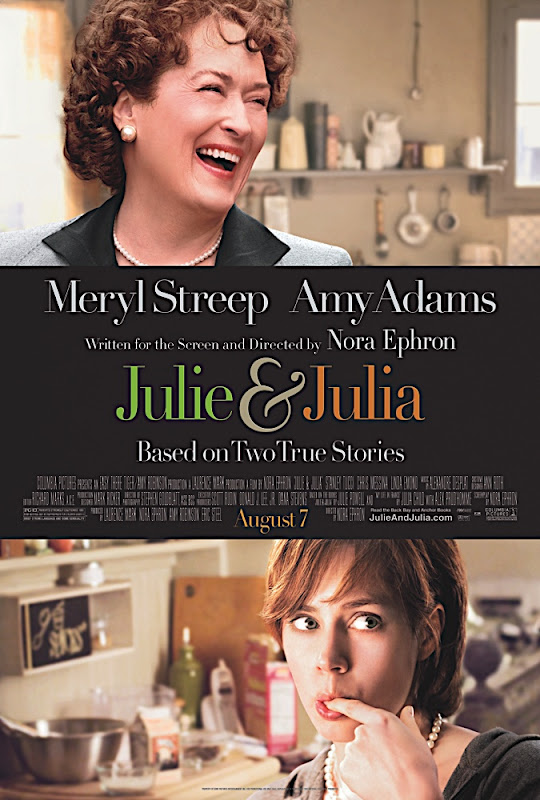
Movie Review: Julie & Julia (2009)


Coming Soon to DVD & Blu-ray


Photo Slideshow


Delicious
Bookmark this on Delicious
submit to reddit
Print Page

Digg!

MovieBlips: vote it up!

Despite the fact that they are separated by more than fifty years in two thematically similar narratives, the presence of both personalities referenced in the title as well as the talented women portraying them linger as the film flows back and forth in time.

Similar to producer Scott Rudin’s film The Hours (also starring Meryl Streep and based on a literary source), Julie & Julia uses time freely and in a circular fashion. Reuniting with not just producer Rudin but her co-star Amy Adams from Doubt (although in this film the two don’t share a scene), Julie's more contemporary plot concerns Adams’ hardworking, highly educated but frustrated failed novelist Julie Powell who moves from Brooklyn to Queens in 2002 while the aftermath of 9/11 is still painfully fresh.

Spending her days in a cubicle alternating from anger to tears of heartache as she takes calls while employed with the Lower Manhattan Development Corporation—Powell discovers that the only solace she receives from a hard day at the office is in the certainty of following a recipe she knows and trusting that she’ll be able to predict the outcome of its resulting comfort food.


Following a disastrous lunch with her group of power hungry friends from college and an embarrassing article about her lack of success as she nears thirty which finds her feeling dissatisfied with herself as a writer, Powell’s loyal husband Eric (Chris Messina) suggests that she should look for an outlet that somehow gives her the artistic release she desperately needs.


As the dawn of the twenty-first century began the rise in popularity of blogging, suddenly Powell realized precisely what she wanted to do. But unlike the flood of vanity blogs filled with random thoughts, gossip, Dear Diary like entries, or items that most of us would never want to read, she put her literary skills to good use and employed an intriguing hook by embarking on a quest to cook all 524 recipes in 365 days contained within the culinary tome Mastering the Art of French Cooking.


While Powell gets to work on her blog, writer/director Nora Ephron has been deftly weaving us through the simultaneous and similar challenge facing Meryl Streep’s Julia Child who—no stranger to governmental work-- like Powell has also moved and is in search of something to do that will fulfill her on a personal and creative level.

Thus, we follow Streep’s journey as Julia Child from her 1948 arrival in Paris until she eventually channeled her appetite for life and food into the study of cuisine, becoming not just the first American woman to study at Cordon Bleu but to eventually bring her academic pursuits to America with the publication of Mastering the Art of French Cooking which was co-written with Louise Bertholle and Simone Beck.


Easily the greatest actress working today, Streep manages to fully convince us she’s Child within seconds, going beyond that recognizable accent that was made part of our pop culture landscape once more via Dan Akyroyd on Saturday Night Live by fully embracing just how much Child simply loved life and seemed to treasure all those with whom she came into contact.

Moreover, the Child sequences in Paris are far more compelling than any of the material involving Powell. And unfortunately this seems as though it's because, no matter how much you ultimately dress it up—aside from her genuine affection for Child- the blog itself felt like a race-to-the-finish-line style gimmick rather than a true celebration of the overwhelming amount of work that Child put into the book so many who own it take for granted. Of course, this probably was not Powell's intention but for truncated film reasons, that's the way it comes across.


Additionally, despite my admiration for Adams as one of my generation’s most talented actresses, she isn’t given very much with which to work. Basically, Adams' Powell seems to be a pretty narcissistic character especially considering the fact that as evidenced in the script-- not only does it indicate that it’s female driven professional jealousy that drives her to blog but the film also contains a conversation that’s nearly entirely comprised of her character and another agreeing on how much of a bitch Powell is-- as well as another throwaway line that all women hate their friends.


Thus, since the representation of Powell went against the celebration of living life to the fullest and Child’s zest for this manner of being, I kept thinking how much better the movie would’ve been if they’d axed the Julie Powell plot completely and just gone solely with a film about the fascinating Julia Child.

This idea was solidified by the pitch-perfect chemistry that Streep had with her Devil Wears Prada costar Stanley Tucci who portrayed her adoring husband Paul. Able to spark so well together that early into the picture you can actually see Streep blush right through her makeup-- and indeed, according to the production notes from Sony’s Columbia Pictures, Streep suggested Tucci for the role—the two present a refreshing depiction of a true marriage of equals.


Of course they have their troubles and Streep and Tucci are able to bring quiet layers to their work showing private doubts and fears of not fitting in during a few unscripted dialogue-free moments that ordinarily would’ve been left on the cutting room floor. Yet their relationship unlike Julie and Eric’s which mostly consists of grocery buying, food tasting, and disagreements was the one that truly inspired and nourished me as a jaded twenty-first century singleton the way that Child's food and cookbook has nourished countless chefs over the years.


For, they not only support each other through the hard times of feeling less like a man or a woman when he’s interrogated during the McCarthy era and humiliated and likewise as Child is unable to have a child but also in the way they seem to look at each other as though they’re still the only people in the room. And this is evidenced in the cute (yet slightly scandalous) nude bubble bath etc. postcard photos recreated on film that they took to share with others their love and delight in life and each other.


All in all, it's an ambitious and highly literary film that combines not just two works of nonfiction including Julie Powell’s Julie & Julia and Julia Child with Alex Prud’homme’s My Life in France as well as her famous cookbook along with what I can only imagine was endless research in a masterful script by Nora Ephron. Additionally it proves to her harshest critics she’s much more than the queen of the romantic comedies whom they'd had her pegged to be and although the Julie portion of the film made it a bit unbalanced, it’s still highly recommended.

Likewise, given another wondrous turn by Streep and a dynamic supporting performance from Tucci who helps augment our leading lady, I believe that Ephron’s work may be up for some serious awards consideration also given the amazing talent involved behind the scenes from producer Rudin, Benjamin Button and Painted Veil Oscar nominated composer Alexandre Desplat and cinematographer Stephen Goldblatt (Closer, Angels in America, Charlie Wilson’s War, Rent).

However, as a longtime fan of Ephron’s--for this reviewer, the most inspiring and empowering story involved in the production from a female standpoint aside from Ms. Julia Child’s is that of Ms. Nora Ephron’s who—with Julie & Julia seemed to provide a subtextual third character and narrative to the piece of a woman seeking inspiration, something to do, and the right outlet to find herself. To explain-- with this film, Ephron managed to do just that as a filmmaker.


As when it comes to Julia, Ephron has actually created something that looks and feels completely different than any of her other works and at its heart, it’s a film that applauds a woman’s need to find a creative outlet. And while most moviegoers will be caught up fully in the tale of the characters, I was just as invested in the evolution of the woman yelling “action” and the way that somehow she managed to juggle various texts to produce not just a cohesive structure but a mightily impressive and intelligent screenplay at the same time.

For, while I’m sure that the movie will have a tough time battling the testosterone fare of GI Joe, to me the greatest measure of its success would be that-- similar to both Julie and Julia-- if Nora Ephron has finally realized just how valuable, worthwhile and important her work has been to female filmmakers and audience members all along.


And, much like Julia Child trying to fight prejudices and labels against the Americans trying to master French cuisine-- Ephron has battled the Rom-Com label for years. And although her romantic comedies are still the most sophisticated ones I’ve seen in decades, with Julie & Julia she proved that she can leave the genre whenever she wants and meander directly into Rudin territory of literary works without managing to forget to season the work with intelligence, feminism, and wit.


Text ©2009, Film Intuition, LLC; All Rights Reserved. http://www.filmintuition.com

Unauthorized Reproduction or Publication Elsewhere is Strictly Prohibited.

1/07/2009

DVD & Blu-ray Review: Swing Vote (2008)


Campaigning for Your Vote
On DVD & Blu-ray

1/13/09


In 2007, the world was introduced to the young Irish actress Saoirse Ronan with her Oscar nominated turn in director Joe Wright's acclaimed Golden Globe winning heartbreaker Atonement, based on the novel by Ian McEwan.

While admittedly, director Joshua Michael Stern's political satire Swing Vote doesn't aim for the same high brow art house crowd, those who sought out the 2008 film in its August release, became acquainted with a young, extraordinarily talented eleven-year-old American actress named Madeline Carroll.

Turning in a performance that was both bittersweet and mature, the young girl whom actor Kevin Costner called the film's "little home run" in the DVD & Blu-ray Making-of Featurette managed to keep us interested, even when the sometimes bloated film began to veer off course.

Holding her own opposite not only Costner but Stanley Tucci and other acclaimed professionals more than three times her age, it was young Carroll who managed to stop the film from becoming a spoiled ballot, despite a number of fine supporting performances and an ingenious concept.

Now arriving on DVD and Blu-ray in the same month that our country finds ourselves being given a new opportunity with a change of leadership, it's the right time to check out a political comedy now that we can all collectively breathe a sigh of relief that campaign media coverage has ended.

And although I can't altogether recommend the film which moves unevenly in tone-- I have to recommend that you seek it out regardless as young Carroll definitely earned the vote of this reviewer in a performance that I listed as one of the standouts of the year in Film Intuition's 2008 Year in Review.

However, before I delve into the aspects both the DVD and Blu-ray disc themselves, I'll break this post up into three parts beginning with my original theatrical review of the film.


I. The Movie

Director: Joshua Michael Stern

To precocious twelve-year-old Molly Johnson (an impeccable Madeline Carroll), voting is not only an optimistic privilege but it’s also an American citizen’s “civic duty.” However, to Molly’s under-achieving father whom — for the zero parenting he offers — she fittingly calls Bud (Kevin Costner), voting in America simply risks the chance that you’ll wind up on the fast track for jury duty. Unfortunately for Bud, along with making the family budget and packing his daily lunch, Molly registered her father to cast his vote, aligning him as a political “independent” since she proclaims that “the two-party system neglects the working poor.”

While Lou Dobbs would no doubt beam with pride, Bud struggles to make sense of his daughter. This is especially the case when — in equal fascination of the electoral process as well as her tie-in school project — Molly reveals that she took the trouble to fill in her parental political questionnaire for Bud because she wanted to make him “sound smart.” Despite his protests and canned statements that voting is useless, Molly demands that her father meet her at the polling place after school with a peck on the cheek and a warning to Bud, namely, “screw this up and I’m leaving you.”

And while Molly has a fruitful day delivering a beautifully worded political essay and ends up on the news after local Texico, New Mexico reporter Kate Madison (Paula Patton) decides to feature it in the evening broadcast, Bud’s prospects that day are far less successful. With incriminating footage that depicts Bud ruining more of the eggs than he’s able to neatly package in the plant where he works — not to mention the fact Bud hasn’t punched in on time in six months and proceeded to take thirty-one sick days — before he’s officially laid off, his boss and former high school friend asks him to give him one good reason not to let him go. Foreshadowing his inability to make a decision which will propel the rest of Swing Vote's plot, needless to say Bud can’t offer him any explanations.

Later, predictably forgetting his promise to Molly until it’s nearly too late, Election Day ends on a far stranger note after a bizarre computer error concerning Bud’s vote makes the results of the day — already in a deadlock for the presidency — all boil down to whom Bud will vote for ten days later when, by oath, he swears he must recast his vote. Literally holding the fate of the government in his hands as his vote will decide which candidate earns swing state New Mexico’s five electoral votes and ensures him the presidency, Bud is overwhelmed by the media reaction as every major outlet from MTV to CNN to the BBC sets up a stakeout right outside his trailer. And just as quickly, political organizations start flooding into the tiny town that — before the gaffe — had been so inconsequential it wasn’t even on the state map.

However, the story really heats up when both candidates journey out to try and win over Bud by any means necessary. Pulling out all the stops and White House goodie bags he can carry, the first of the two competing front-runners, the favored Republican incumbent President Andrew Boone (a pitch-perfect Kelsey Grammar) arrives in Texico complete with the aptly named Martin Fox, his amoral strategist, in tow (Stanley Tucci). Also vying for Bud’s ear — or rather his vote — the earthy Democratic challenger Donald Greenleaf (Dennis Hopper), who along with his campaign manager Art Crumb (Nathan Lane) promises a racially blind, all inclusive “rainbow” White House, pack up their “Truth Train” and “Operation Real Deal” to make the long trek to the desert. Although the Dems learn that — while they can’t even begin to compete with Air Force One — their secret weapon is none other than Willie Nelson, who was the subject of a tribute band that Bud had played in before his rhythm section ended up in the slammer.

In an effort to better understand Bud, the candidates and their smarmy managers resort to shameless pandering, insincere flattery, and manipulation, including letting the dimwitted, perpetual beer drinker win at poker or using cue cards to make small talk with Bud about fishing. Most memorably, this results in a wonderfully hilarious speech by Grammar likening his role as commander-in-chief to that of a quarterback, breaking foreign policy down with the aid of football terminology. Grammar nails every scene he’s in and nobody plays a buffoon or the prototypical blue collar American male quite like Kevin Costner, although he’s essentially recycling the far more likable characterizations he crafted in Bull Durham and Tin Cup.

However, by making our lead character such an idiotic Homer Simpson-like oaf, we’re laughing at Bud rather than with him throughout the film’s entirety. And far more often than I felt empathy for him, I was surprised to find myself actually loathing him numerous times throughout because of his complete inability to see beyond himself and understand not just the gravity of the situation but recognize how it’s all affecting his daughter. Speaking of which, as Molly, the young Madeline Carroll completely steals the film and our hearts in the process, especially in a scene wherein she shows far more worldliness and morality than her father ever could, while breaking down in tears in front of her classroom, telling white lies in order to make her father sound like he actually cares about the country he’s living in and his fellow Americans.

For a comedy, Swing Vote is a bit more melancholic than perhaps director Joshua Michael Stern, along with his co-writer Jason Richman, had planned since there’s nothing funny about child neglect; but they try to keep the satire swinging along with the mystery of Bud’s vote and make great use out of their supporting players in the process. As the candidates begin to address Bud directly in a series of new political ads, suddenly Costner’s Bud becomes his very own Truman Show, being followed and analyzed around the clock in every journalistic medium. Although quality wise, Swing Vote is less like Truman Show and more like EdTV.

However, hilarity ensues as the candidates embrace political flip-flopping as the Republicans suddenly promote gay marriage and environmental protection with the Democrats tackling illegal immigration and embracing the pro-life movement simply because the inarticulate Bud misspoke a few times while being interviewed by the beautiful local, ambitious newswoman Kate Madison. In an underdeveloped subplot, Madison, who shares a bond with Bud’s brainy daughter, must reconcile her ethics with her desire to get ahead in the business, seeing Bud’s story as the ultimate break in getting the hell out of her tiny town and station run by George Lopez in order to follow in the footsteps of idols like Paula Zahn.

With the inclusion of an “everyman” and a “reporter with a conscience,” Stern reaches to emulate the type of underdog film that Frank Capra perfected with Mr. Deeds Goes to Town and Mr. Smith Goes to Washington. And while the performers elevate the material, Stern forgot the fact that what made Capra’s films such a success is they delivered us a hero we could root for and one whom - despite not being the smartest - had a heart as big as the White House and therefore endeared us to him from the get-go. Predictably, Costner’s Bud has a wake-up call late into the film but it’s rushed and protracted — crammed into the last twenty minutes, making it pay off less than it could have had we seen glimmers of his goodness earlier on.

While it’s not as cynically intelligent as Wag the Dog or Bulworth, nor as paranoid as the underrated Man of the Year, there’s no doubt this film plays much better during this particular election year with audiences growing weary of endless coverage of the candidates and outrageous accusations and distracting spin. Despite this, Swing’s sound bites and satire get awfully repetitive in the last hour of the film’s surprisingly lengthy running time.

And similar to the way that the issues a voter cares most about are often neglected as soon as their candidate hits the Oval Office, on my way out of Stern’s film I felt like I’d just voted again. For instead of contemplating any food for thought by recalling some truly terrific scenes and stellar performances, I wondered what would have happened if the film hadn’t been ultimately overshadowed by such an inconsistent screenplay. Now that’s something that calls for a re-vote or at least, in the case of Swing Vote — political comedy reform.


II. The DVD

Featuring an audio commentary by the two friends turned professional collaborators, writer/director Joshua Michael Stern and his fellow scribe Jason Richman, this beautifully transferred widescreen DVD from Walt Disney Home Studios Entertainment and Touchstone Pictures arrives with great new cover art to highlight the film's stellar cast via an Altman-like design although unfortunately Carroll isn't billed in either side of the box.

Revealing that the impetus behind the film was following the shock of the 2000 election and the scary idea that the presidential decision could be narrowed down to "a tiny district in Florida," Stern and Richman share that they figured narrowing it down even further to just one man wasn't only not far fetched but great comedy fodder.

When it came to casting, the two who share that they "always wanted Costner" for the lead in order to "deconstruct his movie star persona," gratefully reveal the actor's generosity in arriving on the set as an actor first and foremost and leaving his "director's hat" at home (so-to-speak), ensuring that the film was the young director's vision through and through.

Crediting the richness of the script and the way it moved from humor to great emotion, numerous actors reveal the way that they were drawn to the piece because of precisely that mixture and the added bonus that it would make audiences think as well.

"Let's face it, we're making fun of ourselves as a country," one interviewee notes in the extra "Inside The Campaign: The Politics of Production," but in doing so, the filmmakers wanted to add as much credibility and authenticity as possible in persuading reporters, anchors and pundits from Larry King to Arianna Huffington to Bill Maher to make brief "TV Cameos" to heighten the film.

Additionally, it features some great tongue-in-cheek remarks from the cast including Grammer who notes that he couldn't turn down the opportunity to act opposite an elephant (as we discover in the deleted scenes) and Dennis Hopper who jokes that although this is a long ways away from Easy Rider and Blue Velevet, he doesn't "want to give up my day job playing villains."

Likewise, we also gain a greater appreciation for Patton's turn as the actress shares the way she studied the posture, intimations, and delivery of CNN and other channels to nail her character, along with Tucci who we discover improvised one of the funniest lines of the film that made it into the trailer (a spontaneous response to Carroll's charge that he would sell his own mother).

Additionally, although it's standard DVD fare, when it comes to Swing Vote, the deleted and extended scenes (with optional filmmaker commentary) are actually worth watching as-- in the two best ones that add more humanity to the politicians-- we see a hilarious "what if?" moment as Tucci and Lane hypothesize the way they could change Washington, Hopper and Grammer get in touch with the real reason they entered politics in the first place (including that aforementioned elephant).

Also boasting the "Hey Man, What About You?" music video from Costner's band Modern West which fuses footage of the film together and giving fans a better gauge of the actor's true musical talent (in lieu of the purposely overdone Bud Jams with the Democrats sequence in the film), the DVD also includes an insert for the debut album by the band-- Untold Truths-- which you can learn more about on the official website.

III. The Blu-ray Disc

As Walt Disney Home Entertainment was generous enough to send out both formats for Swing Vote, I was able to judge the technical quality of the film's Blu-ray version as well. Boasting the same featurettes that comprise the DVD (as described above) and a fun interactive menu that uses the sound of camera "flash bulbs" as you move through the options, the Blu-ray's quality is predictably far superior to the DVD with the soundtrack blaring out as though we were in a rock arena in 5.1 DTS-HD surround (especially evidenced in one of the earliest scenes as Bud drives Molly to school).

Seducing owners of Blu-ray players with a plethora of pre-feature trailers to experience the works of Miramax, Paramount Vantage, and other Disney owned films in the HD format, you'll get chills seeing some clips of your favorite films like Kill Bill and There Will Be Blood in their Blu-ray glory (which I can actually attest to, having rented Blood recently on Blu).

As for the feature film itself, Swing Vote's Blu-ray transfer is crystal clear from the far left of the screen to the far right as we can see heightened detail in flesh-tones, individual hairs blowing, and a wondrous magical effect of the chicken feathers flying as though they were snow at Bud's workplace near the beginning.

With heightened 3D like depth perception and a super sharp contrast, Swing Vote excels. This is particularly noticeable in scenes where the politicians and reporters all clamor together dressed in dark business suits, holding cameras and microphones with a high transfer of the deep, rich black tones that don't blur together to a muddy effect to which some Blu-rays have fallen prey. Thus in the end, it offers home viewers an even better Voter experience than the one I witnessed via the print I viewed during a crowded press screening back in August of '08.

10/26/2008

DVD Review: Kit Kittredge: An American Girl


Click Here to Explore Video Clips, Interviews, Photos & More


Digg!

In honor of October 28th's DVD & Blu-ray release of the heartfelt family film, Kit Kittredge: An American Girl, I'm offering you an insider's view of the DVD that Warner Brothers was kind enough to send my way. However, before I go into the DVD features, first I'll serve up a reprint of my original review (with bonus photos) published for its theatrical run back on 7/2/08.

Kit Kittredge: An American Girl
Director: Patricia Rozema

As every parent knows, all kids ask “why” but while most are satisfied enough by succinct replies to end their fleeting curiosity there, precocious ten year old Kit Kittredge (Little Miss Sunshine's Abigail Breslin) doesn’t neglect to ask the other five questions that go along with it-- namely the “who,” “what,” “where,” “when,” and “how” which all meld together to illuminate the bigger picture of whatever pops into her fascinatingly inquisitive mind.
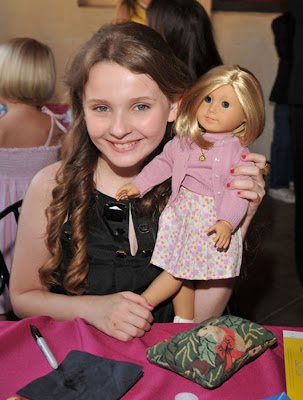


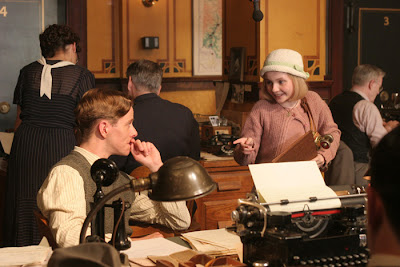
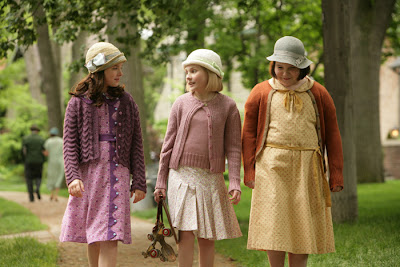
An ambitious newshound, when Kit isn’t spending time with the three other members of her adolescent feminist Treehouse Club complete with photos of idols Amelia Earhart and Eleanor Roosevelt given places of honor on the wooden walls, she wears out her shoe leather and typewriter ribbon in her ardent quest to become a full-fledged journalist for the local Cincinnati Register. Despite her youth, the tireless self-starter investigates every lead at her disposal, knowing how to handle a source with confidentiality, work a piece from a new angle, always be cautious of burying the lead, endlessly checking her facts and similar to the way that Nancy Drew was known as a “girl detective,” Kit Kittredge--to whom she’ll no doubt draw comparisons-- is a truly gifted “girl reporter.”


Based on the successful American Girl series of books from Kit author Valerie Tripp made popular in my own adolescence, Mansfield Park director Patricia Rozema’s earnest, unabashedly nostalgic and sweet-natured film which was penned by Chronicles of Narnia scripter Ann Peacock announces its aims towards offering something positive for women proudly from the start over opening credits which reveal that in addition to the writer and director, there were an uncharacteristically large amount of female professionals associated with the movie including executive producer Julia Roberts, whose own niece Emma had coincidentally starred in the most recent version of Nancy Drew.

Given the outstanding production value of not only Drew but especially Kit, I’m remaining cautiously optimistic that the film won’t be buried in the wake of ultra-violent, special effects driven summer blockbusters and that it will not only earn a steady following increased no doubt by positive word of mouth but will also inspire more intelligent fare for young knowledge hungry audiences as impressively Kit seems to be a film entirely apart from what could’ve had excellent product placement potential, standing on its own as superlative and overdue family fodder.

Set during the uncertainty of the Great Depression, we find Kit’s initial goal of trying to break into print journalism through the connection of her brother’s friend who erroneously assumed the young woman simply wanted a tour of the big, bad, masculine newsroom led by domineering editor Wallace Shawn, placed on the back burner when the effects of the trying economy and era hit home as her caring father (played by Chris O’Donnell) finds his car dealership taken over by the bank and he’s forced to venture to Chicago to find work to support his wife (Julia Ormond) and family.


Not content to sit back and wait, Kit and her mother take in eccentrically zany boarders such as a husband hunting, flirtatious dance instructor (Jane Krakowski), Joan Cusack as a buttoned-up mobile librarian who’s a terror behind the wheel, and a part time magician and full time ham played by Stanley Tucci. When the gregarious and trusting Kit befriends two young hobos (Jumper’s Max Thieriot and Willow Smith) whom her mother employs to contribute in odd jobs in exchange for food, she encounters class prejudice after a series of robberies hits her sleepy neighborhood and all fingers point towards the hobos, inspiring Kit to once again rely on her budding reporter’s intuition and skills to sleuth out the case on her own in discovering the true culprits and helping to clear not only her friends’ names but also try and prevent her home from foreclosure.

Although the primary audience will most likely be young girls and their mothers, this G rated feature packs a great punch in offering viewers a surprisingly complicated mystery—including one that does admittedly seem to confuse slightly in the final rushed act when clues are revealed far too quickly. In addition, it’s filled with important historical information that definitely echoes today in our struggling economy not to mention messages of loyalty, perseverance, tolerance, justice and friendship which make it ideal for viewers of both genders, if parents can manage not to mention the American Girl book series connection in getting their sons into the theatre.


And speaking from the perspective of a girl who, much like Kit was far too eager to jump into the professional realm in her adolescence (and in my case trying to join Seinfeld’s writing staff at the age of eleven), it’s a wonderful celebration of childhood innocence and the reminder never to diminish a child’s dream, especially when like Kit, they’re more concerned with intellectual pursuits rather than begging for trips to the mall to buy toy tie-ins to other summer blockbusters. Although in the case of Kit, as an aunt, if my niece were just a few years older, I wouldn’t hesitate to purchase her a Kittredge doll in lieu of Barbies and Bratz.


DVD Features:

Winner of the Heartland Award certifying Kittredge as a "Truly Movie Picture," the DVD offers 3 formats for your viewing pleasure-- the original widescreen aspect ratio which preserves the theatrical version and is enhanced for widsecreen televisions, a full-screen edition which is modified from the original but formatted to fit the shape of your screen, as well as a digital copy you can download to play on your Mac, PC, Video iPod or other portable video device.

Featuring a gallery of of trailers from the other American Girl Movies that went straight-to-DVD and can be purchased below by checking out the Mini-Amazon American Girl Collection Slideshow I've provided, Kit's DVD also boasts features that are enhanced for DVD-ROM equipped personal computers. Additionally, the film provides English and Spanish subtitles for the deaf or hearing impaired as well as crystal clear Dolby Digital 5.1 Surround Sound.

Hands down the best live action (or non-animated) children's film I've seen in 2008, Kit Kittredge is one you should definitely introduce to the women in your life-- whether it's your grandmothers who may recall the time period firsthand, your mothers, or for the next generation and its target audience of children and grandchildren. An extraordinary, underrated gem-- follow along with Kit and stay on the case until you bring this highly recommended disc home on DVD or Blu-ray.


10/17/2008

What Just Happened (2008)


Digg!


Check out the Trailer & Photo Gallery

Admittedly, the shooting of a dog in No Country for Old Men may have added to the brutal ambiance needed for the Coen Brother's allegorical depiction of a country that's "hard on people," in earning it the Academy Award for Best Picture. However, when it comes to mainstream cinema, putting two in the chest of a beloved family pet is hardly the way to win people over at a test screening. Hollywood producer Ben (Robert De Niro) learns this lesson the hard way in fake Technicolor blood as he watches his latest edgy film Fiercely-- directed by a British nail-polish wearing ticking temper-tantrum time bomb Jeremy (Michael Wincott) -- send audience members either fleeing for the exits or leaving scathing notes on his comment cards ranging from "my wife is still crying" to the one-worded question, "why?"

While Jeremy is just one of several characters in director Barry Levinson's hilarious adaptation of screewnwriter Art Linson's fictionalized and far more satirical version of his bestselling 2002 insider memoir who pleads "artistic integrity" the way most mobsters take the fifth in court, the bottom line is changes need to be made or the film will not only lose millions, further jeopardize Ben's dwindling "power credentials" but possibly end careers as well. Putting it bluntly, Catherine Keener's two-faced cutthroat studio executive Lou (another one of her fascinating creations reminiscent of her ball-breaking turn in Being John Malkovich), demands that either both Jeremy and Ben makes the changes or she'll take away the film and cut it herself. Although Jeremy is sent into hysterics and Ben's wise, young assistant is kicked out of the room when she suggests that the film's edge could've been the reason its star Sean Penn (appearing in the film as himself) signed on, Ben knows it is all part of the game. And it's the same game he plays twenty times a day at a breathlessly breakneck pace over fourteen hellish days that take him from La La Land to Cannes.


And throughout Levinson's film, Ben juggles his responsibilities as a devoted dad driving his children (from two marriages) to school, endlessly chatting away on his cell phone earpiece, trying to come to terms with his feelings for his soon to be ex-wife Kelly (Robin Wright Penn), massaging egos and holding the hands of his temperamental colleagues, hearing pitches at school drop-offs, listening to Morricone while stuck in traffic, or trying to figure out how to persuade Bruce Willis (also playing himself) to shave a beard for his role to maximize leading man sex appeal.

While it’s nowhere near the same league as Altman’s masterful film The Player-- as the latest in a long line of insider comedy/dramas, refreshingly What Just Happened is much more successful than this year's other Hollywood insider-comedy Tropic Thunder. And this is precisely because in making it a human story first and foremost, it also makes the situations both accessible and believable, without solely playing to only those well-versed in film industry knowledge.

Additionally, De Niro's quiet, contemplative and fascinatingly restrained character that always seems to be spreading himself far too thin marks one of the actor's best performances in years. Getting the chance to be both funny and endearing and never slipping into the caricature that helped propel the success of the Meet the Parents films, it's a wonderful change of pace for De Niro devotees such as myself (for proof click here) to see Bobby D playing the most level-headed one in the room when Bruce Willis pleads "artistic integrity" and trashes a room filled with costumes before stomping off to his trailer. As Linson noted in the press release, De Niro "instinctively knew that a man hanging over a ledge in Hollywood is desperately funny and true. He ferociously inhaled that idea and the rest of us followed," as his character tries to "hold his family together while navigating through," as Levin called it--- the Hollywood "battlefield."


Shot in just thirty-three days, the artistry of the film's look is quite impressive with fast-cuts, intriguing sound and visual cues, and the stunning photography of lensman Stephane Fontaine. Likewise it’s one of those films that seems as though it must've been as enjoyable to make as it is to watch as it's filled with what feel like spontaneous little touches by scene-stealing players like Wincott (truly one of the most hilarious people in the film), John Turturro, Stanley Tucci, and Bruce Willis (courageously playing the worst version of himself). Although initially, I feared it would feel like most indulgent Hollywood industry comedies where we're all showing up as extra guests at a party to which we really shouldn't have been invited (and film buffs instinctively get the impression of "who called who" when realizing the overlapping credits of those involved), upon the first viewing, it's an overwhelming whirlwind as we try to keep up with Ben's chaotic lifestyle.

However, during the second time around, I realized that despite its ridiculously jaded setting where a man's facial hair can put hundreds of people out of work, it's a great, artistic glimpse of a life lived at full-speed, under too much pressure like a bulb ready to burn out from overuse which is something to which most Americans multitasking during their waking hours can definitely relate --that is before our inevitable crash of however long we sleep before doing the exact same thing again. And while the great thing is that, unlike Ben's life, ours isn't spent under the microscope, it's nice to be able to laugh at the problems of the little things times ten magnified Hollywood style, whether it's in the over-the-top bravura performance of Jeremy or in some truly great, organic humor between Robin Wright Penn and Robert De Niro as they attend a couple's therapy where the ultimate goal is to keep them apart as opposed to bringing them together.

While What Just Happened is used as both a question by Wright Penn in the film in a throwaway line near the end (and honestly makes for a lackluster title destined to be forgotten once the film ends), it also seems to be the name of Ben's game in explaining to everyone what just happened regarding any given situation, no matter how unbelievable it is. And as the film careens into an overly long yet terrifically unpredictable windup, it will most likely have you going over what exactly happened during your drive home. Just don’t forget to pack the Morricone but maybe—unless you want to end up in soon to be ex-couple’s therapy-- leave your Bluetooth earpiece at home.


Read the Book that Started it All & More from Art Linson


Explore the Soundtrack (CD or MP3)


8/01/2008

Swing Vote (2008)


Read the DVD Review


Director:
Joshua Michael Stern


To precocious twelve-year-old Molly Johnson (an impeccable Madeline Carroll), voting is not only an optimistic privilege but it’s also an American citizen’s “civic duty.” However, to Molly’s under-achieving father whom — for the zero parenting he offers — she fittingly calls Bud (Kevin Costner), voting in America simply risks the chance that you’ll wind up on the fast track for jury duty. Unfortunately for Bud, along with making the family budget and packing his daily lunch, Molly registered her father to cast his vote, aligning him as a political “independent” since she proclaims that “the two-party system neglects the working poor.”

While Lou Dobbs would no doubt beam with pride, Bud struggles to make sense of his daughter. This is especially the case when — in equal fascination of the electoral process as well as her tie-in school project — Molly reveals that she took the trouble to fill in her parental political questionnaire for Bud because she wanted to make him “sound smart.” Despite his protests and canned statements that voting is useless, Molly demands that her father meet her at the polling place after school with a peck on the cheek and a warning to Bud, namely, “screw this up and I’m leaving you.”

And while Molly has a fruitful day delivering a beautifully worded political essay and ends up on the news after local Texico, New Mexico reporter Kate Madison (Paula Patton) decides to feature it in the evening broadcast, Bud’s prospects that day are far less successful. With incriminating footage that depicts Bud ruining more of the eggs than he’s able to neatly package in the plant where he works — not to mention the fact Bud hasn’t punched in on time in six months and proceeded to take thirty-one sick days — before he’s officially laid off, his boss and former high school friend asks him to give him one good reason not to let him go. Foreshadowing his inability to make a decision which will propel the rest of Swing Vote's plot, needless to say Bud can’t offer him any explanations.

Later, predictably forgetting his promise to Molly until it’s nearly too late, Election Day ends on a far stranger note after a bizarre computer error concerning Bud’s vote makes the results of the day — already in a deadlock for the presidency — all boil down to whom Bud will vote for ten days later when, by oath, he swears he must recast his vote. Literally holding the fate of the government in his hands as his vote will decide which candidate earns swing state New Mexico’s five electoral votes and ensures him the presidency, Bud is overwhelmed by the media reaction as every major outlet from MTV to CNN to the BBC sets up a stakeout right outside his trailer. And just as quickly, political organizations start flooding into the tiny town that — before the gaffe — had been so inconsequential it wasn’t even on the state map.

However, the story really heats up when both candidates journey out to try and win over Bud by any means necessary. Pulling out all the stops and White House goodie bags he can carry, the first of the two competing front-runners, the favored Republican incumbent President Andrew Boone (a pitch-perfect Kelsey Grammar) arrives in Texico complete with the aptly named Martin Fox, his amoral strategist, in tow (Stanley Tucci). Also vying for Bud’s ear — or rather his vote — the earthy Democratic challenger Donald Greenleaf (Dennis Hopper), who along with his campaign manager Art Crumb (Nathan Lane) promises a racially blind, all inclusive “rainbow” White House, pack up their “Truth Train” and “Operation Real Deal” to make the long trek to the desert. Although the Dems learn that — while they can’t even begin to compete with Air Force One — their secret weapon is none other than Willie Nelson, who was the subject of a tribute band that Bud had played in before his rhythm section ended up in the slammer.

In an effort to better understand Bud, the candidates and their smarmy managers resort to shameless pandering, insincere flattery, and manipulation, including letting the dimwitted, perpetual beer drinker win at poker or using cue cards to make small talk with Bud about fishing. Most memorably, this results in a wonderfully hilarious speech by Grammar likening his role as commander-in-chief to that of a quarterback, breaking foreign policy down with the aid of football terminology. Grammar nails every scene he’s in and nobody plays a buffoon or the prototypical blue collar American male quite like Kevin Costner, although he’s essentially recycling the far more likable characterizations he crafted in Bull Durham and Tin Cup.

However, by making our lead character such an idiotic Homer Simpson-like oaf, we’re laughing at Bud rather than with him throughout the film’s entirety. And far more often than I felt empathy for him, I was surprised to find myself actually loathing him numerous times throughout because of his complete inability to see beyond himself and understand not just the gravity of the situation but recognize how it’s all affecting his daughter. Speaking of which, as Molly, the young Madeline Carroll completely steals the film and our hearts in the process, especially in a scene wherein she shows far more worldliness and morality than her father ever could, while breaking down in tears in front of her classroom, telling white lies in order to make her father sound like he actually cares about the country he’s living in and his fellow Americans.

For a comedy, Swing Vote is a bit more melancholic than perhaps director Joshua Michael Stern, along with his co-writer Jason Richman, had planned since there’s nothing funny about child neglect; but they try to keep the satire swinging along with the mystery of Bud’s vote and make great use out of their supporting players in the process. As the candidates begin to address Bud directly in a series of new political ads, suddenly Costner’s Bud becomes his very own Truman Show, being followed and analyzed around the clock in every journalistic medium. Although quality wise, Swing Vote is less like Truman Show and more like EdTV.

However, hilarity ensues as the candidates embrace political flip-flopping as the Republicans suddenly promote gay marriage and environmental protection with the Democrats tackling illegal immigration and embracing the pro-life movement simply because the inarticulate Bud misspoke a few times while being interviewed by the beautiful local, ambitious newswoman Kate Madison. In an underdeveloped subplot, Madison, who shares a bond with Bud’s brainy daughter, must reconcile her ethics with her desire to get ahead in the business, seeing Bud’s story as the ultimate break in getting the hell out of her tiny town and station run by George Lopez in order to follow in the footsteps of idols like Paula Zahn.

With the inclusion of an “everyman” and a “reporter with a conscience,” Stern reaches to emulate the type of underdog film that Frank Capra perfected with Mr. Deeds Goes to Town and Mr. Smith Goes to Washington. And while the performers elevate the material, Stern forgot the fact that what made Capra’s films such a success is they delivered us a hero we could root for and one whom - despite not being the smartest - had a heart as big as the White House and therefore endeared us to him from the get-go. Predictably, Costner’s Bud has a wake-up call late into the film but it’s rushed and protracted — crammed into the last twenty minutes, making it pay off less than it could have had we seen glimmers of his goodness earlier on.

While it’s not as cynically intelligent as Wag the Dog or Bulworth, nor as paranoid as the underrated Man of the Year, there’s no doubt this film plays much better during this particular election year with audiences growing weary of endless coverage of the candidates and outrageous accusations and distracting spin. Despite this, Swing’s sound bites and satire get awfully repetitive in the last hour of the film’s surprisingly lengthy running time.

And similar to the way that the issues a voter cares most about are often neglected as soon as their candidate hits the Oval Office, on my way out of Stern’s film I felt like I’d just voted again. For instead of contemplating any food for thought by recalling some truly terrific scenes and stellar performances, I wondered what would have happened if the film hadn’t been ultimately overshadowed by such an inconsistent screenplay. Now that’s something that calls for a re-vote or at least, in the case of Swing Vote — political comedy reform.