As a freewheeling celebration of the limitless potential and life-altering power of the imagination, director Ben Stiller’s remake of the classic 1947 eponymous film (adapted from the original story by James Thurber) is one of the most stunningly creative works to come out of the Hollywood studio system since Stranger Than Fiction.
Sublimely lensed by the cinematographer of The Piano (Stuart Dryburgh) with incredible special effects by Soho VFX, The Secret Life of Walter Mitty, which languished in development hell and passed from one helmer to the next for roughly twenty years found its ultimate storytelling team in the form of Pursuit of Happyness scripter Steve Conrad and a top-of-his-game Stiller.
Building off what he’s learned and explored onscreen in his own twenty year directorial career, Stiller crafts what is his most truly cinematic work to date.
A triumph that was lost in the over-crowded shuffle of too many Oscar-bait films filling the multiplexes alongside blockbusters raking in dough during the holiday moviegoing season, Mitty is an underrated dazzler that‘s sure to gain a larger fanbase on this gorgeous Blu-ray disc.
The type of film that plays that much better the second time around, Mitty is especially satisfying to discuss with others while dissecting just how intricately Stiller, Conrad and company managed to weave together so many seemingly disparate threads to craft such a beautiful, humanistic tapestry.
Walking a fine balance between a wholesome old fashioned approach both in the structure and characterization with some truly audacious techniques that (while risky) pay off in a big way, Stiller elevates the deceptively simple story in which he also stars.
As the titular Life Magazine photo department employee, Stiller’s head-in-the-clouds Walter Mitty finds himself actually embarking on the type of adventures he usually only dreams about, urged on by his crush on a lovely coworker (played by Kristen Wiig).
While the heroic journey storyline is often utilized, because Walter is a character who lives out elaborate fantasies in his mind – forever imagining he had the guts to say what he wants or live like he does in his dreams) Stiller uses a bold magical realism laced approach of expressionist filmmaking where for example we’re given the ability to see the things he usually only imagines come to life.
As he gradually dares himself to act as the film continues, Walter’s real life becomes far more extraordinary than his wildest daydream as evidenced by the way he sees Wiig’s face cheering him on at different points along the way including a staggering sequence wherein she sings “Ground Control to Major Tom” and it results into a big veritable leap of faith for Walter.
That leap of faith comes at a pivotal moment, taking the viewer along for the ride as we realize that the more he participates in life, the more we discover that every daydream he’s had foreshadows something that will pay off later in an unexpected way.
Paying homage to the world of mysteries with various clues that help reveal the larger truth – acknowledged aloud first by Wiig when she gives Walter (and by extension us) key wisdom learned in her mystery writing class – Mitty is a marvel.
Using creative storytelling to the absolute fullest and transcending its rigid scripted confines to make a much more layered work, The Secret Life of Walter Mitty should appeal to those who responded to the same blend of old and new, visual and written spinning of a good yarn on display in everything from Amelie to Eternal Sunshine to the Spotless Mind.
A wholly satisfying picture that marks his most inventive work thus far, with Walter Mitty Ben Stiller has done the unthinkable; he’s turned a studio remake into a big budget art movie with multigenerational, universal appeal.
Although I believe I only attempted quilt-making once in my life, a major lesson was learned in the process. Namely-- and despite my love of color and pattern and big and bold-- in order for everything to go together and complement each other, the designs must work in tandem as a whole.
In other words, you can't have one extremely decorative or flowery piece of fabric right next to an old beat up denim patch next to something that looks like one of those horrible reject ties given to American dads on Father's Day. There has to be a sense of harmony or fluidity as one piece of fabric melds into another and if you stare at it long enough, all you see is one ornate tapestry that draws your attention to it in its entirety rather than wanting to pick it apart piece by piece.
It's about this time I'm sure you're wondering, “What on Earth does this have to do with the new film from Wayne Kramer?” And honestly, the answer is “Everything.”
In fact, all it takes is one glimpse at the poster for Crossing Over, which follows up Kramer’s terrific indie The Cooler (starring William H. Macy and Maria Bello) which illustrates the ways that Los Angeles freeways and highways interconnect in a color scheme reminiscent of the American flag.
Of course, first you must move your eyes away from the obligatory “talent shot” at the top of the poster that shows some of the highlights in the ensemble cast headed up by a nice, understated Harrison Ford (as well as Ashley Judd, Ray Liotta, and Jim Sturgess in supporting roles) which seems overly photo-shopped into his ornate decoration below. Underneath the star power, we're presented with decorative red and white roads that-- upon first glance-- look like yarn, piping, or cords and you get a sense that that Kramer was using the idea of weaving and/or thread-work in what he aspired to be a cinematic collage.
It only takes a few moments after the film begins to immediately grasp the works that influenced Kramer which by now have echoed throughout every single film review for Crossing Over thus far-- namely it's an amalgam of Babel, Traffic, Short Cuts, What's Cooking?, Crash, and countless other multi-layered character pieces that introduce us to more than a dozen individuals whose lives intersect in a variety of ways over the course of its running time. Likewise, I’d also hazard to throw Fast Food Nation, Maria Full of Grace, Amores Perros, House of Sand and Fog, 21 Grams, and ESL into the politically volatile patchwork that takes a look at all sides of the immigration issue in the United States of America in present day.
Initially slated to run at roughly 2 1/2 hours before reportedly The Weinstein Company insisted upon roughly a half an hour of cuts (including the willing Sean Penn who bowed out of the film for political reasons of his own), the finished work seems as though it's full of jarring stops and starts that give us as much whiplash as you'd face on a Los Angeles freeway.
Moving uneasily between characters-- the film suffers when it spends an inadequate amount of time on the stories that really hit us as in the case of Towelhead star Summer Bishil’s turn as a Bangladeshi devout Muslim teenager whose speech about wanting to understand the 9/11 hijackers is reported by her principal to the office of Homeland Security and she's threatened with deportation. Yet instead of investigating that further, Kramer cuts away to endless subplots involving characters who soon begin to feel like stereotypes.
Those who are shortchanged the most and should’ve been left on the cutting room floor altogether involve a few including a Korean teenager who gets mixed up with a bad crowd just days away from his Naturalization ceremony (shades of early ‘90s South Central dramas like Menace II Society and Boyz in the Hood, anyone?) and the un-involving struggle of a young Australian actress (the otherwise talented Alice Eve) who arrives illegally in Los Angeles seeking fame and fortune only to prostitute herself for a green card.
Spending a ridiculous amount of time exploiting Eve with so many topless shots, it feels a little like a Cinemax late night movie; although most men won't complain-- sadly, it dawned on me after the film ended that only one female adult character and one minor female in the entire movie gets a happy ending.
But, forgive me as I digress and we'll move back to Eve's Claire who first wins and then loses our sympathy in an uneven handling of the cliched situation Kramer dwells far too often on, involving her decision to become a virtual sexual slave to the unspeakably sleazy and married immigration applications adjudicator Cole Frankel (Ray Liotta).
While Cole is the film’s devil, it’s his wife Denise (Ashley Judd) who is the film’s angel as a human rights crusading immigration defense attorney who fights to protect the very people her husband willingly exploits.
The film’s central storyline follows Harrison Ford’s Max Brogan-- an agent employed by Immigration and Customs Enforcement-- who witnesses firsthand the number of holes in the system, realizing that nothing is as simple as it appears every evening on Lou Dobbs' presentation of the issue as there’s good and bad every which way he turns.
When he becomes personally invested in the life in one illegal immigrant—a young mother (Alice Braga) who begs him to check up on her young son—Brogan begins calling in sick, testing out his Spanish, and trying to help make just one story end happily by returning the boy to his home in Mexico.
Of course, we know that the situations that drive people across the border are ridiculously complex and while Kramer gets bonus points for taking an unusual look at the immigration problem by trying to show it from every ethnicity (including one rather amusing subplot featuring 21 and Across the Universe’s Jim Sturgess as a British atheist who tries to pass himself off as a super devout Jew to gain a green card and hopefully a music career), ultimately he tears his own audacious quilt apart.
While not a complete failure and you’re definitely invested in the timely subject of the film-- unfortunately, as soon as we begin to feel a connection with one character, Kramer moves on. It's a work that's riddled with an over-abundance of speech-making—most ridiculously in a contrived and overly flowery confrontation during a store robbery at the end that sounds like a political campaign advertisement. And by hitting us on the head so hard instead of sewing things in gently, we're also left dazed by the overwhelming aftermath of too many loose threads that probably were ripped apart in the hasty editing process to meet studio distribution demands which cheats the final outcome for a subplot involving Brogan’s Iranian-American partner (Cliff Curtis).
Losing you in an uneasy, grainy, and awkward sea of distractions, you’re left with the realization of how much potential the film squandered in its excessive need to be big and bold. Ultimately, although the heart was in the right place for Kramer’s personal film he made as an American immigrant himself-- essentially Crossing Over is the type of quilt you’ll end up putting in the closet. For, in the times you do try to bring it out, you're faced with the harsh realization that no matter how many colors and designs are in it, instead of complimenting your furniture in a way so that things start to look new, you’re disappointed by the inevitable realization that what it mostly does is clash-- by offering nothing beneficial or interesting to a situation we face every single day in these United States.
Film is subjective. What we bring to it and what it brings to our lives is a two way street and no two people see a film the same way. As much as we want to pretend it's objective and/or mere entertainment, it's not. We react to things because in some way they touch something inside of us and it can be a range of emotions from love to hate or a simple understanding that it's a humanistic medium that's not only a valid part of our history and society but one that continually reminds us that we're all in this together.
There is a reason that I don't rate films with a star system consisting of some arbitrary number of four or five stars or assigning a subjective numerical value out of ten and it's the same reason that I seldom make Top Ten Lists at the end of the year to discern which films are my favorites in a particular order. Namely, it's because I feel it shortchanges the work and tries to indicate that it's going to have some sort of stamp on it that will apply in the exact same way to everyone watching a given film. So instead, I share their strengths and weaknesses and how they affect me.
Likewise, there is absolutely no way to guarantee you're going to see every single film that has come out in a year as even somebody who dedicates themselves to watching as many films as possible from around the globe can tell you. Milk was such a case for me and a film I'd call more of an "experience" than a movie.
Earlier in 2008, my favorite film of the year was In Bruges -- a film I didn't think would be rivaled and nearly wasn't until I saw Danny Boyle’s Slumdog Millionaire which recently earned the Best Picture Academy Award at the 2009 Oscar ceremony. When I pulled together the obligatory year in review in late December, it was Slumdog that I named my favorite work of last year of the movies I’d seen anyway and it's one that's still a marvel to me on a number of levels.
However-- eager to vote for the first time ever in the Independent Spirit Awards-- I felt it was only right to try and see as many of the nominated works as possible including the ones I'd missed them the first time around. Thus, I saw Milk in a crowded screening on a Saturday night and by then the buzz was huge as it had been listed on countless Top Ten Lists for the year.
It was a far cry from the quiet afternoon press screenings or rowdy evening screenings that bring in a crowd full of excited movie fans all clamoring for a free pass. And simply attending as a typical moviegoer made the Milk screening extremely fascinating to me. Of course, there was a built in audience for the film since it told the story of the first openly gay man ever elected to United States public office in 1977. And I believe most assumed that it would garner tremendous support (as did Focus Features' Brokeback Mountain years earlier) from the gay and lesbian community, but much like Mountain-- the crowd was jam-packed and extremely diverse.
While on the surface every demographic seemed to be represented but upon closer inspection, I noticed that there was a good majority of individuals in attendance who would've been around in the era of Harvey Milk who probably still recall learning of the man's horrific assassination in 1978 along with Mayor George Moscone by City Supervisor Dan White.
And therefore is only seemed fitting that-- although it was incredibly annoying to the film lover in me--throughout the movie the sound of chatter filled the theater as it became a collective experience of people whispering their remembrances of where they were, the shock of Anita Bryant's hate filled rants, and the incredibly faithful recreation of a particular time and place of San Francisco in the 1970s.
So, in addition to Danny Elfman’s Oscar-nominated score, the strains of Puccini's Tosca that echo throughout, the memorable speeches contained in Dustin Lance Black's Academy award-winning screenplay, we heard the sounds of individuals-- almost involuntarily-- wanting to share their experiences whenever actual historical footage was intercut into director Gus Van Sant's film.
Coming off of what is arguably the most important presidential election of my lifetime so far, Harvey Milk's incessant message of hope and his populist speaking style to unite the us's against the "thems" (or the political machine) seemed like it was perfectly in tune to reflect the society that elected the first African American candidate to the United States presidency. However as we all know with the recent and shocking ban on the gay marriage bill in California and other states,Milk could not have been released at a timelier moment.
It would be extremely easy to write off the film as being solely for the gay and lesbian audience or preaching to the left-wing choir, but-- as the movie continues-- we realize that it is a film that champions the American dream and necessity of fighting for civil rights. Moreover, at its core-- and much more than just a biopic-- Milk is a humanistic story and the issues that Harvey Milk was fighting for in the 1970s are the exact same things the Democratic candidates were fighting for in 2009.
Simply put, we've come a long way since that mind-bogglingly tragic day when Dan White fired five bullets into Harvey Milk after coolly executing San Francisco Mayor George Moscone since ultimately Milk's message didn't die with him and his actions inspired an entire movement. However, his fight for equal rights for the disabled, women, minorities, senior citizens, the blue-collar working class-- and yes-- the gay and lesbian community continues on to this very day.
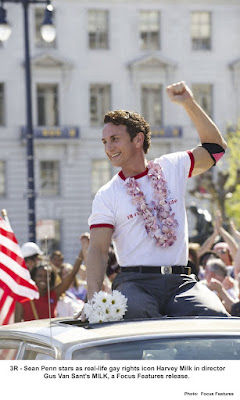
And just like we do for Meryl Streep, Al Pacino, or Robert De Niro -- by now we've begun to take actor Sean Penn for granted. Over the last few decades, we've seen him play tough, we've seen him play a stoner, we've seen him play a mentally challenged man, we've seen him play a death row inmate and we've definitely seen him play real-life characters before but Penn's complete chameleon-like ability to bring Harvey Milk to life makes Gus Van Sant's film work better than any other American film in 2008.
And of course, although part of me still would've loved to have seen Mickey Rourke win that richly deserved Oscar for his turn in The Wrestler since everyone (and especially Harvey Milk himself) loves an underdog-- ultimately, upon a second viewing, I believe the Academy made the correct choice.
While the filmmakers of Milk had Rob Epstien's 1984 Oscar-winning documentary The Times of Harvey Milk to go on-- what strengthens this film is the startlingly naturalistic screenplay to move away from the trappings of biopics to making the film feel fresh, flawed, and relatable. Penned by the impossibly young and talented screenwriter of HBO's TV series Big Love-- Dustin Lance Black--this retelling is intimate, human, erotic, unexpectedly funny, warm, melancholy, and empathetic much like Harvey Milk himself.
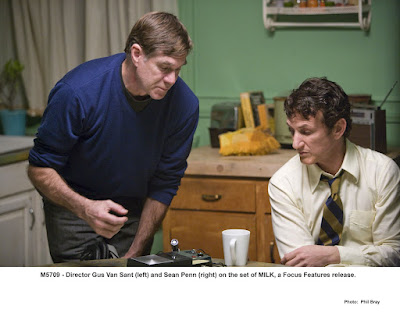
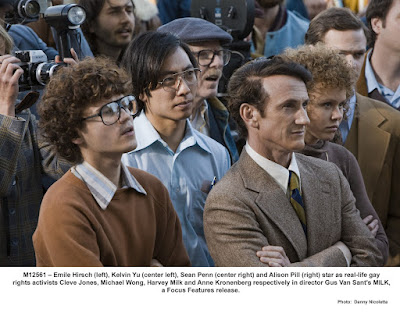
In what can only be described as Gus Van Sant's dream projects for fifiteen impossible years which found him trying to find the stars aligning to bring him the right cast and crew at the right moment in time-- Gus Van Sant makes his strongest work to date. And despite the fact that it's been more than three decades since his death and the painstaking authenticity and involving those who knew Harvey Milk best like Cleeve Jones, Anne Kronenberg, and Daniel Nicoletta who all offered a historical wealth of information as producers-- there is something undeniably urgent and contemporary about the film that cries out to those of us watching today.
This is most evident in the sequences wonderfully edited together in which we become familiar with the Harvey Milk platform. As a director, Van Sant has always had the ability to move effortlessly from the darkly comedic satire utilized in To Die For to his wildly successful Good Will Hunting up through the experimental and tragic Cannes Film Festival award-winning Elephant. Yet we realize once Milk begins that those fifteen years of dreaming were vital as he's now able to freely blend his independent filmmaking roots, inherent sense of artistry, his compassion for the human struggle, and love of a good American story to a richly rewarding achievement. Yes, it is a cliche but he got better with age-- much like Harvey Milk.
On Universal Studios Home Entertainment's extraordinary Blu-ray transfer of the Focus Features production Milk-- Dustin Lance Black recalls growing up as a young man in San Antonio, Texas struggling with his sexual identity before he ultimately moved with his parents to San Francisco. Emotionally, he remembers the impact of witnessing the 1984 Oscar-winning documentary about Harvey Milk and the way that a particular moment stood out in his memory wherein Milk argues that the reason he was fighting was for the next generation and for those everywhere such as a kid in San Antonio, Texas. And it was this passion that drew him to the story and again it is this passion to capture Milk as a human being that inspired the young Dustin Lance Black the same way his incredibly intuitive script manages to inspire us as we watch.
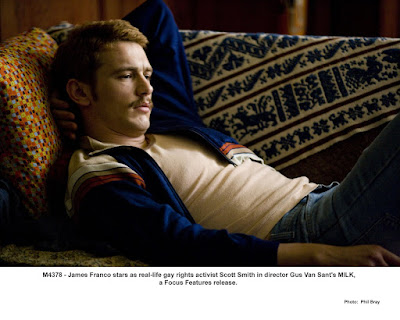
As Harvey Milk so often stated on the box he labeled with the word 'Soap,' "My name is Harvey Milk and I want to recruit you," and Gus Van Sant's film does recruits you the same way Barack Obama recruited a whole new generation of voters by drawing us right into the fight in a credit sequence that illustrates the cruel way that homosexual men were persecuted, pulled from bars and arrested. However, this quickly gives way to a subtle romantic pick-up of the soon to be forty year old Milk as he meets his partner Scott (James Franco) in a work that's structurally book-ended by Milk's narration of his life only to be played in the event of his death to a work that's surprisingly as life-affirming and uplifting as it is powerful and desperately haunting.
At the beginning, we meet Harvey Milk as a New York Republican businessman who's still extremely discreet about his sexuality (hiding in the shadows and barely out of the closet). This couldn't be a further cry from the Harvey Milk we would all come to see years later after he and Scott relocated to San Francisco where the two opened the Castro Camera shop and-- having faced prejudice-- by the small merchants association started to become politically active in their neighborhood which evolved from its Irish Catholic conservative roots to a gay mecca.
And just as soon, Harvey Milk's camera shop became the center of everything and with police brutality was on the rise, quickly Milk and others pulled together to realize they were stronger as a group whether in protest or in getting things done. And ultimately, Milk understood that just like the black movement needed black leaders and other minorities needed their leaders to represent them in the government system he fiercely believed in, somebody should step up for his community as well.
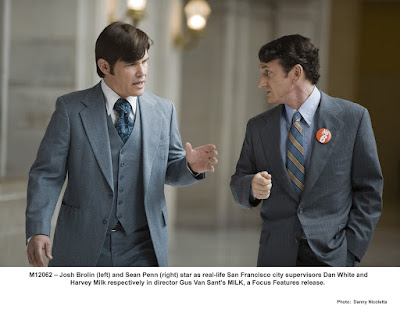
He began on a local level in an extremely grass-roots campaign strategy working with those around him including Scott as his campaign manager through three failed local elections until finally and sadly at the cost of alienating Scott who always had to share Harvey with everyone else and every cause he was elected to office as the city supervisor in 1977 along with the handsome former Vietnam veteran, police officer, and fireman Dan White (Josh Brolin). The opposite of everything Milk stood for-- at least on the surface-- although in Brolin's complex Oscar nominated portrayal, we realize perhaps they were more alike than one thinks as Milk implies that White could've been "one of us," yet to his credit, Van Sant never tries to draw any certain conclusions on what led to that fateful day when bullets rang out in city hall.
Instead, by illustrating the fight and all those involved-- he shows us the entire process from the ground up as Milk evolved from the meek "closet case" to a national icon likened to Martin Luther King Jr. and Ghandi by Brolin in another Blu-ray extra feature. To watch Milk is to become alternately amused, inspired, and enraged as it's more than a film but an experience and one that feels so much more urgent than any other contemporary film playing today. Since in the end-- thirty-two years after he was elected-- Milk is still recruiting us with his legacy, minus the soap box and through this tremendous portrait crafted by Van Sant, written by Black, and embodied by Penn.
Given its inventive camera cuts and cinematography by Harris Savides (in his fifth collaboration with Van Sant)-- the Blu-ray of Milk actually surpasses its theatrical experience with the sharpest of picture and sound. It also contains the benefit of educating new Blu-ray owners on the best way to maximize their experience of the film with a friendly user's guide (especially helpful given the format's typically confusing menus), the pop-up bar to show you precisely where you are at any given moment, optional subtitles in three languages and three worthwhile featurettes.
The mini-documentaries contain interviews with not only the cast and crew but also the real life consultants who are brought to life in the film and adding a richer understanding of their role and the way that Milk affected their lives including discussions with Cleeve Jones, Daniel Nicoletta, Carol Ruth Silver, Anne Kronenberg, and Allan Baird in "Remembering Harvey." Further going into the making of the feature, we join Van Sant and company on the hunt for the utmost in authenticity in "Hollywood Comes to San Francisco" and "Marching for Equality," making the disc a great achievement for the Blu-ray format and one that also engages the viewer into wanting to learn more.
Whether it's in researching the life of Milk and his colleagues to getting involved in your own community to fight for what's right, the bottom line is-- if you're unmoved by Milk, you may need to check for a pulse as this viewer has been recruited in what I now firmly feel was the best film of last year and ultimately the one which should've earned the Academy Award.
On Tuesday, March 10 cast your own vote by picking it up-- but do so with the warning that it's an experiential event and not just a film. Additionally, it's one wherein you must check your apathy at the door as it reminds you again as great cinema should that we're all in this together and we're all united more by our similarities than we would initially assume are our differences since in the always critical effort to ensure civil rights, we're fighting for each and every one of us regardless of our racial, sexual, gender, and political identity. In other words, consider yourself recruited and get to work.
Walking Movie Encyclopedia at Film Intuition; 3-Time National Award Winning Scribe; Film Reviewer; "Watch With Jen" Podcast Host; Screenwriter; Movie Discussion Host; BA in Film Studies & Communication.