Showing posts with label Julia Ormond. Show all posts

5/15/2009

Blu-ray Review: The Curious Case of Benjamin Button (2008) -- 2-Disc Criterion Collection


Now Available on DVD & Blu-ray


View the Photo Gallery Slideshow
(All Images Courtesy of Paramount Pictures & Warner Brothers)


Delicious
Bookmark this on Delicious
submit to reddit
Print Page

Digg!

MovieBlips: vote it up!

In addition to the critical acclaim, Golden Globe and Oscar nominations, perhaps the most significant barometer for the level of unsurpassed class exemplified in David Fincher's masterpiece The Curious Case of Benjamin Button-- which followed another underrated masterpiece in Zodiac-- is that it's one of the very few contemporary films that's been given The Criterion Collection treatment right off the bat with its debut on Blu-ray and DVD.


The prestigious film buffs involved with crafting those amazing one to multiple disc sets that consist of scholarly essays, worthwhile featurettes, and the highest level of transfer and respect paid in moving the work from film to DVD and/or Blu-ray have done so 475 times prior to Button and while usually we're treated to magical offerings by filmmakers including Truffaut, Fellini, Kurosawa, Polanski, Renoir, Godard, or De Sica, it's the rarest and most curious of honors when a new release is given the same consideration.


While I do remember Wes Anderson's The Royal Tenenbaums releasing via Criterion, the fact that it's so atypical that that's the only one that immediately springs to mind makes the distinction of Button worth so much more than any traditional award since the award is in the Blu-ray and it's shared with everyone.


Indeed, this stellar transfer takes the most exquisite pains in ensuring that Fincher's largely digital original material not only presents his intent as a filmmaker (complete with a directorial seal of approval) but also marks Button as a film that actually looks the best it ever has when given the Blu-ray treatment.


Of course, as curious and rare as the Criterion honor is for a new release, a film like The Curious Case of Benjamin Button is that rarest and most curious of films being served up by the studio system (financed actually by two titans in the form of Paramount and Warner Brothers) as it hearkens back to the epics of yesteryear but does so without treacly saccharine or forced nostalgia.


Definitely romantic, daring, and fascinating in its literary approach and the boldness to present a man's entire life in its eighty year span of-- as the film notes-- the “unusual circumstances” that our hero Benjamin Button was born old, ages in reverse, and dies young but it's a film without gimmicks. Likewise, it's one without dubious plot points to intercut our lead into every major historical event taking place, preferring instead to take a subtle, humanistic, dark, heartbreaking, wise, yet unbelievably breathtaking approach from scripter Eric Roth (working from both F. Scott Fitzgerald's original short story and the many drafts of Robin Swicord who helped shape the story into an actual plot) and helmer David Fincher.


As the filmmakers involved stress-- including producers Kathleen Kennedy and Frank Marshall who were onboard during the project's earliest development at Spielberg's Amblin Entertainment-- the film is at its heart the simple story of an everyman or a regular person whose experiences and interactions from first kisses to first hangovers help craft him into the man he becomes.


Despite this, some critics and audiences had fun riffing on the work as essentially a dark Se7en, The Game, Fight Club, and Panic Room director Fincher's interpretation of Eric Roth's Oscar winning screenplay for Forrest Gump. While the theory does hold water since both are adaptations of whimsical, fantastical literary material that chronicle a man's life and indeed share some central structural issues including a devotion to his mama (although Button's is an “adopted” one as his own dies in childbirth and horrified by the elderly “creature” that had just been brought into the world, his father dumps Benjamin off on the stairs of an elderly home) as well as a free-spirited true love-- there's much more wisdom in this piece than in the masterful fairy tale of Gump with its pop-culture one-liners.


Roth, who-- much like Fincher and other cast and crew members-- had experienced the painful deaths of parents during the process of conceiving the work, manage to sidestep the trappings of what seems to be a pop-song sentiment of “I wish that I knew what I know now, when I was younger” or “Ah, but I was so much older then, I'm younger than that now” (from Faces and Bob Dylan respectively) and instead look deeply into both the benefits and challenges of what it would mean to live your life in reverse.


While on the one hand, Benjamin comes to understand mortality at a very young age and must face it again and again throughout the course of his life as he learns that everything is temporary and life itself quite fleeting while losing one person to the next. However, on the other he's also been given the double edged sword of looking old and being perceived as someone who is ready to face the world as though he was seventy when in reality he's just a questioning adolescent still taken in by bedtime stories, eager to make friends, and fall in love.


And that he does when he first lays eyes on the beautiful red-headed child Daisy (perhaps named for Fitzgerald's most famous female character in The Great Gatsby) who-- while chronologically is the same age as he is-- appears young enough to be her granddaughter. Although again to some critics and audiences, Benjamin's struggle to make friends and go through typical coming-of-age experiences (such as his crush on Daisy) seemed far too creepy or unnatural to handle. Likewise, while I'm sure it probably will be a film that doesn't sit well with some churches since it “goes against nature” which is another argument I read-- honestly, it's a wide-eyed, equally optimistic yet realistic and mortal tale of discovery and an individual's journey through the time-line of life that is in the end more life-affirming than one would think once they get past their “creepy” reservations.


With the sweepingly assured storytelling approach and sheer beauty in the New Orleans set cinematography as well as the performances by its endlessly talented cast-- ultimately I was most moved by the underlying theme and subtext of the work that human beings are essentially comprised by not just the experiences they encounter but those who cross their paths and leave an unmistakable fingerprint on their lives.


Bravely confronting mortality right from the start as that thing that we're always trying to ignore in most modern day cinema as well as our daily lives, this existential work celebrates the collective experiences of Benjamin's life as well as his choices to take from each what he needs to, in order to ultimately become the man he wants to be as the film essentially plays as though it were presented via literary chapters complete with breathtaking illustrations from those bedtime stories that Benjamin and Daisy marveled in as children (despite their differing exteriors).


The Criterion set boasts a second Blu-ray filled with an unspeakably fascinating and emotional feature length documentary that is indeed broken into-- not simply chapters-- but installments that are named for the processes of a person's birth as well as the traditional Criterion caliber scholarly essay “The Man Who Watched the Hours Go By” this time by Kent Jones.


However, the most impressive aspect of the set in its own right is its presentation of the film itself which-- unlike most works-- wasn't completely pulled from the theatrical print shown in theatres but (aside from a few scenes that Fincher did shoot with 35mm film stock) but was instead moved directly from its digital source directly to Blu-ray providing the purest image possible. Additionally, it contains as a rich, multichannel mix audio experience which was optimized by the sound engineer Ron Klyce from the theatrical soundtrack to deliver the best in home audio.


In the end it's a richly rewarding film that unfolds like a novel and one complete with some illogical literary conceits as our narrator Benjamin describes things he couldn't possibly know (such as recounting the internal issues facing a number of strangers on a fateful morning). One of the top cinematic achievements of 2008 which admittedly did test the patience of those in the theatre with its requirement to watch with intellect fully engaged-- The Curious Case of Benjamin Button makes a far more satisfying "case" on Blu-ray in a Criterion Collection installment well-worth the investment.

10/26/2008

DVD Review: Kit Kittredge: An American Girl


Click Here to Explore Video Clips, Interviews, Photos & More


Digg!

In honor of October 28th's DVD & Blu-ray release of the heartfelt family film, Kit Kittredge: An American Girl, I'm offering you an insider's view of the DVD that Warner Brothers was kind enough to send my way. However, before I go into the DVD features, first I'll serve up a reprint of my original review (with bonus photos) published for its theatrical run back on 7/2/08.

Kit Kittredge: An American Girl
Director: Patricia Rozema

As every parent knows, all kids ask “why” but while most are satisfied enough by succinct replies to end their fleeting curiosity there, precocious ten year old Kit Kittredge (Little Miss Sunshine's Abigail Breslin) doesn’t neglect to ask the other five questions that go along with it-- namely the “who,” “what,” “where,” “when,” and “how” which all meld together to illuminate the bigger picture of whatever pops into her fascinatingly inquisitive mind.


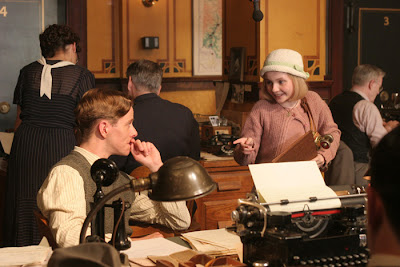
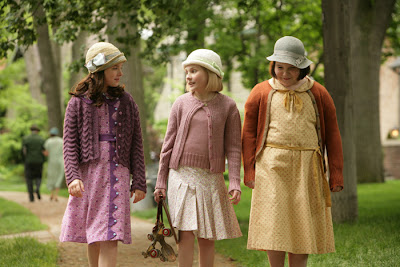
An ambitious newshound, when Kit isn’t spending time with the three other members of her adolescent feminist Treehouse Club complete with photos of idols Amelia Earhart and Eleanor Roosevelt given places of honor on the wooden walls, she wears out her shoe leather and typewriter ribbon in her ardent quest to become a full-fledged journalist for the local Cincinnati Register. Despite her youth, the tireless self-starter investigates every lead at her disposal, knowing how to handle a source with confidentiality, work a piece from a new angle, always be cautious of burying the lead, endlessly checking her facts and similar to the way that Nancy Drew was known as a “girl detective,” Kit Kittredge--to whom she’ll no doubt draw comparisons-- is a truly gifted “girl reporter.”


Based on the successful American Girl series of books from Kit author Valerie Tripp made popular in my own adolescence, Mansfield Park director Patricia Rozema’s earnest, unabashedly nostalgic and sweet-natured film which was penned by Chronicles of Narnia scripter Ann Peacock announces its aims towards offering something positive for women proudly from the start over opening credits which reveal that in addition to the writer and director, there were an uncharacteristically large amount of female professionals associated with the movie including executive producer Julia Roberts, whose own niece Emma had coincidentally starred in the most recent version of Nancy Drew.

Given the outstanding production value of not only Drew but especially Kit, I’m remaining cautiously optimistic that the film won’t be buried in the wake of ultra-violent, special effects driven summer blockbusters and that it will not only earn a steady following increased no doubt by positive word of mouth but will also inspire more intelligent fare for young knowledge hungry audiences as impressively Kit seems to be a film entirely apart from what could’ve had excellent product placement potential, standing on its own as superlative and overdue family fodder.

Set during the uncertainty of the Great Depression, we find Kit’s initial goal of trying to break into print journalism through the connection of her brother’s friend who erroneously assumed the young woman simply wanted a tour of the big, bad, masculine newsroom led by domineering editor Wallace Shawn, placed on the back burner when the effects of the trying economy and era hit home as her caring father (played by Chris O’Donnell) finds his car dealership taken over by the bank and he’s forced to venture to Chicago to find work to support his wife (Julia Ormond) and family.


Not content to sit back and wait, Kit and her mother take in eccentrically zany boarders such as a husband hunting, flirtatious dance instructor (Jane Krakowski), Joan Cusack as a buttoned-up mobile librarian who’s a terror behind the wheel, and a part time magician and full time ham played by Stanley Tucci. When the gregarious and trusting Kit befriends two young hobos (Jumper’s Max Thieriot and Willow Smith) whom her mother employs to contribute in odd jobs in exchange for food, she encounters class prejudice after a series of robberies hits her sleepy neighborhood and all fingers point towards the hobos, inspiring Kit to once again rely on her budding reporter’s intuition and skills to sleuth out the case on her own in discovering the true culprits and helping to clear not only her friends’ names but also try and prevent her home from foreclosure.

Although the primary audience will most likely be young girls and their mothers, this G rated feature packs a great punch in offering viewers a surprisingly complicated mystery—including one that does admittedly seem to confuse slightly in the final rushed act when clues are revealed far too quickly. In addition, it’s filled with important historical information that definitely echoes today in our struggling economy not to mention messages of loyalty, perseverance, tolerance, justice and friendship which make it ideal for viewers of both genders, if parents can manage not to mention the American Girl book series connection in getting their sons into the theatre.


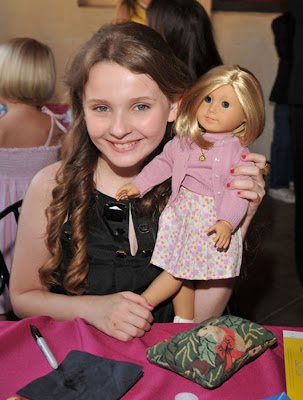
And speaking from the perspective of a girl who, much like Kit was far too eager to jump into the professional realm in her adolescence (and in my case trying to join Seinfeld’s writing staff at the age of eleven), it’s a wonderful celebration of childhood innocence and the reminder never to diminish a child’s dream, especially when like Kit, they’re more concerned with intellectual pursuits rather than begging for trips to the mall to buy toy tie-ins to other summer blockbusters. Although in the case of Kit, as an aunt, if my niece were just a few years older, I wouldn’t hesitate to purchase her a Kittredge doll in lieu of Barbies and Bratz.


DVD Features:

Winner of the Heartland Award certifying Kittredge as a "Truly Movie Picture," the DVD offers 3 formats for your viewing pleasure-- the original widescreen aspect ratio which preserves the theatrical version and is enhanced for widsecreen televisions, a full-screen edition which is modified from the original but formatted to fit the shape of your screen, as well as a digital copy you can download to play on your Mac, PC, Video iPod or other portable video device.

Featuring a gallery of of trailers from the other American Girl Movies that went straight-to-DVD and can be purchased below by checking out the Mini-Amazon American Girl Collection Slideshow I've provided, Kit's DVD also boasts features that are enhanced for DVD-ROM equipped personal computers. Additionally, the film provides English and Spanish subtitles for the deaf or hearing impaired as well as crystal clear Dolby Digital 5.1 Surround Sound.

Hands down the best live action (or non-animated) children's film I've seen in 2008, Kit Kittredge is one you should definitely introduce to the women in your life-- whether it's your grandmothers who may recall the time period firsthand, your mothers, or for the next generation and its target audience of children and grandchildren. An extraordinary, underrated gem-- follow along with Kit and stay on the case until you bring this highly recommended disc home on DVD or Blu-ray.


7/02/2008

Kit Kittredge: An American Girl

NEW UPDATES


Director: Patricia Rozema

As every parent knows, all kids ask “why” but while most are satisfied enough by succinct replies to end their fleeting curiosity there, precocious ten year old Kit Kittredge (Little Miss Sunshine's Abigail Breslin) doesn’t neglect to ask the other five questions that go along with it-- namely the “who,” “what,” “where,” “when,” and “how” which all meld together to illuminate the bigger picture of whatever pops into her fascinatingly inquisitive mind. An ambitious newshound, when Kit isn’t spending time with the three other members of her adolescent feminist Treehouse Club complete with photos of idols Amelia Earhart and Eleanor Roosevelt given places of honor on the wooden walls, she wears out her shoe leather and typewriter ribbon in her ardent quest to become a full-fledged journalist for the local Cincinnati Register. Despite her youth, the tireless self-starter investigates every lead at her disposal, knowing how to handle a source with confidentiality, work a piece from a new angle, always be cautious of burying the lead, endlessly checking her facts and similar to the way that Nancy Drew was known as a “girl detective,” Kit Kittredge--to whom she’ll no doubt draw comparisons-- is a truly gifted “girl reporter.”

Based on the successful American Girl series of books from Kit author Valerie Tripp made popular in my own adolescence, Mansfield Park director Patricia Rozema’s earnest, unabashedly nostalgic and sweet-natured film which was penned by Chronicles of Narnia scripter Ann Peacock announces its aims towards offering something positive for women proudly from the start over opening credits which reveal that in addition to the writer and director, there were an uncharacteristically large amount of female professionals associated with the movie including executive producer Julia Roberts, whose own niece Emma had coincidentally starred in the most recent version of Nancy Drew.

Given the outstanding production value of not only Drew but especially Kit, I’m remaining cautiously optimistic that the film won’t be buried in the wake of ultra-violent, special effects driven summer blockbusters and that it will not only earn a steady following increased no doubt by positive word of mouth but will also inspire more intelligent fare for young knowledge hungry audiences as impressively Kit seems to be a film entirely apart from what could’ve had excellent product placement potential, standing on its own as superlative and overdue family fodder.

Set during the uncertainty of the Great Depression, we find Kit’s initial goal of trying to break into print journalism through the connection of her brother’s friend who erroneously assumed the young woman simply wanted a tour of the big, bad, masculine newsroom led by domineering editor Wallace Shawn, placed on the back burner when the effects of the trying economy and era hit home as her caring father (played by Chris O’Donnell) finds his car dealership taken over by the bank and he’s forced to venture to Chicago to find work to support his wife (Julia Ormond) and family. Not content to sit back and wait, Kit and her mother take in eccentrically zany boarders such as a husband hunting, flirtatious dance instructor (Jane Krakowski), Joan Cusack as a buttoned-up mobile librarian who’s a terror behind the wheel, and a part time magician and full time ham played by Stanley Tucci. When the gregarious and trusting Kit befriends two young hobos (Jumper’s Max Thieriot and Willow Smith) whom her mother employs to contribute in odd jobs in exchange for food, she encounters class prejudice after a series of robberies hits her sleepy neighborhood and all fingers point towards the hobos, inspiring Kit to once again rely on her budding reporter’s intuition and skills to sleuth out the case on her own in discovering the true culprits and helping to clear not only her friends’ names but also try and prevent her home from foreclosure.

Although the primary audience will most likely be young girls and their mothers, this G rated feature packs a great punch in offering viewers a surprisingly complicated mystery—including one that does admittedly seem to confuse slightly in the final rushed act when clues are revealed far too quickly. In addition, it’s filled with important historical information that definitely echoes today in our struggling economy not to mention messages of loyalty, perseverance, tolerance, justice and friendship which make it ideal for viewers of both genders, if parents can manage not to mention the American Girl book series connection in getting their sons into the theatre.

And speaking from the perspective of a girl who, much like Kit was far too eager to jump into the professional realm in her adolescence (and in my case trying to join Seinfeld’s writing staff at the age of eleven), it’s a wonderful celebration of childhood innocence and the reminder never to diminish a child’s dream, especially when like Kit, they’re more concerned with intellectual pursuits rather than begging for trips to the mall to buy toy tie-ins to other summer blockbusters. Although in the case of Kit, as an aunt, if my niece were just a few years older, I wouldn’t hesitate to purchase her a Kittredge doll in lieu of Barbies and Bratz.