Showing posts with label Amy Adams. Show all posts

4/01/2014

DVD Review: American Hustle (2013)


Fire Up Some Popcorn in Your Science Oven:
American Hustle is Now Available to Own  

Bookmark and Share

More than any other time of the year, award season brings out the critic in all of us as films are held side by side for comparison and ranked in an endless number of ways on an ever-growing number of lists.

And since film press is nothing if not pattern driven as PR firms pitch the same press releases and angles to everyone on their contact list, by the end of each annual award season, audiences inundated by the constant stream of similarly covered news and editorial pieces often feel like opinions announced again and again have become the official word on the matter.


Whether consciously or not, the steady stream of repetition can trick you into thinking you’ve seen something you might not have seen or felt something you might not have felt just because of majority rule and the amount of ink spilled on whatever the topic may be. Of course, in the end, the only opinion that truly matters to you is your own in assessing everything and making up your own mind.

Yet given how successfully opinion is turned into fact in today’s fast-paced world, I couldn’t help but feel that the conman, chameleon-like quick-thinking characters that populate American Hustle would – if set in contemporary Hollywood rather than ‘70s New York – have been absolutely brilliant working in the film industry when it comes to spinning yarns and selling anything they want to earn a buck.

And perhaps part of the reason that Silver Linings Playbook and Three Kings filmmaker David O. Russell was so drawn to the world of Hustle was because it felt so familiar. Of course, that’s in addition to the way the film provides him with a springboard for the themes and motifs that have obsessed him for ages given its tale of multiple love triangles that lie just below the surface of the characters’ existential search for the happiness epitomized by the promise of the American Dream.


Revisiting the same throughline that has dominated his oeuvre from Flirting With Disaster all the way up through Silver Linings that focuses on an internal quest undertaken by a character who hits a metaphorical wall and then needs to figure out how to turn their life around for the better, Russell has achieved the impossible. He’s managed to make the seemingly larger-than-life characters of American Hustle not only endlessly fascinating but surprisingly relatable (if only on the most primal of levels) from start to finish.

Like all other film fans who read far too much award season coverage, I couldn’t believe how much this film was compared to Martin Scorsese’s ode to Wall Street driven hedonistic excess – The Wolf of Wall Street.

While some people focused on both films’ emphasis on con men and colorful characters (not to mention the fact that both pictures were based on true stories – albeit quite loosely in the case of Hustle), others emphasized the Goodfellas meets Boogie Nights ode to glitz and glamour of Russell’s cinematic technique.


Going against popular consensus – despite growing up with a particular fondness for Scorsese whose works I knew inside and out – while I understood the surface level comparisons, the one thing I was totally unprepared for is just how much I preferred Hustle to the overblown exhaustive spectacle that was Wolf.

Additionally it was absolutely thrilling to discover that unlike the interchangeable blow-up doll like women that were used as sex toys for gratuitous scenes of unappealingly animalistic sexcapades in Wolf, Russell has – in once again reteaming not only with his Oscar winning Silver actress Jennifer Lawrence but nominated Fighter star Amy Adams – crafted two fully realized female characters.


Using Adams and Lawrence as muses the way that Scorsese uses DiCaprio, writer/director Russell ensured that the women of Hustle were just as (if not more) powerful, intelligent and fascinating than the male characters who became their marks in love and life via Bradley Cooper’s ambitious yet easily manipulated FBI agent to Christian Bale’s confident conman and the bighearted politician played by Jeremy Renner.

Completely vanishing into their Oscar nominated roles and changing multiple times from start to finish, American Hustle is a master class in acting.

Rewriting Eric Warren Singer’s more procedural, fact based script that centered on the outrageous headline grabbing Abscam scandal to flesh out the characters and infuse the thriller elements with off-the-cuff, fast-moving humor and complicated, multifaceted romance, Russell used his writer’s sensibility to helm what is his most exciting film to date.

The recipient of three Golden Globes including Best Picture (Musical or Comedy), while it would lose all ten of its Oscar nominated categories matching the same fate as Wolf's, it’s my prediction that just like 1997’s overlooked Boogie Nights, Hustle’s reputation will grow stronger than Silver and Fighter’s in the years ahead.


Featuring some of the most quotable dialogue of the year, American Hustle also boasts a virtuoso performance by Amy Adams who plays a woman with so many layers and complex mysteries that in retrospect, I truly believe she had the most difficult role and should’ve been awarded the Oscar for Best Actress over dazzling Blue Jasmine star Cate Blanchett.

Newly transferred to disc to hopefully kickstart a greater appreciation for this American masterpiece, Sony’s high-caliber DVD release comes complete with an Ultraviolet digital copy and featurettes plus additional footage you’re sure to relish on repeat viewings to explore the dizzying highs and lows that coexist in a single scene by characters that grow more intriguing with each passing minute.

Through American Hustle, Russell proves that when it comes to quality filmmaking, you can’t hustle viewers ready to process everything they’ve read during award season on their own terms while watching a movie filled with people that do the same.   


Text ©2014, Film Intuition, LLC; All Rights Reserved. http://www.filmintuition.com Unauthorized Reproduction or Publication Elsewhere is Strictly Prohibited and in violation of the Digital Millennium Copyright Act.  FTC Disclosure: Per standard professional practice, I may have received a review copy of this title in order to evaluate it for my readers, which had no impact whatsoever on whether or not it received a favorable or unfavorable critique.

8/07/2009

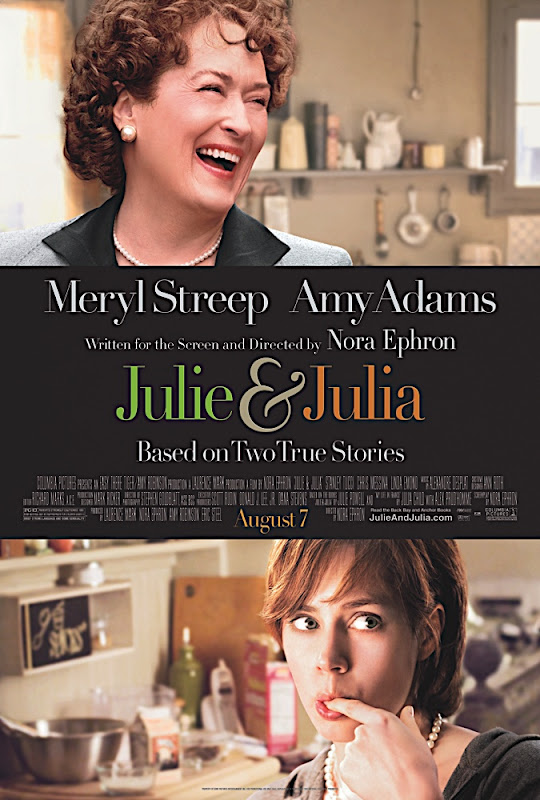
Movie Review: Julie & Julia (2009)


Coming Soon to DVD & Blu-ray


Photo Slideshow


Delicious
Bookmark this on Delicious
submit to reddit
Print Page

Digg!

MovieBlips: vote it up!

Despite the fact that they are separated by more than fifty years in two thematically similar narratives, the presence of both personalities referenced in the title as well as the talented women portraying them linger as the film flows back and forth in time.

Similar to producer Scott Rudin’s film The Hours (also starring Meryl Streep and based on a literary source), Julie & Julia uses time freely and in a circular fashion. Reuniting with not just producer Rudin but her co-star Amy Adams from Doubt (although in this film the two don’t share a scene), Julie's more contemporary plot concerns Adams’ hardworking, highly educated but frustrated failed novelist Julie Powell who moves from Brooklyn to Queens in 2002 while the aftermath of 9/11 is still painfully fresh.

Spending her days in a cubicle alternating from anger to tears of heartache as she takes calls while employed with the Lower Manhattan Development Corporation—Powell discovers that the only solace she receives from a hard day at the office is in the certainty of following a recipe she knows and trusting that she’ll be able to predict the outcome of its resulting comfort food.


Following a disastrous lunch with her group of power hungry friends from college and an embarrassing article about her lack of success as she nears thirty which finds her feeling dissatisfied with herself as a writer, Powell’s loyal husband Eric (Chris Messina) suggests that she should look for an outlet that somehow gives her the artistic release she desperately needs.


As the dawn of the twenty-first century began the rise in popularity of blogging, suddenly Powell realized precisely what she wanted to do. But unlike the flood of vanity blogs filled with random thoughts, gossip, Dear Diary like entries, or items that most of us would never want to read, she put her literary skills to good use and employed an intriguing hook by embarking on a quest to cook all 524 recipes in 365 days contained within the culinary tome Mastering the Art of French Cooking.


While Powell gets to work on her blog, writer/director Nora Ephron has been deftly weaving us through the simultaneous and similar challenge facing Meryl Streep’s Julia Child who—no stranger to governmental work-- like Powell has also moved and is in search of something to do that will fulfill her on a personal and creative level.

Thus, we follow Streep’s journey as Julia Child from her 1948 arrival in Paris until she eventually channeled her appetite for life and food into the study of cuisine, becoming not just the first American woman to study at Cordon Bleu but to eventually bring her academic pursuits to America with the publication of Mastering the Art of French Cooking which was co-written with Louise Bertholle and Simone Beck.


Easily the greatest actress working today, Streep manages to fully convince us she’s Child within seconds, going beyond that recognizable accent that was made part of our pop culture landscape once more via Dan Akyroyd on Saturday Night Live by fully embracing just how much Child simply loved life and seemed to treasure all those with whom she came into contact.

Moreover, the Child sequences in Paris are far more compelling than any of the material involving Powell. And unfortunately this seems as though it's because, no matter how much you ultimately dress it up—aside from her genuine affection for Child- the blog itself felt like a race-to-the-finish-line style gimmick rather than a true celebration of the overwhelming amount of work that Child put into the book so many who own it take for granted. Of course, this probably was not Powell's intention but for truncated film reasons, that's the way it comes across.


Additionally, despite my admiration for Adams as one of my generation’s most talented actresses, she isn’t given very much with which to work. Basically, Adams' Powell seems to be a pretty narcissistic character especially considering the fact that as evidenced in the script-- not only does it indicate that it’s female driven professional jealousy that drives her to blog but the film also contains a conversation that’s nearly entirely comprised of her character and another agreeing on how much of a bitch Powell is-- as well as another throwaway line that all women hate their friends.


Thus, since the representation of Powell went against the celebration of living life to the fullest and Child’s zest for this manner of being, I kept thinking how much better the movie would’ve been if they’d axed the Julie Powell plot completely and just gone solely with a film about the fascinating Julia Child.

This idea was solidified by the pitch-perfect chemistry that Streep had with her Devil Wears Prada costar Stanley Tucci who portrayed her adoring husband Paul. Able to spark so well together that early into the picture you can actually see Streep blush right through her makeup-- and indeed, according to the production notes from Sony’s Columbia Pictures, Streep suggested Tucci for the role—the two present a refreshing depiction of a true marriage of equals.


Of course they have their troubles and Streep and Tucci are able to bring quiet layers to their work showing private doubts and fears of not fitting in during a few unscripted dialogue-free moments that ordinarily would’ve been left on the cutting room floor. Yet their relationship unlike Julie and Eric’s which mostly consists of grocery buying, food tasting, and disagreements was the one that truly inspired and nourished me as a jaded twenty-first century singleton the way that Child's food and cookbook has nourished countless chefs over the years.


For, they not only support each other through the hard times of feeling less like a man or a woman when he’s interrogated during the McCarthy era and humiliated and likewise as Child is unable to have a child but also in the way they seem to look at each other as though they’re still the only people in the room. And this is evidenced in the cute (yet slightly scandalous) nude bubble bath etc. postcard photos recreated on film that they took to share with others their love and delight in life and each other.


All in all, it's an ambitious and highly literary film that combines not just two works of nonfiction including Julie Powell’s Julie & Julia and Julia Child with Alex Prud’homme’s My Life in France as well as her famous cookbook along with what I can only imagine was endless research in a masterful script by Nora Ephron. Additionally it proves to her harshest critics she’s much more than the queen of the romantic comedies whom they'd had her pegged to be and although the Julie portion of the film made it a bit unbalanced, it’s still highly recommended.

Likewise, given another wondrous turn by Streep and a dynamic supporting performance from Tucci who helps augment our leading lady, I believe that Ephron’s work may be up for some serious awards consideration also given the amazing talent involved behind the scenes from producer Rudin, Benjamin Button and Painted Veil Oscar nominated composer Alexandre Desplat and cinematographer Stephen Goldblatt (Closer, Angels in America, Charlie Wilson’s War, Rent).

However, as a longtime fan of Ephron’s--for this reviewer, the most inspiring and empowering story involved in the production from a female standpoint aside from Ms. Julia Child’s is that of Ms. Nora Ephron’s who—with Julie & Julia seemed to provide a subtextual third character and narrative to the piece of a woman seeking inspiration, something to do, and the right outlet to find herself. To explain-- with this film, Ephron managed to do just that as a filmmaker.


As when it comes to Julia, Ephron has actually created something that looks and feels completely different than any of her other works and at its heart, it’s a film that applauds a woman’s need to find a creative outlet. And while most moviegoers will be caught up fully in the tale of the characters, I was just as invested in the evolution of the woman yelling “action” and the way that somehow she managed to juggle various texts to produce not just a cohesive structure but a mightily impressive and intelligent screenplay at the same time.

For, while I’m sure that the movie will have a tough time battling the testosterone fare of GI Joe, to me the greatest measure of its success would be that-- similar to both Julie and Julia-- if Nora Ephron has finally realized just how valuable, worthwhile and important her work has been to female filmmakers and audience members all along.


And, much like Julia Child trying to fight prejudices and labels against the Americans trying to master French cuisine-- Ephron has battled the Rom-Com label for years. And although her romantic comedies are still the most sophisticated ones I’ve seen in decades, with Julie & Julia she proved that she can leave the genre whenever she wants and meander directly into Rudin territory of literary works without managing to forget to season the work with intelligence, feminism, and wit.


Text ©2009, Film Intuition, LLC; All Rights Reserved. http://www.filmintuition.com

Unauthorized Reproduction or Publication Elsewhere is Strictly Prohibited.

4/17/2009

Blu-ray Review: Doubt (2008)


Without a Doubt...
One of the Best Films of 2008
Hits DVD & Blu-ray


Read the Pulitzer Prize Winning Play


Download the Film on iTunes

Doubt


Delicious
Bookmark this on Delicious
submit to reddit
Print Page

Digg!

“When everybody assumes that they share the same values, they share also a certain blindness. I think the utter lack of vigilance and profound credulity of people of that time [the 1960s] was what allowed the church scandals to ever happen in the first place. It was too obvious if you were paying any attention whatsoever to the amount of it taking place. It calls for a kind of cultural blindness. I was reminded in more recent times of the time I was living in a few years ago -- let's say in the run-up to the invasion of Iraq -- that again there was this kind of certitude and blindness, and it had echoes for me in this earlier time.

“I found myself living in an era of extreme advocacy... I felt surrounded by a society that seemed very certain about a lot of things. Everyone had a very entrenched opinion, but there was no real exchange, and if someone were to say ‘I don't know,’ it was as if they would be put to death in the media coliseum. There was this mask of certainty in our society that I saw hardening to the point that it was developing a crack -- and that crack was doubt.

“I thought that doubt was a hallmark of wisdom and an active and ongoing enterprise…. So I wanted to write about those issues … that celebrated the fact that you can never know anything for certain. I wanted to explore the idea that doubt has an infinite nature, that it allows for growth and change, whereas certainty [‘and dogma’] is a dead-end. Where there is certainty, the conversation is over, and I'm interested in the conversation, especially because another word for that conversation is ‘life.’ We've got to learn to live with a measure of uncertainty. That's the silence under the chatter of our time.”
-- Writer/Director John Patrick Shanley
(As Quoted in Miramax's Press & Production Notes for Doubt)

And although he began with the idea for a work that would simply be called Doubt, Shanley is careful to explain that he wasn't necessarily inspired or overly fascinated with the revelations about the global Catholic Church scandals that were featured as a regular nightly news story over the past few years. For, as he and the Oscar nominated four cast members state-- the film can resonate with anyone, anywhere, and within any given situation.

However, with the ultimate goal “that the sense of doubt belongs to the audience,” as he was determined to avoid telling “them what's right and wrong,” in lieu of making them ultimately “think and feel something, rather than tell them what to think and feel,” by centering the action for the Pulitzer Prize winning first play--in a prospective trilogy-- in a 1960s Bronx Catholic school and church with the subtext of a possible scandal, was precisely the right combination needed to ignite the audience.

Ideally Shanley knew that the decision to set his work in this particular “polarizing situation, one in which most people would brook no hesitation in condemning a person -- and then throwing those assumptions back at the audience in a different light,” would eventually cause-- what he shares on the stunningly transferred Blu-ray edition of the film-- the “final act” of Doubt to occur after audience members walked out as each person saw it in a different way.

Set in 1964, just one year after John F. Kennedy's assassination at St. Nicholas school—Shanley’s Doubt occurs just before the pivotal change for Catholicism that would eventually find nuns being able to go without the habit with the recent reformations and decisions made by 1962’s “establishment of Vatican II by Pope John XXIII” as well as encouraging “much less formality between priests and their parishioners.”

Representing the new breed of familiar, direct, and personable priests, Philip Seymour Hoffman’s affable Father Flynn tries to shake up the overly strict surroundings much to the chagrin of the equally stubborn but old-fashioned school principal Sister Aloysius (Meryl Streep) who is a taskmaster that preaches not on the pulpit but in the hallways and offices enforcing discipline and order to the utmost extent.

Caught in the middle between the old-fashioned values of her superior Sister Aloysius and the likable and far friendlier Father Flynn-- the young, quiet, shockingly innocent, and sweet Sister James (Amy Adams) finds her loyalties tested even more when she witnesses a few too many peculiar moments and strange behavior shared between Father Flynn and the school’s first black student, Donald Miller (Joseph Foster II).

Not quite sure what it is she has seen but feeling in her gut that it was inappropriate, Adams’ Sister James dutifully informs Streep’s Aloysius who-- much like the allegorical cat brought in to kill the mice in another scene—tells Sister James “that we have to take care of this ourselves.”

Since-- as the film and Miramax’s Notes inform-- in the unequal gender divide and “power gap between the priests, who could wield their complete authority in church matters, and the nuns who had to eek out power in very different and subtler ways,” the Sisters of Charity at St. Nicholas had no men to whom Aloysius felt they could go with the information.

As Streep reveals in her research, commending the nuns’ “sense of great capability,” she also confides in the Production Notes that she “also got… a sense of their hierarchy in the church, how they were always second-tier to the male hierarchy of the priests and how some chafed against that. All of that was very valuable for Sister Aloysius. And all that drives the narrative.”

And indeed that it does as the film which changed from a four person theatrical production morphs into a fully-realized living and breathing work. Shot at the same corner and neighborhood where Shanley grew up as he dedicates the film to nuns as well as the real Sisters of Charity including the woman who inspired Sister James—he manages to make it a personal affair as the real sisters were brought on as consultants and the children he attended the school with now have cameos as parents in the church scenes.

Transporting the dialogue driven play in which Streep called one of her truly "great nights in the theatre” that she’d ever had where she said there were “two audible gasps [from the audience] as one voice,” as well as Hoffman who saw it countless times and Adams who fought hard for the role—Shanley decided to “utilize the conventions of [the mystery] genre—to provide a propulsive energy to the narrative.”

Of course, the lingering question that he begins with that’s starting to divide the audience from one of the earliest scenes in which Hoffman is caught in a single frame with the children is “did he or didn’t he?” [regarding Father Flynn’s "relationship" with Donald] but knowing that he would go against the one hundred plus year tradition of filmmakers who “have tended to ask a question and at the end of the movie... answer it,” this mystery evolves as Aloysius confronts Flynn directly and the three characters go around in circles without a shred of proof.

By constantly switching gears and changing your impressions, at times I felt the work recalled David Mamet's Oleanna and Arthur Miller's The Crucible except Shanley's is much more fine-tuned and speaks softly where the others shout--instead, building up tension by what isn't being said, shown, or somehow otherwise revealed.


Knowing that he was going to—similar to the play—“leave the audience at the end not with an answer, but saying rather ‘What a beautiful question’… [so] in that way, it becomes the audience’s story,” which grows far more complicated when the boy’s mother (played by an unbelievably effective Viola Davis) arrives with a rather unpredictable reaction to Aloysius and several new facts that must be taken into consideration.

The type of film that manages to somehow break through the screen and pull you inside its claustrophobic setting of Elia Kazan East of Eden like slanted cinematography by master lensman Roger Deakins to weigh possible balances of power, a clever usage of color, an emphasis on the visuals to punctuate a line or what’s not being said in a large amount of stillness and silence-- Doubt is that rare film that must be viewed more than once and is best done so along with others as each individual will make up their own mind on what has happened.


While the film’s conclusion of uncertainty and further confusion works incredibly well on the stage, even the actors admit in one of the Blu-ray’s outstanding featurettes in a discussion with Entertainment Weekly, that movie audiences (including Meryl Streep who admits to the practice herself) are far more likely to make a snap decision about something and this one doesn’t play by those expectations in the least.

Quite daring and provocative because the very nature of the story at its core is in everything we don’t see—while as Hoffman has admitted, he privately came up with his own decision as to Father Flynn’s guilt or innocence (but never shared it)—I was fascinated by Amy Adams’ unique take in challenging viewers to watch the film a number of different ways, trying to shut out one entire side and say “yes, he did it” and then “no, he did not,” to understand the complexity.

However, at its core, we soon realize that the guilt or innocence is only part of the story for as soon as Viola Davis enters the film, that simplistic of a question (no matter how devastating it is) is tossed aside to one that’s so filled with gray areas, it’s almost that particular fiery exchange that will affect you even more than the “yes” or “no” and suddenly make us second guess all snap judgments… at least for a few days after you see it.

Including feature length commentary from writer/director John Patrick Shanley as well as a few mini-documentaries and featurettes—the quality of the Blu-ray for a work I now consider as one of my Top 5 Best Films of 2008 is first rate, bringing a theatrical experience right into your home and one in which the sharpness of high definition actually makes the film and characters (especially Aloysius) bring anyone who attended Catholic school right back to that surrounding. So hide your rulers and be prepared to challenge yourself with the idea of embracing Doubt (both the film and the state of mind) instead of arithmetic and school uniforms.

4/07/2009

New on DVD & Blu-ray for the Week of 4/5/09

Jen's Pick of the Week:

Doubt


Delicious
Bookmark this on Delicious
submit to reddit
Print Page

Digg!


2010: The Year We Make Contact (Blu-ray)


Above the Law (Blu-ray)


American History X (Blu-ray)


Bedtime Stories


Britney: For the Record


Cleopatra: Universal Backlot Edition-- 75th Anniversary Edition


Collateral Damage (Blu-ray)


The Day the Earth Stood Still (2008)


Disney Animation Collection 1: Mickey & Beanstalk


Disney Animation Collection 2: Three Little Pigs


Disney Animation Collection 3: Prince and the Pauper


Donkey Punch


Doubt


House


I.O.U.S.A.


No Country for Old Men (Blu-ray Collector's Edition)


Not Easily Broken


One Missed Call: Final


Point of No Return (Blu-ray)


Pre Code Hollywood: The Collection


Scooby Doo & the Samurai Sword


Swamp Devil


The Tale of Despereaux


Tango & Cash (Blu-ray)


TCM Spotlight: Doris Day Collection


The Wedding Singer (Blu-ray)


Yes Man


Yo Gabba Gabba! New Friends


3/20/2009

Movie Review: Sunshine Cleaning (2009)


Get the Soundtrack on iTunes

Golden Smog - Sunshine Cleaning (Original Motion Picture Soundtrack)


Delicious
Bookmark this on Delicious
submit to reddit
Print Page

Digg!


Rather than give into the required ultimatum that she must medicate her mischievous grade school age son, Oscar (Jason Spevack)-- the proud and hard-working maid Rose (Amy Adams) decides to go into business for herself in order to foot the bill for private school tuition. Somehow finagling her deadbeat, pot smoking, perpetually fired, younger sister Norah (Emily Blunt) to join the venture, Rose takes the rather unorthodox advice of her married police officer lover (Steve Zahn) to get into the lucrative but biohazard filled racket of crime scene cleanup.


Advertised by Overture Films as a quirky comedy in the vein of the similarly themed and titled Oscar-winner Little Miss Sunshine that also shares some of the same cast and crew including Best Supporting Actor winner Alan Arkin in a fairly similar role to the 2006 movie-- Sunshine Cleaning has surprisingly become the most profitable film released so far in 2009.


As an Overture Films press release notes in a quotation from Executive Vice President of Theatrical Distribution Kyle Davies, the studio’s “aggressive word of mouth campaign, paired with favorable reactions from audiences and critics, have paid off in such a big way,” that the film has earned the “best per-theater average… of any limited or wide release thus far in 2009.”

While Sunshine Cleaning is a bit stormier than its charming Little Miss predecessor-- touching on some pretty melancholy topics throughout and opening with a suicide that jars the audience-- it's nonetheless a surprisingly touching work from Australian director Christine Jeffs (Rain, Sylvia) and first-time screenwriter Megan Holley that is consistently elevated by the solid portrayals of Amy Adams and Emily Blunt, along with supporting players Steve Zahn and Mary Lynn Rajskub.


Additionally, it’s an intelligent look at family and the way that the past still manages to linger in the present. While Blunt seems to be playing the more chaotic sister who's just one or two seconds away from spiraling out of control as she becomes affected by one of the jobs and tracks down the victim's daughter, Mary Lynn Rajskub—soon we realize that both Lorkowski siblings (as well as their flaky father) must find time to attempt to clean up some of their own messes.


And likewise, Adams shows another side of subtle heartbreaking depth as Rose. And on the surface, she appears to be the sister who tries to exude confidence and a sense of having it all together but soon we realize she’s the one on the increasing verge of chaos as the two personalities begin to shift.


Still struggling with both the tragedy of their mother's death as well as a battle with low self-esteem that finds Rose continuously returning for more hotel room trysts with her old high school boyfriend Zahn (incidentally Oscar’s father) who married somebody else—Adams manages to find a way to play the various levels and contradictory thought processes raging through Rose all at the same time that’s simply a marvel.

Intriguingly, Blunt and Adams-- who had previously worked together on-screen briefly indirectly on Mike Nichols’ film Charlie Wilson's War-- revealed in an Entertainment Weekly interview with Nicole Sperling (3/20/09; pg. 46), that they were both interested in the screenplay for Sunshine Cleaning before they even shot Wilson’s War.


Describing their natural chemistry and appreciation for one another as “love at first sight,” the two easily and believably fall into the role of downtrodden sisters in New Mexico in Jeffs’ film that was inspired by a 2001 “All Things Considered” NPR story about “best friends…in the Seattle suburbs who started a biohazard removal/cleaning service.”


Another character driven piece by Overture Films which is responsible for two extraordinary works from last year—The Visitor and Last Chance Harvey-- while Sunshine Cleaning isn't as instantly charismatic as Little Miss Sunshine, it gets its strength from the actors and by only vaguely sketching what may lie ahead in their future.


Never condescending to the audience although ensuring that their futures will be less cloudy than they had been before-- Jeffs and Holley end the film on precisely the right note. Namely, by showing us that all have changed but not trying to pigeonhole them into fixed conclusions. Instead, the filmmakers allow them to be free, breathe, and remain as natural as they were when we were first introduced to the women ninety minutes earlier.


Amy Adams & Emily Blunt


8/20/2008

New on DVD for the Week of 8/17/08


Digg!

I find I get an awful lot of phone calls from friends and relatives at the video store as they wander the aisles aimlessly trying to find something worth renting. While of course, I urge them to explore my DVD New Releases page which is filled with trailers and links, I thought I'd start adding a weekly update when new discs are served up that I've reviewed:

My pick for this week is the undeniably charming comedy, Miss Pettigrew Lives for a Day starring Frances McDormand and Amy Adams which is a much better female bonding film than the phony, agenda-driven and propagandist but artistically impressive The Life Before Her Eyes starring Uma Thurman and Evan Rachel Wood, which also hits the shelves this week. However, there's another one that was just released that's sure to fly under the radar, especially for those without HBO (such as myself... who was lucky enough to see it in a "Free Preview Weekend"), namely the Kevin Spacey produced Recount ,which chronicles all the drama and craziness which ensued during and after the 2000 election. To explore the reviews, you can click on the titles in this paragraph or feel free to use the links below:

Miss Pettigrew Lives for a Day

The Life Before Her Eyes

Recount

3/22/2008

Enchanted

Director:
Kevin Lima

Forget the Roomba. When it comes to cleaning apartments, would-be fairy tale princess Giselle (Amy Adams) sings the Oscar nominated “Happy Working Song” and her mellifluously melodic voice attracts animal friends from all around who help her wash dishes, scrub floors and make everything zestfully clean in two minutes flat. Although I confess it’s strange, in the films from Walt Disney Studios, the presence of animals that speak, dance, sew and make up a lovely young woman’s entourage is nothing new but it’s a sight mostly found in their beloved feature-length animated works like Cinderella, Snow White and the Seven Dwarfs and The Little Mermaid. It’s a different proposition altogether when we see live action vermin and mosquitoes flee from New York City’s Central Park only to appear in the posh apartment of divorce attorney Robert Philip (Patrick Dempsey) yet that’s just one of many scenes of inventive hilarity in Disney’s best “princess” film in ages, director Kevin Lima’s Enchanted.

Beginning with a full ten minute animated sequence, the viewer is thrust into familiar territory as we meet the fair animated maiden Giselle (still voiced by Adams) who, on the day of her wedding to Prince Edward (James Marsden) is tricked by Edward’s evil mother, Queen Narissa (Susan Sarandon) into banishment as she plummets from the kingdom of Andalasia only to find herself climbing up from the sewer into modern day Time Square. Convinced that it’s only a matter of time before her prince will come, Giselle sets off looking for help and finds unlikely and mostly unwilling assistance in the form of handsome Robert Philip, who, about to venture into an unromantic engagement with the kind but bland Nancy Tremaine (Idina Menzel) is prodded into rescuing Giselle by his daughter Morgan (Rachel Covey).

Filled with lots of Dinsey in-jokes and references to the history of the animated division of the studio along with giving three actresses who voiced princesses in the past cameos in the film (Jodi Benson’s Ariel, Paige O’Hara’s Belle, and Judy Kuhn’s Pocahontas), the delightful and surprisingly engaging Enchanted managed to hook me soon after the live action sequence began, thanks to the creative script from Bill Kelly who wrote the similarly themed Blast from the Past. However, most of the film's charm comes from the unceasingly talented Adams who, with her variety of excellent performances in the past two years, has the makings of becoming one of our top leading ladies. The film’s soundtrack featuring lyrics by Stephen Schwartz and music by Alan Menken received two additional nominations for original song for the tracks “So Close” and “That’s How You Know” and Enchanted also earned recognition by the Phoenix Film Critics Society Awards as the Best Live Action Family Film of last year.

3/17/2008

Miss Pettigrew Lives for a Day

Director: Bharat Nalluri

With arguably her best written role since her Oscar nominated character penned by Cameron Crowe in Almost Famous, talented actress Frances McDormand has a chance to show off her funny, passionate and protective side in this richly intelligent and fun offering that, like Famous, surprisingly had nothing to do with her multitalented husband Joel and brother-in-law Ethan Coen.

Based on Winifred Watson’s 1938 novel, Miss Pettigrew Lives for a Day stars McDormand as the unlucky and hardworking title character Guinevere Pettigrew who finds herself out of yet another job as a governess in pre World War II 1939 London. In an act of desperation, she picks up on a lead for employment in the home of Delysia Lafosse (a terrific Amy Adams) and soon realizes that instead of work as a governess, she has found herself the new social secretary for the American singer hoping for her big break. Needing Pettigrew to navigate her romantic life which is growing increasingly complicated by her entanglements with three very different men all with something enticing to offer such as employment, a big break and true love, Delysia bonds instantly with her new friend and the two women embark on a day filled with adventure, misunderstanding and great fun for the audience.

A delightful and old-fashioned work that feels like an Oscar Wilde or Noel Coward play, Pettigrew is not only photographed in rich colors of the period with set and costume design eye candy but also contains a plethora of performances that seem modeled after the screen stars of the 30’s, especially in the case of the fast talking, charming Adams who reminds viewers of Irene Dunne, Carole Lombard and Claudette Colbert. With a witty script by David Magee (Finding Neverland) and Simon Beaufoy (The Full Monty) and further evidence of the versatility of McDormand and Adams along with a star-making supporting turn from Lee Pace (who looks like Clive Owen’s adorable younger brother), Miss Pettigrew Lives for a Day may take place over a breakneck twenty-four hour period but pulls viewers along with the cast from stop to stop, never overstaying its welcome and continually leaving us with a smile on our face, just like the perfect companion.