Showing posts with label Meryl Streep. Show all posts

8/07/2009

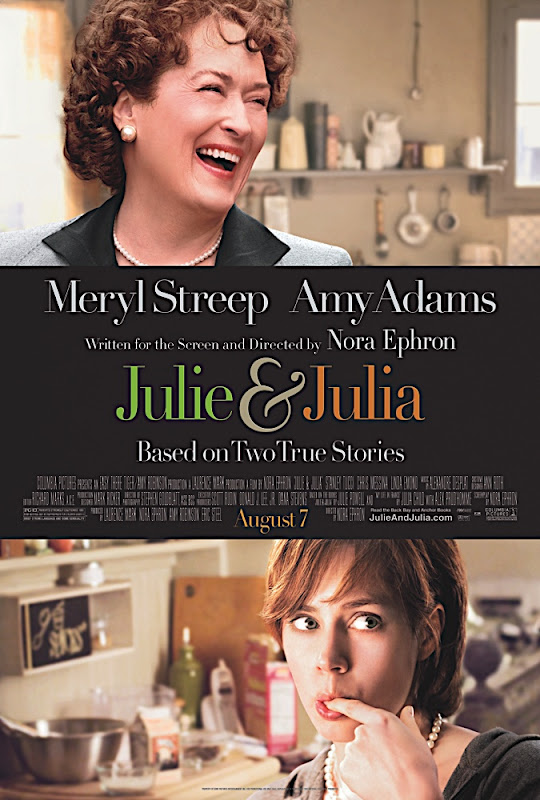
Movie Review: Julie & Julia (2009)


Coming Soon to DVD & Blu-ray


Photo Slideshow


Delicious
Bookmark this on Delicious
submit to reddit
Print Page

Digg!

MovieBlips: vote it up!

Despite the fact that they are separated by more than fifty years in two thematically similar narratives, the presence of both personalities referenced in the title as well as the talented women portraying them linger as the film flows back and forth in time.

Similar to producer Scott Rudin’s film The Hours (also starring Meryl Streep and based on a literary source), Julie & Julia uses time freely and in a circular fashion. Reuniting with not just producer Rudin but her co-star Amy Adams from Doubt (although in this film the two don’t share a scene), Julie's more contemporary plot concerns Adams’ hardworking, highly educated but frustrated failed novelist Julie Powell who moves from Brooklyn to Queens in 2002 while the aftermath of 9/11 is still painfully fresh.

Spending her days in a cubicle alternating from anger to tears of heartache as she takes calls while employed with the Lower Manhattan Development Corporation—Powell discovers that the only solace she receives from a hard day at the office is in the certainty of following a recipe she knows and trusting that she’ll be able to predict the outcome of its resulting comfort food.


Following a disastrous lunch with her group of power hungry friends from college and an embarrassing article about her lack of success as she nears thirty which finds her feeling dissatisfied with herself as a writer, Powell’s loyal husband Eric (Chris Messina) suggests that she should look for an outlet that somehow gives her the artistic release she desperately needs.


As the dawn of the twenty-first century began the rise in popularity of blogging, suddenly Powell realized precisely what she wanted to do. But unlike the flood of vanity blogs filled with random thoughts, gossip, Dear Diary like entries, or items that most of us would never want to read, she put her literary skills to good use and employed an intriguing hook by embarking on a quest to cook all 524 recipes in 365 days contained within the culinary tome Mastering the Art of French Cooking.


While Powell gets to work on her blog, writer/director Nora Ephron has been deftly weaving us through the simultaneous and similar challenge facing Meryl Streep’s Julia Child who—no stranger to governmental work-- like Powell has also moved and is in search of something to do that will fulfill her on a personal and creative level.

Thus, we follow Streep’s journey as Julia Child from her 1948 arrival in Paris until she eventually channeled her appetite for life and food into the study of cuisine, becoming not just the first American woman to study at Cordon Bleu but to eventually bring her academic pursuits to America with the publication of Mastering the Art of French Cooking which was co-written with Louise Bertholle and Simone Beck.


Easily the greatest actress working today, Streep manages to fully convince us she’s Child within seconds, going beyond that recognizable accent that was made part of our pop culture landscape once more via Dan Akyroyd on Saturday Night Live by fully embracing just how much Child simply loved life and seemed to treasure all those with whom she came into contact.

Moreover, the Child sequences in Paris are far more compelling than any of the material involving Powell. And unfortunately this seems as though it's because, no matter how much you ultimately dress it up—aside from her genuine affection for Child- the blog itself felt like a race-to-the-finish-line style gimmick rather than a true celebration of the overwhelming amount of work that Child put into the book so many who own it take for granted. Of course, this probably was not Powell's intention but for truncated film reasons, that's the way it comes across.


Additionally, despite my admiration for Adams as one of my generation’s most talented actresses, she isn’t given very much with which to work. Basically, Adams' Powell seems to be a pretty narcissistic character especially considering the fact that as evidenced in the script-- not only does it indicate that it’s female driven professional jealousy that drives her to blog but the film also contains a conversation that’s nearly entirely comprised of her character and another agreeing on how much of a bitch Powell is-- as well as another throwaway line that all women hate their friends.


Thus, since the representation of Powell went against the celebration of living life to the fullest and Child’s zest for this manner of being, I kept thinking how much better the movie would’ve been if they’d axed the Julie Powell plot completely and just gone solely with a film about the fascinating Julia Child.

This idea was solidified by the pitch-perfect chemistry that Streep had with her Devil Wears Prada costar Stanley Tucci who portrayed her adoring husband Paul. Able to spark so well together that early into the picture you can actually see Streep blush right through her makeup-- and indeed, according to the production notes from Sony’s Columbia Pictures, Streep suggested Tucci for the role—the two present a refreshing depiction of a true marriage of equals.


Of course they have their troubles and Streep and Tucci are able to bring quiet layers to their work showing private doubts and fears of not fitting in during a few unscripted dialogue-free moments that ordinarily would’ve been left on the cutting room floor. Yet their relationship unlike Julie and Eric’s which mostly consists of grocery buying, food tasting, and disagreements was the one that truly inspired and nourished me as a jaded twenty-first century singleton the way that Child's food and cookbook has nourished countless chefs over the years.


For, they not only support each other through the hard times of feeling less like a man or a woman when he’s interrogated during the McCarthy era and humiliated and likewise as Child is unable to have a child but also in the way they seem to look at each other as though they’re still the only people in the room. And this is evidenced in the cute (yet slightly scandalous) nude bubble bath etc. postcard photos recreated on film that they took to share with others their love and delight in life and each other.


All in all, it's an ambitious and highly literary film that combines not just two works of nonfiction including Julie Powell’s Julie & Julia and Julia Child with Alex Prud’homme’s My Life in France as well as her famous cookbook along with what I can only imagine was endless research in a masterful script by Nora Ephron. Additionally it proves to her harshest critics she’s much more than the queen of the romantic comedies whom they'd had her pegged to be and although the Julie portion of the film made it a bit unbalanced, it’s still highly recommended.

Likewise, given another wondrous turn by Streep and a dynamic supporting performance from Tucci who helps augment our leading lady, I believe that Ephron’s work may be up for some serious awards consideration also given the amazing talent involved behind the scenes from producer Rudin, Benjamin Button and Painted Veil Oscar nominated composer Alexandre Desplat and cinematographer Stephen Goldblatt (Closer, Angels in America, Charlie Wilson’s War, Rent).

However, as a longtime fan of Ephron’s--for this reviewer, the most inspiring and empowering story involved in the production from a female standpoint aside from Ms. Julia Child’s is that of Ms. Nora Ephron’s who—with Julie & Julia seemed to provide a subtextual third character and narrative to the piece of a woman seeking inspiration, something to do, and the right outlet to find herself. To explain-- with this film, Ephron managed to do just that as a filmmaker.


As when it comes to Julia, Ephron has actually created something that looks and feels completely different than any of her other works and at its heart, it’s a film that applauds a woman’s need to find a creative outlet. And while most moviegoers will be caught up fully in the tale of the characters, I was just as invested in the evolution of the woman yelling “action” and the way that somehow she managed to juggle various texts to produce not just a cohesive structure but a mightily impressive and intelligent screenplay at the same time.

For, while I’m sure that the movie will have a tough time battling the testosterone fare of GI Joe, to me the greatest measure of its success would be that-- similar to both Julie and Julia-- if Nora Ephron has finally realized just how valuable, worthwhile and important her work has been to female filmmakers and audience members all along.


And, much like Julia Child trying to fight prejudices and labels against the Americans trying to master French cuisine-- Ephron has battled the Rom-Com label for years. And although her romantic comedies are still the most sophisticated ones I’ve seen in decades, with Julie & Julia she proved that she can leave the genre whenever she wants and meander directly into Rudin territory of literary works without managing to forget to season the work with intelligence, feminism, and wit.


Text ©2009, Film Intuition, LLC; All Rights Reserved. http://www.filmintuition.com

Unauthorized Reproduction or Publication Elsewhere is Strictly Prohibited.

4/17/2009

Blu-ray Review: Doubt (2008)


Without a Doubt...
One of the Best Films of 2008
Hits DVD & Blu-ray


Read the Pulitzer Prize Winning Play


Download the Film on iTunes

Doubt


Delicious
Bookmark this on Delicious
submit to reddit
Print Page

Digg!

“When everybody assumes that they share the same values, they share also a certain blindness. I think the utter lack of vigilance and profound credulity of people of that time [the 1960s] was what allowed the church scandals to ever happen in the first place. It was too obvious if you were paying any attention whatsoever to the amount of it taking place. It calls for a kind of cultural blindness. I was reminded in more recent times of the time I was living in a few years ago -- let's say in the run-up to the invasion of Iraq -- that again there was this kind of certitude and blindness, and it had echoes for me in this earlier time.

“I found myself living in an era of extreme advocacy... I felt surrounded by a society that seemed very certain about a lot of things. Everyone had a very entrenched opinion, but there was no real exchange, and if someone were to say ‘I don't know,’ it was as if they would be put to death in the media coliseum. There was this mask of certainty in our society that I saw hardening to the point that it was developing a crack -- and that crack was doubt.

“I thought that doubt was a hallmark of wisdom and an active and ongoing enterprise…. So I wanted to write about those issues … that celebrated the fact that you can never know anything for certain. I wanted to explore the idea that doubt has an infinite nature, that it allows for growth and change, whereas certainty [‘and dogma’] is a dead-end. Where there is certainty, the conversation is over, and I'm interested in the conversation, especially because another word for that conversation is ‘life.’ We've got to learn to live with a measure of uncertainty. That's the silence under the chatter of our time.”
-- Writer/Director John Patrick Shanley
(As Quoted in Miramax's Press & Production Notes for Doubt)

And although he began with the idea for a work that would simply be called Doubt, Shanley is careful to explain that he wasn't necessarily inspired or overly fascinated with the revelations about the global Catholic Church scandals that were featured as a regular nightly news story over the past few years. For, as he and the Oscar nominated four cast members state-- the film can resonate with anyone, anywhere, and within any given situation.

However, with the ultimate goal “that the sense of doubt belongs to the audience,” as he was determined to avoid telling “them what's right and wrong,” in lieu of making them ultimately “think and feel something, rather than tell them what to think and feel,” by centering the action for the Pulitzer Prize winning first play--in a prospective trilogy-- in a 1960s Bronx Catholic school and church with the subtext of a possible scandal, was precisely the right combination needed to ignite the audience.

Ideally Shanley knew that the decision to set his work in this particular “polarizing situation, one in which most people would brook no hesitation in condemning a person -- and then throwing those assumptions back at the audience in a different light,” would eventually cause-- what he shares on the stunningly transferred Blu-ray edition of the film-- the “final act” of Doubt to occur after audience members walked out as each person saw it in a different way.

Set in 1964, just one year after John F. Kennedy's assassination at St. Nicholas school—Shanley’s Doubt occurs just before the pivotal change for Catholicism that would eventually find nuns being able to go without the habit with the recent reformations and decisions made by 1962’s “establishment of Vatican II by Pope John XXIII” as well as encouraging “much less formality between priests and their parishioners.”

Representing the new breed of familiar, direct, and personable priests, Philip Seymour Hoffman’s affable Father Flynn tries to shake up the overly strict surroundings much to the chagrin of the equally stubborn but old-fashioned school principal Sister Aloysius (Meryl Streep) who is a taskmaster that preaches not on the pulpit but in the hallways and offices enforcing discipline and order to the utmost extent.

Caught in the middle between the old-fashioned values of her superior Sister Aloysius and the likable and far friendlier Father Flynn-- the young, quiet, shockingly innocent, and sweet Sister James (Amy Adams) finds her loyalties tested even more when she witnesses a few too many peculiar moments and strange behavior shared between Father Flynn and the school’s first black student, Donald Miller (Joseph Foster II).

Not quite sure what it is she has seen but feeling in her gut that it was inappropriate, Adams’ Sister James dutifully informs Streep’s Aloysius who-- much like the allegorical cat brought in to kill the mice in another scene—tells Sister James “that we have to take care of this ourselves.”

Since-- as the film and Miramax’s Notes inform-- in the unequal gender divide and “power gap between the priests, who could wield their complete authority in church matters, and the nuns who had to eek out power in very different and subtler ways,” the Sisters of Charity at St. Nicholas had no men to whom Aloysius felt they could go with the information.

As Streep reveals in her research, commending the nuns’ “sense of great capability,” she also confides in the Production Notes that she “also got… a sense of their hierarchy in the church, how they were always second-tier to the male hierarchy of the priests and how some chafed against that. All of that was very valuable for Sister Aloysius. And all that drives the narrative.”

And indeed that it does as the film which changed from a four person theatrical production morphs into a fully-realized living and breathing work. Shot at the same corner and neighborhood where Shanley grew up as he dedicates the film to nuns as well as the real Sisters of Charity including the woman who inspired Sister James—he manages to make it a personal affair as the real sisters were brought on as consultants and the children he attended the school with now have cameos as parents in the church scenes.

Transporting the dialogue driven play in which Streep called one of her truly "great nights in the theatre” that she’d ever had where she said there were “two audible gasps [from the audience] as one voice,” as well as Hoffman who saw it countless times and Adams who fought hard for the role—Shanley decided to “utilize the conventions of [the mystery] genre—to provide a propulsive energy to the narrative.”

Of course, the lingering question that he begins with that’s starting to divide the audience from one of the earliest scenes in which Hoffman is caught in a single frame with the children is “did he or didn’t he?” [regarding Father Flynn’s "relationship" with Donald] but knowing that he would go against the one hundred plus year tradition of filmmakers who “have tended to ask a question and at the end of the movie... answer it,” this mystery evolves as Aloysius confronts Flynn directly and the three characters go around in circles without a shred of proof.

By constantly switching gears and changing your impressions, at times I felt the work recalled David Mamet's Oleanna and Arthur Miller's The Crucible except Shanley's is much more fine-tuned and speaks softly where the others shout--instead, building up tension by what isn't being said, shown, or somehow otherwise revealed.


Knowing that he was going to—similar to the play—“leave the audience at the end not with an answer, but saying rather ‘What a beautiful question’… [so] in that way, it becomes the audience’s story,” which grows far more complicated when the boy’s mother (played by an unbelievably effective Viola Davis) arrives with a rather unpredictable reaction to Aloysius and several new facts that must be taken into consideration.

The type of film that manages to somehow break through the screen and pull you inside its claustrophobic setting of Elia Kazan East of Eden like slanted cinematography by master lensman Roger Deakins to weigh possible balances of power, a clever usage of color, an emphasis on the visuals to punctuate a line or what’s not being said in a large amount of stillness and silence-- Doubt is that rare film that must be viewed more than once and is best done so along with others as each individual will make up their own mind on what has happened.


While the film’s conclusion of uncertainty and further confusion works incredibly well on the stage, even the actors admit in one of the Blu-ray’s outstanding featurettes in a discussion with Entertainment Weekly, that movie audiences (including Meryl Streep who admits to the practice herself) are far more likely to make a snap decision about something and this one doesn’t play by those expectations in the least.

Quite daring and provocative because the very nature of the story at its core is in everything we don’t see—while as Hoffman has admitted, he privately came up with his own decision as to Father Flynn’s guilt or innocence (but never shared it)—I was fascinated by Amy Adams’ unique take in challenging viewers to watch the film a number of different ways, trying to shut out one entire side and say “yes, he did it” and then “no, he did not,” to understand the complexity.

However, at its core, we soon realize that the guilt or innocence is only part of the story for as soon as Viola Davis enters the film, that simplistic of a question (no matter how devastating it is) is tossed aside to one that’s so filled with gray areas, it’s almost that particular fiery exchange that will affect you even more than the “yes” or “no” and suddenly make us second guess all snap judgments… at least for a few days after you see it.

Including feature length commentary from writer/director John Patrick Shanley as well as a few mini-documentaries and featurettes—the quality of the Blu-ray for a work I now consider as one of my Top 5 Best Films of 2008 is first rate, bringing a theatrical experience right into your home and one in which the sharpness of high definition actually makes the film and characters (especially Aloysius) bring anyone who attended Catholic school right back to that surrounding. So hide your rulers and be prepared to challenge yourself with the idea of embracing Doubt (both the film and the state of mind) instead of arithmetic and school uniforms.

4/13/2009

New on DVD & Blu-ray for the Week of 4/12/09

Overstock.com, Inc. 234 X 60

Netflix, Inc.

Jen's Picks of the Week:

Classic:
Pillow Talk: 50th Anniversary Edition


Foreign Flick:
The Pope's Toilet


DVD of the Month Club for Award Winning Film

Miniseries:

Pride and Prejudice [Blu-ray]


ShopPBS.org - All purchases support PBS programming

New Blu-ray:
Mean Girls


Obscure '80s Release:
Irreconcilable Differences


TV on DVD:

Ruth Rendell: Set 4


Visit Acorn Online for Unique Gifts and Videos


Delicious
Bookmark this on Delicious
submit to reddit
Print Page

Digg!

8 Mile [Blu-ray]


Cranford [Blu-ray]


Dark Matter


House of Saddam


Knot's Landing:
The Complete Second Season


The Last Kiss [Blu-ray]


Lost in Austen


Mary Higgins Clark Collection


Mask of the Ninja


Mean Girls [Blu-ray]


November Son


Paris


Pillow Talk:
50th Anniversary Edition


The Pope's Toilet


Pride and Prejudice [Blu-ray]


The Reader


Ruth Rendell: Set 4


She Fell Among Thieves


The Spirit


Strange Wilderness [Blu-ray]


Wings: Final Season


Additional New Releases


SecondSpin.com
Apple iTunes
15% off $50 –4/12 thru 4/18 only fye.com
Free Shipping at Buy.com!

4/07/2009

New on DVD & Blu-ray for the Week of 4/5/09

Jen's Pick of the Week:

Doubt


Delicious
Bookmark this on Delicious
submit to reddit
Print Page

Digg!


2010: The Year We Make Contact (Blu-ray)


Above the Law (Blu-ray)


American History X (Blu-ray)


Bedtime Stories


Britney: For the Record


Cleopatra: Universal Backlot Edition-- 75th Anniversary Edition


Collateral Damage (Blu-ray)


The Day the Earth Stood Still (2008)


Disney Animation Collection 1: Mickey & Beanstalk


Disney Animation Collection 2: Three Little Pigs


Disney Animation Collection 3: Prince and the Pauper


Donkey Punch


Doubt


House


I.O.U.S.A.


No Country for Old Men (Blu-ray Collector's Edition)


Not Easily Broken


One Missed Call: Final


Point of No Return (Blu-ray)


Pre Code Hollywood: The Collection


Scooby Doo & the Samurai Sword


Swamp Devil


The Tale of Despereaux


Tango & Cash (Blu-ray)


TCM Spotlight: Doris Day Collection


The Wedding Singer (Blu-ray)


Yes Man


Yo Gabba Gabba! New Friends