Showing posts with label Alan Rickman. Show all posts

8/21/2015

Blu-ray Review: A Little Chaos (2014)


Now Available to Own   


Photo Slideshow   


For his sophomore feature as a director following his work on the acclaimed 1997 character-driven indie sleeper The Winter Guest (which starred his Sense and Sensibility screenwriter and costar Emma Thompson), Alan Rickman called upon another Sense collaborator in the form of Kate Winslet, with whom he hadn’t worked since they were cast as onscreen love interests in Ang Lee’s beloved ’95 classic.


Playing a poor but talented widow with a flair for architectural design, Winslet shines in Rickman's female-centric revisionist period picture that weaves a rich wish-fulfillment narrative about love, loss, gender, and gardening in the time of French King Louis XIV's court at Versailles.

A self-proclaimed "clay kicker" known for thinking outside-of-the-box – which we gather has been a constant requirement in her life as an intelligent woman of independent mind rather than independent means – after Winslet's gardening savant comes up with an ingenious way to conserve and incorporate water into the burgeoning garden design, she's invited to work alongside a master in the field, portrayed by Matthew Schoenaerts.


A victim of timing, while their natural chemistry is easily apparent, their love story takes awhile to bloom. And although she’s challenged by her own self-doubt as well as outside forces hoping to bring Winslet down professionally and personally, thanks to the film’s largely jovial tone and some amusing if half-baked supporting characters and subplots, we're never in doubt that our heroine will succeed by the film's end.

Infused with an intentionally modernist sensibility given its progressive treatment of gender roles and sexuality in all manner of male/female relationships, the lovingly crafted historical dramedy plays well to its target audience of Anglophiles whose DVRs are full of Masterpiece Theatre productions and female-centric series such as Call the Midwife.


And although the admittedly feminist fairy-tale arc makes an overt misstep as our intelligent widower finds herself finally able to let go of guilt only after a man tells her something isn't her fault, all in all, it's easy to forgive since overwhelmingly the film's heart is in the right place.

Overstuffed with talent – by trying to make room for all of its immensely talented cast of characters (including Rickman as the King and Stanley Tucci as his brother, the Marquus), Chaos loses us here and there with scenes that pull focus from the main journey undertaken by our heroine.

Augmented by the beautiful cinematography from Winslet's gifted Eternal Sunshine of the Spotless Mind director of photography Ellen Kuras, while eventually it guides us back into Winslet's storyline thanks to the strong hand of Rickman, overall A Little Chaos may be best remembered as a lovely, decorative diversion much like the palace gardens themselves.

Lacking the roots and depth of a more sophisticated plotline, the nonetheless amiable, earnest effort from scripters Alison Deegan, Jeremy Brock, and Alan Rickman is like a lovely bouquet of wildflowers that quickly charms but loses its hold on us much too soon.

Featuring a standout score from Peter Gregson that matches the power of Kuras' hypnotic images, the newly released to Blu-ray feature ends on a high note for all in a showstopper of a finale that pulls back from a small garden party to gradually reveal the magnificent magnitude of the maze-like creation of interlocking gardens in one single breathtaking shot.

A welcome return to filmmaking for Rickman, although Little doesn't have as big of an impact as it might have with a sharper script, staggering moments like that closing sequence as well as his all-around skill with actors make us hope we won't have to wait another two decades for the talented actor to direct once again.


Bookmark and Share

Text ©2015, Film Intuition, LLC; All Rights Reserved. http://www.filmintuition.com Unauthorized Reproduction or Publication Elsewhere is Strictly Prohibited and in violation of the Digital Millennium Copyright Act.  FTC Disclosure: Per standard professional practice, I may have received a review copy of this title in order to voluntarily decide to evaluate it for my readers, which had no impact whatsoever on whether or not it received a favorable or unfavorable critique.

1/14/2014

Blu-ray Review: Lee Daniels' The Butler (2013)


Now Available to Own   


Photo Slideshow 


Before it was ever put into words, from his youngest days working under a sadistic boss on a cotton farm to his thirty-plus years spent serving eight U.S. presidents as a White House butler, Cecil Gaines understood precisely what was meant when he was advised to possess two faces – his own and the one he would show to white folks.


While that sentiment alone has slavery era literary roots, in director Lee Daniels’ The Butler, which was written by Emmy award-winning historical screenwriter Danny Strong, it serves as something beyond mere advice to become an actual way of life for the eponymous lead portrayed by Forest Whitaker in a role that was inspired by – (read: very loosely based upon) – fact.

Gorgeously crafted and undeniably well-intentioned with all departments from cinematography and production design to hair and makeup firing on all cylinders, one of The Butler’s biggest problems in fact is its picture-perfect, museum-like approach to its subject matter.

From its convenient plot points that hit the desired emotional beats at precisely the right time to some awkward transitions between presidential administrations, everything feels so extremely choreographed that most of what occurs onscreen ends up feeling melodramatically manipulative rather than natural. The end result is a film that holds us at arm’s length rather than one that successfully transports us into the film to fully buy into the story the filmmaker is trying to tell.

And while their names and faces looks great on a poster, the Cameo Carousel approach of offering viewers a Where’s Waldo like game of “Spot the Movie Star” – wherein a new A-lister enters and exists every ten minutes as if part of a Hollywood parade –  pulls us out of the plot with each new walk-on and detracts from the work as a whole.

From a storytelling standpoint, this gimmick makes the episodic nature of Strong’s script that much more apparent. But more troublingly it calls far too much attention to itself as one by one we identify the movie star currently onscreen and just as frequently find ourselves disappointed by the casting choice of selecting someone for the sake of name recognition rather than addressing the question of whether or not they’re actually right for the role or look anything like the people they’re supposed to play.


While the actors try their best with Liev Schreiber’s fiery Lyndon Johnson a film highlight, when most feel so grossly miscast, what it ultimately boils down to is stunt casting and it’s condescending to its audience – making the whole picture less effective all-around.

And at the same time, the commanding lead turns by not only Whitaker but in a surprisingly powerful supporting role by Oprah Winfrey (that reminds us just how effective she was in Spielberg’s The Color Purple), help anchor the film and prove just how beneficial it can be to cast the right actors in the right parts. Winfrey is so good in fact that it makes us wish she’d spend more time acting and less time focusing on conquering the small screen as a media mogul.

While she’s a bit shortchanged in her performance due to peculiar editing choices that force us to guess far more than we’d like about particular indiscretions or behavioral motivations of the character based on a look here or a throwaway line there, her scenes with Whitaker are the strongest in the picture.


In fact, the two are so good together that it makes you wish the film was far more emotionally riveting than it actually turned out to be, not only to be worthier of the audience but to its stars as well.

While nowhere near as naturalistic and impactful as another 2013 film that Whitaker was involved with behind the scenes while serving as the producer on another biographical effort Fruitvale Station, (which incidentally shares today's release date with The Butler), the stunning production values and stellar turns at the heart of the film make it worthy of at least one spin.

And while every fiber of my being wanted to like the picture and indeed, Lee Daniels’ The Butler appears to be as eager to please as Gaines was in his White House role, nearly stamping “For Your Awards Consideration” onto each gorgeously composed frame of this Forrest Gump-like ode to old-fashioned storytelling, it just doesn’t live up to its enormous ambition or potential.


Instead of merely presenting both of Gaines’s faces to the audience, this Butler tries to be all things to all people. From the gross manipulation of the facts that were either heightened or completely changed for maximum soap-opera effect to not having enough faith in Gaines’s plotline so that they had to invent a fictional militant son to serve as a political counterpoint for the era, this Butler is a mess of a missed opportunity.

For one of the greatest problems is that we’ve seen the alternate histories of the ‘60s done so many times before that the fictionalized Freedom Rider turned Black Panther son should’ve been left on the cutting room floor altogether.

As instead of Vietnam War unrest and civil disobedience struggles we’ve faced onscreen before, the thing we’d never encountered is the story of Cecil Gaines and unfortunately, it’s his story that Daniels and Strong seemed least interested in telling (aside from a chosen anecdote here or there).


And while I can only yearn for what was missed and indeed can’t critique a film I wasn’t shown, you can’t tell me that serving eight presidents didn’t generate enough valid material for a great movie. Unfortunately the one we’re left with is beautifully executed enough but far too bland for us to remember anything about The Butler we were so looking forward to getting to know.

Using the same manipulative tricks he employed in Precious, Daniels knows how to play his audience like a fiddle, while also inspiring some staggeringly raw, honest performances. But unfortunately this time around he doesn’t achieve the impact we’d been braced for by all the pomp and circumstance established by the film’s first act build-up or the promise of its award season campaign.

While worth a look for history buffs as well as Whitaker fans – with the caveat that it’s also a good idea to seek out the original source material to separate the small amount of fact from a massive amount of fiction – ultimately history will be the best judge of the film’s longevity long after award season passes and those easily influenced by it will be able to watch with more perspective.

Of course, it could become a cult classic in future years but something tells me that producer Whitaker’s masterfully made Fruitvale Station will far surpass Lee Daniels’ The Butler not only with regard to Forest Whitaker but in terms of the cinematic year of 2013 in general, inspiring future generations to come with its celebration of life on a small scale vs. this star-studded, sprawling soap.    

Text ©2014, Film Intuition, LLC; All Rights Reserved. http://www.filmintuition.com Unauthorized Reproduction or Publication Elsewhere is Strictly Prohibited and in violation of the Digital Millennium Copyright Act.  FTC Disclosure: Per standard professional practice, I may have received a review copy of this title in order to evaluate it for my readers, which had no impact whatsoever on whether or not it received a favorable or unfavorable critique.

7/15/2009

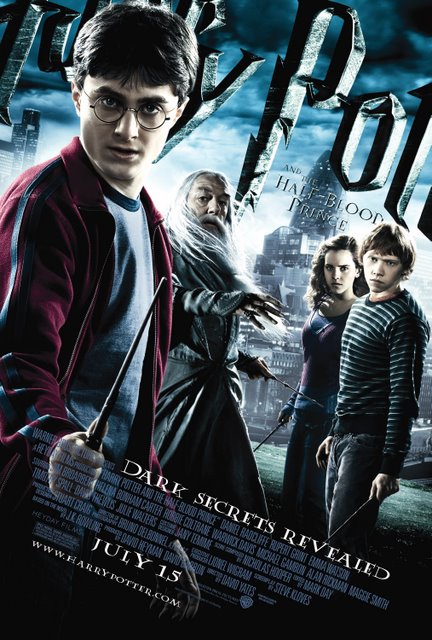
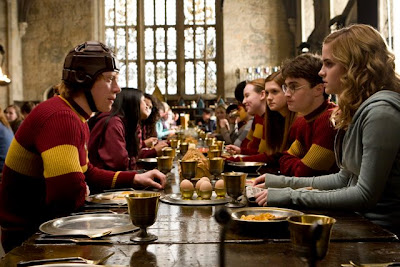
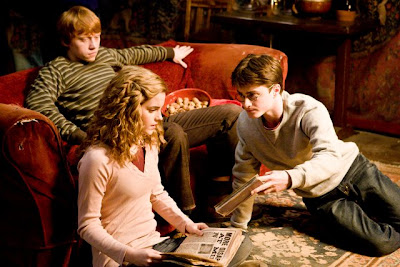
Movie Review: Harry Potter and the Half-Blood Prince (2009)


Official Shop of Warner Bros

Get Caught Up With the Movies


For Potter-- Reading is FUNdamental
Share J.K. Rowling's Series


Read Jen's Take on Prisoner of Azkaban


Half-Blood Prince
Photo Slideshow


Delicious
Bookmark this on Delicious
submit to reddit
Print Page

Digg!

MovieBlips: vote it up!

For the non-readers, the excitement of the next cinematic Harry Potter installment has always been in the steady development of experiencing J.K. Rowling's mythology unfold on the big screen. And as such the films have served as a sort of conveniently abridged version of the works for those either too busy, not quite interested enough, or just seeking a perfunctory knowledge of the world of Hogwarts to fake their way through office conversation.


Yet this is a series that at its heart seems to celebrate its readers the most given its painstaking adaptations and the evidence of this is sometimes its downfall via the detriment of the yawn-inducing screenplays-- as each and every important building block has been included throughout the movies. And in doing so, the directors and strategies have changed throughout which has not only been a brilliant tool in tapping into the short attention spans of the youngest audience members but also ensuring that there isn't only one vision for the Harry Potter universe that's being presented on the screen since the boy who lived in the cupboard under the stairs belongs to everyone who carries him around in their bag.

Moreover, despite his great beginning-- thankfully we've come a long way from the extraordinarily dull first film from one of the great filmmakers of my youth-- Mr. Chris Columbus-- which was surpassed by his own second movie (although book-wise for Rowling number two had been a literary step backward) before Alfonso Cuaron released the masterful Harry Potter and the Prisoner of Azkaban which was and remains the crowning achievement of the works so far.


Essentially, while aside from one exception with Wonder Boys scripter Steve Kloves wielding the pen for all of the transitions from books to movies-- for viewers who know the source material before going in-- the main attraction is from the visual point-of-view and the way in which this franchise has managed never to grow stale is by constantly bringing in a revolving door of new directors, cinematographers, and editors and endless behind-the-scenes talent to switch up the look.


Some of the experimentation offered up has been ghastly in my opinion such as in Mike Newell's The Goblet of Fire wherein every cast member and camera lens looked like it had been dragged through the mud (purposely according to the director's desire for grubbiness) before he yelled “action.”

In terms of script, direction, cinematography, editing, and overall execution,
the most successful adaptation all-around is still Azkaban as that final "Time-Turner "sequence has yet to be topped and Hermione was given her due for the first time in the series. And although I'd cite the first and fourth film as the weakest entries-- despite Newell's success in Harry's terrifying and violent showdown with Voldemort when death hits Hogwarts-- the one recurring complaint aside from the predictable format of "the end of summer break to end of school year standard structure" is the sheer length of the films themselves. Still, I'd like to throw one more problem into the pile-- namely Rowling's over-reliance on the “overhear” device which made more sense when the kids were younger since eavesdropping was conceivably the most reliable way for the trio to acquire information... but more on that later on.


And dropping extraneous details-- to the chagrin of some die hard fans-- Girl in the
Café director David Yates (who had cited Cuaron's work as his own personal favorite) moved the series back in the right direction with the much faster paced fifth film which found Harry developing his own army on behalf of Dumbledore which leads to a devastating conclusion as his godfather Sirius Black is murdered before his eyes.


After being asked to return to helm the rest of the series including the final book which will be broken into two films--(although I'm not sure if that's wise and wonder if perhaps blending books six and seven into two films may have led to a stronger narrative)-- Yates reveals supreme confidence right from the start with a bravura opener unlike anything we've seen before in Harry Potter that's sure to dazzle in 3D despite my admitted weariness of the format. In doing so he offers audiences an entirely new visual look by bringing aboard Jeunet's Amelie cinematographer Bruno Delbonnel that adds a striking color palette and style to the work especially in tandem with veteran Potter editor Mark Day. And some of the sequences in this-- the sixth Potter film to hit the screen-- are so breathtakingly gorgeous that they rival Azkaban on sheer beauty alone.


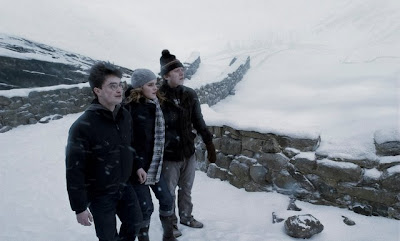
Whether Delbonnel employs old-fashioned trickery to move easily into flashbacks from water drops in a cauldron into the past with a soft focus or words on a page that evolve from ink and font into kids walking in the snow-- it's always dazzling and just flows so well that an argument can be made for Delbonnel to receive a cinematography nomination for his mind-blowing work.


And it's a great thing too because while the film is sumptuous-- readers of Half-Blood Prince go into the theatre keenly aware that it's a very introspective, flashback heavy, chatty (a.k.a. not exactly action packed entry) which is designed to push everything in the right direction towards an unsettling “throw the uninitiated off a narrative cliff” ending as one main character is murdered and another we've been on the fence about is the one wielding the wand, thereby effectively leaving those breathlessly anticipating what's to happen next.


As a film, it's still quite good--if a bit too long again-- and filled with Rowling's structural Achilles heel as the trio and especially Harry this time-- since Ron and Hermione are busy obsessing over which one the other one is “snogging” (the Brit slang for kissing)-- are seen more than half a dozen times at least eavesdropping or listening in on conversations as if Rowling forgot that there were other ways Nancy Drew, Miss Marple, or any number of detectives could find clues.


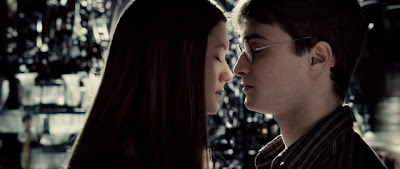
Since the cast is getting older-- they're predictably more caught up with their raging hormones. To this end, Harry starts to return Ginny's previously unrequited affection only to realize that she'd moved on to the athletic Quidditch player Dean Thomas whereas Ron has caught the eye of a stereotypically clingy girly-girl named Lavender much to Hermione's wrath that he hasn't realized that girls with the ability to carry on a conversation are much more interesting than those who snog so much that poor Ron is going to have the market cornered on chapstick.


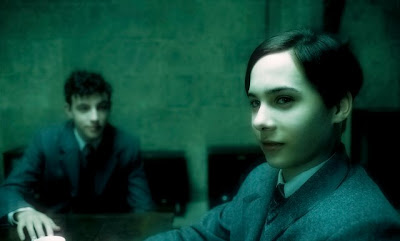
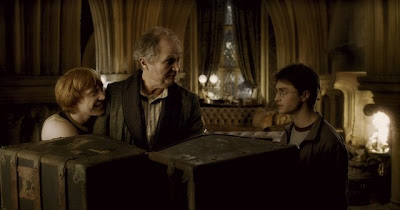
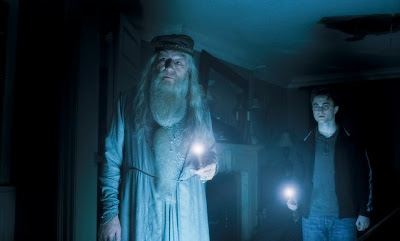
Yet, it's not all "The Young and the Hogwarts"-- as The Death Eaters have stepped up their fight on behalf of the Dark Lord and we learn early on that not only is Draco Malfoy to be an important player but that Alan Rickman's Severus Snape has promised Helena Bonham Carter's Bellatrix Lestrange to step in if he's unable to fulfill his duty. Likewise, Michael Gambon's Dumbledore has been turning Harry into a double agent to get close to one of Tom Riddle's old teachers-- Horace Slughorn (Jim Broadbent).


And despite the tradition that the final showdown is always the most exciting-- honestly the one captured in Half-Blood Prince isn't quite as memorable as some of the ones which have come before it. One of the reasons for this could most likely be because the events leading up to the big murder were executed with such overt Christian symbolism like we were watching a Charlton Heston movie to the point that afterward others including myself wondered when it suddenly became The Ten Commandments thereby in making these choices, it pulled viewers out of Harry Potter suspension-of-disbelief and into post-modern, pop-culture referential mode.


Additionally, in the book although Harry was outnumbered and out-wanded to help prevent a beloved friend from death, there was much more to the scene than having him stand there like yet another "overhear" in an anti-climactic fashion.


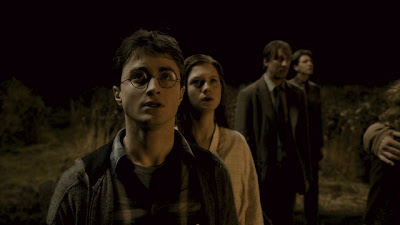
Despite this, there is one amazing sequence that keeps you in check within the film that I don't remember-- at least to this extent-- in the novel which takes place at Christmas at the Weasley household when Bellatrix Lestrange shows up and a huge chase through the cornfield ensues as though we were in a vintage horror movie classic.


Furthermore it's surprises like these-- unexpected, away from Hogwarts, brilliantly lensed and pieced together in the most dynamic way that heightens the tension which brilliantly keepsus watching even when we're left realizing that this time around, Ron and Hermione have very little to do (with the former given hardly anything save for the obligatory comic relief scene). And likewise the filmmakers will definitely have their work cut out for them in making us buy into the Harry and Ginny relationship
in Deathly Hallows since the ultimate few second "snog" looked about as passionate as a walk to Hagrid's hut.


And in the end, for the readers who've been joyfully treated with
Delbonnel's beautiful lensing, you'll find yourself growing excited and anxious for the plot division of the next book since obviously the big revelation that sets up the final quest for the end of the series is revealed in this title. Yet this one may be rough going for the non-readers given the lack of action in comparison to the rest. However, for the patient viewers who manage to watch all the way through-- the best achievement of the picture's final sequence (and indeed the film itself) is that the murder and perpetrator are so startling that you may find yourself going over to the bookstore to grab Hallows just to see what happens next.


Text ©2009, Film Intuition, LLC; All Rights Reserved. http://www.filmintuition.com

Unauthorized Reproduction or Publication Elsewhere is Strictly Prohibited.

6/19/2009

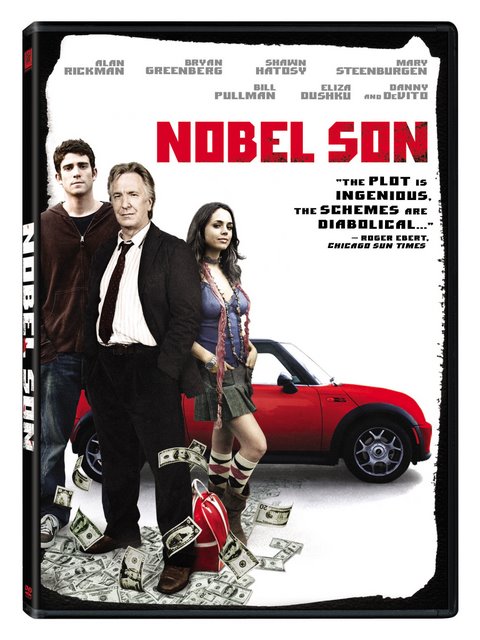
DVD Review: Nobel Son (2008)


Delicious
Bookmark this on Delicious
submit to reddit
Print Page

Digg!

MovieBlips: vote it up!

In The Perfect Sleep--another recently released dark opus of betrayal, family secrets, blood, and sadistic characters that felt like they were the product of an unholy union between classic film noir and modern day horror-- the plot, much like that of Nobel Son was so tremendously complicated that even the most casual viewer would feel as though they needed a pad of paper, knowledge of shorthand and a pen to keep 'em all straight.


Yet the main difference between the two in retrospect is simple-- since I finally gave up trying to makes sense of anything in the case of The Perfect Sleep which was so confoundedly pretentious and ludicrous that the ability of its cast to deliver bloated Shakespearean lines with a straight face was the only thing that kept me watching. Okay, well to be fair-- in addition obviously to professional obligation-- it was a train wreck of such ghastly proportions that part of the bizarre fascination came from sheer bewildered amusement.

However, when faced with the admittedly equally full of itself Nobel Son-- the tone perfectly suits that of its egomaniacal Nobel prize winning chemist lead Dr. Eli Michaelson (a deliciously wicked Alan Rickman) in the mesmerizingly sharp script penned by Marilyn Hotchkiss' Ballroom Dancing and Charm School and Bottle Shock husband and wife team Jody Slavin and Randall Miller.


For in Nobel Son, they trade in their previous instinct for nostalgia and audience pleasing sentimentality with the darkest of explorations in a film wrought with an emphasis on the definition of insanity, cannibalism, suicide, infidelity, kidnapping, and revenge.

And while the gruesome opening minutes may find some viewers reaching for the eject button and indeed, it's only the first of several scenes that will make you cringe-- if you stick with the devious work, you may realize as I did in sheer surprise that as twisted and sinister as it was in all of its forever changing glory, I was engrossed throughout its entire running time.

While the plot of The Perfect Sleep can't be summed up with any amount of words in the English language since I'm not sure even those involved knew just what the hell was going on-- everything about Nobel Son makes perfectly logical (yet unsettling and disturbing) sense, even when it threatens to journey several twists past our suspension of disbelief.

Yet, still I hesitate to reveal much about the storyline and was dismayed by the amount of spoilers readily available in reviews around the web so surf with caution even in publications like Variety.


In a nutshell, it centers on the insufferably smug academic-gone-wild Eli Michaelson (Rickman, of course!) who constantly reminds everyone he comes into contact with of their intellectual inferiority. Endlessly unfaithful to the tune to his early introduction via shagging a grad student he has no qualms about giving a D-- Eli is the last person the world should reward for his rude behavior with a Nobel Prize.


Fond of publicly humiliating his colleagues and family-- Eli loves to reduce those around him to nothing including the PhD candidate son (Byran Greenberg) he gives a thirty-five dollar a week allowance to since he disapproves of his thesis topic of cannibalism and reverence for Game Boy as well as making jokes out of his brainy MD wife (Mary Steenburgen) whose expertise regarding insanity vs. sanity finds her consulting with local and national law enforcement on a regular basis.

Yet, as the film ironically concedes-- the world of academics doesn't actually care about a person's private life-- just the professional accomplishments and contributions to his field so Eli and his wife Sarah venture to Sweden for him to bask in the honor and two million dollar prize.


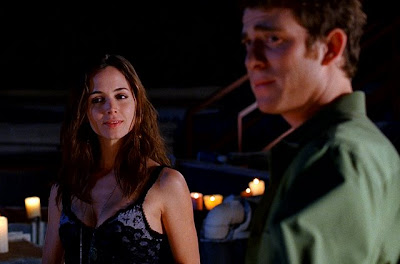
However, when their son fails to return home from a date with his unstable coffeehouse poet crush City Hall (Dollhouse and Bottle Shock's Eliza Dushku, again using her dry wit and sexuality as currency), they find themselves in for one hell of a twist. As-- instead of a telegram or congratulatory letter from a well-wisher-- they receive a delivery of a human thumb that may indeed be that of their son Barkley.


Returning home from a passionate night with City Hall, Barkley is clubbed in the head and held for the Nobel prize money by the calculating "autodidact" Thaddeus James (Shawn Hatsoy). Yet in lieu of taking us down the familiar terrain of a hostage film, Slavin and Miller's calculating screenplay continues to leave us thoroughly baffled-- complete with the sharp editing that only hints at future twists to come by presenting us with various pieces of the puzzle that only finally make sense once the end credits roll.

While we understand that two million dollars is reason enough for a kidnap and ransom with an eerie opportunist like Thaddeus-- soon it's revealed that Eli's unscrupulous behavior in the past has finally caught up to him as Hatsoy's Thaddeus drops a bombshell on Barkley regarding his more revenge fueled motive.

Moving from the idea of two young men working together to put one over on the wicked academic Scrooge-- the film's subsequent acts switch up the motive repeatedly as other characters come out of the woodwork (some in new ways than we'd previously been shown) along with the main cast's ability to easily get in touch with their darkest sides when prompted with the film's exceptionally heightened circumstances.

Although Barkley is far from an ideal "hero" since his obsession with cannibalism is enough to make one's stomach turn right off the bat-- and Dushku and Rickman are used more as "types" (as is Danny De Vito who plays their obsessive compulsive neighbor) than full three-dimensional characters-- Steenburgen is given her best material in years.


As a woman who-- despite our early poor judgment of her for tolerating life with Eli-- proceeds to become a tough heroine in her own right by cursing out a reporter with a gun blazing to stay off her lawn and setting off sparks with the detective who's terribly sweet on her, Bill Pullman's Max Mariner, Steenburgen's instantly feminine and genteel demeanor make her especially fascinating to watch throughout.


Despite this, Nobel Son isn't for everyone and I found myself incredibly glad I'd missed the press screening that night back in its December theatrical release and had the ability to view it at home in the a.m. where I could pause and think about things without being held captive at night in a dark theatre. Moreover, as I write this, I realize that I have no idea when I'd watch it again other than to perhaps fully appreciate the plot that unfolds after enough time has passed and I've blocked certain images from mind.


Still, aside from some situations that are designed specifically to repulse-- as in the gruesome opener, one extremely tasteless payoff involving Barkley's thesis topic near the ending, and sleazy satires on psychotically indulgent coffeehouse poetry that grows old fast-- director Randall Miller's movie will remind you of a much darker version of Christopher Nolan's The Prestige blended together with Joel Coen's Fargo with its ultimate evolution into a macabre, morose, and morally bankrupt magic trick.


And centering on a family so bizarre they'd make Bud Cort's Harold from the Hal Ashby classic Harold and Maude look normal by comparison-- while you may not know who to root for or why you find yourself continuing to watch-- at least the complexity of this screenplay (unlike the ultimately faux intelligence of Perfect Sleep) makes it downright impossible to guess what's coming from one scene to the next.


Therefore, Nobel Son is all the more successful as a feature film because it remains logical despite its celebration of chaotic craziness. Likewise, it's especially rewarding for offering Steenburgen a wonderful follow-up role to her surprisingly deft comedic turn in Stepbrothers with yet another creatively written gem that goes against the grain of most parts envisioned for women over the age of forty.


5/19/2009

DVD Review: Galaxy Quest -- Deluxe Edition (1999)


This Hilarious Cult-Favorite
Is Now Available As a Deluxe DVD & Blu-ray


Delicious
Bookmark this on Delicious
submit to reddit
Print Page

Digg!

MovieBlips: vote it up!

I'm not sure if I was in another galaxy during the winter of '99 but when I received information about the tenth anniversary deluxe edition release of director Dean Parisot's Galaxy Quest, I was sold within an instant upon seeing the names Alan Rickman and Sam Rockwell. Likewise, I was completely stunned that I'd never caught it before.


Yet, just as I was about to say that I'd love to review it-- my eyes moved lower on the screen wherein the clincher to the entire press release arrived with three little words proudly promising, "Sigourney Weaver Raps." Yes, it may be in an extra and not actually the film but the idea of the classy, tall, elegant and accomplished three-time Oscar nominee pulling a Dr. Dre seemed far too irresistible to pass up.


While of course, admittedly I knew that it would help if the movie was good but when-- day in and day out-- you read an overflowing inbox filled with various press releases and news articles (with way too many awesome offerings and precious little time to take in as much as I'd like to discover), I'm always on the lookout for that something extra to grab my attention and share with Film Intuition.


And obviously, in that respect, I'm not alone as the geniuses at Paramount knew that Weaver rapping would make the title stand out even more than in its beautifully (and rather expensive looking) futuristic packaging as they made the wise decision to slap those same three words in yellow font on a sticker that adorns the beautiful, 3D hologram style box for the Deluxe Edition's debut on shelves May 12th.


Marketing wise, the release of Galaxy Quest (which technically wouldn't celebrate its tenth anniversary until December) received an early and logical push now to help thematically tie in with both Paramount's big screen, fun summer blockbuster Star Trek from helmer J.J. Abrams along with the killer new Blu-ray releases of the classic films and series that also boldly offered fans the chance where Kirk had never gone before.


And for those who were unfamiliar with the material, such as yours truly, this premature bow as a collectible DVD was more than justified with this surprisingly heartwarming yet hilarious good-natured spoof of the Star Trek franchise (both on-screen and off in the lives of the actors and their undyingly devoted fans) with the thinly disguised fictitious version of the series, appropriately sharing the title Galaxy Quest.

Once an admittedly cheesy yet wildly entertaining television series-- the movie opens with a look at a clip of the Star Trek like vintage clip and then catches us up with the show's cast twenty years following the now cult hit's cancellation as the actors grudgingly eek out an undignified living cutting the ribbons at new shopping centers, signing autographs at science fiction conventions while posing for photos and answering trivia that fans obsess over when questioning the logic of the "mythology" and rules perpetuated throughout the series.


When the film itself begins, the frequently late, hung-over and always sneaking off for extra solo gigs-- Tim Allen's hilariously egocentric actor Jason Nesmith-- who's the crowd favorite for his William Shatner modeled role as Galaxy Quest's Commander Peter Quincy Taggart seems to fare better than his colleagues.


While the show's one-time bit player Guy Fleegman (a terrific Sam Rockwell) serves as the emcee and scheduler for the crew-- having been so insignificant to the series that his nameless character died in episode 81-- essentially he serves as the bridge between the fans and the actors as he's stuck in the middle himself, never fully accepted on either side. Of course, we're not sure which one is less co-dependent or extreme as the fans dress up like their favorite characters and line up in droves to cheer and celebrate whereas the cast struggles to put on their game faces, wondering what happened to their careers.


Rounding out the rest of the main "cast" of both the film and the fictitious show, we have: Allen's jealous sidekick in the form of the resentful and frustrated formerly Shakespearean thespian Alexander Dane (Alan Rickman in a role that channels Nemoy's Spock) who has said his famous one-liner so many times he's ready to snap; Weaver's beautiful blonde Gwen DeMarco, whose only role aboard Quest as Lieutenant Tawny Madison was to show as much cleavage as possible while simply serving as the translator to repeat whatever it is the computer has just said; Daryl Mitchell's former child actor Tommy Webber who played the youngest integral member of the crew; and Tony Shalhoub's illogically named Fred Kwan who played the "Asian" Tech. Sergeant Chen despite the fact that... well he's as white as his USA Network character Adrian Monk.


When Jason is persuaded to appear in what he assumes is merely a paid side appearance by a group of strange yet aggressively friendly "fans," the movie ventures away from what we assumed was its satirical premise about has-beens struggling with their former glory and lives stuck on nostalgic repeat with as Shalhoub described a beautiful misdirection as Jason finds himself face-to-face with real aliens who-- after having mistaken old reruns of Galaxy Quest for factual "historical documents" completely rebuilt the ship to its exact parameters (useless, cheesy set-pieces and all) to recruit him to help fight an evil intergalactic villain set on destroying their race.


After Jason returns to Earth, his cast-mates assume he was simply trying to steal another gig out from under them and come along, only to find themselves all in an outer space reality version of Galaxy Quest minus the rubber bullets. Highly creative and incredibly amusing both in the screenplay form from writers David Howard (who sold the spec script from the midwest and amazingly found his work realized) and screenwriter Robert Gordon as well as the talented ensemble cast.


Following as Allen explains the director's advice to ignore the "jokes" and tendency to go for broad humor by playing everything seriously, the movie works so incredibly well for that reason as it's a film lampooning a franchise while also respecting it in a way that makes Galaxy Quest a movie that's still hard to pinpoint. As Weaver notes-- first acknowledging that it's probably the film she's been in that people have loved the most-- viewers didn't know what to make of it and ten years later they still don't as Allen simply confesses that "every part of [the film]... is great."


Filling the work with the same kind of absurd logic that is apparent in series like Star Trek with a hallway that's filled with an intense gauntlet of medieval like blades and traps that can slice and dice stars serving no purpose other than to entertain (as Weaver's character complains throughout that they're stuck re-living the same badly written episode this time for real), it's even more amusing as it requires the assistance of the Galaxy Quest version of a Trekkie as Jason has to contact Ed star and "Hi, I'm a Mac" actor Justin Long as an obsessive, nerdy teenager who helps return the crew to safety along with his dedicated friends.

Yet, somehow managing to wrap the actors all up in the arc as well as Rockwell's unappreciated bit player worries that he has to die in this version of Galaxy Quest since that's what he did in the show and Rickman realizes just how important it is to say those same old lines once more with feeling-- it's an unexpectedly lovable romp that's guaranteed to entertain.


Augmented with fond featurettes that roll out new interviews (as opposed to the same old material usually found in re-releases) and of course the extra where Weaver-- inspired by Daryl Chill Mitchell-- composes a rap for her agent's birthday in a video filmed by Parisot and co-starring some of the Quest crew, the film's a blast and one that I wholeheartedly wish I would've seen back in its initial release, although perhaps it may have fared better as a summer blockbuster a la the work its gently toying with in the form of Star Trek.