Showing posts with label Politics. Show all posts

10/15/2020

Film Movement Movie Review: White Riot (2019)


Now Available


Once upon a time, Eric Clapton lost his mind. Stopping a show in Birmingham to ask any "foreigners" in the audience to raise their hands, he told them he wanted them gone, not just from the concert but his country altogether. "I don't want you here," he shouted. "I think we should send them all back...We need to make clear to them they are not welcome. England is for white people, man … This is Great Britain, a white country!"

The year was 1976. As shocking as these words were back then and remain to this day, when it came to views like these, Eric Clapton was far from alone. Joined in supporting the new rise of fascism in the UK, David Bowie argued that Britain was ready for a fascist leader and called Adolf Hitler the first rock star in an interview with "Playboy." Following Clapton's lead, Rod Stewart went even further, giving a full-throated endorsement for racist National Front political party member Enoch Powell, saying that he too thought it was time for foreigners to leave. But this position wasn't just coming from those in rock. With punk taking over the music scene in Britain, The Sex Pistols, Adam Ant, and Siouxsie and the Banshees were just three punk groups who openly embraced Nazi symbolism and swastikas in their costumes and performances.


What the hell was going on, you might ask? The short answer is that in the mid to late '70s, England was rampant with anger and hate. Inundated with job loss and scapegoating the problems of the country on immigrant "invaders" with "black, brown, and yellow faces," as the National Front ranted in their rallies, Britain's tide was turning in a horrific direction. Watching this happen in real-time, rock photographer Red Saunders vowed to do whatever he could to stop the impending flood of xenophobia before it was too late.

Writing an open letter to Clapton, whose music, he rightfully charged, was cribbed directly from Black blues artists, Saunders sounded the alarm and offered a solution. "We want to organise a rank-and-file movement against the racist poison in rock music," he wrote. Leaving his contact information in the letter for interested parties, after his missive was printed in music publications across the UK, Saunders was overwhelmed by the response.


Joining forces with gifted graphic designers, writers, photographers, musicians, and artists, they formed the group Rock Against Racism to reach the youths of England in an attempt to educate the younger generation against propagandist hate. Hosting events where they purposely had Black and white bands playing back-to-back, the organization put on more than two hundred shows in its first year and created a fanzine called "Temporary Hoarding," which addressed the real-world problems of racist policing, the Catholic side of the North Ireland conflict, sexual violence, immigration, LGBT issues, and other topics which were ignored by the mainstream press.

Chronicling the legacy of the group while bringing issues of "Temporary Hoarding" bursting to life through vibrant animation (which filmmaker Rubika Shah acknowledges was inspired by the films of Brett Morgan, including "Kurt Cobain: Montage of Heck"), "White Riot" is a lively time capsule of a fraught period in England made eerily prescient due to recent events.

Watching the arguments made by the National Front in the wake of MAGA, Trump, the murderous Nazi march on Charlottesville, police brutality and the Black Lives Matter protests, as well as the advent of increasing fascism around the globe, "White Riot" plays like one of the scariest horror films you'll see ahead of Halloween. From bullets in the mailbox to assaults against musicians and concertgoers to the open police support for the National Front and their policies, it's a harrowing document of a fraught era in British history and the brave artists, organizations, and youths who dared to join forces to put hate in its place.


Interviewing not only Red Saunders and his colleagues but also some of the musicians who played Rock Against Racism (or RAR) gigs, including The Tom Robinson Band and Alien Kulture, while Shah's film admittedly suffers from a lack of focus as it seems to adjust and expand its thesis every time a vital new issue is introduced, it's an urgent eye-opener, nonetheless. Releasing to virtual cinemas from Film Movement ahead of the U.S. election, it's sure to inspire viewers to get involved, stay involved, and – here in the states, at least – vote.

Featuring amazing archival interviews, photos, and concert footage with bands including The Clash, Sham 69, Matumbi, Steel Pulse, X-Ray Spex, and more, "White Riot," which gets its name from a widely misunderstood Clash song off their first album, is of particular interest to UK music fans. Celebrating the grassroots movement that started in an east London print shop and exploded into a legendary carnival so important that The Clash swallowed their egos and played second to last before event headliner Tom Robinson (who'd been with RAR from the very beginning), the debut feature from Shah promises great filmmaking from the documentarian to come.

Clocking in at a mere eighty minutes, "White Riot," is the film equivalent of a punk song. Frenetically edited, it hits its thematic chords hard to drive home the message, ensuring that, unlike Clapton's "I Shot the Sheriff," this is one refrain you'll be glad to get stuck in your head long after it’s done.


Text ©2020, Film Intuition, LLC; All Rights Reservedhttps://www.filmintuition.com  Unauthorized Reproduction or Publication Elsewhere is Strictly Prohibited and in violation of the Digital Millennium Copyright Act.  Also, as an Amazon Associate, I earn from qualifying purchases made off my site through ad links. FTC Disclosure: Per standard professional practice, I may have received a review copy or screener link of this title to voluntarily decide to evaluate it for my readers, which had no impact whatsoever on whether or not it received a favorable or unfavorable critique. Cookies Notice: This site incorporates tools (including advertiser partners and widgets) that use cookies and may collect some personal information to display ads tailored to you etc. Please be advised that neither Film Intuition nor its site owner has any access to this data beyond general site statistics (geographical region etc.) as your privacy is our main concern.

8/14/2018

Blu-ray Review: Affairs of State (2018)


Now Available 


Bookmark and Share

More than a year after the death of the senator for whom he interned, Michael Lawson (an excellent David Corenswet) finds himself "living on borrowed time in a borrowed SUV," in desperate need of a job.

Fluent in the official language of Washington, D.C., which is telling people what they want to hear, Michael has also perfected the art of the charm attack. When he isn't hitting up his friends for leads (including his roommate Callie played by Thora Birch), he cashes in on his looks, regularly sleeping with the Ladies Who Fund in exchange for an invite or introduction to someone higher up on D.C.'s power ladder.


Far from a cad, in this awkward yet ambitious feature from director Eric Bross, Corenswet's calculating but still seemingly sincere protagonist morally resides somewhere between Warren Beatty in Shampoo and Dustin Hoffman in The Graduate.

Tired of relying on sex as his only skill set, Lawson makes a Faustian deal with Adrien Grenier's devilish political wunderkind Rob Reynolds by trading a thumb drive worth of blackmail material on a judge in exchange for a job working on the presidential campaign of Texas Senator John Baines (David James Elliott).


Looking to use this position as a stepping stone towards his own eventual congressional career, Michael gets much more than he bargained for when he falls under the spell of not only the senator's sexy but intimidating second wife, Judith (played by Mimi Rogers) but also his beautiful daughter, Darcy (Grace Victoria Cox), who has a complicated relationship with her stepmom.

Opening with Michael's timely voice over as well as a like-minded speech by Baines that addresses our divided country, Affairs of State tries to square its politics somewhere to the right of dead-center by having the candidate run under Rob's newly launched conservative-leaning United Party.


However, just like the film's bland politics and the way that Michael is with everyone he meets, instead of giving us something assured and compelling, Tom Cudworth's script falters as it tries on various genres in the hopes of delivering something for everyone.

Missing not only the cloak and dagger style intrigue – let alone suspense – needed for a potent political thriller as well as more time spent building up the love triangle aspect to create either D.C.'s Graduate or a gender-reversed play on Damage, Affairs of State unsuccessfully fuses the two half-developed plot arcs together to create something roughly average and in between.


Spending too much time with characters and subplots we could care less about and not enough time with the ones we do, by the end, we feel very little connection to any of them. And that is unfortunate indeed as I was very impressed by the way Eric Bross and Tom Cudworth handled character driven storytelling in their 1995 debut Ten Benny, starring Adrian Brody.

Watchable in a "it's late, it's on cable, and the remote's on the other side of the room and I'm too tired to get it" kind of way, while State has its moments and the cast does their best to turn their underwritten one dimensional roles into three-dimensional ones, it isn't too long before this predictable house of cards comes tumbling down.


Text ©2018, Film Intuition, LLC; All Rights Reserved. http://www.filmintuition.com Unauthorized Reproduction or Publication Elsewhere is Strictly Prohibited and in violation of the Digital Millennium Copyright Act.  FTC Disclosure: Per standard professional practice, I may have received a review copy or screener link of this title in order to voluntarily decide to evaluate it for my readers, which had no impact whatsoever on whether or not it received a favorable or unfavorable critique. Cookies Notice: This site incorporates tools (including advertiser partners and widgets) that use cookies and may collect some personal information in order to display ads tailored to you etc. Please be advised that neither Film Intuition nor its site owner has any access to this data beyond general site statistics (geographical region etc.) as your privacy is our main concern.

7/12/2009

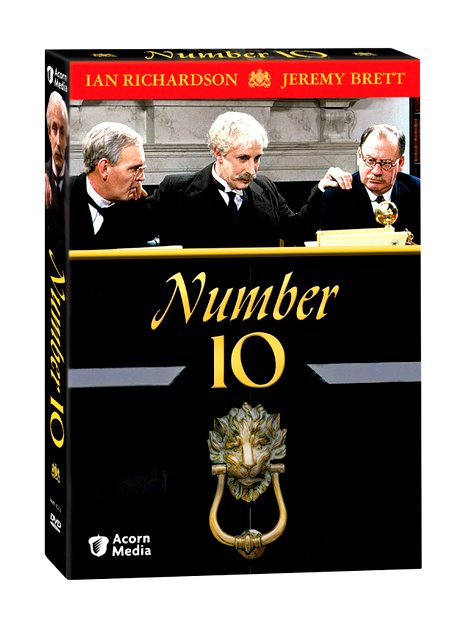
TV on DVD: Number 10 (1983)


Shop AcornOnline.com


Now Available on DVD


Delicious
Bookmark this on Delicious
submit to reddit
Print Page

Digg!

MovieBlips: vote it up!

When it comes to prime ministers captured on screen-- obviously for looks alone (along with extra points for sheer willingness to dance himself silly when he thinks no one's looking as though he were suddenly Kevin Bacon in Footloose or Tom Cruise in Risky Business)-- you're not going to do much better than Hugh Grant in Love Actually.


While of course, as hard as it is to envision a world where Hugh Grant-- stuttering and adorable as he is-- would actually be voted prime minister along with buying Billy Bob Thornton as the American president (well, okay given Obama's predecessor, the man who famously dug his "French fried potaters" would've most likely been several steps in the right direction than W.) or the fact that any woman would ever dream of cheating on Colin Firth-- overall Grant's version of the ideal prime minister is definitely the most viewer friendly rom-com one of the twenty-first century.


Yet it's far from the only one and moreover, I'd urge everyone who caught Stephen Frears' Oscar winning Helen Mirren film The Queen to track down its made for British HBO companion piece The Deal-- the far superior and more politically engrossing work with Michael Sheen and David Morrissey-- which brings viewers a closer look behind those great yelling sessions of Parliament into the rivalry and friendship of Tony Blair and Gordon Brown.


However, the most complete portraits of life inside not just Number 10 Downing Street but also the House of Parliament can always be found from our friends in U.K. television and the incomparable Acorn Media who brings the titles to audiences on this side of the pond. Last year, the work that first introduced me to both the magic of Acorn and mastery of British television was the '80s adaptation of Jeffrey Archer's compelling miniseries First Among Equals (starring a young Tom Wilkinson) in an absorbing political soap for intellectuals.


In Equals, we watched four very different men begin their careers as humble, earnest MPs (or "Members of Parliament") as they all tried to stay in office and make their way to that most coveted and powerful address in all of London of No. 10 Downing. Now, almost a year following the release of the fictional (yet Archer's loosely autobiographical) Equals, Acorn once again is given access to ITV classics in debuting the network's 1983 U.K. drama Number 10 for its inaugural release in any format (VHS or DVD) to American viewers.

The show is rooted in history and covers centuries of territory capsulized in an hour long format as glimpsed within the narrow scope of examining the private lives, intimate relationships, loyal circle of family and friends of seven different prime ministers who have occupied the residence with painstakingly accurate attention to detail.

In a period jumping format that nicely moves freely throughout its setting which transports viewers from the turn of the century in one episode to the 1920s in another to the Napoleonic era, veteran television writer and producer Terence Feely who also helped adapt the works of Henry James into the exceptional series Affairs of the Heart manages to find a great storytelling hook that ensnares you throughout a majority of the seven episodes.


In exploring the lives of some of England's most renowned or memorable prime ministers, the first episode "Old Glad Eyes" set in 1880s London uses the pious nature of William Gladstone (Denis Quilley) to trick you with its eerie, Jack the Ripper-esque set-up as he picks up prostitutes on his many "night walks."

As an American viewer watching today given the endless parade of shame of politicians admittedly to infidelities, we assume we know precisely where this episode is headed until Gladstone tells the hookers that he works on behalf of the "Reclamation of Fallen Women," spending every evening trying to lead the women to a better path back to the Lord and rehabilitation before he begins to belt "Rock of Ages" and pray with his "guests," wife and staff in the kitchen.

Declining police protection or more importantly a bodyguard given the unrest in Ireland and advent of bombs, it's not too long before we begin to question the real motive for Gladstone's zealous need to spend so much time among "fallen women" that suddenly makes the more than a century's old tale of "Old Glad Eyes" pretty timely.

Moving from sin to celebration, we're led into 1924 to find the first Labor Party Prime Minister Ramsay MacDonald, a widowed, Scottish schoolteacher taking up residence with the assistance of an all blue-collar appointed cabinet of factory workers and drivers and his eldest daughter who has left college to become the "jill of all trades," looking after press scheduling events, the rest of the children, as well as the financial demands immediately placed on the new PM.

Realizing that given their humble background and modest furnishings, they'd only have enough furniture to fill one portion of Number 10 Downing, MacDonald's daughter has to appeal to the Board of Works to provide some necessities but then realizes that they've been given the bottom of the barrel and will need to hire and pay their own staff, purchase dishes for the parties they're expected to host, as well as supply their own extravagant full evening dress wear for the prime minister.

Struggling to hold everything together at the age of twenty, she tries not to burden her father with the matters of the house as he finds himself embroiled in not just the snobbery of others given his background but also the fact that they're in the middle of a full out Communist scare given the Bolshevik Revolution in Russia and his rivals are breathlessly anticipating to exploit any misstep he makes to label the man a "commie" and take him down.

And indeed throughout the series, we're frequently presented with the challenges the prime ministers and their group of family, friends, and colleagues face to separate the public and private matters amidst manners of foreign policy (with the issue of Ireland a recurring theme as most prime ministers feel it should be independent as well as questions of prejudice against Catholics etc.) and of course matters of the heart when wives stun husbands by telling them they weren't quite as blind to infidelities as assumed.

Yet while there were only a few that failed to capture the attention with quite the same degree as the rest, the final episode "Bloodline" starring Jeremy Brett as William Pitt the Younger is a work of such unexpected heartbreak, beauty, tenderness, and poetry that I'm amazed that nobody has made a feature film out of it (and if they have, please go ahead and correct me).

Opening with a rather frightfully dark display of Dickensian like suffering as the sickly William is soon beaten by the son of his family physician on the orders of his father to try and make him stronger, we realize that as he matures during the era of the Boston Tea Party and impending American Revolution, William's health is still on the decline as he faithfully drinks port throughout the day, having done so for medicinal purposes since he was a youth.

Haunted by what you and I would refer to as temper flares but what he calls "interludes"-- it becomes evident that with the overwhelming brilliance and capacity for intellectual genius running throughout his bloodline-- he's also suffering from a touch of a genetic predisposition of insanity.

Having sworn to his father on his death bed that he wouldn't marry or reproduce out of fear of spreading their genetic predisposition for "interludes" any further, William Pitt the Younger's word is challenged when the middle aged man falls in love with the nineteen year old daughter of a friend whom he'd last seen five years earlier.

However, far from a mid-life crisis romance, we realize that she's wise beyond her years and mathematically gifted to the point that she's able to instantly reconfigure his accounts to realize that Pitt is so good-natured and preoccupied with governmental affairs that he's being cheated by his staff. And although the world ridicules the prime minister for his relationship with a girl so young (even though given our vantage point whom we ascertain that would be fully able to take care of both him and make him sublimely happy just by walking into a room), Pitt must try to come to terms with his feelings about his bloodline before he ruins his chance at love.

Overall, the series is gorgeously acted by the cast and given a great deal of careful consideration by the producers in ensuring that they present audiences with three dimensional "living biographies" of the men whose portraits we may walk by in a museum or whose name we may read abruptly. Likewise, the Acorn set which is slim-packaged and divided into 3 discs with closed captioning also comes with biographies of the prime ministers featured, some of whom you'll definitely want to learn more about.

Admittedly dated and of the original '80s British TV video quality-- its technical hiccups are instantly forgiven by the substantive episodes. It's also heightened by Feely's skilled approach to tackling it as he did with Affairs of the Heart by breaking down the massive source material on the subjects into roughly hour long, compelling screen portraiture of the PMs at a certain particular point and time.

For while the physical setting itself is always Number 10 (yet its appearance changes) and some of the domestic and political themes stay more or less the same over the centuries-- no two prime ministers are alike. And although the Hugh Grant dance party is a nice fantasy to have in our heads, exploring the reality is always beneficial and Acorn's Number 10 is a great place to start.

Text ©2009, Film Intuition, LLC; All Rights Reserved. http://www.filmintuition.com

Unauthorized Reproduction or Publication Elsewhere is Strictly Prohibited.

6/09/2009

DVD Review: The People's Republic of Capitalism (2008)


NEW:
Acorn Media & Athena Release
A Series of Titles That
Celebrate Lifelong Learning


Shop AcornOnline.com


Delicious
Bookmark this on Delicious
submit to reddit
Print Page

Digg!

MovieBlips: vote it up!

Although I think it's safe to say that the same is true around the world-- given our economic recession and the overwhelming number of jobs lost throughout the United States, everyone you meet here in America has an opinion on outsourcing and our economy.

Yet the double-edged sword aspect about our valuable first amendment which allows for freedom of speech is that it doesn't necessarily go hand-in-hand with knowledge as sometimes these statements regarding legal and illegal migrant workers, outsourcing jobs overseas to India, China and other countries can lead to some pretty divisive and angry language.

Yes, we'd like to keep more jobs in our country... but at the same time we must ask what we ourselves are doing about it via actively thinking about what our choices mean by perhaps refusing to shop at stores that outsource labor, use sweat shops etc.

For example, although it's commonly known that Wal-Mart's low prices are low because of the company's outrageous practices (which you can explore in greater detail in the brilliant documentary Wal-Mart: The High Cost of Low Prices)-- because consumers are in debt from layoffs, we'll continue to shop at such stores, buy products made cheaply in other countries from those whose jobs used to be our own that are now exploited in unsafe conditions for little pay...and so the cycle continues on.


While on the surface, one may not realize how alike China and the United States are in all actuality-- nonetheless economically both countries are as Ted Koppel reveals in the first part of this brilliant four-part documentary "joined at the hip," although our relationship of interdependence and back-and-forth trade-offs of supply and demand is incredibly complicated.

Of course, admittedly it's safe to say that all sides of the issue can't be addressed in this fascinating 176 minute critically acclaimed documentary which aired on the Discovery Channel a year ago in the Koppel on Discovery series, yet the forty-two time Emmy Award Winner Ted Koppel (who is also the recipient of eight prestigious Peabody honors and has been inducted into the Broadcasting Hall of Fame) is precisely the right man for the job to give us an investigative overview.

Now Koppel's The People's Republic of Capitalism has been made available as a two disc set from Athena and Acorn Media as part of Athena's ongoing commitment to promoting lifelong learning through high quality documentary releases. Arriving in a nice slim-packaged 2-disc set, the title also comes complete with a full color twenty page viewer's guide that goes over main factual highlights, further background information about China and the cultural revolution, avenues for further learning, and thoughtful questions to consider to help you digest what is being discussed. Also boasting an exlusive interview with Koppel as well as releasing the documentary on Blu-ray as well, the collection could not be timelier given our econonomic crisis and the way that our economy affects every other country's as well.

To this end, he wisely narrows his scope specifically to the Sichuan Province city of Chongqing (located southwest of Shanghai) that now has a population of thirty million residents.

Throughout the four part documentary which consists of "Joined at the Hip," "MAO-ism to ME-ism," "The Fast Lane," and "It's the Economy, Stupid," Koppel takes an in-depth approach using business model compare and contrast techniques (such as Ethan Allen & Wal-Mart), candid interviews, global impact studies, and research.

Additionally and quite admirably, he manages to incorporate other aspects of Chinese life that immediately we wouldn't have thought to take into consideration by exploring their emerging and deadly relationship with automobiles from a former bicycle culture on their path to becoming a major economic superpower.

Shockingly uncovering that China now has twice as many highway fatalities via four hundred accidents a day and the estimation that they will have more cars on the road than the United States by 2030, Koppel examines the impact this has on not only the lives of those on the road or those working in construction to help support this demand for roads but also how this will detrimentally affect the environment as in China "everything depends on coal" which is cheap but dangerous for miners and devastating to our planet.

Throughout the series, he views the impact capitalism is having on the country with its new advent of governmental corruption and "look the other way policy "to the "illegal" yet widespread practice of prostitution in karaoke bars and brothels (where business deals are decided a la the American strip club).

And moreover, Koppel consistently uses prior issues uncovered as a springboard, following through on them to see the way that one topic leads to several others, thereby constantly reminding us that although it's easy to say something is "good" or "bad," there's so much to consider from an international perspective.

However, despite our vast differences given China's strict one-child policy and the citizens' trust in their government that they're willing to abandon our American style political freedom for what they feel will lead to a far better economic and prosperous future for the country-- an underlying theme throughout is that we both share the same contradictions of corruption, bribery, and exploitation of workers. Of course, this goes even further working in the widening class divide as the rich continue to grow wealthier and aspire to live a life of luxury products and surroundings whereas the poorer "peasant" class find themselves struggling to afford education or find suitable or safe work. Does this sound familiar?

Overall it's amazingly engrossing and quite hard to sum up the all-encompassing documentary that makes it an ideal source of advanced independent lifelong learning or continuing education especially considering the fact that everything transferred to disc resonates so strongly today. And although it will leave you with a far greater understanding of how dependent our economies are on each other and it's especially great to watch and discuss with others-- in the end it made me glad that I'm not in charge of a major corporation or served as a governmental decision maker in the area of trade relations.

However, at the same time-- it does call you to action and make you evaluate your own attitudes and decisions. Of course, while I already avoid Wal-Mart, you (like me) may find yourself thinking twice about not just your attitudes on outsourcing since that's just one small part of the whole chain but also via purchasing specific items from certain stores when you ascertain how every single one of us is impacted around the globe no matter where the item's label states it was manufactured in the first place.

5/03/2009

DVD Review: Incendiary (2008)


Michelle Williams & Ewan McGreggor
Reunite in Sharon Maguire's Explosive
Incendiary on 5/5/09


Also Available On Demand From Amazon


Delicious
Bookmark this on Delicious
submit to reddit
Print Page

Digg!

As we hear in endless prescription commercials-- most medications come with a stern warning to patients not to operate heavy machinery while under the influence of whatever the pill contains. And much like the supremely devastating work of Danish Dogme director Lars von Trier (Breaking the Waves, Dancer in the Dark, Dogville, and Manderlay)-- Bridget Jones's Diary helmer Sharon Maguire traded in the tacky reindeer sweater of Colin Firth for her unflinchingly bleak follow-up film Incendiary which, similar to von Trier's films should be doled out to viewers along with a temporary supply of anti-depressants at least until the post-traumatic stress wears off.


Although the phenomenal turn by Brokeback Mountain Oscar nominee Michelle Williams anchors this controversial tragedy that-- like David Gordon Green's recent Snow Angels-- proves that women's weepie cinema didn't die in the 1950s as initially assumed-- even an impassioned portrayal can't aid the film during its severe gaps in logic, human decency, taste, and thinly disguised manipulation as a female punishment picture.


Although helmed by a woman, Incendiary invites us to judge right from the start as we meet Williams as a strong-willed Cockney accented cliched East Ender who takes her beloved four year old son to the beach for a day while running around in jeans that read "Sexy Mama." Soon her voice-over begins labeling her sad-sack soccer obsessed (or "football" rather), Top Gear, and TV dinner husband "right miserable," while she bemoans her hum-drum life as a third generation resident in what appears to be government housing.


Moreover, and in an incredibly unflattering light, we see Williams portraying someone whom Maguire and the original novel's author want us to assume is so typical that she hasn't even been given the decency of being bestowed with an actual name and the only one that seems to stick out from the start is the lewd one she applies to herself as a "slapper."


To this end, it isn't long before the "young mother" who is prone to wearing miniskirts and staring off into space in boredom decides to act. Thus, tired of coping with her psychologically drained police officer husband who returns from work on the bomb squad with the same unfunny line, "Well, I'm still here, aren't I?" whenever Williams inquires about his day, she begins looking for an outside thrill.

Dressing even trashier than usual and planting her baby monitor directly in the hands of a next door neighbor, she hits the local pub and makes a good show of blowing off the slightly sleazy journalist (Ewan McGregor) who comes onto her instantly before soon enough he's at her table, the floodgates open, and she begins telling him every detail about her unhappy life.

Williams manages to evoke sympathy for her stereotypical character in that we sense just how lonely she is without someone with whom to speak and-- despite the fact that she embarks on an affair, because of her undeniable humanity and authenticity, we're with her every step. However, it's a tentative trust we have in her that is dismissed just as soon as it is introduced by Maguire, working from the divisive and infamous novel by Chris Cleave-- when it moves Williams' and McGregor's early coupling into excruciatingly tawdry terrain.


For, in the middle of a very graphic extramarital shag right on the sofa she watches television on with her husband, the two are caught in the act by the most brutal form of comeuppance ever as a bomb rips through the soccer stadium where her husband and child are at that very minute.

Running towards the scene of horrific terrorism which left over a thousand residents killed-- still in shock-- we suspend our disbelief long enough with our jaws still on the floor as McGregor and Williams journey to the site knowing in our gut even before she does that the men in her immediate family are dead because as the film implies, "the slapper" deserved it.

While Cleave's novel had the intense misfortune of being released on the very day that London's public transit system was attacked back on July 7, 2005, Maguire's film-- already building in that bad sense of karma-- was struck by more horrific timing when its premiere at Sundance coincided with the death of Williams' ex and father of her child, Heath Ledger in 2008.


Now over one year later, Incendiary makes its way to DVD and Blu-ray via ThinkFilm and Image Entertainment. And while certainly it's bolstered by the performances of its two lead stars who also worked well together in the equally misguided yet infinitely more watchable, predictable clunker Deception with Hugh Jackman, Incendiary is a film that it's nonetheless hard to view objectively. This is especially true given not just the subject matter and sense that the wounds are still not healed in regards to horrific attacks but also on another level when you realize what Williams has gone through as well.


Still, trying to push all this aside and simply focus on the narrative with gaping plot holes and juggling a few too many red herrings and false starts in this jam-packed work that has several storylines all fighting to be the main one-- we're left with an absolutely compelling and heart-rending performance by Williams in a film that moves from a five stages of grief melodrama to paranoid thriller as Williams and McGregor ascertain that a cover-up may have been involved. As if this isn't enough, it also tries at least for little while as well to become a portrait of loss on both sides of the situation when she becomes friends with the unaware and surviving family members of a man who was more than likely one of the suicide bombers.

Flirting with the possibility of moving into Pelican Brief territory as her husband's former boss (creepily played by Matthew Macfadyen) makes a play for Williams and lets a few details about that fateful day at the stadium slip in an unforgiving and disturbing love triangle-- the film's decision to make McGregor a journalist at first showed potential that a mystery would be resolved but ultimately it's all inconsequential.


And unfortunately Maguire's adaptation and direction for the work soon makes a large case that it's an allegorical female punishment movie a la The Life Before Her Eyes as Williams' tartish character must make amends and physically save or resurrect life to "replace" the ones she took away with her unbridled lust.


While it does have its moments of sheer power and gives Williams a real "one woman show" style to display her amazing capability to convey emotion despite our wish that she was offered something far better than this work-- in the end it buries itself an even deeper grave. Embodied in an arc that at first seemed chilling and intriguing-- we find Williams narrating letters she's written to Osama Bin Laden as part of the healing process to deal with her loss that move from poignant to ridiculous by the film's conclusion with lines that have been quoted verbatim in countless reviews in utter disbelief.

A well-intentioned film that nonetheless "blows apart"-- to borrow from its tagline-- by the "truth" that it's all flash and spark that ignites us more from shock than by anything from the picture as a whole; in fact, you'll discover that much like Life Before Her Eyes and Blindness, you'll grow even warier of it the day after the one hundred minute work concludes and you can start wrapping your head around what you've seen.

Of course, I must admit that it's always nice to see the natural chemistry between Williams and McGregor and this pleasant admiration would be even stronger if the two were actually allowed to act opposite one another in a film that's worth their considerable talents. Moreover, let's hope that next time for the sake of the women of London's East End who may not appreciate the idea that they're all nameless and interchangeable or journalists who will do anything for a story-- we find them moving away from anything resembling a conspiracy and perhaps towards something that--horror of horrors, may actually involve a smile or come without a warning of serious post-traumatic depression.

1/26/2009

Blu-ray Review: Election (1999)


Tracy Flick Won't Let a
Presidential Inauguration Get In Her Way
Pick Flick on Blu-ray
1/20/09


Already Available


Director Alexander Payne


Note:
Sideways Hits Blu-ray on 2/3


Author Tom Perrotta


Digg!


Following the earlier comparison to Lucy in the Peanuts Cartoon Strip which called up images of the know-it-all bossy girl who ran an advice stand and dominated her male friends, after Alexander Payne's 1999 release of his cult favorite independent comedy Election, it seems as though every woman running for political office is compared to the film's fictional overachiever Tracy Enid Flick. For proof, enter in a female candidate's name and Tracy Flick on YouTube or turn on any major cable news channel and let the sexism rip.


Embodied by Reese Witherspoon in the film that launched her from supporting roles into the commanding Oscar winning presence she would become, Election garnered Ms. Witherspoon a Golden Globe nomination for her pitch perfect performance.


If Charlie Brown's Lucy isn't your thing, to put it bluntly, Tracy Flick is the brand of Type A, unrelenting ball-buster that makes men-- much like her film nemesis, the popular teacher turned selfish saboteur Jim McAllister (Matthew Broderick playing the type of man that Ferris Bueller would've hated)-- both infinitely nervous and cross their legs. Thus, like McAllister, they'll do anything to crush her by any means necessary.

Payne's Election-- an unceasingly dark and satirical take filled with unsympathetic characters-- was inspired by the '98 novel by Little Children author Tom Perrotta who based his book on What Makes Sammy Run?, the '92 Bush/Clinton/Perot election and an incident where a Wisconsin high school faculty member burned winning ballots to prevent a pregnant student from becoming prom queen.


And although it's revealed that in the book, Tracy is far more attractive (with some phrasing quoted by Wikipedia that recalls Nabokov's Lolita) and there are major differences in plot concerning what happens to the ensemble characters, Payne and co-writer Jim Taylor pushed their version to the edge.


While it was released within a few years of the terrifically sunny take on high school-- Amy Heckerling's Jane Austen Emma inspired Clueless and Wes Anderson's humorous, melancholy, yet heartwarming Rushmore-- Election is a film for which it's truly hard to vote.


Despite the first-rate performances and writing--we're torn as we watch McAllister's unraveling personally and professionally as he persuades a dumb but sweet jock (Chris Klein in his first role) to run against the dedicated but friendless Tracy whose affair with his colleague destroyed him forever. Yet, by never truly giving us someone with which to empathize, we're a bit baffled by the overall mean-spiritedness of the purposely ugly feature that seems to specialize in finding the worst angles and most repulsive aspects of humanity to magnify.


It's a similar problem I had with the joyless and equally misanthropic About Schmidt and although I greatly admired Payne's sharp Citizen Ruth and still feel that Sideways was one of the best mature comedies of the last few years, I realize that no matter how many times I try and revisit Election as years go by (and this could very well be my eighth viewing), I evaluate more films, and gather more life experience, I still can't completely recommend it.


Finding humor in misery and appalling actions obviously exaggerated to effect-- while Payne's penchant for pain works exceedingly well in places such as showing the actual ugliness of teachers who have affairs with students as Tracy's instructor (in flashback) seduces her to Lionel Ritchie in his house with baby toys in the family room after a heart to heart at a pizza joint, most of the time we're not sure just what the director's attitude is about the story he's aspiring to tell.


Broderick completely breaks free from the stereotype of his youth as an '80s icon (as he did in Helen Hunt's superb Then She Found Me and the recent Magnolia film Finding Amanda which benefited mostly from his unscrupulous turn ) and I can't think of any other actress better suited for the manipulative, cutey-pie, fast-talking Flick than Witherspoon who seems to be taking a cue from Faye Dunaway in Network mixed with an Avon lady (which seems fitting because Witherspoon is now the face of Avon).


But, it must be said that for women, the film was essentially one step forward and two steps back. As recent as last week in the event of Caroline Kennedy's withdrawal for consideration for New York office (whether one agrees or disagrees with her campaign to take office in the first place is unimportant), political pundits on news channels began tossing around comparisons to Tracy Flick, just as they had for the women preceding her including Sarah Palin and Hillary Rodham Clinton (who was endlessly dubbed Flick).


Would Payne's Election have been as successful or memorable as if Broderick was trying to take down an overachieving male or is there something subconsciously rooted deep within us that finds the idea of super ambitious Type A women especially dangerous and worth ridiculing? Additionally, you have to wonder why women must try so very hard to compete and why even at times we turn on each other to do so, labeling one another Tracy Flick. I have my theory and the answer is that the fault lies not in Election's frequent use of the biblical metaphor involving the Apple or Eve but that the fault is directly Adam's (ahem, or McAllister's and by extension Payne's) in this particular case.

It's these questions that are well worth considering whether you love the film and/or hate it, just as one needs to question the choice of making the rest of the female characters mostly unlikable as well as Klein's trouble-making lesbian sister played by Jessica Campbell stereotypically tries to get even for a broken heart, Broderick's wife basically uses him as a stud endlessly hoping to get pregnant, and he goes after his colleague's ex and now sex-starved wife.


Still it must be said that one cannot argue that Broderick is the most reprehensible character of the lot. Yet foolishly there were some critiques that raised questions as to which character was worse-- Flick or McAllister that are just plain ridiculous as one was a child and one an adult authority figure. And willing to take the brunt of the blame as the film's idiot, Broderick is photographed in incredibly unflattering ways in the movie as he urinates on an apple tree as aforementioned, apples are used throughout as another Adam/Eve sexist metaphor as is the battle between Tracy who represents Coca Cola and McAllister who represents Pepsi. Despite this, Election is decidedly slanted in its portrayal of women who dare to dream.

And even if they annoy the hell out of us in the process with endless buttons and cupcakes like Flick, again and maybe it's unfortunate that this Blu-ray is released following a national election (and on the President's Inauguration no less) where sexism definitely played a role in media coverage-- ultimately, we must ask just how much of Tracy being a female is why the film is deemed so incredibly "funny" and why she's considered so "shrill."

Transferred to high definition-- while clarity is improved-- the color quality was always meant to be muted and purposely drab and ugly so the Blu-ray isn't overly impressive or necessary when compared to its DVD counterpart, especially considering that the sole extra feature is filmmaker commentary that runs throughout, making it unworthy of an upgrade unless you're a fan purchasing the film for the first time.

10/20/2008

Kiss of the Spider Woman (1985)


Digg!

If there is one thing we've discovered over our far too frequently violent and tragic global history it's that human beings are resilient creatures. Equally capable of conducting acts of the most astounding cruelty or ones that are the most selflessly compassionate-- the human race has managed to withstand some truly unspeakable events carried out by their fellow man. "What doesn't kill us only makes us stronger," has become not just a cliche but an oft-cited justification that helps us cope, similar to the athlete's chant of "no pain, no gain," or the argument that tragedy builds character.

While some cling to faith and others to memories, no matter what form comprises the coping mechanism of any individual, the bottom line is that although history has found us tortured and enslaved, our saving grace has been in the limitless potential of the human mind. Simply put, you can't handcuff one's thoughts, chain someone's dreams, lock up their hopes, or torture their memory.

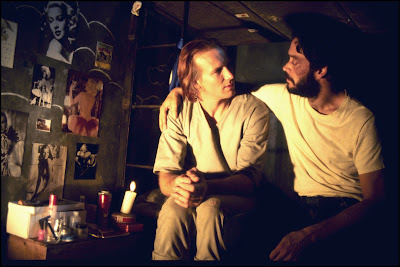
In the Oscar winning film Life is Beautiful, Roberto Benigni uses his penchant for creativity to try and hide the horrors of the Holocaust from his son as they spend their days in a labor camp and likewise, in director Hector Babenco's landmark 1985 independent classic, Kiss of the Spider Woman, William Hurt's character, Molina escapes from his imprisonment in an unspecified Latin American country by recalling the plots of old movies. In the beginning of the film, based on Manuel Puig's novel and adapted by screenwriter Leonard Schrader (the brother of fellow writer/director Paul Schrader), we're introduced to the effeminate Molina as he begins chronicling the story of "the most ravishing woman in the world" who kept men at a distance no matter how lonely she'd get.

Shortly after Hurt begins the opening monologue of his Oscar winning role, we realize that instead of seeing the man on a stage--which feels like it would be far more natural-- Molina is sharing a cell with fellow prisoner, Valentin (Raul Julia). Although Molina has been locked up for corrupting a minor in a homosexual affair, Valentin is a political prisoner who fears for his girlfriend living life on the outside as a part of the underground movement hoping to overthrow the corrupt government that's tortured, vanished, and murdered so many of his fellow citizens.

While at first, the macho Valentin and the gay former department store window dresser Molina struggle to get along with Valentin rudely growing annoyed with Molina's unceasing storytelling of old film plots. However, soon he begins to depend on them to pass the time. Although he advises his cell-mate not to include erotic descriptions of naked women or conversations about food, given his inability to access either, soon Julia's Valentin becomes engrossed in the tale, imagining the story by picturing his own true love, played by Sonia Braga in Molina's narrativse.

The first independent film to receive the top four Oscar nominations including Best Picture and Best Director, Kiss of the Spider Woman finally makes its DVD and Blu-ray debut in a gorgeous 2-disc transfer from City Lights Home Entertainment on 10/21/08.

A passionate celebration of humanity, tolerance, and the fight for survival, it pulls the viewer in a number of directions one wouldn't see coming. While it begins as a near chamber piece centering solely on the two men whom we quickly realize will eventually learn to appreciate one another, it moves into surprising terrain roughly midway through upon discovering a new plot twist that changes everything that has come before it.

As the men begin to have such a profound effect on one another, we realize that they may be exchanging characteristics as well as Valentin's bravery and devotion to something bigger begin to influence Molina and likewise, Molina's sensitivity, compassion and tendency to want to escape mentally begin to find their way into Valentin's psyche.


Although it's become one of the most highly regarded works of its time and seems impossible to consider anything to the contrary, further research revealed that originally the two men had been cast in each other's roles but during the rehearsals for the film, they experimented with playing the opposite part, discovering that they truly belonged in the roles they hadn't been given. Reportedly working for just the price of their air tickets and Brazilian hotel bills during the Sao Paulo shoot, the two men and Sonia Braga (who had to recite her lines phonetically as she was unfamiliar with the English language) crafted a true independent classic that, despite being dubbed "as a gay Casablanca" by The San Francisco Chronicle helped spawn a successful Broadway show and continues to reach fans across the world in book, cinematic, play and musical form.

Additionally including the "never-before-seen" feature length documentary Tangled Web: Making Kiss of the Spider Woman on the second disc of the DVD set, it also offers a mini-documentary with original author Manuel Puig, a featurette on the Broadway adaptation, over 150 images in a DVD photo gallery and a "Slide Show Commentary: Transition from Novel to Film," the loaded set is a must for fans looking to explore the film again from a variety of different insider's perspectives in a stunningly beautiful digital transfer.

And as Chronicle writer Bob Graham noted, "people who see the film will realize, along with Valentin, that they like being told stories," however, when it comes to Hurt and Julia's masterful web, they'll realize that this is a story that is impossible to predict and must be witnessed firsthand to appreciate, as this reviewer did, taking in the movie for the first time.