Showing posts with label Kelsey Grammer. Show all posts

8/03/2018

Netflix Movie Review: Like Father (2018)


Now Playing on Netflix

Bookmark and Share

The first of two excellent new female directed features to premiere on Netflix this month, Lauren Miller Rogen's Like Father begins with the tried-and-true romantic comedy premise of a bride being left at the altar before things move in a delightfully unexpected direction.

Opting to leave strategic voice mail reminders instead of walking down the aisle on time, when her husband-to-be realizes that his fiancée has chosen her phone over him once again, Kristen Bell's workaholic bride Rachel finds herself without a groom.

However when one man leaves, another arrives. Surprised to be face-to-face with Harry (Kelsey Grammer), the estranged father she hasn't seen in decades, the two spend a spontaneous night of drunken commiserating after which, she's even more shocked to discover that they've wound up on her honeymoon.


Trapped on a cruise ship together, while on one level the film works very well as an upbeat, feature length ad for Royal Caribbean – in stark contrast to the way that Adam Sandler has freely admitted he chooses exotic settings for his films as a way to vacation with family and friends – Like Father's setting serves a crucial role.

Had the two reconnected and found themselves in say, Hawaii, they would've gotten on the next available flight back to reality as soon as they sobered up. But trapped in close quarters on a vessel where they don't know anyone else and are constantly congratulated by strangers who believe they're newlyweds, Rachel and Harry are forced to interact. Like two people stuck on a desert island, on a cruise ship in the middle of the ocean, Rachel can run but she can't hide.


Addressing some of the practicalities of their instant vacation right away (like the fact that they'd left without luggage), as a storyteller, Miller Rogen is smart enough to know that they're not going to be able to dive right into the rift of their relationship without a serious push.

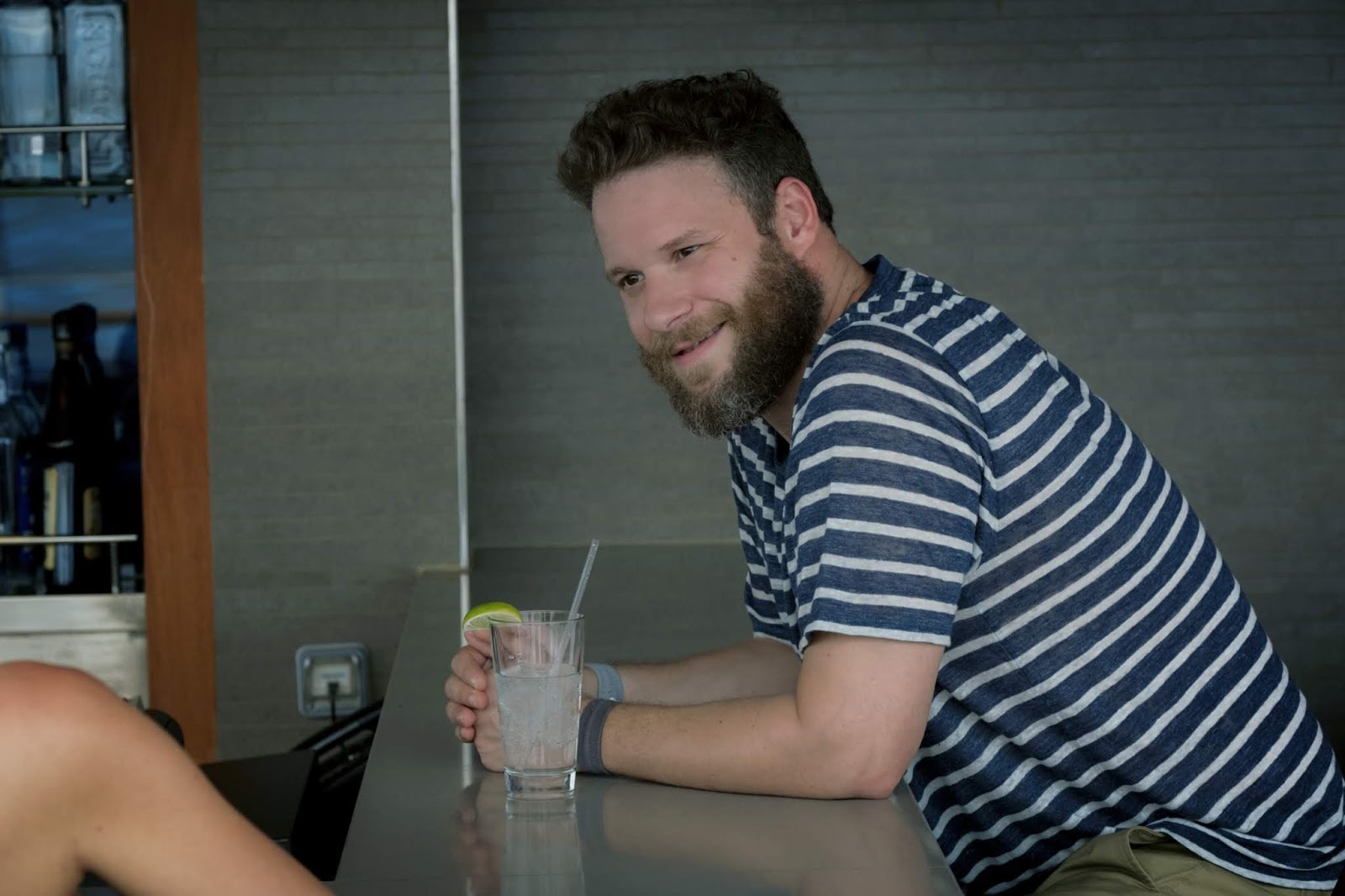
And in Like Father, this comes in the form of an entertaining and wisely diverse ensemble of fellow travelers, including scene stealer Paul M. Downs as a new family therapist and one half of a gay couple as well as the filmmaker's husband Seth Rogen as a Canadian schoolteacher in a small but hilariously understated role.


Calling Rachel out for her incessant cellphone use and pushing her and Harry into a number of the ship's activities – from appearing as contestants on a newlywed game show in one of the film's comedic highlights to hiking around Jamaican waterfalls – it's only a matter of time before emotions, grudges, and secrets erupt.

Written over the course of six years (and seventeen drafts!), following her the release of her first co-scripted effort For a Good Time Call..., after life dealt Miller Rogen a cruel hand following her mother's Alzheimer's diagnosis, she was inspired to turn that darkness into light, resulting in an ultimately sweet yet surprisingly moving, multilayered feature filmmaking debut.


While the decision to incorporate some of the real world issues facing people today gives Father an unexpected sense of gravitas, Miller Rogen takes a cue from mid '80s John Hughes and (along with her charming stars) keeps things moving at a fast pace, knowing that it works against her upbeat, sunshine bright summer picture to dwell on things too long.

Likewise working against some of the genre's stereotypes by taking Like Father out of the realm of romantic comedy and into the mainstream, despite some unavoidable predictability in plot, Miller Rogen does her best to take an unexpected approach. And one of the most impressive examples is in the way the writer/director makes sure that, although she needs to find a balance, Rachel isn't treated like a villain for (much like her father) loving her job.


Immediately believable as father and daughter, in what – despite the fun ensemble vibe – is a terrific two-hander, the always likable Bell and Grammer serve and volley one-liners with ease, nicely adapting to changes in tone.

Delivering some of the staples of other Netflix movies including multi-generational appeal and a killer soundtrack, Like Father adds in cruise friendly karaoke tunes, knowing that when your film stars a Disney princess, you've absolutely got to get her to sing.


While, yes, Royal Caribbean couldn't have paid for better advertising, in Like Father, Miller Rogen combines real world problems with traditional screwball and romcom building blocks to create a solidly entertaining summer comedy you're sure to stream more than once. And who knows, you might just call your relatives to come over and watch.


Text ©2018, Film Intuition, LLC; All Rights Reserved. http://www.filmintuition.com Unauthorized Reproduction or Publication Elsewhere is Strictly Prohibited and in violation of the Digital Millennium Copyright Act.  FTC Disclosure: Per standard professional practice, I may have received a review copy or screener link of this title in order to voluntarily decide to evaluate it for my readers, which had no impact whatsoever on whether or not it received a favorable or unfavorable critique. Cookies Notice: This site incorporates tools (including advertiser partners and widgets) that use cookies and may collect some personal information in order to display ads tailored to you etc. Please be advised that neither Film Intuition nor its site owner has any access to this data beyond general site statistics (geographical region etc.) as your privacy is our main concern.

2/13/2009

TV on DVD: Cheers -- The Final Season (4-DVD Set)


Cheers Returns on DVD for its Last Call

Own it Now


Delicious
Bookmark this on Delicious
submit to reddit
Print Page

Digg!

One of the most iconic American sitcoms of all time — inspired by the same “workplace as a secondary family”-style series such as The Mary Tyler Moore Show and Taxi — television’s genius creators James Burrows, Les Charles, and Glen Charles struck comedy gold with Cheers. Although, as the press release notes, it was ranked dead last during its initial season as its parent network NBC felt that the bottle was decidedly half empty in nearly canceling it, the show grew a loyal and steady following as it continued on.


Ultimately the show became part of the quintessential “Must See Thursday” lineup titles that the Peacock network boasted throughout the '80s and ‘90s, with Cheers sandwiched alongside Family Ties and The Cosby Show. Once actor Woody Harrelson became a regular cast-mate as the sweet but dim bartender Woody Boyd, “ratings increased dramatically” as the show picked up momentum throughout the course of eleven seasons.


Perpetually ranked in the Nielsen’s Top Ten for eight consecutive seasons once its final season started in 1992, the show — which had raked in the Emmys and Golden Globes — utilized a cinematic approach to each individual episode involving roughly 100 crew members all working with film in lieu of videotape and an emphasis on motion over static master shots by seasoned director James Burrows. Groundbreaking from the start with plotlines involving addiction, adultery, homosexuality, feminism, and with an underlying emphasis on the blue verses white collar subconscious battle lurking right below the surface during the Reagan and Bush administrations, there’s much more to the folks at Cheers than one may remember, which is immediately evident in its ultimate season.


Deeply respecting its audiences — who much like the characters had essentially become participants in a codependent relationship filled with ups and downs with the characters on the series — Cheers ended on a classy and nostalgic note without wrapping things up too neatly (a la Friends) nor taking a mean-spirited approach at a final goodbye as evidenced in the backhanded finale of Seinfeld or Will and Grace (incidentally all other successful series on NBC).


Recently released from CBS DVD and Paramount Home Entertainment, the season comes in a slim-packaged, space-saving, four-disc set that’s conveniently the width of a standard DVD. Released in its original 4:3 aspect ratio, the show, which Wikipedia notes was restored once it went into highly successful syndication, still looks and sounds great throughout its twenty-eight episode finale, including the memorable 90-minute conclusion that found the original series heroine, Shelley Long’s Diane Chambers, returning for a terrific twist.


While usually final seasons are filled with the climax of the incessant and oft utilized “will they or won’t they” romantic complications or the ultimate surprises of births, marriages, or deaths, Cheers defied expectations right off the bat following up its prior season which found Woody Boyd marrying his wealthy love Kelly Gaines with one of Kirstie Alley’s great monologues regarding a new life plan for her character Rebecca. Vowing that she’s going to become an entirely new woman and one who no longer whines or complains or screws up pretty much everything that comes her way — once she takes a long drag on what she calls her final cigarette — unfortunately Rebecca can’t change her accident prone nature when what’s left of her cigarette burns down most of Sam Malone’s bar.

Unable to face Sam (Ted Danson), she confides in Dr. Frasier Crane (Kelsey Grammer) until finally the guilt gets the better of her as Sam faces near financial ruin. Starting with a surprising obstacle Cheers went against the grain during each episode that followed. However, it’s a sitcom first and foremost and there are still some memorable classic bits of hilarity throughout, most notably when Norm (George Wendt) is hired as a beer sampler at a local brewery (in an episode directed by John Ratzenberger), Sam battles a Frenchman over who can score the most phone numbers in an America verses France competition as Carla (Rhea Perlman) brings out his trusty “babe kit,” and we learn that Carla’s secretly dating the seafood restaurant-owning upstairs snob when he has a heart attack following her confession that she loves him.


One of the strongest arcs during its final season and the best set-up for the superior spin-off that followed — Frasier — finds Cheers’ resident psychiatrist Dr. Frasier Crane experiencing more heartache and anxiety than his patients when he learns that Lillith (Bebe Neuwirth) has fallen in love with another man and has decided to leave both Frasier and their son Frederick to journey with her new beau to live in an eco-pod. Threatening to jump from Cheers and finding himself so mixed up he nearly winds up sleeping with Rebecca (again playing against our preconceived ideas of what will happen to the bar’s resident cast), Frasier becomes the ideal anchor of the final season.


Moreover by growing and changing into something new, he seems to provide the ultimate therapy for the audience that will have to bid farewell to the place “where everybody knows your name” as the show realized it was time to close its doors. Thus, Frasier’s shocking plot made the perfect segue for a series that was ready to move onto to something more socially relevant since the Clinton era made the ideal setting for Frasier’s Seattle based, upper-crust sitcom that again managed to work in some of the classic blue-collar elements of its previous series with actors Peri Gilpin and John Mahoney (both of whom appear in tiny unrelated roles during this final season).


And I definitely do grant that the final episode does find a few things wrapped up nicely for certain characters as Rebecca marries someone you’d never expect and Woody is elected as a city official. Yet despite that there’s a wonderful twist involving Ted Danson’s character that will no doubt cause one to get a little teary-eyed when he realizes that, in a sense, the ultimate love of his life was none other than Cheers. For in the end it was more than just a bar but rather a show that transcended the art of the sitcom and gave everybody a nice, safe place to escape… at least for thirty minutes every Thursday night.

1/07/2009

DVD & Blu-ray Review: Swing Vote (2008)


Campaigning for Your Vote
On DVD & Blu-ray

1/13/09


In 2007, the world was introduced to the young Irish actress Saoirse Ronan with her Oscar nominated turn in director Joe Wright's acclaimed Golden Globe winning heartbreaker Atonement, based on the novel by Ian McEwan.

While admittedly, director Joshua Michael Stern's political satire Swing Vote doesn't aim for the same high brow art house crowd, those who sought out the 2008 film in its August release, became acquainted with a young, extraordinarily talented eleven-year-old American actress named Madeline Carroll.

Turning in a performance that was both bittersweet and mature, the young girl whom actor Kevin Costner called the film's "little home run" in the DVD & Blu-ray Making-of Featurette managed to keep us interested, even when the sometimes bloated film began to veer off course.

Holding her own opposite not only Costner but Stanley Tucci and other acclaimed professionals more than three times her age, it was young Carroll who managed to stop the film from becoming a spoiled ballot, despite a number of fine supporting performances and an ingenious concept.

Now arriving on DVD and Blu-ray in the same month that our country finds ourselves being given a new opportunity with a change of leadership, it's the right time to check out a political comedy now that we can all collectively breathe a sigh of relief that campaign media coverage has ended.

And although I can't altogether recommend the film which moves unevenly in tone-- I have to recommend that you seek it out regardless as young Carroll definitely earned the vote of this reviewer in a performance that I listed as one of the standouts of the year in Film Intuition's 2008 Year in Review.

However, before I delve into the aspects both the DVD and Blu-ray disc themselves, I'll break this post up into three parts beginning with my original theatrical review of the film.


I. The Movie

Director: Joshua Michael Stern

To precocious twelve-year-old Molly Johnson (an impeccable Madeline Carroll), voting is not only an optimistic privilege but it’s also an American citizen’s “civic duty.” However, to Molly’s under-achieving father whom — for the zero parenting he offers — she fittingly calls Bud (Kevin Costner), voting in America simply risks the chance that you’ll wind up on the fast track for jury duty. Unfortunately for Bud, along with making the family budget and packing his daily lunch, Molly registered her father to cast his vote, aligning him as a political “independent” since she proclaims that “the two-party system neglects the working poor.”

While Lou Dobbs would no doubt beam with pride, Bud struggles to make sense of his daughter. This is especially the case when — in equal fascination of the electoral process as well as her tie-in school project — Molly reveals that she took the trouble to fill in her parental political questionnaire for Bud because she wanted to make him “sound smart.” Despite his protests and canned statements that voting is useless, Molly demands that her father meet her at the polling place after school with a peck on the cheek and a warning to Bud, namely, “screw this up and I’m leaving you.”

And while Molly has a fruitful day delivering a beautifully worded political essay and ends up on the news after local Texico, New Mexico reporter Kate Madison (Paula Patton) decides to feature it in the evening broadcast, Bud’s prospects that day are far less successful. With incriminating footage that depicts Bud ruining more of the eggs than he’s able to neatly package in the plant where he works — not to mention the fact Bud hasn’t punched in on time in six months and proceeded to take thirty-one sick days — before he’s officially laid off, his boss and former high school friend asks him to give him one good reason not to let him go. Foreshadowing his inability to make a decision which will propel the rest of Swing Vote's plot, needless to say Bud can’t offer him any explanations.

Later, predictably forgetting his promise to Molly until it’s nearly too late, Election Day ends on a far stranger note after a bizarre computer error concerning Bud’s vote makes the results of the day — already in a deadlock for the presidency — all boil down to whom Bud will vote for ten days later when, by oath, he swears he must recast his vote. Literally holding the fate of the government in his hands as his vote will decide which candidate earns swing state New Mexico’s five electoral votes and ensures him the presidency, Bud is overwhelmed by the media reaction as every major outlet from MTV to CNN to the BBC sets up a stakeout right outside his trailer. And just as quickly, political organizations start flooding into the tiny town that — before the gaffe — had been so inconsequential it wasn’t even on the state map.

However, the story really heats up when both candidates journey out to try and win over Bud by any means necessary. Pulling out all the stops and White House goodie bags he can carry, the first of the two competing front-runners, the favored Republican incumbent President Andrew Boone (a pitch-perfect Kelsey Grammar) arrives in Texico complete with the aptly named Martin Fox, his amoral strategist, in tow (Stanley Tucci). Also vying for Bud’s ear — or rather his vote — the earthy Democratic challenger Donald Greenleaf (Dennis Hopper), who along with his campaign manager Art Crumb (Nathan Lane) promises a racially blind, all inclusive “rainbow” White House, pack up their “Truth Train” and “Operation Real Deal” to make the long trek to the desert. Although the Dems learn that — while they can’t even begin to compete with Air Force One — their secret weapon is none other than Willie Nelson, who was the subject of a tribute band that Bud had played in before his rhythm section ended up in the slammer.

In an effort to better understand Bud, the candidates and their smarmy managers resort to shameless pandering, insincere flattery, and manipulation, including letting the dimwitted, perpetual beer drinker win at poker or using cue cards to make small talk with Bud about fishing. Most memorably, this results in a wonderfully hilarious speech by Grammar likening his role as commander-in-chief to that of a quarterback, breaking foreign policy down with the aid of football terminology. Grammar nails every scene he’s in and nobody plays a buffoon or the prototypical blue collar American male quite like Kevin Costner, although he’s essentially recycling the far more likable characterizations he crafted in Bull Durham and Tin Cup.

However, by making our lead character such an idiotic Homer Simpson-like oaf, we’re laughing at Bud rather than with him throughout the film’s entirety. And far more often than I felt empathy for him, I was surprised to find myself actually loathing him numerous times throughout because of his complete inability to see beyond himself and understand not just the gravity of the situation but recognize how it’s all affecting his daughter. Speaking of which, as Molly, the young Madeline Carroll completely steals the film and our hearts in the process, especially in a scene wherein she shows far more worldliness and morality than her father ever could, while breaking down in tears in front of her classroom, telling white lies in order to make her father sound like he actually cares about the country he’s living in and his fellow Americans.

For a comedy, Swing Vote is a bit more melancholic than perhaps director Joshua Michael Stern, along with his co-writer Jason Richman, had planned since there’s nothing funny about child neglect; but they try to keep the satire swinging along with the mystery of Bud’s vote and make great use out of their supporting players in the process. As the candidates begin to address Bud directly in a series of new political ads, suddenly Costner’s Bud becomes his very own Truman Show, being followed and analyzed around the clock in every journalistic medium. Although quality wise, Swing Vote is less like Truman Show and more like EdTV.

However, hilarity ensues as the candidates embrace political flip-flopping as the Republicans suddenly promote gay marriage and environmental protection with the Democrats tackling illegal immigration and embracing the pro-life movement simply because the inarticulate Bud misspoke a few times while being interviewed by the beautiful local, ambitious newswoman Kate Madison. In an underdeveloped subplot, Madison, who shares a bond with Bud’s brainy daughter, must reconcile her ethics with her desire to get ahead in the business, seeing Bud’s story as the ultimate break in getting the hell out of her tiny town and station run by George Lopez in order to follow in the footsteps of idols like Paula Zahn.

With the inclusion of an “everyman” and a “reporter with a conscience,” Stern reaches to emulate the type of underdog film that Frank Capra perfected with Mr. Deeds Goes to Town and Mr. Smith Goes to Washington. And while the performers elevate the material, Stern forgot the fact that what made Capra’s films such a success is they delivered us a hero we could root for and one whom - despite not being the smartest - had a heart as big as the White House and therefore endeared us to him from the get-go. Predictably, Costner’s Bud has a wake-up call late into the film but it’s rushed and protracted — crammed into the last twenty minutes, making it pay off less than it could have had we seen glimmers of his goodness earlier on.

While it’s not as cynically intelligent as Wag the Dog or Bulworth, nor as paranoid as the underrated Man of the Year, there’s no doubt this film plays much better during this particular election year with audiences growing weary of endless coverage of the candidates and outrageous accusations and distracting spin. Despite this, Swing’s sound bites and satire get awfully repetitive in the last hour of the film’s surprisingly lengthy running time.

And similar to the way that the issues a voter cares most about are often neglected as soon as their candidate hits the Oval Office, on my way out of Stern’s film I felt like I’d just voted again. For instead of contemplating any food for thought by recalling some truly terrific scenes and stellar performances, I wondered what would have happened if the film hadn’t been ultimately overshadowed by such an inconsistent screenplay. Now that’s something that calls for a re-vote or at least, in the case of Swing Vote — political comedy reform.


II. The DVD

Featuring an audio commentary by the two friends turned professional collaborators, writer/director Joshua Michael Stern and his fellow scribe Jason Richman, this beautifully transferred widescreen DVD from Walt Disney Home Studios Entertainment and Touchstone Pictures arrives with great new cover art to highlight the film's stellar cast via an Altman-like design although unfortunately Carroll isn't billed in either side of the box.

Revealing that the impetus behind the film was following the shock of the 2000 election and the scary idea that the presidential decision could be narrowed down to "a tiny district in Florida," Stern and Richman share that they figured narrowing it down even further to just one man wasn't only not far fetched but great comedy fodder.

When it came to casting, the two who share that they "always wanted Costner" for the lead in order to "deconstruct his movie star persona," gratefully reveal the actor's generosity in arriving on the set as an actor first and foremost and leaving his "director's hat" at home (so-to-speak), ensuring that the film was the young director's vision through and through.

Crediting the richness of the script and the way it moved from humor to great emotion, numerous actors reveal the way that they were drawn to the piece because of precisely that mixture and the added bonus that it would make audiences think as well.

"Let's face it, we're making fun of ourselves as a country," one interviewee notes in the extra "Inside The Campaign: The Politics of Production," but in doing so, the filmmakers wanted to add as much credibility and authenticity as possible in persuading reporters, anchors and pundits from Larry King to Arianna Huffington to Bill Maher to make brief "TV Cameos" to heighten the film.

Additionally, it features some great tongue-in-cheek remarks from the cast including Grammer who notes that he couldn't turn down the opportunity to act opposite an elephant (as we discover in the deleted scenes) and Dennis Hopper who jokes that although this is a long ways away from Easy Rider and Blue Velevet, he doesn't "want to give up my day job playing villains."

Likewise, we also gain a greater appreciation for Patton's turn as the actress shares the way she studied the posture, intimations, and delivery of CNN and other channels to nail her character, along with Tucci who we discover improvised one of the funniest lines of the film that made it into the trailer (a spontaneous response to Carroll's charge that he would sell his own mother).

Additionally, although it's standard DVD fare, when it comes to Swing Vote, the deleted and extended scenes (with optional filmmaker commentary) are actually worth watching as-- in the two best ones that add more humanity to the politicians-- we see a hilarious "what if?" moment as Tucci and Lane hypothesize the way they could change Washington, Hopper and Grammer get in touch with the real reason they entered politics in the first place (including that aforementioned elephant).

Also boasting the "Hey Man, What About You?" music video from Costner's band Modern West which fuses footage of the film together and giving fans a better gauge of the actor's true musical talent (in lieu of the purposely overdone Bud Jams with the Democrats sequence in the film), the DVD also includes an insert for the debut album by the band-- Untold Truths-- which you can learn more about on the official website.

III. The Blu-ray Disc

As Walt Disney Home Entertainment was generous enough to send out both formats for Swing Vote, I was able to judge the technical quality of the film's Blu-ray version as well. Boasting the same featurettes that comprise the DVD (as described above) and a fun interactive menu that uses the sound of camera "flash bulbs" as you move through the options, the Blu-ray's quality is predictably far superior to the DVD with the soundtrack blaring out as though we were in a rock arena in 5.1 DTS-HD surround (especially evidenced in one of the earliest scenes as Bud drives Molly to school).

Seducing owners of Blu-ray players with a plethora of pre-feature trailers to experience the works of Miramax, Paramount Vantage, and other Disney owned films in the HD format, you'll get chills seeing some clips of your favorite films like Kill Bill and There Will Be Blood in their Blu-ray glory (which I can actually attest to, having rented Blood recently on Blu).

As for the feature film itself, Swing Vote's Blu-ray transfer is crystal clear from the far left of the screen to the far right as we can see heightened detail in flesh-tones, individual hairs blowing, and a wondrous magical effect of the chicken feathers flying as though they were snow at Bud's workplace near the beginning.

With heightened 3D like depth perception and a super sharp contrast, Swing Vote excels. This is particularly noticeable in scenes where the politicians and reporters all clamor together dressed in dark business suits, holding cameras and microphones with a high transfer of the deep, rich black tones that don't blur together to a muddy effect to which some Blu-rays have fallen prey. Thus in the end, it offers home viewers an even better Voter experience than the one I witnessed via the print I viewed during a crowded press screening back in August of '08.

8/01/2008

Swing Vote (2008)


Read the DVD Review


Director:
Joshua Michael Stern


To precocious twelve-year-old Molly Johnson (an impeccable Madeline Carroll), voting is not only an optimistic privilege but it’s also an American citizen’s “civic duty.” However, to Molly’s under-achieving father whom — for the zero parenting he offers — she fittingly calls Bud (Kevin Costner), voting in America simply risks the chance that you’ll wind up on the fast track for jury duty. Unfortunately for Bud, along with making the family budget and packing his daily lunch, Molly registered her father to cast his vote, aligning him as a political “independent” since she proclaims that “the two-party system neglects the working poor.”

While Lou Dobbs would no doubt beam with pride, Bud struggles to make sense of his daughter. This is especially the case when — in equal fascination of the electoral process as well as her tie-in school project — Molly reveals that she took the trouble to fill in her parental political questionnaire for Bud because she wanted to make him “sound smart.” Despite his protests and canned statements that voting is useless, Molly demands that her father meet her at the polling place after school with a peck on the cheek and a warning to Bud, namely, “screw this up and I’m leaving you.”

And while Molly has a fruitful day delivering a beautifully worded political essay and ends up on the news after local Texico, New Mexico reporter Kate Madison (Paula Patton) decides to feature it in the evening broadcast, Bud’s prospects that day are far less successful. With incriminating footage that depicts Bud ruining more of the eggs than he’s able to neatly package in the plant where he works — not to mention the fact Bud hasn’t punched in on time in six months and proceeded to take thirty-one sick days — before he’s officially laid off, his boss and former high school friend asks him to give him one good reason not to let him go. Foreshadowing his inability to make a decision which will propel the rest of Swing Vote's plot, needless to say Bud can’t offer him any explanations.

Later, predictably forgetting his promise to Molly until it’s nearly too late, Election Day ends on a far stranger note after a bizarre computer error concerning Bud’s vote makes the results of the day — already in a deadlock for the presidency — all boil down to whom Bud will vote for ten days later when, by oath, he swears he must recast his vote. Literally holding the fate of the government in his hands as his vote will decide which candidate earns swing state New Mexico’s five electoral votes and ensures him the presidency, Bud is overwhelmed by the media reaction as every major outlet from MTV to CNN to the BBC sets up a stakeout right outside his trailer. And just as quickly, political organizations start flooding into the tiny town that — before the gaffe — had been so inconsequential it wasn’t even on the state map.

However, the story really heats up when both candidates journey out to try and win over Bud by any means necessary. Pulling out all the stops and White House goodie bags he can carry, the first of the two competing front-runners, the favored Republican incumbent President Andrew Boone (a pitch-perfect Kelsey Grammar) arrives in Texico complete with the aptly named Martin Fox, his amoral strategist, in tow (Stanley Tucci). Also vying for Bud’s ear — or rather his vote — the earthy Democratic challenger Donald Greenleaf (Dennis Hopper), who along with his campaign manager Art Crumb (Nathan Lane) promises a racially blind, all inclusive “rainbow” White House, pack up their “Truth Train” and “Operation Real Deal” to make the long trek to the desert. Although the Dems learn that — while they can’t even begin to compete with Air Force One — their secret weapon is none other than Willie Nelson, who was the subject of a tribute band that Bud had played in before his rhythm section ended up in the slammer.

In an effort to better understand Bud, the candidates and their smarmy managers resort to shameless pandering, insincere flattery, and manipulation, including letting the dimwitted, perpetual beer drinker win at poker or using cue cards to make small talk with Bud about fishing. Most memorably, this results in a wonderfully hilarious speech by Grammar likening his role as commander-in-chief to that of a quarterback, breaking foreign policy down with the aid of football terminology. Grammar nails every scene he’s in and nobody plays a buffoon or the prototypical blue collar American male quite like Kevin Costner, although he’s essentially recycling the far more likable characterizations he crafted in Bull Durham and Tin Cup.

However, by making our lead character such an idiotic Homer Simpson-like oaf, we’re laughing at Bud rather than with him throughout the film’s entirety. And far more often than I felt empathy for him, I was surprised to find myself actually loathing him numerous times throughout because of his complete inability to see beyond himself and understand not just the gravity of the situation but recognize how it’s all affecting his daughter. Speaking of which, as Molly, the young Madeline Carroll completely steals the film and our hearts in the process, especially in a scene wherein she shows far more worldliness and morality than her father ever could, while breaking down in tears in front of her classroom, telling white lies in order to make her father sound like he actually cares about the country he’s living in and his fellow Americans.

For a comedy, Swing Vote is a bit more melancholic than perhaps director Joshua Michael Stern, along with his co-writer Jason Richman, had planned since there’s nothing funny about child neglect; but they try to keep the satire swinging along with the mystery of Bud’s vote and make great use out of their supporting players in the process. As the candidates begin to address Bud directly in a series of new political ads, suddenly Costner’s Bud becomes his very own Truman Show, being followed and analyzed around the clock in every journalistic medium. Although quality wise, Swing Vote is less like Truman Show and more like EdTV.

However, hilarity ensues as the candidates embrace political flip-flopping as the Republicans suddenly promote gay marriage and environmental protection with the Democrats tackling illegal immigration and embracing the pro-life movement simply because the inarticulate Bud misspoke a few times while being interviewed by the beautiful local, ambitious newswoman Kate Madison. In an underdeveloped subplot, Madison, who shares a bond with Bud’s brainy daughter, must reconcile her ethics with her desire to get ahead in the business, seeing Bud’s story as the ultimate break in getting the hell out of her tiny town and station run by George Lopez in order to follow in the footsteps of idols like Paula Zahn.

With the inclusion of an “everyman” and a “reporter with a conscience,” Stern reaches to emulate the type of underdog film that Frank Capra perfected with Mr. Deeds Goes to Town and Mr. Smith Goes to Washington. And while the performers elevate the material, Stern forgot the fact that what made Capra’s films such a success is they delivered us a hero we could root for and one whom - despite not being the smartest - had a heart as big as the White House and therefore endeared us to him from the get-go. Predictably, Costner’s Bud has a wake-up call late into the film but it’s rushed and protracted — crammed into the last twenty minutes, making it pay off less than it could have had we seen glimmers of his goodness earlier on.

While it’s not as cynically intelligent as Wag the Dog or Bulworth, nor as paranoid as the underrated Man of the Year, there’s no doubt this film plays much better during this particular election year with audiences growing weary of endless coverage of the candidates and outrageous accusations and distracting spin. Despite this, Swing’s sound bites and satire get awfully repetitive in the last hour of the film’s surprisingly lengthy running time.

And similar to the way that the issues a voter cares most about are often neglected as soon as their candidate hits the Oval Office, on my way out of Stern’s film I felt like I’d just voted again. For instead of contemplating any food for thought by recalling some truly terrific scenes and stellar performances, I wondered what would have happened if the film hadn’t been ultimately overshadowed by such an inconsistent screenplay. Now that’s something that calls for a re-vote or at least, in the case of Swing Vote — political comedy reform.