Showing posts with label Writers. Show all posts

4/19/2019

Movie Review: Wild Nights with Emily (2018)


Now Playing

Bookmark and Share

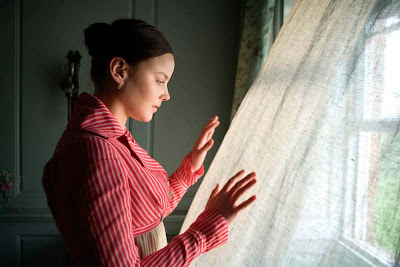
A freewheeling, revisionist look at the life of Emily Dickinson, Wild Nights with Emily boldly contradicts the popular narrative of the author as a virginal, reclusive spinster by using her poems and private correspondence to instead focus on the as yet untold story of the poet's romantic relationship with her girlhood friend turned sister-in-law Susan.

With the leads brought wondrously to life by Molly Shannon in the titular role and Susan Ziegler as Dickinson's near-lifelong muse and lover, although playwright turned filmmaker Madeleine Olnek's ambitious third feature struggles to find a consistent tone and rhythm throughout, when Wild Nights trusts in the richness of its biographical storyline, it never fails to weave a fascinating spell.


Initially purporting to be a comedy, the film opts for satirical humor as a counterpoint to its sudden change in point-of-view. Moving freely back-and-forth in time, Wild Nights contrasts Dickinson's actual day-to-day life as a prolific lesbian artist struggling against the small-minded (mostly male) literary gatekeepers of the era with the revised, "sanitized," and sensationalized version of her life put forth by Mabel Loomis Todd (played by Amy Seimetz) twenty years later.

The woman who would posthumously edit and publish Dickinson's work and create the Bronte-esque spinster persona the world would come to know, Todd — whom we discover was the mistress of Emily's brother and Susan's husband — serves as a kind of unreliable narrator throughout the film as well as its overall villain.

Frequently contrasting Todd's false narrative with Dickinson's actions to make a comedic point, Olnek inadvertently undercuts her own vital research. Shortchanging the film's emotional impact for the sake of the script's jokes — save for a few memorable exceptions — when an unfunny exchange goes on for too long or a sightgag doesn't land, the film's wavering, half-serious tone threatens to make us care less about Dickinson's otherwise engrossing life story than Wild's filmic approach.


Winning us over with its romantic arc which culminates in a heartbreaking split-screen image, from its flashbacks to Emily's younger years discovering romantic love through Shakespeare's words to her struggle to see the object of her affection marry her brother Austin (Kevin Seal), contrary to its earliest intentions as a broad comedy, Nights is vastly more successful as a drama infused with situational humor overall.

At times reminiscent of a college thesis project (and indeed, a packet filled with eye-opening articles and supporting material to back up Olnek's claims was made available to press), though bursting with knowledge and passion for the subject, Wild Nights serves up an academically intriguing if ultimately uneven chronicle of Emily Dickinson's life.

While nowhere near as sumptuous or polished as the recent big screen Dickinson biopic A Quiet Passion from Terence Davies and starring Cynthia Nixon (regardless of how much it might adhere to Todd's legend), I applaud Olnek's decision to take a fresh, mothball free approach to the genre and especially her pursuit of Dickinson's true identity.


Obviously, a person's sexuality is no one's business but their own. However, given how many of Dickinson's nearly two thousand poems were dedicated to or inspired by Susan, it's vital to read them with that perspective in mind, and doubly so to ascertain just how much damage can be done when someone decides to "erase" a person's past in order to better fit their own prejudicial beliefs as well as their preferred vision for the future.

Needless to say, even if the message is better than the movie, more than one hundred years later, we must thank Olnek (and company) for refusing to be content to let the woman who wrote "I'm Nobody! Who are you?" be anybody except her wild, complex, and wholly original self.


Text ©2019, Film Intuition, LLC; All Rights Reserved. http://www.filmintuition.com Unauthorized Reproduction or Publication Elsewhere is Strictly Prohibited and in violation of the Digital Millennium Copyright Act.  FTC Disclosure: Per standard professional practice, I may have received a review copy or screener link of this title in order to voluntarily decide to evaluate it for my readers, which had no impact whatsoever on whether or not it received a favorable or unfavorable critique. Cookies Notice: This site incorporates tools (including advertiser partners and widgets) that use cookies and may collect some personal information in order to display ads tailored to you etc. Please be advised that neither Film Intuition nor its site owner has any access to this data beyond general site statistics (geographical region etc.) as your privacy is our main concern.

9/25/2009

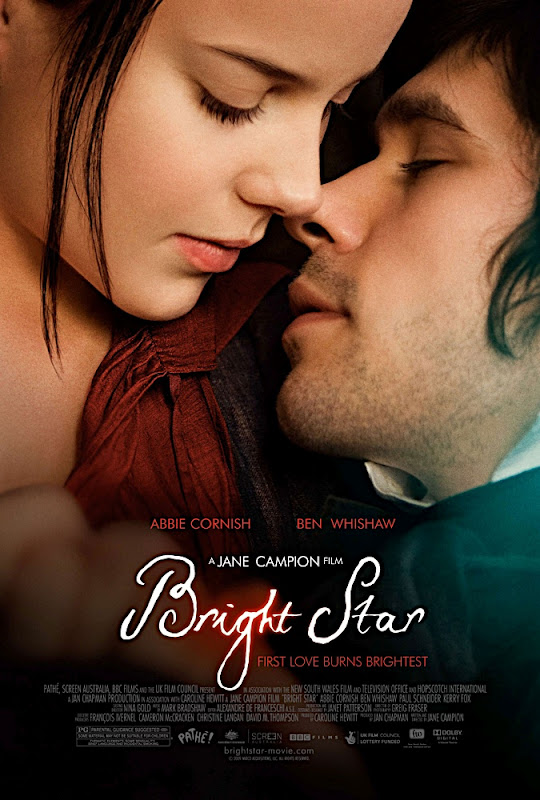
Movie Review: Bright Star (2009)


Photo Slideshow

Check Out Our Trailer & Photo Gallery


Delicious
Bookmark this on Delicious
submit to reddit
Print Page

Digg!

MovieBlips: vote it up!

As the last of the great pre-Victorian era Romantic poets, John Keats wrote in the oft-quoted "Ode to a Grecian Urn," "Beauty is truth, truth beauty-- that is all/Ye know on earth, and all ye need to know."


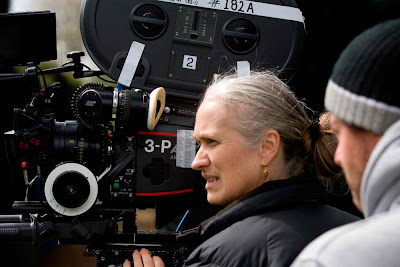
Keats was sensitive, passionate, contradictory and daring both in his life and his work. And even if John Keats hadn't have been officially labeled as a Romantic poet or if you consider his poems "a strain to work out" as his sweetheart Fanny Brawne admitted, his ability to transform words into an impressionistic literary painting of love make it easy to understand why filmmaker Jane Campion would gravitate towards Keats for her long-anticipated return to filmmaking.


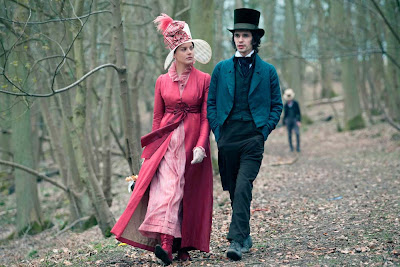
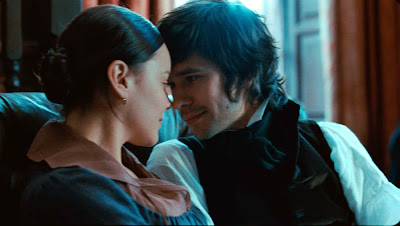
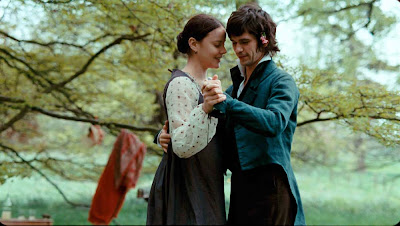
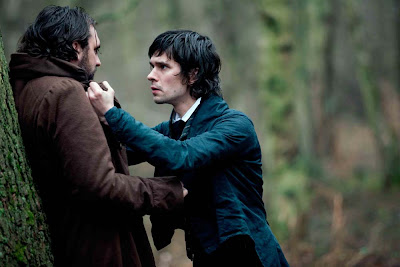
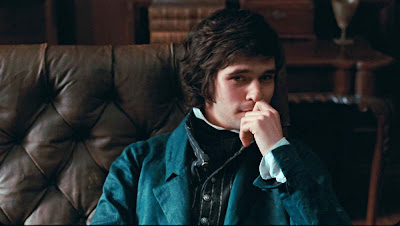
Much like Keats (Brideshead Revisited actor Ben Whishaw) would confess to feeling as though he was "dissolving" in his love for seamstress Fanny Brawne (Abbie Cornish) who lived next door, Campion creates a sensuous feast of a film to dissolve in as well. Although on the surface, Campion's ongoing experimental quest to use nature as subtext to address the feelings her characters cannot share verbally may seem ill-suited for a film about a poet whose phrases have become part of our culture. Yet, it's a surprisingly effective technique for Bright Star.


For, while poetry and discussion of the process is used throughout the work, Campion's film goes against what is expected in a traditional biopic by centering her film purely on the chaste but all-consuming ill-fated three year romance between Brawne and Keats before his untimely death from tuberculosis at the age of twenty-five.


Instead of trying to add to history's ongoing study of Keats, Campion remains in the realm of her expertise by investing the most time and attention in the point-of-view of strong women. To this end, Australian actress Abbie Cornish who'd already impressed me with turns in Candy, Elizabeth: The Golden Age, and Stop-Loss is as intensely passionate as The Piano's Holly Hunter and driven to the same level of extremes in her emotions as Kate Winslet was in Campion's Holy Smoke.


And despite the fact that she smolders alongside a beautiful Ben Whishaw, she easily overpowers him with her skill and intensity in every scene. Although this could've possibly been a direction made by Campion to illustrate Brawne's effect on the poet, the only actor who's routinely able to hold their own opposite Cornish is Paul Schneider. Sure to be in contention for a Best Supporting Actor Oscar nomination, Schneider, who is usually given sidelined but effective supporting roles in movies like The Assassination of Jesse James... and Lars and the Real Girl finally reminded me just why he commanded my attention opposite Zooey Deschanel in All the Real Girls.


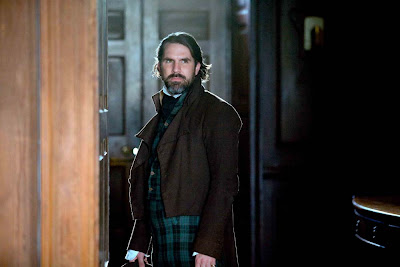
In Bright Star, he creates a riveting, endlessly complicated portrait of Keats' best friend, his Scottish collaborator Charles Brown who openly accuses Brawne of being nothing but a flirt and tries to prevent their infatuation since he views the woman as either unworthy, a drain on his friend's talent, or a rival for Keats' affection.


Drawing from Andrew Motion's 1997 biography Keats, writer/director Campion's Bright Star is at once her strongest yet most subtle film since The Piano by using character driven emotion as the driving force for the entire plot and therefore breaking down the usually stuffy walls of period pieces like Whishaw's Brideshead Revisited to make us feel as though we're in the midst of the all-consuming love affair as well.


Thankfully avoiding the same Avant-garde interpretation which ruined her adaptation of Portrait of a Lady, she's made an inviting yet intoxicating reverie about an unlikely human connection between an early nineteenth century pre-feminist fashionista and the penniless poet who-- thinking himself a failure-- was therefore an unsuitable marital match for the woman he adored which made them both miserable in love.


Employing the gifted cinematographer Greig Fraser and editor Alexandre de Franceschi for some bold and intoxicating sequences that may test the patience of audience members who are still dizzy from the rollercoaster of flashy CGI summer movies with cuts that only last for two seconds at a time, Bright Star contains some of the most unabashedly sincere and genuine sequences of true romance brought to life in years.


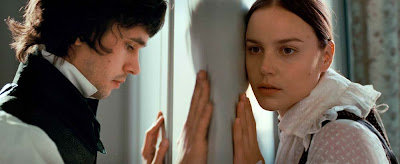
Without removing a single article of clothing and most of the time, never away from the watchful eyes of Fanny's younger brother and sister who accompany her as makeshift chaperones, Campion reminds us that sexuality and sensuality is the most effective when it's withheld. Thus, since she refuses to change the important facts, Campion won't rewrite history and manages to make us swoon along with characters who refuse to go against the social mores of the time and have to find other ways to express their desire such as placing their hands on the opposite side of the same wall at night, Keats requesting that Brawne kiss thoroughly a letter so that he can feel her lips, sleeping with a handwritten "good night" note under his pillow, or the Brawnes' turning Fanny's room into a butterfly museum after a letter he writes inspires their quest.


Although further research reveals that there's an ongoing debate as to how one or two-sided their relationship may have been or what exactly transpired, Campion's Bright Star which is named after the poem that Keats had written for Fanny Brawne (which is referenced in the film) is a gorgeous, naturalistic, and seductive piece of filmmaking wherein "beauty is truth" indeed and that's "all ye need to know."

Jane Campion


John Keats


Text ©2009, Film Intuition, LLC; All Rights Reserved. http://www.filmintuition.com
Unauthorized Reproduction or Publication Elsewhere is Strictly Prohibited.

1/01/2009

DVD Review: Ghost Writer (2007)


Scaring Writer's Block Away

On January 6, 2009


Digg!


Former Title:
Suffering Man's Charity


Nobody does creepy quite like Alan Cumming. Whether he's trying to force himself on Minnie Driver in Circle of Friends or stalking Lisa Kudrow with his "huge notebook" in Romy and Michelle's High School Reunion, the actor has certainly cornered the market on playing smiling eccentrics with a dangerous twinkle in their eye.


After landing a Tony Award for his performance in Cabaret and co-directing the critically acclaimed and award-winning domestic dramedy The Anniversary Party with his Cabaret's Sally Bowles (Ms. Jennifer Jason Leigh), Cumming makes his solo directorial debut with Ghost Writer, which playwright Thomas Gallagher adapted into screenplay form from his original work, Suffering Man's Charity.


(Photo Source)

Essentially a one-man show giving Cumming free range to out-ham Jack Nicholson in The Shining with a campier What Ever Happened to Baby Jane? meets Mommie Dearest aura-- the actor, director and executive producer trades Faye Dunaway's wire hangers for Christmas lights, lingerie, and a violin bow in one of Ghost Writer's most vicious scenes.


(Photo Source)

Playing a wicked intellectual snob and music teacher who takes it upon himself to become the benefactor and Oscar Wilde inspired Greek tradition tutor of handsome young aspiring artists whom he takes under his wing, Cumming's John Vandermark finds himself growing increasingly obsessed by his latest lodger, Sebastian (Angel's David Boreanaz).


(Photo Source)

Having developed a hopeless crush on the handsome young womanizing gigolo who fancies himself a writer (yet cannot quote Shakespeare or Beckett-- to John's annoyance), when John realizes that his tenant has reneged on the unspoken deal to offer him bodily comfort for his generosity in favor of bringing home drunken floozies (including a hilarious, bawdy Karen Black), he snaps like a violin string.


(Photo Source)

Using the bow sadistically to lash Sebastian when he answers scholarly questions incorrectly-- having first tied him up with Christmas lights, gagged him with duct tape and dressed him in women's lingerie-- the film quickly crosses from twisted Tennessee Williams territory into the Hard Candy and Funny Games styled torture genre. Yet it's precisely this indecision and fast misstep in tone from odd comedy to downright shocking confrontation that makes us extremely uneasy and keeps us at arm's length from Cumming's work. Mainly, we're never sure if it wants to go for high camp and "midnight cult" movie status (as Salon.com and Parade Magazine noted in the press release) or venture directly into "torture porn."

Additionally, the director seems as easily confused as the rest of us, putting his heart and soul into an effective scenery chewing "one for the books" performance of hammy excess that feels like it was derived directly from the school of Norma Desmond (as Parade Magazine also noted, comparing it to Sunset Boulevard), while the film struggles at the same time.

And sure enough, the first act predictably ends in bloodshed as John's plan goes awry and he finds himself haunted by his tenant, leading us into two dubious final acts that tries to keep us invested with stunt casting (featuring a range of talents including Anne Heche, Henry Thomas, Jane Lynch, and Carrie Fisher) before it ends with John's final comeuppance-- a cross between O. Henry and Edgar Allen Poe.


(Photo Source)

Seemingly far more successful as a literary premise, short film, or perhaps as a Sweeney Todd like opera that Cumming's John always longed to write and kept trying to force into the hands of his musician friend (Henry Thomas)-- despite the film's strong start and a fascination with the undeniably gifted Scottish born actor, unfortunately it's a misfire as we realize we don't like or care enough about any of the characters onscreen to suffer through John's twisted form of charity (as the original title referenced).


6/19/2008

Reprise


Director:
Joachim Trier

Just after snakes, the theme song to Twin Peaks, preachers, Alan Rickman, escalators, and reality dating shows, as a writer, one of the most terrifying items I’m faced with literally several times a day is the blinking cursor on my computer screen. Like those men you just hate to love and love to hate, that cursor taunts me, seduces me, and enchants me to pick myself up, kick myself in the rear, mingle with the backspace key, rely too much on sugarless gum and caffeine, and reach for the thesaurus hoping to create something worthy of that blank page. Why go through the agony? Since as much as I try to put off face-to-face time with the word processor by killing far too many minutes joking around via e-mail, I have no choice but to write, as babies have no choice but to cry, and often the best place to cry to the world and console yourself into serenity is right in front of that flickering cursor. It’s a persistent battle that writers face, whether we want to admit it or not from those smug individuals who claim that writer’s block is a myth to the same annoying ones who never cease to amaze by the sheer volume of prolific work they crank out in a given year. And heartbreakingly, even after one has gone through all of the required phases of the creative process and is justifiably spent-- in need of a stretch, a walk, a laugh or a hug-- the lingering insecurity continues on.

“Do I really want to expose the world to this?” a twenty-three year old character asks right at the beginning of Danish born Joachim Trier’s Norwegian feature-length debut, Reprise, as he stands alongside his good friend, securely gripping heftily filled manila envelopes in front of a public mailbox. Seeking literary glory and all of the fame and fortune that goes with it, both Phillip (Anders Danielsen Lie) and Erik (Espen Klouman-Hoiner) decide to take the plunge, submitting their manuscripts out into that vast unforgiving void of the publishing world as Trier’s restless camera which-- much like its youthful, hyper, never contented and always changing characters-- proceeds to flash forward into the world of possibilities this fateful act would have on their lives, friendships and careers.

While Erik’s work is rejected, Phillip’s is given the benefit of publication and publicity, which unfortunately seems to be more than the young man can handle or had possibly envisioned when he was alone in his apartment cranking out the work filled with fear and exhilaration in trying to satisfy that tantalizing cursor. Institutionalized for six months following a horrifying breakdown, Erik finds his once exuberant pal changed—detached and distant—with a battle-scarred body and glassy eyes either from prescription drugs or disillusionment as he discovers he’s unable to slide back into step with his unruly clique of fellow young men who spend far too much time and money debating literature and music and hiding their total lack of understanding about women with misogynistic rants and generalizations.

Of the three main women in the movie who are relegated to supporting players in Trier’s obvious ode to white European male angst and artistic temperament set to the tune of Truffaut and Godard styled New Wave (in which some of the masters' works cited in Trier’s homage almost make one want to scream out the titles like we’re watching a cover band playing the favorite songs of a mix tape from our past), we’re the most fascinated by Viktoria Winge’s understated portrayal of Kari. With as Manohla Dargis noted an appearance that definitely calls to mind Godard’s former love and one-time muse Anna Karina, Winge’s Kari plays the soulful, emotionally torn and equally conflicted on-again, off-again love of Phillip who struggles to try and go through the motions recreating their most romantic dates, which is especially apparent in a heartbreaking trip to Paris where they realize that not just the fire has vanished but in its place has conjured up two competing magnets wanting to push them apart and pull them together either for love or maybe just comfortable yet possibly ill-advised old time’s sake.

Stylistically inventive and showing off its New Wave roots proudly from the start with some grainy black and white cinematography that-- to cite two of Godard’s titles will leave you Breathless while watching this Band of Outsiders. Unfortunately, I wasn’t as completely enraptured by the work as most of my contemporaries, feeling it lacked the emotional spine more evident in the tenderness of Truffaut (Jules and Jim) and needed Godard’s penchant for wide open spaces (Pierrot Le Fou) as the claustrophobic set pieces and slightly blurry white subtitles start to tire us out in its rambling final act that made me wonder if perhaps working on the screenplay for five years (Wikipedia) had possibly caused the filmmakers to spend too much time in front of that cursor and too little time out on the streets, breathing the air like the forefathers of the New Wave.

6/03/2008

Sex and the City


Director:
Michael Patrick King

The poster says it all—a glamour shot of a contemplative, wised-up, possibly battle scarred Carrie Bradshaw (Sarah Jessica Parker) against a night background. She’s come a long way from the tutu, wandering through the sunlit streets in a toss between a ballerina’s grace and a tigress on the prowl. That was until cynical reality hit her in the form of a splashed puddle from a bus in the beginning of the television show’s timeless credit sequence that set up the sophisticated, randy, melancholy, witty and beloved award winning HBO series for its astronomically successful six season run. Yet in transferring the tale of single former love and sex columnist Carrie Bradshaw and her three best friends to the big screen, it’s evident fairly early on that the focus has changed considerably.

While it was always fixated on Carrie, there was never a shortage of compelling plots concerning the rest of the Manhattan quartet to elevate the series into a multilayered tapestry of humor, intellectuality and poignant truths. However, that’s quickly forgotten on the big screen as Carrie becomes not only the predictable leading lady but her cohorts are given so little to work with that they become as uninspired and clichéd as countless best friends in the romantic comedy genre, just there to offer a shoulder to cry on, try and deliver a well-timed joke, but never forget their place to stand in the background like a bridesmaid, never upstaging the bride on her big day.

Thus it’s only fitting that the film’s bride-like character becomes a bride as we check in with Carrie, five years after she went to Paris and got accidentally slapped by Petrovsky before the dashing, comical Big (Chris Noth) showed up, sold the key line, “I’m clocking this foreigner,” until Carrie tripped him in the hallway and they ended up falling on the floor and for one another (AGAIN) in a terrific series finale that’s quickly become one of the shows’ most memorable episodes. Now happily committed to Big whom we learn is really named John James Preston (after King’s favorite director Preston Sturges, creator of unforgettable comedies and also intriguingly the first kiss-proof lipstick which is no doubt a SATC staple), Carrie and the wealthy playboy decide unceremoniously in a nearly business mindset to wed before moving into their own corner of “real estate heaven,” namely, a breathtaking penthouse where the view is only outdone by the jaw-dropping, flatteringly lit, and highly organized racquetball court sized walk-in closet.

Obviously, Manolo Blahnik loving Carrie seems less intrigued by the prospect of a ring than the closet and before long, her wealthy, prim dark haired Grace Kelly like princess friend Charlotte (Kristin Davis) is lending Carrie her best gay friend Anthony (Mario Cantone) to plan the big day. While Charlotte is just as we left her, living a life of uneventful domestic bliss married to the good-natured Harry Goldenblatt (Evan Handler) complete with adorable puppies and a cute adopted Chinese daughter who, along with Harry and the puppies seem merely decorative, the tough-as-nails, heart attack waiting to happen, successful law film partner Miranda Hobbes (Cynthia Nixon) is stretching herself too thin in her married life to her own puppy dog husband Steve Brady (David Eigenberg) and son. When a predictable wrench is thrown into her marriage after the unhappily ignored Steve acts out on his dissatisfaction, Miranda is even less thrilled than we’d expect to be involved with Carrie’s nuptials but it’s Carrie’s maid of honor, the show’s saucy vixen cougar Samantha Jones (Kim Cattrall) who coupled with countless frogs until she met her far younger, wart free, golden boy prince Smith (the dishy Jason Lewis), who we’re most stunned to see. Now living a largely hapless existence as a miserable stay-at-home manager to her actor lover in Los Angeles, Samantha is tirelessly devoted to her man yet finds her old urges haven’t disappeared with age when she begins obsessing about her lothario manwhore neighbor.

Rushing off to New York every chance she gets, Samantha and the girls pick up where they left off, yet instead of the fast-paced screwball laughs to which we’d grown accustomed, the sour tone of the Sex and the City movie is shockingly melancholic and while they’ve necessarily replaced the sex and single scene obsession of the show given their relationship status and maturity, by filling an exhaustive 145 minutes with endless fashion shows and product placements and using an uninspired Cinderella theme in lieu of the rampant feminism, it’s a more materialistic and less soulful version of Sex than one could possibly imagine. And even when writer/director Michael Patrick King tries to pen the required daring one-liner or raunchy hook-up, the execution feels sexless, clinical, cool and overwhelmingly tired, making me think that if the script itself had been a man, none of the foursome would have let him get past the first date.

With Carrie’s trio relegated to backup singers as Charlotte is prone to shrieking hysteria in virtually every scene, Miranda has grown even less cheerful, and Samantha is in desperate need of a hug, it pales in comparison to the six inventive seasons of the series. Although it was always a chicken soup show, making one feel better after a horrible date, breakup, or day at the office, and as a woman, I’m infinitely grateful for not only its existence but also that Hollywood actually released a film starring four women over the age of forty, in addition to Carrie, Miranda, Charlotte, and Samantha, SATC’s dedicated fans deserve something much richer, vital and rewarding than what in the end feels about as deep as one of the latest new age self-help books such as The Secret, that hilariously Samantha Jones throws into the sand. Too bad it couldn’t have been the script! Needless to say, skip this and go back to your bookshelves to dust off the old DVD box sets.

5/28/2008

Roman de Gare

Alternate Title: Crossed Tracks
Director: Claude Lelouch

In his frequent comical plugs for his book I Am America and So Can You, Stephen Colbert jokes—and I’m paraphrasing-- that if you make your first work good enough, you don’t have to complete another. And although it wasn’t his first release, essentially the same could be said for writer/director Claude Lelouch, whose landmark 1966 film A Man and a Woman has become synonymous with his name, earning him honors from around the globe including the Cannes Film Festival and our very own Academy Awards.

Sort of a pre-Love Story for international art house viewers, A Man and a Woman, while being stylistically impressive seemed to be a larger hit with audiences and in the same turn, one prone to far more critical evaluations by scholars who have since labeled Lelouch a “middlebrow” (Ebert) and others who felt it was derivative of far superior French New Wave works, repackaged without passion for the masses. Still, it’s a gorgeous work with a sweeping score instantly recognizable after only a few notes and a film that-- despite a few intermittent hits here and there-- Lelouch has never been able to top. It's also one that he continually references on some level (whether conscious or not) throughout his oeuvre dominated by works about the inexhaustible dramatic implications between the genders both in terms of the plot and titles, such as Lelouch’s uninspired film And Now… Ladies and Gentlemen, which nearly put me to sleep after just twenty minutes.

Given to complicated, taut spider web like narratives that seem to weave over one another, going back and forth before finally freeing the viewer to create any sort of linear plotline that will fit, Lelouch has released his most exciting work in years with Roman de Gare. While it still harkens back to his commercial version of the New Wave in terms of style, it seems to be taking a page out of the playbook of fellow French New Wave Hitchcock devotee Claude Chabrol. Nobody builds a vaguer sense of impending doom better than Chabrol and Lelouch channels him to great effect right from the start as we meet our three main characters whose lives intersect throughout the film like travelers switching trains or as the title so beautifully translates, Crossed Tracks.

No stranger to French noir from her work with past masters including a delightful turn for Francois Truffaut in Confidentially Yours, actress Fanny Ardant portrays bestselling mystery author Judith Ralitzer whom we first see in two locations as she discusses her latest novel and is also brought in for questioning in regards to the disappearance of her rumored ghost writer. As the possible writer Dominique Pinon (Amelie, A Very Long Engagement) gives the film’s very best and most subtle performance in his role as Pierre Laclos who first crosses paths with neurotic Huguette (Cesar nominated newcomer Audrey Dana), a stranded, high-strung hairdresser whose fiancé dumps her after a horrible argument while en route to meet her family. Out of equal parts chivalry, pity, boredom and fascination, Pierre offers Huguette a ride and soon establishes such a rapport with the perfect stranger that she enlists his help in pretending to be her fiancé. While in the hands of most, this set up would traditionally lead to light-hearted romantic comedy wherein the two predictably fall in love, Lelouch instead seasons his tale with danger and intrigue in the form of overlapping plotlines chronicling the escape of a serial killing magician from prison who pulls murder instead of rabbits out of a hat and the search for a missing schoolteacher who's disappeared without a trace.

Visually impressive from the get-go with the double exposure of two completely different reels of film to introduce both the prisoner’s escape as well as a man driving at night, Lelouch’s stunning film photographed by Gerarde de Battista and edited by Charlotte Lecoeur and Stephane Mazalaigue never fails to create a mood that’s the most effective in a creepy sequence at Huguette’s family’s farm tinged by Lelouch and company with shades of Deliverance. Admittedly the final twist is fairly obvious to predict given the film’s slower pacing near the conclusion which loses a bit of the intrigue when Pinon is reacquainted with Ardant and the film becomes less Chabrol and more Sirk tinged melodrama. This being said, Gare holds up particularly well in post-film discussion when you realize the amount of truth mixed in with the lies as expressed by the characters and deduce with dismay that some of the earliest clues were hiding in plain sight, making Lelouch and not the film's serial killer, the magician we’re the most consumed by in Roman de Gare.

5/22/2008

Numb


Director:
Harris Goldberg

Have you ever had one of those days where you remember getting in your car and driving home from work but have absolutely no memory of what happened on the drive? You know you’ve obeyed the traffic lights and gone the same route you always do yet you’re so used to going through the motions that it’s impossible to distinguish one trip from the next… that is until something major changes. We take comfort in knowing that our detachment is only temporary but for Hudson (Matthew Perry), living in a “horrific perpetual dreamstate” becomes permanent after the anxiety ridden, high-strung screenwriter triggers his preexisting tendency for disassociation in a bong binge after smoking too much dope too fast while trying to pause his penchant for panic.

Soon diagnosed with “depersonalization” disorder or feeling entirely outside his body as he goes about his day, Hudson fights his condition in the quest for the perfect psychiatrist, experimenting with both talk and drug therapies while attempting his own remedies from an unsuccessful venture to reconnect with reality by visiting his parents to spending far too much time in front of his television zoning out to The Golf Channel. Nearly resigned to a life spent indoors watching the longest films ever made on DVD, Hudson is faced with an optimistic jolt when he becomes attracted to the beguiling, lovely, carefree, and refreshingly weird studio development girl Sara (Lynn Collins) after meeting her in a pitch meeting with his long suffering writing partner Tom (Kevin Pollak).

Surprisingly accepting of his predilection for evenings in front of the television, one night when faced with viewing the entire Star Wars trilogy complete with the filmmaker’s commentary, Sara urges Hudson out of the house and serious sparks begin to fly during some completely unexpected adventures. Now given a true reason to cure his depersonalization due to the fear that revealing his condition will alienate his new love, Hudson fights even harder to try and find the right course of treatment but when playing “musical drugs” begins failing, his tendency towards self-sabotage kicks in as writer/director Harris Goldberg’s impressive, autobiographical, and wholly original romantic comedy continues.

Featuring a pitch perfect performance by Matthew Perry in a role that seems completely tailor-made for the star given his incredible talent for dialogue and self-deprecation, Goldberg admirably fills in the rest of the script with equally involving characters, even when they begin bordering on caricature such as in a fine if slightly artificial subplot featuring Mary Steenburgen as an unstable cognitive behavior specialist who breaks the boundaries of a traditional doctor/patient relationship when she gives into temptation with Hudson.

Far better than one would assume given Goldberg’s other credits as a screenwriter contributing to the awful Dana Carvey vehicle The Master of Disguise and the downright despicable Deuce Bigalow series, we realize that the talented filmmaker has much more to offer than lowbrow credits. Given the maturity and well-earned laughs from this completely human script, it's safe to say that we can look forward to other movies from Goldberg that-- if he manages to stay as close to his heart as he did with this deeply personal tale-- are sure to garner him more fans in the world of independent film. Co-produced by its star Matthew Perry, Numb, which earned the Audience Award from the Gen Art Film Festival, has been recently released on DVD.


5/20/2008

I Really Hate My Job

Director: Oliver Parker

Following a voice over narration which drowns out the visually atmospheric introduction of London’s hustle and bustle before the action is transferred to the claustrophobic setting of Stella Bar in Soho, author Alice (Shirley Henderson) receives a letter from her publisher informing the scribe that her latest manuscript has been rejected as both “unmarketable” and “mind-numbing.” Shortly thereafter, one begins to feel exactly the same way about writer Jennifer Higgie’s unfocused, rambling, and over-the-top screenplay which, just like Alice’s overly intellectualized novel, seems to be in dire need of revision.

Director Oliver Parker has proven in the past that he has a penchant for plays with the inventive adaptation of An Ideal Husband and the mediocre yet watchable versions of Othello (saved by Kenneth Branagh) and The Importance of Being Earnest. He seems to be up to his old theatrical tricks once again when tackling Higgie’s text, which although it tries to pass itself off as a film, seems like it would have been better suited to an avant-garde or experimental college feminist theatre troupe production rather than the world of independent film. Saddled with an unimaginative and narrow title that fails to highlight the film’s ensemble nature, Parker relies heavily on his talented cast to disguise the many shortcomings as we spend a chaotic, irritating, and disaster ridden evening among five female restaurant employees who find themselves in charge of the entire bar after they’re unexpectedly disappointed by two other male employees off-screen.

While task-master Madonna (Anna Maxwell Martin)-- a well-intentioned but largely ineffective manager tries to promote working as a team and trying to cover up her soon to be broken heart, affable Henderson’s Alice suffers burns and catastrophe slaving away in the kitchen alongside a maniacal dishwashing assistant named Rita (Oana Pellea) who smokes like a chimney and spouts communist revolutionary theories with zero prompting. Rounding out the group is the film’s saving grace in the form of the sweet but admittedly dim German art student Suzie (Alexandra Maria Lara) whose innocent naiveté provides an entirely welcome counterpoint to Neve Campbell’s brash, debt-ridden struggling actress Abbie who comes to work on her thirtieth birthday and proceeds to have a breakdown over the course of the ninety minute film.

Unsuccessfully trying to cram far too many offbeat (and 99% unlikable) characters into the chaotic production does little to endear Parker’s film to audiences, despite a nice cameo in the end by actor Danny Huston who seems to have both waltzed in from and onto an entirely different production altogether. While every once in awhile an actress delivers a killer line you know you’ll remember long after you hit eject, you can’t help wondering how much better it would’ve been if-- much like Alice’s manuscript-- they’d streamlined it when it was still in the writing stage by trimming the fat, combining personalities or removing some of the unruly characters altogether.


4/26/2008

Americano

Director: Kevin Noland

In their decision to-- as one character surmises-- rethink whatever it is they think they thought by escaping the realities of student loans, the 9-5 grind, and obligations, three friends head to Spain for one last adventure following college graduation.

Hoping to participate in the Fiesta de San Fermin a.k.a. the Running of the Bulls in Pamplona, Spain, Ryan (Timm Sharp), his girlfriend Michelle (Ruthanna Hopper), and their unofficial leader Chris (Joshua Jackson) find themselves all uniquely affected by their surprising foreign experiences and the intriguing characters they meet along the way such as a strange, Beat styled philosophizing club owner Riccardo (Ruthanna’s father Dennis Hopper) who advises Chris not to “fall for the con—the Ameri-con.”

Coming to grips with, as Ryan explains, the old adage that if you really want to get to know someone better, travel with them, his relationship with Michelle becomes strained both by his yearning for home and his preference to zone out with Vicodin and keep everything at an arm’s length. While those two seem to be nearing the conclusion of their relationship, artistic Chris, whose backpack is stolen at the start of the film, realizes that instead of material belongings, he’s discovered bliss in the simple, unhurried practice of wandering around, scribbling and sketching in his journal.

His love for his new way of life is infinitely deepened when he meets the gorgeous, aggressively confident and I daresay nearly macho fly-fishing actress Adela (Leonor Varela). Drawn to her insistence that bullfights are sensuous dances wherein the matador adorns feminine clothing to look as beautiful as possible before seducing and killing the bull, Chris finds himself seduced by her own tantalizing dance-like conversation and the two embark on a tentative friendship with developing flirtation as the film continues.

Despite too much screen time devoted to a highly bizarre and off-putting Dennis Hopper whose aimless character runs a club (aptly named Americano) which seems to be a twisted version of Moulin Rouge,the film Americano is an engaging and charming sleeper. Admittedly Hemingway purists will find the film’s frequent parallels to the author and his masterwork The Sun Also Rises wearing on their nerves rather quickly, yet writer/director Kevin Noland’s breathtakingly photographed and engaging 2005 film festival favorite (which was screened in Palm Springs, Seattle, Austin, Los Angeles, Vail, Milan, and Newport Beach) is well worth the investment.

4/18/2008

Moliere

Director:
Laurent Tirard

In this delectable, frothy, yet mostly decorative confection, three of Moliere’s beloved plays “Le Bourgeois Gentilhomme,” “The Misanthrope,” and “Tartuffe” are sifted together with a generous helping of Shakespeare in Love and Casanova added in for flavor. The result is an entertaining and gorgeously photographed although largely fictitious look at the famous French seventeenth century playwright Moliere or as he is better known throughout the bulk of the film, Jean-Baptiste Poquelin.

Played by one of my favorite dark haired, dreamy eyed French actors, Romain Duris (L’Auberge Espagnole, Dans Paris), we first meet Moliere in 1658 after he’s spent thirteen years with his theatrical troupe entertaining citizens in the provinces and steadily building up such a reputation that upon his arrival, the king gives him a Parisian theatre to stage his latest work.

The only catch is that the king has a weakness for comedies and Moliere, long tired of farces, desperately wants to deliver his audiences an epic tragedy but his mind is changed after a young woman pays him a visit and beckons him to go see her gravely ill mother. Moliere’s relation to the women and indeed their identity is kept hidden from viewers although it’s fairly easy to guess the facts only a half hour or so after the film ventures back to thirteen years earlier when struggling performer Moliere is arrested for failing to pay a large debt.

His cry of “A plague on creditors; long live the theatre!” seems to fall on deaf ears until the wealthy M. Jourdain (Intimate Strangers star Fabrice Luchini) offers to cover his debts in exchange for acting lessons. Bewitched by the sharp-tongued young beauty Celimene (Swimming Pool’s Ludivine Sagnier) the married Jourdain wrote a one act play to win the fair maiden’s favor and in order to hide his hopeful future seduction from his wife, he asks Moliere to stay with him at his home under the guise of priesthood as Moliere must pretend he is Father Tartuffe.

The clever script, which could have easily fallen into farce is saved by the talented Jourdain who earned a Best Actor award for his performance at the Moscow International Film Festival as he plays the entire thing straight, making the comedy both accidental and spontaneous while Jourdain balances his schedule of taking music, dance and painting lessons with his duties of husband and father thereby hiding his true passion for acting out of guilt for his intended affair. The lovely Laura Morante (Dancer Upstairs, Avenue Montaigne) stars as Jourdain’s wife who, suspicious of Moliere’s appearance and her husband’s sudden interest in the church, quickly becomes the target of the younger man’s affections as we find Moliere up to his old tricks of trying to win her over with earnest romantic words both written and spoken.

While Moliere purists will no doubt feel dismayed by the film that appears to have been undertaken in the same spirit as the misguided fictitious biopic Becoming Jane about Jane Austen, Moliere succeeds where Jane did not by celebrating Moliere’s spirit in keeping the work as entertaining as one of his plots in this sumptuously photographed film which earned four Cesar Award nominations in its native France. Although it may not qualify as the proper Moliere nourishment, the end result is something quite close to a cinematic French dessert—scrumptious, luscious yet minus the calories of a French Silk Pie.

4/03/2008

Neighbor's Dog

Complete Title:
How to Kill Your Neighbor’s Dog
Director:
Michael Kalesniko

We’ve all been there. Whether it’s in the middle of the afternoon and you’re busily trying to finish a spreadsheet or it’s in the middle of the night and you’ve nearly broken your neck repeatedly straining to read the red digital time on your clock in disbelief-- whatever time of day it is, there are few sounds more irritating than that of a perpetually barking dog. Even for dog lovers such as me who forgive a few vocal barks here and there, there's a certain acceptable line that is crossed when it’s a repeated offense and one without provocation from a stranger, mailman or typical distraction.

This is precisely the same situation that playwright Peter McGowan (Kenneth Branagh) finds himself in during Candian writer/director Michael Kalesniko’s six-time award winning film How to Kill Your Neighbor’s Dog. I should stress that the film's title doesn't reflect its contents. Neighbor's Dog isn’t a twisted instruction manual and without any overt onscreen violence it is not as objectionably graphic as Amores Perros and more importantly the dog in question is just one of the many annoyances the insomniac, misanthropic chain-smoking playwright who’s about ten years overdue for a successful production faces throughout the course of the film.

No, the primary obstacle aside from trying to get his latest show off the ground which is challenged by the offbeat young director’s insistence to perpetually sing Petula Clark songs with no provocation (similar to a barking dog) concerns his relationship with his supportive wife Melanie (the always likable Robin Wright Penn). Much like Peter has been struggling with repeated failures in the theatre, dance teacher Melanie is struggling to combat failures in trying to conceive with an overactive biological clock, which is testing her relationship with Peter as insistence and demand makes setting the mood much tougher, without of course factoring in the barking dog and duties taking care of Melanie’s senile mom (Lynn Redgrave) into the conjugal mix.

Even more difficulties arise when Peter learns he has a doppelganger in the form of Jared Harris who has been wandering around his Los Angeles neighborhood at night pretending he’s Peter McGowan along with a much different obstacle when a single mother and her eight year old daughter Amy (Suzi Hofrichter) move in across the street. Hofrichter, quite mature and charismatic in her portrayal (making her an uncommonly gifted young star), never lets the audiences pity her character’s challenges with cerebral palsy. It's her interactions with Peter who at first uses playtime as an excuse to learn youthful dialogue that grows into a near sibling and child dynamic which are unexpectedly moving, touching yet far more realistic than one would assume.

Kalesniko’s 2000 film with the unfortunate title is a worthwhile find due to his deft and layered script filled with characters whose situations echo one another and dialogue that comes alive when spoken by the film’s leads. Although it was only released on premium cable television here in the states, Neighbor's Dog can also be tracked down on DVD.

3/22/2008

Hannah Takes the Stairs

Director: Joe Swanberg

By now the phrase “We should probably talk later,” seems to echo the same sentiment as “Don’t call me, I’ll call you,” or “I hope we can still be friends,” that all daters seem to use while trying to process how to break up with someone. “We should probably talk later,” is a phrase I’ve personally used (more times than I care to admit since knock on wood, so far I’ve always been the dumper although that’s hardly a victory) and it’s the same one that Hannah (Greta Gerwig) tells her first of three boyfriends shortly into the delightful indie comedy Hannah Takes the Stairs. Although it’s used early on, viewers who, like Hannah, are in their twenties know damn well that it won’t be the last time we hear either those exact words or something similar from our feisty, hyper, annoyingly indecisive and self-obsessed yet unquestionably bright and affable heroine. No, we find ourselves making the decision to break up often before it dawns on Hannah as the young college graduate navigates through the instantly relatable and compulsively addictive terrain of three slightly older men including her twenty-eight year old boyfriend Mike (Puffy Chair writer and star Mark Duplass) who quit his job since work nor rocking out in bands is no longer making him happy, the moody and self-deprecating intellectual narcissist in humility’s clothing Paul (Mutual Appreciation and Funny Ha Ha writer/director Andrew Bujalski), and thanks to the gifts of antidepressants, the higher functioning fellow trumpet playing writer Matt (filmmaker Kent Osborne).

Shot without a script or without much in the way of a plot, Hannah Takes the Stairs isn’t quite as mesmerizing as Bujalski’s films that are also included in the, as The New York Times explains “Do-It-Yourself” style independent movement Bujalski named “mumblecore” with self-involved characters who chat about nothing in films with low-production value. Yet, despite this, Hannah is one that feels less like a vanity project than some other mumblecore offerings and seems to be an articulate, recognizable if slightly ridiculous film that keys into the aimless wanderings of intellectual twentysomethings still trying to figure out just where to go from here. Reared on pop culture, the characters like Hannah admittedly suffer from “chronic dissatisfaction” yet in between their ramblings amidst these messy Cassavetes like glimpses of people all striving to find meaning, they manage to ask some pretty engaging questions about life, art, the manic state of romantic crushes and the fleeting nature of love. In other words, when the conversation is this engaging, suddenly the phrase “we should probably talk later” doesn’t seem so dire after all.

3/17/2008

Slipstream

Director: Anthony Hopkins

“I perceive life as a game, a game that we play at some unconscious level,” Anthony Hopkins explained to journalist Scott Macaulay in the Fall 2007 Filmmaker Magazine article “The Hollywood Life” which chronicled his latest experimental puzzler Slipstream from its birth as a stream-of-consciousness screenplay to its wild shoot and inventive post-production that found Oscar winning Anthony Hopkins both in front of the camera and behind it serving as the writer/director/star and film score composer as well.

While the film, which explores “the strange nature of time” is a wild opus purposely created to “annoy the audience” as the actor explained may be his own version of a game, the question then becomes in asking whether or not viewers will want to take part as, like Mulholland Drive, Inland Empire, 8 & ½ and Last Year in Marienbad, it infuriates its audience with constant shifts in plot, character, and text that continually build on itself until we realize that it’s a film within a film within a film just like our main character, the “film’s” screenwriter Felix Bonhoeffer (Hopkins) is, as Vince Vaughn may have said in Swingers, the guy behind the guy behind the guy. Although Felix is perceived to be a main character, the film focuses instead on several others as the movie begins and we meet Michael Clarke Duncan as a bouncer of sorts and two villains played by Jeffrey Tambor and Christian Slater who decide to hold up a diner, not for any monetary gain, but just for the sake of menace as Tambor and Slater ramble out an increasingly crazy story about the 50’s film Invasion of the Body Snatchers and Slater’s typical Jack Nicholson styled cadence becomes far more frightening with each passing minute. Then, as soon as we’re beginning to grasp this nonsensical storyline, a “cut” is yelled and we’re taken behind the scenes of a sloppy film shoot in the desert that will soon find one actor dead and the rest all struggling to figure out how that will affect the film, with studio head John Turturro (given a majority of the picture’s best lines) arriving on the scene like a domineering madman.

Filled with Hollywood in-jokes as Turturro’s character named Harvey seems on some level to be a nod to the controversial tactics and persona of former Miramax head Harvey Weinstein, an off-screen phone call from “Dino” (De Laurentis) about casting Hopkins in Hannibal 4 as long as the price is right and a joke about films being cheesy dreams that can find Huckleberry Finn fishing on the moon similar to the image used as the Dreamworks logo. In addition, Hopkins casts his wife and the film’s producer Stella Arroyave as Gina, the wife of his character Felix and soon the film morphs from an Altman styled Player satire of the film business into one concerned with the past and of how characters came to be where they are in the face of their own mortality.

While an indisputable vanity project and one that will have most viewers reaching for the eject button within the first half an hour, it’s still an artistically imaginative ride for those willing to participate and while it’s nowhere near as effective as the films its emulating such as Marienbad or as I began to feel, literature from Kafka or Calvino, it’s of particular interest to film students who appreciate the amount of work that goes into experimental filmmaking and even more, the amount of dedication and artistry from those involved. Instead of being Hopkins’s film all the way, in the end, the real star of Slipstream and the one responsible for a large majority of its moderate success as a valuable work is the courageous editor Michael Miller who not only respected Hopkins’ vision but also added a dazzling sense of style to the picture giving it a feeling of more depth at times than it actually deserves in the process.

3/10/2008

Dedication

Director: Justin Theroux

Success in this business is 99% perseverance and 1% talent,” children’s book publisher Arthur Planck (Bob Balaban) tells three in-house illustrators before dismissing two of them to give the sole female, Lucy Reilly (Mandy Moore) her big break. By this point, it’s evident to the audience that the question isn’t whether or not Lucy is talented and she undeniably is but whether or not she can persevere to work with the publisher’s most unspeakably cruel, judgmental, depressing and misogynistic yet successful authors, Henry Roth (Billy Crudup) after his longtime collaborator Rudy Holt (Tom Wilkinson) dies.

With a constant unease about his existence and a preference to lay on the floor with heavy objects (usually books) atop his body to keep him feeling safe and secure, Henry is a walking time-bomb who, despite producing the wildly popular Marty the Beaver children’s book and being prompted for a sequel, spends most of his time alienating everyone he meets as punishment for his misery and “crap childhood” as well as imagining he’s speaking to Rudy throughout the film even while in the presence of Lucy. Eager to rip his new partner to shreds, he takes Lucy to a diner for a meeting and like most writers, proceeds to inventively create stories about those with whom he comes into contact yet each story is filled with such contempt and horror that Lucy soon flees, only to return with the promise of a two hundred thousand dollar bonus from the publisher to get the book finished, when she’s strapped for cash and nearly kicked out of her apartment by her controlling landlady, Carol (Dianne Wiest) who happens to be her mom.

Hardly the stuff of an “uplifting romantic comedy” as the back of the film’s box promises and while there’s not much going for the film to keep us invested for the first half, the actors (especially Crudup who by this point has made a career of playing neurotic jerks) keep us watching. In addition, there are enough surprises wherein the film fails to go down routes of predictability as when Henry, who beginning to have feelings for Lucy, has the means to crush her former flame seeking a second chance and doesn’t, to make us forgive some of its overly aware eccentricities the filmmakers hoped were quirky but in all reality were just plain annoying.

Making his directorial debut from a first time script by David Bromberg, actor Justin Theroux (Charlie’s Angels: Full Throttle, Mulholland Drive) is best when giving his fellow character actors such as Crudup and Wilkinson a chance to shine and misguided when he tries too hard to make some moments overly romantic such as a cringe-worthy confrontation where Crudup pleads for Moore to take him back with more than enough bizarre profanity and crazy stream-of-consciousness dialogue to have anyone (let alone a possible mate) head for the hills. Still, particularly admirable in giving Moore another opportunity to break out of the twenty-something romantic girl movie pack in offering her character a story arc of her own. In Moore's hands, the thoughtful and intelligent Lucy becomes more than simply a one-dimensional cliché of the rescuing, selfless angel out to melt a cold man’s heart who masochistically casts hers aside in the process. However, similar to Lucy's character, overall, the bottom line of Dedication's success will be up to the viewers to decide whether or not they'd like to persevere in the company of Crudup's Holt for the film's entire running time.

3/01/2008

I Could Never Be Your Woman


Director:
Amy Heckerling

Fast Times at Ridgemont High and Clueless director Amy Heckerling has always had her finger on the pulse of what’s hip and timely with her funny and irreverent takes on contemporary life. While working on the television spinoff of Clueless for ABC and raising a daughter as a single parent, Heckerling became as Entertainment Weekly’s Missy Schwartz wrote, “increasingly ambivalent about working in an industry that promotes unrealistic standards of beauty for young girls and considers women over 40 to be prehistoric beasts,” (“Would You Dump This Woman?” 2/8/08). In response, she penned the clever and witty I Could Never Be Your Woman which first took shape in the late 1990’s before being retooled again a few years ago in a script that reunited Heckerling with her Clueless leading man Paul Rudd and garnered a commitment from talented actress Michelle Pfeiffer whose celebrity helped get the film made by the controversial production company Bauer Martinez Entertainment which arrived in Hollywood in 2005.

While fans and members of the industry and press awaited its release in theatres, the film kept getting pushed back due to an unbelievably complicated mess of contract, technicality and even legal issues that made the film one of the most challenging of Heckerling’s career before it was relegated to a recent DVD release after being rescued by The Weinstein Company. Although articles such as Schwartz’s in-depth Entertainment Weekly piece may help illuminate some of the difficulties surrounding its post-production, we may never really know why the film was sidelined by red tape and despite the fact that some of the references feel a few years old, it’s still a wonderfully funny film that as Paul Rudd notes is “deceptively layered, as Amy’s work tends to be,” (Entertainment Weekly).

Pfeiffer stars as sharp Heckerling-like television writer Rosie for the aptly named teen sitcom You Go Girl starring Brianna (Clueless star Stacey Dash) who struggles to find a balance in her professional life with her personal one as she raises a precocious daughter Izzie (Irish star Saoirse Ryan before her Oscar nominated breakthrough in Atonement). Izzie who spends her free time prank calling celebrities such as Matthew Perry and Henry Winkler from her mother’s phone book along with dropping her Ken doll in the vent because he has Alzheimer’s is not only starting to outgrow Barbies but actually wanting to find a love of her own as well. It’s romance times two when forty year old Rosie, constantly egged on by Mother Nature (a hilarious Tracey Ullman) about her aging body, finds herself caught off guard when she begins to fall for twenty-nine year old comic actor Adam (Paul Rudd) who manages to steal both Rosie’s hearts along with the viewers' when he signs onto You Go Girl. The charming Rudd who has some truly memorable scenes that can’t be missed brings out a far more carefree and wild side in Pfeiffer that’s refreshing to see and while it’s pretty safe to say that I Could Never Be Your Woman has lost its momentum with the absence of press and arriving instead in video stores, for those who take the time to check it out, it’s a pleasantly affable little sleeper.