Showing posts with label Angst. Show all posts

8/22/2008

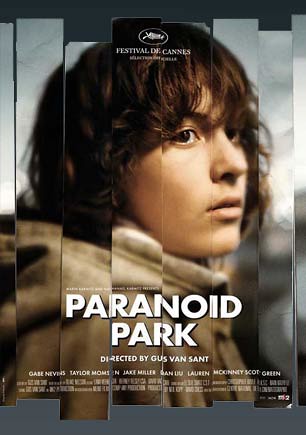
Paranoid Park


"Skateboarding is not a crime…
unless it becomes one."


Digg!

First Published on Blogcritics in my New Feature: Under the Radar:

Director: Gus Van Sant

Nobody does young male angst quite like Gus Van Sant. And over the course of more than twenty years it’s a landscape he returns to again and again throughout his filmmaking career. While some films are more successful than others, when evaluated as a body of work, Van Sant has painted an increasingly complex and irreplaceable portrait of moral and sexual ambiguity, coming-of-age amidst painful contemporary circumstances and above all, the evolving nature of masculinity during the last few decades.

Whether he’s chronicling the prescription pill popping robber Matt Dillon in Drugstore Cowboy, casting River Phoenix as the narcoleptic gigolo who shares a Dustin Hoffman Midnight Cowboy-like affection for Keanu Reeves in the Shakespearean tinged My Own Private Idaho, or dealing with Joaquin Phoenix’s lust turned obsession with Nicole Kidman’s “bubble headed bleach blonde” in To Die For, he seems most comfortable with evaluating the lives of loners and outsiders.

And while he had his biggest hit with Matt Damon and Ben Affleck’s breakout Oscar winner Good Will Hunting, despite filming the thematically similar yet equally fascinating and overlooked Finding Forrester starring Sean Connery, Rob Brown, and Anna Paquin (with the only misstep being Connery’s ill-advised tagline of “You the man now, dog!”) he refused to play by the rules. Following up the more mainstream fare of both Good Will and Forrester along with the experimentally strange shot-by-shot color remake of Alfred Hitchcock’s Psycho, Van Sant returned to art house territory for what he refers to as his “Death trilogy.” Beginning with the Cannes Palme d’Or winner and unflinching Columbine-like Elephant (which Tom Hanks has cited as one of “his top five all-time favorite films”), he continued the thread with Damon and Casey Affleck’s wandering docudrama-like Gerry and the Kurt Cobain inspired Last Days.

However, old habits die hard and death continues to play a part of his most recent work Paranoid Park which won one of two awards it was nominated for at the Cannes Film Festival as well. Additionally, those who intend to check it out will do best to avoid watching the film’s spoiler heavy trailer and most major film reviews which reveal virtually every twist and turn of the subtle film’s plot.

With this in mind, I ask that you forgive a rather vague set-up to Park, but essentially it’s an artistic mood piece about the internal workings of a character as opposed to a standard by-the-numbers hero’s journey. This should come as no surprise since we all know by now — just as there are no legitimate villains — there are no heroes in the works of Gus Van Sant as all characters, even those involved in death, seem to reside firmly in the gray area in between.

And yet although its effects seep through every frame, it’s life and not death that’s the central focus of Park. No, rather like Michael Cuesta’s phenomenally brilliant and equally underrated Twelve and Holding, Paranoid Park shows how precarious life can be and the way we’re all affected by an unexpected passing; however instead of Cuesta’s young group of suburban tweens, Van Sant remains true to his favored demographic of the high school age.

Based on Blake Nelson’s novel and set in Portland Oregon, Park centers on its skateboarding lead character Alex (newcomer Gabe Nevins) who finds himself somehow involved in a death, of which the circumstances are revealed throughout the artistic tapestry woven by Van Sant in its roughly ninety minute running time. However, true to his age and Van Sant’s determination to keep things realistic in doing more than any director in recent memory in accurately portraying the struggle of males during their teens, Alex is also dealing with the disintegration of his parents' marriage. Couple this with the added pressure that arises when the subtly orientation-conflicted Alex finds that it’s he and not his virginal girlfriend — the pretty and popular cheerleader Jennifer (Gossip Girl’s Taylor Momsen) — who wants to put the brakes on their decision to go all the way, and you’re quick to understand that beneath the surface of the deceptively blank-faced gaze of Nevins’ Alex, lies a veritably figurative sea of angst.

And indeed, it’s hard to watch without — as an adult — wanting to somehow reach through the screen and intervene. For, when Alex is called to the principal’s office fairly early on into the movie and in a slowly paced walk choreographed to Billy Swan’s “I Can Help,” which would no doubt have been left on the cutting room floor of most major film shoots, Alex’s true delicate nature is revealed and ironically, we understand that — despite the lyrics — he’s the one we desperately want to help.

Swan’s music is just one of several intriguing selections, along with a quintessential Van Sant inclusion of the late, great Elliot Smith (who virtually filled Good Will Hunting’s memorable soundtrack) as well as tracks from Beethoven, Frances White, Ethan Rose, and more predominantly numerous works from composer Nino Rota’s fascinating score for Federico Fellini’s experimental Juliet of the Spirits.

While in anyone else’s hands, making overwhelming use of classic Italian cinematic compositions may have been seen as pretentious, it works to tremendous effect here, helping to add to the film’s air of mystery as well as Paranoid Park’s strange melancholic sense of beauty, frustration, and compassion. Not to mention, when laid over the breathtaking cinematography by one of film’s truest modern day magicians, Christopher Doyle (who shot Zhang Yimou’s Hero, Wong Kar-Wai’s In the Mood for Love as well as Philip Noyce’s Quiet American and Rabbit Proof Fence), it seems to form the ideal creation of yet another subtle Van Sant masterwork that emphasizes ambiguity in favor of easy answers and utilizes a near docudrama feel. Perhaps most significantly, above all, Paranoid Park remains true to not only his favorite theme but the one he excels in like no other craftsman — namely, depicting the portrait of a young man just trying to get by in the twenty-first century


6/19/2008

Reprise


Director:
Joachim Trier

Just after snakes, the theme song to Twin Peaks, preachers, Alan Rickman, escalators, and reality dating shows, as a writer, one of the most terrifying items I’m faced with literally several times a day is the blinking cursor on my computer screen. Like those men you just hate to love and love to hate, that cursor taunts me, seduces me, and enchants me to pick myself up, kick myself in the rear, mingle with the backspace key, rely too much on sugarless gum and caffeine, and reach for the thesaurus hoping to create something worthy of that blank page. Why go through the agony? Since as much as I try to put off face-to-face time with the word processor by killing far too many minutes joking around via e-mail, I have no choice but to write, as babies have no choice but to cry, and often the best place to cry to the world and console yourself into serenity is right in front of that flickering cursor. It’s a persistent battle that writers face, whether we want to admit it or not from those smug individuals who claim that writer’s block is a myth to the same annoying ones who never cease to amaze by the sheer volume of prolific work they crank out in a given year. And heartbreakingly, even after one has gone through all of the required phases of the creative process and is justifiably spent-- in need of a stretch, a walk, a laugh or a hug-- the lingering insecurity continues on.

“Do I really want to expose the world to this?” a twenty-three year old character asks right at the beginning of Danish born Joachim Trier’s Norwegian feature-length debut, Reprise, as he stands alongside his good friend, securely gripping heftily filled manila envelopes in front of a public mailbox. Seeking literary glory and all of the fame and fortune that goes with it, both Phillip (Anders Danielsen Lie) and Erik (Espen Klouman-Hoiner) decide to take the plunge, submitting their manuscripts out into that vast unforgiving void of the publishing world as Trier’s restless camera which-- much like its youthful, hyper, never contented and always changing characters-- proceeds to flash forward into the world of possibilities this fateful act would have on their lives, friendships and careers.

While Erik’s work is rejected, Phillip’s is given the benefit of publication and publicity, which unfortunately seems to be more than the young man can handle or had possibly envisioned when he was alone in his apartment cranking out the work filled with fear and exhilaration in trying to satisfy that tantalizing cursor. Institutionalized for six months following a horrifying breakdown, Erik finds his once exuberant pal changed—detached and distant—with a battle-scarred body and glassy eyes either from prescription drugs or disillusionment as he discovers he’s unable to slide back into step with his unruly clique of fellow young men who spend far too much time and money debating literature and music and hiding their total lack of understanding about women with misogynistic rants and generalizations.

Of the three main women in the movie who are relegated to supporting players in Trier’s obvious ode to white European male angst and artistic temperament set to the tune of Truffaut and Godard styled New Wave (in which some of the masters' works cited in Trier’s homage almost make one want to scream out the titles like we’re watching a cover band playing the favorite songs of a mix tape from our past), we’re the most fascinated by Viktoria Winge’s understated portrayal of Kari. With as Manohla Dargis noted an appearance that definitely calls to mind Godard’s former love and one-time muse Anna Karina, Winge’s Kari plays the soulful, emotionally torn and equally conflicted on-again, off-again love of Phillip who struggles to try and go through the motions recreating their most romantic dates, which is especially apparent in a heartbreaking trip to Paris where they realize that not just the fire has vanished but in its place has conjured up two competing magnets wanting to push them apart and pull them together either for love or maybe just comfortable yet possibly ill-advised old time’s sake.

Stylistically inventive and showing off its New Wave roots proudly from the start with some grainy black and white cinematography that-- to cite two of Godard’s titles will leave you Breathless while watching this Band of Outsiders. Unfortunately, I wasn’t as completely enraptured by the work as most of my contemporaries, feeling it lacked the emotional spine more evident in the tenderness of Truffaut (Jules and Jim) and needed Godard’s penchant for wide open spaces (Pierrot Le Fou) as the claustrophobic set pieces and slightly blurry white subtitles start to tire us out in its rambling final act that made me wonder if perhaps working on the screenplay for five years (Wikipedia) had possibly caused the filmmakers to spend too much time in front of that cursor and too little time out on the streets, breathing the air like the forefathers of the New Wave.

Mama's Boy


Director:
Tim Hamilton

They say that the best way to uncover just what a man truly thinks of women is to see how he treats his mother. In fact, right up there with “sense of humor,” one of the most desirable qualities female friends rattle off when listing the ideal man seems to be “gets along well with his mother.” Of course, one can’t help who their parents are just as much as one can’t help who their children are and there are definite understandable exceptions to this rule. And granted, chivalry may be on its last legs but often times the little things men do to show their affinity or compassion for women from simply holding a door, offering a coat, walking us to our car in bad neighborhoods, or not trying to grope us in the first instant we’re alone are often internally, instinctually ingrained at a young age by their relationship to the first woman in their life-- namely "mom." However, this being said, there’s a definite difference between loving one’s mother and being a mama’s boy and I know plenty of relationships that went south precisely because of this difference in what attracted a woman in the first place was just a sneak preview of the mother issues her mate had once they’d gotten together. But truth be told, when it comes to mama’s boys, Napoleon Dynamite star Jon Heder’s character Jeffrey Mannus takes the cake in the aptly named film Mama’s Boy.

Like Matthew McConaughey in Failure to Launch, Jeffrey is one of those twenty-nine year old late bloomers who still lives at home but while McConaughey’s alter ego in Launch used it to an advantage as the perfect excuse to end a relationship without doing any of the heavy lifting or awkward “we need to talk” conversations most of us try desperately to avoid, Jeffrey prefers that the only woman in his life is his mother Jan (Diane Keaton) and that likewise, he should be her only man. Predictably things change when Jan approaches the cheesy if innocuous "success coach" Mert Rosenbloom (a hilarious Jeff Daniels), like a smitten groupie after a lecture and she accepts a date to see him perform with his jazz band, aptly named “The Mertones." While great for the desperately lonely Jan, this agreement sounds an insecurity alarm in Jeffrey who-- similar to his mother-- hasn’t dated in three years and cruelly reminds Jan that as a middle aged widow she’s “not some trollop from a Jackie Collins novel.”

Thankfully she ignores her son’s advice, not to mention his insistence to stalk his mother’s every move during her courtship with Mert, between his hobbies of collecting comic books, role-playing intricate outdoor battles with other Dungeons and Dragons types, obsessively watching and listening to all things 1980s dressed like a New Wave Smiths devotee, and usurping control of classic video games at the local arcade. Then flirtation finds Jeffrey and he's equally thrown for a loop after meeting cute with Nora Flannigan (Lost in Translation’s Anna Faris), a rebellious coffee shop employee whose real hobby is as “plucky songstress” writing protest anthems about corporate America including her own favorite track, “Bed, Bath and Bulls**t.”

While Nora’s interest in the mean-spirited loser who demands that his mother continue to make his daily lunch and walk him to the bus (since he refuses to drive), seems far-fetched at best, Faris is so genuinely likable that she’s the one singular breath of fresh air in this slightly stale straight-to-DVD, forgettable confection that wastes its gift of Diane Keaton, makes Heder a far creepier version of the geek he played in School for Scoundrels, and gives both saving grace Faris and the amazingly diverse and resourceful Daniels too few opportunities to shine.

But admittedly it's much better than one would assume, even with an overly padded ending that seems tacked on simply to try and lighten up the film’s tone after a painfully unfunny turn of events sours us on the main characters, it’s sure to garner more support on DVD due to the commercial appeal of the leads. Despite this and I note this with affection as someone who was forced to move back in with mom for grad school budgetary reasons-- mama’s boys be warned as director Tim Hamilton’s Mama’s Boy may provide one more stumbling block for men in their late twenties who still live at home in trying to meet a romantic mate. For a more flattering—if admittedly just as predictable—view of homebound males as "McConaughey-like shirtless hotties," it’s perhaps best to rent Failure to Launch if you’re choosing a film to share on a date... just before revealing that you still sleep in your childhood bedroom.

6/12/2008

The Promotion

Director: Steve Conrad

On the surface, “the customer is always right” may seem like the ultimate corporate management dictum but as my favorite boss once told me, the real strategy is to never let the customers make a scene. Strange advice from a former heavy metal drummer with plenty of stories of things getting out of control but realizing I’ve never been fond of public scenes of any kind, I took Dave’s advice to heart and despite a few unavoidable hiccups with those who seem to delight in perpetuating misery, it made my employment run infinitely smoother. Unfortunately, for the audience, this advice has never made it to the ear of The Promotion’s main character Doug (Seann William Scott). Slaving away as the hapless assistant manager, Doug fights against impromptu slaps by a gibberish speaking Teddy Graham coveting rebel and trying to broker peace between himself and his two apathetic fourteen year old security guards who—unsurprisingly-- seem more devoted to their cell phones than trying to deal with an intimidating young gang that terrorizes the shoppers and employees of the film’s supersized fictitious Donaldson’s Chicago grocery store. Of course, if Doug had been informed of this tactic, Pursuit of Happyness and Weather Man writer Steve Conrad wouldn’t have had a film with which to make his directorial debut. Although, dubbed “one of the unfunniest comedies ever,” by The Hollywood Reporter’s Kirk Honeycutt who also wrote that “watching The Promotion” should be added “to the Geneva Conventions’ list of humanitarian abuses,” possibly that would’ve been the best thing all around… if only-- much like our sad-sack Doug-- for filmgoers to avoid scenes as unpleasant as the ones found in The Promotion.

In a film that makes the similarly themed Dane Cook, Dax Shepard, and Jessica Simpson vehicle Employee of the Month look downright Shakespearean, our struggling thirty-three year old Doug assumes that his years of serving time in Donaldson’s under a boss who escapes to daytime matinees and car washes while he contends with an overabundance of customer complaint cards will be coming to a deserved end when he learns the chain is building a brand new store nearby. Convinced he’s a “shoo-in” for a promotion to manager at the new location, Doug and his hardworking wife Jen (The Office’s Jenna Fischer) purchase a home they can’t afford to escape their amorous gay banjo playing neighbors. Predictably, a wrench is thrown into Doug’s path in the form of John C. Reilly’s Richard, an aggressively friendly Canadian from Quebec who transfers down to Doug’s store with the intention of going after the same position and cushy benefits package for his new baby and Scottish wife Laurie (Lili Taylor using a hilarious Scottish Canadian hybrid accent) that he’d met while on a Christian mission. Initially unable to get a handle on the new “wild-card” Richard whom we later learn is a recovering alcoholic and drug addict, Doug and the newbie sidle up to one another, forming a strange professional bond that seems borderline friendly and competitive but grows increasingly acrimonious when Doug is relegated to near permanent parking lot duty in favor of self-actualization, self-help book-on-tape obsessed Richard.

All one has to do to anticipate the squirm-inducing, awkward and frankly painful stabs at humor in what I felt seemed like a manic-depressive screenplay is to reread the aforementioned descriptions one more time—a man who may lose his house; a recovering addict—not exactly the most surefire ways to garner laughs. While I applaud Conrad’s ingenuity and willingness to go against standard movie clichés, as Roger Ebert noted, the film is never quite sure of its tone, similar to the writer’s woefully uncomfortable Weather Man. In addition, I still can't get over the troubling realization that I found circulating throughout my screening notes that an overwhelming majority of the humor seemed to stem from cheap shots involving minorities (whether homosexual, ethnic, or mentally disabled). While I can’t imagine this was the film or Conrad’s intention, I couldn't help questioning just how and why so many talented cast members including Bobby Cannavale and Jason Bateman (who turn in nice cameos) even bothered to get involved. Mercifully, it will most likely be buried in the wake of the Edward Norton starrer The Hulk this weekend here in Phoenix, again reminding us that in addition to not wanting to witness such a disastrous scene, when it comes to mean-spirited and dissatisfying drivel like this-- by staying away in droves, in the end the customer is always right.

5/20/2008

I Really Hate My Job

Director: Oliver Parker

Following a voice over narration which drowns out the visually atmospheric introduction of London’s hustle and bustle before the action is transferred to the claustrophobic setting of Stella Bar in Soho, author Alice (Shirley Henderson) receives a letter from her publisher informing the scribe that her latest manuscript has been rejected as both “unmarketable” and “mind-numbing.” Shortly thereafter, one begins to feel exactly the same way about writer Jennifer Higgie’s unfocused, rambling, and over-the-top screenplay which, just like Alice’s overly intellectualized novel, seems to be in dire need of revision.

Director Oliver Parker has proven in the past that he has a penchant for plays with the inventive adaptation of An Ideal Husband and the mediocre yet watchable versions of Othello (saved by Kenneth Branagh) and The Importance of Being Earnest. He seems to be up to his old theatrical tricks once again when tackling Higgie’s text, which although it tries to pass itself off as a film, seems like it would have been better suited to an avant-garde or experimental college feminist theatre troupe production rather than the world of independent film. Saddled with an unimaginative and narrow title that fails to highlight the film’s ensemble nature, Parker relies heavily on his talented cast to disguise the many shortcomings as we spend a chaotic, irritating, and disaster ridden evening among five female restaurant employees who find themselves in charge of the entire bar after they’re unexpectedly disappointed by two other male employees off-screen.

While task-master Madonna (Anna Maxwell Martin)-- a well-intentioned but largely ineffective manager tries to promote working as a team and trying to cover up her soon to be broken heart, affable Henderson’s Alice suffers burns and catastrophe slaving away in the kitchen alongside a maniacal dishwashing assistant named Rita (Oana Pellea) who smokes like a chimney and spouts communist revolutionary theories with zero prompting. Rounding out the group is the film’s saving grace in the form of the sweet but admittedly dim German art student Suzie (Alexandra Maria Lara) whose innocent naiveté provides an entirely welcome counterpoint to Neve Campbell’s brash, debt-ridden struggling actress Abbie who comes to work on her thirtieth birthday and proceeds to have a breakdown over the course of the ninety minute film.

Unsuccessfully trying to cram far too many offbeat (and 99% unlikable) characters into the chaotic production does little to endear Parker’s film to audiences, despite a nice cameo in the end by actor Danny Huston who seems to have both waltzed in from and onto an entirely different production altogether. While every once in awhile an actress delivers a killer line you know you’ll remember long after you hit eject, you can’t help wondering how much better it would’ve been if-- much like Alice’s manuscript-- they’d streamlined it when it was still in the writing stage by trimming the fat, combining personalities or removing some of the unruly characters altogether.


3/22/2008

Hannah Takes the Stairs

Director: Joe Swanberg

By now the phrase “We should probably talk later,” seems to echo the same sentiment as “Don’t call me, I’ll call you,” or “I hope we can still be friends,” that all daters seem to use while trying to process how to break up with someone. “We should probably talk later,” is a phrase I’ve personally used (more times than I care to admit since knock on wood, so far I’ve always been the dumper although that’s hardly a victory) and it’s the same one that Hannah (Greta Gerwig) tells her first of three boyfriends shortly into the delightful indie comedy Hannah Takes the Stairs. Although it’s used early on, viewers who, like Hannah, are in their twenties know damn well that it won’t be the last time we hear either those exact words or something similar from our feisty, hyper, annoyingly indecisive and self-obsessed yet unquestionably bright and affable heroine. No, we find ourselves making the decision to break up often before it dawns on Hannah as the young college graduate navigates through the instantly relatable and compulsively addictive terrain of three slightly older men including her twenty-eight year old boyfriend Mike (Puffy Chair writer and star Mark Duplass) who quit his job since work nor rocking out in bands is no longer making him happy, the moody and self-deprecating intellectual narcissist in humility’s clothing Paul (Mutual Appreciation and Funny Ha Ha writer/director Andrew Bujalski), and thanks to the gifts of antidepressants, the higher functioning fellow trumpet playing writer Matt (filmmaker Kent Osborne).

Shot without a script or without much in the way of a plot, Hannah Takes the Stairs isn’t quite as mesmerizing as Bujalski’s films that are also included in the, as The New York Times explains “Do-It-Yourself” style independent movement Bujalski named “mumblecore” with self-involved characters who chat about nothing in films with low-production value. Yet, despite this, Hannah is one that feels less like a vanity project than some other mumblecore offerings and seems to be an articulate, recognizable if slightly ridiculous film that keys into the aimless wanderings of intellectual twentysomethings still trying to figure out just where to go from here. Reared on pop culture, the characters like Hannah admittedly suffer from “chronic dissatisfaction” yet in between their ramblings amidst these messy Cassavetes like glimpses of people all striving to find meaning, they manage to ask some pretty engaging questions about life, art, the manic state of romantic crushes and the fleeting nature of love. In other words, when the conversation is this engaging, suddenly the phrase “we should probably talk later” doesn’t seem so dire after all.

Dans Paris

Translated Titles:
Inside Paris
or
In Paris
Director:
Christophe Honore

In my teens I fell in love with the French New Wave or more accurately the gorgeously inventive if admittedly pretentious cinema of what occurs to lovers after the “happily ever after” usually featuring intellectually snobbish, sad-eyed and soulful dreamers including Jean-Paul Belmondo or Jean-Pierre Leaud as they fall in and out of love with beguiling and maddeningly aloof women such as Anna Karina or Catherine Deneuve. With sweeping scores, jump-cuts, and nonlinear narratives, it’s the type of filmmaking audiences either love or hate but to love New Wave is to fall hard (both blindly and passionately) and New Wave fans are my favorite kind of film lovers.

However, when New Wave fans begin to direct, the results at times are mixed with the incredible Godard inspired Tarantinto masterwork Pulp Fiction to the disconcertingly uneven yet compulsively watchable Dans Paris from novelist and playwright turned writer/director Christophe Honore.

L’Auberge Espagnole star Romain Duris stars as Paul whose relationship with Anna ends after the two fall out of love and overwhelmingly depressed and near-suicidal, the gloomy Paul returns home to live in the apartment occupied by his father played by Guy Marchand (Cesar nominated for his role). Also living at home is the scene-stealer of Dans Paris who comes in the form of Paul's gorgeous, much younger brother Jonathan (The Dreamers star Louis Garrel) who spends his time attending class when he feels like it and others perpetually seducing women with such questioning lines as “Can I possibly kiss you? It’s a matter of life or death.”

With a running time of roughly ninety minutes, not a frame is wasted in the hands of Honore, who sets himself up as the New Wave’s most ardent and fanatic devotee with his painstaking homage to the movement that on one hand seems unspeakably pretentious but on the other helps breathe life into a story that, had it been told in a more traditional manner such as the increasingly depressing fare of American independent film, would have had audiences pressing eject after only a dozen minutes.

A hit in his native France, reaction to Honore’s Dans Paris or rather its influence from the New Wave forefathers had critics divided with The Hollywood Reporter dismissing it as “a greatest-hits collection of French cinema” with its references to Godard, Demy, Rivette, and Truffaut (although I would also add Lelouch and Chabrol to the list) and Manola Dargis of The New York Times assessing Honore as someone who “may be a student of the New Wave but he’s not a slave, and he steers clear of pastiche in this film precisely because he knows the difference between empty imitation and creative inspiration.” With Dargis overstating it and The Hollywood Reporter flippantly understating it, it’s up to the viewer to decide how the New Wave references play out. As far as I’m concerned, the result is in between the critical assessments for Honore’s above average work, which benefits tremendously from Garrel and especially Duris’ dynamic portrayals and for my money, any film that may make its viewers seek out New Wave classics deserves an A for effort any day of the week, even though I’d probably give Dans Paris a B.


3/17/2008

I Want Someone to Eat Cheese With

Director:
Jeff Garlin

In order to get out of yet another physical education requirement in college, I halfheartedly signed up for the most convenient health class that would fit into my schedule. Enrolled in Foods and Nutrition, I found myself growing even hungrier day by day as our obsessive teacher railed against the perils of entrees overflowing with fat and sugar and like a preacher, going off on tangents including only one I still remember to this day which is her belief that in order to solve America’s obesity problem, we should find a way to stop emotionalizing food. From comfort food, to chocolates on Valentine’s Day, to cookies at Christmas, to countless dinners on first dates, she warned that as long as we made food a part of a bonding ritual to get closer to another person, we were going to grow larger. While on one hand, she may have had a point, on the other, despite the discomfort most of us feel about the nerve-racking first date dinner audition, she failed to recognize that not only is getting to know someone fun but in doing so, sometimes it’s nice to share food as well or as Curb Your Enthusiasm star Jeff Garlin put it in his newest film, sometimes we just want someone to eat cheese with.

Part Italian, I’m a cheese lover from way back whether it is cooked into dishes like ziti or piled onto pizza, the title instantly attracted me and after watching the entire movie, I can happily say that the charms of the entire film go way beyond its cute title. Previously known to me as Jeff, one of my favorite Curb characters who as Larry David’s agent/loyal sidekick has a laid back manner and willingness to go along with whatever ridiculous situation the two find themselves in, no questions asked, Garlin makes us forget that more scheming character within minutes of Cheese but keeps one important trait and that is his willingness to let others shine and go along with the given situation. Possibly indicative of his own background working on Second City, Garlin’s character James may be our main character but is consistently upstaged by the rest of the cast. However, he’s the heart of our film as, in an update of the classic Oscar winning Marty, to which Cheese makes several references, we follow the thirty-nine year old struggling actor who works on Second City while looking for his big break, living with his mother (Mina Kolb) and trying to meet a nice woman.

Overweight and frustrated, James is the type of character who would’ve driven my Nutrition professor nuts with his nightly ritual of going to the local mom and pop market to buy snacks filled with sugar and fat such as his beloved rice pudding from a shopkeeper who, like a bartender to an alcoholic, always wants to cut him off. Prone to leaving his Overeaters Anonymous meeting (of which he is the only male) during the final silent meditation and hanging around with his scene-stealing best friend Luca (David Pasquesi), things begin looking up for James when he meets the wacky, hot, ice cream server Beth (Sarah Silverman) who teases James with ice cream delights and a trip lingerie shopping as they embark on an awkward courtship. While Silverman’s Beth is arguably the most enticing yet maddeningly odd girl James has probably ever come into contact with, he also meets cute with Stella, a like-minded jazz fan and teacher (Bonnie Hunt), who may be better suited to the self-loathing James.

Far from having everything work out in a predictable manner, the freewheeling Cheese, although written by its star Garlin, feels refreshingly improvised and inspiringly natural in even the most ridiculous situations and not only will it make Garlin’s Curb fans look at him in a new light but it’s also great date fare for those of us who, like James are also looking for someone to eat cheese with. And as Larry David might say, that’s “pretty, pretty, pretty good” indeed.

Ira and Abby

Director: Robert Cary

A few hours after the psychiatrist he’s been seeing for twelve years tells him it’s time to end therapy since their “relationship” is no longer working, Ira Black (Chris Messina) decides to tour a health club on a whim. With four pages of questions thrust at him on a fluorescent clipboard, Ira sits and waits for his tour only to have his beautiful, free-spirited guide Abby Willoughby (Jennifer Westfeldt) arrive forty-five minutes late, snacking on French fries and advising him not to join the health club since she hates exercise herself. Hardly the right way to approach a possible commission, Ira is intrigued despite himself by her openness right off the bat and the two reach a level of intimacy that most of us struggle to attain with a potential mate fairly quickly and before he knows it, he’s revealing intimate problems such as his aversion to making decisions or finishing things. An aspiring psychologist who is unable to finish his dissertation, the two chat for roughly six hours before Abby asks him to analyze her. He does so and it’s a negative, sharply defined analysis yet one free of any pretentions or flattery to lure her into bed and surprised by his accuracy, Abby impulsively asks Ira to marry her and even more to his surprise, Ira finds himself accepting and thus begins one of the most adorable romantic comedies in recent memory.

Winner of the Best Feature and Actress Awards at the U.S. Comedy Arts Festival in addition to other accolades at festivals across the country, Kissing Jessica Stein writer/star Jennifer Westfeldt penned an even more irresistible romantic comedy with the indie sleeper Ira and Abby. Director Robert Cary’s movie is so likable that, like as Ebert said about Juno, you almost want to "hug" it as it sneaks up on viewers with the leads’ tangible chemistry and unaffected dialogue that will have us falling in love with the film just as quickly as Ira and Abby fall for each other.

With terrific supporting turns by Frances Conroy, Fred Willard, Robert Klein and Judith Light and an authenticity, intellectuality and spontaneity that elevates it far beyond most mainstream Hollywood fare, I’m hoping that Ira and Abby, like another similarly themed indie favorite Happy Accidents, will find a much larger audience on DVD.

City of Men

Director: Paulo Morelli

It’s said that the sins of the father eventually go to his son but it’s a trickier proposition when a person either doesn’t know who his own father is or has vague memories of a father who was killed when he was young and now must face his own identity as a father to his baby boy. In director Paulo Morelli’s cinematic follow-up to Fernando Meirelles’s masterpiece City of God, the two main characters find themselves in exactly these situations as they turn eighteen. After losing his son at a young age, Ace (Douglas Silva) realizes he must try and make amends to ensure that his son Clayton doesn’t grow up to repeat his mistakes coming-of-age without male guidance but barely able to take care of himself or his equally young wife, Ace struggles with responsibility and priority when he’s enlisted by his best friend Wallace (Darlan Cunha) to track down the father he’s never met in order to secure his identity and get a needed signature on his eighteen year old identification card.

Like City of God, City of Men, which is based on the critically acclaimed Brazilian television series recently released in the states on both DVD and through the Sundance Channel, is set in the low class slums of Rio de Janeiro although while God was set in the past, Men’s action takes place today as the children of their community hill align themselves with a local gang leader and are willing to take up arms and risk their lives to fight local gangs over territory. Although one doesn’t necessarily have to see City of God in order to appreciate its far more linear follow-up with an emphasis on sentimentality and a cleaner narrative than its flashier, edgier, father God, it’s fascinating to view it with the first grand scale work fresh in one's mind.

Although Men feels like an ideal companion piece to the first film, however despite some similarities in style and crew behind and in front of the camera, Men is a more audience friendly picture that will be able to attract those who may have run for the exits from the brutality and horror of the first film. Although, Men comes with a few contrivances and one predictable twist near the end, which reminded me that it was missing the impact of the first picture which, in its much louder way offered up a truer sense of the beating heart of Rio and one less carefully and deliberately presented to filmgoers as this more accessible work. However, this being said, it’s a great, great film in its own right and one that feels, similar to God years earlier, like the perfect antidote to the mindless and numb Hollywood manufactured orgies of violence and gore by never letting us forget that we’re not looking at just bored teens who turn to violence to titillate or shock, but teens who grew up with absolutely nothing and must find a way to fight to survive, to make tough choices and more importantly, discover how to take the lessons or lack thereof they learned from their fathers and apply them to the next generation.

Sleepwalking

Director: William Maher

Returning to the same bleak and gritty territory she explored in works such as In the Valley of Elah, North Country and Monster, Charlize Theron proves her devotion to indie sleepers with her involvement as both a supporting actress and producer on Sleepwalking. An Official Selection at the Sundance Film Festival and a feature debut for former assistant director William Maher and his former Chumscrubber colleague (writer Zac Stanford), Theron stars as Joleen, an irresponsible, unlucky, self-involved and promiscuous mother who, after her live-in boyfriend is arrested for growing marijuana, packs up her belongings and brings her eleven year old daughter Tara (AnnaSophia Robb) to stay with her younger brother James (Nick Stahl).

After a one-night stand with a trucker, Joleen impulsively leaves, abandoning her daughter with her clueless brother and a vague letter explaining that she’ll be back in a month in time for Tara’s birthday. Barely able to take care of himself and without a driver’s license, James struggles with his newfound responsibility and it isn’t long before he loses his job, apartment and social services starts calling until he and Tara ultimately decide to go off on their own. While my summary ends there, the film’s marketing campaign wasn’t quite that tactful, saddling Sleepwalking with one of the most wholly revealing film trailers in recent memory. From only one viewing, I’d venture to guess that 99.9% of the viewers will be able to predict the entire plot in detail so this being said, if you have any desire to see Sleepwalking, avoid the preview like the plague.

With fine support from character actors Woody Harrelson (the film’s sole comic relief) and a chilling, one-note Dennis Hopper who seems to be, at this point, playing a Dennis Hopper stereotypical baddie, the film is filled with the typical depression and purposely dirty, ugly and gray cinematography to superfluously establish the tone. In a sea of endlessly depressing indie works, Sleepwalking rates about average and the film's simplistic feel makes one realize that it may have been more successful as a work of fiction. While not as good as the aforementioned Theron films or nearly as brilliant as Nick Stahl’s similarly themed picture In the Bedroom, it provides Stahl with an even greater opportunity than his brief role in Bedroom to show his impressive range and although it’s hard to relate to any of the characters in the film, the viewers (just like the characters of Joleen and Tara) tend to put their trust in him and are lucky that their belief is largely justified… even if I can’t say the same for the film.

Day Zero

Director: Brian Gunnar Cole

“It’s our turn, guys. It’s only fair,” James Dixon (Jon Bernthal) reasons to his two best friends only a few scenes into director Brian Gunnar Cole’s feature film debut. In trying to air on the side of logic and patriotic duty, James argues the positive of the situation that finds the three friends all summoned for service in the American military from a reinstated draft that had lured sixteen million men into the armed forces from World War I through Vietnam before its suspension. Now, set in the near distant future of a world not only hit hard from the attacks of 9/11 but another lethal fictitious attack on Los Angeles, the draft has been made active again. According to the film, the draft coincides with our war on terror overseas growing much larger, encompassing other countries and the unfortunate need for an estimated twenty-five thousand additional troops is discussed on the radio has hopefully been satisfied by increasing the maximum draftable age to thirty-five years old, not only recruiting just college age men but leaders in corporate America as well.

While cab driver James Dixon eagerly looks forward to follow in the long line of soldiers in his family before he falls in love with a sociology graduate student (Elisabeth Moss), the timing couldn’t be worse for his two friends, neurotic writer Aaron Feller (Elijah Wood) halfway through his follow up book to his first successful work and married lawyer George Rifkin (Chris Klein) who has just been made partner of his firm and also can’t bear the thought of being away from his loving cancer survivor wife Molly (Ginnifer Goodwin) who’s recently made it to her five year disease free status. George’s actions to try and find a loophole out of the contract with Uncle Sam and Aaron’s increasingly erratic behavior after his indifferent therapist (Ally Sheedy) inspires him to create and carry out the items of a top ten list send him chasing down new experiences such as skydiving to far riskier fare, further alienate Dixon from his friends. Although, it seems illogical that three very different characters would remain this close for years and at times their actions seem far too contrived to believe and instead feel like they're just hitting some required notes in the “soldier movie” cliché list, it’s a compelling film made all the more timely given our fears of what kind of global climate has been evolving since we invaded Iraq.

While we’re always riveted by Klein and especially the fiery and passionate Bernthal, ultimately it is veteran actor Wood who is given the most highly unbelievable role of the film as a young man whose actions defy common sense as he begins to lose his grip of reality far too quickly. Adding insult to injury, the ultimately vague and perfunctory conclusion feels like a cheat to audiences who’ve invested time and emotion in the tale and it seems that director Cole and writer Robert Malkani quit filming about one or two vital minutes too early, as a more decisive action by one of the two characters we see in the final sequence would’ve had a greater impact than it’s passive blink-and-you-missed-it conclusion. For a better film about the moral quandaries of fighting our current war, look for Kimberly Peirce’s Stop Loss coming to theatres in a few weeks but Cole and Malkani at least receive admirable points for effort and intention for a work that, although uneven, never fails to make us think.