Showing posts with label Film Noir. Show all posts

12/27/2019

In the Key of Noir - Movie Review Essay: I Walk Alone (1947)


In the Key of Noir
by Jen Johans


To hear Lizabeth Scott's jaded torch singer Kay Lawrence tell it in I Walk Alone, "all the songs sound alike these days." And with their good and evil tales of antiheroes, bad decisions, and femme fatales that together create an instantly recognizable cinematic melody, Kay might just as well have been talking about the film noir genre where the tropes had been established a decade earlier in their nearest relative — '30s crime pictures.

Most evident in standard cops and robbers fare or gangster epics like Scarface, the moral quandaries of right and wrong permeated through the era's socially conscious films as well, including the union centered Warner Bros. crime melodrama Black Fury, which Walk director Byron Haskin had lensed for Michael Curtiz back in 1935.

An existential B movie noir, I Walk Alone knows the rules of the genre well and embraces them with as much matter-of-fact resignation as recent parolee Frankie Madison (Burt Lancaster) does when he sees vertical shadows on the ground and informs his friend, "bars, Dave, I guess I'll never get away from 'em." Yet while Frankie observes this with a hint of despair onscreen, Haskin appears to have taken the bars of noir as a challenge to stage a great escape offscreen.


Understanding the standard notes of noir that must be played, in the 1947 production, he opts for a different arrangement and fills his chorus with character actors like Scott, Lancaster, and a knockout Kirk Douglas, all of whom did some of their best work in the genre. And once they start singing the wry, lyrical dialogue penned by Red River scribe Charles Schnee, I Walk Alone sounds like a dream.

It looks like one too, thanks to the contribution of the great cinematographer Leo Tover who painted the lush Hold Back the Dawn and The Heiress with light during the exact same decade that he let the shadows and fog take hold here. Most importantly, as not only a former cinematographer but an award winning Warner Bros. special effects wizard who'd developed a rear-projection photography system that helped advance the medium and also worked on such landmark films as They Drive By Night, and Arsenic and Old Lace, Toller had a vital ally in Haskin.

Together, the two men knew how to make Walk's symbolic and sumptuous visuals count. The end result is a sexy, grown-up noir that shocked critics like Bosley Crowther of The New York Times who thought it violated the Hays Code and The Nation's James Agee who dubbed it "unclean, unclean" upon its post-World War II release.

In I Walk Alone, Lizabeth Scott's Kay Lawrence isn't the only one who's jaded. Long before we encounter the torch singer who feels she's "sung too many torch songs," the picture finds Lancaster's Frankie out after a fourteen year stretch that's changed the man so much that he believes that he can now smell fear. Desperate and angry, with Frankie hoping to get what's coming to him from his old partner Noll "Dink" Turner (Douglas) even though we know right away that it's hopeless, Haskin's movie feels like it would play perfectly as one half of a double bill with Straight Time, Dog Day Afternoon, or any number of other dead-end neo-noirs of the 1970s.


However, featuring an over-the-top final moment with Douglas (for which the actor has taken full credit), unlike those two films, I Walk Alone is saddled with an ending that feels out of step with the rest of the picture. And while it dulls some of its hard edges with the type of misguided musical moments that were common in the genre — as well as an all in one night, largely one set approach that makes you question Lancaster's character swings and the film's logistics — overall, this noir works far too well for it to be so forgotten.

A mature effort, Walk was based upon the play Beggars are Coming to Town by Theodore Reeves. As stylistic as it is natural, even in a few instantly quotable, lusty double entendres from scene stealer Kristine Miller, Schnee's script is filled with surprisingly wistful, half optimistic, half pessimistic sentiments ideally suited to characters in their thirties who've been around the block a few times. Unafraid of complex conversations that, just like in unrehearsed real life, spiral off in any number of directions over a period of minutes, in I Walk Alone, two long, talky sequences stand out.

Dropping lines that still feel fresh today, in a drawn-out dinner date between Scott and Lancaster, she suddenly confesses, "I've never been out with a man who didn't keep talking about himself and end up thinking he knew all about me," before marveling that tonight — opposite the chiseled, silent as a vault ex-con who can smell fear — the opposite is true.


And this recurring theme of expecting the unexpected when it comes to the man who just can't escape the bars of his past continues on in a heartbreaking hold-up sequence where Frankie learns the hard way just how much the world has changed in fourteen years. Discovering that he can't use a gun to rob a bureaucracy or board of directors in a scene with Kirk Douglas that Douglas plays with so much amused venom that you half expect poison to drip from your TV, I Walk Alone proves it's far more sophisticated than one might expect.

Though still not as fun or frisky as the director's Lizabeth Scott led follow up, Too Late for Tears, this film, which I hadn't seen in decades, hits much harder as an adult when you're closer in age to the characters onscreen. A towering figure if there ever was one, with his masculine, musically clipped cadence and unflappable charisma, Lancaster easily draws you into the film's conflict so that you're on his side before he even crosses those shadowy bars in the very first sequence.

However, intriguingly going against those expectations, in the first of seven films Lancaster would make opposite Douglas and the first and only one where he received second billing, it's Douglas as the handsome shark — leaning back in his chair like the chairman of the board — who really gets under our skin.


Lounging like a playboy in his robe or running his hand through his hair as though he could shake Lancaster right out of it, the ease with which Douglas tells his worried henchmen that he can handle his old friend foreshadows his '50s climb to the A-list with star turns in films like The Bad and the Beautiful, and 2 Weeks in Another Town (also written by Schnee).

Likewise when, as Scott sings, Walk makes "a fool out of someone who cares" as Lancaster temporarily allows himself to be handled, the coolly calculating Douglas helps propel the film forward until our leading man changes his mind. Of course, then, having stared Douglas down every time he unleashes that deadly smile, we're eager as ever to walk along with Lancaster's fool so that he won't have to go it alone, regardless of the rushed ending and a few minor bumps along the way.

An existential melodrama sung in the key of noir, the harmonious I Walk Alone teaches us that, even if the song sounds the same, with this cast and crew fiddling with the arrangement, it'd be foolish not to care.

Now Available


Text ©2019, Film Intuition, LLC; All Rights Reservedhttps://www.filmintuition.com Unauthorized Reproduction or Publication Elsewhere is Strictly Prohibited and in violation of the Digital Millennium Copyright Act.  Also, as an Amazon Associate, I earn from qualifying purchases made off my site through ad links. FTC Disclosure: Per standard professional practice, I may have received a review copy or screener link of this title in order to voluntarily decide to evaluate it for my readers, which had no impact whatsoever on whether or not it received a favorable or unfavorable critique. Cookies Notice: This site incorporates tools (including advertiser partners and widgets) that use cookies and may collect some personal information in order to display ads tailored to you etc. Please be advised that neither Film Intuition nor its site owner has any access to this data beyond general site statistics (geographical region etc.) as your privacy is our main concern.

6/10/2018

Olive Films Blu-ray Review: Odds Against Tomorrow (1959)


Now Available 


Bookmark and Share

Wanting something and needing it fast is a trait often attributable to male leads in American movies but – whether planning a heist or offing their lover's husband – it's safe to say that men in Film Noir pictures are an altogether different breed.

Willing to do whatever it takes after they zero in on what they need, the men in director Robert Wise's largely overlooked, stylish 1959 feature Odds Against Tomorrow are no exception. And this is perhaps best epitomized in a scene where Robert Ryan's racist, domineering screw-loose lead barrels down the road on his way to rob a bank, driving 110 miles-per-hour with his eyes closed towards the film's literal and metaphorical dead end.

Closer to the work of Sam Fuller than Fritz Lang, Wise's odd, thought-provoking, atmospheric effort works best as an allegory about racism and masculinity filtered through the lens of Film Noir.


Occasionally using an infra-red camera to create “black skies with white clouds” and change the look and feel of certain scenes including our introduction to Robert Ryan's WWII vet and ex-con Earl Slater, similar to the way that the screenplay employs creative call backs to lines in earlier scenes to give them a brand new read, Robert Wise does the same thing with Tomorrow’s editing and cinematography.

The first major film to be edited by Dede Allen, who would change the craft forever less than a decade later in Bonnie and Clyde, in Odds Against Tomorrow, you can see her experiment with the jump cuts that would serve her so well in Dog Day Afternoon as well as Bonnie and Clyde.


Shot by Edge of the City's Joseph C. Brun, from the film's use of quick cuts to get us into Slater's lonely, paranoiac frame-of-mind to some to others that took my breath away in their artistry as pigeons flew off like a shot just as two of the film's heavies meet, Odds looks better than ever in this new high definition Blu-ray release from Olive Films.

Based on William P. McGivern's novel of the same name, although producer and star Harry Belafonte tapped the blacklisted Abraham Polonsky to pen the script, the two had to use Belafonte's novelist friend John O. Killens as its credited front for thirty-seven years until Polonsky's name was rightfully restored.


Singing a few lively numbers (and banging the hell out of a xylophone), the ever-charming Belafonte serves as a terrific foil to Ryan's Slater as gambler Johnny Ingram.

Up to his eyeballs in debt, although he initially turns down mutual friend Dave Burke (Ed Begley) on his offer to rob a bank alongside the bigoted Slater, once his ex-wife and daughter are threatened, Ingram quickly changes his mind, even though he knows it's sure to end in tragedy.


Co-starring dynamic scene-stealers Shelly Winters and Gloria Grahame, there's an interesting sequence revolving around sexual invitation and the idea of a locked or unlocked door – that moves from lovingly romantic to frighteningly manic – which takes on additional meaning as the film continues and we learn that the robbery's success or failure all hinges on the chain of a door lock.

Composed and conducted by the Modern Jazz Quartet's John Lewis, the film's hit soundtrack album had more staying power than Wise's riveting, bold film, especially compared to the work that was to come from The Sound of Music director. Thankfully its long overdue Blu-ray release from Olive Films serves up a much needed second chance to discover a forgotten classic that Noir lovers in particular are sure to want.


Text ©2018, Film Intuition, LLC; All Rights Reserved. http://www.filmintuition.com Unauthorized Reproduction or Publication Elsewhere is Strictly Prohibited and in violation of the Digital Millennium Copyright Act.  FTC Disclosure: Per standard professional practice, I may have received a review copy or screener link of this title in order to voluntarily decide to evaluate it for my readers, which had no impact whatsoever on whether or not it received a favorable or unfavorable critique. Cookies Notice: This site incorporates tools (including advertiser partners and widgets) that use cookies and may collect some personal information in order to display ads tailored to you etc. Please be advised that neither Film Intuition nor its site owner has any access to this data beyond general site statistics (geographical region etc.) as your privacy is our main concern.

7/13/2016

Criterion Collection Blu-ray Review: Ride the Pink Horse (1947)


Now Available to Own


Talk about tempting fate. Only in Film Noir would a man named Lucky travel to a New Mexico town that's so well-known for its bad luck that each year, the locals host a festival to shed the curse through the ritual of fire.

As a popular tourist destination, the event makes a terrific diversion in theory. But once you burn something, the scent lingers in the air, attaching itself from one person to another like the carousel at the center of town, which — despite the colorful distraction of a pink horse — can't hide the fact that it leads you nowhere.

Hauntingly captured by cinematographer Russell Metty eleven years before he lensed another southwestern Noir soaked stunner via Touch of Evil, this flawed yet mildly effective black-and-white B-movie is filled with shady symbolism.


Based on the Dorothy B. Hughes novel and produced by five time Alfred Hitchcock co-writer Joan Harrison (who's rumored to have also taken a pass at the screenplay), Ride the Pink Horse reflects the ideas of far too many off-screen storytellers.

A long forgotten postwar crime picture that’s been resuscitated by The Criterion Collection, although Ride’s meandering plotline often stops and starts just like a carousel, the sharp one-liners served up by Ben Hecht (Notorious) and Charles Lederer (His Girl Friday) give the film a badly needed illusion of speed. Sadly, the feeling is short lived.


Taking what should’ve been a naturally thrilling confrontation between hero and villain in the form of a foot chase and dragging it out to a near crawl, Horse is strained even more by its characters' wildly inconsistent personalities that seem to change at — if not the drop of a fedora — than with a sudden shift of that unlucky wind.

Still less daring yet more palatable than actor turned director Robert Montgomery’s first film that was released earlier that same year, Ride the Pink Horse’s emphasis on ensemble, ambience, and mood illustrates the filmmaker's love for the medium and its ability to introduce us to people whom we wouldn't normally encounter in our day-to-day life.


And unlike the objective point-of-view approach he employed throughout his boldly experimental adaptation of Raymond Chandler's Lady in the Lake that forced us to look at the world through the eyes of Phillip Marlowe, Montgomery favors a more straightforward style for his follow-up Noir which better serves the material.

As a man fascinated by character driven conflict, it's no wonder that Robert Montgomery gravitated to Noir early on in his filmmaking career since the genre frequently asks us to take a closer look at someone we might have misjudged earlier.

Unfortunately, this film takes it a bit too far as most of the people who fill the screen (including Montgomery's ironically named unlucky WWII vet) seldom reveal the same side of their personality twice.


Offering viewers the opportunity to play Marlowe to greater effect in this film than in the gimmicky Lake, one way Criterion could've bolstered the lukewarm title is by including the much maligned Lady in the Lake on a bonus disc in order to better appreciate Montgomery's genre transition and enjoy the Ride.

Nonetheless although it’s sure to be of interest from a historical and cultural perspective as the first film to result in an Academy Award nomination for a Latino actor (via scene stealer Thomas Gomez), in the end and in spite of Criterion’s technically stellar Blu-ray high definition transfer, the oft-forgotten film remains just as forgettable today.   

Bookmark and Share

Text ©2016, Film Intuition, LLC; All Rights Reserved. http://www.filmintuition.com Unauthorized Reproduction or Publication Elsewhere is Strictly Prohibited and in violation of the Digital Millennium Copyright Act.  FTC Disclosure: Per standard professional practice, I may have received a review copy of this title in order to voluntarily decide to evaluate it for my readers, which had no impact whatsoever on whether or not it received a favorable or unfavorable critique.

11/27/2014

Movie Review: Too Late for Tears (1949)


Now Available to Own   


AKA: Killer Bait

Note:
This piece was originally Published by Brian Sauer on his blog Rupert Pupkin Speaks as part of the Underrated Thrillers series by author Jen Johans in the fall of 2014.

Review:
Considering the fact that Byron Haskin is best known for helming movies that drew heavily on his extensive background as a Warner Brothers special effects head (including Disney’s first feature length foray into live action via Treasure Island and the 1953 Orwell adaptation of The War of the Worlds), it’s no wonder that his late ‘40s thrillers get lost in the shuffle.

However, Noir fans would do well to seek out the one-two punch of I Walk Alone and Too Late for Tears that Haskin executed prior to Island which teamed him up with under-utilized B-movie actress Lizabeth Scott for a pair of potent pictures.


Seduced by the enviable cast including Burt Lancaster and Kirk Douglas (in an early turn fresh off his impressive work in Out of the Past), when sought out by genre scholars, most of the ink has been spilled about Walk.

But when compared side by side, in truth it’s the less flashy 1949 public domain gem Too Late for Tears (also known as Killer Bait) that’s far worthier of cult classic status alongside other low-budget public domain favorites such as Quicksand and Detour.

Easily the more compelling of the two, Tears also sets itself apart by centering the entire film around a female antihero – which in retrospect helped anticipate the ‘80s and ‘90s revisionist Neo-Noirs that harked back to genre classics while giving women much stronger roles.

Following an accidental money drop which finds a bag filled with sixty thousand dollars erroneously tossed into Lizabeth Scott’s car, the quick-thinking blonde decides to do everything in her power to play finders keepers, even if that means bumping off her straitlaced husband (and anyone who crosses her path) to get her way.

What could’ve been a fairly straightforward crime melodrama about the evils of greed (as predictably one misdeed follows another) turns into a surprisingly complex web of comeuppance, calculation, and intrigue as new players appear out of the woodwork changing the rules and adding new layers to the already escalating plotline.

Based on a serial from The Saturday Evening Post and adapted by its author Roy Huggins (who would go on to create TV’s The Fugitive, Maverick and 77 Sunset Strip), Tears offered both Scott and former bit player turned I Walk Alone actress Kristine Miller two of the best written roles of their careers.

Likewise the film not only helped anticipate the future directorial success of Haskin but also offers an early glimpse of the same character driven multifaceted plotting that would hold viewers captive for decades once Huggins took his mind for murderous mysteries to the small screen. 


Bookmark and Share

Text ©2014, Film Intuition, LLC; All Rights Reserved. http://www.filmintuition.com Unauthorized Reproduction or Publication Elsewhere is Strictly Prohibited and in violation of the Digital Millennium Copyright Act.  FTC Disclosure: Per standard professional practice, I may have received a review copy of this title in order to voluntarily decide to evaluate it for my readers, which had no impact whatsoever on whether or not it received a favorable or unfavorable critique.

10/16/2014

Blu-ray Review: Hangmen Also Die (1943)


Now Available to Own   

  Photo Slideshow   


AKA: Never Surrender; Lest We Forget; Hangmen Also Die! 

Even without any knowledge of the real-life complications, confrontations or compromises that comprised the offscreen push-and-pull power struggle of director Fritz Lang and his co-scripter Berlot Brecht on the 1942-43 production of their fact-based WWII passion project, viewers are able to sense clashes in tone, style, structure and character just by watching this – the final result.


Dubbed Hangmen Also Die by a quick-thinking secretary who garnered a hundred dollars and a place in motion picture history for her clever suggestion – as it turns out, even the question of what to call the work divided Lang and Brecht’s sole collaboration, ultimately resulting in the latter never making another hands-on picture in the United States.


Restored for Cohen Film Collection Blu-ray by Pinewood Studios and the British Film Institute (BFI), the legend of the Lang vs. Brecht title fight is in all reality just the tip of the iceberg of what amounts to an impressively made if disappointingly uneven tale of World War II suspense.

An anti-Nazi epic all the same and one given double the air of authenticity considering that it was crafted by German émigrés who’d fled Hitler’s stranglehold on their homeland during the time period, Fritz Lang had intended Hangmen to be another one of his efficiently executed, crisply-paced Noir thrillers.

With this in mind, the Austrian born director drew on both his personal and professional background as a German expressionist master craftsman who’d helped define the look of the Noir genre (in classics like Metropolis, M and Fury) along with the shadow heavy cinematography by legendary lensman James Wong Howe (Sweet Smell of Success).


Unfortunately by swinging like a pendulum around a large number of characters on both sides of the Czechoslovakian Resistance’s assassination plot to take out Moravia “Hangman” and Deputy Reich-Protector of Bohemia Reinhard Heydrich, Hangmen Also Die loses the taut rhythm and breakneck pace that grabbed hold of us in the nail-biter of a beginning.

Gradually getting bogged down by endless speechmaking, instead of the terse, suspenseful thriller Lang had intended, ultimately we're left with an overly-long message movie that’s far too light on tension.

And unfortunately after such an ambitious first act, Hangmen loses its steely focus on a core group of Czechs who have to improvise after part of their plot collapses and leaves the assassin without a getaway car.


For what started as a cat-and-mouse espionage movie (wherein everyday citizens must ask themselves how much they’re willing to risk and/or sacrifice when threatened by the Gestapo) soon begins to veer off in too many directions.

And this misstep escalates – magnifying the film's flaws – thereby making the already lengthy 135 minute work (which adds in an extra minute of previously unreleased footage) feel as long as Brecht’s original 280 page draft.

Whittled down to 190 screen-minutes by three additional writers and translators (all with different styles and interests in where they wanted to story to go), when added together, Hangmen had at any given time as least five storytellers assigned to the same overcrowded, undeniably complicated personal project with each one on a completely different page.


Needless to say, you're left with a prime example of too many cooks in the kitchen without a head chef corralling all the ingredients into one recipe. And as such it’s easy to understand why the film collapsed under the weight of a structure that's constantly shifting like a foundation after each new earthquake-like rewrite by talented scripters (including Angels With Dirty Faces scribe John Wexley).

A nonetheless worthwhile find for Lang fans, especially given Cohen’s lush restoration, Hangmen also offers a decidedly unique look at a different part of the war by focusing on brave, unsung Czech heroes who were willing to lay down their lives if it meant they were able to put the Third Reich’s notorious hangman in a literal or figurative noose.

And this goal clearly helped the film strike a chord with western audiences in its 1943 release as U.S. and British viewers (many of whose loved ones were fighting overseas) were only too happy to stand up and cheer for the demise of Hitler’s regime, which had forced so many artists like Lang and Brecht to leave their ancestral home.


Bookmark and Share

Text ©2014, Film Intuition, LLC; All Rights Reserved. http://www.filmintuition.com Unauthorized Reproduction or Publication Elsewhere is Strictly Prohibited and in violation of the Digital Millennium Copyright Act.  FTC Disclosure: Per standard professional practice, I may have received a review copy of this title in order to evaluate it for my readers, which had no impact whatsoever on whether or not it received a favorable or unfavorable critique.

4/29/2014

DVD Review: Cry Danger (1951)


Now Available to Own


Photo Slideshow   


A feature filmmaking Jack of All Trades, Robert Parrish first broke into the movies acting in such classics as the 1930 antiwar Best Picture winner All Quiet on the Western Front as well as Charlie Chaplin’s bittersweet romance City Lights.

Later apprenticing as an editor while working on multiple John Ford films including the definitive Great Depression era John Steinbeck dustbowl epic The Grapes of Wrath, after eventually winning an Oscar of his own in the field of editing roughly a decade later, Robert Parrish put all his varied experience on both sides of the camera to good use by launching his directorial career.


Transitioning nicely into the role, Parrish sought out crackling original scripts with memorable dialogue, helming two Film Noirs in his first year on the job, both of which had been penned by screenwriter William Bowers.

While his second film The Mob is mostly notable for marking the onscreen debut of Charles Bronson, it’s his first effort – the razor sharp, briskly paced double crossing thriller Cry Danger (which Bowers adapted from a story by Jerome Cody) that remains just as fresh and deliciously complex more than sixty years later.


Filmed in just twenty-two days on location in Los Angeles, Cry Danger which looks better than ever in this Olive Films DVD release that serves up the Film Noir Foundation funded 2010 UCLA Film and Television Archive restoration to dazzling effect, is bolstered by the sizzling one-liners delivered with the right kind of no-nonsense, devil may care dry wit of Dick Powell.

One of film history’s greatest (yet most painfully underrated) Philip Marlowes given his stellar turn in Edward Dmytryk’s gritty adaptation of Raymond Chandler’s Farewell, My Lovely in Murder, My Sweet, Powell commands every scene he’s in in Danger.

An ingenious after-the-fact heist picture, Cry Danger finds Powell released from prison at the start of the film, after serving five years for a crime he didn’t commit.


Eager to settle the score, identify the people who framed him and find out their reasons, Powell’s search for not only truth but also the whopping hundred thousand dollar loot that had disappeared (and been blamed on him) leads him to face some truly shocking revelations about the people he’d assumed were on his side.

Followed by the police as well as other hoods anxious to make a play for the money before he can, Powell finds himself dodging gunfire and endless lies until he at last realizes that what put him behind bars was one hell of a complicated plan rather than a simple miscarriage of justice.

Dialogue-heavy yet distinctly Noir in mood and spirit, Cry Danger makes one hell of a stylish first impression for Parrish’s technical and artistic promise as a cinematic teller of stories.

And while from a storytelling perspective, it may tip its hat a bit too soon early on as we’re able to piece together clues and catch onto danger much faster than our hard-time hardened Hitchcockian wronged man hero, fortunately Bowers and Parrish remedy this as the movie continues.


Respecting the audience enough to keep us in suspense as the stakes are raised in the fast-moving midsection, while it grows increasingly complicated eventually Danger’s secrets are revealed in an elegantly simple yet heartbreaking twist as Powell (and by extension the viewer) learns not only the whereabouts of the loot but more importantly, the person who’d been manipulating him from the start.

A forgotten Noir that’s been given new life in this fresh presentation, Cry Danger is sure to find a new audience in viewers whose favorite film genre is filled with tough guys backlit with smoldering beauties amid heavy shadows, where danger lurks just around the corner.


Bookmark and Share

Text ©2014, Film Intuition, LLC; All Rights Reserved. http://www.filmintuition.com Unauthorized Reproduction or Publication Elsewhere is Strictly Prohibited and in violation of the Digital Millennium Copyright Act.  FTC Disclosure: Per standard professional practice, I may have received a review copy of this title in order to evaluate it for my readers, which had no impact whatsoever on whether or not it received a favorable or unfavorable critique.

3/01/2010

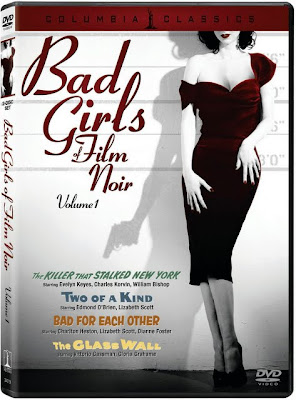
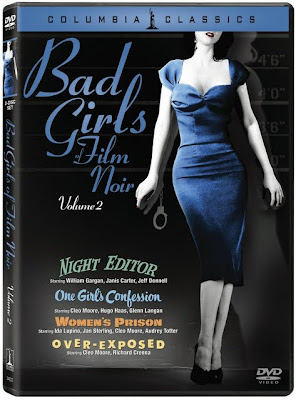
DVD Reviews: Bad Girls of Film Noir, Volumes 1 & 2


Now Available to Own


Volume 1 Titles:
The Killer That Stalked New York; Two of a Kind; Bad for Each Other; The Glass Wall


Volume 2 Titles:
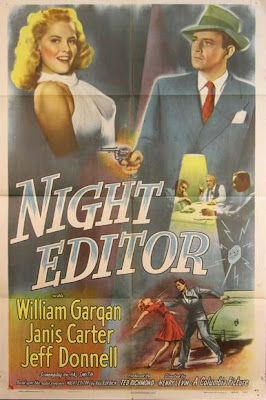
Night Editor; One Girl's Confession; Women's Prison; Over-Exposed


Surprisingly, this time around if it walks like a Noir and talks like a Noir, is shot like a Noir and is hot like a Noir, it may not actually be a Film Noir as we discover in this mostly disappointing set of B-movies from Columbia Pictures vaults.


As oddly packaged together as Sony's nonsensically titled Martini Movies, the two volume kick-off of their Bad Girls of Film Noir collection largely fail to deliver on the studio's two basic promises that a) the films are filled with genuine bad girl characters as 75% of the time, they're not and b) that what we're watching is genuine Double Indemnity, Laura, The Postman Always Rings Twice, Out of the Past, and The Big Sleep style Film Noir since again 75% of the time, we're not.

Instead, we're mainly presented with melodramatic misunderstandings, some sudsy soaps, and wronged women in trouble as otherwise nice girls are one bad decision away from turning into individuals that Sony promises are just "too sexy to be good."

Fortunately as a fan of the old flickering images of lost black and white movies, not to mention the promise of crackling dialogue and strong female characters that typically pervade the genre, I'm happy to say that not all eight movies are a bust. Yet sadly, they're just not that good either, making you repeatedly wish you could pull elements from a few titles to re-work them together into a super Film Noir.

Unlike the studio's Icons of Screwball Comedy series that debuted on DVD over the summer, one volume doesn't necessarily stand head and shoulders above the other title as the mediocrity is spread throughout. And even though I'm tempted to advise you to skip directly to the second volume, you'd be missing out on two a few fairly entertaining films if you did so.

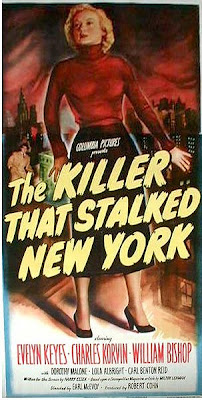
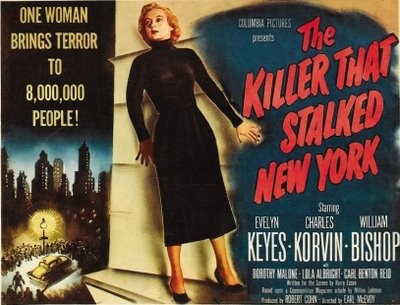
Immediately we're plunged into an Outbreak style medical drama dressed in Noir clothing with a scintillating narrative track that opens The Killer That Stalked New York. Shot entirely on location in New York City, the slightly tongue in cheek uncredited voice-over certainly feels Noir inspired as we meet a manipulated woman (Evelyn Keyes) whose two-timing husband has talked her into smuggling diamonds in from his native Cuba, unknowingly bringing back smallpox as well.

While Elia Kazan's far superior Panic in the Streets dealt with the same material in a much more compelling fashion, the misnomer of the title fools us from the start as we realize that Keyes is unaware that she's the infected epidemic-causing Killer Stalking the city that never sleeps.

Although it's initially gripping, director Earl McEvoy's film based on Milton Lehman's Cosmopolitan Magazine article about an actual epidemic in 1946, unfortunately turns screenwriter Harry Essex's promise of a diamond smuggling plot into nothing more than a propagandist horror film about the dangers of smallpox.


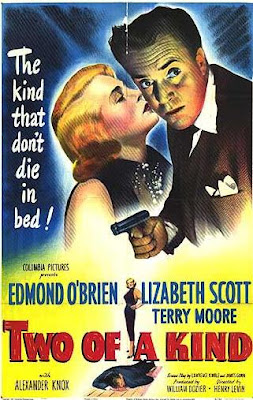
It must be a law in Film Noirdom that if you can't give somebody the nickname of Slim then Lefty is the immediately the fallback option when the beautiful but dangerous Lizabeth Scott goes on a diabolical hunt to find herself a missing heir to a fortune. Needing a man who could believably look like the estranged son of a wealthy couple, Scott's Brandy Kirby finds her man in former orphan turned small time racketeer ex-Navy man Lefty Farrell (Edmond O'Brien).


One of the few legitimate Noirs in the set, complete with all of the ingredients including Lefty, crackling dialogue like "if you see him, give him a little squeeze... around the neck," along with a love triangle and a double-cross, the remastered work which also arrives complete with an introduction from co-star Terry Moore is the perfect follow up to the previous New York dud.

A B-picture that is ranked as the B-picture as the second film on the first disc, Two of a Kind would've been the right one to open the set with, had Sony not decided that it'd be best to keep their actresses in order by leading you from a strong movie to a melodramatic one also starring Scott with Volume 1, Disc 2's introductory movie, Bad for Each Other.

Moving back into medical territory for better results than Stalked, the "nothing like Noir" effort Bad for Each Other finds top-notch Korean war vet surgeon Charlton Heston returning to the same dead-end mining town he grew up in, as the latest in a long line of men in his family who vowed to get out. Since Lefty was already taken, Heston becomes our handsome Slim who sends the society women's hearts all-a-flutter when he rescues a party girl from an attention-seeking suicidal gesture.

When Lizabeth Scott's divorcee extremely used to getting her way sets her sights on Slim's scalpel defined features, she makes him her pet project in this melodramatic morality tale of class verses medicine that, despite a solid early turn by Heston never sells us on his chemistry with Scott or the wrong-side-of-the-bedpan plot-line that today you could classify as Royal Pains meets How Green Was My Valley. While the inferior Stalked was at least in the ballpark of Noir, Bad feels like it belongs to the '40s women's weepie genre, despite its Bad Girl prerequisite.

And
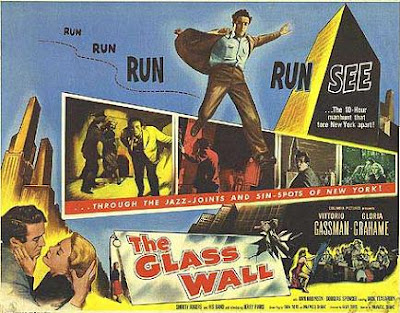
although she's willing to eat table scraps and try to steal a coat to stay alive, there's absolutely nothing bad about waif-like Gloria Grahame in the disc's best effort, the not-a-Noir, formerly 3-D immigration drama The Glass Wall that uses body doubles for its terrific docudrama overnight Times Square cinematography but gets away with it since the story is so good.


More a blend of the urgency of Sweet Smell of Success, near real-time dramas as it takes place in a single night, and Italian neorealism, it's easily the most emotionally riveting title in the film which makes an unlikely bookend to Stalked's back-story of a trip to Cuba with a down-on-his-luck character named Kuban.

In a phenomenal display of slow-motion circular camera work, we meet out unlikely lead whom, having lost his entire family to the Nazis, twenty-five year old Hungarian Peter Kuban (Vittorio Gassman) arrives illegally on our shores seeking a home, peace and shelter.

Illustrating the danger of returning home, while I couldn't help but ask why the whole misunderstanding couldn't have fallen under political asylum, Kuban tries to persuade officials that he's applicable for citizenship because he assisted in the Allied cause by rescuing an American soldier named Tom.

Escaping quarantine when all hope is lost and they're about to send him back home, Kuban does indeed become the man That Stalked New York, looking for the musician he rescued whose last name he doesn't know. And after helping Grahame break free when she attempts to steal a coat, she becomes one of Kuban's only friends during a long, complicated night spent evading the manhunt and hunting down the man who can vouch for his story.

With a nail-biting finale set at The Glass Wall a.k.a. the UN Building, although there's nothing Noir about the work or bad about Grahame beneath the surface, it was a terrific, forgotten B-picture that made me anxious to begin the second volume one could dub, the Cleo Moore collection instead of the misnomer title.

Featuring
the stunning, blonde B-movie actress in three very different films as one of Columbia's favorite "sexpots" of the era but in a distinctly "nice girl" way, Moore is sure to attract as many fans today as she did in her heyday, if you take in her three turns in One Girl's Confession, Women's Prison, and Over-Exposed. Although none of the films are Noir per se, the first title on the disc, Volume 2's opener, Night Editor definitely qualifies.

Nonetheless, it's bogged down by the claustrophobic set-up culled from its origins as a radio show wherein the Night Editor would relate a tale since-- in the film-- the eponymous editor isn't a major player at all. However, when you take the story down to its essence and ditch the editor construct, it's a feisty little B-thriller in need of a main character first person point-of-view and a new title.


When William Gargan and Janis Carter's characters witness a brutal murder on lover's lane, Carter's Jill Merrill begs her married police officer lover not to shoot or call it in since there's sure to be an investigation which would alert their spouses to their salacious relationship.

Yet when Gargan predictably gets called in to investigate the same homicide, he struggles with the idea that not only did he let a murderer go free but he also can't share what he knows with his colleagues without jeopardizing the people he loves.

A wicked premise that builds into some well-earned suspense, the moody Noir complete with Burnett Guffrey's sharp atmospheric cinematography makes you stay tuned even when the movie loses momentum by its halfway point.

The Cleo Moore trio offer us a chance to truly appreciate the underrated actress for her talent as opposed to simply the marketing bait she was often dangled as by Columbia in the '50s. A favorite of actor turned director Hugo Haas, whom as Leonard Maltin revealed made his works independently before major studios released them to the movie-going public, we first encounter Moore in a feature by the director that find her exploring what Sony deemed "his favorite themes of luck and fate."


With a life of Bronte proportions as a woman who spent her childhood in an orphanage and a convent until her deceased dad's crooked business partner felt she could "slave away" slinging dishes as a waitress at a seaside dive, it isn't long into the movie that Mary Adams (Moore) decides to exact revenge on her selfish boss by stealing twenty-five grand from him in the dead of night.

Confessing to the crime and happily going to jail for years, Mary is willing to sing like a canary about everything she did to make up for how much the man cheated her father out of back when he was alive with the major exception of telling anyone where the money is hidden.

While her fellow prisoners buckle under the pressure of incarceration, Mary flourishes, working in the garden and ensuring she's a model prisoner since she knows precisely how much money is waiting for her on the outside, if she can find a way to get it by shaking the cops.

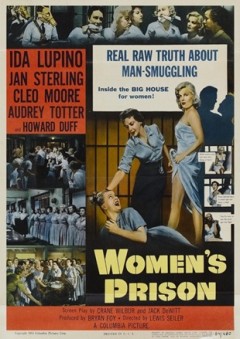
Engrossing and fast-paced, One Girl's Confession is the two volume set's strongest offering since The Glass Wall and because of the ingenious order of the films by Sony, endears Moore to us enough that we're not at all shocked to see her back in the penitentiary in the social consciousness cheese-fest Women's Prison.

Although Moore is terrific as a worldlier prisoner looking out for the weak new fish, she's no match for devious warden Ida Lupino who ensures that everything about their stay will fall under the heading of cruel and unusual until the inmates decide to teach her a lesson.


Completely unbelievable as prison is filmed as though it's a sorority or summer sleepaway camp with cheerful inmates and jokes, it's a giant misstep in the pacing of the quadruple feature that luckily is rectified by Prison director Lewis Seller's Over-Exposed.

Giving Moore her strongest chance to shine occurs in the final feature of the collection, from the start of this title, which like the previous three passes the land of Film Noir without stopping or collecting $200, we see a pattern of nearly finding the likable actress sent back in the clink. However, as a newcomer who allegedly and naively wound up at a clip joint, she's warned by the police that she needs to leave their fair community.

With only an evening dress to her name as all of her belongings are in a locker at the bus station, she makes the remarkably trusting decision to go home with an elderly photographer. However, his ability to ignore the usual male attraction while taking pictures of her modeling swimwear intrigues Moore enough to take up the trade herself after realizing she can make quite a good living at a rare career that allows women to succeed.

And with the old man as a mentor teaching her everything he knows about the art of photography and Moore showing him a thing or two about business, soon she's on her way as a top New York photographer, leaving her "good girl" image behind when she wanders into the gray area of blackmail to quicken her climb up the professional ladder.

While it's still hard to call her character a downright bad girl since Moore is simply a morally flexible opportunist who makes some bad judgment calls, the B-movie nonetheless gives her the chance that unfortunately not a lot of women labeled "buxom bombshells" had in the era of playing a character whose role didn't involve her making a fool out of herself for a man but instead trying to reach her dreams.

An imperfect picture but still one of the better titles in the lackluster collection, Over-Exposed makes us curious why Sony didn't offer a Cleo Moore set in the first place in order to bypass all of the misnomers to be found in the series description of Bad Girls of Film Noir. The set also including the original theatrical trailers for a majority of the films and two bonus shorts.

Of course, any time a studio reaches way back into their vault to remaster and distribute films that haven't seen the light of day since their theatrical release, film buffs should certainly rally around the effort. Yet at the same time, I'm not sure that these eight were the right ones to pair together under the right heading without a firmer grasp on just what Film Noir actually is, let alone making us question why on Earth anything would be called a Martini Movie.

Text ©2010, Film Intuition, LLC; All Rights Reserved. http://www.filmintuition.com
Unauthorized Reproduction or Publication Elsewhere is Strictly Prohibited and in violation of the Digital Millennium Copyright Act.

FTC Disclosure:
Per standard professional practice, I received a review copy of this title in order to evaluate it for my readers, which had no impact whatsoever on whether or not it received a favorable or unfavorable critique.

7/17/2009

DVD Review: Dark Streets (2008)


Now Available on Sony DVD


Get the Soundtrack


Delicious
Bookmark this on Delicious
submit to reddit
Print Page

Digg!

MovieBlips: vote it up!

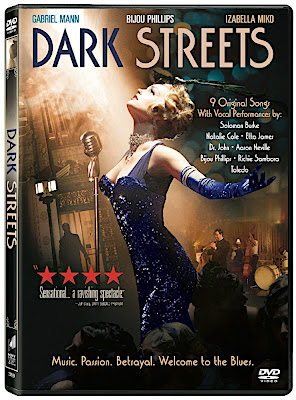
It seems that what happens in Vegas, stays in Vegas-- even when it comes to CineVegas where filmmaker Rachel Samuels received a 2008 Special Jury Prize for this-- her third feature film based on screenwriter Wallace King's adaptation of Glenn M. Stewart's play "City Club."


And perhaps the reason Dark Streets was such a hit in a city filled with so much sinful eye candy is precisely because that's exactly the type of film that Samuels made. Likewise, it's the style of musical I gravitate to with its classic film noir landscape of dark shadowy sidewalks and mysterious alleyways-- men dressed from head to toe in slanted fedoras complete with shoes so shiny you can see your face in them and women who are sassy, sexy, yet refreshingly smart wearing gowns that practically need to be sewn onto them directly with perfect red lips and chip free nail polish to match.


In fact, this is where the film's downfall comes in as the talent and beauty simply oozes off the screen in an overwhelming visceral feast for the senses that musical and noir junkies are sure to eat up on aesthetics alone... until that is, they realize that we're all following the wrong main character throughout the eighty-four minute running time, the screenplay makes little-- if any-- sense, and the last portion of the film derails completely into a strange hybrid of Moulin Rouge meets Inland Empire.


Still for a majority of the 1930s set work-- the areas of costume, makeup, production design, luscious cinematography, classy Fosse meets 30s choreographer from Rent brainchild Keith Young, and original music from such blues and jazz luminaries as B.B. King, Natalie Cole, Etta James, Richie Sambora, Aaron Neville and Dr. John keep us dazzled as the backdrop for a classic musical noir storyline.


Having recently inherited the Tower nightclub after his power company executive father died in mysterious circumstances, we're soon caught up in blandly inevitable love triangle involved when our leading man (played in all actuality by Gabriel Mann) casts aside his brunette headliner Crystal-- a talented cabaret singing sexy girl Friday (Bijou Phillips)-- in favor of a blonde and seemingly angelic chanteuse (Izabella Miko).

Although Mann struggles with a bad period mustache and an under-written role that's roughly on par to Michael Douglas sitting in the audience in A Chorus Line-- Phillips easily dominates her scenes and all of her numbers. While Samuels and her screenwriter try to throw a few red herrings into the film including some frequent power outages that Ebert, Cinematical and others have likened to possible Enron allegories and Mann's character does initially try to pursue what had happened to his father-- ultimately it never really pays off and we don't feel that invested in his plight.


In fact, I became far more fascinated wondering how much better the Dark Streets would have been if-- obviously in addition to a complete rewrite and just going for it with those tremendous show-stopping numbers-- perhaps Phillips' Crystal would've been the character we'd been following all along in the vein of more female-centric (or at least better gender-balanced) musicals like Chicago, Moulin Rouge and Cabaret.


Likewise, Mann's character's stupidity is infuriating as it doesn't take a rocket scientist to realize that something is definitely rotten in these Dark Streets when the blonde woman shows up shortly after his father's death when the indebted young man is asked to audition her by a shady police lieutenant friend (Elias Koteas).


Overall, Samuels has ultimately made a beautiful and passionate film of wasted potential-- that's essentially similar to a jazz or blues artist who squanders their promise not on the music but the fast lifestyle that the film's trailer, tagline, and synopsis promise. Although, honestly, given the amount of talent involved, I still think it could still be salvaged as one hell of a wonderful Broadway musical.

Yet much like a weekend in Vegas, it's an artistically imaginative and inspiring spectacle from a purely visual and auditory standpoint and something you'll have to see to believe but you probably won't want to return to often... when you realize that in the end, there's still no place like home or a narrative that makes sense.


Still, for those fellow musical buffs like yours truly that can't wait to scope it out-- you'll be happy to learn that it's been impeccably transferred on this Sony DVD that boasts director and cast commentary (which beats the uninspired dialogue but not the musical numbers so you'll want to switch it off for that) along with deleted scenes. Though, overall, for a superior movie from Sony about what it truly means to sing the blues-- check out last year's underrated Cadillac Records.


Text ©2009, Film Intuition, LLC; All Rights Reserved. http://www.filmintuition.com

Unauthorized Reproduction or Publication Elsewhere is Strictly Prohibited.