Showing posts with label Anthony Hopkins. Show all posts

4/29/2021

Movie Review: The Virtuoso (2021)


Now Available


As we watch him execute his target at the beginning of the largely lifeless “The Virtuoso,” Anson Mount's unnamed hitman regales us with tongue-twister levels of alliteration. In his clunky voice-over narration, Mount describes the tricks of his trade. This means that for professional killers hoping for pristine, precise hits, it’s of paramount procedure to follow the protocols of planning and position in order to persevere. I'm paraphrasing, of course, but as Mount punches those alliterative words with purpose – undoubtedly trying to make sense of it all – it's hard not to feel like you're getting hit in the face by the “P” key of an old-fashioned typewriter for how often they're used.

Following up one surgically precise assassination with a rushed hit that goes wrong almost as soon as it starts, writer James C. Wolf's “Virtuoso” screenplay loosens up after that. Abandoning the emphasis on “P,” as though one consequence of the botched job was to cause the pages of Wolf's thesaurus to become unstuck, we watch as our virtuoso killer is lured away from his rustic, self-imposed isolation in the woods by his trusted employer (a game yet wasted Anthony Hopkins).

Making a horrifying meal out of a matter-of-fact monologue about the time his character was ordered to slaughter men, women, and children in Vietnam, Hopkins proves why he and he alone is the film's true virtuoso. Dropping in like a veritable hired gun for a few scenes before he presumably goes off to work on grander fare like “The Father,” Hopkins is easily the best thing in this self-important mess of a B-movie.


Sending Mount on a cryptic assignment where the quarry is given a code name like he's The Riddler in a Batman movie, our virtuoso ventures to a country town in the middle of nowhere. After a chance run-in with a few suspicious strangers at a gas station, he suddenly finds himself in a diner full of shady figures he's supposed to covertly assess as potential targets. Forgetting his lofty voice-over protocols of planning and precision, illogically, Mount just starts running the code name past people, quickly becoming the most conspicuous man in town.

One of those films with classic or neo-noir ambitions that at times you think might've been attempting to strive for “Key Largo” or even “Identity” like atmosphere and tension with its ensemble cast of characters in a small setting, the most surprising thing about director Nick Stagliano's muted, muddied “Virtuoso” is just how unsurprising it is from start to finish.

Almost as soon as one particular stranger is introduced, genre conventions tell you precisely where this thing is headed and like its hitman (well, in the first hit anyway) it doesn't deviate from its plan. Saddled with wooden dialogue and zero chemistry between the leads, “The Virtuoso” spends the rest of its 110 minute running time trying to make you believe another twist is coming. Sadly, it doesn't take long to realize that, despite the film's allusions to the contrary, Mount's visibly bored main character is many things but a virtuoso is not one of them.


Hoping to stack the deck, the movie is loaded with terrific character actors like the aforementioned Hopkins as well as Abbie Cornish, Eddie Marsan, and David Morse, some of whom appear for only the briefest of scenes to hopefully follow Hopkins' lead to show up, do the work, collect the paycheck, and get the hell out.

Still, whether it's with its talented cast, the film's few bursts of violence, or its near-bookended, gratuitously clinical depictions of nudity/sex which only call attention to themselves, no matter how hard “The Virtuoso” tries to command our attention, it's impossible to camouflage just how dull it is overall.

Bowing into theaters in some markets (including Phoenix) only five days after Hopkins garnered his second Oscar and four days before it bows onto DVD and Blu-ray, since curiosity over Hopkins' involvement is sure to drive some people to see this on the big screen, the timing of the film couldn't be better. Reinforcing Mount's words about the importance of his many professional “P”'s, what “The Virtuoso” lacks in pristine precision, its marketing team more than makes up for with their plan to persevere with a little help from gold.
 

Text ©2021, Film Intuition, LLC; All Rights Reserved. https://www.filmintuition.com  Unauthorized Reproduction or Publication Elsewhere is Strictly Prohibited and in violation of the Digital Millennium Copyright Act.  Also, as an Amazon Associate, I earn from qualifying purchases made off my site through ad links. FTC Disclosure: Per standard professional practice, I may have received a review copy or screener link of this title to voluntarily decide to evaluate it for my readers, which had no impact whatsoever on whether or not it received a favorable or unfavorable critique. Cookies Notice: This site incorporates tools (including advertiser partners and widgets) that use cookies and may collect some personal information to display ads tailored to you etc. Please be advised that neither Film Intuition nor its site owner has any access to this data beyond general site statistics (geographical region etc.) as your privacy is our main concern.

7/20/2009

Blu-ray Review: Fracture (2007)


New to Warner Brothers Blu-ray


Already Available on DVD


Production Photo & Poster Slideshow


Delicious
Bookmark this on Delicious
submit to reddit
Print Page

Digg!

MovieBlips: vote it up!

Tying in with the New Line Cinema release of director Gregory Hoblit's Fracture-- Entertainment Weekly purported in their original 2007 review upon the film's release that if Ryan Gosling wasn’t careful, he was going to become a movie star.


And while at the time that was as true as it was when The Notebook charmer turned in his amazing Oscar nominated performance in Half Nelson-- in all actuality, the man who may want to be careful in Fracture is Oscar winner Anthony Hopkins. For Hopkins has not only cornered the market on playing creepy killers-- as even the name "Clarice" cannot be uttered without hearing him slither it in character off his tongue in Silence of the Lambs-- but if he isn’t careful, he’s going to become typecast to the point that those roles are all that he’s offered.


This being said, he plays the privileged sociopaths with superiority complexes better than most actors around and such is the case in Fracture which finds Hopkins at his devious and pretentious best.


When we first catch a glimpse of Hopkins as structural engineer Ted Crawford who at the start of the film follows his beautiful younger wife Jennifer (Embeth Davidtz) during her extramarital tryst with police Lieutenant Robert Nunallay (Billy Burke), we just know that a cold blooded murder won't be too far along.


Yet instead of the passionate Film Noir variety, Hopkins' egomaniacal Crawford will exact his revenge coolly, clinically, and in a way that would've made even Hannibal Lecter proud.


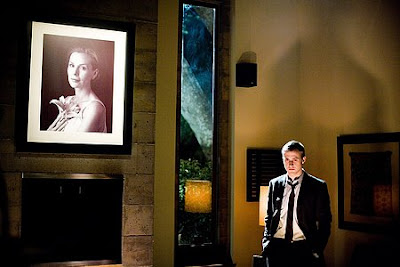
Thus preferring murder most simple as it were-- to the Jerry Springer styled theatrics of confronting the lovely Davidtz (whose portrait hangs in the house as an homage to Otto Preminger's Laura) directly-- Crawford waits until his wife returns later in the evening and puts a bullet in her brain.


And he takes this several steps further, later confessing to the crime when Nunally comes to the house only to find his lover shot-- having failed to realize exactly whom the woman he met for idyllic poolside trysts actually was given their Hitchockian Mr. and Mrs. Smith aliases (a nod to the film about a couple that learns they were never really married).


The homicide of Mrs. Crawford seems like an open and shut case when it’s given to young, talented prosecutor Willy Beachum (Gosling) who is eager to leave his ninety-seven percent conviction rate earning minor paydays for the city of Los Angeles to become a climbing, wealthy attorney at an exclusive law firm where he’s offered a prestigious position.

However, this last case proves to be quite upsetting when Crawford opts to serve as his own attorney, waiting for the chance to discredit Officer Nunally and challenge the hotshot Beachum whose weakness for success and self-centered tunnel vision may be his downfall to the man's great pleasure as Crawford discovers Beachum's vain Achilles heel upon first glance when their initial meeting in court coincides with Beachum in a tuxedo-- no less-- on his way to attending an opera charity gala for his new firm.


While too much time is wasted on a trite subplot as Beachum finds himself falling for his lovely boss played by Pride and Prejudice's Rosamund Pike who is given no favors in being offered the metaphorical role of "the bad angel" sitting on the selfish Beachum's shoulder and therefore-- hiding beneath all of her beauty and shine-- the reason he went into criminal law in the first place, it's still quite gripping throughout.


Likewise, although director Hoblit manages to pull the wool over our eyes numerous times with twists throughout, two of the major “surprises” are fairly easy to predict to audience members who have seen more than a couple of legal thrillers, including Hoblit’s masterpiece Primal Fear starring Richard Gere and Edward Norton.


However, having viewed both Fear and Fracture again in Blu-ray for review within the span of months, I've realized something interesting. While Fear I'd still call the masterpiece since it's an undeniable one-man actor's showcase for Edward Norton whose performance alone made that movie work (even though we realize there are more than a few gaps in logic), viewing Fracture again for review two years later provided surprising results.


This time around, I discovered that-- although again, I felt that the romantic subplot should've been axed completely and despite his amazing talent Gosling is a tad young for his role-- it's honestly Fracture that has the far more intellectually satisfying screenplay in comparison to Primal Fear.

Demanding more of its audience that just giving us a method actor version of a magic trick (although Norton's in particular still works just as well nearly fifteen years later), the wondrous brilliance of Fracture is that we watch the crime occur, we're given all of the puzzle pieces. Moreover, we're fully along with Beachum and just as frustrated by the case as he is especially considering that despite Crawford's candid, in-your-face confession of essentially "I killed my wife," the underscore is "now prove it," and it seems damn near impossible to do so.


Screenwriters Daniel Pyne and Glenn Gers must be commended for their ability to impressively weave such an amazingly tense yarn worthy of any Agatha Christie novel but it goes against the tired mystery paradigm by simply taking away one piece and is bold enough to reveal everything from motive to weapon to details all the way.

Moreover, despite the fact that it's usually a bad sign when the cast is called back for rewrites to redo the ending two additional times after poor preview screening reactions-- now with this Blu-ray-- we get the chance to see the genius of the script at work as the film's roughly eleven minute ending evolves into something far more finely tuned. And in doing so, I realized that they never lost the essence of what they ultimately wanted to convey in the finale.


Although Gosling's character's actions are much more audacious and a bit unbelievable in the two alternates which makes it seem darker and Cloak and Daggers-like--coupled with overly dramatic and demonstrative post-production choices that complicate the denouement to almost nonsensical effect-- it's awesome as a writer to see the way some pieces were scrapped and others were kept to make the ending as dynamic as the one contained in the final cut.

While the Blu-ray also contains deleted and additional/extended scenes not used in the final print, unfortunately unlike Paramount Home Entertainment's recent release of Primal Fear, there are no featurettes or commentary tracks to savor the memorable meeting of minds.


The picture is impressive throughout considering how new the print is without a trace of grain or any artifacting nor some of the dullness in the evening scenes or sequences with a lot of grays, midnight blues, deep blacks, and rich browns which have been a past hurdle for WB with some of their newest releases including the disappointing DVD transfers of The Dark Knight and Yes Man.


However, those titles definitely out performed Fracture in the audio department (if not visually) since the sound balance was way off throughout with music that screamed through the speakers but the quiet near-mumbling style of Gosling and Hopkins at times made me increase the volume near the 60 or 70 mark just to try and faintly make it out.

Still, despite the lack of bonus features and struggles with sound, it's a recommended title overall as Fracture-- in addition to being a brainy and impressive film-- is worthwhile even simply for lovers of great acting just to relish in the sheer pleasure to be derived in witnessing two superb talents go head to head... even if I wish Hopkins would maybe take a step back towards Remains of the Day every now and then.


Text ©2009, Film Intuition, LLC; All Rights Reserved. http://www.filmintuition.com

Unauthorized Reproduction or Publication Elsewhere is Strictly Prohibited.

3/17/2008

Slipstream

Director: Anthony Hopkins

“I perceive life as a game, a game that we play at some unconscious level,” Anthony Hopkins explained to journalist Scott Macaulay in the Fall 2007 Filmmaker Magazine article “The Hollywood Life” which chronicled his latest experimental puzzler Slipstream from its birth as a stream-of-consciousness screenplay to its wild shoot and inventive post-production that found Oscar winning Anthony Hopkins both in front of the camera and behind it serving as the writer/director/star and film score composer as well.

While the film, which explores “the strange nature of time” is a wild opus purposely created to “annoy the audience” as the actor explained may be his own version of a game, the question then becomes in asking whether or not viewers will want to take part as, like Mulholland Drive, Inland Empire, 8 & ½ and Last Year in Marienbad, it infuriates its audience with constant shifts in plot, character, and text that continually build on itself until we realize that it’s a film within a film within a film just like our main character, the “film’s” screenwriter Felix Bonhoeffer (Hopkins) is, as Vince Vaughn may have said in Swingers, the guy behind the guy behind the guy. Although Felix is perceived to be a main character, the film focuses instead on several others as the movie begins and we meet Michael Clarke Duncan as a bouncer of sorts and two villains played by Jeffrey Tambor and Christian Slater who decide to hold up a diner, not for any monetary gain, but just for the sake of menace as Tambor and Slater ramble out an increasingly crazy story about the 50’s film Invasion of the Body Snatchers and Slater’s typical Jack Nicholson styled cadence becomes far more frightening with each passing minute. Then, as soon as we’re beginning to grasp this nonsensical storyline, a “cut” is yelled and we’re taken behind the scenes of a sloppy film shoot in the desert that will soon find one actor dead and the rest all struggling to figure out how that will affect the film, with studio head John Turturro (given a majority of the picture’s best lines) arriving on the scene like a domineering madman.

Filled with Hollywood in-jokes as Turturro’s character named Harvey seems on some level to be a nod to the controversial tactics and persona of former Miramax head Harvey Weinstein, an off-screen phone call from “Dino” (De Laurentis) about casting Hopkins in Hannibal 4 as long as the price is right and a joke about films being cheesy dreams that can find Huckleberry Finn fishing on the moon similar to the image used as the Dreamworks logo. In addition, Hopkins casts his wife and the film’s producer Stella Arroyave as Gina, the wife of his character Felix and soon the film morphs from an Altman styled Player satire of the film business into one concerned with the past and of how characters came to be where they are in the face of their own mortality.

While an indisputable vanity project and one that will have most viewers reaching for the eject button within the first half an hour, it’s still an artistically imaginative ride for those willing to participate and while it’s nowhere near as effective as the films its emulating such as Marienbad or as I began to feel, literature from Kafka or Calvino, it’s of particular interest to film students who appreciate the amount of work that goes into experimental filmmaking and even more, the amount of dedication and artistry from those involved. Instead of being Hopkins’s film all the way, in the end, the real star of Slipstream and the one responsible for a large majority of its moderate success as a valuable work is the courageous editor Michael Miller who not only respected Hopkins’ vision but also added a dazzling sense of style to the picture giving it a feeling of more depth at times than it actually deserves in the process.

9/26/2007

Movie Review: Fracture (2007)


New to Warner Brothers Blu-ray


Already Available on DVD


Production Photo & Poster Slideshow


Director: Gregory Hoblit

Entertainment Weekly stated in their review of Fracture that if Ryan Gosling isn’t careful, he’s going to become a movie star. While that is as true as it was when he turned in his amazing Oscar nominated performance in Half Nelson, the man who may want to be careful in Fracture is Oscar winner Anthony Hopkins who has not only cornered the market on playing creepy killers but if he isn’t careful, he’s going to become typecast to the point that those roles are all that he’s offered. This being said, he plays the privileged sociopaths with superiority complexes better than most actors around and such is the case in Fracture which finds Hopkins at his devious and pretentious best as structural engineer Ted Crawford who at the start of the film follows his beautiful younger wife Jennifer (Embeth Davidtz) during her extramarital tryst with police Lieutenant Robert Nunallay (Billy Burke). Preferring murder to Jerry Springer styled theatrics, Crawford waits until his wife returns later in the evening and puts a bullet in her brain, later confessing to the crime when Nunally comes to the house only to find his lover shot. It seems like an open and shut case when it’s given to young, talented prosecutor Willy Beachum (Gosling) who is eager to leave his ninety-seven percent conviction rate earning minor paydays for the city of Los Angeles to become a climbing, wealthy attorney at an exclusive law firm where he’s offered a job. However, this last case proves to be quite upsetting when Crawford opts to serve as his own attorney, waiting for the chance to discredit Officer Nunally and challenge the hotshot Beachum whose weakness for success and self-centered tunnel vision may be his downfall. Although director Hoblit manages to pull the wool over our eyes numerous times with twists throughout, two of the major “surprises” are fairly easy to predict to audience members who have seen more than a couple of legal thrillers, including Hoblit’s masterpiece Primal Fear starring Richard Gere and Edward Norton. Still, like Fear, Fracture is memorable and worthwhile (at the time of this review it has an overwhelming fresh rating on Rotten Tomatoes) simply for lovers of great acting for the sheer pleasure to be derived in watching two superb talents go head to head.