Showing posts with label Male Bonding. Show all posts

11/09/2008

DVD Review: Tropic Thunder-- 2 Disc Director's Cut


Hitting DVD & Blu-Ray on November 18

Order It Today


Read the Original Soundtrack Review

Read the Original Theatrical Review


Digg!


In honor of November 18th's DVD & Blu-ray release of the Ben Stiller's summer comedy Tropic Thunder, I'm offering you an insider's view of the DVD that DreamWorks and Paramount Pictures Home Entertainment were kind enough to send my way. However, before I go into the DVD features, first I'll serve up the first four paragraphs of my original theatrical review of Tropic Thunder, originally published on August 13, 2008.


Tropic Thunder


Director:

Ben Stiller

Former highbrow theatrical director turned filmmaker Damien Cockburn (Steve Coogan) is in trouble. When the explosives expert (Pineapple Express scene stealer Danny McBride) working on his big budget Vietnam epic film debut misinterprets Cockburn’s temper tantrum for a cue, four million dollars in explosives are wasted, everything is blown to smithereens, and the worst thing is that the camera wasn’t even rolling. Unable to control the actors on his set and already one month behind schedule after just five days of shooting, the British thespian is soon punched in the face very hard by a grip, upon orders shouted via webcam by sleazy studio boss Les Grossman (a hilarious and nearly unrecognizable Tom Cruise).

Out of desperation, he turns to Nick Nolte’s Four Leaf Tayback, the former Vietnam soldier who wrote the book they are adapting — not to mention the type soldier who may not have gotten the memo that the war is over. Visibly relishing his role, Nolte’s Tayback is often framed in a corner spouting off sentence fragments and irrational, obscenity-laced anecdotes that frighten and amuse all at the same time. Advising the mild-mannered Brit to get the actors “off the f***in’ grid” and into “the s***,” Cockburn heeds Tayback’s advice. With the hope that improvisational filmmaking will get the movie back on track, he sets up his “own little personal slice of ‘Nam.”

However, shortly after depositing his cast of five diverse leads deep into the heart of the jungle in order to show his pampered actors he’s really running the show, things go terribly, shockingly wrong. And soon enough the cast find themselves in a real life mini-war of their own when instead of guerilla filmmaking, the men become the target of heroin-trafficking guerillas who’ve mistaken them for DEA soldiers (yeah, I didn’t get that either). Obviously, this proves to be much more than the actors can handle, as they’d signed on with their contractual clauses for perks like gift baskets, TiVo, and luxury items, only to find themselves dodging bullets instead.


Heading up the group is Tropic Thunder’s director and co-writer Ben Stiller as Tugg Speedman, a has-been, Rambo-styled action star whose most recent film wherein he played a mentally challenged character — Simple Jack — not only ruined his career but was also named one of the worst films of all time. With his barefooted agent (Matthew McConaughey) behind him, Speedman tries to get back into Hollywood’s spotlight but is worried he’ll be upstaged by his costar, the five time Oscar winner Kirk Lazarus (Robert Downey Jr. channeling Russell Crowe), an Australian method actor so committed to his craft that he underwent skin pigmentation surgery in order to play an African-American for Cockburn’s film..."

Click Here to Read the Entire Review


The 2-Disc Director's Cut DVD


Although it's dubbed the "director's cut," I couldn't honestly tell a distinct difference between the theatrical version of Tropic Thunder with the feature film presented on the first disc of this set. Yet, for true fans of the movie and those interested in filmmaking in general, the 2-Disc set is ideal with Stiller providing enough added hilarity and down and dirty, gritty behind-the-scenes movie-making 101 examples to make it a terrific investment.

Offering audiences the chance to watch the film with two different commentary tracks including one consisting of the more creative and technical side from the filmmakers of Thunder-- the second track is the more free-wheeling DVD commentary offered up by the cast, including Downey who joked in the film that he doesn't break character until he's recorded the DVD commentary.


Also, perhaps to answer the bad press the movie received shortly before its premiere regarding the "Simple Jack" controversy as Stiller's action movie character Tugg Speedman had recently played a mentally challenged man resulting in a few instances in the film where the word "retarded" is bantered about (more to poke fun at Hollywood ego and industry exploitation than anything else)), there is a quality Public Service Announcement added onto Disc 1 wherein the tagline promises that the only "R" word those with intellectual disabilities deserve is "respect." While it feels a bit forced, it's a worthwhile sentiment and actually should've possibly played before the film as one of the many commercials or trailers as opposed to being buried in a separate menu of Thunder's first disc.

However, fans can rejoice in Thunder mania that fills the entirety of the second disc as we discover co-writer, director and star Ben Stiller's passion for his screenplay that dates back twenty years. In "Before the Thunder," Stiller notes that while he was busy making one of his first and most important screen appearances in a bit part in Spielberg's Empire of the Sun, most of his friends were auditioning for the war movies that were incredibly popular in the late 80's such as Platoon and Hamburger Hill. Noting the ridiculousness of actors who shared with him that their two week boot camp really helped them get into character and bond, Stiller became inspired by the absurdity of pampered actors not realizing how very different it is to actually be in a war as opposed to a movie about war and initially toyed with the premise of a group of actors returning from movie boot camp with post-traumatic stress disorder.

Upon realizing that he just couldn't find away to make it work comically, he set it aside until ten years later when he and actor Justin Theroux (Charlies Angels 2, Mulholland Drive) began e-mailing back and forth various scenes they wrote in the hopes of keeping each other laughing. It's easy to get caught up in Stiller's twenty year passion with Thunder's excellently packaged DVD set as we go into each and every extra which run the gamut from standard "pat each other on the back" electronic press kit generic enthusiasm to some truly hilarious and inventive additions including a fake Apocalypse Now/Heart of Darkness styled documentary called "Rain of Madness" which chronicles the fake "movie within the movie" and another similar bonus dubbed "Dispatches from the Edge of Madness."


In numerous candid behind-the-scenes interviews and clips including original videotapes from the auditions and various tests, we discover just how damn funny the film's straight man played by Jay Baruchel actually is as we glimpse the film's epic table reading and the way that Downey managed to just launch into his character head-first in a way that made Baruchel share that, "I hadn't laughed this much since Dick Cheney shot that guy in the face." With Downey admitting that they aren't satirizing Hollywood on the same level as Altman's brilliant Player by joking that "we're kind of destroying any leg [we have] to stand on in the future," in Stiller's lampoon styled "love letter to what we do," we realize just how much effort was put into making the comical film look so professional.


In "The Hot LZ," "Blowing Shit Up," "Designing the Thunder," and more, we witness some of the epic undertakings by Stiller and company, whether it's creating a cinematic compilation mix tape of their favorite war scenes for the epic opening sequence which took three weeks and fifty stuntmen to shoot or gauging the level of explosion offered up by the special effects man who Stiller says may be "slightly insane but in a good way," during the incredibly complicated shoot by veteran 2-time Oscar winning cinematographer John Toll (Legends of the Fall, Braveheart, Thin Red Line).


In an entertaining special feature dedicated to "The Cast of the Thunder" which is broken down by the last name of each actor, the cast members riff on their own characters as well as their cast-mates discussing what must have been a creatively freeing shoot filled with improvisation and laughter as well as interesting surprises as the American Humane Association handler for Bertha the water buffalo that carries Jack Black unexpectedly delivered a baby that they named after the comedic actor.


Also including deleted and extended scenes as well as "full mags," to illustrate the number of choices that were made by Stiller and his editor, we finally discover just what happens to Matthew McConaughey's character at the end of the film and learn that the scene stealing dance by a nearly unrecognizable Tom Cruise was the brainchild of Cruise himself, who impulsively started dancing without music during a makeup test.

Featuring promotional material as well-- one amusing bonus consisted of a great MTV Movie Awards promotional spoof as Stiller, Black and Downey all toy with each other's egos by trying to figure out the best way to sell their movie. While it's nearly impossible to absorb the plethora of features included on the disc or listen to all of the available and optional commentary, the 2-Disc Director's Cut really makes one appreciate Thunder on an entirely different level.


Moreover, it makes one realize just how easy it is to overlook the master craftsmanship behind everything as we're far too busy laughing at the performances to fully appreciate the effects, production design and stunning cinematography that makes it seem nearly as authentic as the films it references, even so much as to set up the DVD menus as though we were getting ready to watch Platoon or Apocalypse Now. Of course, once the movie begins with fake ads for "The Fatties" and "Booty Sweat," we realize we aren't exactly in Oliver Stone territory... but it's always nice to escape the realities of war by laughing at men rushing out to go fake one.


10/20/2008

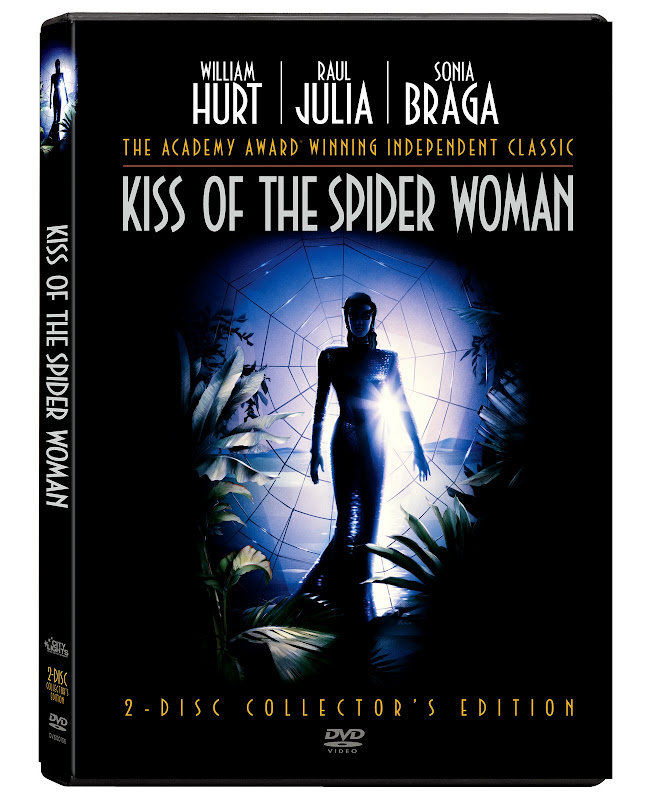
Kiss of the Spider Woman (1985)


Digg!

If there is one thing we've discovered over our far too frequently violent and tragic global history it's that human beings are resilient creatures. Equally capable of conducting acts of the most astounding cruelty or ones that are the most selflessly compassionate-- the human race has managed to withstand some truly unspeakable events carried out by their fellow man. "What doesn't kill us only makes us stronger," has become not just a cliche but an oft-cited justification that helps us cope, similar to the athlete's chant of "no pain, no gain," or the argument that tragedy builds character.

While some cling to faith and others to memories, no matter what form comprises the coping mechanism of any individual, the bottom line is that although history has found us tortured and enslaved, our saving grace has been in the limitless potential of the human mind. Simply put, you can't handcuff one's thoughts, chain someone's dreams, lock up their hopes, or torture their memory.

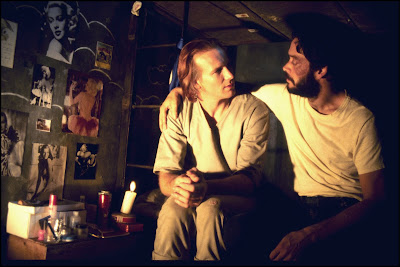
In the Oscar winning film Life is Beautiful, Roberto Benigni uses his penchant for creativity to try and hide the horrors of the Holocaust from his son as they spend their days in a labor camp and likewise, in director Hector Babenco's landmark 1985 independent classic, Kiss of the Spider Woman, William Hurt's character, Molina escapes from his imprisonment in an unspecified Latin American country by recalling the plots of old movies. In the beginning of the film, based on Manuel Puig's novel and adapted by screenwriter Leonard Schrader (the brother of fellow writer/director Paul Schrader), we're introduced to the effeminate Molina as he begins chronicling the story of "the most ravishing woman in the world" who kept men at a distance no matter how lonely she'd get.

Shortly after Hurt begins the opening monologue of his Oscar winning role, we realize that instead of seeing the man on a stage--which feels like it would be far more natural-- Molina is sharing a cell with fellow prisoner, Valentin (Raul Julia). Although Molina has been locked up for corrupting a minor in a homosexual affair, Valentin is a political prisoner who fears for his girlfriend living life on the outside as a part of the underground movement hoping to overthrow the corrupt government that's tortured, vanished, and murdered so many of his fellow citizens.

While at first, the macho Valentin and the gay former department store window dresser Molina struggle to get along with Valentin rudely growing annoyed with Molina's unceasing storytelling of old film plots. However, soon he begins to depend on them to pass the time. Although he advises his cell-mate not to include erotic descriptions of naked women or conversations about food, given his inability to access either, soon Julia's Valentin becomes engrossed in the tale, imagining the story by picturing his own true love, played by Sonia Braga in Molina's narrativse.

The first independent film to receive the top four Oscar nominations including Best Picture and Best Director, Kiss of the Spider Woman finally makes its DVD and Blu-ray debut in a gorgeous 2-disc transfer from City Lights Home Entertainment on 10/21/08.

A passionate celebration of humanity, tolerance, and the fight for survival, it pulls the viewer in a number of directions one wouldn't see coming. While it begins as a near chamber piece centering solely on the two men whom we quickly realize will eventually learn to appreciate one another, it moves into surprising terrain roughly midway through upon discovering a new plot twist that changes everything that has come before it.

As the men begin to have such a profound effect on one another, we realize that they may be exchanging characteristics as well as Valentin's bravery and devotion to something bigger begin to influence Molina and likewise, Molina's sensitivity, compassion and tendency to want to escape mentally begin to find their way into Valentin's psyche.


Although it's become one of the most highly regarded works of its time and seems impossible to consider anything to the contrary, further research revealed that originally the two men had been cast in each other's roles but during the rehearsals for the film, they experimented with playing the opposite part, discovering that they truly belonged in the roles they hadn't been given. Reportedly working for just the price of their air tickets and Brazilian hotel bills during the Sao Paulo shoot, the two men and Sonia Braga (who had to recite her lines phonetically as she was unfamiliar with the English language) crafted a true independent classic that, despite being dubbed "as a gay Casablanca" by The San Francisco Chronicle helped spawn a successful Broadway show and continues to reach fans across the world in book, cinematic, play and musical form.

Additionally including the "never-before-seen" feature length documentary Tangled Web: Making Kiss of the Spider Woman on the second disc of the DVD set, it also offers a mini-documentary with original author Manuel Puig, a featurette on the Broadway adaptation, over 150 images in a DVD photo gallery and a "Slide Show Commentary: Transition from Novel to Film," the loaded set is a must for fans looking to explore the film again from a variety of different insider's perspectives in a stunningly beautiful digital transfer.

And as Chronicle writer Bob Graham noted, "people who see the film will realize, along with Valentin, that they like being told stories," however, when it comes to Hurt and Julia's masterful web, they'll realize that this is a story that is impossible to predict and must be witnessed firsthand to appreciate, as this reviewer did, taking in the movie for the first time.


10/16/2008

TV on DVD: Adam 12-- Season 2


Digg!

Film Intuition Log #1:
"One Adam-12, One Adam-12: Seasons 3-7, Please Report to DVD."


Whether they're volunteering alongside school children in preparation for the local Police Olympics or taking on a biker gang while on a picnic, veteran officer Pete Malloy (Martin Milner) and probationary rookie Jim Reed (Kent McCord) are able to downshift from everyman to crime-fighting men in blue in a moment's notice.

Created and produced by legendary television visionary Jack Webb as an NBC spin-off from his wildly popular police procedural series Dragnet, "one Adam-12" became the new catchphrase following Dragnet's popular "just the facts, ma'am," tagline and while it seeped quickly into American culture, it was as deeply rooted in authenticity as its predecessor. Although partially filmed in the Universal Studios back-lot, outdoor filming also occurred in Toluca Lake, Studio City, North Hollywood, and Hollywood Hills as well as the then "newly completed Rampart Division station of the Los Angeles Police Department." Additionally, the secret to Adam-12's success was in its strict attention to detail as it featured "department issue badges, vehicles, and Los Angeles patrol stations" during its "seven season run... from 1968-1975," according to the official press release. Similar to Dragnet, the show's complicated plots were derived from actual LAPD cases, yet Adam-12 revealed an unprecedented grittiness in its depiction, ushering in a new far more dangerous era of policing as the show revealed the beginnings of the S.W.A.T. division, an increase in helicopter patrol, and the latest technology that we now take for granted.


While I feared it would seem hopelessly dated by today's standards, especially as a viewer who'd never seen the series before, I found myself quickly engrossed in the newly releasedwo-disc Season 2 DVD set from Shout! Factory and the way that, although methodology has changed, some of it still holds so true today. And while it opens with a slightly dull and less-than-action packed episode, it serves as an important introduction to those such as myself who'd been unacquainted with the original as we become familiar with the dedicated, gifted veteran and lifelong bachelor Malloy and his young overly eager Boy Scout like trainee Jim Reed who has a far more natural way with people but matures considerably under his partner's tutelage.

Notably switching gears from its opener-- perhaps crafted specifically to draw in audiences who may have missed the first season-- we're soon entrenched in the increasingly dangerous adventures the two ordinary men find themselves in as they track a serial rapist and murderer preying on young beautiful female hitchhikers around lover's lane. As is frequently the case throughout the series, Reed and Malloy must endure the constant scrutiny of the public who overstep their bounds throughout-- either trying to antagonize the officers, getting in the way, or causing quite a stir. When some of the situations prove far too much for young Reed-- a devoted husband and father to be-- such as when he arrests his first sex offender, Malloy is warned to reign in his partner who has less than one year on the force as Reed finds it hard to keep it together in a world where people who prey on children breathe the same air.

Fully humanizing the officers and doing much to fight stereotypes of both the officers (and diverse civilians), the two manage to always maintain integrity even when they're put in the most dire situations as Reed is threatened by a man who swears he'll get him once he's released from jail and Malloy finds himself held hostage when he wanders into the wrong restaurant for lunch.

With a natural antenna and a cop's intuition that only years of service can create, Malloy (Milner) continues to amaze such as when he notices that a local shopkeeper who'd never taken a day off in his life is suddenly nowhere to be seen as they cruise down the street in their Plymouth Belvedere and Kent McCord (as Reed) plays off of him well. Fearless and willing to try anything from hearing a baby crying and venturing into an apartment that's rumored to have a lion in it or assisting a young neighbor kid who returned home from a party on drugs, Reed and Malloy balance each other out.

Predictably, they develop a mental shorthand that's fun to watch as they exchange amused glances when faced with an overly chatty colleague, must try and stop a frightening sniper, deal with an elderly man who's tired of his wife's disruptive karate practice or trying to figure out how they could intervene when a man steals an airplane for a joyride and Reed deadpans, "What do ya do-- pull 'em over to the nearest cloud?"


With some events that have to be seen to be believed which makes it all the more riveting when you realize it's all strictly taken from "just the facts" as their Dragnet contemporaries would've said, perhaps its greatest legacy is upon discovering that episodes from both shows "have been used for training purposes by police academies in the United States, especially when teaching recruits correct handcuffing procedures" as well as the accurate depiction of "hand signals used by officers... to the methods used in field interviews, and even such minor details as routinely locking the doors of the patrol car before leaving it unattended to interview victims or witnesses."

In a New York University doctoral study conducted in 1976 by Joesph S. Coppolino, he concluded that not only did Adam-12 excel in its correct portrayals "as realistically reflecting police work" but also noted that the show influenced the way police officers acted as well, as Wikipedia further noted that since the series was the first to show arrestees being given the new Miranda Warning, suspects "would correct actual officers... [who] used a slightly different wording."

And although, like most civilians, I assumed that the catchy "one Adam-12" dispatch call that opened every show referenced Malloy and Reed directly, I realized upon further research that it broke down as one (their Central Division or Rampart Division location, Adam in revealing they were a two man patrol and twelve to referencing their precise beat. Likewise, I was thrilled to discover that the 2-Disc DVD set comes complete with two catchy, free Adam-12 ringtones so that you can experience the dispatch call for yourself, if your cell phone is compatible.

View One Version of the Opening Credits


Complete with actual LAPD commentary, a historic police based photo gallery, a "Ride Along Fact Track" and "Tour of Reed & Malloy's Training Center," the fast-paced and addictive twenty-six episodes of Season 2 may all run roughly 22 minutes each but they pack enough drama for a show twice its length. Police procedural television at its best and minus all of the grotesque violence and gratuitous Dennis Franz nudity of 90's shows, Adam-12 offers a wonderfully retro trip back in time as we ride-along with the endlessly hardworking Reed and Malloy who spend every waking minute doing their best to clean up the city of Angels.


9/16/2008

The Jaguar


You'd have more fun in a Gremlin.


Digg!

“Indian magic is no holiday,” Jean Campana (Jean Reno) exclaims nearly midway into writer/director Francis Veber’s mirthless comedy, The Jaguar. And boy, it turns out that he wasn’t kidding. Veber, a master at unlikely buddy comedies and mistaken identities for more than three decades of filmmaking (including La Cage Aux Folles, La Chevre, Le Grand Blond Avec Une Chaussure Noire, and Les Compères) has provided endless fodder for American remakes (respectively The Birdcage, Pure Luck, The Man With One Red Shoe, and Father’s Day). Unfortunately, he misses the mark in his last action/comedy before he again found his footing with a string of popular hits such as The Dinner Game, The Closet, and The Valet (all of which have been subject to remake rumors and contracts).

It’s highly unlikely an American version of The Jaguar will ever see the light of day and frankly, director Veber would probably be the first one to admit that that’s for the best. While sitting down with IndieWire reporter Brandon Judell several years back to discuss The Closet, he admitted that not only did the film-- originally titled Le Jaguar-- fail to earn a stateside release but also he confessed that, “it was not very good.”

Sadly, that’s an understatement as this excruciatingly bizarre mixture of several half-baked plots combusts about thirty minutes into its roughly ninety-minute running time, making the last hour a test of one’s endurance to withstand indisputable trash of the highest order. Veber himself pinpointed the problem directly, arguing that, “when I try to make films that look like American films, they’re not interesting. I tried that. I tried to make an action movie, and we’re not gifted for that. You are better than us in that area.” By noting the cultural differences in filmmaking in France verses America, he does offer an ingenious hypothetical, saying that “if we could mix the systems, having this intellectual approach that the French have and having this entertaining obligation that the Americans have, the result would be the perfect movie.” While no doubt that would’ve helped The Jaguar immensely, Mr. Veber has plenty of perfect films on his resume to bounce back from, as does the film’s leading man Jean Reno. My admiration for these two men provided the two very reasons that I found myself ignoring Veber’s own warning and plunging headfirst into the action/comedy recently released on DVD by Koch Entertainment and SKD.

Obviously inspired by not only the Indiana Jones series but additionally Romancing the Stone and The Jewel of the Nile, Veber introduces us to a mysterious, elderly Indian shaman named Wanu (Harrison Lowe) currently on a PR humanitarian tour to save his beloved Amazon rainforest. Reno’s Campana who serves as Wanu’s assistant/babysitter/interpreter finds he’s in way over his head when Wanu take an inexplicable liking to a stranger they share a Parisian elevator with, Francois Perrin (Patrick Bruel).

One hundred thousand dollars in debt, the freeloading gambler Perrin tries to sweet talk an old flame into loaning him enough money to pay off the mobster loan sharks who have purchased his debt but instead of a check, he forms an unlikely friendship with Wanu who stows away on Perrin’s Jeep and follows him home. After phoning Campana to come pick up the shaman, Perrin sums up his bad luck with a classically penned Veber quip: “What a night. I go out for big bucks and come back with an old Indian.” Wanu, who feels a strange and intense spiritual bond with Perrin, quickly decides that although they don’t speak the same language, in the poker player he has encountered “The Chosen One.” And in the increasingly peculiar events that follow as Veber continually asks us to suspend our disbelief until finally the entire film is incomprehensible and unintentionally hilarious, the fatally ill Wanu depends on his strange new acquaintance to journey deep into the heart of the Amazon forest alongside Campana in order to rescue his “stolen soul.” By now, let's just say I was thinking that it's a damn shame that Mystery Science Theatre 3000 isn't still on the air.

Of course, while Perrin mistakenly leaps at the chance to escape the mobsters, he soon realizes that life in the jungle is far more dangerous than any loan shark, once they venture into the strange land and deadly adventures ensue within the first hour of their arrival. Whether they’re trying to fight off the evil Kumare (Danny Trejo), whom Campana states is a man so evil that he’s a “disaster for the whole planet,” a.k.a. the suspect most likely to have hijacked Wanu’s soul, Veber further muddies up the ludicrous set-up by adding in the beautiful Patricia Velasquez as Perrin’s love interest Maya.

Yet no matter how much mayhem the characters find themselves in, we constantly realize it’s not just the heroes but our director who has completely lost the map as they meander from one ridiculous set-up to another illogical one, and all the while the audience wishes (no doubt as much as Veber, Reno and all involved) that he would’ve played his winning hand and dealt us a comedy of manners instead of a comedy of magic.

Transferred to disc in the original widescreen format with the ability to hear the original French language track (highly preferable) complete with English language subtitles or the redubbed English audio version where the voices sound far too similar, the only other feature available on the newly released DVD is trailers for other projects from the company.

And while, like me, all of the Veber and Reno fans out there will no doubt be tempted to give it a whirl, you’re better off following the talented writer/director’s advice and sticking with the action comedies of Spielberg and company if the mood strikes you or Veber’s own witty odes to wordplay as evidenced in one of his masterpieces such as The Dinner Game or The Closet.

9/02/2008

First Among Equals


The West Wing meets Desperate Housewives.
Who Wants to be a Prime Minister?


Digg!

Typically in America, when you talk about a “red box,” you’re usually alluding to the increasingly popular, inexpensive DVD rental company RedBox, which — operating like a vending machine — dispenses discs on the cheap in and around major shopping centers. Moreover, the American version of the RedBox privately doles out offerings you may not want to walk into the public Blockbuster to rent such as Meet the Spartans, Witless Protection, National Lampoon Presents Cattle Call, and Blonde and Blonder (actual films listed on their website). However, in England, a “red box” is something far more prestigious — namely instead of James Bond DVDs, these bad boys contain top secret documents worthy of James Bond himself.

Carried by members of Parliament and colored red to “signify British state ownership,” these official red boxes which are filled with highly sensitive governmental information were initially lined with lead and made of wood, “originally so that they could be thrown off the side of a ship in the event of capture.” However, now these locked and hinged, bomb- and disaster-proof ultra-briefcases “designed to survive any catastrophe that may befall their owner,” are still “a mark of prestige and high office,” not to mention most likely hell to pass through our post-9/11 airline X-ray security checkpoints, where you would probably be told next time to bring a RedBox’s The Hottie and the Nottie instead of the Parliamentary version.

Near the beginning of the brilliant 1986 British televised ten-part miniseries adaptation of Jeffrey Archer’s internationally bestselling novel, First Among Equals, we’re introduced to four very different, yet equally intelligent and ambitious newly elected members of Parliament. While of course, their very own red boxes are acquired easily as they climb the ranks from the backbenches in 1964, this riveting tale follows the same four and spans more than two decades as each one tries in their own unique way to become Prime Minister. Filled with secret alliances, sex scandals, shady financial dealings, infidelities and divorce, terrorism, death, sabotage, and power struggles, this politically charged soap opera may seem daunting at first given its 494 minute running time spread across the three-disc DVD set (hitting stores on September 16) but I found it so gripping that I was hooked within the first episode and managed to squeeze in the entire set within days.

First Among Equals draws significantly on Archer’s own firsthand experience as an MP (Member of Parliament) from the Lincolnshire constituency of Louth, following his election at the age of twenty-nine to the conservative party. And in fact, “several situations in the novel,” chronicle some of the events in his “own early political career in the British House of Commons” as well as the numerous controversies which have followed him throughout his life’s work.

Although the text was released as two distinctly different versions with a dropped character and changed ending for American readers additionally adding greater explanation of the British political process, screenwriter Derek Marlowe and directors John Gorrie, Sarah Harding and Brian Mills made a wise decision to not only use the UK version of the book but also retain all four characters. Wisely changing some of the names of actual politicians like Margaret Thatcher (to Hilary Turner), Harold Wilson (to George Bainbridge), Edward Heath (to Henry Lindsey), Reginald Maudling (to Christopher Morland), and James Callaghan (to Kenneth Hollander), it’s the ideal miniseries soap opera for thinking audiences. Despite an absence of any real print restoration which would’ve helped with the dated transfer, First Among Equals stands alongside my very favorite miniseries, including The Thorn Birds and Roots.

While initially — unfamiliar with Archer’s work — I feared that it would completely slant towards the right given his own political leanings, Wikipedia explained that “in Parliament, Archer was on the left of the Conservative Party, rebelling against some of his party’s polices,” and in his very own words once said, “I’m what you might call centre-right but I’ve always disliked the right wing as much as I’ve disliked the left wing." And indeed, he illustrates the hypocrisies of both parties and manages to put his emphasis first and foremost on the characters themselves rather than making them mouthpieces for any strict political rhetoric.

Featuring a nicely divided plot line centering on two members of the Labour Party and two from the Conservative, the title is derived as the “literal translation of the Latin term Primus inter pares,” which can refer to “either the most senior member of a group of equals,” or most likely in this case, “someone who claims to be just one member of a group of equals when in reality he or she completely dominates said group.” While each member of the cast of characters does get their turn to dominate, some are more obvious than others such as the staunch and unscrupulous schemer, Charles Seymour (Jeremy Child), an old-fashioned conservative in every sense who puts his career before everything else, alienating his surprisingly hilarious and unceasingly perceptive wife Fiona (a remarkable Jane Booker) who always sees through Charles’s tricks.

While on the surface everything about Seymour seems like the epitome of old-England and monarchy is practically stamped on his forehead, he gets a remarkable run for his money from the earnest, idealist Simon Kerslake (James Faulkner). Arguably the most likable character of the series — and perhaps one who shares Archer’s own centrist view — Kerslake represents a new face for the conservatives. Not wealthy by any means — he’s the opposite of Seymour in every sense — as one of the few non-lawyers in the house with a background studying literature at Oxford and a wife who is a top doctor (Joanna David) instead of a party-planning socialite, Simon takes his work seriously, although he makes some foolish financial decisions along the way.

And although one would assume that his greatest ally would be a member of his own party, Kerslake realizes (almost far too late) how ruthless Seymour can be in competition. Indeed from his earliest days on the backbenches, he befriends an equally unlikely member of the Labour Party, the Scotish Andrew Fraser (David Robb), who disappoints his wealthy conservative family in running on the other ticket. Passionate and impulsive, in the first episode Fraser further goes against his predetermined course in life by dumping his fiancé (on the night their engagement was to be announced) when he falls in love at first sight with a beguiling woman he makes his wife (Diana Hardcastle). The only problem is that his ex’s father is a superior Member of Parliament and may want to use his power for familial revenge.

Even though he’s incredibly bright, the exceptionally blue collar worker turned hard-working lawyer Raymond Gould (remarkable two-time Academy Award nominee Tom Wilkinson from In the Bedroom and Michael Clayton), initially appears as the Atticus Finch of the Labour Party. With his devoted wife Joyce (Anita Carey) at his side, this uncommonly gifted speaker and author rises steadily through the party; however he realizes with an increase in status just how different everything (including Joyce) is back home in Leeds. Soon unwilling to admit he’s ashamed of his roots, Gould spends more and more time away from home, indulging in extramarital flings including one that turns into true love as a heartbreaking triangle develops.

Although it’s a bit light on the extras, perhaps given the fact that the original production is more than twenty years old, the DVD set includes a biography of Jeffrey Archer (known to Generation Y for his Bridget Jones movie cameo) as well as the rest of the cast. Using real life situations and political figures for the backdrop, this incredibly authentic miniseries seems as realistic as those red boxes the men carry back and forth, which owes as much to Archer as it does for the studio behind the production. Originally filmed for Granada Television, the studio “constructed a full-scale replica set of the House of Commons Chamber… which for many years formed a central part of their Granada Studios Tour attraction, where visitors could see mock debates being performed on the set by actors,” although it has since been placed into storage after being purchased for usage in the recent acclaimed miniseries State of Play by Paul Abbott.

And indeed, far more entertaining than the dry business order of the day viewable on CSPAN, the scenes in the House of Commons are filled with intensity, shouting, demonstrative applause and boos, making it no wonder that there’s footage of John McCain falling asleep in the house on CNN as I think, much like their far cooler versions of the red boxes, we could definitely learn a thing or two on how to bring things to the floor with style from the dear old Brits… although perhaps we could skip the wigs.

However, for the time being, First Among Equals makes for a nice escape of too much campaign coverage and repetitive soundbytes, political infighting that — much like a great political story on cable news channels — doesn’t skimp on sex scandals, intrigue, and ever-changing events throughout the decades. Needless to say, this set is highly recommended — of the “buy” not “rent” category — so skip the RedBox (they don’t carry it anyway), do not pass go, and surf right over to Acorn Media or Amazon.

8/29/2008

The Search for John Gissing


Digg!

Originally published at Blogcritics as part of my feature: Under the Radar

The story behind the final release of writer/director Mike Binder’s charming corporate culture clash comedy The Search for John Gissing seven years after its production is nearly as entertaining, surprising, amusing, and filled with enough dubious events to rival the plot of the film itself.

After using the benefit of a British tax break to shoot overseas and scraping up enough money between his own savings and that of supportive family and friends, Binder filmed Gissing in early 2001 entirely “on the cheap,” as he told Cinematical’s James Rocchi. Yet, despite drawing raves from audience members and inclusions into several film festivals around the globe, he was never able to find a fair studio offer, admitting that, “the only deals we could get were from people who wanted to own it. Forever. For doing nothing.”

Understandably finding it unacceptable, Binder promptly moved on to other projects, including HBO’s The Mind of the Married Man, his critical breakout Joan Allen and Kevin Costner vehicle The Upside of Anger, the straight-to-DVD, Preston Sturges meets Jerry Maguire Ben Affleck comedy Man About Town, and the little-seen, entirely underrated Don Cheadle and Adam Sandler post 9/11 buddy film Reign Over Me.

However, while Gissing remained on the back burner for Binder who even at one point “re-wrote the whole script… called… The Multinationals,” with the intention of filming it again, the search for the original John Gissing film remained a constant obsession for its fiercely loyal, determined, and unwavering fans. While Binder grants that the devotees consisted of “primarily absolute Rickman fans” (among which he includes himself), an online petition was begun to force the film’s release, ultimately gathering 3,630 signatures and fans flew from across not only the U.S. but England as well to see the film and Binder’s Q&A when Gissing was included “as a last minute thing” at the Westwood International Film Festival. Touched by their passion, Binder took down the mailing information of forty attendees and sent them each a burned copy of the DVD, as Cinematical reports.

Inspired, finally he decided to follow through on his goal “to put together a site to sell my movies,” which he admits was “more work than I thought it was going to be… there’s a new obstacle every day.” However, via his experiment to eventually create “a big-ass pipeline going right through the ground to people that want to buy my movies,” he found an unlikely DVD maker through an adult entertainment DVD company “looking to go letimate.” Eventually the disc earned its release, with no studio input — a Binder film (made by Mike and produced by his brother Jack) on a Binder website to a Binder audience. After stumbling on the DVD at a local video store, I found myself becoming quite the Gissing fan in my own right.

To be fair, I’ve been a Binder fan without realizing it since tagging along with my parents to see the Big Chill-like, sunny Indian Summer in the early '90s (which he wrote and directed) but ever since Upside of Anger, I’ve made a special effort to seek out his work. In that film, he became one of those unique and admirable (yet far too few) males to accurately portray women as complicated and fully realized characters and it was thrilling to witness a movie with such a tremendous and overwhelmingly female cast wherein the women weren’t obsessed with shopping or mani/pedis. Yet, more than that, he’s equally — and obviously given his gender — probably even more so at home in the world of the male-dominated concrete jungle where Art of War seems to be the post-MBA manual. It’s a subject he keeps returning to again and again — whether it plays a dominant role as it did in Man About Town or a more subtle one with Don Cheadle’s character's work struggles in Reign Over Me.

And again, international business is the agenda of the day in The Search for John Gissing, yet to just say it’s a business comedy would be to do it an immense disservice. It begins as a far better hodgepodge of Neil Simon’s Out-of-Towners and the comedies of the modern day French master Francis Veber (The Valet, The Closet, The Dinner Game) with a little of Billy Wilder’s The Apartment thrown in for good measure, which Binder admits indeed helped inspire the office building set decoration.

When Compu-Corp employee Matthew Barnes (Binder) and his wife Linda (Janeane Garofalo) arrive in London, they assume it’ll be their next temporary landing place in a series of buy-outs, mergers that go along with being one spoke in the wheel of his employer’s international conglomerate company. However, from the moment their feet touch cement at Heathrow Airport, anything and everything goes wrong as all the plans made for the couple’s arrival by Matthew’s same-level London colleague John Gissing (Alan Rickman) fall through. Soon they begin to wonder if their trip is being sabotaged on purpose by Mr. Gissing himself. And the first forty minutes of the film blends the misunderstandings and mistaken identities found in not only Veber but also British sex farces to great effect as the couple find themselves in situations one has to see to believe. I’d reveal more about exactly what and whom the Americans encounter but hesitate to do so as by even expanding on the character descriptions, I’d be killing several of the film’s jokes before one even inserted the disc into their DVD player.

However, once Rickman and Binder share screen time, it morphs first from a chess match of one-upmanship into thematically similar territory of the freewheeling buddy movie adventure he did so well in Reign Over Me. Except in the case of Gissing, the tears come from laughter this time instead of sadness and we absolutely can’t get enough of Rickman as we’ve never seen him before. As a Steve Martin-like “wild and crazy guy,” Binder notes that contrary to his fear that Rickman was “gonna be tough; he seems kind of cranky and cantankerous and a bit curmudgeonly in the meetings,” he was instead the “warmest, sweetest gentlemen I’d ever worked with in my life,” adding that he believes Rickman “was just dying to tear up the scenery and the furniture.” And after viewing it, I wouldn’t hesitate to agree and despite my fondness for Rickman as a serious actor (despite being the source of my childhood nightmares after I watched Die Hard with my older brother while still in grade school), I would honestly love to see him offered more comedic work to show the wise-cracking, pratfall friendly side of Harry Potter’s Severus Snape.

With a great turn by the always hysterical Janeane Garofalo who makes a perfect bantering partner for Binder, Gissing is one of those word-of-mouth films sure to get one phoning others as soon as it’s over. Filled with inventive jokes about the culture clash to be found when Americans travel abroad even to a country that speaks our language, the award-winning The Search For John Gissing also contains priceless bits sure to attract an even wider international base as the finale involves a German group of buyers and a French antique-chair obsessed superior to Barnes and Gissing who receives his comeuppance in a decidedly unexpected way.

And although given the background of the film, it’s easy to forgive the skimpy extras (containing outtakes and deleted scenes), one can’t help but wonder, given its cinematic plot-worthy backstory, if perhaps in the future Binder won’t do something with it down the road. Whether he chooses to make an insider Hollywood satire (although after the lackluster Tropic Thunder -- man, do we have enough of those) or in its next DVD release, turn Gissing into a double-disc special feature heavy version, one thing is for certain — namely, you can guess you’ll find it via Binder’s own “big ass pipeline,” online, which may inspire more independent filmmakers to reach prospective audiences down the road.

Still, in the effort not to inspire yet another petition to plead with him to reinvent a perfectly good DVD, I must say that Binder’s movie is even more entertaining than the seven year odyssey to its release. Or in the spirit of brevity to match the setting of the film’s business world — I’d urge you to begin The Search for John Gissing at your earliest convenience. Thank you for your time and there will be a meeting about it in the morning. And as I’m sure Matthew Barnes would warn — just make sure you don’t ask John Gissing to call you with the details.


8/13/2008

Tropic Thunder (2008)


Director: Ben Stiller

Former highbrow theatrical director turned filmmaker Damien Cockburn (Steve Coogan) is in trouble. When the explosives expert (Pineapple Express scene stealer Danny McBride) working on his big budget Vietnam epic film debut misinterprets Cockburn’s temper tantrum for a cue, four million dollars in explosives are wasted, everything is blown to smithereens, and the worst thing is that the camera wasn’t even rolling. Unable to control the actors on his set and already one month behind schedule after just five days of shooting, the British thespian is soon punched in the face very hard by a grip, upon orders shouted via webcam by sleazy studio boss Les Grossman (a hilarious and nearly unrecognizable Tom Cruise).

Out of desperation, he turns to Nick Nolte’s Four Leaf Tayback, the former Vietnam soldier who wrote the book they are adapting — not to mention the type soldier who may not have gotten the memo that the war is over. Visibly relishing his role, Nolte’s Tayback is often framed in a corner spouting off sentence fragments and irrational, obscenity-laced anecdotes that frighten and amuse all at the same time. Advising the mild-mannered Brit to get the actors “off the f***in’ grid” and into “the s***,” Cockburn heeds Tayback’s advice. With the hope that improvisational filmmaking will get the movie back on track, he sets up his “own little personal slice of ‘Nam.”

However, shortly after depositing his cast of five diverse leads deep into the heart of the jungle in order to show his pampered actors he’s really running the show, things go terribly, shockingly wrong. And soon enough the cast find themselves in a real life mini-war of their own when instead of guerilla filmmaking, the men become the target of heroin-trafficking guerillas who’ve mistaken them for DEA soldiers (yeah, I didn’t get that either). Obviously, this proves to be much more than the actors can handle, as they’d signed on with their contractual clauses for perks like gift baskets, TiVo, and luxury items, only to find themselves dodging bullets instead.

Heading up the group is Tropic Thunder’s director and co-writer Ben Stiller as Tugg Speedman, a has-been, Rambo-styled action star whose most recent film wherein he played a mentally challenged character — Simple Jack — not only ruined his career but was also named one of the worst films of all time. With his barefooted agent (Matthew McConaughey) behind him, Speedman tries to get back into Hollywood’s spotlight but is worried he’ll be upstaged by his costar, the five time Oscar winner Kirk Lazarus (Robert Downey Jr. channeling Russell Crowe), an Australian method actor so committed to his craft that he underwent skin pigmentation surgery in order to play an African-American for Cockburn’s film.

While admittedly it’s a risky move to play “blackface,” Downey loses himself completely in the role. He’s a tongue-in-cheek marvel the entire way; vowing to stay in character until he records the DVD commentary track, he immerses himself in a sort of Black Power homage to '70s stars like Richard Roundtree in a way that makes one giggle even before he opens his mouth to deliver another questionably politically incorrect line.

Of course, this is much to the chagrin of the cast’s real African-American actor, Brandon T. Jackson’s Alpa Chino. Still annoyed that the only good black role in the film was given to “Crocodile Dundee,” Chino, who hopes the film will up his credibility from just peddling his soft drink Booty Sweat, doesn’t let him get away with anything, especially when Lazarus lectures him about the “n word” and Chino calls him out on quoting the theme song from TV’s The Jeffersons.

Rounding out the group is Jack Black’s troubled comedian Jeff Portnoy. Much like the other characters we first meet in a series of fake trailers preceding the film, Portnoy is hoping the film will prove his range as well, since he’s mostly known for his drug arrests and overly flatulence-based humor starring in Eddie Murphy-like comedies with titles like "The Fatties: Fart 2". However, when his drug stash gets lost amidst the chaos of their new surroundings, he begins to suffer from withdrawal in a series of escalating scenes with range from disgusting (trying to eat an animal who ingested his last supply) to hilarious as he orders the men to tie him to a tree when they realize they have to storm the drug dealer’s compound in order to rescue Speedman who erroneously assumed this was all part of the movie. Why tie him to a tree? So he won’t do all the heroin in sight, Portnoy explains in a twisted but freakishly logical speech.

Of course, there’s the obligatory straight man played by likable Jay Baruchel as Kevin Sandusky but he’s mostly ignored by the hammy antics of our leads. Filled with Hollywood in-jokes, the film at times feels like an overly long Comedy Central roast of the industry, as each character gets to exorcise their demons and impersonate those they’ve encountered in Tinsletown. And while — much like the funny but uneven Zoolander — there’s enough good stuff involved to keep you interested, you can’t help thinking you’re watching a series of skits that were awkwardly stretched into a feature length film.

From the ads, one would assume that Downey is the highlight and indeed, of the main cast, he’s the one we can’t take our eyes off of, managing to show his chameleon-like nature and astronomical depth following turns in Iron Man, Charlie Bartlett and last year’s brilliant, underrated Zodiac.

However, this being said, the true revelation of the film is none other than former couch jumping Scientologist poster boy, Tom Cruise. Yes, you read that correctly — as the smarmy, amoral, balding, bespectacled, gold chain wearing, chest hair revealing, profanity driven studio head who likes to freak dance to Flo Rida, Tom Cruise all but steals the entire film away from everyone else. In fact, it’s similar to the way that Ben Stiller guest starred in one of Mission Impossible 2’s best spoofs (included on the DVD) as Cruise’s obsessive stunt double.

Playing it ridiculous couldn’t have been a better professional decision for Cruise, given the scathing media attacks and popular opinion backlash over the past few years. Additionally, he reminds us again, just how good he can be when he isn’t preoccupied by arguing with Matt Lauer or criticizing Brooke Shields. While it’s safe to say his role is a composite of many types, as are a majority of the characters featured in the film, Grossman’s overreliance on Diet Coke did make me recall that it’s also the beverage of choice of a certain former head of Miramax (although, like Cruise’s characterization, I’ll let you do your homework in discovering the identity).

As far as his directorial career goes, it’s Stiller’s most ambitious film and it’s certainly impressively executed as it begins with an outstanding sequence that pays homage to the film’s greatest influences, Apocalypse Now and Platoon. However, it’s also guilty of Stiller’s comedic tendency towards “everything and the kitchen sink,” in trying to squeeze in far too much, preferring quantity over quality. Ultimately, I realized the film may have been better off if it had either dropped his character altogether or blended his with the underused Baruchel or Jack Black’s, in order to make the comedy more consistent and strengthen the storyline.

And while on the surface, that may seem like a crazy idea, in the words of Downey’s memorable Kirk Lazarus, “Crazy’s better than nothin’.” Fortunately, while not nearly as hilarious as most critics would have you believe, Tropic Thunder is elevated far above “crazy” or “nothin’,” thanks mostly to the always memorable Downey. However, the real saving grace is again in the surprisingly hysterical turn by Cruise that actually kept viewers in their seats during the credits to see him continue to dance with the most joy since he slid through the entryway in his socks in Risky Business.


8/06/2008

Pineapple Express (2008)


Director:
David Gordon Green


Let me lay a few images on you: 1) Environmental activist and electric car poster boy Ed Begley Jr. packing heat and dropping f-bombs like pocket change. 2) Petite Rosie Perez putting the smack down on James Franco. 3) Danny McBride baking a cake to commemorate the birthday of his dead cat. 4) Seth Rogen feeling insecure when he meets his high school girlfriend’s hot male classmate who’s wowed her, not with his muscles, but his ability to do a killer Jeff Goldblum impression.

No, my friend, these are not hallucinations. Instead, welcome to director David Gordon Green’s stoner comedy Pineapple Express, which, paying homage to Spike Lee’s term-of-choice, could be called a "Judd Apatow Joint." Emulating 70’s stoner classics from its opening credits, Express gets a much-needed credibility boost, as award-winning writer/director David Gordon Green (All the Real Girls, George Washington) and his talented cinematographer Tim Orr turn what could have been a Harold and Kumar meets Cheech and Chong rip-off into something that’s more beautifully photographed and painstakingly edited than one would assume such a comedy should be.

Yet, that’s not to say it’s George Washington 2. In producer Apatow’s Pineapple Express, "everybody must get stoned" and in the process, laugh themselves silly. That’s right, in the latest trippy offering from the informal Judd Apatow School of Comedic Filmmaking, following Knocked Up, Walk Hard: The Dewey Cox Story, and Superbad, co-screenwriter and star Seth Rogen plays a process server with two passions in life: weed and talk radio.

When he isn’t donning elaborate costumes to surprise his “targets” with subpoenas, Rogen’s Dale Denton can usually be found driving down the highway, joint and steering wheel in one hand, and cell phone in the other, spouting off his own life lessons to whatever unfortunate DJ happens to be on the air. Tackling every issue, from his obvious ardent support of the legalization of marijuana, to trying to justify to the world—and disbelieving audiences—his improbable relationship with Angie (Amber Heard) a pretty, eighteen year old blonde, Dale coasts through his days, seemingly without any greater ambition than receiving the perfect smoke and giving the perfect pearl of wisdom.

While the logic of Dale and Angie: The Couple, makes as much sense as Leah Remini and Kevin James on The King of Queens, Rogen and his co-writer Evan Goldberg manage to cull a great deal of unexpected humor from the situation as Dale proceeds to surprise Angie with a visit in two of the film’s funniest scenes. The first occurs early into Express, when he arrives at her high school and gets busted by faculty within minutes; then, in one of the most uproarious sequences, after he shows up, bleeding and dirty, for dinner with her parents on an evening gone horribly wrong. However, in this instance - as in every time he’s paired alongside James Franco - Rogen is instantly upstaged by Angela’s father, played by Ed Begley Jr. as an uncharacteristic and downright hysterical Clint Eastwood type, eager to unload his rifle into his daughter’s loser beau.

Why is Dale bleeding and dirty, you might ask? Well, it’s a long story, but keeping the dwindling attention spans of the target stoner crowd in mind, it can best be summed up in one name: Saul Silver. Shortly after Dale agrees to Angie's request to finally meet the parents, he predictably retreats to his loyal drug dealer’s house, to take the edge off before continuing on to deliver the rest of his assigned subpoenas.

Like Begley, by playing against type, serious Golden Globe winning actor James Franco (TV’s James Dean) manages to score the greatest laughs by seemingly channeling both Brad Pitt in True Romance and Sean Penn in Fast Times at Ridgemont High in his role as the perpetually stoned drug dealer, Saul Silver. Ridiculously clueless and desperately lonely, save for his adoration for his elderly grandmother, Saul is the type of dealer who claims "lingerers" are bummers yet when it comes to his relationship with his client of two months-- Dale-- he tries to lure him into hanging out by any means necessary.

Like most potheads, Saul’s conversation changes topics from one moment to the next, and Franco shows amazing untapped comedic potential by nailing every joke right from the start, gaining our empathy and winning us over with his portrayal of a morally questionable yet lovable loser. While he’s unable to persuade Dale into staying, either by watching The Jeffersons on one of his two televisions airing different programs simultaneously, or with his satellite radio, Dale can’t resist the chance to light Saul’s unusual “cross joint.” Additionally, while Saul pawns off low-quality fare to his less-deserving clientèle, Dale realizes that he’s been sold the first batch of high quality "Pineapple Express" pot (which Saul claims is the “dopest dope” he’s ever smoked); it’s so good that Saul explains it’s nearly a shame to smoke it since it’s “like killing a unicorn.”

Unfortunately, after Dale leaves his dealer’s apartment to serve one last subpoena, he experiences the ultimate buzz-kill when he witnesses an actual killing by sleazy drug kingpin Ted Jones (Office Space's Gary Cole) and Rosie Perez's crooked cop, Carol. During his chaotic escape, he leaves the rest of his joint at the scene of the crime, and sure enough, after discovering that Ted is Saul’s supplier, Saul and Dale have to flee their homes to outrun not only Ted and Carol, but also a duo of killers sent after the bumbling pair.

Comedic adventure ensues, and it starts out strong, with a genuinely hilarious evening spent in the woods (which goes from The Marx Brothers to The Blair Witch Project in a matter of seconds), then builds to even funnier effect when they encounter Saul’s double crossing, kimono wearing middle-man Red (a terrifically inventive Danny McBride).

But the film takes an ill-conceived turn when it replaces humor for ultra-violent action. The initial fight between Red, Dale and Saul recalls the creative high-jinks and absurdity of Cato Fong and Inspector Clouseau’s fights in the original Pink Panther movies and are excellently staged by Pineapple’s stunt coordinator Gary Hymes (Wanted, The Italian Job). The sight-gags have to be seen to be believed, as Saul jumps up and down on a portable phone in a shower, and Red hits Saul repeatedly with a dust-buster, but unfortunately, the humor and gags soon become increasingly violent.

Despite my belief that when it came to the Apatow trademark of earning its R rating to the "nth" degree, any alternative to the gross-out gags was preferable, the violence in Express crosses the line, especially in an overly long final battle that's shot to resemble a war film. Thus, much like its constantly dazed and confused characters, Pineapple Express throws the viewers off balance by the film’s constant questioning of its tone.

Green, Rogen, and Apatow never seem entirely sure whether they want to make the film a no-holds-barred action movie as homage to Tarantino, or just a buddy comedy turned “bromance,” as the relationship between Saul and Dale begins to blur the lines between comically genre-inspired homoeroticism (think Hot Fuzz and Top Gun) and the typical frat-pack feeling of similarly themed comedies such as Wedding Crashers or Talladega Nights. However, despite a funny, if far too brief performance by Rosie Perez, the film proves to be this week’s male answer to the release of The Sisterhood of The Traveling Pants 2, or as Pineapple’s sexist Red would argue, “bros before hoes.”

Coming, as it does, right off the heels of the release of Step Brothers, and just before next week’s Ben Stiller comedy, Tropic Thunder, only time will tell how reliable the attention spans of audiences will be in remembering Pineapple as an unlikely Apatow joint.

Although the films are very different and I have yet to see Tropic Thunder, the laughter at the Pineapple screening was so raucous that I know I missed half the jokes. So despite fighting an overwhelming urge to look at my watch as its final battle raged on -- based on sheer entertainment value alone -- I think I'd go back to ride the Express once more before revisiting the humorous but unusually cruel, Step Brothers again.

And overwhelmingly, the wish for a repeat viewing would be to appreciate again the awe-inspiring range of Spiderman and Tristan and Isolde’s James Franco, in a role he plays so well that it’s a shame that comedies are frequently overlooked during awards season. However, if you want more reasons, just go back and reread the opening paragraph, where the price of admission is justified right there in black and white, in case your mind (like Saul's) has begun to wander.