Showing posts with label William Hurt. Show all posts

1/31/2014

TV on DVD Review: Bonnie & Clyde (2013)


Now Available to Own   


  Photo Slideshow


Bookmark and Share

More than just a movie, biopic or true-crime saga, director Arthur Penn’s now iconic 1967 slice of American filmmaking Bonnie and Clyde ushered in our own country’s cinematic response to the outside world, following in the footsteps of post-World War II Italian Neorealism and the French New Wave of the late 1950s.

Featuring a new urgent style of editing, an emphasis on questions rather than answers and starring counter-culture antiheroes who went against the status quo in the wake of the Vietnam draft era, endless assassinations of political figures and general unrest, Bonnie and Clyde sent shockwaves through American filmgoers.

Furthermore, Penn’s feature film easily paved the way for the impact of the titles and associated filmmakers that would follow with the subsequent releases of Easy Rider, The Graduate and Midnight Cowboy.

A film with Freudian subtext, Penn’s masterpiece of American moviemaking fearlessly linked sex and violence together including a causal reference to Clyde Barrow’s impotence with his dependence on his gun that viewers hadn't seen before.


Yet perhaps Bonnie was most famous for Dede Allen’s brilliantly edited handling of the film’s gratuitously violent final sequence where the titular bank-robbing, gun-toting Depression era sweetheart bandits Clyde Barrow and Bonnie Parker are put down in a hail of bloody gunfire.

Obviously, more revered for its artistry and place in filmmaking history than it is in its actual handling of the source material – when the History Channel announced that they were planning to tackle a new version of the events in the tradition of their successful Hatfields & McCoys miniseries format, it seemed like a good opportunity to set the facts straight.

A three-network effort in which History collaborated with Lifetime and A&E on the ambitious project, while it’s safe to say that no one will ever choose the 2013 two-part version from Fried Green Tomatoes filmmaker Bruce Beresford over Penn’s original in terms of longevity and impact, this grand, well-made ensemble drama still manages to keep us watching, sometimes even in scenes long after they should’ve yelled “Cut!”

Whereas Dede Allen’s pacing was chaotic and fast, the leisurely pace of this miniseries bogs down the all-too-important mid-section of this roughly three hour presentation (four with commercial) and causes us to stifle a few yawns as the couple disagrees about their robbery strategy and goes on the run.


The narrative throughline of the miniseries is challenged that much more by the addition of a strange psychic energy to Barrow as he’s given the gift (or rather curse) of seeing negative events in the future via ominous warning signs that indicate how he and those around him might die.

While it does admittedly add a sense of gravitas to the proceedings and is effective with regard to the fate of his brother Buck, it’s also a peculiar artistic choice that continually pulls us out of the otherwise solid production’s admirable attention to detail and gorgeous art direction that makes us feel lost in the depressing era setting.

Though the script is overall steeped in facts, the motives behind the mayhem have been drastically changed, reframing the criminal history as being all the product of Bonnie Parker (Holliday Grainger) as the Lady Macbeth style mastermind, manipulator and maneater as opposed to the along-for-the-ride accomplice she’d previously been portrayed as in pop culture.

Using her sexuality and feminine wiles to bend her lover to her will in her quest for fame, in this questionable reconfiguration Bonnie is painted as the brains behind the operation whereas Emile Hirsch’s Clyde would rather retire, settle down and raise a whole bunch of baby Bonnies and Clydes.


While this new gender reversal power switch never fully works and indeed comes off as slightly misogynistic given how out-of-sync with the facts the history of Bonnie’s gun-handling was (especially in an onscreen scene when she’s selected to be the murderer of a father on Christmas), the talented cast plays the hell out of it, milking the drama for all it’s worth.

And in all her character’s various cons and manipulations, Holliday Grainger is a revelation – reminding us of Renee Zellweger’s turn as Roxy Hart in Chicago in one particularly witty courtroom scene where she flashes her leg, faints, and flirts her way out of a jail sentence. The liveliest actor in the film, Grainger reminds us once again why the two were dubbed Bonnie and Clyde in that order.

Also working in some more detail about the time period including newsreel footage, articles and references to John Dillinger and Pretty Boy Floyd as Clyde’s voice-over asks if people are a product of their times (if all they’re seeing are people taking the violent, easy ways out of poverty), this miniseries does benefit from opening up the narrative to offer a wider view of the facts.

Showing us how the couple was presented in the media and spending a good deal of time via a fascinating subplot in the area of journalism to dwell on ethical responsibility, actress Elizabeth Reaser turns in an excellent performance as a conflicted crime reporter who isn’t sure whether her coverage of Bonnie and Clyde constitutes aiding and abetting the two or if she should be using her press power to judge.


Also featuring a stellar supporting cast including William Hurt as legendary Texas Ranger Frank Hamer and his Broadcast News co-star Holly Hunter as Bonnie’s mother, while the miniseries does suffer a bit in terms of its pacing and historical errors, it is commendable in its attempt to try and expand upon the story we know so well to serve up a greater account of their history.

Though a bit suspiciously sexist in its primal motivations of Bonnie as the bossy woman and Clyde as the lovesick beau (particularly when you factor in that the writers were male and also that it’s contrary to the historical accounts of Parker and Barrow), when you put the characterizations aside, it’s nonetheless the closest chronicle we’ve seen of their crimes so far.

Nonetheless, it’s a shame that the History Channel didn’t ask itself the same ethical questions that Reaser’s character did and include a nothing-but-the-facts feature-length documentary on the DVD set’s otherwise light (roughly twenty minute long) special features disc to balance out the misrepresentations in the miniseries.

Flaws and slim supplementals aside, this Bonnie and Clyde is still a gorgeously produced miniseries that’s sure to steal your interest for the length of its three hour running time, thanks largely in part to the criminally charming cast. 


Text ©2014, Film Intuition, LLC; All Rights Reserved. http://www.filmintuition.com Unauthorized Reproduction or Publication Elsewhere is Strictly Prohibited and in violation of the Digital Millennium Copyright Act.  FTC Disclosure: Per standard professional practice, I may have received a review copy of this title in order to evaluate it for my readers, which had no impact whatsoever on whether or not it received a favorable or unfavorable critique.

10/20/2008

New on DVD for the Week of 10/19


Video Pick of the Week: Rain Shadow


Digg!


New Releases via Amazon

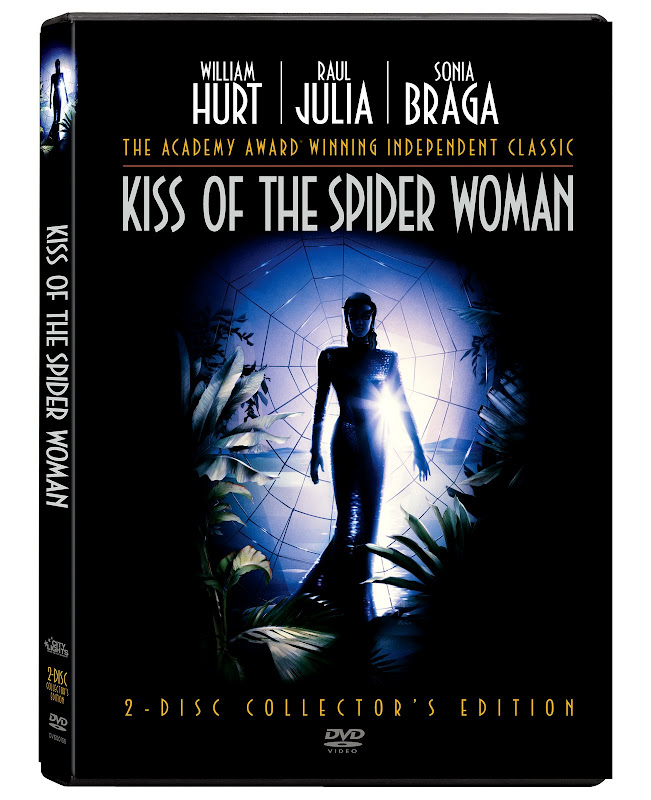
Kiss of the Spider Woman (1985)


Digg!

If there is one thing we've discovered over our far too frequently violent and tragic global history it's that human beings are resilient creatures. Equally capable of conducting acts of the most astounding cruelty or ones that are the most selflessly compassionate-- the human race has managed to withstand some truly unspeakable events carried out by their fellow man. "What doesn't kill us only makes us stronger," has become not just a cliche but an oft-cited justification that helps us cope, similar to the athlete's chant of "no pain, no gain," or the argument that tragedy builds character.

While some cling to faith and others to memories, no matter what form comprises the coping mechanism of any individual, the bottom line is that although history has found us tortured and enslaved, our saving grace has been in the limitless potential of the human mind. Simply put, you can't handcuff one's thoughts, chain someone's dreams, lock up their hopes, or torture their memory.

In the Oscar winning film Life is Beautiful, Roberto Benigni uses his penchant for creativity to try and hide the horrors of the Holocaust from his son as they spend their days in a labor camp and likewise, in director Hector Babenco's landmark 1985 independent classic, Kiss of the Spider Woman, William Hurt's character, Molina escapes from his imprisonment in an unspecified Latin American country by recalling the plots of old movies. In the beginning of the film, based on Manuel Puig's novel and adapted by screenwriter Leonard Schrader (the brother of fellow writer/director Paul Schrader), we're introduced to the effeminate Molina as he begins chronicling the story of "the most ravishing woman in the world" who kept men at a distance no matter how lonely she'd get.

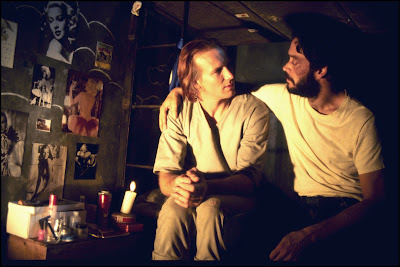
Shortly after Hurt begins the opening monologue of his Oscar winning role, we realize that instead of seeing the man on a stage--which feels like it would be far more natural-- Molina is sharing a cell with fellow prisoner, Valentin (Raul Julia). Although Molina has been locked up for corrupting a minor in a homosexual affair, Valentin is a political prisoner who fears for his girlfriend living life on the outside as a part of the underground movement hoping to overthrow the corrupt government that's tortured, vanished, and murdered so many of his fellow citizens.

While at first, the macho Valentin and the gay former department store window dresser Molina struggle to get along with Valentin rudely growing annoyed with Molina's unceasing storytelling of old film plots. However, soon he begins to depend on them to pass the time. Although he advises his cell-mate not to include erotic descriptions of naked women or conversations about food, given his inability to access either, soon Julia's Valentin becomes engrossed in the tale, imagining the story by picturing his own true love, played by Sonia Braga in Molina's narrativse.

The first independent film to receive the top four Oscar nominations including Best Picture and Best Director, Kiss of the Spider Woman finally makes its DVD and Blu-ray debut in a gorgeous 2-disc transfer from City Lights Home Entertainment on 10/21/08.

A passionate celebration of humanity, tolerance, and the fight for survival, it pulls the viewer in a number of directions one wouldn't see coming. While it begins as a near chamber piece centering solely on the two men whom we quickly realize will eventually learn to appreciate one another, it moves into surprising terrain roughly midway through upon discovering a new plot twist that changes everything that has come before it.

As the men begin to have such a profound effect on one another, we realize that they may be exchanging characteristics as well as Valentin's bravery and devotion to something bigger begin to influence Molina and likewise, Molina's sensitivity, compassion and tendency to want to escape mentally begin to find their way into Valentin's psyche.


Although it's become one of the most highly regarded works of its time and seems impossible to consider anything to the contrary, further research revealed that originally the two men had been cast in each other's roles but during the rehearsals for the film, they experimented with playing the opposite part, discovering that they truly belonged in the roles they hadn't been given. Reportedly working for just the price of their air tickets and Brazilian hotel bills during the Sao Paulo shoot, the two men and Sonia Braga (who had to recite her lines phonetically as she was unfamiliar with the English language) crafted a true independent classic that, despite being dubbed "as a gay Casablanca" by The San Francisco Chronicle helped spawn a successful Broadway show and continues to reach fans across the world in book, cinematic, play and musical form.

Additionally including the "never-before-seen" feature length documentary Tangled Web: Making Kiss of the Spider Woman on the second disc of the DVD set, it also offers a mini-documentary with original author Manuel Puig, a featurette on the Broadway adaptation, over 150 images in a DVD photo gallery and a "Slide Show Commentary: Transition from Novel to Film," the loaded set is a must for fans looking to explore the film again from a variety of different insider's perspectives in a stunningly beautiful digital transfer.

And as Chronicle writer Bob Graham noted, "people who see the film will realize, along with Valentin, that they like being told stories," however, when it comes to Hurt and Julia's masterful web, they'll realize that this is a story that is impossible to predict and must be witnessed firsthand to appreciate, as this reviewer did, taking in the movie for the first time.


7/06/2008

The Incredible Hulk (2008)


Director: Louis Leterrier

Whereas Iron Man began with a testosterone shot of military hummers, war torn Afghanistan, and with a soundtrack blaring classic hair metal rock, the second Marvel studio release, The Incredible Hulk begins like an exquisitely beautiful and delicate silent movie. I’d almost call it arty if I wasn’t afraid it would conjure up bad memories from the nearly universally loathed, most recent Hulk incarnation from director Ang Lee. No, the 2008 film opens with a terrifically edited montage—a visual tapestry and feast for the ears as well as Scotish Moulin Rouge! composer Craig Armstrong’s impressive musical score (which has now become one of my favorite of 2008) is synched along with images that brings even those of us unfamiliar with the comic book mythology up to speed, with nary a trace of dialogue. In order to best capture the back-story in an efficient and sweepingly visual way, French director Louis Leterrier (Transporter 2), the talented Australian Die Hard 3 cinematographer Peter Menzies Jr. and Hulk’s three person editing team utilize classic cinematic trickery along with telling newspaper headlines and data from pertinent documents to chronicle the sad tale of brainy scientist Dr. Bruce Banner (Edward Norton) whose experiments with radiation resistance went horribly wrong, not only poisoning Dr. Banner with dangerous levels of gamma rays but also morphing him into a violent, super-sized green Hulk who unleashes fury when angry, leaving bodies and injury in his wake, including accidentally harming his beloved Dr. Betty Ross (Liv Tyler) in the process.


Once the credit sequence ends, our hero vanishes for five years and-- instead of offering a tried, true and admittedly tired superhero paradigm-- the film admirably stays in the mold of great "man on the run" pictures including The Fugitive and The Bourne Identity trilogy. Soon we catch up with Banner hiding in Brazil where-- when he isn’t concentrating on controlling his anger levels with breathing techniques-- works as a lowly factory bottling employee. Now with the sneaking suspicion that he was manipulated by Betty’s shady military general father William Hurt into using the science he assumed was for good for violent ends instead in the General’s quest to harness the Hulk’s capabilities into creating a super soldier where man becomes a weapon for Iron Man hero Tony Stark’s weapons conglomerate Stark Industries, Banner makes strides in contacting a U.S. based scientist to try and reverse the experiment.

Of course, it isn’t too long before the General becomes aware of Banner’s location and sends a team in with enough firepower to take out the entire country, headed up by the ambitious career soldier, Emil Blonsky (Tim Roth), who after realizing that Banner is “a whole new level of weird” finagles a deal with the General to be injected with the very same product in order to level off the playing field of an unstoppable Hulk whom bullets nor bombs can penetrate.

Realizing that he has no choice but to face the life he’s been escaping, Banner returns home where he unintentionally reunites with his love Betty Ross, now a professor at Culver University in Virginia. Quickly the two go on the lam to search for a cure, with time running out as the General and Blonsky continually track their whereabouts and with every new annoyance, Banner’s pulse increases dangerously towards the magic number of 200 wherein he turns into an uncontrollable version of himself that he most fears, namely The Incredible Hulk.

Although Norton lacks the easy mischievously sexy, albeit sometimes over-the-top charisma of Iron Man’s Robert Downey Jr., he is the quintessentially earnest everyman and one we instinctively empathize with as a likable scientist who’s trying to right some extraordinarily unfortunate wrongs. Granted some critics have-- similar to their main Iron Man attack-- found legitimate fault with Hulk’s lack of a real worthwhile villain although, as a fan, I enjoyed seeing Roth play evil once again. Despite this, the film works best when it’s understated in its attacks, especially in a phenomenally choreographed battle at the university midway through the film and at its absolute worst when it relies too heavily on frankly lackluster special effects in a damn near deafeningly loud, overwhelmingly cheesy video game styled final battle between Norton and Roth that seems to last longer than watching every installment of both The Thorn Birds and Roots miniseries combined.

However, aside from the overly long confrontation which will wear on the patience of a majority of audience members who aren’t fourteen year old boys, as it stands The Incredible Hulk is a superior film to Iron Man—majestic, beautiful, with a more compelling and richer storyline and of course that fantastic score, although this being said, when held up next to Iron Man, it’s nowhere near as fun. And, even though his cameo seemed to last no longer than two minutes, it was an incredibly lively and welcome sight indeed to see the handsome, impeccably dressed Tony Stark (Robert Downey Jr.) arrive in the concluding moments of the film to set up the Hulk sequel and you could audibly hear the anticipation, gratitude, and amusement of the audience who let out either a chuckle or a small admiring holler at the prospect of the two franchises linking up... (okay, so that last cheer may have come from this reviewer).


Apple iTunes

3/10/2008

Into the Wild

Director:
Sean Penn

It almost seems like it’s a prerequisite for becoming an adult but most people I’ve talked with have had a similar feeling of restlessness following graduation when, after years of raising one’s hand and waiting for a hall pass to leave the room, there’s the unmistakable urge to break free, to wander, to explore, to see beauty in nature, and to stop worrying about the clock on the wall. For me it followed high school when my friend Shelley introduced me to Jack Kerouac and Bob Dylan and I felt a sense of wonder I hadn’t encountered since I’d first read Steinbeck and Fitzgerald—a hopeful sense of idealism, an unquestioning love for the idea of the American dream, and an overwhelming sense of wanting to get out and see the gorgeous landscapes and talk to people just as people and not as clips on the news categorized into whatever stereotype the network has decided to spin that day.

While my destination of Arizona ended up becoming my new home after a traditional visit, I admit that, as bizarre and illogical as it is, there is something undeniably intoxicating about the journey that Christopher McCandless took following his graduation from Emory University in 1990. Even though, those familiar with the resulting novel by Jon Krakauer or from the media coverage, knew that his story ended tragically inside that Magic Bus in the Alaskan wilderness, there’s a haunting indescribable joy mixed with dread and sadness that comes from watching his tale realized on the big screen by a compassionate filmmaker in actor turned writer/director Sean Penn.

Penn, who’d wanted to make the film for more than ten years and originally had envisioned Leonardo DiCaprio in the role, waited for official permission and approval from the McCandless family according to IMDb and I think that the film benefits not only from the space in time from the day that Christopher fled Atlanta in his Datsun but also from Penn’s maturity and growth as an artist in his own right as I recall the multitude of characters, performances, directorial efforts and choices he’s made over the last ten years as well.

After only a few moments of watching actor Emile Hirsch disappear into the role of Christopher in a career making effort, it seems to be an absolute crime that he was denied a Best Actor nomination from the 2007 Oscar season. A gifted student with the promise of an even brighter future at Harvard Law School, Christopher makes a choice that seems to shock everyone but his loving sister Carine (Jena Malone) when he donates his professional school fund of $24,000 to Oxfam, uses a scissors to cut up his credit cards and identification and burns his social security card in an act of defiance before taking to the road. Inspired by his beloved books by Thoreau and London, Chris heads west until his car fails him in the unforgiving Arizona desert and begins to "hoof it," now as what hippies would later dub him in his role as a “leather-tramp.” Fitting to his newly dubbed name of Alexander Supertramp, the film, divided into chapters that illustrate his new life from birth, to adolescence, manhood etc. follows Chris/Alex as he meets some people who would become like a second family to him on the road including a terrific Catherine Keener and Brian Dierker as hippies Jan and Rainey, a memorable Vince Vaughn as his farming boss in South Dakota whom he writes postcards to regularly throughout the film and countless others while his sister and parents (William Hurt and Marcia Gay Harden) must contend with his absence without any explanation, save for the flashbacks showing a rather tumultuous upbringing with some abuse, rage and lies. In a truly heartbreaking and Oscar nominated role, Hal Holbrook plays a retired military veteran with a tragic past who grandfatherly looks after Chris before he ultimately heads north for his true destination of Alaska.

Soon the film, which has intercut his past travels for two years before making it to the bus which would be his final destination, meets up in the same timeline and it careens towards its chilling and desperate finale—yet there’s a beauty and a quiet to these moments that recall the wonder and innocent joy of the earlier work that keeps things bearable, despite viewers' underlying sense of dread.

Gorgeously photographed on the exact locations from the life of Chris McCandless with an unrecognizable Hirsch who, in his brave role lost not only forty pounds but also used no doubles or stuntmen in even the most dangerous of situations, it’s Penn’s greatest directorial achievement so far and manages to hook us completely after its stylistically uneven start with too many scrawled journal entries and notes moving across the canvas of the frame. With an undeniable nod to the road pictures of the 60’s and 70’s such as Easy Rider and Bound for Glory, Penn’s film is admirable and unique in the sense of it seeming like an actual document of a life and one that, unlike some of the more polished works of 2007, will not become dated with each passing year, kind of like the life of McCandless that will no doubt continue to fascinate and inspire for decades to come.

Vantage Point

Director: Pete Travis

Kurosawa’s Rashomon meets TV’s 24 with this highly entertaining yet dubious political thriller, which tells the story of an attempted presidential assassination and bombing at a terror summit meeting in Salamanca, Spain from the points of view of eight strangers who are all privy to different aspects of the event. Dennis Quaid is the ideal choice to play Secret Service Agent Thomas Barnes, who after taking a bullet for American President Ashton (William Hurt) has been suffering from post-traumatic stress. Lured back on the job by his younger colleague Kent Taylor (Matthew Fox), Barnes tries to overcome his fears and overwhelming stress that sets him even further on edge after the first bullet is shot.

It’s shortly after this first burst of action that the film rewinds itself roughly a half and hour to show the same events from another point of view including one from American tourist Howard Lewis (Forest Whitaker) who is conveniently filming the historic event on his camcorder before we meet several other participants and witnesses. While indeed each rewind brings new light to the events, about halfway into the film we begin losing track of characters when reaching rewind number five; thus instead of a clever and nonlinear experiment in storytelling, it becomes a gimmick and far more ludicrous distraction as events grow even harder to believe.

Still, clocking in at just under ninety minutes, director Pete Travis and first time scripter Barry Levy (a former teacher at L.A.’s Temple Israel) keep pulses pounding and once the film careens into a tense action thriller for the last portion of the movie, I began wishing there would have been more scenes of action earlier on, rather than just setting things up until the point when things get interesting and then deciding to rewind. However, much more enjoyable than most critics would have you believe—it’s a slightly above average political thriller, without the intellect required for some of the Tom Clancy styled releases, yet just as riveting as a better evening of TV’s 24, except instead of Kiefer Sutherland’s superhero influenced Jack Bauer or Clancy’s Jack Ryan, we have a cast filled with Oscar nominees and winners including Quaid, Hurt, Whitaker, and Siguorney Weaver.