Showing posts with label Zooey Deschanel. Show all posts

11/23/2010

Blu-ray Review: Elf -- Ultimate Collector's Edition [Holiday Gift Tin] (2003)


Now Available to Own 


If you took the same syllogistic “if a then b” logic and applied it to actors in a Six Philosophical Degrees of Kevin Bacon style manner, it stands to reason that Meryl Streep must be quite a fan of Will Ferrell.

Instead of dishing up a generous helping of glittering generalities while praising Ferrell's onscreen Taladega Nights love interest Amy Adams, her Doubt costar Streep went a step further to describe Adams' level of talent by acknowledging her gift for believably portraying innocence, which Streep reveals is one of the hardest characteristics to successfully carry out.


And sure enough, there's some degree of innocence that floods through the often outrageous fictitious creations that Ferrell has brought to life in movies like Anchorman, Stranger than Fiction and Step Brothers whether it's in his man-child Adam Sandler-esque personae or through the mask of ignorant arrogance his alter-egos adorn like a shield to cover up their emotional immaturity.


Yet, it's hard to argue that – more than any of his other characters and right on par with Adams' turn as an out-of-her-element princess who goes from Disney animation to live action Manhattan in Enchanted – Ferrell's role as an orphan raised among Santa's elves in the North Pole before winding up in the Big Apple in search of his biological father is his most heartfelt, innocent and guilelessly masterful portrayal yet.


The fact that Ferrell makes it look so effortless and natural is a testament to his skill since admittedly at times the role of Buddy the Elf does walk a fine line between innocence and immature idiocy and a lesser actor may have turned Buddy's naiveté into an opportunity to play it far too broadly. However, even when Ferrell does burst with energetic non sequiturs and sugar-induced jolts of hyperactivity like a kid in a candy store, we're never in doubt that his motives are sweeter than a candy cane, his heart is in the right place and it's completely within the context of the character.

Likewise, Ferrell resists the temptation to break character as well as the fourth wall even for an instant to wink knowingly at the audience in reference to the sheer ridiculousness of some of the situations that comprise director Jon Favreau's now contemporary Christmas classic. In doing so, he remains utterly genuine from start to finish, taking in the city he lived and worked in as a cast member on SNL as though he'd never been there in his entire life.


After roughly thirty years of ignoring the obvious signs that he wasn't an elf, the former orphan who as a baby crawled into the bag belonging to Santa (Ed Asner) is sent on a journey to track down his real dad (James Caan) by his loving adoptive father (Bob Newhart). Determined that a little Christmas cheer is all that his workaholic book publishing papa, Walter Hobbs needs to get off Santa's naughty list, Buddy doesn't let a little thing like Empire State Building security guards spoil his first meeting with the man who never even knew he'd fathered a son.


Needless to say, the arrival of an always cheerful thirty year old grown man wearing a green elf's uniform complete with matching tights takes Walter by complete surprise as he reluctantly gives into the wishes of his loving, thoughtful wife (Mary Steenburgen) and brings Buddy home to stay at his place with his tween son (Daniel Tay) until he adjusts to life away from the North Pole.

In a creative holiday movie lover homage to the classic Christmas feature, Miracle on 34th Street that, like Elf urges viewers to renew their childlike belief in Santa Claus and share in the true meaning of the holiday, Buddy gets work in a department store's North Pole display where his commitment to authenticity gets in the way of the store's commercial celebration.


And just like a department store aims to fit the needs of a diverse clientèle, Elf successfully manages to appeal to a wide range of viewers. An unlikely coming-of-age picture that's also effective as a fish out of water culture clash comedy, Elf is especially meaningful for children who were adopted as well as those who “feel different” than the rest whether it's anything from ethnicity to disability etc.

Additionally, it's a great crossover effort for both independent filmmaker Jon Favreau into the type of big budget blockbusters he'd eventually embrace by taking the helm of the two recent Iron Man movies along with its star who was in dire need of breaking out of the “frat pack.” Just in time for the holidays, Elf is made all shiny and new again in Warner Brother's adorable collectible tin box set.


Given a terrific high-definition transfer to Blu-ray that accentuates its slick production values and feisty musical choices that incorporate Louis Prima and actress Zooey Deschanel who would later enter the music business, the set includes a soundtrack sampler along with gift tags, a holiday stocking and picture frame along with an extra digital copy of the film to download to your portable devices.

More than just another terrific Christmas comedy, Elf reaffirms a child's need to explore their imagination and belief in Santa Claus as well as being part of a loving family unit. At the same time, it inspires genuine laughter in adults who can identify with Buddy's sincerity and his off-the-wall plight in addition to the nostalgia of the season that the film utilizes from start to finish.

When epitomized by a sugar crazed Will Ferrell who just wants to be loved, innocence never felt more hilarious or heartwarming. Now if only we could get Ferrell and Streep to star in a movie together before next season!

Text ©2010, Film Intuition, LLC; All Rights Reserved. http://www.filmintuition.com Unauthorized Reproduction or Publication Elsewhere is Strictly Prohibited and in violation of the Digital Millennium Copyright Act.  

FTC Disclosure: Per standard professional practice, I received a review copy of this title in order to evaluate it for my readers, which had no impact whatsoever on whether or not it received a favorable or unfavorable critique.

8/14/2009

DVD Review: Gigantic (2009)


Now Available on DVD


Photo Slideshow


Delicious
Bookmark this on Delicious
submit to reddit
Print Page

Digg!

MovieBlips: vote it up!

DVD Review & Introduction


In addition to relishing in the opportunity of helping a reader remember the title of a favorite movie that they can't quite recall or sharing recommendations via e-mail, I'm consistently flattered when I'm contacted either by a filmmaker or a PR firm working on behalf of a studio to review a new film.

And it's always a treat, whether it's hearing from a debut filmmaker who's just completed his or her first feature financed on seventeen credit cards or being asked to review a film before its theatrical release since it will only be given a limited run going from one city to another.

Unfortunately, while time has made it difficult to accept all offered titles and at the same time you're never quite sure just exactly what is going to land in your mailbox-- overall, I'm constantly inspired by just how much creativity is out there. And criminally since money talks and movies without that never see the light of day, the result is that work is under appreciated and unavailable to those who don't live in New York or Los Angeles who happen to be free the one week an indie or low-budget work is screened.

As a rule, I always try to approach these films in particular filled with optimism since I'm simply grateful as a fan to see something that wouldn't be shown in a local theatre. Likewise, at the same time if the timing works out and I can fit in the works, I purposely avoid reading too much about them other than the tiniest synopses available and sometimes only view a portion of the trailer to prevent spoilers.

After all and especially in the case of art-house or independent fare, somebody took the time to create something out of thin air and somehow manged to not only complete the work but get it out there without the full power of a large scale marketing campaign behind it complete with product tie-ins or Happy Meal toys. So with this in mind, the least I can do is return the favor and view it as someone who just wants to be led on a unique cinematic journey for two hours.

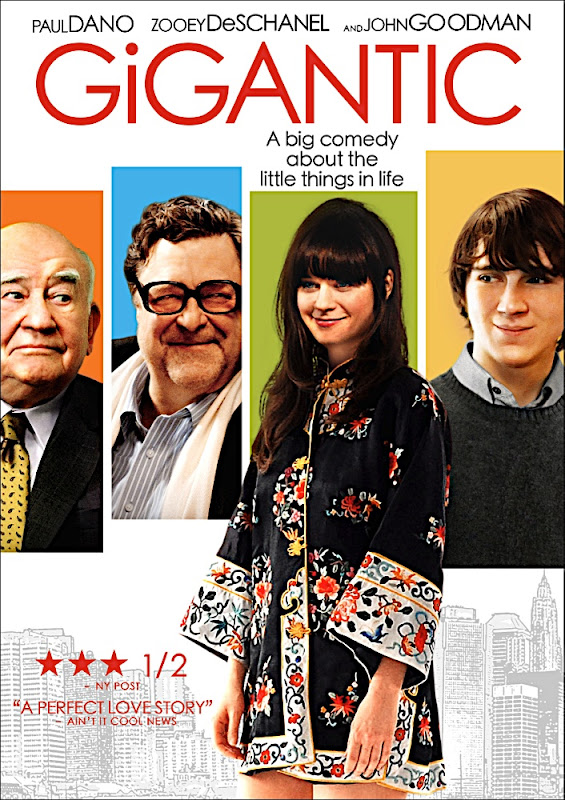
And that is exactly what Gigantic director Matt Aselton managed to do with this unabashedly absurdist, imaginative and inspired feature filmmaking debut about human relationships that would make the ultimate companion piece to screen as a double feature with actress Zooey Deschanel's big-screen wildly successful Fox Searchlight hit (500) Days of Summer.

After just twenty chaotic minutes of Gigantic, I realized it was the type of movie that-- like Scorsese's After Hours, Jake Kasdan's Zero Effect or Wes Anderson's Bottle Rocket-- I immediately wanted to share with someone else because I had that much confidence in his singular vision. And luckily, Gigantic just kept evolving with each passing scene into something far more ingenious from one moment to the next as it paid homage to previous works but didn't feel derivative in the slightest.


Although it was highly praised by critics, sadly Matt Aselton's film which starred the mesmerizing and chameleon-like Paul Dano never managed to break out to experience the same level of success of other sleeper art films. Yet now that this overlooked work has made its way to disc, I urge you to track it down.

Having had only the screener with which to compare the quality of the DVD, I found it to be equally sharp and crisp in its inventive New Wave meets absurdist color and set design, yet I was extremely disappointed by the bonus features. Despite the fact that I must applaud Vivendi Entertainment for bringing this unique award-winning work from First Independent Pictures to disc in the first place-- the press release promised a plethora of extras including "behind-the-scenes candid interviews with the cast and crew, an alternate ending, deleted scenes, and commentary by director Matt Aselton."

However, the ultimate release delivered only two deleted scenes including one extremely crass conversation on a beach and a kitchen fire along with an alternate version of a fight scene which probably total less than five minutes of new material that's essentially pointless. Likewise, providing viewers with a trailer and stills gallery doesn't quite make up for the fact that with such an intellectually stimulating work, viewers who dig it will sorely miss those promised extras. However, I'm hopeful that eventually enough people will become Gigantic fans that eventually it will earn a second and superior release. Still until then, it's a highly recommended title to add to your collection and one of my picks of the week and on the short list for art films of '09 along with Ms. Deschanel's (500) Days of Summer.

Original Movie Review
Published: May 2009


In his feature filmmaking debut, director Matt Aselton uses absurdism the way that Hitchcock employed the MacGuffin.

And in Hitch's world the MacGuffin may have been "that thing in which the hero is chasing" such as top secret documents in a briefcase or diamonds in a museum, but in the end as Hitchcock and scholars deduced-- it just turns out that it's an inconsequential piece of matter or material that propels his characters into action. Or in other words, we never needed to know what the hero was chasing specifically or what the top secret codes or devices sought after did since we were more than happy to just go along for the ride anyway.

Without over-explaining motives or plot structures, Aselton utilizes the exact same technique repeatedly throughout his intelligent, offbeat, and deliciously weird film Gigantic which hearkens back to his affection for "films and stories in which reality and absurdity cross [paths]" by filling his quirky indie charmer with a surreal series of events he reveals are "just there and you believe it."

The events include for starters the impetus for the screenplay itself as Aselton acknowledged that "when we wrote this movie we knew two things: there would be a nameless assassin hunting the main character and that we'd rather not overtly explain why."

In the film, Paul Dano's meek and sensitive twenty-eight year old Swedish mattress company employee-- Brian Weathersby-- is the last person on the planet that should grab the attention of a nameless and homeless assassin but for reasons unknown, someone's after Brian and whether you feel it's real or surreal or even metaphorical, it's there from the start.

Yet, despite that structural decision-- in the scheme of Gigantic-- this is just all in the periphery, cropping up unexpectedly in between the film's main plot that centers on Brian's long-time goal to adopt a Chinese baby. Obviously as a single man under the age of thirty, he's not the ideal candidate to make that lifelong obsession a reality but having put his name on three waiting lists, he's eager to start building his own family, which we feel stems from the fact that he's the youngest and least successful son (and a "surprise" baby at that) of a father (played by Ed Asner) who'd had him when he was fifty-two.


However, before he readies himself to return from New York City to Vermont for his dad's eightieth birthday (where-- again and quite absurdly-- the Weathersby men get high on mushrooms in a wooded cabin), he meets an entirely different family that changes the course of both the film's plot and his life upon the arrival of the larger-than-life Al Lolly (John Goodman).


A blunt businessman with a bad back-- before Dano's quiet Brian even begins to discuss the details involving a $14,000 Swedish bed that comes with a twenty-five year warranty-- Al fast-talks Brian into free shipping, handling, and delivery.

Arriving later with her father's credit card before she falls into an easy two and a half hour slumber on the grand mattress-- Zooey Deschanel's fairy-tale like entry into the piece as a Sleeping Beauty who despite the name of Harriet is routinely called "Happy" aptly brightens Brian's day considerably.


And, in a nice twist of fate after Brian is told by a coworker that the regular delivery "dude ate bad chicken," it's Brian himself who arrives with the mattress at the Lolly residence. Once there, unexpectedly and again very absurdly he's fast-talked once again by the loud Al and beaming Happy to take the rest of the day off from work and drive them into New York City to see Al's spinal specialist since Al doesn't ride in taxi cabs and Happy refuses to drive in the city.

While Al is told-- for what appears to be the umpteenth time-- that his back is fine and the pain emanates from stress, Happy proves to be just as forward as her father, offering herself up for a quickie in the car with Brian that leads to a budding courtship between the two eccentrics.


While, despite the fact that on the surface, they couldn't be more different as for example, the constantly restless Happy reads ads instead of articles and moves from one passion to the next in stark contrast to Brian's wish for stability in his life in becoming a father-- somehow their relationship works. Or I should say, it's successful at least until life and family intersect in daffy, nonsensical, and unpredictable ways as Gigantic moves to its amiable conclusion.

A true born storyteller-- Matt Aselton who collaborated with his co-writer Adam Nagata-- has inspired a breath of fresh air into American independent filmmaking in a movie that stylistically seems more European than traditional mainstream fare from our country. And in fact, Aselton readily reveals in the film's production notes that he is a major fan of Luis Bunuel's The Discreet Charm of the Bourgeoisie as well as the oeuvre of Jean-Luc Godard and the fingerprints of both men show up from time to time-- although thankfully in a far more linear and accessible fashion.


However, he also cites other maverick American helmers like Hal Ashby, Robert Altman, and David Lynch whose painterly works and ability to think outside the box undoubtedly gave him the confidence to center a work on "what was happening to [his] characters in the present moment they resided."


Continuing on regarding his passion for the absurd-- the (in my view, existential or gently surreal) landscape of Gigantic is used for as he notes "liberating," and spontaneous effect since being in the moment without worrying about what will happen next is "ultimately the only thing that matters."


Along with Discreet Charm, Aselton makes a special mention of Harold and Maude director Hal Ashby's Being There in the film's notes for its similar approach involving "plain characters populating surreal worlds, [with] no need to explain their actions, or the madness that surrounds them." And indeed, there's a definite thematic and tonal link to Ashby's film which-- intriguingly-- also shares a one-degree relative in common with Aselton's Gigantic star Zooey's father Caleb Deschanel having been employed as the irreplaceable cinematographer on the masterful Being There.


While the film is sure to frustrate viewers who prefer the real to the surreal and find greater comfort in having everything neatly resolved-- especially when we're watching There Will Be Blood and Little Miss Sunshine's tremendously affable Dano being beaten to a bloody pulp by an assassin-- amazingly, we continue watching long after frequently rapid questions start cropping into our mind.


And the basis for this is simple-- namely that our enjoyment is augmented by the liberating cinematic approach that leaves everything in the realm of the unexplained MacGuffin as well as the sheer pleasure and uplift of this alternately dark and twisted yet assured, tender and refreshing achievement.

Likewise, I predict that like Spike Jonze, Michel Gondry, Wes Anderson, and Charlie Kaufman, Aselton will be a name we'll hear for a long while based on this debut work alone that also reminded me in tiny ways of the decorative works of Jacques Tati and the later entries in Truffaut's Antoine Doinel series.


Text ©2009, Film Intuition, LLC; All Rights Reserved. http://www.filmintuition.com

Unauthorized Reproduction or Publication Elsewhere is Strictly Prohibited.

7/24/2009

Movie Review: (500) Days of Summer (2009)


View the Photo Slideshow


Now Available to Own


Get the Infectious Soundtrack

& Zooey Deschanel's Album by She & Him


Or Download the Soundtrack from iTunes

Mychael Danna & Rob Simonsen


Delicious
Bookmark this on Delicious
submit to reddit
Print Page

Digg!

MovieBlips: vote it up!

If you were to ask the screenwriters Scott Neustadter and Michael H. Weber why they wrote the amazingly personal and refreshingly relatable, genuinely authentic and male-centric romance (500) Days of Summer--according to Neustadter, "our aim was simple-- tell the story of a relationship, make it real, make it funny, try to make it not suck."

In the production notes for the Fox Searchlight sleeper that's been building momentum since picking up positive buzz and acclaim from the film festival circuit including screening as an Official Selection at the Phoenix Film Festival-- the writers humbly continue on. Noting that they based the screenplay on some of their own heartbreaks, aches, and romantic misadventures-- as
Neustadter shares-- they ultimately aspired to craft something more in the vein of their "heroes Cameron Crowe and Woody Allen" wherein audiences could connect with their particular brand of "boy meets girl" rather than trying to force humor out of "some squirrel attack in the woods."


In setting out to chart on paper and in screenplay form a nonlinear, challenging narrative for audiences used to the traditionally straightforward rom-com fodder we're fed every week (and will see again this week in the benign Ugly Truth), Neustadter explains that the men designed, "an anatomy of a romance [that's] equal parts autobiography and fantasy[;] a pop song in movie form."

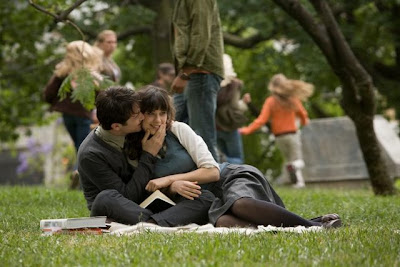
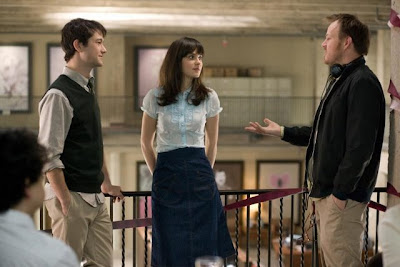
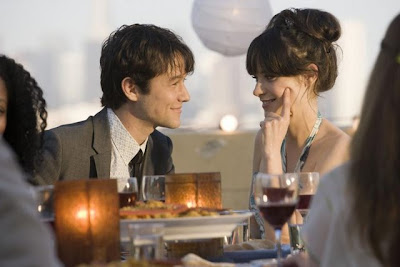
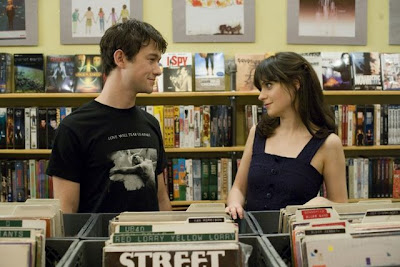
Although the film begins with both the description in narrative form that it "is a story of boy meets girl," we're also presented with the disclaimer that it's "not a love story." This is an intriguing confession since we see what is the definitive beginning of the young couple's initial interaction with one another as Joseph Gordon-Levitt's Tom works for a greeting card company and finds a dull meeting instantly livened up with the beaming promise of the fresh, sunny face as bright as her name-- embodied by the girl dubbed Summer (Zooey Deschanel) who's been employed as the firm's secretary, new to Los Angeles from the Midwest.


While we see the first awkward moments of bonding over pop culture including a mutual affection for the music of The Smiths and other coincidences that Tom reads much more into than Summer-- the writers and our inventive director Marc Webb throw us for a loop by cutting to what very well may be the disintegration of the relationship before it even begins as we move to a devastated Tom breaking dishware in his apartment.

Later we discover that this followed a conversation wherein Summer ditched him in a diner by saying that the two had become like Sid and Nancy (the notorious couple chronicled on film whose relationship ended in stabbing) but only in Summer's view, she was the man who did wielded the knife.


Of course, the writers credit the films of Crowe and Allen and right from the get-go we see allusions to the sing-along happy feel-great moments found in Crowe that can be matched by the emotional downpour of tears in some male angst moments found in his masterworks of Almost Famous (also starring Deschanel) and Say Anything along with Woody Allen's Annie Hall for revealing the spoiler about a breakup (or possible one at least) from the very beginning.


Yet the writers also noted they initially sought nonlinear inspiration from Christopher Nolan's Memento and set out to write a rom-com in that format. Again, everything links up once more as Gordon-Levitt is next gearing up to work for the Memento auteur but (500) Days of Summer is correctly described in the notes as not just a pop song captured on cinema but it also feels like a cinematic collage that's fittingly indicative of its beautiful, eye-catching poster.


Fans of High Fidelity and the writing of Nick Hornby will note that a large majority of the uncharacteristically masculine overly romantic delusions possessed by Tom seem to stem from pop songs. Obviously pop culture is also a culprit as the screenplay notes Tom underwent a horrid misinterpretation of the ending of The Graduate-- which in itself was dissected brilliantly to comedic effect by Chris Eigeman in Whit Stillman's Barcelona.


Likewise, it's also reminiscent of a cheerier and less fantastical version of Charlie Kaufman and Michel Gondry's Eternal Sunshine of the Spotless Mind which subtly revealed that the things that may attract us to someone today may repel us tomorrow, as well as a '60s French New Wave feel from the movies of Jacques Demy like Young Girls of Rochefort and Umbrellas of Cherbourg and Jean-Luc Godard's A Woman Is a Woman and Breathless.


And this seems only fitting for if there's one actress working in the industry today who always seems like she defies a set generation with a Judy Garland '40s like soulful voice, a feminine Audrey Hepburn-esque demeanor, and a taste for the avante garde it would be none other than Zooey Deschanel. Deschanel's work in (500) Days of Summer marks her second quirky indie romance following a supporting turn in the little-seen but highly recommended Gigantic co-starring Paul Dano and John Goodman which hits shelves next month.


Although fans of Deschanel already know that she can sing-- whether it's on film even in small scenes in movies like Jon Favreau's Elf or Julia Stiles' directorial debut short Raving or via her remarkable cult success alongside M. Ward as the female half of the band She & Him so it comes as no surprise to see her cut loose in the movie's karaoke scenes. However, I was pleasantly delighted by the vocal stylings of Gordon-Levitt. Going for Pixies karaoke is brave indeed when he took to the microphone as well but you're truly stunned to see his jubilant energy as he dances it up in a beautiful fantasy sequence choreographed to Hall & Oates to show the invincible power of love.


While in the relationship between the two, Tom's decidedly the one with more to lose as one of my friends had cruelly stated that in any romance one person loves the other one more-- in the case of Summer and Tom-- she makes it clear from the start that she doesn't want to be anyone's girlfriend or anyone's anything. Of course, when you're blinded by your own love and complete conviction that you're soul mates, blindly Tom feels he can love Summer enough for the two of them and that she'll come around eventually and there are moments that-- to anyone else's eyes-- would give off the evidence of pure, unabashed love from her side of the bed as well.


However as the timeline moves throughout the five hundred days of their courtship from bliss to boredom, we're offered that rare gift of looking longer and deeper at young romance in a way that feels amazingly real and likewise may make some couples flinch who aren't rock solid or possibly haven't admitted some true feelings to one another about the pace or course of their relationship. Thus, it make this film a bit dicey for some viewers to tread into without realizing that what you're getting isn't a pre-packaged Sandra Bullock happily-ever-after movie.


Obviously, as the genre dictates--the screenwriters fill it with various quirky friends and/or relatives and this film is no exception as Tom is saddled with a wise beyond her years twelve year old sister Rachel. As played by Chloe Moretz, Rachel curses like Gordon Ramsay and dutifully pedals her bike over late at night to urge her big brother to man up and drink some vodka in a device that feels a bit borrowed from Luke Wilson's precocious younger sister in Bottle Rocket than one that's authentic.


However, whereas some found it a really glaring misstep, I thought it was important to give us a chance to breathe, laugh, and step away from the claustrophobic intensity of love for a minute and likewise gave Gordon-Levitt another actor to play off of and show us his always-increasing range as he continues to impress from one movie to the next.

Whether he's strumming his guitar in his heartbreaking exit of the underrated Stop-Loss, giving a performance in Mysterious Skin that seemed to influence Heath Ledger's even subconsciously in Brokeback Mountain, finding his dreams shattered and unsure of whom to trust in The Lookout or holding his own alongside Oscar nominees like Mickey Rourke and Diane Lane in Killshot (note: I'm the "Jon" quoted on the back)-- in my book, Gordon-Levitt continues to be one of our best kept secrets. In fact on a second viewing of Summer, I realized that the young man who's also set his sights on filmmaking by adapting a great Elmore Leonard piece into a short film starring Carla Gugino and Eric Stoltz (which I'm dying to see... somehow)
could definitely could be in awards consideration for his varied, dynamic performance in Webb's film.


Perfectly matched with Deschanel-- with whom Gordon-Levitt had previously starred in the film Manic-- you immediately fall in love with the two characters and actors both as a couple and separately if you hadn't been fans before and considering that the film has already made a splash with its opening in select markets last week as one of summer's sleepers, I'm thinking we'll see much more of them soon.

Blending music from the past and present to weave a highly personal romantic film for those involved as they note that whenever we fall in love, we do inevitably develop a soundtrack of whatever we're listening to at the time-- it's no wonder that the soundtrack is quickly becoming popular as well. Of course it's helped that the selections are wonderful and even go as far as to include my very favorite track by The Doves in "There Goes the Fear."


Cleverly edited with split frames and camera trickery to keep the old "boy meets girl" story fresh as if the film's wondrous dialogue and premise didn't do it already for us-- while romantic works and especially ones about this particular age group don't necessarily catch on with Academy voters-- as far as screenplays go, Michael H. Weber and Scott Neustadter's (500) Days of Summer is easily the strongest written work of the year so far.


And this is due not only for its creative daring to go against the grain in a genre we know so well and also give us a male's perspective on love but also for doing so in a highly unusual nonlinear way that reminds us that it's never one thing that makes or breaks a relationship and sometimes it's all just there from the beginning like an extraordinary work of writing.


Text ©2009, Film Intuition, LLC; All Rights Reserved. http://www.filmintuition.com

Unauthorized Reproduction or Publication Elsewhere is Strictly Prohibited.

5/08/2009

Movie Review: Gigantic (2009)


Fandango - Movie Tickets Online


Delicious
Bookmark this on Delicious
submit to reddit
Print Page

Digg!

In his feature filmmaking debut, director Matt Aselton uses absurdism the way that Hitchcock employed the MacGuffin.

And in Hitch's world the MacGuffin may have been "that thing in which the hero is chasing" such as top secret documents in a briefcase or diamonds in a museum, but in the end as Hitchcock and scholars deduced-- it just turns out that it's an inconsequential piece of matter or material that propels his characters into action. Or in other words, we never needed to know what the hero was chasing specifically or what the top secret codes or devices sought after did since we were more than happy to just go along for the ride anyway.

Without over-explaining motives or plot structures, Aselton utilizes the exact same technique repeatedly throughout his intelligent, offbeat, and deliciously weird film Gigantic which hearkens back to his affection for "films and stories in which reality and absurdity cross [paths]" by filling his quirky indie charmer with a surreal series of events he reveals are "just there and you believe it."

The events include for starters the impetus for the screenplay itself as Aselton acknowledged that "when we wrote this movie we knew two things: there would be a nameless assassin hunting the main character and that we'd rather not overtly explain why."

In the film, Paul Dano's meek and sensitive twenty-eight year old Swedish mattress company employee-- Brian Weathersby-- is the last person on the planet that should grab the attention of a nameless and homeless assassin but for reasons unknown, someone's after Brian and whether you feel it's real or surreal or even metaphorical, it's there from the start.

Yet, despite that structural decision-- in the scheme of Gigantic-- this is just all in the periphery, cropping up unexpectedly in between the film's main plot that centers on Brian's long-time goal to adopt a Chinese baby. Obviously as a single man under the age of thirty, he's not the ideal candidate to make that lifelong obsession a reality but having put his name on three waiting lists, he's eager to start building his own family, which we feel stems from the fact that he's the youngest and least successful son (and a "surprise" baby at that) of a father (played by Ed Asner) who'd had him when he was fifty-two.


However, before he readies himself to return from New York City to Vermont for his dad's eightieth birthday (where-- again and quite absurdly-- the Weathersby men get high on mushrooms in a wooded cabin), he meets an entirely different family that changes the course of both the film's plot and his life upon the arrival of the larger-than-life Al Lolly (John Goodman).


A blunt businessman with a bad back-- before Dano's quiet Brian even begins to discuss the details involving a $14,000 Swedish bed that comes with a twenty-five year warranty-- Al fast-talks Brian into free shipping, handling, and delivery.

Arriving later with her father's credit card before she falls into an easy two and a half hour slumber on the grand mattress-- Zooey Deschanel's fairy-tale like entry into the piece as a Sleeping Beauty who despite the name of Harriet is routinely called "Happy" aptly brightens Brian's day considerably.


And, in a nice twist of fate after Brian is told by a coworker that the regular delivery "dude ate bad chicken," it's Brian himself who arrives with the mattress at the Lolly residence. Once there, unexpectedly and again very absurdly he's fast-talked once again by the loud Al and beaming Happy to take the rest of the day off from work and drive them into New York City to see Al's spinal specialist since Al doesn't ride in taxi cabs and Happy refuses to drive in the city.

While Al is told-- for what appears to be the umpteenth time-- that his back is fine and the pain emanates from stress, Happy proves to be just as forward as her father, offering herself up for a quickie in the car with Brian that leads to a budding courtship between the two eccentrics.


While, despite the fact that on the surface, they couldn't be more different as for example, the constantly restless Happy reads ads instead of articles and moves from one passion to the next in stark contrast to Brian's wish for stability in his life in becoming a father-- somehow their relationship works. Or I should say, it's successful at least until life and family intersect in daffy, nonsensical, and unpredictable ways as Gigantic moves to its amiable conclusion.

A true born storyteller-- Matt Aselton who collaborated with his co-writer Adam Nagata-- has inspired a breath of fresh air into American independent filmmaking in a movie that stylistically seems more European than traditional mainstream fare from our country. And in fact, Aselton readily reveals in the film's production notes that he is a major fan of Luis Bunuel's The Discreet Charm of the Bourgeoisie as well as the oeuvre of Jean-Luc Godard and the fingerprints of both men show up from time to time-- although thankfully in a far more linear and accessible fashion.


However, he also cites other maverick American helmers like Hal Ashby, Robert Altman, and David Lynch whose painterly works and ability to think outside the box undoubtedly gave him the confidence to center a work on "what was happening to [his] characters in the present moment they resided."


Continuing on regarding his passion for the absurd-- the (in my view, existential or gently surreal) landscape of Gigantic is used for as he notes "liberating," and spontaneous effect since being in the moment without worrying about what will happen next is "ultimately the only thing that matters."


Along with Discreet Charm, Aselton makes a special mention of Harold and Maude director Hal Ashby's Being There in the film's notes for its similar approach involving "plain characters populating surreal worlds, [with] no need to explain their actions, or the madness that surrounds them." And indeed, there's a definite thematic and tonal link to Ashby's film which-- intriguingly-- also shares a one-degree relative in common with Aselton's Gigantic star Zooey's father Caleb Deschanel having been employed as the irreplaceable cinematographer on the masterful Being There.


While the film is sure to frustrate viewers who prefer the real to the surreal and find greater comfort in having everything neatly resolved-- especially when we're watching There Will Be Blood and Little Miss Sunshine's tremendously affable Dano being beaten to a bloody pulp by an assassin-- amazingly, we continue watching long after frequently rapid questions start cropping into our mind.


And the basis for this is simple-- namely that our enjoyment is augmented by the liberating cinematic approach that leaves everything in the realm of the unexplained MacGuffin as well as the sheer pleasure and uplift of this alternately dark and twisted yet assured, tender and refreshing achievement.

Likewise, I predict that like Spike Jonze, Michel Gondry, Wes Anderson, and Charlie Kaufman, Aselton will be a name we'll hear for a long while based on this debut work alone that also reminded me in tiny ways of the decorative works of Jacques Tati and the later entries in Truffaut's Antoine Doinel series.