Returning to the war-torn city of Sarajevo that she’d first visited decades earlier as an Italian graduate student researching her thesis just before the 1984 Winter Olympics, we get to know Penelope Cruz’s now aged professor Gemma across two different spans of time as we follow her on a journey into her past and present that could forever affect her future in Twice Born.
Based on the explosive European best-seller by Margaret Mazzantini and co-produced by Cruz herself, director Sergio Castellitto’s labor-of-love adaptation spent two years battling its way into production, which resulted in a fast-moving fifteen week shoot in which the prolific Castellitto created the first cut of Twice (filmed on digital via Arri Alexa) that clocked in at four and a half hours.
Although he preferred the longer, more thorough telling of this ambitious epic of love and war which is augmented by its utterly mesmerizing cast, Born was cut down greatly for its American release, recently debuting on DVD at a 127 minute running time.
While long by traditional mainstream standards, it’s also a bit open-ended at times in its meandering second act. And because it forces the viewer to piece together the motivations of multiple players by relying on context clues to try and wrap up a number of loose ends that arise throughout the story that focuses on a rather large ensemble of free-thinking friends and lovers who form a makeshift family in the film, I for one would love to see the missing footage from the original cut.
Bringing everything together in a devastating yet moving final act that (despite a few convenient twists and one major contrivance) is so humanistic and uplifting that if it’s true to the novel it easily explains why the book was so popular. One of those unforgettable endings you’ll want to discuss afterward, you can imagine readers being left so stunned and mesmerized that they immediately pressed the book into the hands of another in order to do the same by talking about the turn of events that play out over more than two decades.
While I envy the Italians in the filmmaker’s home country that word is may get a chance to see the lengthier miniseries-like production that should appeal to the same viewers that championed another thematically similar Italian miniseries via 2003’s masterful The Best of Youth, this flawed yet fascinating mini-version of Castellitto’s opus is still much better than some American critics would have you believe.
While the chemistry between Cruz and her otherwise mindblowingly great romantic leading man Emile Hirsch (Into the Wild) is almost as uneven as the manic highs and – later during the height of the war – the shell-shocked lows of his onscreen American photographer alter-ego Diego who fits in everywhere and nowhere, they both have plenty of opportunities to shine.
Although it needs to be said that it would be a terrific change of pace for Hirsch to play a man who actually manages to live all the way up until the final credits roll (which is in no way a spoiler as his fate is revealed very early on), Hirsch fans won't want to miss yet another intense performance by the promising young actor.
Nonetheless, the film is easily stolen by its supporting cast. And this is best personified by Adnan Haskovic‘s potently charismatic performance as Gojco, the decades-long friend of Gemma who’s not only been in love with the Italian academic for years but also knows the truth about those she’s loved as a woman in the form of Diego and as a mother in the form of her son Pietro (Pietro Castellitto), whose introduction to the world happened in the midst of the horrific war.
While the haunting visuals from cinematographer Gianfilippo Corticelli definitely deserve a re-release in high definition Blu-ray complete with the longer Italian cut from editor Patrizio Marone, like Gemma on her journey to uncover both the past and present simultaneously, this edition of Twice Born offers us a great place to start our search.
More than just a movie, biopic or true-crime saga, director Arthur Penn’s now iconic 1967 slice of American filmmaking Bonnie and Clyde ushered in our own country’s cinematic response to the outside world, following in the footsteps of post-World War II Italian Neorealism and the French New Wave of the late 1950s.
Featuring a new urgent style of editing, an emphasis on questions rather than answers and starring counter-culture antiheroes who went against the status quo in the wake of the Vietnam draft era, endless assassinations of political figures and general unrest, Bonnie and Clyde sent shockwaves through American filmgoers.
Furthermore, Penn’s feature film easily paved the way for the impact of the titles and associated filmmakers that would follow with the subsequent releases of Easy Rider, The Graduate and Midnight Cowboy.
A film with Freudian subtext, Penn’s masterpiece of American moviemaking fearlessly linked sex and violence together including a causal reference to Clyde Barrow’s impotence with his dependence on his gun that viewers hadn't seen before.
Yet perhaps Bonnie was most famous for Dede Allen’s brilliantly edited handling of the film’s gratuitously violent final sequence where the titular bank-robbing, gun-toting Depression era sweetheart bandits Clyde Barrow and Bonnie Parker are put down in a hail of bloody gunfire.
Obviously, more revered for its artistry and place in filmmaking history than it is in its actual handling of the source material – when the History Channel announced that they were planning to tackle a new version of the events in the tradition of their successful Hatfields & McCoys miniseries format, it seemed like a good opportunity to set the facts straight.
A three-network effort in which History collaborated with Lifetime and A&E on the ambitious project, while it’s safe to say that no one will ever choose the 2013 two-part version from Fried Green Tomatoes filmmaker Bruce Beresford over Penn’s original in terms of longevity and impact, this grand, well-made ensemble drama still manages to keep us watching, sometimes even in scenes long after they should’ve yelled “Cut!”
Whereas Dede Allen’s pacing was chaotic and fast, the leisurely pace of this miniseries bogs down the all-too-important mid-section of this roughly three hour presentation (four with commercial) and causes us to stifle a few yawns as the couple disagrees about their robbery strategy and goes on the run.
The narrative throughline of the miniseries is challenged that much more by the addition of a strange psychic energy to Barrow as he’s given the gift (or rather curse) of seeing negative events in the future via ominous warning signs that indicate how he and those around him might die.
While it does admittedly add a sense of gravitas to the proceedings and is effective with regard to the fate of his brother Buck, it’s also a peculiar artistic choice that continually pulls us out of the otherwise solid production’s admirable attention to detail and gorgeous art direction that makes us feel lost in the depressing era setting.
Though the script is overall steeped in facts, the motives behind the mayhem have been drastically changed, reframing the criminal history as being all the product of Bonnie Parker (Holliday Grainger) as the Lady Macbeth style mastermind, manipulator and maneater as opposed to the along-for-the-ride accomplice she’d previously been portrayed as in pop culture.
Using her sexuality and feminine wiles to bend her lover to her will in her quest for fame, in this questionable reconfiguration Bonnie is painted as the brains behind the operation whereas Emile Hirsch’s Clyde would rather retire, settle down and raise a whole bunch of baby Bonnies and Clydes.
While this new gender reversal power switch never fully works and indeed comes off as slightly misogynistic given how out-of-sync with the facts the history of Bonnie’s gun-handling was (especially in an onscreen scene when she’s selected to be the murderer of a father on Christmas), the talented cast plays the hell out of it, milking the drama for all it’s worth.
And in all her character’s various cons and manipulations, Holliday Grainger is a revelation – reminding us of Renee Zellweger’s turn as Roxy Hart in Chicago in one particularly witty courtroom scene where she flashes her leg, faints, and flirts her way out of a jail sentence. The liveliest actor in the film, Grainger reminds us once again why the two were dubbed Bonnie and Clyde in that order.
Also working in some more detail about the time period including newsreel footage, articles and references to John Dillinger and Pretty Boy Floyd as Clyde’s voice-over asks if people are a product of their times (if all they’re seeing are people taking the violent, easy ways out of poverty), this miniseries does benefit from opening up the narrative to offer a wider view of the facts.
Showing us how the couple was presented in the media and spending a good deal of time via a fascinating subplot in the area of journalism to dwell on ethical responsibility, actress Elizabeth Reaser turns in an excellent performance as a conflicted crime reporter who isn’t sure whether her coverage of Bonnie and Clyde constitutes aiding and abetting the two or if she should be using her press power to judge.
Also featuring a stellar supporting cast including William Hurt as legendary Texas Ranger Frank Hamer and his Broadcast News co-star Holly Hunter as Bonnie’s mother, while the miniseries does suffer a bit in terms of its pacing and historical errors, it is commendable in its attempt to try and expand upon the story we know so well to serve up a greater account of their history.
Though a bit suspiciously sexist in its primal motivations of Bonnie as the bossy woman and Clyde as the lovesick beau (particularly when you factor in that the writers were male and also that it’s contrary to the historical accounts of Parker and Barrow), when you put the characterizations aside, it’s nonetheless the closest chronicle we’ve seen of their crimes so far.
Nonetheless, it’s a shame that the History Channel didn’t ask itself the same ethical questions that Reaser’s character did and include a nothing-but-the-facts feature-length documentary on the DVD set’s otherwise light (roughly twenty minute long) special features disc to balance out the misrepresentations in the miniseries.
Flaws and slim supplementals aside, this Bonnie and Clyde is still a gorgeously produced miniseries that’s sure to steal your interest for the length of its three hour running time, thanks largely in part to the criminally charming cast.
Film is subjective. What we bring to it and what it brings to our lives is a two way street and no two people see a film the same way. As much as we want to pretend it's objective and/or mere entertainment, it's not. We react to things because in some way they touch something inside of us and it can be a range of emotions from love to hate or a simple understanding that it's a humanistic medium that's not only a valid part of our history and society but one that continually reminds us that we're all in this together.
There is a reason that I don't rate films with a star system consisting of some arbitrary number of four or five stars or assigning a subjective numerical value out of ten and it's the same reason that I seldom make Top Ten Lists at the end of the year to discern which films are my favorites in a particular order. Namely, it's because I feel it shortchanges the work and tries to indicate that it's going to have some sort of stamp on it that will apply in the exact same way to everyone watching a given film. So instead, I share their strengths and weaknesses and how they affect me.
Likewise, there is absolutely no way to guarantee you're going to see every single film that has come out in a year as even somebody who dedicates themselves to watching as many films as possible from around the globe can tell you. Milk was such a case for me and a film I'd call more of an "experience" than a movie.
Earlier in 2008, my favorite film of the year was In Bruges -- a film I didn't think would be rivaled and nearly wasn't until I saw Danny Boyle’s Slumdog Millionaire which recently earned the Best Picture Academy Award at the 2009 Oscar ceremony. When I pulled together the obligatory year in review in late December, it was Slumdog that I named my favorite work of last year of the movies I’d seen anyway and it's one that's still a marvel to me on a number of levels.
However-- eager to vote for the first time ever in the Independent Spirit Awards-- I felt it was only right to try and see as many of the nominated works as possible including the ones I'd missed them the first time around. Thus, I saw Milk in a crowded screening on a Saturday night and by then the buzz was huge as it had been listed on countless Top Ten Lists for the year.
It was a far cry from the quiet afternoon press screenings or rowdy evening screenings that bring in a crowd full of excited movie fans all clamoring for a free pass. And simply attending as a typical moviegoer made the Milk screening extremely fascinating to me. Of course, there was a built in audience for the film since it told the story of the first openly gay man ever elected to United States public office in 1977. And I believe most assumed that it would garner tremendous support (as did Focus Features' Brokeback Mountain years earlier) from the gay and lesbian community, but much like Mountain-- the crowd was jam-packed and extremely diverse.
While on the surface every demographic seemed to be represented but upon closer inspection, I noticed that there was a good majority of individuals in attendance who would've been around in the era of Harvey Milk who probably still recall learning of the man's horrific assassination in 1978 along with Mayor George Moscone by City Supervisor Dan White.
And therefore is only seemed fitting that-- although it was incredibly annoying to the film lover in me--throughout the movie the sound of chatter filled the theater as it became a collective experience of people whispering their remembrances of where they were, the shock of Anita Bryant's hate filled rants, and the incredibly faithful recreation of a particular time and place of San Francisco in the 1970s.
So, in addition to Danny Elfman’s Oscar-nominated score, the strains of Puccini's Tosca that echo throughout, the memorable speeches contained in Dustin Lance Black's Academy award-winning screenplay, we heard the sounds of individuals-- almost involuntarily-- wanting to share their experiences whenever actual historical footage was intercut into director Gus Van Sant's film.
Coming off of what is arguably the most important presidential election of my lifetime so far, Harvey Milk's incessant message of hope and his populist speaking style to unite the us's against the "thems" (or the political machine) seemed like it was perfectly in tune to reflect the society that elected the first African American candidate to the United States presidency. However as we all know with the recent and shocking ban on the gay marriage bill in California and other states,Milk could not have been released at a timelier moment.
It would be extremely easy to write off the film as being solely for the gay and lesbian audience or preaching to the left-wing choir, but-- as the movie continues-- we realize that it is a film that champions the American dream and necessity of fighting for civil rights. Moreover, at its core-- and much more than just a biopic-- Milk is a humanistic story and the issues that Harvey Milk was fighting for in the 1970s are the exact same things the Democratic candidates were fighting for in 2009.
Simply put, we've come a long way since that mind-bogglingly tragic day when Dan White fired five bullets into Harvey Milk after coolly executing San Francisco Mayor George Moscone since ultimately Milk's message didn't die with him and his actions inspired an entire movement. However, his fight for equal rights for the disabled, women, minorities, senior citizens, the blue-collar working class-- and yes-- the gay and lesbian community continues on to this very day.
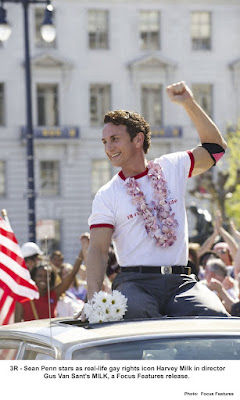
And just like we do for Meryl Streep, Al Pacino, or Robert De Niro -- by now we've begun to take actor Sean Penn for granted. Over the last few decades, we've seen him play tough, we've seen him play a stoner, we've seen him play a mentally challenged man, we've seen him play a death row inmate and we've definitely seen him play real-life characters before but Penn's complete chameleon-like ability to bring Harvey Milk to life makes Gus Van Sant's film work better than any other American film in 2008.
And of course, although part of me still would've loved to have seen Mickey Rourke win that richly deserved Oscar for his turn in The Wrestler since everyone (and especially Harvey Milk himself) loves an underdog-- ultimately, upon a second viewing, I believe the Academy made the correct choice.
While the filmmakers of Milk had Rob Epstien's 1984 Oscar-winning documentary The Times of Harvey Milk to go on-- what strengthens this film is the startlingly naturalistic screenplay to move away from the trappings of biopics to making the film feel fresh, flawed, and relatable. Penned by the impossibly young and talented screenwriter of HBO's TV series Big Love-- Dustin Lance Black--this retelling is intimate, human, erotic, unexpectedly funny, warm, melancholy, and empathetic much like Harvey Milk himself.
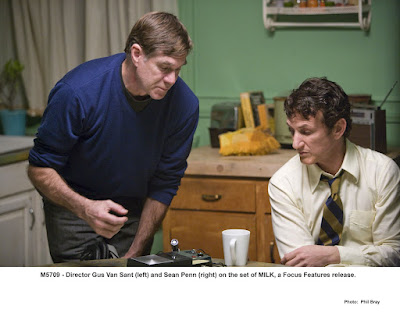
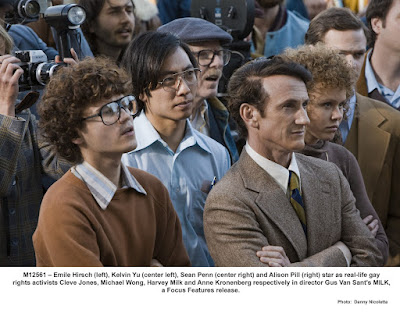
In what can only be described as Gus Van Sant's dream projects for fifiteen impossible years which found him trying to find the stars aligning to bring him the right cast and crew at the right moment in time-- Gus Van Sant makes his strongest work to date. And despite the fact that it's been more than three decades since his death and the painstaking authenticity and involving those who knew Harvey Milk best like Cleeve Jones, Anne Kronenberg, and Daniel Nicoletta who all offered a historical wealth of information as producers-- there is something undeniably urgent and contemporary about the film that cries out to those of us watching today.
This is most evident in the sequences wonderfully edited together in which we become familiar with the Harvey Milk platform. As a director, Van Sant has always had the ability to move effortlessly from the darkly comedic satire utilized in To Die For to his wildly successful Good Will Hunting up through the experimental and tragic Cannes Film Festival award-winning Elephant. Yet we realize once Milk begins that those fifteen years of dreaming were vital as he's now able to freely blend his independent filmmaking roots, inherent sense of artistry, his compassion for the human struggle, and love of a good American story to a richly rewarding achievement. Yes, it is a cliche but he got better with age-- much like Harvey Milk.
On Universal Studios Home Entertainment's extraordinary Blu-ray transfer of the Focus Features production Milk-- Dustin Lance Black recalls growing up as a young man in San Antonio, Texas struggling with his sexual identity before he ultimately moved with his parents to San Francisco. Emotionally, he remembers the impact of witnessing the 1984 Oscar-winning documentary about Harvey Milk and the way that a particular moment stood out in his memory wherein Milk argues that the reason he was fighting was for the next generation and for those everywhere such as a kid in San Antonio, Texas. And it was this passion that drew him to the story and again it is this passion to capture Milk as a human being that inspired the young Dustin Lance Black the same way his incredibly intuitive script manages to inspire us as we watch.
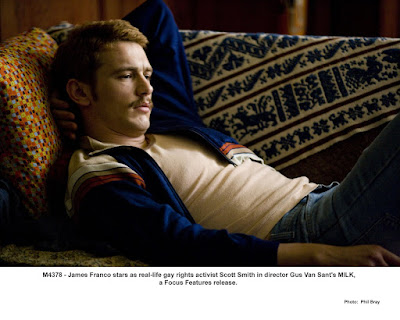
As Harvey Milk so often stated on the box he labeled with the word 'Soap,' "My name is Harvey Milk and I want to recruit you," and Gus Van Sant's film does recruits you the same way Barack Obama recruited a whole new generation of voters by drawing us right into the fight in a credit sequence that illustrates the cruel way that homosexual men were persecuted, pulled from bars and arrested. However, this quickly gives way to a subtle romantic pick-up of the soon to be forty year old Milk as he meets his partner Scott (James Franco) in a work that's structurally book-ended by Milk's narration of his life only to be played in the event of his death to a work that's surprisingly as life-affirming and uplifting as it is powerful and desperately haunting.
At the beginning, we meet Harvey Milk as a New York Republican businessman who's still extremely discreet about his sexuality (hiding in the shadows and barely out of the closet). This couldn't be a further cry from the Harvey Milk we would all come to see years later after he and Scott relocated to San Francisco where the two opened the Castro Camera shop and-- having faced prejudice-- by the small merchants association started to become politically active in their neighborhood which evolved from its Irish Catholic conservative roots to a gay mecca.
And just as soon, Harvey Milk's camera shop became the center of everything and with police brutality was on the rise, quickly Milk and others pulled together to realize they were stronger as a group whether in protest or in getting things done. And ultimately, Milk understood that just like the black movement needed black leaders and other minorities needed their leaders to represent them in the government system he fiercely believed in, somebody should step up for his community as well.
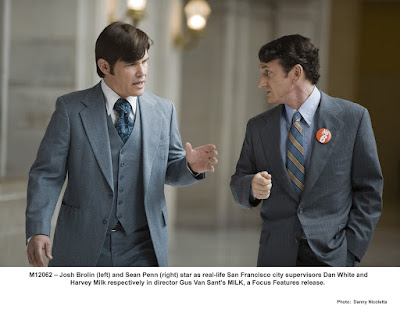
He began on a local level in an extremely grass-roots campaign strategy working with those around him including Scott as his campaign manager through three failed local elections until finally and sadly at the cost of alienating Scott who always had to share Harvey with everyone else and every cause he was elected to office as the city supervisor in 1977 along with the handsome former Vietnam veteran, police officer, and fireman Dan White (Josh Brolin). The opposite of everything Milk stood for-- at least on the surface-- although in Brolin's complex Oscar nominated portrayal, we realize perhaps they were more alike than one thinks as Milk implies that White could've been "one of us," yet to his credit, Van Sant never tries to draw any certain conclusions on what led to that fateful day when bullets rang out in city hall.
Instead, by illustrating the fight and all those involved-- he shows us the entire process from the ground up as Milk evolved from the meek "closet case" to a national icon likened to Martin Luther King Jr. and Ghandi by Brolin in another Blu-ray extra feature. To watch Milk is to become alternately amused, inspired, and enraged as it's more than a film but an experience and one that feels so much more urgent than any other contemporary film playing today. Since in the end-- thirty-two years after he was elected-- Milk is still recruiting us with his legacy, minus the soap box and through this tremendous portrait crafted by Van Sant, written by Black, and embodied by Penn.
Given its inventive camera cuts and cinematography by Harris Savides (in his fifth collaboration with Van Sant)-- the Blu-ray of Milk actually surpasses its theatrical experience with the sharpest of picture and sound. It also contains the benefit of educating new Blu-ray owners on the best way to maximize their experience of the film with a friendly user's guide (especially helpful given the format's typically confusing menus), the pop-up bar to show you precisely where you are at any given moment, optional subtitles in three languages and three worthwhile featurettes.
The mini-documentaries contain interviews with not only the cast and crew but also the real life consultants who are brought to life in the film and adding a richer understanding of their role and the way that Milk affected their lives including discussions with Cleeve Jones, Daniel Nicoletta, Carol Ruth Silver, Anne Kronenberg, and Allan Baird in "Remembering Harvey." Further going into the making of the feature, we join Van Sant and company on the hunt for the utmost in authenticity in "Hollywood Comes to San Francisco" and "Marching for Equality," making the disc a great achievement for the Blu-ray format and one that also engages the viewer into wanting to learn more.
Whether it's in researching the life of Milk and his colleagues to getting involved in your own community to fight for what's right, the bottom line is-- if you're unmoved by Milk, you may need to check for a pulse as this viewer has been recruited in what I now firmly feel was the best film of last year and ultimately the one which should've earned the Academy Award.
On Tuesday, March 10 cast your own vote by picking it up-- but do so with the warning that it's an experiential event and not just a film. Additionally, it's one wherein you must check your apathy at the door as it reminds you again as great cinema should that we're all in this together and we're all united more by our similarities than we would initially assume are our differences since in the always critical effort to ensure civil rights, we're fighting for each and every one of us regardless of our racial, sexual, gender, and political identity. In other words, consider yourself recruited and get to work.
Since the inspiration for director Jieho Lee’s feature film debut The Air I Breathe derived from the Chinese proverb categorizing the four pillars of life into (as IMDb notes) the “emotional cornerstones” of happiness, pleasure, sorrow and love, it seemed only fitting that his work reminded me of another ancient Chinese proverb dictating that if you save’s another person’s life, you are responsible for it.
Formatted into four distinct vignettes that-- in true Altman and P.T. Anderson fashion-- overlap in surprising ways throughout the course of the picture, Lee’s usage of his four primary emotions that are even echoed by some characters which share the same names, are constantly evolving. While each twenty to thirty minute segment is introduced with the corresponding emotion, basically it seems as inconsequential as a name-card at a crowded wedding reception where people table hop at will, as ultimately in the hands of Lee and co-writer Bob De Rosa, they merge into one super emotion that isn’t quite "sorrowfully-happy-pleasure-filled-love" but—perhaps truer to life—one that seems to better fit our frequent transient states in the human experience as we go about our days surprised by several emotional ups and downs. Although of course, filmmaker Lee ratchets his character’s plots to overwhelming dramatic heights where lives are either cut short or given a second chance and the destiny of those involved in these decisions are thus forever entwined, holding all individuals accountable for each twist of fate or rash decision. And if it sounds incredibly ambitious, it is and it’s not always successful but one has to give Lee points for walking his talk.
Despite a clunky start that fails to separate Lee’s film from the rest of the trendy pack of independent vignette works using any random connective tissue to overlap the lives of a seemingly diverse population of film characters as we’re introduced to a predictably pulpy noir inspired beginning which finds hardworking bank employee Happiness (Forest Whitaker) making a perilous bet on a horse race, we’re snapped to attention with a genuinely engrossing second storyline. In Pleasure, we encounter the emotion’s ironically corresponding namesake played by Brendan Fraser as the loyal, right-hand man of gangster "Fingers "(Andy Garcia), who according to the movie, earned the nickname because all he has to do is snap his terrifying fingers and Fraser’s Pleasure will strong-arm anyone at will.
What separates Pleasure from what ordinarily would be a typical noir cliché is his character’s peculiar ability to see the future, or-- even more frighteningly-- the ultimate destiny and death of those whom he encounters which makes him the handiest man to have on your side in a fight as he babysits Fingers’ immature, pig nephew Tony (Into the Wild’s Emile Hirsch). Soon he finds his gift at risk when he sees a poster of Trista (Sarah Michelle Gellar), a gorgeous singer to whom he’s attracted and realizes that not only can he not see into the beguiling young woman’s future but also feels a strange pull towards Trista, wondering if perhaps she is his own destiny. Fraser's character is so fascinating that I half-wished the film's entire four handed bridge game of Chinese proverbs would have been abandoned for a classic narration of Pleasure’s penchant for psychic premonition and the problems that are undoubtedly tied up within the questionable gift but Lee proved he wanted to explore several ambitious ideas with his first crack at direction.
Pleasure's instinct that Trista is his future proves to be an accurate assumption as Trista (who doubles as Sorrow in the film) finds herself bartered by her sleazy manager who trades her contract to Fingers in order to make good on an astronomical debt. Longing to escape the intimidation of Fingers who wants to milk his newest employee for all she’s worth like the cattle he considers her, Trista falls under both the protection and spell of Pleasure, embarking on a dangerous romance before her journey eventually leads to a fourth unevenly tacked-on segment involving crusading doctor Kevin Bacon who struggles to save the life of his married college sweetheart Julie Delpy at all costs.
Unfortunately, the film’s final act doesn’t quite fit the noir mold that Lee perpetuated with the nearly monochromatic color scheme and brooding tone for more than the film’s first hour and does slightly pull one out of its darkly seductive allure as a modern day homage to classic German expressionist influenced American noir works of the 1940’s, largely because the majority of the finale is filmed in predominant sunlight. And, given the genre, in the harsh light of day, Air's flaws along with its ability to cloak its shortcomings in noir style become glaring to the viewer.
However, it’s still a highly compelling film where earlier actions build on one another in unexpected ways and also one where-- more than just using the four emotions as a convenient structural device-- responsibility and accountability comes into play with the lives that are spared, making it a worthwhile proverbial Chinese puzzle to be solved for movie lovers who are game for viewing something out of the ordinary on DVD.
It almost seems like it’s a prerequisite for becoming an adult but most people I’ve talked with have had a similar feeling of restlessness following graduation when, after years of raising one’s hand and waiting for a hall pass to leave the room, there’s the unmistakable urge to break free, to wander, to explore, to see beauty in nature, and to stop worrying about the clock on the wall. For me it followed high school when my friend Shelley introduced me to Jack Kerouac and Bob Dylan and I felt a sense of wonder I hadn’t encountered since I’d first read Steinbeck and Fitzgerald—a hopeful sense of idealism, an unquestioning love for the idea of the American dream, and an overwhelming sense of wanting to get out and see the gorgeous landscapes and talk to people just as people and not as clips on the news categorized into whatever stereotype the network has decided to spin that day.
While my destination of Arizona ended up becoming my new home after a traditional visit, I admit that, as bizarre and illogical as it is, there is something undeniably intoxicating about the journey that Christopher McCandless took following his graduation from Emory University in 1990. Even though, those familiar with the resulting novel by Jon Krakauer or from the media coverage, knew that his story ended tragically inside that Magic Bus in the Alaskan wilderness, there’s a haunting indescribable joy mixed with dread and sadness that comes from watching his tale realized on the big screen by a compassionate filmmaker in actor turned writer/director Sean Penn.
Penn, who’d wanted to make the film for more than ten years and originally had envisioned Leonardo DiCaprio in the role, waited for official permission and approval from the McCandless family according to IMDb and I think that the film benefits not only from the space in time from the day that Christopher fled Atlanta in his Datsun but also from Penn’s maturity and growth as an artist in his own right as I recall the multitude of characters, performances, directorial efforts and choices he’s made over the last ten years as well.
After only a few moments of watching actor Emile Hirsch disappear into the role of Christopher in a career making effort, it seems to be an absolute crime that he was denied a Best Actor nomination from the 2007 Oscar season. A gifted student with the promise of an even brighter future at Harvard Law School, Christopher makes a choice that seems to shock everyone but his loving sister Carine (Jena Malone) when he donates his professional school fund of $24,000 to Oxfam, uses a scissors to cut up his credit cards and identification and burns his social security card in an act of defiance before taking to the road. Inspired by his beloved books by Thoreau and London, Chris heads west until his car fails him in the unforgiving Arizona desert and begins to "hoof it," now as what hippies would later dub him in his role as a “leather-tramp.” Fitting to his newly dubbed name of Alexander Supertramp, the film, divided into chapters that illustrate his new life from birth, to adolescence, manhood etc. follows Chris/Alex as he meets some people who would become like a second family to him on the road including a terrific Catherine Keener and Brian Dierker as hippies Jan and Rainey, a memorable Vince Vaughn as his farming boss in South Dakota whom he writes postcards to regularly throughout the film and countless others while his sister and parents (William Hurt and Marcia Gay Harden) must contend with his absence without any explanation, save for the flashbacks showing a rather tumultuous upbringing with some abuse, rage and lies. In a truly heartbreaking and Oscar nominated role, Hal Holbrook plays a retired military veteran with a tragic past who grandfatherly looks after Chris before he ultimately heads north for his true destination of Alaska.
Soon the film, which has intercut his past travels for two years before making it to the bus which would be his final destination, meets up in the same timeline and it careens towards its chilling and desperate finale—yet there’s a beauty and a quiet to these moments that recall the wonder and innocent joy of the earlier work that keeps things bearable, despite viewers' underlying sense of dread.
Gorgeously photographed on the exact locations from the life of Chris McCandless with an unrecognizable Hirsch who, in his brave role lost not only forty pounds but also used no doubles or stuntmen in even the most dangerous of situations, it’s Penn’s greatest directorial achievement so far and manages to hook us completely after its stylistically uneven start with too many scrawled journal entries and notes moving across the canvas of the frame. With an undeniable nod to the road pictures of the 60’s and 70’s such as Easy Rider and Bound for Glory, Penn’s film is admirable and unique in the sense of it seeming like an actual document of a life and one that, unlike some of the more polished works of 2007, will not become dated with each passing year, kind of like the life of McCandless that will no doubt continue to fascinate and inspire for decades to come.
Walking Movie Encyclopedia at Film Intuition; 3-Time National Award Winning Scribe; Film Reviewer; "Watch With Jen" Podcast Host; Screenwriter; Movie Discussion Host; BA in Film Studies & Communication.