Showing posts with label Under the Radar. Show all posts

9/22/2008

Married Life (2008)


The Heart Wants What It Wants,
Until It Doesn't Anymore.


Digg!

Originally published on Blogcritics in my
Under the Radar Feature


There’s an old phrase: “the heart wants what it wants.” True enough, although perhaps it should read: “the heart wants what it wants until it doesn’t anymore.” Whether it’s a child growing too old for their favorite teddy bear, a girl taking down a poster of her favorite boy band, or a boy deciding that his favorite video game isn’t cool enough anymore, this desire to acquire along with the persistent thought that there’s always something much more enticing just around the corner only grows stronger as we age. And it especially seems to rear its ugly head as we begin dating and discover that some friends find themselves in relationships simply out of habit or fear of solitude, just biding their time until something better comes along or realizing much too late that the person we want isn’t on our arm as we’d first assumed in the mad throes of early passion, but rather the promise of someone entirely different altogether. Or is it?

Such is the stuff of Greek tragedies, women’s weepies of the 1940’s and ’50s, soap operas, TV melodramas, and dare I say a large instigator for action in one of my favorite genres—film noir. Instead of simply relying on Ladies Home Journal article advice in the “Can This Marriage Be Saved?” column, trial separations, couples counseling, or tawdry extramarital hotel dalliances—in the days of film noir, infidelity, or even the sheer lust for another turned deadly in cinematic classics such as Double Indemnity or The Postman Always Rings Twice.

A self-proclaimed “ardent film buff, with a particular love for 1940s and 1950s movies,” as he noted in the press release, writer/director Ira Sachs crafted a wickedly funny hybrid of both film noir and women’s weepies of the same two decades with his woefully underrated stunner Married Life, now available on DVD. Co-written with Oren Moverman and based on John Bingham’s vintage pulp novel Five Roundabouts to Heaven, this sumptuous period film set in 1949 tells a deceptively simple story that—in the hands of anyone else—would’ve seemed entirely predictable. Summed up best by Sachs himself in the release, he relishes in the smile-inducing, one-sentence version of “a gentle, middle-aged man who falls in love decides to kill his wife because divorce would cause her too much pain.”

Needless to say, it’s the type of risky plotline sure to send audiences running in precisely the other direction to see the latest over-the-top blockbuster where the lines between the heroes and villains are as defined and clearly outlined as the characters themselves, yet I was consistently amazed by my inability to predict any and every plot twist throughout Sachs’ film. Additionally, I was mesmerized by not only the film’s beauty but its wickedly funny screenplay acted to perfection by a truly gifted quartet of performers including Pierce Brosnan, Patricia Clarkson, Chris Cooper, and Rachel McAdams.

Sadly, despite playing to rave reviews as well as being screened as an Official Selection at both the Toronto International and New York Film Festivals, Married Life is one of those hidden gems that seemed destined to become forgotten. This is especially apparent when you witness the baffling marketing campaign that didn’t really serve the comedic texture offered up by the filmmakers. As co-screenwriter Oren Moverman himself told friend Ryan Gosling in a Fall 2007 Filmmaker Magazine interview entitled “The Overachiever,” the complicated “film sort of found itself in the editing,” (pg 45) which may in fact be the reason the film’s trailer didn’t exactly manage to capture the spirit of the finished result.

Married Life Trailer


Noting that additional voiceovers were written and the evolving shape of the piece changed during the post-production, Moverman continued offering his admiration for Sachs’ “enormous amount of confidence” and willingness to change things in “a really great process discovering what the film could be through the editing,” (Filmmaker, 45).

With subtly intimidating roles in films such as American Beauty and Breach, by now actor Chris Cooper has sort of cornered the market on playing a deceptive everyman whose true demons lurk just below the surface. In Life, he plays Harry, a hardworking businessman and devoted husband, father, and grandfather who reveals a secret to his best childhood friend, Richard (Pierce Brosnan) shortly into the film. While to the casual passerby, Harry’s picture-perfect marriage to Pat (Patricia Clarkson) seems to be the envy of all, his wife’s emotionally cool exterior and belief that sex is the sole key to happiness along with affection and compassion has left her husband with the dire wish and need for true love. Yes, get that non-stereotypical gender characterization—a man wants love and a woman wants sex.

Of course, predictably, Harry’s wish has been filled when he falls for a beguiling younger woman who seems to love him unconditionally and he tries to explain his situation to the notorious bachelor Richard who in his narration throughout reveals his belief that “marriage is an illness like chickenpox,” to which he is immune. However, despite this, passion and love is something to which Richard’s entirely susceptible as he becomes taken with Harry’s beautiful, blonde mistress Kay (Rachel McAdams) upon her entrance which seems to echo Vertigo due to not only the use of a green dress but also a breathtaking and unabashedly romantic score by Dickon Hinchliffe.


Committed to ending his relationship with Pat, Harry makes great conversational strides one evening before his wife experiences a panic attack. And after a fateful encounter with a hitchhiker, Harry makes the bizarrely macabre and overwhelmingly egocentric decision to conduct a mercy killing to spare his wife any further grief. Although the audience realizes far before Harry does that there’s much more to Harry’s plans than meets the eye as we discover that Pat too is looking for love elsewhere. And in a revolving door of romance, Richard has decided not to let something as precarious as a lifelong friendship get in the way of trying to seduce Harry’s girl. Soon, torn between two men, the introverted Kay with a tragic past, finds herself pursued in two varying ways via a more intimate, stay at home approach with her married lover and the boldly freewheeling, on-the-town, overwhelm of Brosnan’s dashing Richard.

Harry and Kay: “I Want to Love You.”


Richard and Kay: Date Night

Richard’s Request


And as all characters grow increasingly fixated on pursuing their own desires, the playful tone of Married Life grows much tenser and wildly unpredictable as it makes its way towards an inevitable, yet completely unexpected conclusion. While the entire cast turns in uniformly excellent performances, I was especially charmed by Brosnan who actually plays the film’s most deceptive character in the end, knowing as he himself reveals enough information to set everyone free but chooses not to for his own gain.


Yet, it’s Harry who has the most complete arc as Sachs noted in the press release since he “starts off in the beginning of the movie knowing the least about the other characters,” but intriguingly “by the end, he knows the most.” Sure to elicit endless discussion, Married Life is one of those works that in a way may benefit from its sleeper status as it plays infinitely better on a smaller screen and when shared with others, as you may wish to rewind segments, pause and chat, predict, and obsess throughout.

While it may be risky viewing for certain married couples suffering through their own melodrama, Sachs adamantly refuted the idea that it’s a cynical look at marriage, stating that to him, long-term relationships are “always a great, even noble, challenge.” And also as he shared in the release he hoped Life would be considered as “a humanist approach to a genre story, so in the end, it becomes perhaps not really a genre picture itself.” Additionally, attempting to offer up a tale to “make people feel less alone,” when viewers are “in bed and… feeling slightly alienated from your wife or loved one… [you can] realize that… [you] are just like the person in the next house, who’s also coping with these kind of questions,” Married Life is sure to play even better on a second and much less nerve-wracking viewing.

So in the end, while it’s impossible to predict what the heart will want next, Married Life serves as a wise, inventive reminder that we’re all in this together, falling in and out of love and realizing sometimes that our wandering eyes are just that. Yet optimistically, we stay tuned for the next offering—whether it’s Mr. or Ms. Right or a sensational DVD just around the corner. And while, as far as this reviewer’s concerned, I’m still waiting on the gentleman but for right now, I’ll happily settle for the DVD.


9/16/2008

Frozen River (2008)


Memo to Oscar voters:
This
River must be crossed.


Digg!

With an MFA in film as well as a law degree, writer/director Courtney Hunt told Filmmaker Magazine’s Scott Macaulay that she “wanted to do a story where women were really active, where they were really doing stuff. Not relationship stuff,” (Summer 2008; pg. 35). After her first short film was picked up for PBS’ American Playhouse, Hunt found herself fascinated upon the discovery of real life female smugglers going between New York and Canada and bringing in human traffic to provide for their families by crossing the perilous St. Lawrence River.

After setting her thoughts to paper, she interested former Homicide: Life on the Street and 21 Grams actress Melissa Leo as well as talented young Skins actress Misty Upham to appear in the 2004 version of the short film before finally, in true independent spirit, she and her husband raised enough money to turn Frozen River into a feature length work.

Lauded by filmmakers such as Quentin Tarantino and winner of Sundance Film Festival’s Grand Jury Prize along with numerous others, Hunt’s subtle film offers one of the year’s finest, underrated acting portrayals by veteran star Melissa Leo. Now playing in limited theatrical release, Frozen River has skyrocketed to the top five list of the best films I’ve seen so far in 2008 and may very well be the most impressive work I’ve seen all summer.

Truly under the radar, so much that a press screening wasn’t even held for Hunt’s film and it’s receiving little in the way of advertising, Frozen River, which was shot “in sub-zero weather in Plattsburgh, New York” on an HD Panasonic Varicam as noted in the press release, relied heavily on a young, energetic, and eager New York cast and crew to bring this multiple award winning labor of love to the screen.

Buoyed by a tour de force portrayal by Leo, whom Hunt encouraged “to watch John Wayne in Rio Grande,” to study the way “he does absolutely nothing but gives up everything,” (Filmmaker, 92), the film is truly a testament of the undying devotion that mothers have to provide for their children.

Leo stars as Ray Eddy, a hardworking, tireless mother whose gambling-addicted husband has fled their home with money for the down payment for a new doublewide trailer home just one week before Christmas. And it’s heartbreaking to watch as the proud mother tries to appeal to the trailer deliveryman’s good nature in ensuring she’ll be able to provide a suitable home for her children as you can see in the clip below, which certainly rings true in our struggling economy as so many people find their homes jeopardized.

“Call Me When You Have the Money”

While her fifteen-year-old son T.J. (Charlie McDermott) offers to get a job to help contribute, Ray adamantly refuses, telling him flatly that not only has he got to go to school but he’s also got to be there to look after his younger brother. Eager to track down her husband, she tries all of his usual haunts in the Land of the Mohawk and when she notices his car in the parking lot of the local Territorial High Stakes Bingo Parlor, tries to find him herself, encountering a dead end in the form of a woman who refuses to let her into the parlor without paying an entrance fee.

“Can I Just Look?”

The first of many scenes that illustrate the double-standards and reverse racism and sexism in the community on both sides, the angry yet determined Ray follows a mysterious young woman she sees driving her husband’s car. Following a confrontation with the woman named Lila (the talented Misty Upham), upon realizing that her husband is nowhere to be found, she finds herself striking a tentative bargain with the young Native American woman who promises that she’ll be able to help her sell her husband’s Dodge Spirit.

“I’m Not Crossing That”

It’s only when she gets to the other side of the reservation across the river that she realizes Lila’s true intention is to use Ray in the highly dangerous, incredibly risky yet overwhelmingly lucrative venture of human smuggling. Running Chinese and other immigrants who pay forty to fifty thousand dollars to gain entry from Canada into America via cars with push button trunks before they’re delivered to amoral “snakeheads” at a local motel that make the immigrants work for years to pay off their entry fee, soon the desperate Ray is in way over her head.

Still trying her best to legitimately provide for her family at Yankee One Dollar discount store where her rude manager denies her the chance at a full time position in favor for a young, skanky, and perpetually late girl with a visible lower back tattoo, Ray inevitably finds herself going back to work alongside Lila. And soon both women realize that they have far more in common than one would’ve assumed due to their initial prejudices and assumptions.

Although it’s erroneously labeled a traditional thriller and advertised as such, this tense and gripping character drama distributed by Sony Pictures Classics has earned its talented filmmaker countless accolades which is all the more admirable when one realizes it’s just her first feature length work. Deceptively leading the viewer into thinking it will end one of several ways, the film admittedly does venture into thriller territory as it continues but it never feels forced. Every moment seems entirely justified and logical given the character-driven approach and the roadblocks they face along the way.

Although Hunt admitted in Filmmaker that “it’s a hard movie to watch” since “most people don’t live in that world, and asking someone to sit there for 97 minutes and live in a trailer is tough,” (pg. 92) Frozen River is far worth the investment. As opposed to the endless, ugly indie dramas such as The Savages and Margot at the Wedding that we were bombarded with last year is that instead of pretentious, self-involved, overgrown children who don’t resemble anything remotely real, we’re painfully drawn in by Hunt’s authentic approach and the realization that mothers will stop at nothing to protect their children. In fact, Margot and The Savages are far more depressing than River is (for entirely different reasons) and Hunt is talented and intelligent enough to weave us through the many twists and turns of Ray and Lila’s journey in a way that we find ourselves incredibly compelled, sympathetic, fearful yet actively engaged through the whole running time.

And as Leo told Jason Guerrasio in her Filmmaker cover story Q&A, “Pride is not an easy emotion to come up in me, but yeah, I’m very, very proud of Frozen River and what I brought to it,” (pg. 38). I think even the previously cited clips are proof enough that the pride is well-deserved and I urge you to seek the film out. And while I expect we will definitely be seeing actress Misty Upham in far more work down the road, in the end it’s Leo who commands our attention in a way she hasn’t since 21 Grams. Moreover, much like human trafficking, it’ll be an absolute crime if she (as well as Upham’s supporting performance) are overlooked come Oscar season.

So, taking a cue from Hunt who just wanted to make a film where women “were really active” and “doing stuff” as opposed to meeting cute with photogenic and dreamy rom-com leading men, your active to-do list for today is to brave the weather, pack a jacket, and venture onwards to Frozen River.

9/08/2008

Autumn Hearts -- A New Beginning


Digg!

Originally published at Blogcritics in my Under the Radar Series

Since the dawn of DVD and the all important demand that a movie earn far more bang for its box office buck when those cute little book-like boxes hit the shelves as opposed to the overpriced multiplexes, there’s been a strange practice that affects mostly indie, foreign, and art offerings that typically don’t earn a major release save for a few precious film festival screenings. And that is precisely the practice of saddling a perfectly good film with a name change to something the marketing team hopes will be catchier or friendlier to passersby (or more accurately their wallets) strolling through Best Buy or Blockbuster.

In doing so, sometimes they go from a pretentious sounding title like Life/Drawing to Apartment 12 for a festival award-winning Mark Ruffalo romantic comedy from years past or name one film Leon in Europe and the same movie The Professional in America in the mid-'90s to attract our gangster-loving culture. However, in the unique case of director Paolo Barzman’s beautiful, tender, and heartbreaking 2007 film starring Susan Sarandon, Christopher Plummer, Max von Sydow, and Gabriel Byrne, neither the original title nor the DVD title will manage to benefit it in the least.

The film which screened as the closing night film at last year’s Toronto International Film Festival was first dubbed Emotional Arithmetic — a title taken directly from Canadian author Matt Cohen’s novel upon which it is based. And more recently, it was released as Autumn Hearts: A New Beginning. Therefore, sadly Barzman’s quality film went from a nonsensical and ultimately pretentious name to an overly simplistic one that at best conjures up warm, fuzzy images of Hallmark Hall of Fame films and at worst is one so innocuous that you’ll struggle to recall it as soon as you hit eject.


Adding to the confusion is that the film’s official website still uses the old name so it will be hard to track down for those who have been following it since its festival rounds last year and when trying to find information on the film, you have to try searching under both names. Thankfully, IMDb is smart enough to direct those typing in Emotional Arithmetic to the right page but search engines aren’t quite there yet, which is a shame because it’s a touching and affecting work played brilliantly by the leads via an "old fashioned style" concerned primarily with “the emotional journey of the characters,” as Gabriel Byrne notes in a worthwhile behind the scenes featurette on the DVD.

Additionally, as someone who believes that perhaps there have been so many WWII films that not only has it become its own genre but that some are hard to tell apart, Barzman’s film — like last year’s Oscar winning foreign film The Counterfeiters -- opened my eyes to something of which I was unaware. Instead of forcing Jewish prisoners to counterfeit funds to aid the German effort, in Hearts (and now I believe you’ll agree that title seems entirely inappropriate) I learned about about the existence of Drancy — a transit work camp that existed just outside of Paris, set up by eager French collaborators working with the Nazis as a stopping point before the Jews were transported to death camps.

The film opens in “Quebec’s Eastern Townships region” in September of 1985 as we meet the troubled Melanie Lansing Winters (Susan Sarandon), still haunted by her youth spent in Drancy so much so that she’s taken to devoting her life to collecting data regarding each and every human atrocity committed around the globe. She catalogs them in numerous file cabinets with names, dates, and numbers in the hopes that people will never forget. Married to the cold and bitter professorial husband David Winters (played by Christopher Plummer), as Hearts begins, his mood has also hit an all-time low after he was forced into retirement from academia following a heart attack and plans to sue. Although he seems to blame his wife for her inability to forget the past and move on, her loving and devoted grown son Benjamin (Roy Dupuis) and grandson Timmy (Dakota Goyo) who also live at their large homestead treat Melanie with kid gloves, walking on eggshells and gently reminding her to take her antidepressant medication.

Prone to breakdowns and stress, Melanie seems utterly ecstatic when she manages to get in touch with Jakob Bronski (Max von Sydow), the so-called “Poet of the Gulag,” who looked after her as a young girl in Drancy. After surviving the work camp, and later Auschwitz, and years of electroshock therapy in a psychiatric institution, he has finally been freed and agrees to come stay with Melanie in Canada for awhile. While her husband makes it clear that he’s less than thrilled that Melanie has invited what he fears is yet another most likely memory plagued, “emotionally unstable” survivor from the war to live with them, he’s in for a far ruder awakening when Jakob brings with him a surprise for Melanie. For instead of a trinket or bouquet, the gift arrives in the form of Christopher (Gabriel Byrne), another survivor from Drancy who — much like Sarandon’s character — had also lost his parents.

In black and white flashbacks, we realize the instinctually close bond the three shared in their hellish experience, with Jakob looking after the two kids and, once he was removed, making Christopher promise to take care of Melanie, the young girl with whom he was undoubtedly smitten. Briefly after their reunion at the airport, we realize that Christopher’s love for Melanie has increased considerably and the two awkwardly skirt around their feelings until finally confronting one another about what might have been had they managed to be together following Drancy in one of the film’s most moving scenes.

Although it’s been rightly argued that essentially “the film is designed like a stage play” and “hardly leaves the house or garden,” for this deceptively photographically idyllic (from one of Canada’s most gifted and award-nominated cameramen Luc Montpellier) and dialogue-heavy film, the staging seems not only appropriate but completely necessary to best serve the highly sensitive and relationship-based material. Cinematically, Hearts owes something to the works of Ingmar Bergman and even Woody Allen’s gloomier works like Interiors and September. And while there are endless arguments as everything is bared over the course of a painful yet air-clearing and cathartic twenty-four hour period that does seem a bit melodramatic at times, the actors all make it work and a great deal is equally owed to its talented director.


With a background mostly consisting of television credits and the realization that this is just his second feature film, it’s a remarkable achievement. Additionally, it’s one that seems tailor-made for the filmmaker after a little more digging on IMDb revealed that Barzman himself is no stranger to political conflict and global affairs, having been raised in exile until the early 1970’-s in France as the “son of blacklisted screenwriters Ben Barzman and Norma Barzman” following the McCarthy HUAC hearings of the 1950s. And while I fear that due to the title confusion, it may fall under the radar, in order to prompt you to seek it out (no matter which title you prefer), I’ll leave you with a visual reminder.

Theatrical Trailer:

9/02/2008

Turn the River


This Hustler's After The Color of Motherhood.


Digg!


Originally published at Blogcritics in my Under the Radar feature.

Even though we should know better, sometimes it’s fairly easy to mistake the characters an actor plays with what he or she must be like in real life. For example, if you tried an experiment and asked a group of strangers about A-list stars, a majority would probably tell you that Tom Hanks seems like the nicest guy on the planet given his work in Forrest Gump and Big (which is why they avoided his brilliant turn as a hit-man in Sam Mendes’ Road to Perdition). And in the same turn, that probably Wall Street, Fatal Attraction, and Basic Instinct star Michael Douglas seems like he’d be a tad intimidating. Sure enough, it’s this kind of thinking that spans the entire realm of all celebrities whether they’re actors, athletes or musicians whose lives are thrust in front of us in a multitude of ways, all inviting us to label them by their creative output.

Case in point: the highly verbal independent film star, Chris Eigeman a.k.a. an actor upon whom I developed quite an irrationally intellectual crush in the early '90s. Ever since I saw Chris Eigeman in Whit Stillman’s Barcelona -- dissecting the process of physical therapy and analyzing what’s really going on at the end of The Graduate — I became a fan of the actor’s uniquely neurotic delivery of dialogue. Simply put, Eigeman can make the most complicated paragraphs of scripted words sound naturally effortless.

Thus, over the years, since his scene stealing performance in Stillman’s Metropolitan, it’s no wonder that Eigeman has attracted some truly innovative writers such as Noah Baumbach (Kicking and Screaming) and television scribes including Amy Sherman-Palladino (Gilmore Girls) and Peter Mehlman (It’s Like You Know). Indeed if there were ever a verbal Olympics, I’m going on record as stating that the American team should consist of Eigeman as its captain, quickly followed by Lauren Graham, Campbell Scott, Parker Posey, Matthew Perry, and Topher Grace.

And it’s precisely this type of thinking, based on the characters Eigeman has portrayed again and again, that made his much darker, far less verbal, noir-tinged feature filmmaking debut, Turn the River, remind me once again that — similar to the way you shouldn’t judge a book by its cover (as then no one would read Catcher in the Rye) — you shouldn’t judge a man by how many WASPs he’s played. In a truly memorable and impressively subtle character-driven work — Eigeman’s first as a writer/director — he cast his vastly underrated Treatment co-star Famke Janssen (Goldeneye, X-Men, Made) as Kailey, a desperate New York pool hustler, eager to get together enough money to take her child away from her ex and head across the border to start a new life.

Winner of three awards at the Hamptons International Film Festival and lauded with praise by some of the nation’s top critics equally taken by both Eigeman’s debut and Dutch born actress Janssen’s mesmerizing portrayal that was even better than Maggie Gyllenhaal’s similarly themed work in last year’s Sherrybaby, this independent stunner has recently landed on DVD shelves. After having penned a couple of scenes here and there, once Eigeman wrapped The Treatment, he turned once again to his unfinished screenplay and once he began writing Kailey’s dialogue, he told IFC’s Stephen Saito that “it was incredibly evident that I was writing for Famke — there’s something very defining about her,” which he attributes to her “fearlessness” and “great cowboy spirit… both in her life and in her work.”

Although he notes that “it was truly f***ing terrifying,” to shoot the film’s “20 or 30 pool shots,” which they photographed and named and Eigeman laments the fact that he didn’t have the same “support structure to try and pull something like [Martin Scorsese’s Color of Money] off,” he admits that his cast including Janssen got “good enough that we could just let them play. We’d shoot 360 degrees and let them go.” However, while pool plays a primary role as it is Kailey’s immediate source of income aside from a few poker games here and there, Turn the River is at its heart a humanistic portrait of a woman who will do anything to be with her child.

As the film begins, we find ourselves moved by Kailey, who, despite having no visitation rights with her 11-year-old son Gulley (Jaymie Dornan), mails letters to the pool hall run by her trusted friend and fatherly mentor Quinette (a terrific Rip Torn), only able to arrange meetings with her son in secret. While admittedly we’re torn when we become acquainted with Kailey’s plan to kidnap her willing son, once we meet Gulley’s overly religious and domineering birth father David (Matt Ross) and his new submissive wife Ellen (Marin Hinkle), we realize that neither situation is ideal for Gulley and in the end, while a sense of foreboding pervades, we want to believe that Kailey will be able to quit hustling and settle down. Yet, Eigeman refuses to let us off the hook easily — as a veteran of independent cinema, he respects the intelligence of his audience enough not to offer any shortcuts and makes each and every plot turn seem entirely real and inevitable.

View the Trailer:

Also featuring a wonderful music score by Clogs, comprised of “four musicians from the U.S. and Australia who compose and improvise using sounds, textures and influences from across the musical spectrum,” Turn the River plays first and foremost as a tremendous film about motherhood and secondly as an above-average poolroom drama wherein, Eigeman notes that just like sex scenes, pool shots are “infinitely less interesting than [the expressions on] people’s faces.” And with this in mind, the entire film serves as a wonderful showcase to the tour de force performance by Janssen.

Likewise, hopefully if it catches on, Turn the River will earn this truly talented performer many, many more roles… that is, as long as we don’t typecast her as a pool-shark anytime soon. Although, much like the verbal Eigeman — if the game of pool ever becomes an Olympic event, we’ll know whom to send for that category as well.


8/29/2008

The Search for John Gissing


Digg!

Originally published at Blogcritics as part of my feature: Under the Radar

The story behind the final release of writer/director Mike Binder’s charming corporate culture clash comedy The Search for John Gissing seven years after its production is nearly as entertaining, surprising, amusing, and filled with enough dubious events to rival the plot of the film itself.

After using the benefit of a British tax break to shoot overseas and scraping up enough money between his own savings and that of supportive family and friends, Binder filmed Gissing in early 2001 entirely “on the cheap,” as he told Cinematical’s James Rocchi. Yet, despite drawing raves from audience members and inclusions into several film festivals around the globe, he was never able to find a fair studio offer, admitting that, “the only deals we could get were from people who wanted to own it. Forever. For doing nothing.”

Understandably finding it unacceptable, Binder promptly moved on to other projects, including HBO’s The Mind of the Married Man, his critical breakout Joan Allen and Kevin Costner vehicle The Upside of Anger, the straight-to-DVD, Preston Sturges meets Jerry Maguire Ben Affleck comedy Man About Town, and the little-seen, entirely underrated Don Cheadle and Adam Sandler post 9/11 buddy film Reign Over Me.

However, while Gissing remained on the back burner for Binder who even at one point “re-wrote the whole script… called… The Multinationals,” with the intention of filming it again, the search for the original John Gissing film remained a constant obsession for its fiercely loyal, determined, and unwavering fans. While Binder grants that the devotees consisted of “primarily absolute Rickman fans” (among which he includes himself), an online petition was begun to force the film’s release, ultimately gathering 3,630 signatures and fans flew from across not only the U.S. but England as well to see the film and Binder’s Q&A when Gissing was included “as a last minute thing” at the Westwood International Film Festival. Touched by their passion, Binder took down the mailing information of forty attendees and sent them each a burned copy of the DVD, as Cinematical reports.

Inspired, finally he decided to follow through on his goal “to put together a site to sell my movies,” which he admits was “more work than I thought it was going to be… there’s a new obstacle every day.” However, via his experiment to eventually create “a big-ass pipeline going right through the ground to people that want to buy my movies,” he found an unlikely DVD maker through an adult entertainment DVD company “looking to go letimate.” Eventually the disc earned its release, with no studio input — a Binder film (made by Mike and produced by his brother Jack) on a Binder website to a Binder audience. After stumbling on the DVD at a local video store, I found myself becoming quite the Gissing fan in my own right.

To be fair, I’ve been a Binder fan without realizing it since tagging along with my parents to see the Big Chill-like, sunny Indian Summer in the early '90s (which he wrote and directed) but ever since Upside of Anger, I’ve made a special effort to seek out his work. In that film, he became one of those unique and admirable (yet far too few) males to accurately portray women as complicated and fully realized characters and it was thrilling to witness a movie with such a tremendous and overwhelmingly female cast wherein the women weren’t obsessed with shopping or mani/pedis. Yet, more than that, he’s equally — and obviously given his gender — probably even more so at home in the world of the male-dominated concrete jungle where Art of War seems to be the post-MBA manual. It’s a subject he keeps returning to again and again — whether it plays a dominant role as it did in Man About Town or a more subtle one with Don Cheadle’s character's work struggles in Reign Over Me.

And again, international business is the agenda of the day in The Search for John Gissing, yet to just say it’s a business comedy would be to do it an immense disservice. It begins as a far better hodgepodge of Neil Simon’s Out-of-Towners and the comedies of the modern day French master Francis Veber (The Valet, The Closet, The Dinner Game) with a little of Billy Wilder’s The Apartment thrown in for good measure, which Binder admits indeed helped inspire the office building set decoration.

When Compu-Corp employee Matthew Barnes (Binder) and his wife Linda (Janeane Garofalo) arrive in London, they assume it’ll be their next temporary landing place in a series of buy-outs, mergers that go along with being one spoke in the wheel of his employer’s international conglomerate company. However, from the moment their feet touch cement at Heathrow Airport, anything and everything goes wrong as all the plans made for the couple’s arrival by Matthew’s same-level London colleague John Gissing (Alan Rickman) fall through. Soon they begin to wonder if their trip is being sabotaged on purpose by Mr. Gissing himself. And the first forty minutes of the film blends the misunderstandings and mistaken identities found in not only Veber but also British sex farces to great effect as the couple find themselves in situations one has to see to believe. I’d reveal more about exactly what and whom the Americans encounter but hesitate to do so as by even expanding on the character descriptions, I’d be killing several of the film’s jokes before one even inserted the disc into their DVD player.

However, once Rickman and Binder share screen time, it morphs first from a chess match of one-upmanship into thematically similar territory of the freewheeling buddy movie adventure he did so well in Reign Over Me. Except in the case of Gissing, the tears come from laughter this time instead of sadness and we absolutely can’t get enough of Rickman as we’ve never seen him before. As a Steve Martin-like “wild and crazy guy,” Binder notes that contrary to his fear that Rickman was “gonna be tough; he seems kind of cranky and cantankerous and a bit curmudgeonly in the meetings,” he was instead the “warmest, sweetest gentlemen I’d ever worked with in my life,” adding that he believes Rickman “was just dying to tear up the scenery and the furniture.” And after viewing it, I wouldn’t hesitate to agree and despite my fondness for Rickman as a serious actor (despite being the source of my childhood nightmares after I watched Die Hard with my older brother while still in grade school), I would honestly love to see him offered more comedic work to show the wise-cracking, pratfall friendly side of Harry Potter’s Severus Snape.

With a great turn by the always hysterical Janeane Garofalo who makes a perfect bantering partner for Binder, Gissing is one of those word-of-mouth films sure to get one phoning others as soon as it’s over. Filled with inventive jokes about the culture clash to be found when Americans travel abroad even to a country that speaks our language, the award-winning The Search For John Gissing also contains priceless bits sure to attract an even wider international base as the finale involves a German group of buyers and a French antique-chair obsessed superior to Barnes and Gissing who receives his comeuppance in a decidedly unexpected way.

And although given the background of the film, it’s easy to forgive the skimpy extras (containing outtakes and deleted scenes), one can’t help but wonder, given its cinematic plot-worthy backstory, if perhaps in the future Binder won’t do something with it down the road. Whether he chooses to make an insider Hollywood satire (although after the lackluster Tropic Thunder -- man, do we have enough of those) or in its next DVD release, turn Gissing into a double-disc special feature heavy version, one thing is for certain — namely, you can guess you’ll find it via Binder’s own “big ass pipeline,” online, which may inspire more independent filmmakers to reach prospective audiences down the road.
Still, in the effort not to inspire yet another petition to plead with him to reinvent a perfectly good DVD, I must say that Binder’s movie is even more entertaining than the seven year odyssey to its release. Or in the spirit of brevity to match the setting of the film’s business world — I’d urge you to begin The Search for John Gissing at your earliest convenience. Thank you for your time and there will be a meeting about it in the morning. And as I’m sure Matthew Barnes would warn — just make sure you don’t ask John Gissing to call you with the details.


8/22/2008

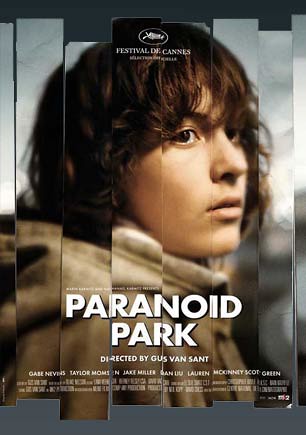
Paranoid Park


"Skateboarding is not a crime…
unless it becomes one."


Digg!

First Published on Blogcritics in my New Feature: Under the Radar:

Director: Gus Van Sant

Nobody does young male angst quite like Gus Van Sant. And over the course of more than twenty years it’s a landscape he returns to again and again throughout his filmmaking career. While some films are more successful than others, when evaluated as a body of work, Van Sant has painted an increasingly complex and irreplaceable portrait of moral and sexual ambiguity, coming-of-age amidst painful contemporary circumstances and above all, the evolving nature of masculinity during the last few decades.

Whether he’s chronicling the prescription pill popping robber Matt Dillon in Drugstore Cowboy, casting River Phoenix as the narcoleptic gigolo who shares a Dustin Hoffman Midnight Cowboy-like affection for Keanu Reeves in the Shakespearean tinged My Own Private Idaho, or dealing with Joaquin Phoenix’s lust turned obsession with Nicole Kidman’s “bubble headed bleach blonde” in To Die For, he seems most comfortable with evaluating the lives of loners and outsiders.

And while he had his biggest hit with Matt Damon and Ben Affleck’s breakout Oscar winner Good Will Hunting, despite filming the thematically similar yet equally fascinating and overlooked Finding Forrester starring Sean Connery, Rob Brown, and Anna Paquin (with the only misstep being Connery’s ill-advised tagline of “You the man now, dog!”) he refused to play by the rules. Following up the more mainstream fare of both Good Will and Forrester along with the experimentally strange shot-by-shot color remake of Alfred Hitchcock’s Psycho, Van Sant returned to art house territory for what he refers to as his “Death trilogy.” Beginning with the Cannes Palme d’Or winner and unflinching Columbine-like Elephant (which Tom Hanks has cited as one of “his top five all-time favorite films”), he continued the thread with Damon and Casey Affleck’s wandering docudrama-like Gerry and the Kurt Cobain inspired Last Days.

However, old habits die hard and death continues to play a part of his most recent work Paranoid Park which won one of two awards it was nominated for at the Cannes Film Festival as well. Additionally, those who intend to check it out will do best to avoid watching the film’s spoiler heavy trailer and most major film reviews which reveal virtually every twist and turn of the subtle film’s plot.

With this in mind, I ask that you forgive a rather vague set-up to Park, but essentially it’s an artistic mood piece about the internal workings of a character as opposed to a standard by-the-numbers hero’s journey. This should come as no surprise since we all know by now — just as there are no legitimate villains — there are no heroes in the works of Gus Van Sant as all characters, even those involved in death, seem to reside firmly in the gray area in between.

And yet although its effects seep through every frame, it’s life and not death that’s the central focus of Park. No, rather like Michael Cuesta’s phenomenally brilliant and equally underrated Twelve and Holding, Paranoid Park shows how precarious life can be and the way we’re all affected by an unexpected passing; however instead of Cuesta’s young group of suburban tweens, Van Sant remains true to his favored demographic of the high school age.

Based on Blake Nelson’s novel and set in Portland Oregon, Park centers on its skateboarding lead character Alex (newcomer Gabe Nevins) who finds himself somehow involved in a death, of which the circumstances are revealed throughout the artistic tapestry woven by Van Sant in its roughly ninety minute running time. However, true to his age and Van Sant’s determination to keep things realistic in doing more than any director in recent memory in accurately portraying the struggle of males during their teens, Alex is also dealing with the disintegration of his parents' marriage. Couple this with the added pressure that arises when the subtly orientation-conflicted Alex finds that it’s he and not his virginal girlfriend — the pretty and popular cheerleader Jennifer (Gossip Girl’s Taylor Momsen) — who wants to put the brakes on their decision to go all the way, and you’re quick to understand that beneath the surface of the deceptively blank-faced gaze of Nevins’ Alex, lies a veritably figurative sea of angst.

And indeed, it’s hard to watch without — as an adult — wanting to somehow reach through the screen and intervene. For, when Alex is called to the principal’s office fairly early on into the movie and in a slowly paced walk choreographed to Billy Swan’s “I Can Help,” which would no doubt have been left on the cutting room floor of most major film shoots, Alex’s true delicate nature is revealed and ironically, we understand that — despite the lyrics — he’s the one we desperately want to help.

Swan’s music is just one of several intriguing selections, along with a quintessential Van Sant inclusion of the late, great Elliot Smith (who virtually filled Good Will Hunting’s memorable soundtrack) as well as tracks from Beethoven, Frances White, Ethan Rose, and more predominantly numerous works from composer Nino Rota’s fascinating score for Federico Fellini’s experimental Juliet of the Spirits.

While in anyone else’s hands, making overwhelming use of classic Italian cinematic compositions may have been seen as pretentious, it works to tremendous effect here, helping to add to the film’s air of mystery as well as Paranoid Park’s strange melancholic sense of beauty, frustration, and compassion. Not to mention, when laid over the breathtaking cinematography by one of film’s truest modern day magicians, Christopher Doyle (who shot Zhang Yimou’s Hero, Wong Kar-Wai’s In the Mood for Love as well as Philip Noyce’s Quiet American and Rabbit Proof Fence), it seems to form the ideal creation of yet another subtle Van Sant masterwork that emphasizes ambiguity in favor of easy answers and utilizes a near docudrama feel. Perhaps most significantly, above all, Paranoid Park remains true to not only his favorite theme but the one he excels in like no other craftsman — namely, depicting the portrait of a young man just trying to get by in the twenty-first century