Fans of Lasse Hallstrom's Chocolat should flock to Spanish writer/director Isabel Coixet's lovely adaptation of Penelope Fitzgerald's novel The Bookshop, which was shortlisted for the Booker Prize in 1978 (and which the author won the next year for Offshore).
Set in a coastal East England village in 1959, The Bookshop centers on Emily Mortimer's headstrong bibliophile Florence Green who – just like Penelope Fitzgerald and the underrated Coixet for that matter – is a passionate woman ahead of her time.
Determined to open a bookshop in the village's historic Old House to not only honor her late husband (who loved to read as much as he loved her) but also follow through on a dream she'd had since she learned the trade as a girl, as the film begins, Florence puts her plan in motion.
With her banker and solicitor dragging their heels, Florence butts heads with the community's old guard, especially the village's wealthy Queen bee Violet Gamart (played by Coixet's Elegy and Learning to Drive star Patricia Clarkson). Violet, we discover, aspires to turn the Old House into an arts center.
On the surface two like-minded proponents of arts and culture, it isn't hard to imagine that under different circumstances Violet and Florence might've been friends. However, in a subtle commentary on the way that women in a male dominated society are forced to compete with one another and doubly so with the added prejudices of class and status, as soon as she senses that Florence won't bend to her will, Violet vows to block her at every turn.
Refusing to budge, the fiercely patient Florence instead uses Violet's threats to derail her as the fuel she needs to drive home her goal. Settling into the Old House, our unflappable heroine soon gains both a new assistant in hardworking schoolgirl Christine (Honor Kneafsey) as well as a loyal customer in the form of the town's much gossiped about bookworm and hermit, Edmund Brundish (Bill Nighy), who places orders with Florence by way of written correspondence.
With their burgeoning relationship strengthened by the building blocks of shared experience and taste, Florence finds an unlikely ally in the reserved man, eventually asking him if he believes in Vladimir Nabokov's newly published Lolita as much as she does to purchase a large quantity of stock for the shop.
Making the most of Nighy's deadpan delivery to drive home the meaning of a few key lines rather than employ him merely for ornamental comedic distraction, when Nighy's Brundish tells Florence he supports her plan for Lolita and adds "they won't understand it but that's for the best. Understanding makes the mind lazy," it serves once again as a nice metaphor for the town.
A beautifully understated picture with fine performances as well as painterly cinematography (by Jean-Claude Larrieu) so crisp you can almost feel the drops of water from the sea coming through the breeze in the trees, The Bookshop is a solid if at times slightly pedestrian adaptation of Fitzgerald's novel.
Yet even if the plot arc on its own is a bit static, Coixet's interpretation of it makes things exciting as you can view her Bookshop as a feminist allegory about "a woman with a vision" (as she wrote in the press notes) who must contend with pushback, obstacles, and condescension while working twice as hard to get half as far.
Additionally touching on issues of censorship while of course, celebrating the love of the written word – especially in print – Coixet's small film is filled with big ideas.
Stressing the importance of legacy while passing on the torch to the next generation or inspiring those her wake, just like Florence argued that nobody feels alone in a bookshop, Coixet knows everyone has a dream. And in her intelligent (if slight) feature, she and the always terrific Mortimer might just encourage you to take Florence's lead and pursue your own passion as well – Violet Gamarts be damned.
An actress of great emotional depth and tremendous skill – over the past twenty years, Patricia Clarkson has honed her skills as a humanistic mathematician.
As such, she's made a career out of transforming even the most blandly underwritten one-dimensional characters on the page into fully realized three-dimensional individuals on the screen.
And given her propensity for navigating the rough terrain of heartbreak and misfortune as well as her innate understanding of the inner workings of the women she brings to life, we often see Clarkson in the role of head matriarch as the figurative captain of a ship she's trying to get back on course following a tragedy.
She does this once again in IFC's October Gale, which marks her second collaboration with her Cairo Time writer-director Ruba Nadda.
Therefore it's only fitting that the role of Helen, a recently widowed physician still mourning the death of her beloved husband, seems tailor-made for the star.
Yet by giving Clarkson her long awaited opportunity to play an ordinary woman turned action hero –due to extraordinary circumstances – Nadda raised the stakes for the actress and Gale to levels reminiscent of The River Wild and Dead Calm.
And once the plot starts to build after a clumsily edited, slow-moving, flashback soaked first act, the result is a mostly successful character driven thriller.
Set on a Canadian island, Gale finds the mild-mannered Helen fighting for her life after giving emergency first aid to a gunshot victim embodied by Scott Speedman's handsome stranger.
Soon stranded at the cabin by someone she thought she knew, when the man who shot Speedman's Will comes back to finish the job, Helen is forced to confront not only the harsh elements of the Canadian wild but also question just who exactly she can trust.
Although the pace quickens along with the peril, the overwhelming amount of bittersweet flashbacks (showcasing Helen and her husband in happier times) threatens to ground Gale to a halt before it even gets going.
Making the first half feel nearly twice as long– along with a sharper edit and tighter script, October Gale would've benefitted from a dual plotline – building greater momentum by introducing Will's storyline earlier on given both its complexity as well as the undeniably riveting nature of his character's own flashbacks.
Admittedly skirting the edges of romantic storytelling stereotypes and pushing the limits of logic a few times as Speedman's sensitive, classic literature loving "bad boy" Will goes from at-risk to Action Jackson a bit too quickly, the shortcomings in Nadda's ambitious Gothic tinged thriller are easily forgiven due to its overall genre novelty.
Buoyed by its core ensemble cast including a brief but effective cameo late in the film from Tim Roth, Gale is a flawed yet worthwhile work of moody Saturday night movie suspense that celebrates brains over brawn in its penultimate sequence.
A real world thriller anchored by a real woman instead of a Lara Croft or Wonder Woman type, the vital message of self-reliance, independence, and empowerment at any age provides this action movie with a role worthy of Clarkson, who visibly relishes showing us the kickass side of her usual melodrama-prone matriarch.
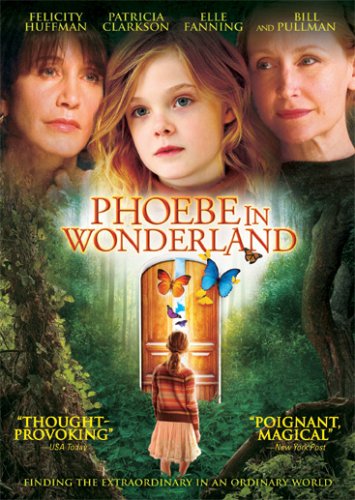
I had the unique privilege to see filmmaker Daniel Barnz's Phoebe in Wonderland three times over the course of a year in three very different formats. My journey through the rabbit hole with the film began last June via a screener from ThinkFilm as I wrote the synopsis for its inclusion as an opening night selection for the Scottsdale International Film Festival, followed by experiencing it on the big screen when it was screened to kick off the fest, and now in its DVD debut from Image Entertainment.
Finally released theatrically in major markets this Spring-- the overlooked gem that seemed to be a casualty of the uncertain future of ThinkFilm and several small studios-- garnered a great word-of-mouth campaign and critical acclaim from everyone including Leonard Maltin to Peter Travers, even going so far as to received Heartland's Truly Moving Picture Award.
Now in tandem with other studios and production companies including Lifetime Pictures, which I'm hoping will guarantee that the film will screen on the channel and be made available to more audiences in the future, the DVD has arrived (serving as my own personal Film Intuition pick of the week) and the transfer is visually stunning.
Presented in the original widescreen aspect ratio-- the menu alone sets up the magic to come by filling the top and bottom black bars with what appears to be a sparkling starry background as the wondrous "Alice in Wonderland" character filled imagery fills the center of the screen.
Sadly missing any special features aside from the original theatrical trailer and the opening previews for The Ramen Girl and Lost in Austen-- the presentation on DVD (in what I ascertained from online retailers gives viewers the option of purchasing it in two different styles of cover packaging) is excellent as the colors pop even brighter than in the print I saw in the theatre on my upconvert Blu-ray player.
While I definitely urge you to go on the hunt for Phoebe, parents will want to be sure to preview the PG-13 emotionally intense work which may bother some young children before bringing it home for family viewing.
Devotees of Lewis Carroll’s beloved children’s classic “Alice in Wonderland” series will be sure to seek out tickets to writer/director Daniel Barnz’s cinematically dazzling tea party which draws numerous parallels to Carroll’s work. In fact, there's so many parallels that I found myself picking up more the third time around as I realized that there's an opposite or backwards world, dialogue that sounds like that of Carroll, etc.
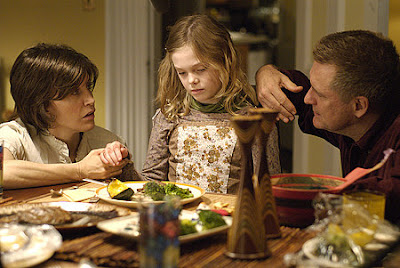
At a crossroads between acceptable childhood innocent curiosity and imaginative exploration mixed with peculiar Alice-like behavior, we follow the tale of the sensitive nine year old Phoebe (Dakota's talented younger sister Elle Fanning), as her tendency to live in her creative mind is beginning to baffle her classmates, teachers, and parents (Bill Pullman and Felicity Huffman).
When she’s given the lead role in the school’s theatrical production of “Alice in Wonderland” by her unorthodox new drama teacher Ms. Dodger (Patricia Clarkson) who likens herself to the Mad Hatter, Phoebe becomes increasingly drawn in by the play, which is coincidentally the same topic of her mother’s scholarly dissertation turned nonfiction work.
Mistaking her daughter’s erratic mannerisms as a cry for motherly attention, Hilary Lichten (Felicity Huffman) tries to intervene when Phoebe runs into trouble with her strict principal (Campbell Scott), however when it becomes apparent that Phoebe is going through something more than just a fleeting fascination with Alice’s “looking glass,” those around her realize they need to stop listening to themselves and start listening to Phoebe.
Tenderly drawn, heartfelt, and filled with gripping portrayals from its ensemble cast, Barnz’s Wonderland was screened in a highly successful premiere at the Sundance Film Festival before it was singled out by several critics as one of the festival’s hidden gems.
And although it's taken a long journey to arrive on DVD-- seemingly falling down the rabbit hole in its trip that lasted more than a year-- it's of particular interest to not just fans of "Alice" but also those looking for brainy, psychologically rich independent films headed up by strong female cast mates with particularly deft turns by Fanning, Clarkson, and Huffman.
"Again," Herb Brooks repeats, forcing his assistant coach Craig Patrick to blow one terse whistle as the shrill sound signals the players of 1980's Team USA to skate back and forth all night after their 3-3 tie with Norway.
And once the skates of the college aged boy return back to Brooks and Patrick's side of the rink, it's "Again," he curtly calls out consistently to remind the boys to pay less attention to the blonde beauties and more attention to what they're doing in Lake Placid, New York. This continues on as he repeats his battle cry of "Again," way past the point of exhaustion until both Coach Patrick and the boys seem like they're ready to give in.
Yet they don't give in and that's what made the "do you believe in miracles?" defeat of the dominant Russian competitors by the scrappy and determined American players all the more inspiring since it gave our country a stronger sense of unity in a time marked by post-Vietnam, post-Nixon uncertainty coupled with the other tumultuous international events occurring simultaneously.
Of course, Disney-- or more specifically screenwriter Eric Guggenheim and director Gavin O'Connor took a creative license with what was called "Herbie's Day" by ending the scene with the resounding moral lesson that instead of calling out their names and the schools for which they played with Mike Eruzione's triumphant declaration that he played for the United States of America as opposed to staying with the facts that Mark Johnson smashed his stick against the glass out of intense frustration ending "Herbie's Day." Yet cinematically the switch is warranted as it's the defining moment for the film in its celebration of always returning to battle "again" until the ultimate goal was achieved both literally and figuratively.
And moreover, the inclusion of fabricated moments to heighten the retelling doesn't negatively impact what is otherwise an essentially by-the-numbers authentic retelling of what was arguably the most memorable Olympic Victory for this country since we first took part in the games.
Over the past twenty years, Disney has shown an unparalleled interest and success in bringing true sports stories of underdogs facing down giants to life in works such as the acclaimed Remember the Titans, Invincible, Glory Road, and The Greatest Game Ever Played just to name a few and they've managed to make the works successful to both fans and critics alike. And honestly Miracle skates by more on nostalgia than the aforementioned works because it isn't quite as engrossing on a character driven level as the structurally more impressive Invincible nor nearly as gripping and sociologically relevant as Remember the Titans and Glory Road or as technically daring as The Greatest Game Ever Played.
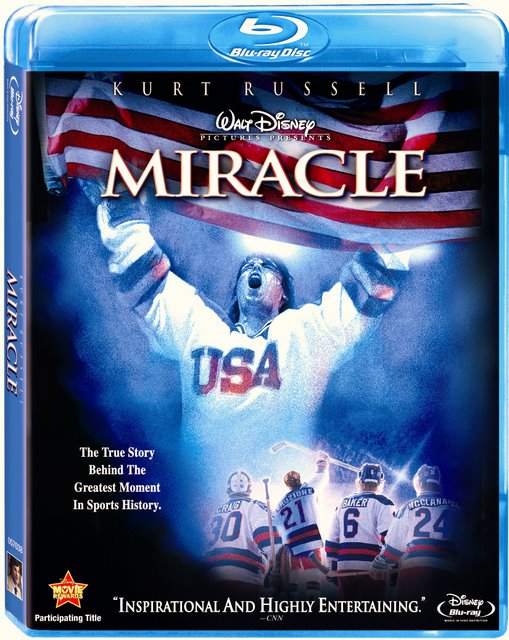
No, instead of spending a whole lot of time really looking for a way in to bring this to audiences on a more historically unique level-- overall, Miracle plays as a stellar reenactment of our amazing victory. Indeed, it's elevated considerably by the always underrated Kurt Russell who disappears into his role as Herb Brooks (making it a loving tribute to the man who would tragically perish in a car crash shortly after production was completed) as well as filmmaker Gavin O'Connor's risky decision to recreate that penultimate match before we took the gold after defeating Finland.
While of course due to the intense research, the involvement of Herb Brooks, key players, and the fact that it was incredibly well-documented by ABC in its original 1980 broadcast assisted the filmmakers greatly, as they note in a Blu-ray making-of-extra, when it comes right down to it, "you can't fake hockey."
Collaborating alongside a technically impressive and trained group of experts, they worked out 133 plays which they choreographed, digitized and recreated with computer animation as if-- they joke-- constructing "a military battle plan" that they captured with numerous cameras to bring us closer inside the game than we'd originally seen on television nearly 30 years ago. And in fact by inserting many more cameras on the ice and therefore having to also work out in painstaking detail where the cameras would be to avoid injury, they ensure continuity and accuracy, yet at the same time manage to get the best image possible which is an exceptional achievement.
It's also aided considerably by its cast of mostly unknown athletes-- including Billy Schneider who portrayed his father Buzz Schneider--all of whom they hired first for their hockey and skating ability before they worried about acting from the pool of more than 4,000 men who showed up to fight for a chance to take on one of the 20 famous slots on the team which makes their movements on the ice incredibly believable. Yet aside from a few obvious standouts, overall the point-of-view of the players or much about their individual personalities is abandoned to take a Herb Brooks approach of making it all about the team and the training on the path to Olympic glory.
Bravely going against the easy approach of just playing Brooks as a complete Dudley Do-Right style hero, Russell-- who nails my native Minnesota accent so perfectly that it's downright uncanny-- presents us with a complex portrait of Brooks who would prefer to be loathed and have his assistant Coach Patrick (the terrific character actor Noah Emmerich) along on the team to be the friendly buffer to push the kids to the limit.
From the near-instantaneous decision which athletes he will recruit onto his team by ignoring the board and money men as well as some of the very best or most obviously gifted players to find the 20 he can mold together to giving them a psychological test to figure out their personalities and how best to manipulate that data for the overall goal-- Brooks is a fascinating figure.
Extremely determined to beat the unstoppable force of the (then) USSR players by training harder, out-skating them, and using their "team play" idea against them by changing the style of the game even to the point of alienating those around him and making questionable decisions-- it's Russell's most fully realized character and strongest performance in years as it becomes just like Hoosiers more of a coach-centric journey rather than one about the players on the team.
Although it's a bit overly long and Patricia Clarkson is wasted in numerous scenes as the stereotypical sports movie wife who jockeys for position and tries to remind Herb not to overwork himself and also spend time with his family and again, we're never that drawn in by the players themselves-- mostly the movie feels like an exceptionally well-choreographed Olympic skating routine.
And as such it delivers all of its competition required technical moves with crisp precision and manages to get the audience in on the routine because there's just no way to describe that feeling of the '80 miracle on ice rather than to just show it to you again in the hopes of inspiration and encouragement when we needed it most as a nation. For fittingly, I discovered it was not only released three years after 9/11 but was also the first movie that filmmakers had to digitally recreate the Twin Towers in production since the terrorist attacks had occurred.
Similarly it reminds us once again of the ingenious methods of Herb Brooks with some terrific extra footage including a videotaped meeting of Herb with Russell and the filmmakers and a plethora of making-of extras and analysis of the game by ESPN in a roundtable in this stellar Blu-ray.
With full HD quality in its 2.40:1 aspect ratio and English 5.1 DTS-Master Audio, the sound and picture is so rich and textured that you can hear the blades crunch on the ice and the puck hit the goal in those aforementioned player point-of-view on-the-ice game shots, ensuring that it's another good time to bring out Miracle once again to rally us just before the thirtieth anniversary of that remarkable game. So to honor Brooks and the players-- go ahead and sound the whistle and get ready to skate "Again!"
Spanish Seduction & Sophisticated Wit Arrive on DVD & Blu-ray 1/27/09
Woody's Muse: Scarlett Johansson
An Introduction to the Film and DVD
Recent winner of the Golden Globe for Best Picture Musical or Comedy, Vicky Cristina Barcelona-- one of two superior films from Woody Allen released in 2008 following Ewan McGreggor and Colin Farrell's turn in the dark Cassandra's Dream-- is set for release on DVD on January 27, 2009.
Debuting on both DVD and Blu-ray in time for both Oscar consideration along with giving the chance for my fellow Independent Spirit Award voters (remember to cast your ballot soon!) a reminder of its lovely brilliance and understated charm, recently The Weinstein Company and Genius Products were kind enough to send me an advance copy of the DVD for review.
In taking in the feature for the third time-- being so charmed by it during my first viewing in a small press screening early in the morning that I feared I'd taken so many notes, I needed to go again to watch it with an audience, this time around I found myself even more captivated by its sophistication. And granted, as a huge Allen devotee, I must admit to being disappointed by the lack of extra features, having experienced countless other films of the writer/director's on DVD with similar sparse presentations, lessened the blow considerably.
While it's no doubt the type of film that will make one want to travel not only to Barcelona but especially Oviedo which our seductive lead Juan Carlos (Javier Bardem) whisks both Vicky and Cristina (Rebecca Hall and Scarlett Johansson, respectively) early on in the ninety-seven minute delightful romp, I'm thrilled to announce that as someone who's recently been spoiled by Blu-ray riches in evaluating the quality of picture and sound, the DVD transfer for this film is one of the best for a standard disc that I've seen since Focus Features' release of Burn After Reading.
Like Burn-- incidentally, a fellow Globe nominee for Best Picture Comedy-- after a few moments, I nearly mistook the DVD for Blu-ray quality although granted I was viewing the film in my player with the up-conversion making it seem as though the Spanish countryside had invaded my living room.
While the film should definitely garner some Oscar attention and the terrifically funny Penelope Cruz gives her best performance since Volver and has won an amazing number of accolades for her turn (including recognition from the National Board of Review), this time around, I was especially captivated by Rebecca Hall.
In a layered and subtly nuanced portrayal, she manages to convey several conflicting thoughts despite her deft Allen dialogue in two key scenes including the first when Juan Carlos (wearing a bullfighter like red shirt) makes his "indecent proposal" and the second when he toys with her when the two dine alone later before an evening of Spanish guitar and impulsive lovemaking.
While the ensemble is perfectly in tune with their roles as obviously some parts (including Johansson's, of course) were written expressly for the actors, this time around it was Hall that I felt was most deserving of a second look and hopefully Oscar will take note, this year possibly breaking free from their tradition of avoiding comedies like the plague to see the human comedy and wit evidenced in every frame of this-- one of my very favorite films of last year.
Woody Allen signs up Scarlett Johansson for Spanish lessons in love with Professor Javier Bardem.
One of the most annoying things about being a writer is that I’m best able to process things with my pen or at my keyboard when I’ve had a moment to let things sink in. I’m a big believer in note-taking, especially in film criticism because automatic writing allows some pools of unrealized creativity to eke out. Sometimes I discover things of which I’d been previously unaware until I read back the barely legible sentence fragments I’d scribbled out on a tiny notebook in a darkened theatre. Yet, as a writer first and foremost, I have a harder time with extemporaneous speaking. The wonderful PR agencies and studio representatives who are kind and courageous enough to screen their films for us wait expectantly with notebooks in their own hands in well-lit lobbies, hoping to get our immediate reactions. Often I struggle to come up with something that’s not only intelligent but balanced. If I hate a film, as a polite Midwesterner (or it could be just feminine instinct), I always find that I want to find something — anything — to say about it that’s positive before I apologetically express my dislike.
Yet, intriguingly, when I’m blown away by a film, often I’m nearly equally at a loss for words. Case in point: Vicky Cristina Barcelona. On the surface, it begins as a typical Woody Allen film with a European feel including a voice-over narration which in this case works well since the setting is Barcelona as we follow two American female tourists on summer holiday. Predictably, issues of love, sex, infidelity, and artistic temperament come into play, per Allen’s most frequently visited themes.
Yet, as a huge Allen fan who’s seen every one of his films (including some I can practically recite from memory), I couldn’t get over the feeling that had I walked into the theatre after his traditional black and white credits had rolled. Just five minutes late and with no prior knowledge of the piece, I wouldn’t have guessed in a million years that it was a film made by Woody Allen.
And admittedly some of his works — even the light, entertaining trifles of the past few years — have felt self-conscious and claustrophobic, which make his epic tragedies like Match Pointand Cassandra’s Dreamfar greater by comparison. However, I'm thrilled to write that Vicky Cristina Barcelona is breezy, earthy, intoxicating, and frankly, sexy as hell.
And yes, I’m aware that as a professional, “sexy as hell” isn’t the most astute observation yet as the only female critic in attendance with a small crowd of men no doubt hoping to ogle Scarlett Johansson and Penelope Cruz’s much-discussed “threesome” (which ultimately consists of a passionate kiss and discussion), I felt a need to represent how the film played to a female audience and one of the first phrases out of my mouth to the eager representative was in fact “sexy as hell.”
Sex has always been Allen’s topic de jour, but whereas it’s been so cerebral in his other films, discussed to death so that it’s nearly clinical (for example, Annie Hall), this film celebrates love, sexuality, and humanity in a life-affirming and dare I say optimistic approach, atypical of the notoriously pessimistic, introspective Allen.
Why so sexy, you may ask? Well, surely the country’s setting helps, photographed to breathtaking effect by award-winning Spanish cinematographer Javier Aguirresarobe (Talk to Her, The Sea Inside, The Others) as does the beauty of the film’s leads including Johansson and Cruz, but mostly, the sex appeal is best personified in the unexpected, pitch-perfect, dreamy performance by Javier Bardem.
Bardem, best known to audiences for his Oscar winning turn playing the “bubonic plague”-likened killer in the most recent Best Picture winner, No Country for Old Men, continues to amaze, showing colors to his personality we never knew existed such as warm humor and irresistible mischief, and Barcelona makes terrific use of his range from the start.
Although one could nearly anticipate the internal groans in audience members as the film began using a lengthy narrative voice-over by introducing us to our leads, ultimately the old-fashioned technique sort of fades into the background as the film goes on — still commenting, yet in a way that never overpowers the main storyline. Quickly we become acquainted with best friends, the grounded and responsible Vicky (Starter for 10 actress Rebecca Hall) and the often dissatisfied, feisty, and passionate Cristina (Allen’s latest muse, Scoopand Match Pointstar Scarlett Johansson). Whereas Vicky has her life all planned out, pursuing a Master’s Degree in Catalan Identity and planning an upcoming wedding to the decent, stable, and successful Doug (Chris Messina), Cristina is endlessly searching for any new adventure to whisk her away.
They both get much more than they bargained for when, staying with family friends (Patricia Clarkson and Kevin Dunn), Cristina catches sight of the smolderingly mysterious presence of Bardem’s Juan Antonio, an artist still reeling from a bad breakup with his ex Maria Elena (Cruz) who tried to murder him before they parted. Whereas most women would run screaming in the other direction upon hearing tales of domestic violence, Cristina becomes all the more intrigued, later using her feminine wiles to attract his attention at a nearby bar. A few hair tricks and eyelash bats later, Juan Antonio is soon at their table, first asking if the two women are American before fixating on Cristina with the painterly come-on, “What color are your eyes?”
Predictably, loosened up by the wine, thrown off her game by his gaze, and generally disoriented by her foreign surroundings, Cristina falls for it hook, line, and sinker. Vicky is far more skeptical, especially when, just seconds after he begins chatting them up, he proposes the two travel with him by plane for the weekend to Oviedo, in order to look at a favorite statue of his, drink wine, and make love in an only-in-the-movies speech which recalls Sirk’s Written on the Wind. And while we can sense Cristina mentally packing her bag, Vicky finds his bravado obnoxious, telling him off before ultimately, and predictably, she ends up going along to chaperone her friend.
Of course, once they arrive in Oviedo, Vicky is quick to realize that she may have misjudged the painter and soon, both women are taken with Juan Antonio, which sends Vicky into a guilt-stricken panic as she’s promised to the dull but secure Doug and Juan is endlessly prone to obsessing about his ex. Things get far more complicated when, late into the picture, Maria Elena reenters his life in a firestorm of neurosis and passion.
Cruz attacks the role with a fearlessness we’ve never seen before and she’s sure to generate Oscar buzz for a performance that for once doesn’t treat her as an exotic, angelic beauty, but celebrates the complexity of her larger-than-life artistic ability. Allen, who had only seen the actress in her Oscar nominated Volver according to the press notes, was thrilled when Cruz’s reps contacted him directly upon learning that his latest feature was to be set in her homeland. And while, she picks up the pace considerably, it’s relatively easy to get swept up in the spark-filled scenes between her and Bardem without realizing just how good some of the supporting players are in the less showy roles. This is most notably easy to do with the talented Rebecca Hall’s understated, subtle and contemplative Vicky as well as Johansson, who, in her third collaboration with the auteur, is game for anything he throws her way.
With what could have been a rather obvious send up of Jules and Jim, Woody Allen finally hits his stride with this frothy, sexy work. Undeniably hip, refreshing, and wonderfully indicative of the twenty-first century, Vicky Cristina Barcelona showcases a side of Allen that wasn’t evidenced in the classically executed (enjoyable yet mild works) The Curse of the Jade Scorpion, Small Time Crooks, and Hollywood Ending.
Although given the gorgeous leads and locales, all audiences are sure to find themselves taken in by the film’s sex appeal, Vicky Cristina Barcelona is an entirely welcome summer inclusion for sophisticated, thinking women after several months of fun yet admittedly testosterone-fueled juvenile buddy comedies and CGI-driven superhero pictures.
And much like fellow New York filmmakers Martin Scorsese before him did with The Departed and Spike Lee offered with Inside Man, Allen has released one of his best works in years, by widening his lens, opening his mind, and traveling to Spain. Oh and by the way, did I mention that it’s sexy as hell?
Walking Movie Encyclopedia at Film Intuition; 3-Time National Award Winning Scribe; Film Reviewer; "Watch With Jen" Podcast Host; Screenwriter; Movie Discussion Host; BA in Film Studies & Communication.