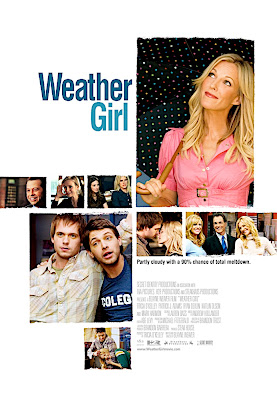
Arriving on DVD 12/29
Movie Still Slideshow
View the Trailer


Bookmark this on Delicious

Print Page


In writer/director Blayne Weaver's utterly charming indie summer sleeper, Tricia O'Kelley plays the titular (albeit soon-to-be-former) weather girl who's as sassy as hell and she's not going to take this anymore.

As we learn in the movie's memorable opener-- she's driven sassy by being forced to be sassy. Likewise, the factors of her restlessness consist of working in an industry where the show's leads are referred to as "anchors" whereas O'Kelley's 35 year old college educated professional Sylvia is still patronizingly described as a "girl" complete with the sexist stereotype of "sassy" being part of her daily on-air introduction that's of course mimicked all over town (you've seen The Weather Man and Groundhog Day). Of course, this isn't helped by being given the thankless and tireless quest to come up with new adjectives for the word "rain" in Seattle while pointing to a green screen sharing-- what Sylvia reveals in her "career suicide" meltdown is not news but "tidbits for dumb people."
Yet, the most pressing reason that has "blacken[ed] all of" her "skies of blue"-- to quote Ella Fitzgerald-- is that she's found the underwear of the perky alcoholic co-anchor Sherry (It's Always Sunny in Philadelphia's Kaitlin Olson) in the condo she's shared with the main anchor, Dale (NCIS star Mark Harmon) for the past two years.
Confronting Dale and Sherry live and on the air of their Seattle morning program where the network affiliate manager Blair Underwood (obviously frantic about FCC violations and viewer complaints for her "R" rated tirade) wants to cut and immediately go to commercial despite the camera crew's decision to keep rolling since this is the stuff of television gold.

Ridiculing not just her position at the station and encouraging viewers to pick up a newspaper but also belittling the "amateurish" sexual technique of Dale-- her on-air blow-up soon becomes a bigger YouTube-like online hit than the Lily Tomlin/David O'Russell back-and-forth exchange (in separate videos) from the set of I Heart Huckabees.

Yet, shortly thereafter, realizing she's given up her job as well as her medical insurance, her condo, and everything else by becoming the laughingstock of the hiring circuit for-- as a friend chides-- her "weather girl" resume, Sylvia quickly seeks shelter by crashing on the couch in the apartment of her younger brother, Walt (Ryan Devlin). And, after lowering her standards, she accepts a job as a waitress for Jane Lynch (effective in a cameo that seems to be a distant and less crazy cousin to the character she played in Role Models).
While some (read: male) critics are easily dismissing the female-centric work-- albeit one crafted by a male writer/director with a knack for clever dialogue-- via that shudder inducing overused description of comparing it to a Lifetime Movie, it's still a highly entertaining feel-great rom-com that benefits considerably from its avoidance of set stereotypes.

For example, as opposed to most Sex and the City knockoffs, Sylvia's two friends (Marin Hinkle and Alex Kapp Horner) are the opposite of supportive, going as far as to set her up with Hinkle's ex on the TV show Two and a Half Men (Jon Cryer) as a man whose biological clock is ticking so hard that he wants to "fast-track" the relationship in a way that makes him-- as Sylvia describes-- "probably the creepiest person on the planet."
While admittedly the film is fairly predictable especially when Sylvia finds herself on the receiving end of the adorable puppy dog crush of Walt's highly articulate, subtly funny and openly flirtatious 29 year old best friend Byron (Patrick J. Adams) which evolves into a "friends with benefits" arrangement with Sylvia's rule that he's not allowed to fall in love with her despite their frequent couplings-- the scenes between Byron and Sylvia are some of the best ones in the film.

However, most likely this is because they may have come from a personal place as the writer/director shared in the production notes that he "got the idea for Weather Girl after dating a woman about five years older than me... The difference in age was minimal... but the pressures she felt professionally, from her friends and from society kept hammering home this idea that 'she didn't have time.' I really liked the idea of this woman who seems to have it all... but then gives it all up and has to start over again with those pressures looming over her."

Moreover, societal pressures and human relationships-- not just romantic ones-- are laced throughout and help make the movie work as Sylvia's estrangement from her friends who blankly tell her that she's cold and puts up emotional walls (which Dale has has used as the reason he's cheated) is so strong that they forget that she even has a brother at one point. And even Walt is given one revealing scene to show our disconnect from one another when he admits that he's worried when she becomes involved with Byron that she'll mess up his one only real friendship.

In fact, the dynamic between the three and the novelty of a strong emotional rollercoaster friendship between a brother and a sister-- instead of two guys just leaning on each other in a "bromance" or women sipping "cosmos"-- make this the opposite of a Lifetime feature. Likewise, it helps elevate the obviously budget-strapped indie (wherein we have to forgive a few "convenient" moments like Sylvia and Byron running into her friends illogically at night on the docks for no reason) in a way that hides its flaws via the thoughtful script and the sheer likability of the cast.

O'Kelley, Adams and Devlin in particular are all wonderful and a special mention must be given to Cryer and Harmon's knack for making what could've been a pretty clear-cut way to tackle each character into something else altogether... so that instead of just one single joke, they get a lot of mileage out of their roles whether it's Cryer's cameo as a Hummer driving baby mama hunter or Harmon's news man diva who sleeps in his makeup towel but feels that he's the victim in his infidelity.

However, to me, the real story was O'Kelley who is a terrific talent and one who energetically tapped into her character and believed so much in the work that she was on board from the start, fighting to help get funding, cast-mates and serving as a producer on the film. Additionally, I truly admired her lack of fear in showing us the flaws of Sylvia's sense of entitlement before she gets a dose of reality and when she ascertains that it's so much better to be a real woman than a "girl" on TV-- even if, unfortunately the beginning of that revelation happens to occur live on-the-air when Sylvia walks out with a pair of pink panties and a whole lot to say.

Text ©2009, Film Intuition, LLC; All Rights Reserved. http://www.filmintuition.com
Unauthorized Reproduction or Publication Elsewhere is Strictly Prohibited.


 Case in point: the highly verbal independent film star, Chris Eigeman a.k.a. an actor upon whom I developed quite an irrationally intellectual crush in the early '90s. Ever since I saw Chris Eigeman in Whit Stillman’s Barcelona -- dissecting the process of physical therapy and analyzing what’s really going on at the end of The Graduate — I became a fan of the actor’s uniquely neurotic delivery of dialogue. Simply put, Eigeman can make the most complicated paragraphs of scripted words sound naturally effortless.
  Although he
  Also featuring a wonderful music score by Clogs,