Showing posts with label Helena Bonham Carter. Show all posts

12/31/2013

Blu-ray Review: The Lone Ranger (2013)


Now Available to Own 


Photo Slideshow


The Lone Ranger is a movie of many contradictions. On the one hand it’s so confusing and episodic that if we aren’t careful we’ll get completely lost in the sun-drenched sands of the western desert. Yet at the same time it’s so contrived in its storytelling structure that it’s bookended by a cheesy extended flashback narrative device featuring an older version of Johnny Depp’s Tonto spinning the exact same yarn that’s being unspooled by each sequential flicker of celluloid to a young boy who serves as a stand-in for the audience.

And as annoying as the gimmick is in spoon-feeding the saga to viewers through an on-screen surrogate, because the film was written multiple times by multiple people, there are times when we do find ourselves thankful for the cinematic hand-holding since what we’re ultimately presented with is a meandering, muddled mess of a picture desperately in search of an overall plot – if not a point.


Pulling us in multiple directions, The Lone Ranger is bogged down by endless possibilities – often trying and failing to chronicle the conflicts and subplots of more than a dozen of characters at once, all with different genre feels and tones until it becomes ever so obvious that a young boy is the last possible person that should be hearing the tale.

Featuring a colorful cast of characters who seem like they’ve wandered in from entirely different films Purple Rose of Cairo style and entered The Lone Ranger, we’re stunned by the choices made by the writers when faced with some of the decidedly un-Disneyfied players that populate the picture and detract from the original plot.

For within the same hour and in a purported “family film” no less, we encounter a cannibalistic killer who cuts the hearts out of his victims to satisfy his disgusting taste buds, a transvestite villain with a fetish for looking ultra-feminine and a one-legged prostitute who conceals a shotgun in her wooden leg.


Just who exactly the film is “really” supposed to play for in actuality as opposed to on the posters is anyone’s guess as is just what on Earth the film we’re presented has in common with the beloved hero of television and film past from which it’s supposed to have been adapted.

As it turns out, very little indeed as instead of the Jimmy Stewart type of heroic ranger intended by producer Jerry Bruckheimer, we’re given an awkward, not very bright, reluctant and at times cowardly hero who has to be goaded into action.

Given that Armie Hammer isn’t exactly a recognizable name cast-choice, the fact that he plays second fiddle to Johnny Depp isn’t all that surprising but what is surprising is Depp’s bizarre take on Tonto as a Native American with a screw loose and a tragic back-story to boot that has filled him with such guilt that it’s a wonder he can function at all.


An odd portrayal at best from his stilted “Ha, white man,” clichéd style line delivery and fanciful whims that never quite gel with the Buster Keaton persona and sense of ‘20s silent movie pratfall physicality he puts forth in some of the film’s more successful scenes.

An overall ugly film that is definitely unsuitable for casual family viewing, The Lone Ranger’s only saving grace comes in the form of its second – far more successful – bookend device featuring complex action sequences executed by horse and train.


While the first one is impressive if a bit short, ultimately it’s just a preview of the brilliance to come in the second and final action sequence of the film – a twenty-minute, all-out, adrenaline pumping blend of bravura action and screwball silent comedy synced to the Lone Ranger theme we know so well.

The expertly choreographed feat is a feast for the ears and eyes, not to mention far more dazzling than anything else not only in Ranger or in other vastly superior action movies during the course of 2013.

It's so good that it makes you mad by how much the rest of the bloated 140 minute movie missed the mark by not matching the remaining 120 minutes to the same pace, tone, spirit, style and humor on display in that sequence.

And against all odds and reason, the formerly must-miss movie becomes a must-see just for that segment alone. An infusion of the goofy fun of 1998’s Zorro remake with the artistry of Buster Keaton’s The General, which most certainly served as a chief inspiration – an argument can be made that that sequence should’ve been trimmed from the picture and released as an Oscar worthy live action short in its own right.


Unfortunately however you can’t just review the film for one part but have to take it as the overall sum of those parts and ultimately Disney’s Lone Ranger is a disaster of epic proportions, especially once you factor in the obscene amount of money gambled on the budget that it justifiably lost at the box office.

Nonetheless, those who have taken a chance on the film in its flawless Blu-ray transfer can take advantage of the handy scene-selection feature to skip the mess and move right to the mini-movie that enthusiasts of the original Ranger were waiting for all along. Hi ho, Silver, and away to the end indeed.     

Text ©2013, Film Intuition, LLC; All Rights Reservedhttp://www.filmintuition.com Unauthorized Reproduction or Publication Elsewhere is Strictly Prohibited and in violation of the Digital Millennium Copyright Act.  FTC Disclosure: Per standard professional practice, I may have received a review copy of this title in order to evaluate it for my readers, which had no impact whatsoever on whether or not it received a favorable or unfavorable critique.

11/29/2009

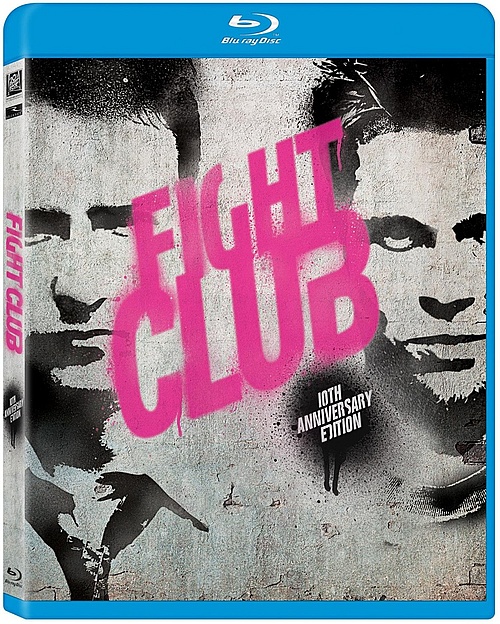
Blu-ray Review: Fight Club -- 10th Anniversary Edition (1999; 2009)

Now Available to Own


The idea of an unreliable narrator is a fascinating literary device that seems to play best in the realm of cinema as film manages to trick viewers like no other medium. Upon researching unreliable narrators, I discovered that they originated in Chaucer’s Canterbury Tales and since the publication of that work, writers have been using false tricksters to guide readers and viewers with tales of increasing complexity.

Probably the most famous work of unreliable narration of the ‘90s was employed in Bryan Singer’s masterful film, The Usual Suspects, which starred Kevin Spacey. The actor followed up Usual Suspects with another neo-noir for director David Fincher in the form of Seven.

After my friend and fellow film critic Colin Boyd urged me to see Zodiac, I realized that I’ve been consistently impressed by the films of David Fincher including Curious Case of Benjamin Button and Panic Room. However, at the time it was released, I loathed Seven and have yet to see it again. Although I grant that it was indeed intelligent and that Fincher's frequent star (in their initial coupling), Brad Pitt finally had the chance to show his enormous range for the first time, overall I felt that it was a downright disgusting thriller. Saw before the horror franchise and torture porn genre was born, Seven is a work I felt sickened trying to view as one that left nothing to the imagination and had no purpose other than to simply horrify.

Yet ironically, most individuals called Fincher’s follow-up Fight Club even more disturbing with some of my favorite critics going as far as to damn the film as one of the most dangerous pieces of cinema ever made… and not in a great Roman Polanski way. However, while it definitely was a chore to sit through, as a film, Fight Club was also brilliant, darkly comic and impossible to forget.

At its essence, the movie was more of an assault on our commercial society than simply a film about a bunch of guys just wailing on each other, which unfortunately was the way it was dismissed by a large amount of reviewers. Still enough viewers identified its underlying theme and overall message on a visceral as well as intellectual level which Variety’s David Rooney likewise acknowledged by writing that, “rarely has a film been so keyed into its time.” And the audience for Fight Club has only grown more passionate about the 1999 work ever since, thereby making it a bona fide cult classic ten years after Fincher’s previous star, Spacey and his film American Beauty earned Oscar gold.


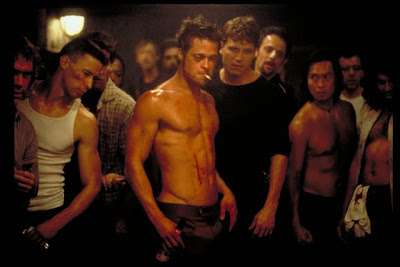
Allegory to the max, Fight Club's final cut was extreme in every way imaginable to ramp up the Fincher’s subtext in Jim Uhls’ brilliant adaptation of Chuck Palahniuk’s novel. Every frame reaffirmed the film’s “message statement” against a generation abiding by “mission statements,” via its expressionistic usages of sound bridges and impressionistic marriage of production design, editing trickery, juxtaposition, and Edward Norton’s deadpan narration. In copious behind-the-scenes extra features, you can witness the painstaking effort of various departments working in tandem like the real external Project Mayhem crew of the movie’s internal guerilla group Project Mayhem to ensure that Fincher’s movie was as much of a psychological extension of the antithesis of late ‘90s consumer driven culture as was its main character Tyler Durden.

While on the surface, guys thrashed each other with full force, once you peeled past that outer layer, astute viewers understood that it’s a counterculture work using graphic imagery in place of a dull professorial lecture. As such, Fight Club is best experienced in the same allegorical spirit Peter Greenaway employed in his intensely sexual, over-the-top NC-17 rated The Cook, The Thief, His Wife, and Her Lover which was a disturbingly in-your-face response film to the British monarchy system of the ‘80s.


For those who have yet to see the movie, Fight Club follows our existentially adrift Narrator, played by Edward Norton, as an insurance calculator/cubicle drone who spends a large amount of time living a “single serving” life of travel by providing an impersonal mathematical formula gauging death vs. cost in deciding whether or not the major automobile company he works for should financially initiate a recall.

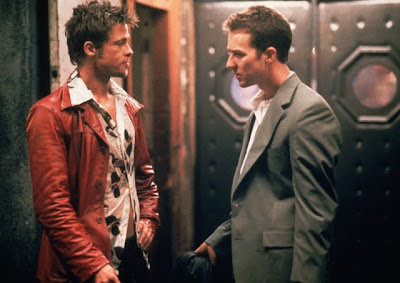
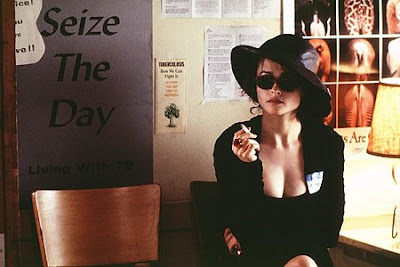
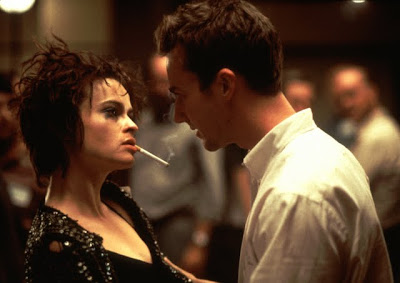
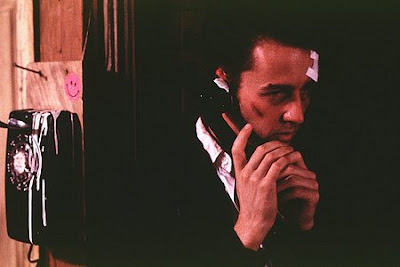
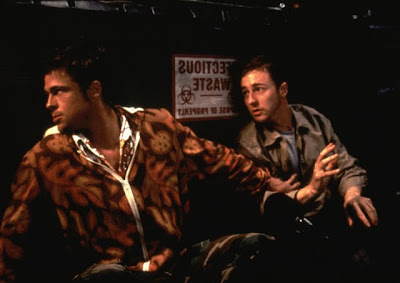
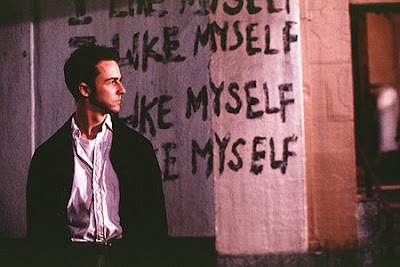
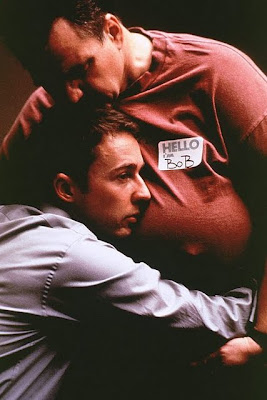
Furthermore, throughout the movie, Norton is credited with no set name other than “Jack” which is an in-film ironic joke after he finds a retro stack of informational health literature about Jack’s Medulla Oblongata, etc. Insomniac and dispassionate in his job, he takes to attending support groups for diseases he doesn’t have—anxious to simply feel and connect with strangers even for a brief period. However, our Narrator’s new and disturbing homeostasis proves to be a temporary solution, which is irrevocably altered when his condo full of Ikea purchased possessions blows up, forcing him to face his life and realize that he’s missing something vital. What he's missing, he realizes once he meets Tyler Durden (Pitt)—a loose cannon with whom he co-creates a “fight club” wherein men can work out their aggression on one another until this leads to acts of homegrown terrorism under the name of Project Mayhem.


Obviously this plot-point was a frightening development that critics and journalists feared would lead to off-screen destruction. And unfortunately, some young men—completely missing the film’s point—did indeed create their own fight clubs but again, this reaction made me recall the reaction to another movie made a decade earlier. Like Spike Lee’s Do The Right Thing, which many people felt would incite riots (and was blamed for the misfortune of being released before Rodney King)—Fight Club is a brilliant work that should incite thought instead of violence. Moreover, I couldn’t help realizing how sad it was at the time that those critiquing it didn’t give American audiences more respect and let the few who may have let media do their thinking for them give the millions of other intelligent viewers a bad name.

Additionally, as I learned in "How to Start a Fight," the original twenty page DVD booklet (which admirably cited reactions which ran the gamut), there is “more violence in the first 10 minutes of Saving Private Ryan than if you watched Fight Club for an entire year.” Moreover honestly, underneath all of the “macho posing,” right from its opening phallic imagery of a gun barrel placed in Norton’s mouth, overall it’s quite homoerotic as both women and gay men noticed instantly. This makes the idea that it’s a total “Guy Film Hall of Fame” movie (as SpikeTV inducted it a few months back, which is included on the Blu-ray) seem far more subversive and fun on another level as several years ago author Chuck Palahniuk finally outed himself as a gay man.


While I’ve never read the book by Palahniuk, I learned from research that the ending varies greatly from his original plot but the author has been widely quoted as stating that he prefers the film’s ending to his own published version. Overall, Jim Uhls' script echoed the tone of the book, which Uhls described as, “a seminal statement of the times, a statement about this particular generation, much in the same way the ‘60s were captured in the better films of that decade,” in Fight Club’s original production notes. And to his immense credit, Uhls succeeded as the film perfectly captured Palahniuk’s beliefs on the power of culture, which were listed in the booklet as follows:
“The first way in which a new generation takes control of society is through the culture; the arts, films, books, music. Through all entertainment. People who feel safe and secure in the existing society are frightened by ideas that threaten their power. People who hold the power in society want nice complacent forms of entertainment, films that comfort people and support the status quo.”
Fight Club was a risky film to be sure and one quite excessive in its violence but the visuals and juxtaposition of shots are quite novel. Producer Laura Ziskin (yes, only a female producer would touch it) really helped keep this labor of love on track by giving unprecedented power to Fincher. In doing so, former music video director Fincher shot more than three times the normal amount of film reels (IMDb) to get his vision right.

The film’s huge narrative shock and switch revealing our unreliable narrator was quite surprising in the first viewing but after one goes through the film again, one notices what a clever craftsman Fincher and his editor were as there are so many clues littered throughout the movie on several sensory levels designed to hit each part of the brain, whether visually, in a literary fashion etc. for a stunned intellectual punch.


Although it’s filmed in L.A., the setting of the work was always Wilmington, Delaware but predictably and with justification, the city officials were worried about duplicate attacks witnessed onscreen so the setting is anonymous, giving viewers a more terrifying experience as we see that it could occur anywhere. And indeed, the film itself took on a whole new resonance after the events of 9/11.

Suddenly a film about a generation without direction, without “great wars” or purpose whose characters resort to terrorism from consumer slavery became a bit too hard to handle as in a scene where Norton’s character prays for a plane crash as well as in the final moments as skyscrapers explode. It only had two years there (released in ’99) when the film fit in with its time but following 9/11, everything changed and suddenly the film felt like a period piece… or it did until its tenth anniversary rolled around.


While watching it again a few years back for an undergraduate project on neo-noir films, I did find it especially eerie considering the aforementioned sequences and sentiment. However, now in 2009, it feels not like it was simply a clever allegory nor a period piece of a more consumerist time but a wake up call in retrospect. Just like viewing the miniseries of Traffik in its twentieth anniversary hit me on a global level in terms of alarm bells regarding Afghanistan and Pakistan that will make you want to shout “why didn’t we do anything?” Fight Club is deeply affecting on the level of not just terror but consumerism as well.

In ’99, Tyler’s “you’re not the car you drive,” monologue was indeed meaningful but not nearly as much as it is now when viewed again in an era where debt has enslaved us to the point wherein most of us can’t even “go to jobs we hate” to “buy shit we don’t need,” since the basics are what’s adding up and this time around, we're also indebted by fighting two “great wars” that we didn’t have then. So suddenly Fight Club becomes just as urgent, tragic, and retroactively potent as ever. This is particularly evident given Project Mayhem’s insane movement to set the debt record back to zero so that everyone becomes free, which is not only just as terrifyingly allegorical as it always was but now makes us want to shout, “why didn’t we do anything?” from a peaceful standpoint, of course since as Palahniuk noted entertainment is the way to introduce ideas for real change.

Yet that quote from the Fight Club scribe is one of the problems with the film’s 10th Anniversary Blu-ray Edition... since it doesn’t exist. When purchased originally in 2000, the two disc DVD set featured not just superlative features packaged in a gorgeous format of concept art but it also contained a twenty page fact and photo filled guide that was Fox 2000 Pictures’ equivalent of releasing their own pre-Criterion version essay.

Missing even a basic one-page Blu-ray insert of what was then titled “Jack’s Chapters,” as well as the aforementioned guide, while Fox’s enviable Blu-ray clarity is top-notch, this single disc dully packaged edition contains just three new extras, with one consisting of a simple search index. Still, a search index is needed since the menu is presented in tinier font and laid out in a more confusing manner. But being that the other two new extras are purely the SpikeTV induction (memorable only for Norton’s dare to Pitt involving Mel Gibson) and a very interesting yet way too short demonstration of the sound design with 2-time Fincher Oscar nominee Ren Klyce, it leaves me hesitant to recommend the full price-tag of the Blu-ray upgrade since no doubt you’d want to hang onto your original DVDs and would therefore double your shelf-space.


While high definition is a great way to appreciate the movie, such a passionately thorough job was done by Fincher in the original film itself that—although it does improve the depth perception—I’m assuming that there will be a far more worthwhile Blu-ray release down the road, either from Fox or perhaps Criterion who were involved in Fincher’s Benjamin Button from its home entertainment debut.

The absence of new features with the cast in fact does make me wonder if they were all far too busy in their respective endeavors like the Button release and Inglourious Basterds to get more involved, yet Fincher does provide a small but tiny gag by inserting the menu of the 1999 film that drew in more box office than Club in the form of Drew Barrymore’s Never Been Kissed for a few seconds before Club kicks in.


Since press were sent notes and e-mails (I received one with the disc and one in the inbox) regarding the importance of not revealing the “Fincher gag,” I was extremely eager to uncover just what we were to expect when it finally arrived and while it’s cute for a moment, sadly just like the subtext of Kissed as having earned more money, this release without the superior packaging, DVD booklet or more than only a handful of bonuses just feels like a format upgrade for the dough and sans the spirit of Durden.

Needless to say, I am Jack’s Supreme Sense of Disappointment. Yet for those whose only interest is purely for the film and its format and not for the features, this particular release echoes one of my favorite lines by Norton's memorably unreliable narrator of, “it’s called a changeover, the movie goes on and nobody in the audience has any idea.”


Text ©2009, Film Intuition, LLC; All Rights Reserved. http://www.filmintuition.com
Unauthorized Reproduction or Publication Elsewhere is Strictly Prohibited.

7/15/2009

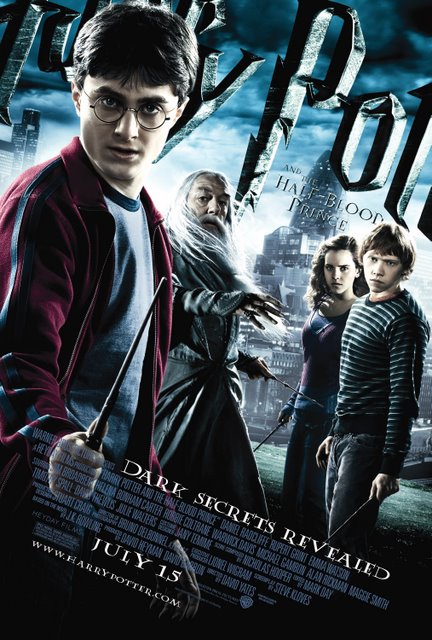
Movie Review: Harry Potter and the Half-Blood Prince (2009)


Official Shop of Warner Bros

Get Caught Up With the Movies


For Potter-- Reading is FUNdamental
Share J.K. Rowling's Series


Read Jen's Take on Prisoner of Azkaban


Half-Blood Prince
Photo Slideshow


Delicious
Bookmark this on Delicious
submit to reddit
Print Page

Digg!

MovieBlips: vote it up!

For the non-readers, the excitement of the next cinematic Harry Potter installment has always been in the steady development of experiencing J.K. Rowling's mythology unfold on the big screen. And as such the films have served as a sort of conveniently abridged version of the works for those either too busy, not quite interested enough, or just seeking a perfunctory knowledge of the world of Hogwarts to fake their way through office conversation.


Yet this is a series that at its heart seems to celebrate its readers the most given its painstaking adaptations and the evidence of this is sometimes its downfall via the detriment of the yawn-inducing screenplays-- as each and every important building block has been included throughout the movies. And in doing so, the directors and strategies have changed throughout which has not only been a brilliant tool in tapping into the short attention spans of the youngest audience members but also ensuring that there isn't only one vision for the Harry Potter universe that's being presented on the screen since the boy who lived in the cupboard under the stairs belongs to everyone who carries him around in their bag.

Moreover, despite his great beginning-- thankfully we've come a long way from the extraordinarily dull first film from one of the great filmmakers of my youth-- Mr. Chris Columbus-- which was surpassed by his own second movie (although book-wise for Rowling number two had been a literary step backward) before Alfonso Cuaron released the masterful Harry Potter and the Prisoner of Azkaban which was and remains the crowning achievement of the works so far.


Essentially, while aside from one exception with Wonder Boys scripter Steve Kloves wielding the pen for all of the transitions from books to movies-- for viewers who know the source material before going in-- the main attraction is from the visual point-of-view and the way in which this franchise has managed never to grow stale is by constantly bringing in a revolving door of new directors, cinematographers, and editors and endless behind-the-scenes talent to switch up the look.


Some of the experimentation offered up has been ghastly in my opinion such as in Mike Newell's The Goblet of Fire wherein every cast member and camera lens looked like it had been dragged through the mud (purposely according to the director's desire for grubbiness) before he yelled “action.”

In terms of script, direction, cinematography, editing, and overall execution,
the most successful adaptation all-around is still Azkaban as that final "Time-Turner "sequence has yet to be topped and Hermione was given her due for the first time in the series. And although I'd cite the first and fourth film as the weakest entries-- despite Newell's success in Harry's terrifying and violent showdown with Voldemort when death hits Hogwarts-- the one recurring complaint aside from the predictable format of "the end of summer break to end of school year standard structure" is the sheer length of the films themselves. Still, I'd like to throw one more problem into the pile-- namely Rowling's over-reliance on the “overhear” device which made more sense when the kids were younger since eavesdropping was conceivably the most reliable way for the trio to acquire information... but more on that later on.


And dropping extraneous details-- to the chagrin of some die hard fans-- Girl in the
Café director David Yates (who had cited Cuaron's work as his own personal favorite) moved the series back in the right direction with the much faster paced fifth film which found Harry developing his own army on behalf of Dumbledore which leads to a devastating conclusion as his godfather Sirius Black is murdered before his eyes.


After being asked to return to helm the rest of the series including the final book which will be broken into two films--(although I'm not sure if that's wise and wonder if perhaps blending books six and seven into two films may have led to a stronger narrative)-- Yates reveals supreme confidence right from the start with a bravura opener unlike anything we've seen before in Harry Potter that's sure to dazzle in 3D despite my admitted weariness of the format. In doing so he offers audiences an entirely new visual look by bringing aboard Jeunet's Amelie cinematographer Bruno Delbonnel that adds a striking color palette and style to the work especially in tandem with veteran Potter editor Mark Day. And some of the sequences in this-- the sixth Potter film to hit the screen-- are so breathtakingly gorgeous that they rival Azkaban on sheer beauty alone.


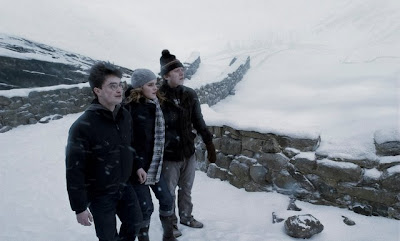
Whether Delbonnel employs old-fashioned trickery to move easily into flashbacks from water drops in a cauldron into the past with a soft focus or words on a page that evolve from ink and font into kids walking in the snow-- it's always dazzling and just flows so well that an argument can be made for Delbonnel to receive a cinematography nomination for his mind-blowing work.


And it's a great thing too because while the film is sumptuous-- readers of Half-Blood Prince go into the theatre keenly aware that it's a very introspective, flashback heavy, chatty (a.k.a. not exactly action packed entry) which is designed to push everything in the right direction towards an unsettling “throw the uninitiated off a narrative cliff” ending as one main character is murdered and another we've been on the fence about is the one wielding the wand, thereby effectively leaving those breathlessly anticipating what's to happen next.


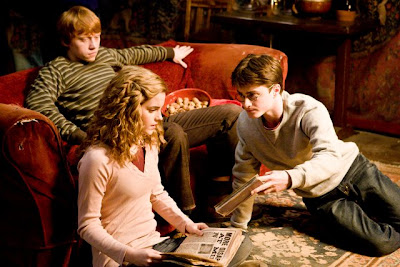
As a film, it's still quite good--if a bit too long again-- and filled with Rowling's structural Achilles heel as the trio and especially Harry this time-- since Ron and Hermione are busy obsessing over which one the other one is “snogging” (the Brit slang for kissing)-- are seen more than half a dozen times at least eavesdropping or listening in on conversations as if Rowling forgot that there were other ways Nancy Drew, Miss Marple, or any number of detectives could find clues.


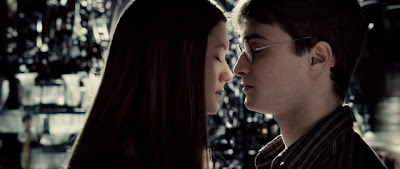
Since the cast is getting older-- they're predictably more caught up with their raging hormones. To this end, Harry starts to return Ginny's previously unrequited affection only to realize that she'd moved on to the athletic Quidditch player Dean Thomas whereas Ron has caught the eye of a stereotypically clingy girly-girl named Lavender much to Hermione's wrath that he hasn't realized that girls with the ability to carry on a conversation are much more interesting than those who snog so much that poor Ron is going to have the market cornered on chapstick.


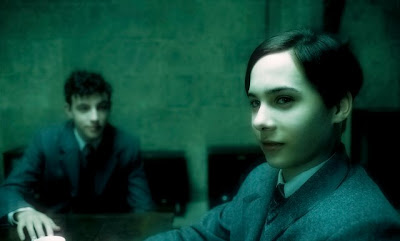
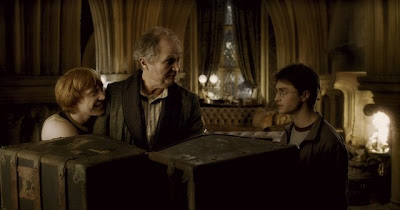
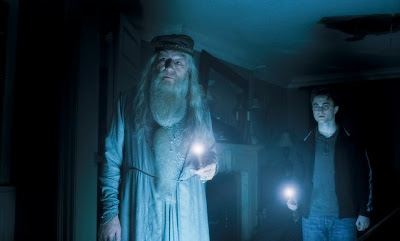
Yet, it's not all "The Young and the Hogwarts"-- as The Death Eaters have stepped up their fight on behalf of the Dark Lord and we learn early on that not only is Draco Malfoy to be an important player but that Alan Rickman's Severus Snape has promised Helena Bonham Carter's Bellatrix Lestrange to step in if he's unable to fulfill his duty. Likewise, Michael Gambon's Dumbledore has been turning Harry into a double agent to get close to one of Tom Riddle's old teachers-- Horace Slughorn (Jim Broadbent).


And despite the tradition that the final showdown is always the most exciting-- honestly the one captured in Half-Blood Prince isn't quite as memorable as some of the ones which have come before it. One of the reasons for this could most likely be because the events leading up to the big murder were executed with such overt Christian symbolism like we were watching a Charlton Heston movie to the point that afterward others including myself wondered when it suddenly became The Ten Commandments thereby in making these choices, it pulled viewers out of Harry Potter suspension-of-disbelief and into post-modern, pop-culture referential mode.


Additionally, in the book although Harry was outnumbered and out-wanded to help prevent a beloved friend from death, there was much more to the scene than having him stand there like yet another "overhear" in an anti-climactic fashion.


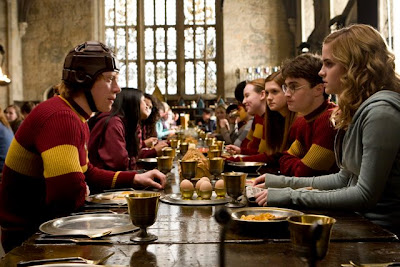
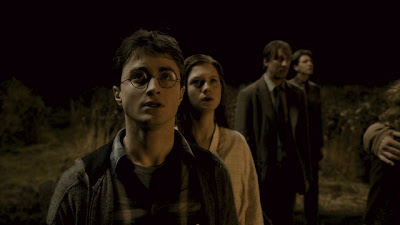
Despite this, there is one amazing sequence that keeps you in check within the film that I don't remember-- at least to this extent-- in the novel which takes place at Christmas at the Weasley household when Bellatrix Lestrange shows up and a huge chase through the cornfield ensues as though we were in a vintage horror movie classic.


Furthermore it's surprises like these-- unexpected, away from Hogwarts, brilliantly lensed and pieced together in the most dynamic way that heightens the tension which brilliantly keepsus watching even when we're left realizing that this time around, Ron and Hermione have very little to do (with the former given hardly anything save for the obligatory comic relief scene). And likewise the filmmakers will definitely have their work cut out for them in making us buy into the Harry and Ginny relationship
in Deathly Hallows since the ultimate few second "snog" looked about as passionate as a walk to Hagrid's hut.


And in the end, for the readers who've been joyfully treated with
Delbonnel's beautiful lensing, you'll find yourself growing excited and anxious for the plot division of the next book since obviously the big revelation that sets up the final quest for the end of the series is revealed in this title. Yet this one may be rough going for the non-readers given the lack of action in comparison to the rest. However, for the patient viewers who manage to watch all the way through-- the best achievement of the picture's final sequence (and indeed the film itself) is that the murder and perpetrator are so startling that you may find yourself going over to the bookstore to grab Hallows just to see what happens next.


Text ©2009, Film Intuition, LLC; All Rights Reserved. http://www.filmintuition.com

Unauthorized Reproduction or Publication Elsewhere is Strictly Prohibited.

5/21/2009

Movie Review: Terminator Salvation (2009)


Coming Soon to DVD & Blu-ray


Photo Slideshow


Delicious
Bookmark this on Delicious
submit to reddit
Print Page

Digg!

MovieBlips: vote it up!

To sequel or not to sequel, that is a franchise's question. It's also one that's invariably asked of its three main participants: a) Hollywood who will always vote to sequel if the first film struck box office gold; b) the audience who must decide if they've had enough of a franchise to justify going once again; and c) the critics who need to figure out just how much preparation to undergo when reviewing yet another installment.


For example, if it's a James Bond film and it's a direct sequel, it helped to view Quantum of Solace directly following Casino Royale (in understanding the plot perhaps rather than being prepared for just how dismal the follow-up would be in every way) but traditionally, we know the man named Bond and we're able to walk right on in.


And sure, for most sequels, it's kind of fun to build up anticipation by viewing earlier titles but due to time constraints sometimes it's not at always possible and this was the case for this particular reviewer when it came time for Terminator Salvation (the fourth movie in the franchise).


But allow me a moment to digress and confess as I should begin by sharing that T2: Judgment Day is one of my all-time favorite action movies. Honestly, it's a movie I still study for its beauty and brilliance, the complexity of the situations, intense orchestration of the action, and the emotional investment we feel for the characters. Likewise, it's one that additionally I feel elevated the franchise from its first very good--if now pretty dated-- introduction to the world of Terminators, Judgment Day, and the prophet that will become John Connor who is man's only hope for survival in a future where machines turn on us.


The third film was entertaining if a noticeable step down from its predecessor in what I believe most of us assumed would be the end of the series in a nicely structured trilogy. Yet with the announcement that the franchise was starting up again with director McG (We Are Marshall, Charlie's Angels) filling in for James Cameron and Batman Begins, The Dark Knight, and The Prestige star Christian Bale as John Connor-- I don't think I'm alone in admitting that it seemed like a strange fit. I mean picture this for starters-- it's the guy who instructed Cameron Diaz to dance to "Baby Got Back" in Charlie's Angels stepping in for "King of the World" Mr. James Titantic Cameron while directing the underrated, critically lauded serious thespian Bale in an action movie. Huh? Exactly.


However, even after Christian Bale's public on-set tantrum-- made infamous on late night talk shows and YouTube-- as a fan of The Terminator, I was eager to see which direction this film would take us and the sad answer is that it wasn't a good one and somebody should have stopped to ask for directions.


Simply put: if it walks like a Terminator, talks like a Terminator, it's essentially a Terminator which seems to have been the goal for the picture via a wooden script where actors repeat phrases that have now become iconic like "Come with me if you want to live" and "I'll be back" as though they were flippant throwaway lines.


Likewise, T4 (if I may be so bold) is one that uses the franchise's incredible action sequences as jumping off points in a series of successful homages that never fail to entertain even when it draws inspiration from the unlikeliest of sources including (as I scribbled in the dark) Apocalypse Now, Jaws, Transformers, Jurassic Park, and even some of the cinematography from Requiem for a Dream.


While the crashes, explosions, and fights aren't quite as impressive as they were back in the earlier days of CGI when T2 was new, ultimately as far as this film's concerned, the action is its "salvation" indeed, bridging one dull plot point to the next. With Bale virtually continuing on in his portrayal of Batman's Bruce Wayne complete with the faux comic book tough guy voice that makes me want to giggle, I wonder if the poor guy would've been better off with a longer break between summer blockbusters since he literally appears at times as though he thinks he's sliding into a remodeled Batmobile and Batpod.


Of course, in The Dark Knight it worked to sort of push Batman into the shadows and bring forward the Joker to steal the movie away. However when Bale is now playing the franchise's legendary John Connor a.k.a. the leader of the dystopian resistance that's occurred after Judgment Day hit the planet, it's not exactly helpful that he's the least charismatic and/or likable character in the entire movie.


Capably going into stud-muffin action movie mode (although The Transporter's Jason Statham should rest easy knowing that Bale is zero threat on this level)-- he's nonetheless missing any emotional involvement whatsoever as he physically goes through the motions in this coolly executed, impressively choreographed, and inventively shot action film that ultimately feels like its missing its central processor. (Hmm, perhaps it needs a Windows Vista update?).


But thankfully, while John Connor bogs down his scenes without a flicker of hope (which is easily understood given the situation yet a bit confusing when his wife played by Bryce Dallas Howard is expecting a baby)-- the film's other lead Marcus Wright (Sam Worthington) unexpectedly commandeers the entire film.


In an opening prologue, we first encounter Wright on death row when he's persuaded by the terminally ill cancer ridden scientist Helena Bonham Carter to donate his body to science in order to possibly receive a second chance to do something good with his life rather than his prior evil.


As we flash forward to the year 2018, fourteen years after the Terminators housed at Skynet's artificial intelligence conglomerate became self-aware and led to the nuclear holocaust of Judgment Day-- we run into not only the solider John Connor (whom some of his military superiors feel is a false prophet as he's unwilling to accept orders to kill humans for the "greater good" in trying to wipe out Skynet) but also Wright having suddenly awoken in the midst of the war-torn planet.


As Wright finds himself striking a fast alliance with the sharp, quick-on-his-feet resistance fighter Kyle Reese (Star Trek and Charlie Bartlett's Anton Yelchin) and a young girl named Star that Kyle is protecting in their makeshift family as two more freedom fighters sans a sophisticated network-- they all try to get in touch with John Connor.


Frequently, they hear Connor's voice on the radio commanding other remaining humans to keep up the resistance and take on the Terminators who predictably swoop in unexpectedly to kill or kidnap humans in a few scenes that directly seem like they're mimicking the holocaust with a crowded container filled with petrified, malnourished humans.


Providing the testosterone fueled series with a much needed strong female character, the screenwriters deliver us Blair Williams (Moon Bloodgood)-- a tough as nails fighter pilot not above snuggling with Marcus Wright for the comforting sound of a heartbeat and body warmth before-- of course-- more violence ensues.


Inexplicably given a rating of PG-13 rather than R (although it falls somewhere in between)-- while it is definitely less gruesome or gory than some of the effects in T2-- it's still a hilarious example of how subjective and nonsensical the MPAA system is since the film will no doubt be far too intense for young teens.


While the excellent production values and score by Danny Elfman (in tandem of course with that original great theme) are impressive as was Worthington-- it was the camera work that was particularly inventive in its use of hand-held cinematography so that we feel like we're spinning in an out of control helicopter or slamming into a vehicle made all the more visceral with its dark color palette and grayish color scheme.


Yet in the end and other than a hell of a lot of great sequences for those involved in the CG, cinematography, and editing departments to put on their respective "reels" of past work, it's a Terminator that doesn't add anything new to the franchise.


In fact, in the debate of to sequel or not to sequel preparation, it's one that damn near requires your complete understanding of the entire mythology (especially the first movie) before this one even begins to make sense. So thereby Salvation ultimately confuses more than it needed to by adding Back to the Future layers onto it (especially in regards to John Connor meeting his teenage father Kyle Reese and we realize with dismay just how boring Connor becomes as though he's a Terminator himself).


Mainly, it feels as though it's trying build a new spin-off of future tales for Reese that will then circle back to the first film and subsequent installments in a bizarre modern day prequel, sequel conundrum a la Star Wars. So all in all-- while it was a definite disappointment, it's still one that I didn't hate as much as most of my colleagues (many of whom are still ridiculing it forty-eight hours later)-- as I even got a few definite kicks out of the action scenes that had me pulling out the requisite ear-plugs within the opening ten minutes.


However, it was a pointless retread so to return to the opening thesis in the case of Terminator Salvation, basically to sequel or not to sequel should be answered with a resounding "not." Thus, please go ahead and just break the "I'll be back" promise while we all enjoy T2 once again instead.