Showing posts with label Maggie Smith. Show all posts

11/09/2019

Blu-ray Review: Quartet (1981)


Now Available


(Ad)


When we hear the phrase "Merchant Ivory Productions," most of us picture handsomely photographed period costume dramas featuring ensemble casts of award-winning British actors. One thing we don't think of, however, is sex. But as director James Ivory explains in a fascinating interview included on the Blu-ray release of the newly restored 1981 feature film Quartet, adultery is a recurring obsession of Merchant Ivory's catalog, showing up as a major theme in at least seven different movies . . . and Quartet is no exception.

Embracing not only adultery but polyamory in the film's overt depiction of the seesaw like power dynamics that play out in a ménage à trois at the heart of its storyline, Quartet, based upon Jean Rhys' autobiographical novel, is set during the Golden Age of Paris in 1927.

With her Polish art dealer husband Stephan (Anthony Higgins) arrested for something that might relate as much to stolen artwork as to his tendency to talk about the Bolshevik Revolution — which made Parisian authorities nervous — the native "West Indian" Marya (played by Isabelle Adjani) is left penniless for a year, and with very few resources she can use to fend for herself.


"A decorative little person" used to being the subject of speculation wherever she goes, Marya makes the acquaintance of the wealthy, well-liked H.J. Heidler (Alan Bates) and his painter wife Lois (Maggie Smith) who offer Marya a place to stay in their home. A particular habit of theirs, unbeknownst to Marya when she accepts, it seems as though H.J. has an extensive history of seducing the young women or "crushed petals" whom he lets stay in his spare room.

Letting him indulge himself and sow his wild sexual oats, out of fear that otherwise the bored man might leave her, Lois puts on a good front to the world at the cafes and bars that she and her husband frequent with the young woman. In private, however, the passive aggressive artist sublimates her rage by playing mind games with Marya. And though the trio evolves into a quartet after Stephan's release, which —  coupled with feelings of love —  makes the dynamic even more complex, James Ivoy's film suffers by making the "open" relationship so closed off that the audience is never able to penetrate it.


Distant and icy, the film might take place during a hedonistic time where people sought to find themselves by ironically losing themselves in drugs, drink, or sex, but the unmistakably beautiful Quartet —shot by gifted cinematographer Pierre Lhomme — feels like a virtual museum piece, roped off and hung up in a temperature controlled room on a wall behind a thick pane of glass.

Bravely accepting what Ivory acknowledges is the undesirable role (of the wife who looks the other way but speaks her mind) that many actresses turned down, Maggie Smith is one of the film's saving graces, alongside Isabelle Adjani, who won the award for Best Actress for this film as well as Possession at the 1981 Cannes Film Festival where it premiered.


Championed by its strong performances that keep you watching when you might otherwise want to tune it out, Quartet is worth a look for Merchant Ivory completists but there's a good reason why Ruth Prawer Jhabvala knew instinctively that she didn't want to adapt the Rhys novel she had been reading when Ivory suggested the film.

Trying to make the characters much more dramatic than they were —  just drinking and sitting around — on the page, Prawer Jhabvala did her best to elevate what she felt was rather "downbeat" material. But even with the film's intriguing motif of mirrors, which beg the characters to take a real, hard look at themselves, in the words of 1920s Paris contemporary Gertrude Stein, "there is no there there."

A below average Merchant Ivory movie, although it resembles any one of their other productions on the surface, regrettably, just like Lois fears that her husband might get bored and leave, you're probably better off if you leave the dull Quartet behind. Then, after grabbing one of their other films that you prefer instead (like The Remains of the Day), you can pay homage to the production team's favorite theme, and — leaving Quartet aside to play something else  — go ahead and cheat.


Text ©2019, Film Intuition, LLC; All Rights Reserved. https://www.filmintuition.com Unauthorized Reproduction or Publication Elsewhere is Strictly Prohibited and in violation of the Digital Millennium Copyright Act.  Also, as an Amazon Associate, I earn from qualifying purchases made off my site through ad links. FTC Disclosure: Per standard professional practice, I may have received a review copy or screener link of this title in order to voluntarily decide to evaluate it for my readers, which had no impact whatsoever on whether or not it received a favorable or unfavorable critique. Cookies Notice: This site incorporates tools (including advertiser partners and widgets) that use cookies and may collect some personal information in order to display ads tailored to you etc. Please be advised that neither Film Intuition nor its site owner has any access to this data beyond general site statistics (geographical region etc.) as your privacy is our main concern.

9/21/2009

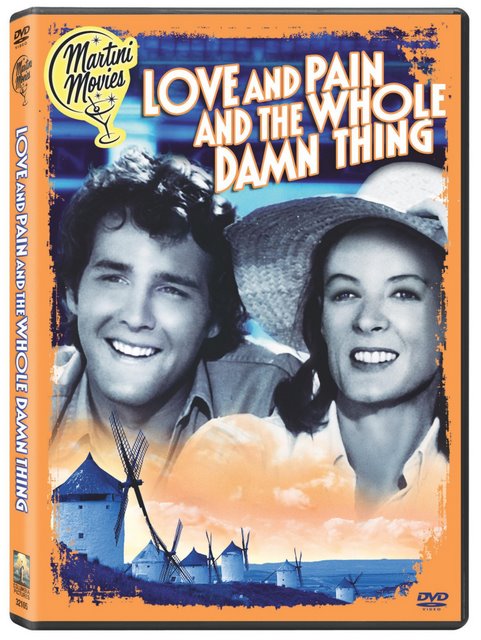
DVD Review: Love and Pain and the Whole Damn Thing (1973) -- Martini Movies: Wave 3


Part of Sony's Martini Movies* Collection


Photo Slideshow


Delicious
Bookmark this on Delicious
submit to reddit
Print Page

Digg!

MovieBlips: vote it up!

Easily overshadowed by director Alan J. Pakula's masterworks Klute, All The President's Men, and Sophie's Choice, the filmmaker's unexpectedly moving 1973 hidden treasure sums up its tone in its title of Love and Pain and the Whole Damn Thing.


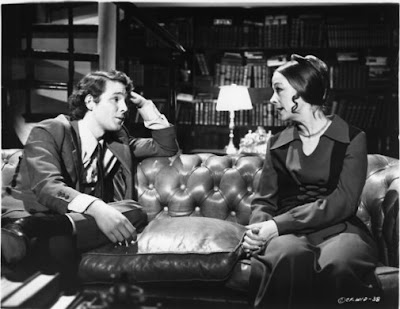
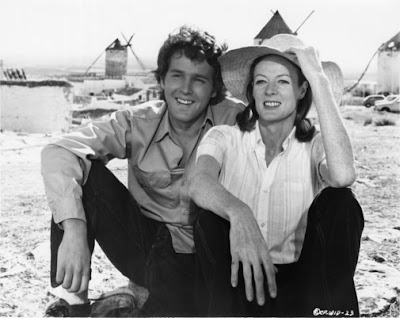
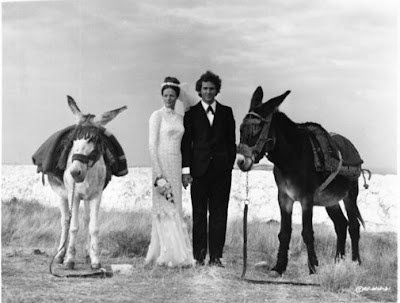
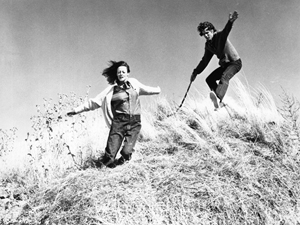
While no doubt it was a marquee nightmare to abbreviate and I'm sure very few ticket buyers would've forked over cash to something dubbed Love and Pain, thankfully Sony has unearthed this long forgotten oddball romantic comedy drama as part of their peculiarly titled Martini Movies series (explained in the footnote below). With the studio's recent release, Pakula's movie has been given a gorgeous transfer to DVD that revels in its colorful Spanish setting that is sadly not evidenced in these black and white publicity stills.


As the film begins, we encounter the painfully introverted asthmatic Walter Elbertson (Timothy Bottoms) whose wealthy historian author father signs him up for a bicycling tour of Spain upon learning that Walter had fallen asleep during his college exams. Seemingly the only member of his family that doesn't have the same workaholic, overachieving drive shared by the rest, Walter struggles with his asthma in Spain and swaps two wheels for four, ditching the bike for a bus.


In doing so, he finds an unlikely soul-mate in the shy spinster Lila Fisher (Maggie Smith) who, aside from missing the same vital people skills absent in Walter, is thankfully given the benefit of maturity and tact. Needless to say, they easily compliment one another and the two begin an awkward courtship that strengthens when she's locked in a restroom and they realize they are better off sticking together.

Both escaping the claustrophobia of an overbearing family as instead of a Pulitzer Prize winning father, Lila is worn out from taking care of her elderly aunts and forgetful lodgers-- although it's Walter who is the more ardent pursuer since she resists due to their age difference and a secret-- we soon realize they're an ideal match of misfits.


Considering the gender reversal May/December romance between the two and the era of its release, the comparison that immediately springs to mind is with Harold and Maude along with a slight Last Picture Show overlap, especially because they share the same star in the talented Timothy Bottoms. And although Love and Pain isn't as masterful as Hal Ashby's cult classic Maude, it's a terrific find not only for those who enjoy Pakula, Bottoms, and Smith but especially considering the way that it foreshadows the style and evolution of Alvin Sargent's work as a screenwriter.


A diverse and fiercely talented scribe with enviable adaptability considering his contributions to the most recent Spiderman films, Alvin Sargent who had previously collaborated with Pakula in 1969's Sterile Cuckoo found the precise blend of sweet and sour with his original screenplay for Love and Pain and the Whole Damn Thing.


With a strong interest in outsiders and the importance of human connection often between two of the unlikeliest candidates, he's been celebrating the flaws in humanity and the need to find common ground for more than four decades following his transition from television to film. This is especially evident whether he's moving us from laughter to tears in the tale of the estranged father and daughter in Bogdanovich's charmer Paper Moon, cutting deep into the heart of a damaged family unit in Redford's masterful Ordinary People (garnering his second Oscar after Julia), or revisiting the idea of Damn Thing in Mandoki's little-appreciated White Palace. Moreover, looking at one of his earliest cinematic pieces and evaluating the way some of these themes keep inspiring him is a rare treat for screenwriters.


However, as Vincent Canby noted in his original New York Times review, Love and Pain does ultimately (yet possibly only subconsciously) succumb to "the attack of Anglo-Saxon ethic" wherein "American and English fiction writers persist in spreading the gloomy word that the conjoining of an older woman and a young man is a near-mortal sin, usually punishable by death."


However, despite the fact that there's a tearjerker undercurrent that persists throughout which was in vogue during the era, fortunately Sargent avoids making it gloomy on the whole nor ending it with sappy Love Story devastation. Yet refreshingly it avoids the death it predicts shortly into the picture by instead celebrating the fact that-- since life is fleeting and no one has a crystal ball-- we must relish in every Damn Thing we can. And of course, this belief is made even lovelier when we have someone with whom to share our experiences whether we're stuck in a Spanish restroom or trading an over-the-top Don Juan for an asthmatic in a trailer.


*Note: Just what is a Martini Movie? Sony's statement: "No matter the decade, there's a place where icons, idols and the infamous flock for bottomless martinis and over-the-top trysts. One part top-shelf martini, two parts celluloid history and garnished with a hint of camp. Sit back and take in the scene with Sony Pictures Home Entertainment's Martini Movies." All titles released so far in the collection have never been available previously in the DVD format.

Text ©2009, Film Intuition, LLC; All Rights Reserved. http://www.filmintuition.com
Unauthorized Reproduction or Publication Elsewhere is Strictly Prohibited.

7/15/2009

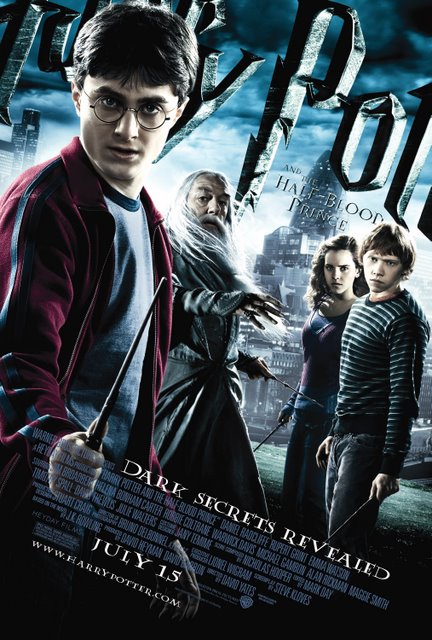
Movie Review: Harry Potter and the Half-Blood Prince (2009)


Official Shop of Warner Bros

Get Caught Up With the Movies


For Potter-- Reading is FUNdamental
Share J.K. Rowling's Series


Read Jen's Take on Prisoner of Azkaban


Half-Blood Prince
Photo Slideshow


Delicious
Bookmark this on Delicious
submit to reddit
Print Page

Digg!

MovieBlips: vote it up!

For the non-readers, the excitement of the next cinematic Harry Potter installment has always been in the steady development of experiencing J.K. Rowling's mythology unfold on the big screen. And as such the films have served as a sort of conveniently abridged version of the works for those either too busy, not quite interested enough, or just seeking a perfunctory knowledge of the world of Hogwarts to fake their way through office conversation.


Yet this is a series that at its heart seems to celebrate its readers the most given its painstaking adaptations and the evidence of this is sometimes its downfall via the detriment of the yawn-inducing screenplays-- as each and every important building block has been included throughout the movies. And in doing so, the directors and strategies have changed throughout which has not only been a brilliant tool in tapping into the short attention spans of the youngest audience members but also ensuring that there isn't only one vision for the Harry Potter universe that's being presented on the screen since the boy who lived in the cupboard under the stairs belongs to everyone who carries him around in their bag.

Moreover, despite his great beginning-- thankfully we've come a long way from the extraordinarily dull first film from one of the great filmmakers of my youth-- Mr. Chris Columbus-- which was surpassed by his own second movie (although book-wise for Rowling number two had been a literary step backward) before Alfonso Cuaron released the masterful Harry Potter and the Prisoner of Azkaban which was and remains the crowning achievement of the works so far.


Essentially, while aside from one exception with Wonder Boys scripter Steve Kloves wielding the pen for all of the transitions from books to movies-- for viewers who know the source material before going in-- the main attraction is from the visual point-of-view and the way in which this franchise has managed never to grow stale is by constantly bringing in a revolving door of new directors, cinematographers, and editors and endless behind-the-scenes talent to switch up the look.


Some of the experimentation offered up has been ghastly in my opinion such as in Mike Newell's The Goblet of Fire wherein every cast member and camera lens looked like it had been dragged through the mud (purposely according to the director's desire for grubbiness) before he yelled “action.”

In terms of script, direction, cinematography, editing, and overall execution,
the most successful adaptation all-around is still Azkaban as that final "Time-Turner "sequence has yet to be topped and Hermione was given her due for the first time in the series. And although I'd cite the first and fourth film as the weakest entries-- despite Newell's success in Harry's terrifying and violent showdown with Voldemort when death hits Hogwarts-- the one recurring complaint aside from the predictable format of "the end of summer break to end of school year standard structure" is the sheer length of the films themselves. Still, I'd like to throw one more problem into the pile-- namely Rowling's over-reliance on the “overhear” device which made more sense when the kids were younger since eavesdropping was conceivably the most reliable way for the trio to acquire information... but more on that later on.


And dropping extraneous details-- to the chagrin of some die hard fans-- Girl in the
Café director David Yates (who had cited Cuaron's work as his own personal favorite) moved the series back in the right direction with the much faster paced fifth film which found Harry developing his own army on behalf of Dumbledore which leads to a devastating conclusion as his godfather Sirius Black is murdered before his eyes.


After being asked to return to helm the rest of the series including the final book which will be broken into two films--(although I'm not sure if that's wise and wonder if perhaps blending books six and seven into two films may have led to a stronger narrative)-- Yates reveals supreme confidence right from the start with a bravura opener unlike anything we've seen before in Harry Potter that's sure to dazzle in 3D despite my admitted weariness of the format. In doing so he offers audiences an entirely new visual look by bringing aboard Jeunet's Amelie cinematographer Bruno Delbonnel that adds a striking color palette and style to the work especially in tandem with veteran Potter editor Mark Day. And some of the sequences in this-- the sixth Potter film to hit the screen-- are so breathtakingly gorgeous that they rival Azkaban on sheer beauty alone.


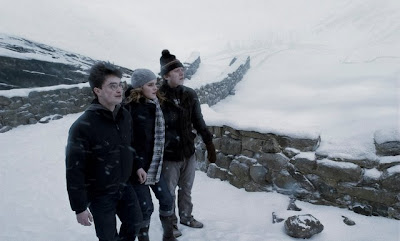
Whether Delbonnel employs old-fashioned trickery to move easily into flashbacks from water drops in a cauldron into the past with a soft focus or words on a page that evolve from ink and font into kids walking in the snow-- it's always dazzling and just flows so well that an argument can be made for Delbonnel to receive a cinematography nomination for his mind-blowing work.


And it's a great thing too because while the film is sumptuous-- readers of Half-Blood Prince go into the theatre keenly aware that it's a very introspective, flashback heavy, chatty (a.k.a. not exactly action packed entry) which is designed to push everything in the right direction towards an unsettling “throw the uninitiated off a narrative cliff” ending as one main character is murdered and another we've been on the fence about is the one wielding the wand, thereby effectively leaving those breathlessly anticipating what's to happen next.


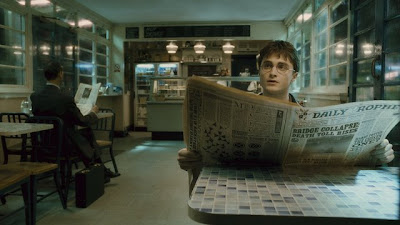
As a film, it's still quite good--if a bit too long again-- and filled with Rowling's structural Achilles heel as the trio and especially Harry this time-- since Ron and Hermione are busy obsessing over which one the other one is “snogging” (the Brit slang for kissing)-- are seen more than half a dozen times at least eavesdropping or listening in on conversations as if Rowling forgot that there were other ways Nancy Drew, Miss Marple, or any number of detectives could find clues.


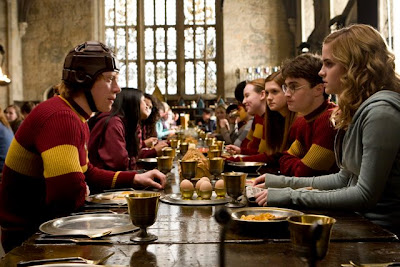
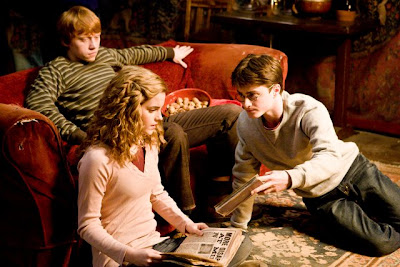
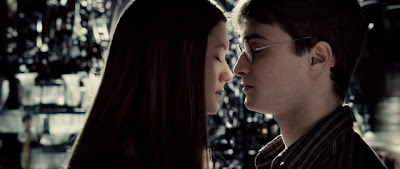
Since the cast is getting older-- they're predictably more caught up with their raging hormones. To this end, Harry starts to return Ginny's previously unrequited affection only to realize that she'd moved on to the athletic Quidditch player Dean Thomas whereas Ron has caught the eye of a stereotypically clingy girly-girl named Lavender much to Hermione's wrath that he hasn't realized that girls with the ability to carry on a conversation are much more interesting than those who snog so much that poor Ron is going to have the market cornered on chapstick.


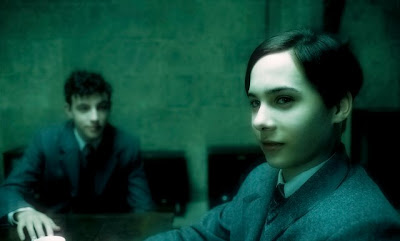
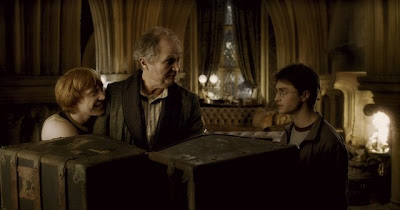
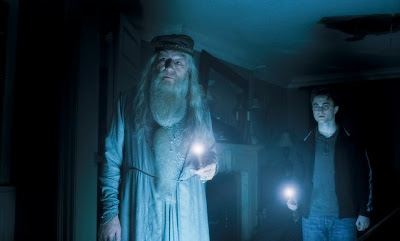
Yet, it's not all "The Young and the Hogwarts"-- as The Death Eaters have stepped up their fight on behalf of the Dark Lord and we learn early on that not only is Draco Malfoy to be an important player but that Alan Rickman's Severus Snape has promised Helena Bonham Carter's Bellatrix Lestrange to step in if he's unable to fulfill his duty. Likewise, Michael Gambon's Dumbledore has been turning Harry into a double agent to get close to one of Tom Riddle's old teachers-- Horace Slughorn (Jim Broadbent).


And despite the tradition that the final showdown is always the most exciting-- honestly the one captured in Half-Blood Prince isn't quite as memorable as some of the ones which have come before it. One of the reasons for this could most likely be because the events leading up to the big murder were executed with such overt Christian symbolism like we were watching a Charlton Heston movie to the point that afterward others including myself wondered when it suddenly became The Ten Commandments thereby in making these choices, it pulled viewers out of Harry Potter suspension-of-disbelief and into post-modern, pop-culture referential mode.


Additionally, in the book although Harry was outnumbered and out-wanded to help prevent a beloved friend from death, there was much more to the scene than having him stand there like yet another "overhear" in an anti-climactic fashion.


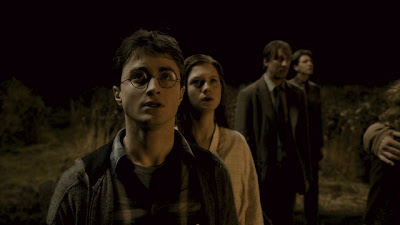
Despite this, there is one amazing sequence that keeps you in check within the film that I don't remember-- at least to this extent-- in the novel which takes place at Christmas at the Weasley household when Bellatrix Lestrange shows up and a huge chase through the cornfield ensues as though we were in a vintage horror movie classic.


Furthermore it's surprises like these-- unexpected, away from Hogwarts, brilliantly lensed and pieced together in the most dynamic way that heightens the tension which brilliantly keepsus watching even when we're left realizing that this time around, Ron and Hermione have very little to do (with the former given hardly anything save for the obligatory comic relief scene). And likewise the filmmakers will definitely have their work cut out for them in making us buy into the Harry and Ginny relationship
in Deathly Hallows since the ultimate few second "snog" looked about as passionate as a walk to Hagrid's hut.


And in the end, for the readers who've been joyfully treated with
Delbonnel's beautiful lensing, you'll find yourself growing excited and anxious for the plot division of the next book since obviously the big revelation that sets up the final quest for the end of the series is revealed in this title. Yet this one may be rough going for the non-readers given the lack of action in comparison to the rest. However, for the patient viewers who manage to watch all the way through-- the best achievement of the picture's final sequence (and indeed the film itself) is that the murder and perpetrator are so startling that you may find yourself going over to the bookstore to grab Hallows just to see what happens next.


Text ©2009, Film Intuition, LLC; All Rights Reserved. http://www.filmintuition.com

Unauthorized Reproduction or Publication Elsewhere is Strictly Prohibited.