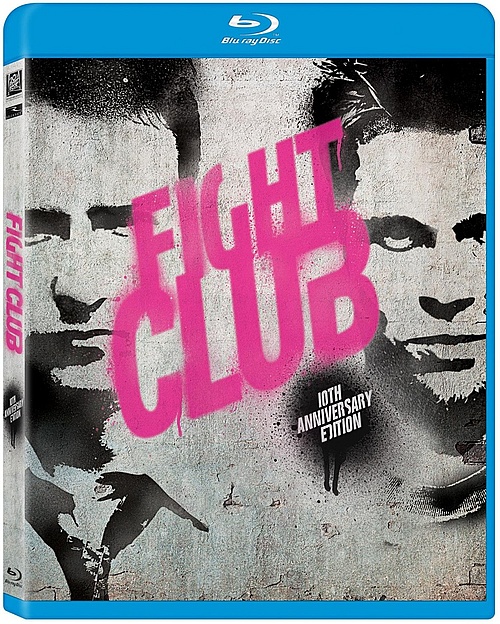
Now Available to Own

The idea of an unreliable narrator is a fascinating literary device that seems to play best in the realm of cinema as film manages to trick viewers like no other medium. Upon researching unreliable narrators, I discovered that they originated in Chaucer’s Canterbury Tales and since the publication of that work, writers have been using false tricksters to guide readers and viewers with tales of increasing complexity.
Probably the most famous work of unreliable narration of the ‘90s was employed in Bryan Singer’s masterful film, The Usual Suspects, which starred Kevin Spacey. The actor followed up Usual Suspects with another neo-noir for director David Fincher in the form of Seven.
After my friend and fellow film critic Colin Boyd urged me to see Zodiac, I realized that I’ve been consistently impressed by the films of David Fincher including Curious Case of Benjamin Button and Panic Room. However, at the time it was released, I loathed Seven and have yet to see it again. Although I grant that it was indeed intelligent and that Fincher's frequent star (in their initial coupling), Brad Pitt finally had the chance to show his enormous range for the first time, overall I felt that it was a downright disgusting thriller. Saw before the horror franchise and torture porn genre was born, Seven is a work I felt sickened trying to view as one that left nothing to the imagination and had no purpose other than to simply horrify.
Yet ironically, most individuals called Fincher’s follow-up Fight Club even more disturbing with some of my favorite critics going as far as to damn the film as one of the most dangerous pieces of cinema ever made… and not in a great Roman Polanski way. However, while it definitely was a chore to sit through, as a film, Fight Club was also brilliant, darkly comic and impossible to forget.
At its essence, the movie was more of an assault on our commercial society than simply a film about a bunch of guys just wailing on each other, which unfortunately was the way it was dismissed by a large amount of reviewers. Still enough viewers identified its underlying theme and overall message on a visceral as well as intellectual level which Variety’s David Rooney likewise acknowledged by writing that, “rarely has a film been so keyed into its time.” And the audience for Fight Club has only grown more passionate about the 1999 work ever since, thereby making it a bona fide cult classic ten years after Fincher’s previous star, Spacey and his film American Beauty earned Oscar gold.
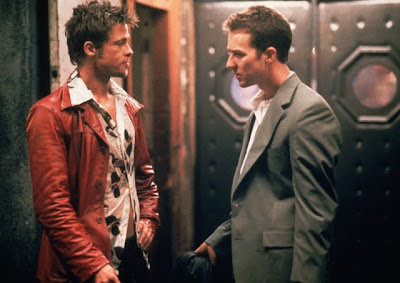
Allegory to the max, Fight Club's final cut was extreme in every way imaginable to ramp up the Fincher’s subtext in Jim Uhls’ brilliant adaptation of Chuck Palahniuk’s novel. Every frame reaffirmed the film’s “message statement” against a generation abiding by “mission statements,” via its expressionistic usages of sound bridges and impressionistic marriage of production design, editing trickery, juxtaposition, and Edward Norton’s deadpan narration. In copious behind-the-scenes extra features, you can witness the painstaking effort of various departments working in tandem like the real external Project Mayhem crew of the movie’s internal guerilla group Project Mayhem to ensure that Fincher’s movie was as much of a psychological extension of the antithesis of late ‘90s consumer driven culture as was its main character Tyler Durden.
While on the surface, guys thrashed each other with full force, once you peeled past that outer layer, astute viewers understood that it’s a counterculture work using graphic imagery in place of a dull professorial lecture. As such, Fight Club is best experienced in the same allegorical spirit Peter Greenaway employed in his intensely sexual, over-the-top NC-17 rated The Cook, The Thief, His Wife, and Her Lover which was a disturbingly in-your-face response film to the British monarchy system of the ‘80s.
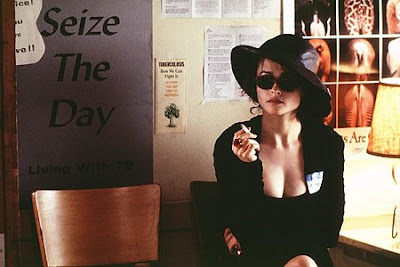
For those who have yet to see the movie, Fight Club follows our existentially adrift Narrator, played by Edward Norton, as an insurance calculator/cubicle drone who spends a large amount of time living a “single serving” life of travel by providing an impersonal mathematical formula gauging death vs. cost in deciding whether or not the major automobile company he works for should financially initiate a recall.
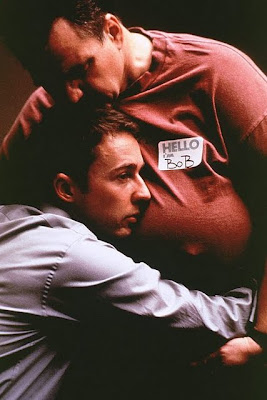
Furthermore, throughout the movie, Norton is credited with no set name other than “Jack” which is an in-film ironic joke after he finds a retro stack of informational health literature about Jack’s Medulla Oblongata, etc. Insomniac and dispassionate in his job, he takes to attending support groups for diseases he doesn’t have—anxious to simply feel and connect with strangers even for a brief period. However, our Narrator’s new and disturbing homeostasis proves to be a temporary solution, which is irrevocably altered when his condo full of Ikea purchased possessions blows up, forcing him to face his life and realize that he’s missing something vital. What he's missing, he realizes once he meets Tyler Durden (Pitt)—a loose cannon with whom he co-creates a “fight club” wherein men can work out their aggression on one another until this leads to acts of homegrown terrorism under the name of Project Mayhem.
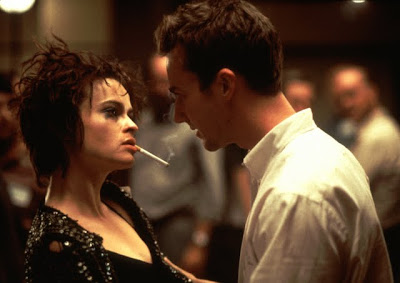
Obviously this plot-point was a frightening development that critics and journalists feared would lead to off-screen destruction. And unfortunately, some young men—completely missing the film’s point—did indeed create their own fight clubs but again, this reaction made me recall the reaction to another movie made a decade earlier. Like Spike Lee’s Do The Right Thing, which many people felt would incite riots (and was blamed for the misfortune of being released before Rodney King)—Fight Club is a brilliant work that should incite thought instead of violence. Moreover, I couldn’t help realizing how sad it was at the time that those critiquing it didn’t give American audiences more respect and let the few who may have let media do their thinking for them give the millions of other intelligent viewers a bad name.
Additionally, as I learned in "How to Start a Fight," the original twenty page DVD booklet (which admirably cited reactions which ran the gamut), there is “more violence in the first 10 minutes of Saving Private Ryan than if you watched Fight Club for an entire year.” Moreover honestly, underneath all of the “macho posing,” right from its opening phallic imagery of a gun barrel placed in Norton’s mouth, overall it’s quite homoerotic as both women and gay men noticed instantly. This makes the idea that it’s a total “Guy Film Hall of Fame” movie (as SpikeTV inducted it a few months back, which is included on the Blu-ray) seem far more subversive and fun on another level as several years ago author Chuck Palahniuk finally outed himself as a gay man.
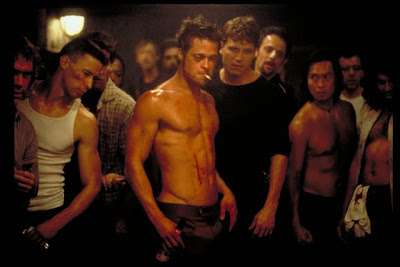
While I’ve never read the book by Palahniuk, I learned from research that the ending varies greatly from his original plot but the author has been widely quoted as stating that he prefers the film’s ending to his own published version. Overall, Jim Uhls' script echoed the tone of the book, which Uhls described as, “a seminal statement of the times, a statement about this particular generation, much in the same way the ‘60s were captured in the better films of that decade,” in Fight Club’s original production notes. And to his immense credit, Uhls succeeded as the film perfectly captured Palahniuk’s beliefs on the power of culture, which were listed in the booklet as follows:
“The first way in which a new generation takes control of society is through the culture; the arts, films, books, music. Through all entertainment. People who feel safe and secure in the existing society are frightened by ideas that threaten their power. People who hold the power in society want nice complacent forms of entertainment, films that comfort people and support the status quo.”Fight Club was a risky film to be sure and one quite excessive in its violence but the visuals and juxtaposition of shots are quite novel. Producer Laura Ziskin (yes, only a female producer would touch it) really helped keep this labor of love on track by giving unprecedented power to Fincher. In doing so, former music video director Fincher shot more than three times the normal amount of film reels (IMDb) to get his vision right.
The film’s huge narrative shock and switch revealing our unreliable narrator was quite surprising in the first viewing but after one goes through the film again, one notices what a clever craftsman Fincher and his editor were as there are so many clues littered throughout the movie on several sensory levels designed to hit each part of the brain, whether visually, in a literary fashion etc. for a stunned intellectual punch.
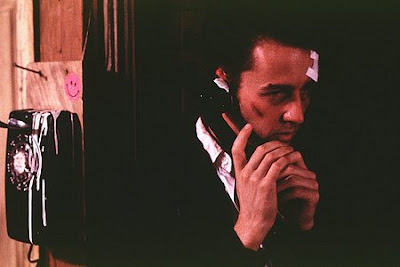
Although it’s filmed in L.A., the setting of the work was always Wilmington, Delaware but predictably and with justification, the city officials were worried about duplicate attacks witnessed onscreen so the setting is anonymous, giving viewers a more terrifying experience as we see that it could occur anywhere. And indeed, the film itself took on a whole new resonance after the events of 9/11.
Suddenly a film about a generation without direction, without “great wars” or purpose whose characters resort to terrorism from consumer slavery became a bit too hard to handle as in a scene where Norton’s character prays for a plane crash as well as in the final moments as skyscrapers explode. It only had two years there (released in ’99) when the film fit in with its time but following 9/11, everything changed and suddenly the film felt like a period piece… or it did until its tenth anniversary rolled around.
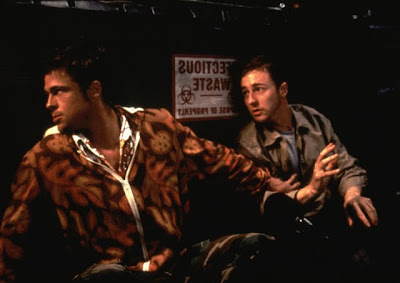
While watching it again a few years back for an undergraduate project on neo-noir films, I did find it especially eerie considering the aforementioned sequences and sentiment. However, now in 2009, it feels not like it was simply a clever allegory nor a period piece of a more consumerist time but a wake up call in retrospect. Just like viewing the miniseries of Traffik in its twentieth anniversary hit me on a global level in terms of alarm bells regarding Afghanistan and Pakistan that will make you want to shout “why didn’t we do anything?” Fight Club is deeply affecting on the level of not just terror but consumerism as well.
In ’99, Tyler’s “you’re not the car you drive,” monologue was indeed meaningful but not nearly as much as it is now when viewed again in an era where debt has enslaved us to the point wherein most of us can’t even “go to jobs we hate” to “buy shit we don’t need,” since the basics are what’s adding up and this time around, we're also indebted by fighting two “great wars” that we didn’t have then. So suddenly Fight Club becomes just as urgent, tragic, and retroactively potent as ever. This is particularly evident given Project Mayhem’s insane movement to set the debt record back to zero so that everyone becomes free, which is not only just as terrifyingly allegorical as it always was but now makes us want to shout, “why didn’t we do anything?” from a peaceful standpoint, of course since as Palahniuk noted entertainment is the way to introduce ideas for real change.
Yet that quote from the Fight Club scribe is one of the problems with the film’s 10th Anniversary Blu-ray Edition... since it doesn’t exist. When purchased originally in 2000, the two disc DVD set featured not just superlative features packaged in a gorgeous format of concept art but it also contained a twenty page fact and photo filled guide that was Fox 2000 Pictures’ equivalent of releasing their own pre-Criterion version essay.
Missing even a basic one-page Blu-ray insert of what was then titled “Jack’s Chapters,” as well as the aforementioned guide, while Fox’s enviable Blu-ray clarity is top-notch, this single disc dully packaged edition contains just three new extras, with one consisting of a simple search index. Still, a search index is needed since the menu is presented in tinier font and laid out in a more confusing manner. But being that the other two new extras are purely the SpikeTV induction (memorable only for Norton’s dare to Pitt involving Mel Gibson) and a very interesting yet way too short demonstration of the sound design with 2-time Fincher Oscar nominee Ren Klyce, it leaves me hesitant to recommend the full price-tag of the Blu-ray upgrade since no doubt you’d want to hang onto your original DVDs and would therefore double your shelf-space.
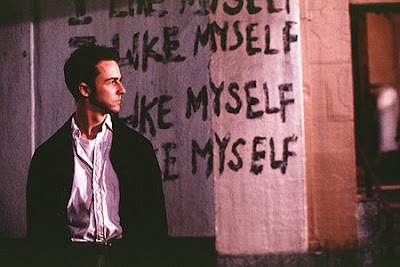
While high definition is a great way to appreciate the movie, such a passionately thorough job was done by Fincher in the original film itself that—although it does improve the depth perception—I’m assuming that there will be a far more worthwhile Blu-ray release down the road, either from Fox or perhaps Criterion who were involved in Fincher’s Benjamin Button from its home entertainment debut.
The absence of new features with the cast in fact does make me wonder if they were all far too busy in their respective endeavors like the Button release and Inglourious Basterds to get more involved, yet Fincher does provide a small but tiny gag by inserting the menu of the 1999 film that drew in more box office than Club in the form of Drew Barrymore’s Never Been Kissed for a few seconds before Club kicks in.
Since press were sent notes and e-mails (I received one with the disc and one in the inbox) regarding the importance of not revealing the “Fincher gag,” I was extremely eager to uncover just what we were to expect when it finally arrived and while it’s cute for a moment, sadly just like the subtext of Kissed as having earned more money, this release without the superior packaging, DVD booklet or more than only a handful of bonuses just feels like a format upgrade for the dough and sans the spirit of Durden.
Needless to say, I am Jack’s Supreme Sense of Disappointment. Yet for those whose only interest is purely for the film and its format and not for the features, this particular release echoes one of my favorite lines by Norton's memorably unreliable narrator of, “it’s called a changeover, the movie goes on and nobody in the audience has any idea.”
Text ©2009, Film Intuition, LLC; All Rights Reserved. http://www.filmintuition.com
Unauthorized Reproduction or Publication Elsewhere is Strictly Prohibited.


 Coming off the heels of last year’s brilliant but bleak Best Picture winner No Country For Old Men, which
  And why should he? Although he’s been working on his memoirs after impulsively quitting the agency in a hilarious confrontational beginning as he’s officially downgraded for a drinking problem, it’s his unfaithful wife Katie (Tilda Swinton) who compiled the data on the disc as a preemptive strike before serving him with divorce papers. Unbeknownst to either of them, their moves are all being watched as the plot grows increasingly complex and chaotic when the link between the two stories — the kinky governmental employee Harry Pfarrer (George Clooney) becomes involved — begins sleeping alternately with Swinton’s Katie and McDormand’s Linda Litzke. And when Osborne proves to be less than cooperative, Linda, desperate to have plastic surgery and oblivious to the earnest affection of her good-natured boss Ted (Richard Jenkins), leads Pitt’s Chad further into an international debacle as they try to sell the “secret shit” to the Russians.
 With an advertising campaign comprised of cool Saul Bass-styled posters echoing the classy spy films and Hollywood blockbusters of the late '50s and '60s (the lettering alone looks like Bass’s work on Vertigo), it’s evident that like No Country was sort of the Coen version of a western, this is their version of a spy comedy, yet it’s surprisingly devoid of humor. And that’s quite a shame as again, it had one of the best ad campaigns of 2008.
 Like The Hudsucker Proxy, Intolerable Cruelty, and The Ladykillers, the timing of this one is just plain off and it took a good twenty minutes to garner one genuine laugh, after Malkovich’s grand confrontation which opens the film. Although some audience members did chuckle, even at the oddest of moments as one character slices another in the head with an axe, it all seemed to be as half-hearted as the direction, more in appreciation of the directors themselves than what was actually served up to audiences. This being said, I wasn’t unprepared, knowing fully how “out there” they can go-- having seen, analyzed, and appreciated even some of their strangest works such as Barton Fink and the wood-chipper finale of Fargo. As a film host and critic I have probably explained, championed, and defended their work to friends, audiences, and strangers more than most.

 If they truly wanted to make us laugh, we would’ve seen these events with our own eyes, rather than be “told” what happened and it’s not like they were overstaying their welcome with a roughly ninety-five minute running time. Ultimately, the Coens end Burn with the same type of similar dissatisfying aftertaste that became one of the biggest criticisms of last year’s abrupt end to No Country. And possibly to fix this, they could’ve found a way to delete the Clooney and Swinton plot altogether and just give us more of “The Chad” (to quote Charlie’s Angels) so we could relish in his childlike awe upon trying to discover all the “highly classified shit” he can get his hands on.