Showing posts with label David Fincher. Show all posts

11/29/2009

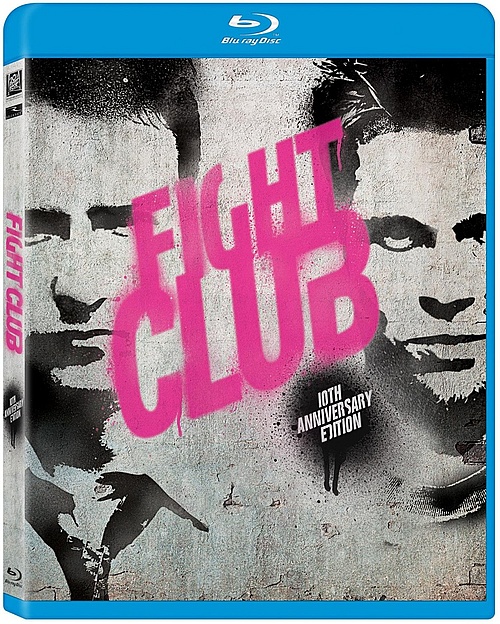
Blu-ray Review: Fight Club -- 10th Anniversary Edition (1999; 2009)

Now Available to Own


The idea of an unreliable narrator is a fascinating literary device that seems to play best in the realm of cinema as film manages to trick viewers like no other medium. Upon researching unreliable narrators, I discovered that they originated in Chaucer’s Canterbury Tales and since the publication of that work, writers have been using false tricksters to guide readers and viewers with tales of increasing complexity.

Probably the most famous work of unreliable narration of the ‘90s was employed in Bryan Singer’s masterful film, The Usual Suspects, which starred Kevin Spacey. The actor followed up Usual Suspects with another neo-noir for director David Fincher in the form of Seven.

After my friend and fellow film critic Colin Boyd urged me to see Zodiac, I realized that I’ve been consistently impressed by the films of David Fincher including Curious Case of Benjamin Button and Panic Room. However, at the time it was released, I loathed Seven and have yet to see it again. Although I grant that it was indeed intelligent and that Fincher's frequent star (in their initial coupling), Brad Pitt finally had the chance to show his enormous range for the first time, overall I felt that it was a downright disgusting thriller. Saw before the horror franchise and torture porn genre was born, Seven is a work I felt sickened trying to view as one that left nothing to the imagination and had no purpose other than to simply horrify.

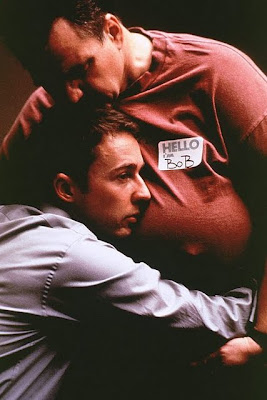
Yet ironically, most individuals called Fincher’s follow-up Fight Club even more disturbing with some of my favorite critics going as far as to damn the film as one of the most dangerous pieces of cinema ever made… and not in a great Roman Polanski way. However, while it definitely was a chore to sit through, as a film, Fight Club was also brilliant, darkly comic and impossible to forget.

At its essence, the movie was more of an assault on our commercial society than simply a film about a bunch of guys just wailing on each other, which unfortunately was the way it was dismissed by a large amount of reviewers. Still enough viewers identified its underlying theme and overall message on a visceral as well as intellectual level which Variety’s David Rooney likewise acknowledged by writing that, “rarely has a film been so keyed into its time.” And the audience for Fight Club has only grown more passionate about the 1999 work ever since, thereby making it a bona fide cult classic ten years after Fincher’s previous star, Spacey and his film American Beauty earned Oscar gold.
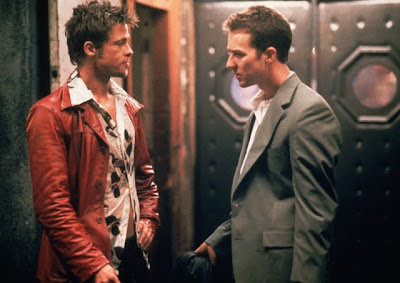

Allegory to the max, Fight Club's final cut was extreme in every way imaginable to ramp up the Fincher’s subtext in Jim Uhls’ brilliant adaptation of Chuck Palahniuk’s novel. Every frame reaffirmed the film’s “message statement” against a generation abiding by “mission statements,” via its expressionistic usages of sound bridges and impressionistic marriage of production design, editing trickery, juxtaposition, and Edward Norton’s deadpan narration. In copious behind-the-scenes extra features, you can witness the painstaking effort of various departments working in tandem like the real external Project Mayhem crew of the movie’s internal guerilla group Project Mayhem to ensure that Fincher’s movie was as much of a psychological extension of the antithesis of late ‘90s consumer driven culture as was its main character Tyler Durden.

While on the surface, guys thrashed each other with full force, once you peeled past that outer layer, astute viewers understood that it’s a counterculture work using graphic imagery in place of a dull professorial lecture. As such, Fight Club is best experienced in the same allegorical spirit Peter Greenaway employed in his intensely sexual, over-the-top NC-17 rated The Cook, The Thief, His Wife, and Her Lover which was a disturbingly in-your-face response film to the British monarchy system of the ‘80s.
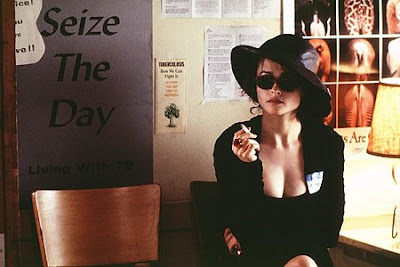

For those who have yet to see the movie, Fight Club follows our existentially adrift Narrator, played by Edward Norton, as an insurance calculator/cubicle drone who spends a large amount of time living a “single serving” life of travel by providing an impersonal mathematical formula gauging death vs. cost in deciding whether or not the major automobile company he works for should financially initiate a recall.

Furthermore, throughout the movie, Norton is credited with no set name other than “Jack” which is an in-film ironic joke after he finds a retro stack of informational health literature about Jack’s Medulla Oblongata, etc. Insomniac and dispassionate in his job, he takes to attending support groups for diseases he doesn’t have—anxious to simply feel and connect with strangers even for a brief period. However, our Narrator’s new and disturbing homeostasis proves to be a temporary solution, which is irrevocably altered when his condo full of Ikea purchased possessions blows up, forcing him to face his life and realize that he’s missing something vital. What he's missing, he realizes once he meets Tyler Durden (Pitt)—a loose cannon with whom he co-creates a “fight club” wherein men can work out their aggression on one another until this leads to acts of homegrown terrorism under the name of Project Mayhem.
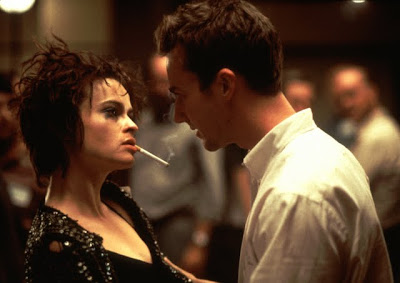

Obviously this plot-point was a frightening development that critics and journalists feared would lead to off-screen destruction. And unfortunately, some young men—completely missing the film’s point—did indeed create their own fight clubs but again, this reaction made me recall the reaction to another movie made a decade earlier. Like Spike Lee’s Do The Right Thing, which many people felt would incite riots (and was blamed for the misfortune of being released before Rodney King)—Fight Club is a brilliant work that should incite thought instead of violence. Moreover, I couldn’t help realizing how sad it was at the time that those critiquing it didn’t give American audiences more respect and let the few who may have let media do their thinking for them give the millions of other intelligent viewers a bad name.

Additionally, as I learned in "How to Start a Fight," the original twenty page DVD booklet (which admirably cited reactions which ran the gamut), there is “more violence in the first 10 minutes of Saving Private Ryan than if you watched Fight Club for an entire year.” Moreover honestly, underneath all of the “macho posing,” right from its opening phallic imagery of a gun barrel placed in Norton’s mouth, overall it’s quite homoerotic as both women and gay men noticed instantly. This makes the idea that it’s a total “Guy Film Hall of Fame” movie (as SpikeTV inducted it a few months back, which is included on the Blu-ray) seem far more subversive and fun on another level as several years ago author Chuck Palahniuk finally outed himself as a gay man.
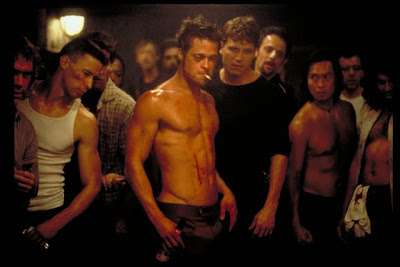

While I’ve never read the book by Palahniuk, I learned from research that the ending varies greatly from his original plot but the author has been widely quoted as stating that he prefers the film’s ending to his own published version. Overall, Jim Uhls' script echoed the tone of the book, which Uhls described as, “a seminal statement of the times, a statement about this particular generation, much in the same way the ‘60s were captured in the better films of that decade,” in Fight Club’s original production notes. And to his immense credit, Uhls succeeded as the film perfectly captured Palahniuk’s beliefs on the power of culture, which were listed in the booklet as follows:
“The first way in which a new generation takes control of society is through the culture; the arts, films, books, music. Through all entertainment. People who feel safe and secure in the existing society are frightened by ideas that threaten their power. People who hold the power in society want nice complacent forms of entertainment, films that comfort people and support the status quo.”
Fight Club was a risky film to be sure and one quite excessive in its violence but the visuals and juxtaposition of shots are quite novel. Producer Laura Ziskin (yes, only a female producer would touch it) really helped keep this labor of love on track by giving unprecedented power to Fincher. In doing so, former music video director Fincher shot more than three times the normal amount of film reels (IMDb) to get his vision right.

The film’s huge narrative shock and switch revealing our unreliable narrator was quite surprising in the first viewing but after one goes through the film again, one notices what a clever craftsman Fincher and his editor were as there are so many clues littered throughout the movie on several sensory levels designed to hit each part of the brain, whether visually, in a literary fashion etc. for a stunned intellectual punch.
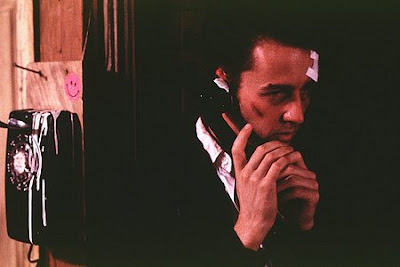

Although it’s filmed in L.A., the setting of the work was always Wilmington, Delaware but predictably and with justification, the city officials were worried about duplicate attacks witnessed onscreen so the setting is anonymous, giving viewers a more terrifying experience as we see that it could occur anywhere. And indeed, the film itself took on a whole new resonance after the events of 9/11.

Suddenly a film about a generation without direction, without “great wars” or purpose whose characters resort to terrorism from consumer slavery became a bit too hard to handle as in a scene where Norton’s character prays for a plane crash as well as in the final moments as skyscrapers explode. It only had two years there (released in ’99) when the film fit in with its time but following 9/11, everything changed and suddenly the film felt like a period piece… or it did until its tenth anniversary rolled around.
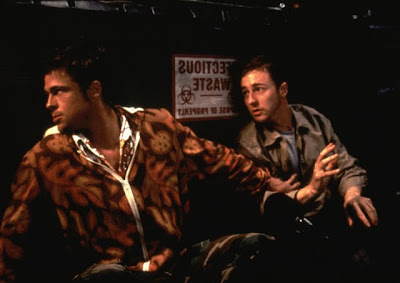

While watching it again a few years back for an undergraduate project on neo-noir films, I did find it especially eerie considering the aforementioned sequences and sentiment. However, now in 2009, it feels not like it was simply a clever allegory nor a period piece of a more consumerist time but a wake up call in retrospect. Just like viewing the miniseries of Traffik in its twentieth anniversary hit me on a global level in terms of alarm bells regarding Afghanistan and Pakistan that will make you want to shout “why didn’t we do anything?” Fight Club is deeply affecting on the level of not just terror but consumerism as well.

In ’99, Tyler’s “you’re not the car you drive,” monologue was indeed meaningful but not nearly as much as it is now when viewed again in an era where debt has enslaved us to the point wherein most of us can’t even “go to jobs we hate” to “buy shit we don’t need,” since the basics are what’s adding up and this time around, we're also indebted by fighting two “great wars” that we didn’t have then. So suddenly Fight Club becomes just as urgent, tragic, and retroactively potent as ever. This is particularly evident given Project Mayhem’s insane movement to set the debt record back to zero so that everyone becomes free, which is not only just as terrifyingly allegorical as it always was but now makes us want to shout, “why didn’t we do anything?” from a peaceful standpoint, of course since as Palahniuk noted entertainment is the way to introduce ideas for real change.

Yet that quote from the Fight Club scribe is one of the problems with the film’s 10th Anniversary Blu-ray Edition... since it doesn’t exist. When purchased originally in 2000, the two disc DVD set featured not just superlative features packaged in a gorgeous format of concept art but it also contained a twenty page fact and photo filled guide that was Fox 2000 Pictures’ equivalent of releasing their own pre-Criterion version essay.

Missing even a basic one-page Blu-ray insert of what was then titled “Jack’s Chapters,” as well as the aforementioned guide, while Fox’s enviable Blu-ray clarity is top-notch, this single disc dully packaged edition contains just three new extras, with one consisting of a simple search index. Still, a search index is needed since the menu is presented in tinier font and laid out in a more confusing manner. But being that the other two new extras are purely the SpikeTV induction (memorable only for Norton’s dare to Pitt involving Mel Gibson) and a very interesting yet way too short demonstration of the sound design with 2-time Fincher Oscar nominee Ren Klyce, it leaves me hesitant to recommend the full price-tag of the Blu-ray upgrade since no doubt you’d want to hang onto your original DVDs and would therefore double your shelf-space.
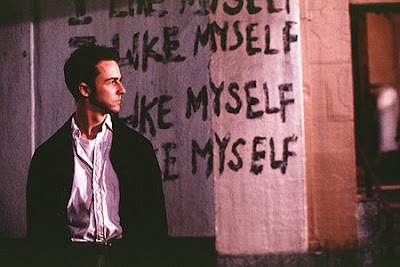

While high definition is a great way to appreciate the movie, such a passionately thorough job was done by Fincher in the original film itself that—although it does improve the depth perception—I’m assuming that there will be a far more worthwhile Blu-ray release down the road, either from Fox or perhaps Criterion who were involved in Fincher’s Benjamin Button from its home entertainment debut.

The absence of new features with the cast in fact does make me wonder if they were all far too busy in their respective endeavors like the Button release and Inglourious Basterds to get more involved, yet Fincher does provide a small but tiny gag by inserting the menu of the 1999 film that drew in more box office than Club in the form of Drew Barrymore’s Never Been Kissed for a few seconds before Club kicks in.

Since press were sent notes and e-mails (I received one with the disc and one in the inbox) regarding the importance of not revealing the “Fincher gag,” I was extremely eager to uncover just what we were to expect when it finally arrived and while it’s cute for a moment, sadly just like the subtext of Kissed as having earned more money, this release without the superior packaging, DVD booklet or more than only a handful of bonuses just feels like a format upgrade for the dough and sans the spirit of Durden.

Needless to say, I am Jack’s Supreme Sense of Disappointment. Yet for those whose only interest is purely for the film and its format and not for the features, this particular release echoes one of my favorite lines by Norton's memorably unreliable narrator of, “it’s called a changeover, the movie goes on and nobody in the audience has any idea.”


Text ©2009, Film Intuition, LLC; All Rights Reserved. http://www.filmintuition.com
Unauthorized Reproduction or Publication Elsewhere is Strictly Prohibited.

5/15/2009

Blu-ray Review: The Curious Case of Benjamin Button (2008) -- 2-Disc Criterion Collection


Now Available on DVD & Blu-ray


View the Photo Gallery Slideshow
(All Images Courtesy of Paramount Pictures & Warner Brothers)


Delicious
Bookmark this on Delicious
submit to reddit
Print Page

Digg!

MovieBlips: vote it up!

In addition to the critical acclaim, Golden Globe and Oscar nominations, perhaps the most significant barometer for the level of unsurpassed class exemplified in David Fincher's masterpiece The Curious Case of Benjamin Button-- which followed another underrated masterpiece in Zodiac-- is that it's one of the very few contemporary films that's been given The Criterion Collection treatment right off the bat with its debut on Blu-ray and DVD.


The prestigious film buffs involved with crafting those amazing one to multiple disc sets that consist of scholarly essays, worthwhile featurettes, and the highest level of transfer and respect paid in moving the work from film to DVD and/or Blu-ray have done so 475 times prior to Button and while usually we're treated to magical offerings by filmmakers including Truffaut, Fellini, Kurosawa, Polanski, Renoir, Godard, or De Sica, it's the rarest and most curious of honors when a new release is given the same consideration.


While I do remember Wes Anderson's The Royal Tenenbaums releasing via Criterion, the fact that it's so atypical that that's the only one that immediately springs to mind makes the distinction of Button worth so much more than any traditional award since the award is in the Blu-ray and it's shared with everyone.


Indeed, this stellar transfer takes the most exquisite pains in ensuring that Fincher's largely digital original material not only presents his intent as a filmmaker (complete with a directorial seal of approval) but also marks Button as a film that actually looks the best it ever has when given the Blu-ray treatment.


Of course, as curious and rare as the Criterion honor is for a new release, a film like The Curious Case of Benjamin Button is that rarest and most curious of films being served up by the studio system (financed actually by two titans in the form of Paramount and Warner Brothers) as it hearkens back to the epics of yesteryear but does so without treacly saccharine or forced nostalgia.


Definitely romantic, daring, and fascinating in its literary approach and the boldness to present a man's entire life in its eighty year span of-- as the film notes-- the “unusual circumstances” that our hero Benjamin Button was born old, ages in reverse, and dies young but it's a film without gimmicks. Likewise, it's one without dubious plot points to intercut our lead into every major historical event taking place, preferring instead to take a subtle, humanistic, dark, heartbreaking, wise, yet unbelievably breathtaking approach from scripter Eric Roth (working from both F. Scott Fitzgerald's original short story and the many drafts of Robin Swicord who helped shape the story into an actual plot) and helmer David Fincher.


As the filmmakers involved stress-- including producers Kathleen Kennedy and Frank Marshall who were onboard during the project's earliest development at Spielberg's Amblin Entertainment-- the film is at its heart the simple story of an everyman or a regular person whose experiences and interactions from first kisses to first hangovers help craft him into the man he becomes.


Despite this, some critics and audiences had fun riffing on the work as essentially a dark Se7en, The Game, Fight Club, and Panic Room director Fincher's interpretation of Eric Roth's Oscar winning screenplay for Forrest Gump. While the theory does hold water since both are adaptations of whimsical, fantastical literary material that chronicle a man's life and indeed share some central structural issues including a devotion to his mama (although Button's is an “adopted” one as his own dies in childbirth and horrified by the elderly “creature” that had just been brought into the world, his father dumps Benjamin off on the stairs of an elderly home) as well as a free-spirited true love-- there's much more wisdom in this piece than in the masterful fairy tale of Gump with its pop-culture one-liners.


Roth, who-- much like Fincher and other cast and crew members-- had experienced the painful deaths of parents during the process of conceiving the work, manage to sidestep the trappings of what seems to be a pop-song sentiment of “I wish that I knew what I know now, when I was younger” or “Ah, but I was so much older then, I'm younger than that now” (from Faces and Bob Dylan respectively) and instead look deeply into both the benefits and challenges of what it would mean to live your life in reverse.


While on the one hand, Benjamin comes to understand mortality at a very young age and must face it again and again throughout the course of his life as he learns that everything is temporary and life itself quite fleeting while losing one person to the next. However, on the other he's also been given the double edged sword of looking old and being perceived as someone who is ready to face the world as though he was seventy when in reality he's just a questioning adolescent still taken in by bedtime stories, eager to make friends, and fall in love.


And that he does when he first lays eyes on the beautiful red-headed child Daisy (perhaps named for Fitzgerald's most famous female character in The Great Gatsby) who-- while chronologically is the same age as he is-- appears young enough to be her granddaughter. Although again to some critics and audiences, Benjamin's struggle to make friends and go through typical coming-of-age experiences (such as his crush on Daisy) seemed far too creepy or unnatural to handle. Likewise, while I'm sure it probably will be a film that doesn't sit well with some churches since it “goes against nature” which is another argument I read-- honestly, it's a wide-eyed, equally optimistic yet realistic and mortal tale of discovery and an individual's journey through the time-line of life that is in the end more life-affirming than one would think once they get past their “creepy” reservations.


With the sweepingly assured storytelling approach and sheer beauty in the New Orleans set cinematography as well as the performances by its endlessly talented cast-- ultimately I was most moved by the underlying theme and subtext of the work that human beings are essentially comprised by not just the experiences they encounter but those who cross their paths and leave an unmistakable fingerprint on their lives.


Bravely confronting mortality right from the start as that thing that we're always trying to ignore in most modern day cinema as well as our daily lives, this existential work celebrates the collective experiences of Benjamin's life as well as his choices to take from each what he needs to, in order to ultimately become the man he wants to be as the film essentially plays as though it were presented via literary chapters complete with breathtaking illustrations from those bedtime stories that Benjamin and Daisy marveled in as children (despite their differing exteriors).


The Criterion set boasts a second Blu-ray filled with an unspeakably fascinating and emotional feature length documentary that is indeed broken into-- not simply chapters-- but installments that are named for the processes of a person's birth as well as the traditional Criterion caliber scholarly essay “The Man Who Watched the Hours Go By” this time by Kent Jones.


However, the most impressive aspect of the set in its own right is its presentation of the film itself which-- unlike most works-- wasn't completely pulled from the theatrical print shown in theatres but (aside from a few scenes that Fincher did shoot with 35mm film stock) but was instead moved directly from its digital source directly to Blu-ray providing the purest image possible. Additionally, it contains as a rich, multichannel mix audio experience which was optimized by the sound engineer Ron Klyce from the theatrical soundtrack to deliver the best in home audio.


In the end it's a richly rewarding film that unfolds like a novel and one complete with some illogical literary conceits as our narrator Benjamin describes things he couldn't possibly know (such as recounting the internal issues facing a number of strangers on a fateful morning). One of the top cinematic achievements of 2008 which admittedly did test the patience of those in the theatre with its requirement to watch with intellect fully engaged-- The Curious Case of Benjamin Button makes a far more satisfying "case" on Blu-ray in a Criterion Collection installment well-worth the investment.

1/26/2009

Blu-ray Review: Zodiac (2007) -- 2-Disc Director's Cut


"This is the Zodiac" Blu-ray
Arriving on 1/27/09


An Introduction

While I'm hesitant to make lists, once I saw 2007's Zodiac, I realized that it was hands down one of the five best films released that year. More All The President's Men than Psycho-- this true tale gives audiences a factual account of the maddeningly unsolved serial killings perpetrated in California during the '60s and '70s.

Basing the film on not only San Francisco Chronicle cartoonist turned amateur detective Robert Graysmith's definitive books on the case but also the exhaustive police interviews, witness accounts, and facts that could fill countless football stadiums, it gives us the opportunity to sleuth along, trying to solve the case.

Quickly into the movie, we take in the facts, rule in and out testimonies and get an insider's view of the various police departments involved, the journalistic plight (as primarily it's told from Graysmith's point-of-view)and the witness accounts of each horrific incident.

Gripping and never exploitative-- the type of intellectually challenging filmmaking that proves that truth is always more compelling than fiction, David Fincher's underrated masterpiece puts all of those sensational and gritty crime scene television shows to shame with this startlingly authentic work.

Primarily using digital photography throughout to recreate streets and areas that no longer exist and with an unrelenting struggle to represent the characters, settings, and events with the utmost in integrity and accuracy-- this 2-disc Blu-ray edition of the Director's Cut, previously released as a 3-Disc DVD is filled with more case files and interviews that will no doubt send your minds working overtime and second-guessing not just the film's prime suspect Arthur Leigh Allen but also some of the other characters used throughout.

However, before I go into the extras of the eerily packaged collection that replicates the Zodiac's letters, misspellings and an old fashioned Chronicle like typeface, I'll serve up my original review of Fincher's work, dated 11/7/07.


I. The Film

Director: David Fincher


Although I loved David Fincher’s Fight Club and Panic Room, I still remember being absolutely repulsed and terrified by the exploitative, disturbing Seven—so much so in fact that it was with great hesitation that I sat down to watch Zodiac—Fincher’s return to the serial killer genre.

However, humans are advised to face their fears for a reason and I couldn’t have been more surprised or impressed by Zodiac which, despite a few brutal and gory crimes in the beginning to set the tone of obsession that will follow, quickly becomes what Roger Ebert justifiably called the “All the President’s Men of serial killer movies, with Woodward and Bernstein played by a cop and a cartoonist.”

Opening with Paramount and Warner Brothers logos that IMDb reported were nearly identical to the ones used in the 1960s, we are plunged back in time to a long hot summer where two young lovers are murdered in their local make-out spot in the San Francisco Bay Area.
The killer phones the police with cold, yet giddy excitement filled with details of his crime and later decides to send letters and ciphers to local papers including The San Francisco Chronicle.

Crime beat reporter Paul Avery (Robert Downey Jr.) begins his series of articles on the man who soon named himself Zodiac and proceeded to break his own pattern with two more murders seen in the first half hour that, although shocking, do not seem quite as exploitative or as painstakingly gruesome as the ones exhibited on a typical CSI or Law and Order spin off series.

The sudden succession of crimes in the beginning admirably--as most critics noted-- gets the traditional horror out of the way so that for the rest of the film we can get lost in the mystery as Avery along with former Eagle Scout, Chronicle cartoonist Robert Graysmith (Jake Gyllenhaal) who later wrote the definitive books on the case begin trying to solve it.

Their efforts consist largely of a love of research and bookwork that present a more academic side to the case, which is balanced out by the "just the facts" mentality and efforts of a talented group of police officers, including Anthony Edward’s Inspector William Armstrong and his compulsive animal cracker eating partner, the scene-stealing Mark Ruffalo’s Inspector Dave Toschi who movie buffs may recall was McQueen’s inspiration for Bullitt.

The two inspectors try to coordinate their exchange of information with other local cops from nearby cities including Sgt. Jack Mulanax (Elias Koteas), and Capt. Ken Narlow (Donal Logue), among others.
Although he’s a bit young for his role as Graysmith, there’s a certain natural boy scout quality about Jake Gyllenhaal that has us instantly on the admittedly nerdy hero’s side in his Clark Kent like quest that dangerously becomes such a preoccupation that he begins to receive anonymous calls at his home and his actions threaten the stability of the family he has with second wife Chloe Sevigny.

Philip Baker Hall, Brian Cox, Adam Goldberg, Dermot Mulroney, Clea Duvall, James LeGros, Ione Skye (un-credited but her father Donovan’s "Hurdy Gurdy Man" is featured on the soundtrack) and a chilling turn by John Carroll Lynch as prime suspect Arthur Leigh Allen help us get lost in the compelling film with an admirable attention to detail that entrances viewers so much that it isn’t until later that one realizes the amount of visual artistry at work from former music video director David Fincher who’s a subtle stylist and received a much-deserved nomination for the 2007 Golden Palm Award at the Cannes Film Festival.

Further research into his deliberate choices revealed that he cast numerous actors in the role of the Zodiac so that, for each scene, it reflects the victims' and witnesses' impression of the perpetrator. It’s these little touches that are so easily lost in the crisp high definition digital cinematography by Harris Savides that calls to mind the same look of the work of Michael Mann.

As someone who was very unfamiliar with the case and like some movie fans just recall the name and the facts being used as fodder for Clint Eastwood in Dirty Harry, it’s hard for me to judge whether or not viewers well-versed in the case will find it all too introspective and contemplative but it worked well for me and is one definite entry on the very short list of my favorite films of 2007; although sadly, I worry that it was released too early in the year to be first and foremost in the minds of Academy voters.

II. The Blu-ray

And while unfortunately I was right in that Academy voters ignored the film and disappointingly, it also failed to garner a single accolade in its twenty-four nominations from various sources, most likely because of its early calendar year release, it's nonetheless a film that improves not just on repeat viewings when one becomes more aware of the subtle nuances throughout but also given its originally and predominately technical source digital photography.

Simply put while I'm sure that the theatrical version was something to behold, the digital transfer of Zodiac is mind-bogglingly good and although initially, my first encounter with the film was via DVD, the Blu-ray surpasses it easily with extraordinary crispness in picture and sound.

Moreover, you can tell how proud Warner Brothers and Paramount Pictures are of the finished result, as they went ahead and upgraded every single special feature save for one on disc two into high definition to make it worthy of an upgrade and are additionally offering a ten dollar rebate to those who already own the film on DVD who are switching to Blu.

The engrossing 162 minute film stands alone on the first disc with two commentary options-- the first with helmer and noted stylistic perfectionist David Fincher who is able to best articulate his decisions throughout (as in disc two we see Jake Gyllenhaal complete 36 takes of flipping a book to make it land precisely the right way) and the second by actors Jake Gyllenhaal and Robert Downey Jr. along with producer Brad Fischer, James Vanderbilt (who produced and penned the screenplay) as well as critically acclaimed mystery scribe and crime aficionado James Ellroy (author of L.A. Confidential).

However for curious would-be sleuths and those audience members who became easily obsessed in trying to solve the case, the real attraction of this edition is the second disc which is divided into two parts focusing on "The Film" and "The Facts," for those who want to go more in-depth with either the making of the feature or the overwhelming mystery itself.

Obviously, as a writer, I went directly for "The Facts," and devoured every detail of the feature-lenth documentary This is the Zodiac Speaking (directed and produced by Fincher himself) that covers every single crime scene, including the first one that wasn't depicted in the film and interviews every surviving victim, detective, and individual who took part in the investigation.

A recurring and underlining theme running throughout This is the Zodiac is that overall, we're dealing with human error, inexperience, and a thirty to forty year plus recollection as angrily we discover the numerous times that first responders may in fact have passed the Zodiac leaving a scene as they approached it in deserted side roads. Additionally, we learn about some facts that were left out of police reports including victim accounts that described the killer, contradictory testimony by a few witnesses and survivors where names other than Arthur Leigh Allen are used, and a general sense of confusion as we try to evaluate all of it with our civilian skills as opposed to the trained eye of a detective.

In perhaps one of the most revealing yet alternatively unsettling pieces entitled His Name Was Arthur Leigh Allen, the Blu-ray offers viewers a 42 minute look at the man whom Graysmith and Toschi ended up concluding was in fact the killer, yet certain revelations including some chilling accounts from Don Cheney (who was initially the person that led the detectives and writers in Allen's direction) make one think there's more to the story than we'll ever know.

Was he a co-conspirator? Were there other people involved? Were copycats at play? We'll never know exactly and the investigation continues in a few departments with new leads and more would-be Graysmiths trying to see just what they can uncover, no doubt inspired by Fincher's film and Graysmith's true-crime classic accounts.

Sensitive to gore, I didn't investigate the non-high definition Previsualization extra which offers split-screen comparisons of the three murder sequences included in the film but did find the 53 minute documentary on the feature, Zodiac Deciphered to be well worth a look as those involved admit to finding the case contagious sometimes spending hours when they should be in wardrobe, going over various details and facts.

In order to honor everyone involved and make the film as authentic as possible, the filmmakers set out to use exactly what the victims were wearing and in one particular instance, had to shoot a crime scene in a different location to make it look identical to how it would've been back then as time has eroded locations.

Primarily shot digitally, the director, writer and producers all agreed that they didn't want to make Zodiac a horror genre film since real lives were taken, real families shattered, and so they made the killing scenes just as straightforward and accurate as possible, not adding extra gore or oomph for our desensitized audiences who prefer Saw to brainy Hitchcockian styled thrillers like Fincher's The Game.

And in doing so, it's essential to point out that the crimes all occur within the first 45 minutes and-- much like real life-- we're left with the aftermath for more than double that time as it continues. Well worth the investment and one of the most impressive true crime films I've ever seen-- while most who are rightfully alarmed when the phrase "serial killer" is used-- I urge viewers to give it a chance. This is all the more essential since the film is ultimately focused on determination, intellect, logic and the American obsession to ensure that the bad guys don't get away with bad deeds that's sure to pull you in along with Graysmith.

Moreover, we want to resolve the mystery, set wrongs right to at least give families closure because we can never bring back their loved ones and be able to say once and for all--in a civilized society-- you can't do this without consequences as the Robert Graysmiths, Dave Toschis, Paul Averys, James Vanderbilts, David Finchers and countless others will be watching you.

7/22/2008

Love and Other Disasters


Director: Alek Keshishian

In order to try and battle what Breakfast at Tiffany’s heroine Holly Golightly would call “the mean reds” of writing traditional romantic comedy, writer/director Alek Keshishian borrows heavily from not only Tiffany’s but also British romantic comedies of the past for the David Fincher and Luc Besson produced Love and Other Disasters.

For his own version of Golightly, Keshishian casts the charismatically affable, brunette beauty Brittany Murphy as “Jacks” (real name Emily Jackson) in a role that demands his actress channel both Golightly as well as the woman who personified her, the legendary Audrey Hepburn. While imitation may be the sincerest form of flattery, initially, Murphy’s characterization feels like an academic acting school exercise (at best) and a blithe parody (at worst) but soon enough, she wins us over. Much like the Clueless heroine Cher, played by Murphy’s costar Alicia Silverstone in director Amy Heckerling’s modern version of Jane Austen’s Emma, Murphy’s Jacks is a matchmaker gone wild.

Trying her best to keep everything running swimmingly, the perpetually rushed Jacks treats life as a never-ending party where as the “hostess” she must always ensure the guests are having the most wonderful time. And in doing so she often places the self-created dramas and romantic complications of her friends far above taking stock of things in her own chaotically fast-paced life where there’s barley enough hours in the day.

When she isn’t shagging James (Elliot Cowan), her formerly long-term, currently ex-boyfriend who just can’t seem to rebound from the fact that his love is one-sided, Jacks bonds with-- as Kathy Griffin would call-- her “main gay,” a.k.a. her endlessly supportive roommate Peter Simon (Matthew Rhys). Although aside from Peter, Jacks’ stable of friends are more irritating than winning. This is especially apparent in an extremely annoying and cringe-worthy performance by Catherine Tate as the Sylvia Plath wannabe Talullah who seems to have wandered in after being rejected from the set of either Notting Hill or Love Actually.

However, amidst juggling all of friends’ romantic subplots, Jacks is surprised to find herself enchanted by a new Argentinean colleague, Paolo (Santiago Cabrera). After confidently declaring that she has the best gaydar in the city, Jacks erroneously decides to fix her new acquaintance up with Peter. Of course, all the while the audience realizes she's mistaken Paolo’s intense looks, flirtatious compliments, and attentiveness as merely friendly when in fact Paolo has fallen in love with our flighty heroine.

If it all sounds complicated it is, and the ambitious Lebanese born, Harvard-educated filmmaker Keshishian (most famous for helming Madonna: Truth or Dare) naively tries to squeeze in far too many characters and situations into his film’s brief running time. And while at times the Tiffany’s homage feels overly forced as he unsuccessfully gives Jacks a misguided Golightly-esque catchphrase of calling cherished friends “babies,” it’s an interesting take on the original material.

In fact, it gamely acknowledges that the film version of Tiffany’s took the homosexual male character from the book and repacked him for straight audiences as a heterosexual in traditional romantic comedy fashion. Thereby, Keshishian uses his own lighthearted romp as an unlikely commentary on the decision by having loads of fun with sexual orientation misunderstandings in our contemporary era.

A beautiful and harmless trifle, Love’s carefree blend of sass and soap suds calls to mind the guilty pleasure of watching the superior CW soap Gossip Girl, but much like Gossip, it’s one of those experiences you may plead the fifth on if asked if you're a fan when in snobbish society.

Unfortunately, Keshishian’s attempt is muddled by superfluity as one feels a strong urge to reach for the “fast-forward” button whenever the obnoxious Talullah along with a few other annoying characters appear onscreen. However the chaos does serve an important purpose in augmenting Jacks and inviting viewers to identify with her a bit more than we could with Hepburn’s Golightly.

For instead of Tiffany’s diamonds, in the twenty-first century, multi-tasking is a girl’s best friend and it serves Jacks well in her self-described position as “a superficial assistant at a major fashion magazine,” namely the London branch of Vogue. Although, unlike Anne Hathaway’s discovery that in the fashion world, The Devil Wears Prada, Jacks puts her work—much like her own needs—on the back burner. And instead navigating the Golightly terrain of “rats and super-rats,” she predictably discovers that ultimately she must stop hiding behind luxury products, eccentric “artist” friends, and haute couture to let down her own guard long enough to fall in love.

Wrapping up the work utilizing the rarely beneficial screenwriting favorite "film-within-a-film" approach, much like Jacks, Keshishian called on the support of friends by serving up Gwyneth Paltrow and Orlando Bloom in an unnecessary concluding cameo that jars the whimsical tone and calls far too much attention to itself. Still, with an irresistible turn by Murphy, uniformly excellent work by Rhys, and a nice change of pace for gorgeous Heroes star Santiago Cabrera, one finds that in the end this Love is far from a total disaster.

5/29/2008

The Fall

Director:
Tarsem Singh
(aka Tarsem)

Those who have spent any significant amount of time convalescing will tell you that nothing speeds recovery along like a worthwhile diversion in the form of an epic tale. When you add thrills, romance, and laughter to the narrative, you create a powerful, side effect free unparalleled prescription for health without the need of co-pays, waiting rooms or HMO red tape where there aren’t any deductions for preexisting conditions and you never have to deal with a clipboard full of paperwork. Imagine your doctors in residence weren’t the test-happy first year medical students still trying to master the right way to hook up a catheter or IV most of us face at our local hospitals but rather Being John Malkovich filmmaker Spike Joze, Zodiac helmer David Fincher and the innovative fellow music video director turned feature filmmaker Tarsem Singh and you’ll begin to get a better sense of their cinematically experimental procedure where reels of film and not dangerous drugs replace mood altering anesthesia. And comparable to the wonderful program Doctors Without Borders, imagine sending this cinematic dream team of Filmmakers Without Borders to expertly stitch together twenty-six locations over four years in more than eighteen countries (IMDb) in Tarsem Singh’s highly anticipated sophomore follow up to his critically acclaimed first feature, The Cell.

Already, the work, entitled The Fall has divided the critics into largely two factions of those who feel his film is a masterpiece and those who call the mad-scientist’s resulting epic an infuriatingly self-important vanity project. However, for my money, Tarsem succeeds where others like Donnie Darko director Richard Kelly failed with his atrocious second feature Southland Tales, in admirably taking risks but like a good doctor, Tarsem contemplates each move with stealth like precision, making sure that the benefits outweigh the negatives for his unforgettably dark, brilliant grown up fairy tale, The Fall.

From the breathtakingly bizarre black and white opening montage set to music and staged as though it were a silent film to its overwhelming eye candy that seems to pour off the screen in each daring frame as it continues, Tarsem’s Fall combines the scope and ambition of a mainstream Hollywood blockbuster with the artistic risk taking of experimental cinema. Admittedly as one who has never been overly keen on fantasy, I worried that it was going to be as bloated and pretentious as some of the critics described but I was quickly taken in by the riveting tale, which was inspired by the 1981 Bulgarian film Yo Ho Ho.

Set in a Los Angeles hospital, we first meet our precocious five year old heroine Alexandria (Romanian newcomer Catinca Untaru) who, still recovering from a broken arm after picking oranges in a grove along with her impoverished family, forms an unlikely attachment with Roy Walker (Lee Pace) a heartbroken, suicidal film stuntman whose legs were damaged after he attempted a ridiculous sequence jumping from a train bridge onto a horse.

Unable to move on with his life because he’s lost the woman he loved, Roy distracts himself along with Alexandria by first sharing with her a story of her namesake Alexander the Great and afterwards, telling her a fictitious epic tale of five heroic men (including Charles Darwin) who aspire to kill the horrible Governor Odious. As the story continually builds from one exciting adventure to the next, Roy begins to subtly blackmail his young friend into procuring enough medicine for himself so that he may end his life, only to have some of his plans backfire in unexpected ways.

Although the bleak nature of Roy’s outlook on life might have been unbearably sad in another’s hands, Singh fills his film with surprising amounts of black comedy, near-misses as the story Roy begins to tell suspiciously morphs into a catharsis when reality and fantasy are blurred as Roy, Alexandria and others they know in the hospital and in their lives begin to make appearances in the emotionally intoxicating and artistically dazzling saga. However, I must warn that it becomes extraordinarily brutal near the end causing us to shift uncomfortably in our seats in trying to anticipate just how Tarsem will conclude the film.

Despite this, admirably The Fall rises from the obvious label of a spectacle picture due to the sheer amazement to be found in the magical sequences that will haunt your dreams after the viewing, by providing a satisfying emotional payoff as well for both of the characters we’ve come to know and love, and both of whom we realize could not have healed without each other nor the unforgettable tale.

And that’s better than an allergic reaction to a prescription medication your insurance won’t cover but the doctor insists you need any day of the week. In other words, go to the cinema and call me in the morning.