Showing posts with label Michael Gambon. Show all posts

8/24/2015

TV on Blu-ray Review: The Casual Vacancy (2015)


Now Available to Own 


  Photo Slideshow


A contemporary Dickensian tragicomic tale of two communities and thirty-four characters, 2012's The Casual Vacancy may not have been part of J.K. Rowling's phenomenally popular Harry Potter series but that didn't stop the BBC and HBO from securing the rights to develop the U.K.'s fastest-selling novel in three years.

No stranger to weaving socioeconomic and political themes into Potter's fantastical coming-of-age storylines, as a book targeted to adults instead of children Vacancy offered Rowling the opportunity to do more than just shed a little light on the issues about which she was passionate.


Digging deeper into the topic of class warfare including its main byproduct of prejudice, in the novel Rowling likened the situation to a sort of suburban apartheid set in a west country town (likely modeled on her birthplace of Yate, Gloucestershire).

Yet determined not to lose herself in political theory, she took a cue from Potter and instead focused on her brilliantly conceived characters. Delving into the difference a small election could make in the lives and futures of the well-to-do Pagford community that's largely populated by those that wish to permanently separate from the poor residents living in the neighboring council estate dubbed The Fields, Rowling explores this from all sides to bring her concerns vibrantly to life.


Rather than voting to make The Fields part of the nearby city once and for all, the miniseries enhances the dramatic impact by paring the issue down even further so that the future a vital local community center becomes the focal point of the Pagford Parrish Council election.

Offering not just a safe haven for the children in both communities (especially those in the impoverished, drug dominated Fields) but also an all-important methadone and health clinic that's much easier for recovering addicts to visit than the one only accessible by unreliable bus service in the city, the aptly named Sweetlove House serves as a important humanistic symbol throughout the work.

And after the death of the beloved council member Barry Fairbrother (well played by Rory Kinnear), who was raised in The Fields but – thanks to the opportunities available with social welfare programs and places like Sweetlove House – went on to become a respected champion for civil rights in Pagford, the community center becomes a permanent reminder of Barry for the rest of the miniseries.


With his seat newly up for grabs and the Council suddenly missing their voice of reason, Pagford descends into chaos, especially after an unknown hacker calling themselves "The Ghost of Barry Fairbrother" begins posting the town's dirty secrets on the Council's website to expose the hypocrisy of those trying to claim his seat for the upcoming election.

Hoping to close the community center and instead build a tourist destination spa in its place (despite the fact that most of its neighboring locals wouldn't be able to afford it), the wealthiest and most powerful Pagford residents try to scheme their way to a victory, oblivious to the fact that everyone has something to hide and Barry's ghosts are watching.

Given Rowling's love of the classics, it's only fitting that veteran BBC miniseries scripter Sarah Phelps (known for the channel's recent critically acclaimed presentation of Great Expectations) was tapped to adapt Rowling's ambitious tome.


Staying true to Rowling's character-driven roots, although The Casual Vacancy is anchored by a large ensemble cast including the phenomenal Abigail Lawrie whose deceptively tough, battle-scarred sixteen-year-old Fields resident Krystal Weedon is the heart of the miniseries, Phelps tactfully cuts out the novel's excess.

Merging some characters into one while removing others completely, perhaps most impressively the screenwriter reconfigured key players in order to ensure everything harks back to the most important issues that Rowling longed to get across.

Although the jump from satirical SNL sketch worthy supporting roles to achingly real portraits of those who could easily be your friends and neighbors feels a bit jarring, Casual is at its best when it abandons the Potter-like players and delivers fly-on-the-wall docudrama.

Understanding that, Phelps sharpens her take on book even more, letting Rowling's stunningly crafted, flawed yet fascinating characters lead the way to terrific, often heartbreaking effect.


While some of the film's plot points are a tad too predictable and after the first episode far too much time is spent on unlikable characters that fail to move the plot forward, all in all, it's an intelligently crafted work which (like Animal Farm or The Wizard of Oz) takes an inventive approach to political allegory.

And this production is timelier than ever – not only for Americans gearing up for the exhausting mudslinging that goes along with a presidential election – but also relatable on a global scale for the clever way that Rowling's small town war can be applied to any number of settings and situations.

However, just like certain aspects of the satire fail to translate from the page, Phelps made an incredibly smart decision to rewrite the devastatingly heavy-handed, Thomas Hardy style ending that may have come off as far too hopeless on the screen.

Understanding that the viewer needs to be able to see the ways in which ignorance, apathy, bureaucracy, fear, and prejudice have failed its characters in order to fully appreciate not only what went wrong but also what went right (and how it could've stayed that way), Phelps's more affecting bittersweet coda reminds us of the basic good in people.

Reassuring us that it's never too late to try and fight for what's right (even if you're outnumbered and going it alone), the superbly crafted film helmed by Jonny Campbell plays better as a three hour feature than a three part miniseries.


Bolstered by top notch production values, Vacancy's strong cast and crew meets the screenplay halfway, abridging Rowling's epic with clever costuming, production design, and cinematography that aids in our understanding of this tale of two communities and way too many subplots through visual storytelling.

An extremely polished yet meandering miniseries that mirrors the state of Pagford after the death of Fairbrother by temporarily losing its way after the exceptionally crafted first installment, despite a few missteps, Vacancy finds its footing again and again.

Bookmark and Share

Text ©2015, Film Intuition, LLC; All Rights Reserved. http://www.filmintuition.com Unauthorized Reproduction or Publication Elsewhere is Strictly Prohibited and in violation of the Digital Millennium Copyright Act.  FTC Disclosure: Per standard professional practice, I may have received a review copy of this title in order to voluntarily decide to evaluate it for my readers, which had no impact whatsoever on whether or not it received a favorable or unfavorable critique.

7/15/2009

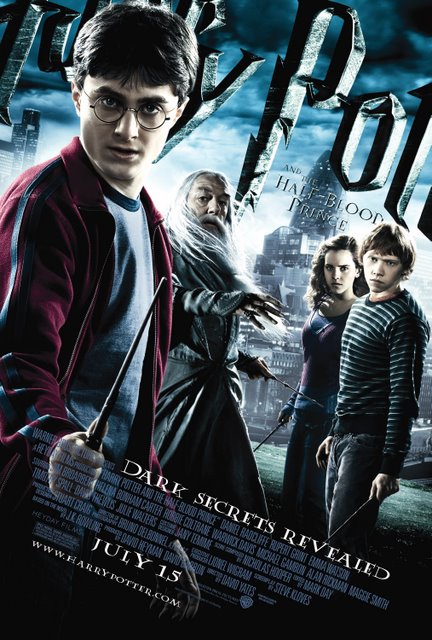
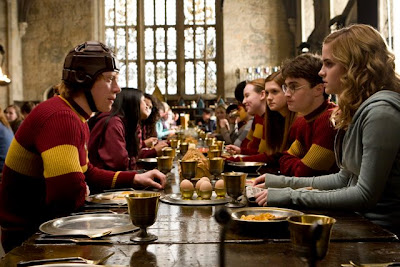
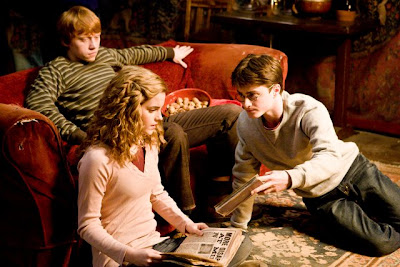
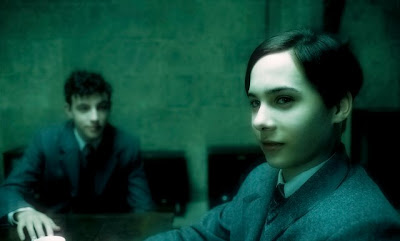
Movie Review: Harry Potter and the Half-Blood Prince (2009)


Official Shop of Warner Bros

Get Caught Up With the Movies


For Potter-- Reading is FUNdamental
Share J.K. Rowling's Series


Read Jen's Take on Prisoner of Azkaban


Half-Blood Prince
Photo Slideshow


Delicious
Bookmark this on Delicious
submit to reddit
Print Page

Digg!

MovieBlips: vote it up!

For the non-readers, the excitement of the next cinematic Harry Potter installment has always been in the steady development of experiencing J.K. Rowling's mythology unfold on the big screen. And as such the films have served as a sort of conveniently abridged version of the works for those either too busy, not quite interested enough, or just seeking a perfunctory knowledge of the world of Hogwarts to fake their way through office conversation.


Yet this is a series that at its heart seems to celebrate its readers the most given its painstaking adaptations and the evidence of this is sometimes its downfall via the detriment of the yawn-inducing screenplays-- as each and every important building block has been included throughout the movies. And in doing so, the directors and strategies have changed throughout which has not only been a brilliant tool in tapping into the short attention spans of the youngest audience members but also ensuring that there isn't only one vision for the Harry Potter universe that's being presented on the screen since the boy who lived in the cupboard under the stairs belongs to everyone who carries him around in their bag.

Moreover, despite his great beginning-- thankfully we've come a long way from the extraordinarily dull first film from one of the great filmmakers of my youth-- Mr. Chris Columbus-- which was surpassed by his own second movie (although book-wise for Rowling number two had been a literary step backward) before Alfonso Cuaron released the masterful Harry Potter and the Prisoner of Azkaban which was and remains the crowning achievement of the works so far.


Essentially, while aside from one exception with Wonder Boys scripter Steve Kloves wielding the pen for all of the transitions from books to movies-- for viewers who know the source material before going in-- the main attraction is from the visual point-of-view and the way in which this franchise has managed never to grow stale is by constantly bringing in a revolving door of new directors, cinematographers, and editors and endless behind-the-scenes talent to switch up the look.


Some of the experimentation offered up has been ghastly in my opinion such as in Mike Newell's The Goblet of Fire wherein every cast member and camera lens looked like it had been dragged through the mud (purposely according to the director's desire for grubbiness) before he yelled “action.”

In terms of script, direction, cinematography, editing, and overall execution,
the most successful adaptation all-around is still Azkaban as that final "Time-Turner "sequence has yet to be topped and Hermione was given her due for the first time in the series. And although I'd cite the first and fourth film as the weakest entries-- despite Newell's success in Harry's terrifying and violent showdown with Voldemort when death hits Hogwarts-- the one recurring complaint aside from the predictable format of "the end of summer break to end of school year standard structure" is the sheer length of the films themselves. Still, I'd like to throw one more problem into the pile-- namely Rowling's over-reliance on the “overhear” device which made more sense when the kids were younger since eavesdropping was conceivably the most reliable way for the trio to acquire information... but more on that later on.


And dropping extraneous details-- to the chagrin of some die hard fans-- Girl in the
Café director David Yates (who had cited Cuaron's work as his own personal favorite) moved the series back in the right direction with the much faster paced fifth film which found Harry developing his own army on behalf of Dumbledore which leads to a devastating conclusion as his godfather Sirius Black is murdered before his eyes.


After being asked to return to helm the rest of the series including the final book which will be broken into two films--(although I'm not sure if that's wise and wonder if perhaps blending books six and seven into two films may have led to a stronger narrative)-- Yates reveals supreme confidence right from the start with a bravura opener unlike anything we've seen before in Harry Potter that's sure to dazzle in 3D despite my admitted weariness of the format. In doing so he offers audiences an entirely new visual look by bringing aboard Jeunet's Amelie cinematographer Bruno Delbonnel that adds a striking color palette and style to the work especially in tandem with veteran Potter editor Mark Day. And some of the sequences in this-- the sixth Potter film to hit the screen-- are so breathtakingly gorgeous that they rival Azkaban on sheer beauty alone.


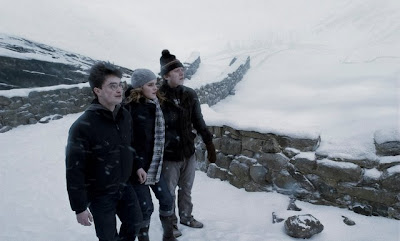
Whether Delbonnel employs old-fashioned trickery to move easily into flashbacks from water drops in a cauldron into the past with a soft focus or words on a page that evolve from ink and font into kids walking in the snow-- it's always dazzling and just flows so well that an argument can be made for Delbonnel to receive a cinematography nomination for his mind-blowing work.


And it's a great thing too because while the film is sumptuous-- readers of Half-Blood Prince go into the theatre keenly aware that it's a very introspective, flashback heavy, chatty (a.k.a. not exactly action packed entry) which is designed to push everything in the right direction towards an unsettling “throw the uninitiated off a narrative cliff” ending as one main character is murdered and another we've been on the fence about is the one wielding the wand, thereby effectively leaving those breathlessly anticipating what's to happen next.


As a film, it's still quite good--if a bit too long again-- and filled with Rowling's structural Achilles heel as the trio and especially Harry this time-- since Ron and Hermione are busy obsessing over which one the other one is “snogging” (the Brit slang for kissing)-- are seen more than half a dozen times at least eavesdropping or listening in on conversations as if Rowling forgot that there were other ways Nancy Drew, Miss Marple, or any number of detectives could find clues.


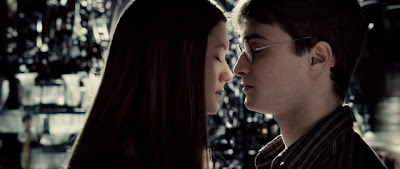
Since the cast is getting older-- they're predictably more caught up with their raging hormones. To this end, Harry starts to return Ginny's previously unrequited affection only to realize that she'd moved on to the athletic Quidditch player Dean Thomas whereas Ron has caught the eye of a stereotypically clingy girly-girl named Lavender much to Hermione's wrath that he hasn't realized that girls with the ability to carry on a conversation are much more interesting than those who snog so much that poor Ron is going to have the market cornered on chapstick.


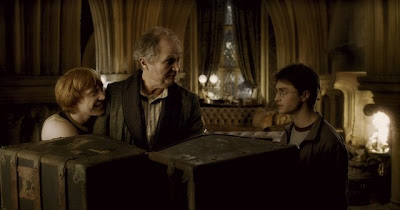
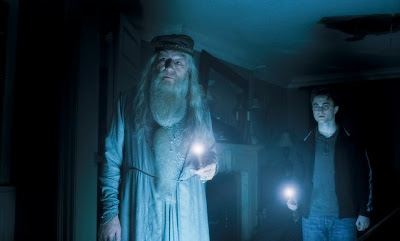
Yet, it's not all "The Young and the Hogwarts"-- as The Death Eaters have stepped up their fight on behalf of the Dark Lord and we learn early on that not only is Draco Malfoy to be an important player but that Alan Rickman's Severus Snape has promised Helena Bonham Carter's Bellatrix Lestrange to step in if he's unable to fulfill his duty. Likewise, Michael Gambon's Dumbledore has been turning Harry into a double agent to get close to one of Tom Riddle's old teachers-- Horace Slughorn (Jim Broadbent).


And despite the tradition that the final showdown is always the most exciting-- honestly the one captured in Half-Blood Prince isn't quite as memorable as some of the ones which have come before it. One of the reasons for this could most likely be because the events leading up to the big murder were executed with such overt Christian symbolism like we were watching a Charlton Heston movie to the point that afterward others including myself wondered when it suddenly became The Ten Commandments thereby in making these choices, it pulled viewers out of Harry Potter suspension-of-disbelief and into post-modern, pop-culture referential mode.


Additionally, in the book although Harry was outnumbered and out-wanded to help prevent a beloved friend from death, there was much more to the scene than having him stand there like yet another "overhear" in an anti-climactic fashion.


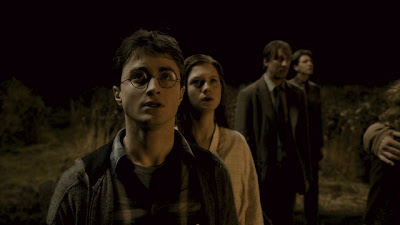
Despite this, there is one amazing sequence that keeps you in check within the film that I don't remember-- at least to this extent-- in the novel which takes place at Christmas at the Weasley household when Bellatrix Lestrange shows up and a huge chase through the cornfield ensues as though we were in a vintage horror movie classic.


Furthermore it's surprises like these-- unexpected, away from Hogwarts, brilliantly lensed and pieced together in the most dynamic way that heightens the tension which brilliantly keepsus watching even when we're left realizing that this time around, Ron and Hermione have very little to do (with the former given hardly anything save for the obligatory comic relief scene). And likewise the filmmakers will definitely have their work cut out for them in making us buy into the Harry and Ginny relationship
in Deathly Hallows since the ultimate few second "snog" looked about as passionate as a walk to Hagrid's hut.


And in the end, for the readers who've been joyfully treated with
Delbonnel's beautiful lensing, you'll find yourself growing excited and anxious for the plot division of the next book since obviously the big revelation that sets up the final quest for the end of the series is revealed in this title. Yet this one may be rough going for the non-readers given the lack of action in comparison to the rest. However, for the patient viewers who manage to watch all the way through-- the best achievement of the picture's final sequence (and indeed the film itself) is that the murder and perpetrator are so startling that you may find yourself going over to the bookstore to grab Hallows just to see what happens next.


Text ©2009, Film Intuition, LLC; All Rights Reserved. http://www.filmintuition.com

Unauthorized Reproduction or Publication Elsewhere is Strictly Prohibited.

8/01/2008

Brideshead Revisited (2008)


Director:
Julian Jarrold

As much pressure as there is when making a period film to keep contemporary viewers interested, extra hurdles are added when the period film is based on one of the most critically acclaimed books of the twentieth century. And the anxiety doubles when it was also adapted into what most devotees assumed was the definitive take on the source material in a wildly popular, classic twelve-hour British miniseries. In taking on Brideshead Revisited, instantly one runs the risk of being labeled a copycat as well as going against conventional wisdom of “if it ain’t broke, don’t fix it,” but by employing celebrated, award-winning screenwriters Andrew Davies (Mr. Adaptation himself having penned updated versions of some of literature’s most beloved works) and Last King of Scotland scribe Jeremy Brock, the filmmakers hoped to tackle that problem head on. However, in telling the story of the poor underdog Charles Ryder (Match Point’s Matthew Goode) who gets tangled up in the lives and loves of the wealthy but ill-fated Sebastian Marchmain (Ben Whishaw) and his headstrong sister Julia (Hayley Atwell), the results are mostly mixed.

Sumptuously photographed and with amazing attention to detail, including filming in Yorkshire’s awe-inspiring tourist attraction, the Castle Howard which had first doubled for the Marchmain’s home Brideshead in the prior television adaptation, Becoming Jane director Julian Jarrold’s sophisticated film is sure to rake in Oscar nominations in the fields of art and costume design as well as a probable nomination for Emma Thompson as the devoutly Catholic, domineering Marchmain matriarch.

And while no doubt one has to admire the intelligence of such a gorgeous work, especially in its daring summer release opposite mindless comedies and special effects driven superhero films which will definitely come as a much needed quiet treat for film reviewers everywhere to heap praise onto the movie, I felt like it kept viewer’s emotions at an arm’s length. Never shaking the museum feel that proves so daunting for period works-- much like another critically loved classic book turned Miramax film, The Wings of the Dove, I had a hard time becoming invested in this rather icy tale. This was especially difficult when considering that—while Charles is positioned as its hero—frequently, he’s the most unlikable character onscreen and often we’re left wondering just whom is using whom when it comes to his dealings with the Marchmains. While one never has to unconditionally love a lead character, the question then becomes whether or not you feel invested in the person’s plight and with Charles, most of the time, I didn’t.

Ultimately, I felt that that while it’s a beautiful looking work bolstered by its talented cast (Whishaw, Goode, and Atwell no doubt have excellent careers ahead of them), I sensed a barrier between myself and the production, which I can only liken to flipping through a photo album with a friend who’s just returned from a trip and can’t wait to show you hundreds of their photos. While the anecdotes and visuals are amusing enough, we realize we’re missing the full effect which was no doubt best experienced by reading Evelyn Waugh’s original novel and/or in the lengthy lauded miniseries.

This being said, I applaud the bold decision to bring the homosexual and extramarital infidelity plots to light and overlap the previously three separate tales in changes that the production notes explain were approved by the Waugh foundation. However, despite a great respect for the brilliance of Davies, I couldn’t help but imagine that this Brideshead adaptation may have been best served by brining in a more contemporary styled yet equally literary and thematically similar writer in the form of The Hours scribe Michael Cunningham. In addition to The Hours along with the brilliant A Home at the End of the World and even in his unsuccessful but imaginative interpretation of the novel Evening, Cunningham routinely explores love triangles and the struggle to come of age while reconciling one’s own desires within their immediate environment and familial obligation. Thus, being that the Brideshead filmmakers made the decision to “out” Sebastian in a greater way than in previous versions as well as try to fight against the Masterpiece Theatre trappings of most period films, by bringing in someone who isn’t usually lumped together alongside the usual suspects of the highbrow British fare, they may have breathed some much needed life into a claustrophobic and slightly overly long adaptation.