Showing posts with label Jim Broadbent. Show all posts

11/26/2021

Netflix Holiday Movie Review: “A Boy Called Christmas” (2021) & “A Castle for Christmas” (2021)


The Netflix equivalent of putting up your Christmas tree and/or starting your holiday shopping the day after Thanksgiving, this year, the streaming service's version of Black Friday comes in two new high profile, high caliber Christmas movies which are scheduled to premiere on Friday, November 26.

Inspired by the question “was Father Christmas ever a boy?” which was posed by author Matt Haig's son, the first film, from “Monster House” director Gil Kenan, is a gorgeously crafted, old-fashioned fairytale adaptation of Haig's bestselling 2015 British children's book “A Boy Called Christmas.”

Tonally a cross between C.S. Lewis, Hans Christian Andersen, Charles Dickens, J.K. Rowling, and Roald Dahl in its balance of darkness, magic, heart, and light, Kenan's film begins with a framing device straight out of “The Princess Bride.”Arriving at their home late at night, a great aunt played by the irreplaceable Maggie Smith tells the tale of the brave boy we'll all eventually know as Father Christmas to her young relatives at bedtime. Next, switching to a different time and place, we move away from contemporary London as Smith's fable starts to play out before our eyes.

Still reeling from the loss of his mother, which is something shared by the characters in the modern setting as well, “Christmas” chronicles the plight of Nikolas (portrayed by top-notch relative newcomer Henry Lawfull). Fearing for the safety of the sole parent he has left (Michiel Huisman), Nikolas sets out on a perilous journey to the north to find his dad when he fails to return from his search for the village of Elfhelm in order to bring hope to us all.  


Populated by a who's who of great character actors, including Sally Hawkins, Kristen Wiig, Jim Broadbent, Toby Jones, and Stephen Merchant (priceless here as the voice of Miika the Mouse), the film looks and sounds like a dream, thanks to the effects team and production designer behind the “Paddington” movies, and a lovely score courtesy of the great Dario Marianelli. Additionally, it's fun to see the actors let loose, particularly Hawkins and Wiig who relish their Wicked Witch-like moments to eat up the screen. 

The type of film you could leave on in the background when you make cookies or put up your tree, while it's easy to lose yourself in the snowy spectacle of it all, disappointingly from a narrative standpoint, “A Boy Called Christmas” runs out of steam quickly. With episodic plot points, as the indefatigable, ever-determined, delightful Lawfull encounters one new character or problem after another in a by-the-numbers fashion, it grows increasingly repetitive as it continues on.

Although I am unfamiliar with the source material, I can't help but ask if perhaps its error might be an early “Harry Potter” franchise-style case of staying far too faithful to the book. Needless to say, of course, young fans of Haig's novel are sure to love seeing every moment come to life. For the rest of us, however, despite some beautiful revelations that come to light near the end of the movie, its muddled second act makes it feel twice as long as the first, and I think most viewers who don't know Haig's novel will grow restless as soon as the storyline begins to wander.

Still, from the jaw-dropping 4k presentation where even the opening sequence of Smith walking down a light-filled city street feels painterly (and indeed I wondered but really didn't care if it was CG), “A Boy Called Christmas” is a stellar technical achievement from these talented craftsmen, even if it doesn't fully work for me as a film overall. Not nearly as successful as “Monster House” or Kenan's wonderful adaptation of “City of Ember,” (of which I might be the only fan and still wish for a sequel), he's such a great director that regardless of the film's shortcomings, I look forward to seeing what he'll do next.

Incidentally, it turns out that looking forward is exactly what romance author Sophie Brown (Brooke Shields) realizes she needs to do at the start of director Mary Lambert's picturesque holiday romcom travelogue “A Castle for Christmas.” 

Whereas “A Boy Called Christmas” was made for the kids, “A Castle for Christmas” is Netflix's present for teens and adults. It comes in the form of a fun, fluffy, snowflake light hybrid of the kinds of seasonal romances that Lifetime and the Hallmark Channel produce with alarming frequency and the sassier UK romcoms that Hugh Grant made popular back in the '90s. 

Centered on Shields' Brown, the plot of "Castle" is incredibly straightforward.  Having killed off the romantic hero of her dozen bestselling novels after a messy divorce, Sophie Brown incurs the wrath of her heartbroken legion of fans who want their dream man back. In desperate need of a change of scenery, she journeys to Scotland to not only hide out and write the next book in her popular Emma Gale romance series but also visit the castle that her late father loved while growing up as the son of the groundskeeper there. 

Having barely arrived in her new surroundings, Sophie finds new friends quickly when she joins the knitting club in the pub of the inn where she's staying. The same dynamic we encountered in Netflix's outstanding (and much more substantive) adaptation of the acclaimed novel “The Guernsey Literary and Potato Peel Pie Society," in “Castle,” the scenes that producer-star Shields shares with her motley knitting crew are absolutely delightful.


Still, as the romance author she's portraying here knows, you can't have a love story without a male lead, and thankfully, for that we have Cary Elwes getting his scowl on as the sour, curmudgeon-like Duke of said castle, who eventually melts under Sophie's charms.

Phenomenally predictable to anyone who's ever seen a romantic comedy before, while the pair are excellent in their roles, Sheilds and Elwes' chemistry does leave a little something to be desired, although that's likely more the fault of their underdeveloped characters than the actors in question, who aren't given a whole lot with which to work.

One of those movies where the credits reveal that it was written by a committee of four different writers, it feels like certain screenwriters were hoping to emphasize the knitting club as well as develop a potential B or C romantic subplot, and others were more clearly focused on the castle angle. All in all, it's a bumpy yet nonetheless, above-average cheery holiday romance.

Featuring a welcome cameo by Drew Barrymore that bookends the film as she first appears in a slightly cringeworthy over-the-top introduction to Sophie Brown who loses it live on Barrymore's talk show (which Shields plays too broadly), Barrymore returns at the end during the final credits in a very funny two-hander between the two women.

Targeted to Gen X, it's ideally suited to those from the era who grew up watching Shields and Barrymore, were dazzled by Lambert's iconic Madonna music video “Like a Prayer,” and frightened by her adaptation of “Pet Semetary,” and fell in love with “Castle” leading man Cary Elwes in “The Princess Bride.” And indeed, Netflix is smart to aim for this demographic. 

Usually overlooked in seasonal fare that's often developed with late teens and early twenty-somethings in mind, “A Castle for Christmas” is just the pleasantly diverting, if ultimately forgettable thing to settle in with after you spend Thanksgiving in the kitchen and Black Friday setting up that tree and/or starting to shop. With so much holiday stress on the horizon, 'tis the season for snowy movies after all.

Buy Me a Coffee at ko-fi.com
Text ©2021, Film Intuition, LLC; All Rights Reservedhttps://www.filmintuition.com  Unauthorized Reproduction or Publication Elsewhere is Strictly Prohibited and in violation of the Digital Millennium Copyright Act.  Also, as an Amazon Associate, I earn from qualifying purchases made off my site through ad links. FTC Disclosure: Per standard professional practice, I may have received a review copy or screener link of this title to voluntarily decide to evaluate it for my readers, which had no impact whatsoever on whether or not it received a favorable or unfavorable critique. Cookies Notice: This site incorporates tools (including advertiser partners and widgets) that use cookies and may collect some personal information to display ads tailored to you etc. Please be advised that neither Film Intuition nor its site owner has any access to this data beyond general site statistics (geographical region etc.) as your privacy is our main concern.

12/02/2013

Short Film DVD Review: Lost and Found (2008)


Now Available to Own   


The penguin who shows up uninvited at the door of a young boy’s home in Lost and Found may not surf, sing or have dancing Happy Feet. But by the time the twenty-five minute short film is finished, Lost’s traveling penguin will have certainly managed to make viewers’ hearts beat in an utterly precious, downright magical adaptation of Oliver Jeffers’s beloved picture book.

A richly executed celebration of friendship that’s deceptively simple both in its storytelling structure and technical approach, Lost and Found may play well on a pure level to children but it’s as artful as a lost classic, drawing comparisons to Buster Keaton, Albert Lamorisse’s The Red Balloon and Mon Oncle era Jacques Tati.


Sheer animated perfection, Lost goes against the grain. Avoiding trends of wisecracking sidekicks, scatological humor, pop culture references, and dumbed down emotions in typical genre fare designed to reach those with the shortest of attention spans, Lost instead unfolds like a bedtime story beautifully told.

Read with compassionate conviction by Jim Broadbent, Lost and Found is brought vividly to life by Studio AKA with such amazing attention to detail that you can almost feel the warmth of the knit hat worn by the young hero.


Likewise, in a 2D sequence that nearly pops off-the-screen like 3D, you’ll feel the wildness of the ocean waves braved by the two in a tiny boat as the boy endeavors to return the penguin to the South Pole, only to discover that perhaps home isn’t a place but actually the feeling the two have found of friendship within one another.

Infused with obvious affection for the story they were trying to tell from all involved, this sweet, gentle hug of a movie also works as a palette cleanser for those tired of the over-used hero’s journey formula often found in contemporary animated fare.

Revolutionary in the way it cuts out gimmicks to get down to basics – having enough faith in the story it’s trying to tell to know that its themes will never go out of style or fail to translate to any culture or language – filmmaker Philip Hunt’s fearless adaptation has earned more than sixty awards from around the globe.

Having aired as a television special in the past, the short film recently released to DVD also features a behind-the-scenes documentary roughly the length of Lost that delves into the adaptation in greater detail.

Sure to appeal to viewers of all ages, Lost and Found earns its place among Pixar, Disney and Studio Ghibli classics, ultimately reminding us that although a penguin with talents to sing, dance or surf may be entertaining, in the end there’s no greater talent than being a good friend.


Text ©2013, Film Intuition, LLC; All Rights Reserved. http://www.filmintuition.com Unauthorized Reproduction or Publication Elsewhere is Strictly Prohibited and in violation of the Digital Millennium Copyright Act.  FTC Disclosure: Per standard professional practice, I may have received a review copy of this title in order to evaluate it for my readers, which had no impact whatsoever on whether or not it received a favorable or unfavorable critique.

7/15/2009

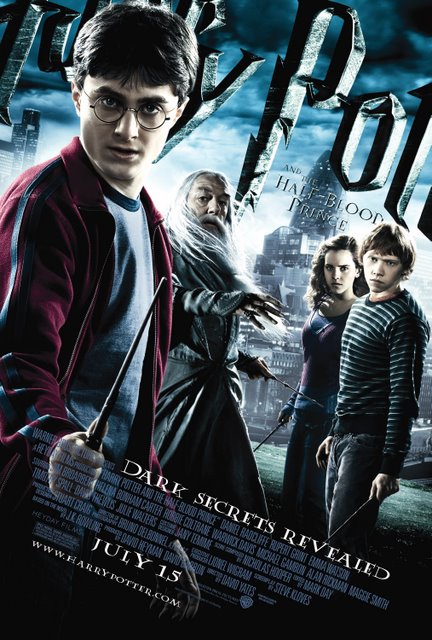
Movie Review: Harry Potter and the Half-Blood Prince (2009)


Official Shop of Warner Bros

Get Caught Up With the Movies


For Potter-- Reading is FUNdamental
Share J.K. Rowling's Series


Read Jen's Take on Prisoner of Azkaban


Half-Blood Prince
Photo Slideshow


Delicious
Bookmark this on Delicious
submit to reddit
Print Page

Digg!

MovieBlips: vote it up!

For the non-readers, the excitement of the next cinematic Harry Potter installment has always been in the steady development of experiencing J.K. Rowling's mythology unfold on the big screen. And as such the films have served as a sort of conveniently abridged version of the works for those either too busy, not quite interested enough, or just seeking a perfunctory knowledge of the world of Hogwarts to fake their way through office conversation.


Yet this is a series that at its heart seems to celebrate its readers the most given its painstaking adaptations and the evidence of this is sometimes its downfall via the detriment of the yawn-inducing screenplays-- as each and every important building block has been included throughout the movies. And in doing so, the directors and strategies have changed throughout which has not only been a brilliant tool in tapping into the short attention spans of the youngest audience members but also ensuring that there isn't only one vision for the Harry Potter universe that's being presented on the screen since the boy who lived in the cupboard under the stairs belongs to everyone who carries him around in their bag.

Moreover, despite his great beginning-- thankfully we've come a long way from the extraordinarily dull first film from one of the great filmmakers of my youth-- Mr. Chris Columbus-- which was surpassed by his own second movie (although book-wise for Rowling number two had been a literary step backward) before Alfonso Cuaron released the masterful Harry Potter and the Prisoner of Azkaban which was and remains the crowning achievement of the works so far.


Essentially, while aside from one exception with Wonder Boys scripter Steve Kloves wielding the pen for all of the transitions from books to movies-- for viewers who know the source material before going in-- the main attraction is from the visual point-of-view and the way in which this franchise has managed never to grow stale is by constantly bringing in a revolving door of new directors, cinematographers, and editors and endless behind-the-scenes talent to switch up the look.


Some of the experimentation offered up has been ghastly in my opinion such as in Mike Newell's The Goblet of Fire wherein every cast member and camera lens looked like it had been dragged through the mud (purposely according to the director's desire for grubbiness) before he yelled “action.”

In terms of script, direction, cinematography, editing, and overall execution,
the most successful adaptation all-around is still Azkaban as that final "Time-Turner "sequence has yet to be topped and Hermione was given her due for the first time in the series. And although I'd cite the first and fourth film as the weakest entries-- despite Newell's success in Harry's terrifying and violent showdown with Voldemort when death hits Hogwarts-- the one recurring complaint aside from the predictable format of "the end of summer break to end of school year standard structure" is the sheer length of the films themselves. Still, I'd like to throw one more problem into the pile-- namely Rowling's over-reliance on the “overhear” device which made more sense when the kids were younger since eavesdropping was conceivably the most reliable way for the trio to acquire information... but more on that later on.


And dropping extraneous details-- to the chagrin of some die hard fans-- Girl in the
Café director David Yates (who had cited Cuaron's work as his own personal favorite) moved the series back in the right direction with the much faster paced fifth film which found Harry developing his own army on behalf of Dumbledore which leads to a devastating conclusion as his godfather Sirius Black is murdered before his eyes.


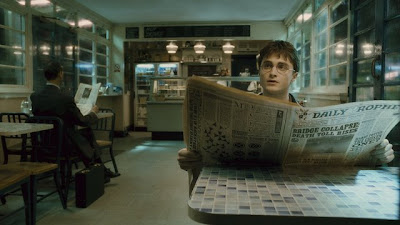
After being asked to return to helm the rest of the series including the final book which will be broken into two films--(although I'm not sure if that's wise and wonder if perhaps blending books six and seven into two films may have led to a stronger narrative)-- Yates reveals supreme confidence right from the start with a bravura opener unlike anything we've seen before in Harry Potter that's sure to dazzle in 3D despite my admitted weariness of the format. In doing so he offers audiences an entirely new visual look by bringing aboard Jeunet's Amelie cinematographer Bruno Delbonnel that adds a striking color palette and style to the work especially in tandem with veteran Potter editor Mark Day. And some of the sequences in this-- the sixth Potter film to hit the screen-- are so breathtakingly gorgeous that they rival Azkaban on sheer beauty alone.


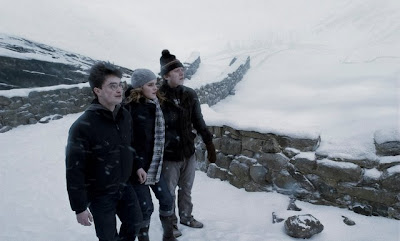
Whether Delbonnel employs old-fashioned trickery to move easily into flashbacks from water drops in a cauldron into the past with a soft focus or words on a page that evolve from ink and font into kids walking in the snow-- it's always dazzling and just flows so well that an argument can be made for Delbonnel to receive a cinematography nomination for his mind-blowing work.


And it's a great thing too because while the film is sumptuous-- readers of Half-Blood Prince go into the theatre keenly aware that it's a very introspective, flashback heavy, chatty (a.k.a. not exactly action packed entry) which is designed to push everything in the right direction towards an unsettling “throw the uninitiated off a narrative cliff” ending as one main character is murdered and another we've been on the fence about is the one wielding the wand, thereby effectively leaving those breathlessly anticipating what's to happen next.


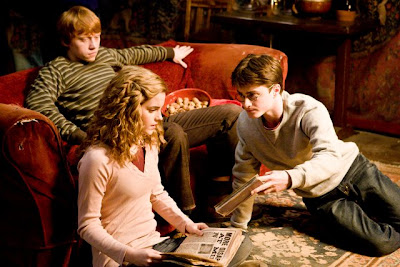
As a film, it's still quite good--if a bit too long again-- and filled with Rowling's structural Achilles heel as the trio and especially Harry this time-- since Ron and Hermione are busy obsessing over which one the other one is “snogging” (the Brit slang for kissing)-- are seen more than half a dozen times at least eavesdropping or listening in on conversations as if Rowling forgot that there were other ways Nancy Drew, Miss Marple, or any number of detectives could find clues.


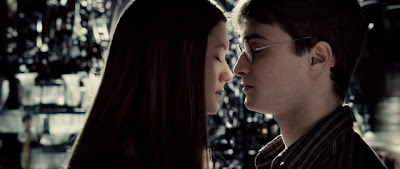
Since the cast is getting older-- they're predictably more caught up with their raging hormones. To this end, Harry starts to return Ginny's previously unrequited affection only to realize that she'd moved on to the athletic Quidditch player Dean Thomas whereas Ron has caught the eye of a stereotypically clingy girly-girl named Lavender much to Hermione's wrath that he hasn't realized that girls with the ability to carry on a conversation are much more interesting than those who snog so much that poor Ron is going to have the market cornered on chapstick.


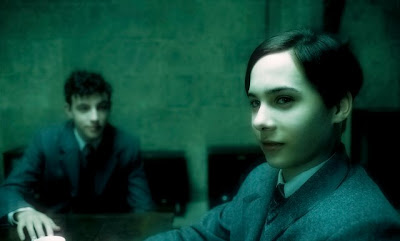
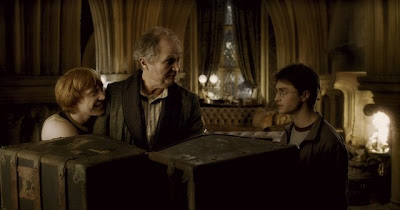
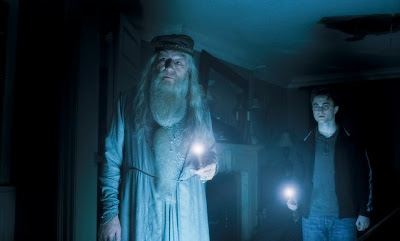
Yet, it's not all "The Young and the Hogwarts"-- as The Death Eaters have stepped up their fight on behalf of the Dark Lord and we learn early on that not only is Draco Malfoy to be an important player but that Alan Rickman's Severus Snape has promised Helena Bonham Carter's Bellatrix Lestrange to step in if he's unable to fulfill his duty. Likewise, Michael Gambon's Dumbledore has been turning Harry into a double agent to get close to one of Tom Riddle's old teachers-- Horace Slughorn (Jim Broadbent).


And despite the tradition that the final showdown is always the most exciting-- honestly the one captured in Half-Blood Prince isn't quite as memorable as some of the ones which have come before it. One of the reasons for this could most likely be because the events leading up to the big murder were executed with such overt Christian symbolism like we were watching a Charlton Heston movie to the point that afterward others including myself wondered when it suddenly became The Ten Commandments thereby in making these choices, it pulled viewers out of Harry Potter suspension-of-disbelief and into post-modern, pop-culture referential mode.


Additionally, in the book although Harry was outnumbered and out-wanded to help prevent a beloved friend from death, there was much more to the scene than having him stand there like yet another "overhear" in an anti-climactic fashion.


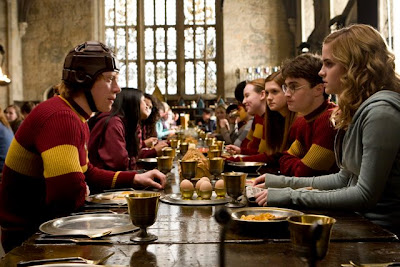
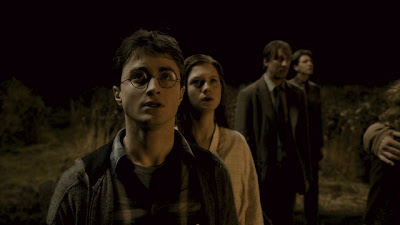
Despite this, there is one amazing sequence that keeps you in check within the film that I don't remember-- at least to this extent-- in the novel which takes place at Christmas at the Weasley household when Bellatrix Lestrange shows up and a huge chase through the cornfield ensues as though we were in a vintage horror movie classic.


Furthermore it's surprises like these-- unexpected, away from Hogwarts, brilliantly lensed and pieced together in the most dynamic way that heightens the tension which brilliantly keepsus watching even when we're left realizing that this time around, Ron and Hermione have very little to do (with the former given hardly anything save for the obligatory comic relief scene). And likewise the filmmakers will definitely have their work cut out for them in making us buy into the Harry and Ginny relationship
in Deathly Hallows since the ultimate few second "snog" looked about as passionate as a walk to Hagrid's hut.


And in the end, for the readers who've been joyfully treated with
Delbonnel's beautiful lensing, you'll find yourself growing excited and anxious for the plot division of the next book since obviously the big revelation that sets up the final quest for the end of the series is revealed in this title. Yet this one may be rough going for the non-readers given the lack of action in comparison to the rest. However, for the patient viewers who manage to watch all the way through-- the best achievement of the picture's final sequence (and indeed the film itself) is that the murder and perpetrator are so startling that you may find yourself going over to the bookstore to grab Hallows just to see what happens next.


Text ©2009, Film Intuition, LLC; All Rights Reserved. http://www.filmintuition.com

Unauthorized Reproduction or Publication Elsewhere is Strictly Prohibited.

1/23/2009

Inkheart (2009)


Now Available on DVD & Blu-ray


Digg!

Much like Robert Downey Jr. in Tropic Thunder described his role as "I'm a dude playing a dude disguised as another dude," director Iain Softley's Inkheart is a movie that plays off a book disguised as another book.

Upon its publication in 2004, bestselling author Cornelia Funke's Inkheart, spent "a total of 70 weeks on the [New York Times Bestseller] list" and was "translated into 37 languages." The first cinematic entry of her Inkwork trilogy-- Softley's film arrives in theatres today as a light snack for those awaiting the postponed release of the next installment of Harry Potter on the big screen this summer.

Originally a New Line Cinema presentation, now releasing domestically from Warner Brothers a.k.a. the same two studios responsible for both the Harry Potter and Lord of the Rings franchises, Inkheart seems like a natural fit for the production of a children's fantasy tale about characters dubbed "Silvertongues" who have the ability to bring the characters and events from the books they read aloud to life.

Obviously, the film and its original book by Cornelia Funke is meant as a celebration of children's literature, individual imagination, and the importance of parents reading books aloud to their children. However, nonetheless these valuable and worthwhile messages get a bit muddled via the contradictions of the plot which finds largely danger and unhappiness exiting the pages as characters vanish from the print and into our world in exchange for one of our own "humans" who get forced inside the binding to even out the transaction of fantasy switching into reality and vice versa.

The film begins as our hero Mortimer "Mo" Folchart (Brendan Fraser, upon whom Funke based the man) reads aloud to both his young daughter and loving wife, only to discover his cruel fate as a "Silvertongue" when his wife Resa disappears within the pages of Inkheart. Offering little in the way of an explanation as to his spouse's departure, we catch up with Mo several years later as the devoted book enthusiast and collector shares a love for the written word along with his now twelve year old daughter Meggie (Eliza Hope Bennett).

Although Meggie finds it odd that her father has never read aloud to her, she accompanies him on his continuous search for the increasingly rare and mysteriously disappearing copies of Inkheart. Fairly quickly, Mo manages to stumble on both the book and a man he'd read out of the text (played by Paul Bettany) who's as eager to get back into the pages of the book to be reunited with his wife (played by Bettany's real life love Jennifer Connelly in a brief cameo) as Mo is to return his wife to civilization.

As the men clash over the book and both try to dodge that terrifying master villain of Inkheart's book, Capricorn (Andy Serkis), Mo is grudgingly forced to bring Meggie up to speed on his perilous gift, only to discover that perhaps it's a familial trait. Eager to get Meggie away from Capricorn's clutches so that Mo can continue on his plight to bring his wife back, he journeys to bring the girl to stay with her estranged great-aunt Elinor (played by Oscar winner Helen Mirren).

Mirren, who mentioned in the production notes that she sought inspiration for the role from the "poet Edith Sitwell, who is famously quoted as saying that her hobbies were 'reading, listening to music and silence.'" An eccentric near-recluse who lives vicariously through the many collectible literary works she houses in her large estate, Mirren adds a great deal of blunt wit to the film, visibly having a ball and gleefully injecting Inkheart with some unexpected bursts of humor.

Featuring terrific cinematography and special effects which ultimately up the obvious "wow" factor of the work, sadly while it's creative and pro-literacy, its mixed message about the dangers of reading and words in general may confuse the youngest audience members who will also miss out on the many subtle literary references, textual jokes, and become frightened by some of its dark intensity.

Moreover, as the plot develops, Softley's interpretation of the novel-- penned by Pulitzer Prize winner David Lindsay-Abaire-- Inkheart evolves into an overwhelming homage to The Wizard of Oz both structurally and as one of many literary references laced throughout (and coupled with Peter Pan, Alice in Wonderland, Arabian Nights, etc.). Additionally, it feels all too familiar, borrowing elements for numerous fantasy tales including not only the aforementioned classic titles but other genre related works of the past where suddenly books, paintings, toys, and board games spring to life as in The Pagemaster, Jumanji, etc.

Therefore, in the end, it's the type of film that made me seriously wish I'd read Funke's book instead in that--as far as I can tell-- the entire "focus" has changed from the idea of the Inkheart book in the film to the grandeur of Inkheart the movie. Or to use Downey's train of thought, we're more impressed with the "dude" being played than we are by the "dude" playing him or the movie's spectacle verses the content itself.

More specifically, we aren't invested enough nor develop enough of an understanding about the "story" within the story to feel as though Mo's Inkheart was anything more than a kiddie version of a Hitchcockian MacGuffin or "sword in the stone," which kind of defeats the purpose in wanting to inspire us to get lost in books.

Perhaps the world of the Inkheart story is better explained in the novel but sadly, much like Softley's overly chilly rendition of The Wings of the Dove, it's hard to feel that moved by many of the characters who all seem a bit bland next to the special effects, aside from the refreshing change of pace for Mirren who nails the eccentric diva role perfectly.


Read the Books of Cornelia Funke


10/24/2007

Hot Fuzz

Related Review:
The World's End

Director: Edgar Wright

Bad Brits, Bad Brits, Whatcha Gonna Do?


In this inventive spoof of American buddy cop films, the Shaun of the Dead duo (Simon Pegg and Edgar Wright) reunite for Hot Fuzz bringing their distinctive blend of hyper cuts, ironic dialogue matched with contradictory images and witty banter to a film that I liked even more than their previous one.


Pegg stars as Nicholas Angell, the literal "Goody Two Shoes" London police officer (the song even plays during his introduction) whose arrest record is 400% higher than any other officer in the entire department. In the simplest terms, the prodigy with the badge is not only a criminal’s worst nightmare but that of his coworkers as well and, tired of looking like slackers, they give him a promotion and send him off to a country department in Sanford, a town with low crime but increasingly deadly accidents that Nicholas quickly believes to be foul play, making him unpopular in his new community.

Of course, this isn’t helped by the fact that on his first night there, he arrests what seems to be half the town for various offenses, only to realize that one of the men he apprehended is to be his new partner, the eager and hilarious Danny Butterman (Nick Frost), son of the Inspector who plies his partner with questions about carnage and danger.

In a humorous play on the homoerotic subtext of cop films made in the states, Butterman invites Angell in for a night of drinking together on the sofa during a cozy double feature of Point Break and Bad Boys II that seems all the more entertaining after discovering on IMDb that early drafts of Hot Fuzz had given Angell a love interest who was cut from the shooting script but lots of her original dialogue was given instead to Butterman “often without any changes.”

Featuring great bits by Martin Freeman, Bill Nighy, Steve Coogan and two nearly unrecognizable cameos by Cate Blanchett and Peter Jackson, the film also offers up two juicy roles for Timothy Dalton as a sadistic grocery store owner and Jim Broadbent as the Inspector unsure of how to deal with his new employee, other than making sure he enforces the swear box policy. A movie that, like Mike Judge’s Office Space, is sure to draw an even bigger following on DVD, Hot Fuzz is best shared with friends, especially those up on their 80’s and 90’s American cop movies.