Showing posts with label Emily Mortimer. Show all posts

7/09/2020

Movie Review: Relic (2020)


Now Playing


The decision to volunteer “x” number of hours at a location of our choosing first started out as just a mandatory part of my high school curriculum. Ignoring all of the trendy businesses that the more popular kids flocked to like birds of a feather, I opted to work at a local nursing home instead. Initially helping out during weekend bingo games and screenings of classic movies on VHS, almost as soon as I started, I was given a new task.

Told I was good at making people laugh and smile, I was instructed to visit what the home referred to as the “shut-ins,” namely, the harder cases including the shy or withdrawn individuals who seldom left their room or those who had relatives or family members who rarely stopped by. Nervously, I made the rounds, hitting it off with certain residents and discovering after a few attempts with others that some people really didn't want anything more than perhaps somebody to just watch “Wheel of Fortune” with from time to time.

The cases that broke my heart the most, though, were the ones who no longer had the mental stamina they'd previously exuded due to worsening dementia. Given a sheet with a brief one or two-sentence bio of each resident and/or their likes and dislikes as provided by their families, I'll never forget seeing one resident who'd been described as a former mathematics professor and leading figure in his field who was now suspicious anytime someone told him that it was time to leave his room for meals or recommended that he put on shoes.

A shocking revelation at fourteen, yet rather than let it deter me, I soon found myself maxing out my required volunteer hours and coming back again and again, mostly to stop and visit with one resident I was particularly close to as well as others, like this gentleman with whom I mostly sat and watched TV in silence.

And while this all took place roughly twenty-five years ago, I found myself flooded by these memories throughout the slow burn shocker “Relic,” which, although heavily influenced by Gothic and Asian psychological horror, doubles as a treatise on aging with dementia. A multi-generational Australian family saga anchored by three powerful women, the feature filmmaking debut from writer-director Natalie Erika James – who wrote the film alongside Christian White – centers on an Edna (Robyn Nevin), an elderly matriarch who suddenly vanishes without a trace.

Traveling to the family's increasingly decrepit country estate, which, in a film that's loaded with symbolism is degrading the exact same way that Edna's mental capacity seems to be, Edna's adult daughter Kay (Emily Mortimer) arrives with her adult daughter Sam (Bella Heathcote) in tow.

After reporting her mother missing to the local authorities, Kay is shocked when Edna returns – reappearing just as enigmatically out of the blue as she'd somehow left. Riddled with dementia, which becomes obvious when the women take inventory of the state of her home and see signs of a forgetful or overwhelmed mind everywhere, Edna is disinterested or evasive regarding all questions about what happened or where she's been.

Differing on what to do now that they're faced with the fact that she can't live alone, while Kay looks into senior care, the excited Sam begins toying with the idea of living with her grandmother so that she can look after her. However, both women are in for a rude wake-up call when Edna's aberrant behavior begins to escalate into violence. Soon, they begin to question just what it is that has taken over the family matriarch and whether that thing is dementia after all or perhaps something far more devious and evil.

An ambitious, largely successful work that features a dynamic turn by the always empathetic Emily Mortimer (who's long been one of my favorite actresses), “Relic” loses a bit of its novelty when, instead of ambiguity, it pays off far too literally with regard to its demonic symbolism in the film's shocking conclusion.

Still, overall, the film is reminiscent of another strong female written and directed work of Australian horror in the form of 2014's “The Babadook,” which used similarly supernatural, haunted elements to deal with questions of grief.

A somber family drama about aging and the way that parents and children's roles change over time before it eventually eases into genre territory, “Relic” might stand on its own as a feminist work of horror in that the three actresses at the heart of the film drive the narrative forward, but its themes are universally relatable.

Body horror that is as alarming as it is tragic, “Relic” calls up all sorts of memories, guilt, and fears in us concerning the seniors we've known over the years whom, as James notes in her director's statement, we've had to grieve for while still alive. An emotionally disturbing film that is bound to resonate with some viewers more than others, while on the one hand I was completely terrified and caught up in the proceedings, at the same time, I do have mixed feelings about its morality in turning a beloved relative into a vehicle of full-fledged horror.


Perhaps trying to temper that with a more sensitive yet deeply unsettling ending that I appreciate even though it didn't quite work for me, “Relic” is a thinking person's horror tale that will undoubtedly play very differently to each viewer given their experiences. It's a truism befitting of all art, of course. Yet in my case, this flawed yet undoubtedly mesmerizing, finely crafted horror tale from Oz immediately took me back to 1995 when I walked around a nursing home with a list, hoping to see some semblance of the people described on a sheet of paper in those before me just looking for someone to sit alongside them and watch TV.

Text ©2020, Film Intuition, LLC; All Rights Reservedhttps://www.filmintuition.com  Unauthorized Reproduction or Publication Elsewhere is Strictly Prohibited and in violation of the Digital Millennium Copyright Act.  Also, as an Amazon Associate, I earn from qualifying purchases made off my site through ad links. FTC Disclosure: Per standard professional practice, I may have received a review copy or screener link of this title to voluntarily decide to evaluate it for my readers, which had no impact whatsoever on whether or not it received a favorable or unfavorable critique. Cookies Notice: This site incorporates tools (including advertiser partners and widgets) that use cookies and may collect some personal information to display ads tailored to you etc. Please be advised that neither Film Intuition nor its site owner has any access to this data beyond general site statistics (geographical region etc.) as your privacy is our main concern.

8/30/2018

Movie Review: The Bookshop (2017)


Now Playing


Bookmark and Share

Fans of Lasse Hallstrom's Chocolat should flock to Spanish writer/director Isabel Coixet's lovely adaptation of Penelope Fitzgerald's novel The Bookshop, which was shortlisted for the Booker Prize in 1978 (and which the author won the next year for Offshore).

Set in a coastal East England village in 1959, The Bookshop centers on Emily Mortimer's headstrong bibliophile Florence Green who – just like Penelope Fitzgerald and the underrated Coixet for that matter – is a passionate woman ahead of her time.


Determined to open a bookshop in the village's historic Old House to not only honor her late husband (who loved to read as much as he loved her) but also follow through on a dream she'd had since she learned the trade as a girl, as the film begins, Florence puts her plan in motion.

With her banker and solicitor dragging their heels, Florence butts heads with the community's old guard, especially the village's wealthy Queen bee Violet Gamart (played by Coixet's Elegy and Learning to Drive star Patricia Clarkson). Violet, we discover, aspires to turn the Old House into an arts center.


On the surface two like-minded proponents of arts and culture, it isn't hard to imagine that under different circumstances Violet and Florence might've been friends. However, in a subtle commentary on the way that women in a male dominated society are forced to compete with one another and doubly so with the added prejudices of class and status, as soon as she senses that Florence won't bend to her will, Violet vows to block her at every turn.

Refusing to budge, the fiercely patient Florence instead uses Violet's threats to derail her as the fuel she needs to drive home her goal. Settling into the Old House, our unflappable heroine soon gains both a new assistant in hardworking schoolgirl Christine (Honor Kneafsey) as well as a loyal customer in the form of the town's much gossiped about bookworm and hermit, Edmund Brundish (Bill Nighy), who places orders with Florence by way of written correspondence.


With their burgeoning relationship strengthened by the building blocks of shared experience and taste, Florence finds an unlikely ally in the reserved man, eventually asking him if he believes in Vladimir Nabokov's newly published Lolita as much as she does to purchase a large quantity of stock for the shop.

Making the most of Nighy's deadpan delivery to drive home the meaning of a few key lines rather than employ him merely for ornamental comedic distraction, when Nighy's Brundish tells Florence he supports her plan for Lolita and adds "they won't understand it but that's for the best. Understanding makes the mind lazy," it serves once again as a nice metaphor for the town.


A beautifully understated picture with fine performances as well as painterly cinematography (by Jean-Claude Larrieu) so crisp you can almost feel the drops of water from the sea coming through the breeze in the trees, The Bookshop is a solid if at times slightly pedestrian adaptation of Fitzgerald's novel.

Yet even if the plot arc on its own is a bit static, Coixet's interpretation of it makes things exciting as you can view her Bookshop as a feminist allegory about "a woman with a vision" (as she wrote in the press notes) who must contend with pushback, obstacles, and condescension while working twice as hard to get half as far.


Additionally touching on issues of censorship while of course, celebrating the love of the written word – especially in print – Coixet's small film is filled with big ideas.

Stressing the importance of legacy while passing on the torch to the next generation or inspiring those her wake, just like Florence argued that nobody feels alone in a bookshop, Coixet knows everyone has a dream. And in her intelligent (if slight) feature, she and the always terrific Mortimer might just encourage you to take Florence's lead and pursue your own passion as well – Violet Gamarts be damned.


Text ©2018, Film Intuition, LLC; All Rights Reserved. http://www.filmintuition.com Unauthorized Reproduction or Publication Elsewhere is Strictly Prohibited and in violation of the Digital Millennium Copyright Act.  FTC Disclosure: Per standard professional practice, I may have received a review copy or screener link of this title in order to voluntarily decide to evaluate it for my readers, which had no impact whatsoever on whether or not it received a favorable or unfavorable critique. Cookies Notice: This site incorporates tools (including advertiser partners and widgets) that use cookies and may collect some personal information in order to display ads tailored to you etc. Please be advised that neither Film Intuition nor its site owner has any access to this data beyond general site statistics (geographical region etc.) as your privacy is our main concern.

7/03/2009

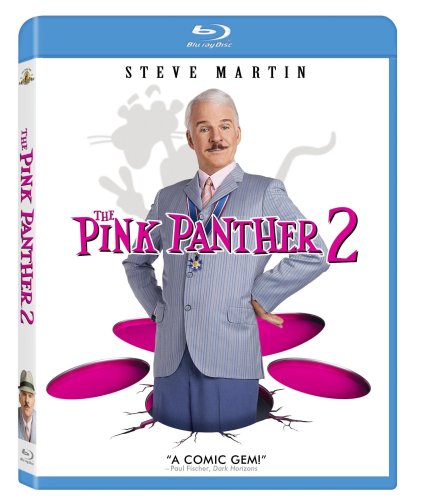
Blu-ray Review: The Pink Panther 2 (2009)


Crazy About Clouseau & The Pink Panther?


Apple iTunes


Delicious
Bookmark this on Delicious
submit to reddit
Print Page

Digg!

MovieBlips: vote it up!

As I sit down to write this I'm reminded of Jack Black's Stevie Wonder related query in High Fidelity when he ponders: "
Sub-question: is it in fact unfair to criticize a formerly great artist for his latter day sins; is it better to burn out or fade away?"


With Steve Martin... I'm not really sure what to think other than beginning to fear he's become so out of touch with reality that he's the only one who thinks these recent films he's made are funny. Furthermore, I'm struck by an even more horrifying question-- namely, for the guy who once upon a time just wanted to make us laugh--has integrity finally just vanished completely and box office greed taken over in its place?


Like the infamous "Black Sox" scandal following the 1919 World Series which found the heartbroken little boy famously asking Shoeless Joe Jackson to "say it ain't so," I'd like to give Martin the benefit of the doubt. But then again when he confesses with a straight face on the Blu-ray of Pink Panther 2 that "it turned out even better than I'd hoped for," I'm at a total loss.


Why would one of my favorite comedic idols with: a Mensa level IQ, a degree in philosophy who is also an accomplished banjo player, a quintessential "wild and crazy guy," author of the brilliantly witty Pure Drivel, and a highbrow art collector who has created and starred in some of the funniest films of our generation not only needlessly crib from the incomparable Peter Sellers? Yet he does so in taking on the genius creation of Inspector Clouseau in the Blake Edwards' Pink Panther movies for an awful 2006 remake and returning once again in 2009 for a sequel to a film that critics and audiences alike mostly couldn't stand?


While of course I've watched enough crime shows to learn that your first instinct is always the one you go with so I'm simply going to cite the money but even with that excuse I'm wondering just where exactly the films make money? It definitely isn't in the United States where Pink Panther 2 opened and closed within the span of what felt like a week following abysmal reviews so I can only guess that the press release may indeed be accurate when the first film is referred to as a "worldwide hit."

Therefore, maybe Panther is funnier in subtitles or when dubbed making Steve Martin's recent comedic phase sort of like Jerry Lewis who's worshiped in France as though he were Chanel... or maybe just like with The Da Vinci Code and Angels and Demons' popularity overseas, Europeans welcome some of the films that just don't strike a chord over here.


And international public relations is not only the key to the film as a "product" but also the bulk of its screenplay (which was given a polish by City Slickers and Fever Pitch writers Lowell Ganz and Babaloo Mandel) which was augmented by the decision to widen its net to cast the most globally diverse and popular stars as the filmmakers could find.


Not only a great marketing ploy to then drum up support in the actors' home countries but also to add to its ridiculously impressive roster of performers that gives a second meaning to the film's new group of detectives dubbed "The Dream Team." The team are hired to find the world's most treasured artifacts (including the Pink Panther diamond, the Shroud of Turin and the Magna Carta etc.) after they were all snagged by the elusive thief, The Tornado.


Although Kevin Kline-- possibly taking a cue from Bill Murray who was smart enough to jump ship and bow out of the second Charlie's Angels movie-- has left the cast, his Fish Called Wanda co-star John Cleese takes his place as Clouseau's superior. However when you take into consideration that one of his earliest big on-screen moments is literally banging his head against a wall, you wonder if deep down even John Cleese wondered just what the hell he was doing there.


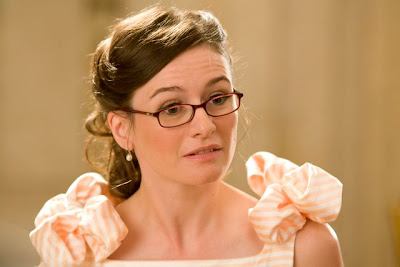
With the adorable, bookish colleague Nicole (Emily Mortimer) setting off sparks with Closeau that neither one can put into words-- their faux romantic relationship is tested as other colleagues fly in such as the drop-dead gorgeous Aishwarya Rai (Bride and Prejudice) who has an only-in-the-movies schoolgirl crush on Clouseau. Likewise, the Cuban-American Andy Garcia throws a wrench into the relationship playing a seductive Italian who decides that Nicole is just the type of woman he'd like to "make-a the babies with... lots and lots of babies... all day long with the babies."


In a great moment of in-joke humor as Martin's Clouseau refers to Garcia as Don Corleone-- I couldn't help remembering that yes, although Garcia did star in Godfather Part III, even that film was more welcome than this one because it closed the trilogy's story and had a purpose. Yet, Garcia who also starred in the Ocean's Eleven movies seems to have no problem disappearing into lackluster ensemble projects even though he deserves much better.


Rounding out the cast we find a Japanese computer expert played by Yuki Matsuzaki (thus, of course prompting Clouseau to go thirty years in the past to the previous films to call him his "little yellow friend") and the always reliable Jean Reno as Clouseau's best friend. Also signing on, Jeremy Irons arrives as a suspect (naturally) and Lily Tomlin appears as an enforcer of political correctness who we view as all too eager to reunite with her All of Me star twenty years later even in something as misguided as this film.

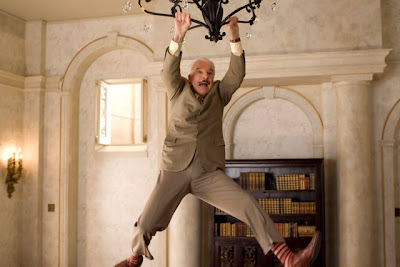
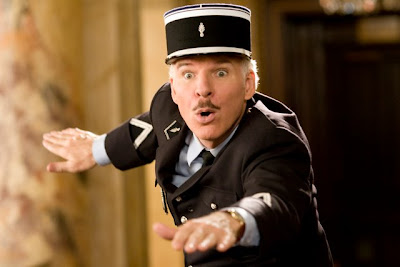
Perhaps the best addition to the group is in the form of Alfred Molina who gets the best scene as he and Martin's Clouseau try to out deduce one another by sizing each other up using their skills as inspectors in an increasingly funny intellectual showdown. However, the script pushes barbs to the background and physical humor to the foreground as mostly the wondrous cast is left with little to do other than to try to cover for the clumsy Clouseau as he falls down a chimney or off the Pope's balcony while dressed as the Pope or just react to his escalating physical gags over the course of the movie.


Slapstick and physical comedy are all ramped up to the extreme in Pink Panther 2 as we note in one of the Blu-ray's extra features when it's revealed that Martin did about eighty percent of his own stunts but there were always two doubles around for the most dangerous ones.


However, aside from the aforementioned back-and-forth one-upmanship exchange with Molina-- it's Martin's willingness to go back into his classic comedy skill arsenal and ability to juggle that helped win me over in the film's second worthwhile scene (aka the only other time I genuinely laughed aloud-- making that two chuckles in 92 minutes which was two more than in the original film).

As he and Nicole push the boundaries of their professional relationship over a romantic dinner in Rome, Clouseau decides to select the perfect bottle of wine as inevitably they come tumbling out and bottles are tossed and juggled to perfection until the restaurant goes up in flames. And it's in this scene especially where I felt that genuine credit was owed to Martin to get in there and go for the laughs with close-ups rather than sit on the side-lines and just count the money (which no doubt he did later) but two successful jokes in a film's running time is hardly a success overall.


In fact, the more enjoyable experience was definitely to be found reading the reviews of the work-- which ranged from scathing to hilarious. Peter Hartlaub of the San Francisco Chronicle had the best opener yet when he wrote, "One can only hope that something good is coming from all the bad movies that Steve Martin has been appearing in. I keep waiting for Martin, Robin Williams and Ice Cube to announce that they've used all the proceeds from their unfunny comedies to cure cancer."

While I would also add Martin's Bowfinger star Eddie Murphy and The Love Guru's Mike Myers to that list of comedy offenders, Hartlaub has a point regarding all the wasted money, wasted resources, and wasted talent. And replacing the second walk-out in the form of the 2006 director Shawn Levy (who's since moved onto helming the financially lucrative Night at the Museum franchise with Ben Stiller), Netherlands native Harald Zwart's decision to make the jokes bigger and faster in the second one helped ensure that it was more cartoonish and kid friendly than the first. It's most likely a skill he acquired directing Agent Cody Banks before moving onto (sigh) the needless remake of Karate Kid called Kung Fu Kid slated for 2010.


While per usual for the exceptional quality of Fox Blu-ray discs-- once again the wizards working in their technical department manage to make this one sound theatre-level and sparkle in clarity as much as the famous diamond and the breathtaking Aishwarya Rai. And given the extra features, we're able to see at least how much work went into the film and appreciate it on that level. Although in certain behind-the-scenes inclusions including the gag reel which-- despite being mostly unfunny-- did result in three laughs from me as opposed to the film's two, making me sadly note that like Garcia's Ocean's movies, the Panther works are only fun if you're on the set and not if you're at home viewing them.


Luckily, Fox knew that this time-- given the poor product-- they'd have to do more than just deliver another breathtaking transfer so in addition to a digital copy file, there's a third disc in the set that boasts 27 classic Pink Panther MGM cartoons including the Oscar winning Animated short "The Pink Phink" which-- clocking in at nearly three hours-- are infinitely more enjoyable than Pink Panther 2, the feature.


Text ©2009, Film Intuition, LLC; All Rights Reserved. http://www.filmintuition.com

Unauthorized Reproduction or Publication Elsewhere is Strictly Prohibited.

11/03/2008

New on DVD for the Week of 11/2/08

DVD Pick of the Week:
Transsiberian


Digg!

Click on the Title to Read the Review:


Browse All of This Week's
New Releases Below
:
Available to Own from Amazon.Com

11/01/2008

Transsiberian (2008)


When we are young, one of the earliest pieces of advice we’re most often given is, “don’t talk to strangers.” Of course, an optimistic response could be that everyone is a stranger until they become your friend but obviously this would most likely be offered by folks who haven’t spent a whole lot of time in the company of Alfred Hitchcock movies. No, as those of us —such as Transsiberian director and master-of-suspense fan Brad Anderson would tell you — beware the lure of a beguiling stranger whose smile and ease seems a bit too rehearsed, especially when you’re traveling abroad.
Whether it’s when we’re away at college and trying to avoid the dreaded freshman ten or traveling on our own, the tendency is to gravitate towards others to feel less alone. Of course, when doing so, we seldom realize that we’re not being quite as choosy as we may be in familiar surroundings, instead becoming fast acquaintances with others that we may have avoided in "real life."
This is especially the case for the cheerfully and aggressively friendly American hardware-store owner and train-enthusiast Roy, played by Woody Harrelson in Anderson’s brilliant new film. Returning from a church mission trip from Beijing, China to Moscow by way of the Trans-Siberian Express train, Roy and his quieter, more streetwise photographer wife Jessie (Emily Mortimer) find themselves startled into the forced, awkward intimacy of sharing a jam-packed compartment with two total strangers.

The handsome Latin American Carolos (Eduardo Noriega) and his much younger girlfriend Abby (Kate Mara) seem on surface level to be the polar opposite of our Iowan, straight-laced leads until secrets come tumbling out, revealing that Jessie has quite a checkered past. Yet as she warns her husband in a brilliant Tennessee Williams quote, if “you kill off all my demons, Roy... my angels might die too,” and the group becomes an unlikely foursome in as Roy describes “the wild, wild east.”

However, they’re not quite sure just how wild it is until the film takes its first of several unexpected turns right around the thirty-minute mark and while the film’s trailer and numerous spoiler-filled reviews (avoid Roger Ebert’s and Stephen Holden’s until after you finish the film) have you expecting things will turn out one way, Anderson fools you again and again. Setting itself up to be a film about two Americans who mistakenly become the tourists who knew too much, to misquote a Hitchcock title, in trusting the wrong people, soon a major character is killed off in a brilliantly vicious and surprising twist of fate, another goes missing, and we’re reacquainted midway through with the man whom we see in the film’s beginning. Sir Ben Kingsley—that unrivaled master of accents and intimidation-- shows up for a mysterious turn as a Russian inspector whose alliances and true character we’re unable to predict until the film careens towards a suspenseful conclusion.

Director Brad Anderson, who co-wrote the film with Will Conroy, reveals all of the Hitchcock cards in his hand from the start — especially as he sets the unbelievably tense character-driven mystery in a film that demands they share such close proximity aboard a train. Yet I defy anyone to guess where the ultimate journey will lead them both figuratively and literally. While one can no doubt accuse me of being awfully vague, you’ll definitely thank me after viewing the film as the less one knows about its plot, the better.

Transsiberian arrives on time at your local DVD and Blu-ray retailer on November 4 from First Look Studios. While the only complaint would be that in the Russian dialogue-based scenes, the yellow subtitles are far too small, otherwise the stellar picture quality and 5.1 Dolby Digital Surround Sound was top-notch on the DVD. Featuring previews but zero extra features save for Spanish subtitles and English ones for the deaf or hearing-impaired, the film itself is the main draw.

While mood-wise it's a far cry from my favorite Anderson film—the underrated critically lauded science fiction tinged romantic comedy Happy Accidents starring Marisa Tomei and Vincent D’Onofrio—Transsiberian is much more accessible than his unflinchingly dark Christian Bale vehicle The Machinist. And moreover, Transsiberian is Anderson's best crafted work so far and one that no doubt you’ll find yourself wanting to watch more than once, if only to try and discover what clue you missed the first time around.

Definitely a train worth catching and one that—similar to Roy and Jessie—you’ll want to stay pretty much in the dark until after you take it in but it’s one of 2008’s biggest sleepers and one you’ll instantly want to recommend to others. However, it may be best if you avoid approaching strangers in the process, especially ones with way too many stamps in their passport and strange advice on not standing out in customs.

Luckily, Anderson failed to listen to his own advice—making a film that intellectually stands out head and shoulders above a large percentage of Hollywood factory-made thrillers by serving up a work so deliciously gripping and sinister that even Hitchcock would probably muster up the faintest trace of that subtle smile in appreciation.

8/19/2008

Soundtrack: Chaos Theory

Composer Gilad Benamram's Henry Mancini styled score excels at musical theory... even if ultimately the soundtrack is a bit chaotic.


Digg!

Originally Published at Blogcritics:

It’s ironic that the lyrics of The Damwells opening song “Golden Days” urge “baby, please don’t rush; keep the tempo slow” as this folksy and nostalgic, yet irresistible soft rock number stands for attributes which are the polar opposite of Chaos Theory's ead character, Frank. While actor Ryan Reynolds’ Frank is an efficiency expert who lives by catchphrases such as “a specific list is a happy list,” it’s Frank’s supportive yet justifiably exasperated wife Susan (Emily Mortimer) who seems to take The Damwells’ advice to heart.

This is especially apparent when, shortly after the film begins, in order to get her husband to slow down, Susan mistakenly changes a clock the wrong way. Thus, instead of giving him more time to relax, her thoughtful yet erroneous action throw his life off-balance and the day ends with a series of misunderstandings and chance encounters. Trainer Frank

Now with his path thrown completely out of whack, Frank embraces the idea of chaos and tells his best friend Buddy (Stuart Townsend) that he’s “decided never to decide another thing again,” and to this end, he writes down everything he’d like to do on a series of cards, choosing one at random to guide his actions, which propels the rest of the film’s plot as you can see in the trailer.

Former music video director turned feature filmmaker Marcos Siega has proven in the past that he knows the right way to incorporate music into his work and the eclectic offerings available on the soundtrack to his latest film Chaos Theory are no exception. Although he reteams with his Pretty Persuasion scorer, the talented Israeli composer Gilad Benamram for Theory’s sixteen original works which are available on the compact disc, he opens with seven pop songs sure to grab hold of the listener.


And therefore it’s no wonder that he opts to begin with the strongest track by The Damnwells, who also contribute three other songs, including the sweet, yet forgettable, “Say” and “Graceless.” However, the group’s romantic and lyrically impressive “Tonight and Forever” makes a fitting closure to the album’s vocal inclusions before listeners venture further into Benamram’s score to relish in his extraordinarily colorful and sophisticated, playful selections.

Yet, it’s The Damwells that get the biggest boost off the contemporary tracks upfront, especially as Wikipedia reported, they came into the spotlight when the now engaged Reynolds and Scarlett Johansson appeared together as a couple at one of their concerts last fall. My favorite mainstream track was the extraordinary “Be Gentle With Me,” by indie UK artists, The Boy Least Likely To (which you can hear on their MySpace Page).

Employing bells to create a deceptively precious or — to quote the title — “gentle” feel, “Be Gentle With Me,” quickly turns into an infectious, hip and danceable track sure to put a smile on one’s face. ReynoldsThe type of song that instantly calls to mind the upbeat songs chosen for iTunes and Target ads. Upon further research, I was unsurprised to discover that the song has been used in several television shows, commercials, and promotional videos for everything from One Tree Hill to Grey’s Anatomy to Juno as well as the fashion chain The Limited.

Like “Golden Days,” it’s the type of song you’ll instantly want to download, but it’s in the inventive and creatively bold arrangement that first hooks you from the start. Although I disagree with the band’s self-labeled style “country disco,” I couldn’t agree more with their Rolling Stone Magazine confession of likening their sound to what would happen “if all your childhood stuffed animals got together and started a band.”

In fact, given the enormous potential for repeat listens of “Be Gentle With Me,” it’s fairly easy to overlook the next two tracks, the faster drum based, bar band like “Calypso Slide,” by Walking Concert and the adult contemporary, easy listening feel of “You Fall Off,” by Gingersol which sort of sounded like what would have happened if the Wallflowers had had church choir training, with lyrics lamenting that they “won’t keep taking; faith you’re trading.”

composerAnd while the original, radio-friendly tracks are a bit forgettable, aside from the aforementioned standouts, Chaos Theory’s composer Gilad Benamram introduces us to his style with the mischievous, whimsical tone of his opening number “Back Door Exits.” Immediately grabbing our attention, he steps the quality up several notches, taking us on an auditory trip down memory lane by sliding right into the next three remarkable numbers “Careful Frank,” “My Wife, The Movies,” and “Five Minutes Efficiency Trainer.”

While together, they make a remarkable triple threat or — to pay homage to another 3 Togetherhockey themed track — “Streak Ice,” a hat-trick, on their own, they’re quite remarkable. Beginning with the sultry and sweeping 1960’s cocktail lounge styling of “Careful Frank,” Benamram seems to draw inspiration from the old Sinatra standard “Young At Heart,” before he builds up the anticipation with the frantic plucking of strings until other instruments join into his larger, orchestral based and jazz influenced “My Wife The Movies.”

And while, on a first listen, these pieces did sound vaguely familiar, it wasn’t until it bridged into “Five Minutes Efficiency Trainer,” that I was able to place Benamram’s most overwhelming influence to the undeniable genius of Breakfast at Tiffany’s and Pink Panther scorer Henry Mancini with Benamram’s homage to one of the greatest and most sophisticated comedic composers.

Unfortunately, these three tunes proved to be the standout, as the rest of the album all seemed to suffer the all-too-familiar fate of movie soundtracks. Specifically with clips that are far too short to seduce. Instead of reeling us in, Chaos Theory eventually flows together into amiable, unchallenging, background music which serves the feel of the movie but doesn’t provide an overly satisfying listening experience for soundtrack buyers. Although this being said, when Benamram swings, he really swings and I applaud his courage for refusing to phone in a simple, innocuous, romantic comedy score.

And those who are interested in the medium will definitely want to take note of those incredibly promising tracks, which may send you clicking over to Amazon to discover more by the composer, or at the very least — in spite of their Bart Simpson like under-achieving name — trying to track down other selections from The Boy Least Likely To. So therefore in the end, when it comes to analyzing Chaos Theory (read original movie review here), those are the boys who are most likely to succeed after all.


4/03/2008

Chaos Theory

Director: Marcos Siega

Those who enjoy boating need lifejackets the way that Type A personalities need index cards. Whether it’s making flashcards for Spanish class or jotting down notes for a speaking engagement, it’s those irreplaceable 3x5 cards that support us like a best friend. Although they come in other sizes and designs for those who, like me, function best when faced with a large array of colors to choose from, the most popular format seems to be the trusty 3x5 crisp, white, classic, lined index card used by some not only to aid them in school or work but also in life for compulsive list-makers. It’s one of these obsessive list-makers we follow around for the duration of the inventive sleeper Chaos Theory from director Marcos Siega.

Working from a script penned by Breakin’ All the Rules writer/director Daniel Taplitz, Siega introduces us to Frank (Ryan Reynolds), an efficiency expert who lives by catchphrases such as “a specific list is a happy list,” who begins each day with a unique list jotted down on (you guessed it!) 3x5 index cards. After his loving and supportive yet justifiably exasperated wife Susan (Emily Mortimer) mistakenly changes a clock the wrong way in order to get her husband to slow down, Frank finds himself struggling to catch up for the rest of the day which begins with missing the ferry and arriving seventy-five minutes late for an important speaking engagement on the now ironic topic of efficiency and time. Crazily disorganized from the start, the day ends with a series of misunderstandings and chance-encounters that throw his life off-balance after he assists a pregnant woman only to be erroneously named the father and gets kicked out of his house by Susan the following morning. When another wrench is thrown in his path to get his marriage back on track with some startling news, Frank embraces the idea of chaos and tells his best friend Buddy (Stuart Townsend) that he’s “decided never to decide another thing again,” and to this end, he writes down everything he’d like to do on a series of cards, choosing one at random to guide his actions.

While this leads to some humorous results, the story according to Siega is essentially “about love and forgiveness” and as the Warner Brothers production notes revealed, writer Taplitz was inspired to craft the screenplay after he became diagnosed with cancer. In his words, Taplitz explains, that he “was interested in writing about what someone does when they’re metaphorically pushed off a cliff both physically and emotionally—how one piece of information can potentially change their life and how they might have to reconstruct that life.”

Although Frank does end up grappling with some hard truths about identity and there’s a dark comedic edge to the film that differentiates it from its Sliding Doors like beginnings, ultimately it’s Reynolds who sells the film and keeps us invested even when it becomes a bit harder to believe as the second half of the film is a bit weaker than the first. As Colin Boyd of The Big Picture wrote in his review, “in line with the desperation of the character, Reynolds portrays a combination of frustration, confusion and desperation immediately and convincingly.”

Initially released theatrically into just two test markets including one in California and one here in Arizona which makes the film’s expansion into other states uncertain, hopefully it will get a second chance to make a first impression through its DVD release.