Showing posts with label Kevin Bacon. Show all posts

1/11/2019

Blu-ray Review: Cop Car (2015)


Now Available


Bookmark and Share

Trading curse words over rationed beef jerky, two bored runaway boys play a game of gradually escalating dares. The pre-teens get much more than they bargained for however when they apply the logic of Finder's Keepers to a seemingly abandoned squad car they've stumbled onto in the middle of a rural Colorado field shortly into this startlingly original sleeper.

Knowing that they haven't been gone long enough for somebody have called the authorities to track them down, the boys quickly move from challenging one another to touch the car to hopping inside for a joy ride.


Taking the opportunity to change the point-of-view, Cop Car helmer Jon Watts moves the narrative backwards in time. Revealing just who and what is waiting for the boys on the other side of the thin blue line, it becomes clear that our young leads have unknowingly set foot inside a real world version of cops and robbers that's far more gray than black and white.

Thin, wiry, and wide-eyed, as the conniving sheriff with his head on a swivel who's up to no good, star and producer Kevin Bacon turns in one of his creepiest villainous performances since he first blew memories of Footloose sky-high while terrorizing Meryl Streep twenty five years ago in The River Wild as a self-described "different kind of nice guy."


Cop Car is fast-paced by necessity and design. And although it's easy to get so caught up in the increasingly nerve-wracking storyline that you lose sight of the way the film sets up future twists and turns to come — most notably through inventive camera angles which call extra attention to the police cruiser's trunk — Cop hooks you from the start nonetheless.

On par with The Gift as one of 2015’s strongest independent thrillers since the previous year's Blue Ruin and Cold in July, this word-of-mouth film festival favorite serves as a vital reminder that great storytelling will always trump costly special effects.


Yet while film buffs can spot traces of Duel, Stand By Me, and Blood Simple in Cop Car's structural, spiritual, and stylistic DNA, by embracing the innocence of its characters as opposed to taking an unrealistic Kick-Ass style shortcut to let them incredulously succumb to the violence, Watts' work remains refreshingly unique.

Never straying too far from darkly realist, Neo Noir terrain, Watts and his stellar team on both sides of the screen refuse to betray their vision or let Cop Car's limited budget get in the way of the tale they’ve dreamed of telling.


Creatively firing on all cylinders while coming up with unexpected ways to bring the action to a head, similar to the way that the titular discovery surprised our talented, young leads in the first act, Cop Car is sure to sneak up on you.

A thrilling Bacon anchored vehicle that demands you buckle up tight, Cop Car is a Finder's Keeper indeed, even if, like all movies (and road trips alike), it’s best enjoyed when you bring others along for the ride.


Text ©2019, Film Intuition, LLC; All Rights Reserved. http://www.filmintuition.com Unauthorized Reproduction or Publication Elsewhere is Strictly Prohibited and in violation of the Digital Millennium Copyright Act.  FTC Disclosure: Per standard professional practice, I may have received a review copy or screener link of this title in order to voluntarily decide to evaluate it for my readers, which had no impact whatsoever on whether or not it received a favorable or unfavorable critique. Cookies Notice: This site incorporates tools (including advertiser partners and widgets) that use cookies and may collect some personal information in order to display ads tailored to you etc. Please be advised that neither Film Intuition nor its site owner has any access to this data beyond general site statistics (geographical region etc.) as your privacy is our main concern.

11/04/2015

Blu-ray Review – The Following: The Third and Final Season


Now Available to Own         

  Photo Slideshow                  


One of the most disturbing programs to ever air on American broadcast TV, from the very beginning The Following has felt less like a network crime drama than a small screen horror movie of the week.
 
Frequently defaulting to gruesome torture as opposed to just coloring a little outside the lines of the macabre to build suspense, although the show's penchant for gore and depravity was established in the show's original pilot (as a fitting ode to its Edgar Allan Poe inspired Gothic horror origins), the use of shock for shock's sake only increased with time.

Testing our patience as well as our stomachs, the Kevin Williamson created work of Seven era David Fincher style Neo-Noir still had its moments in season two.

However, much like a superstitious villain on the verge of getting caught, shortly after a genuinely surprising opening sequence of nerve-wracking episodes, the thrillingly original series began relying too heavily on the same M.O. that had initially set The Following apart early on.


And long before its cast members engaged in a 2015 web video spoofing both the show's paranoia as well as its frequent use of double agents and triple crosses (via the twists that had once floored us), The Following's overreliance on fake outs had started to grow stale to savvy viewers both on social media and at home midway through its rollercoaster second season.

Having embraced its original status as a cult favorite much too literally by doubling or – depending on your math – tripling down on the idea of killer cults, the middle installment of the largely chaotic albeit still compelling serial thriller required its audience to suspend disbelief in a greater way than ever before.


Buoyed by The Following's top notch cast however, the series has rallied along with the lead character played by Kevin Bacon who’s in a much better place literally and figuratively as its final season kicks off.

Of course, we know the tranquility won’t last long but thankfully, when the show’s trademark horror suddenly begins, this time around the writing matches the intensity of its performers including breakout star Michael Ealy who rivals James Purefoy's diabolical mastermind Joe Carroll in terms of both spine tingling moments and evil supremacy as what Joss Whedon would call this season’s “big bad.”

Making the most of the natural chemistry of its characters and character actors – namely Kevin Bacon's (anti)hero Ryan Hardy and Purefoy's aforementioned villain – The Following revisits some of the alarming themes that it had been flirting with from the very first episode, which similar to the show's fake-outs and gore have only grown more apparent over the years.


Going deeper into the existential arena of whether Hardy needs Carroll to remain the "hero," the show also starts to explore the psychological overlap between the two men who had originally been friends.

Although fascinating, this arc is pushed much too far – paying off incredulously in a handful of episodes that threaten to "jump the shark" with regard to The Following as Ryan Hardy goes completely off the rails. Still, thankfully knowing they needed to wrap things up in time for the conclusion, Williamson and company right this ship before long.

Aspiring to deliver something structurally and stylistically commensurate to the incredibly complex, corkscrew-like twists and turns of the vastly superior, intellectually demanding first season, fortunately for viewers, the storyline is much more focused in this, the show’s final outing.

While it still falls prey to contrivances and repetition as the final fifteen episodes make their way to the finish line, to The Following's immense credit, season three wastes no time trying to recapture the same tangible electric shock that made the hairs on the backs of our necks stand up during its critically acclaimed premiere year.

While truncated seasons also mean that a few characters are shortchanged – similar to ABC’s suspenseful soap How to Get Away With Murder, The Following is proof that TV is largely better served with quality versus quantity network orders of ten to fifteen episodes where creativity reigns supreme and filler is left on the sidelines as it is on cable channels.


Much like 24 which had served as a main source of inspiration for Bacon’s dark hero, a few plot strands are left dangling in the end, perhaps in the hope of a last minute renewal or even a standalone feature-length follow-up on any number of channels or platforms that might continue Ryan Hardy's plight to take out the serial killers that walk among us.

Nonetheless, thanks to a return to taut, twisty character-driven storytelling (versus big picture cult-minded gimmickry) as well as a firmer grasp on the type of paradigms that serve the show best, the third season of The Following serves as a worthwhile final chapter to Fox's forty-five episode daring Gothic horror series.


Bookmark and Share

Text ©2015, Film Intuition, LLC; All Rights Reserved. http://www.filmintuition.com Unauthorized Reproduction or Publication Elsewhere is Strictly Prohibited and in violation of the Digital Millennium Copyright Act.  FTC Disclosure: Per standard professional practice, I may have received a review copy of this title in order to voluntarily decide to evaluate it for my readers, which had no impact whatsoever on whether or not it received a favorable or unfavorable critique.

1/10/2014

TV on Blu-ray: The Following - The Complete First Season (2012-2013) [BD/DVD/Ultraviolet Combo Pack]


Now Available to Own   


Photo Slideshow 


Bookmark and Share

While the events of childhood are often mined by writers, little did the parents of screenwriter Kevin Williamson realize just how meaningful a simply family trip to Richmond, Virginia’s Edgar Allan Poe Museum would be in helping to shape one of the writer’s most acclaimed and popular works.

For not only did the haunting images of “The Raven” scribbled on the walls in such a way that you must read your way from room to room strike the author as a young man as “the coolest thing [he’d] ever seen,” but it stayed with him all the way up through adulthood where it would go on to inspire the intelligently riveting as well as horrifyingly visceral world of TV’s The Following.

From a visual standpoint, obviously this image influenced one of the show’s creepiest yet most memorable set pieces wherein the cult of likeminded murderers following the charismatic Poe scholar – professor turned slayer of coeds Joe Carroll (played by James Purefoy) – would pledge their own unique allegiance to the Poe themed madness by writing all over the walls of their secret hideaway.

Yet at the same time, this particular family vacation would likewise go on to inspire the series right from its inception as a contemporary gothic work of romanticism infused horror.


Originally crafted as a feature film screenplay which centered on the role of Carroll as the sole slayer of students (in a much more straightforward spin on Hollywood suspense) – Williamson wisely let his intuition and dissatisfaction with the work inform his decision to set the script aside until he could better decide how to build a much stronger storyline.

Opting to venture into the same given genre with his smash successful satirical horror movie breakthrough Scream, it wasn’t until more than a decade had gone by that Williamson tackled his Poe themed project once again.

Though the decision to write for television and give Carroll a cult certainly opened the work up from a writerly standpoint, personally I think The Following's success hinged on Williamson's decision to stay true to his roots. For perhaps the project's biggest creative breakthrough was in Williamson's decision to treat the audience with the same respect he’d always shown them in the past by making us feel like we’re in on the joke while playing us like a fiddle at the exact same time.


Choosing to deconstruct the very art of storytelling in a way that was similar to his Scream approach, in The Following Williamson harked back to his literary beginnings – breaking down the building blocks of the horror genre by simultaneously poking fun and relishing in the conventions of the very same horror paradigm he was utilizing in a way that made the work come alive.

Postmodern gothic horror that’s at once as terrifying to watch as it is intellectually thrilling to dissect – it’s no wonder that Williamson opted to put a professor at the center of the storyline as it’s a role with which he no doubt identifies – educating us about the art of fiction while using the art of fiction like a magic act over the course of The Following’s masterful fifteen episode first season run.

Showing us the same respect he’d show a tenured Ivy League professor, Williamson allows his characters to address one another using the elements of fiction or more accurately the plot points that comprise of Joseph Campbell like mythic journey by name, delivering a brilliant, shocking, yet undeniably sophisticated spin on traditional television procedurals.


With the villainous Carroll baiting Kevin Bacon’s retired-before-his-prime, functioning alcoholic former FBI Agent Ryan Hardy for a sequel to the true crime book that Hardy had written the first time after he’d stopped the killer -- Carroll challenges him with a second chance at being a hero with an inciting incident and other narrative elements to tempt him back on the case.

Using the clichéd elements so often employed in these types of TV series – from the burned out lawman called back for one last job and a charismatic serial killer on par with Anthony Hopkins in Silence of the Lambs -- as traditional building blocks, Williamson tricks us by using them in nontraditional ways, alternately shocking and awing us with each one of the fifteen mini-movie like installments.

Doing the cat-and-mouse procedural plotline one better, Williamson throws us for an undeniably creepy (if admittedly slightly far-fetched loop) upon Hardy’s realization that he’s dealing with not only with the sociopathic Carroll but with his legion of cult-like murderous followers that come out of the woodwork when you least expect it.

Often former students who’ve fallen under Carroll’s spell as “audience members” to his genius, there’s a chilling undercurrent that runs through The Following about unchecked adoration and hero worship (and indeed the relationship between “artist” and “audience” running through Williamson’s oeuvre) that’s just begging to be explored in an graduate thesis.

And while falling for the overall “hook” requires a certain amount of suspension of disbelief as a Poe cult is a bit harder to buy into than say the horror movie addicts turned murderers who terrorized Neve Campbell’s brainy, battle-scarred highschooler in Scream, if you meet the premise halfway, you’re in for one insanely loopy, undeniably addictive treat that only gets better as it goes along.


Likewise, because it’s played straight instead of satirically, each life or death moment faced by our characters becomes that much more suspenseful as Hardy finds himself overwhelmed and outnumbered by the sudden villainy of otherwise ordinary people who work as doctors, nannies or police officers who are all more than willing to kill or be killed for Carroll.

Pitched to Fox out of respect for the network that produced Williamson’s all-time favorite show 24, The Following uses one of 24’s greatest attributes in a way that instantly elevates the show by presenting us with a passionate yet similarly flawed hero who serves as the anchor of the action and Kevin Bacon plays his character with everything he’s got.

Furthermore, knowing that a hero is only as strong as his nemesis, James Purefoy matches Bacon’s intensity note for note, with eerie charisma that ratchets the tension off-the-charts whenever the two share the same scene.

In fact, watching them volley back and forth is not only a master class in character acting but the deeply felt histories evidenced in the weight of their words in their first scene together in the show’s pilot completely sells you on the reality of the two in their roles.


Not only mentally frazzled, Hardy is saddled with a real-life battle scar from his last encounter with Carroll as well as shortly into the series we discover the professor had nearly cut out his “Tell-Tale Heart” which is the reason Hardy was forced to leave the FBI.

And Hardy’s weakened heart remains a ticking time bomb in not only his physical pursuit of the man’s followers but a painful reminder of the heartbreak endured by our lead regarding the only woman the two men have ever really loved – Carroll’s ex-wife turned Hardy’s ex-girlfriend Claire (Natalie Zea).

Completely spellbinding, the series is elevated by its superlative supporting cast including actress Annie Parisse’s fascinating turn as a special agent whose unique background growing up in a religious cult gives her a special understanding of the enemy they’re facing along with Shawn Ashmore’s staunchly loyal, understated performance as Hardy’s second-in-command.


Although it does border on the grotesquely exploitative at times, The Following nonetheless ensures you’ll at least understand each character on a purely human level, even if it is advisable not to watch it at night.

Deepening our understanding of characters in scenes most other shows would’ve left on the cutting room floor, The Following continually intrigues us by giving even the tiniest of characters some dignity and ensuring that nobody is ever painted as 100% good or evil.

Williamson’s thrillingly clever series which managed to draw over 20 million viewers for its pilot alone is undoubtedly best served by binge-watching as if the season was one long miniseries in order to get the most out of the countless surprises in store from one moment to the next.

Helped considerably in successfully maintaining our suspension of disbelief by its limited season run of just fifteen episodes, The Following’s long-anticipated Blu-ray debut comes as a future-proof collection that boasts the first season in three different formats to ensure you’ll be able to get caught up regardless of whatever device you choose to watch it on.


Including a duplicate of the set in DVD as well as offering a code to redeem an Ultraviolet digital high definition copy of the entire season so you can appreciate the cinematic quality of the series on a level that comes closest to the gorgeous Blu-ray transfer, The Following has been released just in time to get viewers caught up with the tragic events of the shocking finale that will lead right into the upcoming second season.

From audio commentary tracks to mini-featurettes and deleted scenes, The Following is Williamson at his best – using gothic romantic homage and postmodern literary breakdown to create network television that breaks the mold in delivering fifteen thrilling episodes guaranteed to surprise even the most experienced mystery fan.   


Text ©2014, Film Intuition, LLC; All Rights Reserved. http://www.filmintuition.com Unauthorized Reproduction or Publication Elsewhere is Strictly Prohibited and in violation of the Digital Millennium Copyright Act.  FTC Disclosure: Per standard professional practice, I may have received a review copy of this title in order to evaluate it for my readers, which had no impact whatsoever on whether or not it received a favorable or unfavorable critique.

12/30/2013

Blu-ray Review: Jayne Mansfield's Car (2012)


Now Available to Own   


 Photo Slideshow


When the grown children of the British man their mother left their American father for come face-to-face with the now-adult children she left behind for the purpose of returning her body for burial in her Alabama home, there’s a culture clash of epic proportions as sparks fly between the two families.

Very aware that despite meeting one another in the event of a death that nothing is black and white, screenwriter/director/star Billy Bob Thornton and his longtime co-writer Tom Epperson soak up the several shades of fascination that initially color the first encounter of such a large group of characters.


Moving from the green envy shown by two patriarchs that never wanted to look one another in the eye to the surprisingly humorous red-hot lust that crops up between unrelated foreign counterparts as bored adults find themselves intrigued by something altogether new, as a writer as well as a director Thornton paints a vibrant portrait of the madness that ensues.

From backhanded compliments to awkward jokes, stereotypical references and generalizations galore about the way each live their life on opposite sides of the pond, their detailed script captures all the complexities of an extended group of people all trying to come to terms with what this newfound sense of family means to them.

In doing so, he revisits some of the same themes, character traits and narrative obsessions he’s visited earlier in his career in this complex – if overly ambitious – awkwardly told tale of two families who never imagined they’d cross paths that are brought together by a character the audience never even gets a chance to meet.


And in his return to the director’s chair for this very southern saga, Billy Bob Thornton makes the most of not just its place but also its time period of 1969.

For even though it’s the deceased shared matriarch that serves as the link between all of the characters onscreen, the film is far more concerned with the links the individuals share as fathers and sons, as Jayne at times feels as though it were a Tennessee Williams meets Faulkner masculine-centric sequel to D.H. Lawrence’s mama’s boy saga, Sons and Lovers.


It’s just a shame that he didn’t ditch all the extraneous stuff and drive the tale of fathers and sons he was clearly more interested in exploring into a completely different project altogether.

Filled with a wandering sensibility, Jayne Mansfield’s Car has a preoccupation with movement – never staying on one character or idea too long – making the film play more like a collection of scenes rather than a work with a clear narrative through-line as if this Car had no idea where it wanted to go.

While capable of some sudden bursts of brilliance in the form of mesmerizing monologues delivered by its amazing male cast members, these moments are far too fleeting when compared to the overall running time of the 122 minute movie.

Likewise, the superlative near-soliloquies Thornton and Epperson have written feel more like tourist destinations along the way of a much larger journey the film is taking, with each one inviting our awe yet never quite managing to move easily back into a far too distracted screenplay. And given the high quality of the speeches, it isn’t overly long into Jayne that you realized how much better the script would’ve been reconfigured for the stage after all.


Playing yet another variation of a mentally challenged, somewhat broken man who – despite having been a war hero – speaks uninhibitedly with a childlike sense of understanding and penchant for non sequiturs, Thornton is told by the bewildered, beautiful Brit embodied by Frances O’Connor that his “thoughts are so random.”

Attracted to her accent, which in itself echoes Sling Blade’s famous “I like the way you talk” bonding moment, Thornton agrees, proudly telling her, “yeah, I’m a thinker,” before moving on to numerous other topics he initiates and abandons one after the other. And that in a nutshell is Mansfield’s greatest weakness as well as its greatest strength.

Simply put, it has way too many ideas and it wants to tell you all of them and while as observed in the aforementioned speeches, it’s a pleasure to listen then, unfortunately, that only makes up a fraction of an altogether haphazard film.


Although he fills the screen with an Altman worthy cast of characters, quite tragically the men shine and the women are essentially turned into audience surrogates – turning up here or there so that the men have someone to talk to (or more specifically at) while encouraging them to share.

While O’Connor steals one of her biggest scenes away from Thornton in a nice play on the male gaze – giving in to his wish to recite something naked for his pleasure and taking far more joy in it than one would expect, unfortunately, the stellar actresses have little to do than lend a sympathetic ear.

Switching gears from his Guess Who’s Coming to Dinner meets A Family Thing paradigm by focusing not on the matriarch and her families but rather on the relationships the two patriarchs have with their sons, Jayne becomes a tale of history repeating itself.


Cleverly using a period film to address the endless cycle of war by way of World War I vet patriarchs, their World War II vet sons as well as the threat of the draft effecting the grandsons, Thornton focuses on the way that war (and its after effects) not only linger but are passed down through the generations like blood type and eye color.

Admirably resisting the urge to make it 100% pro or anti-war, Thornton lets each veteran tell their own tale, reflecting not only on their experience but their reasons for fighting along with regrets and triumphs, while comparing their scars both internal and external.


In fact, Jayne Mansfield’s Car is so war-focused that at times it felt like all of the other sequences may have been plugged in later from other drafts of other screenplays Thornton and Epperson had laying around.

And honestly, even though it opens one way, Mansfield is at its most compelling when dealing with this subject and at its least when trying to weave in the threads of all the other subplots and topics it introduces into the work including the too-on-the-nose symbolism-heavy one that generated the film’s title.


Likewise by wrapping all of these plots up in a strange accidental LSD trip that not only rings false but also somehow turns Southern patriarch Robert Duvall into a superior father, it becomes painfully obvious how much better the film would’ve been if a handful of characters would’ve been axed along with several subplots in order to make the rest of it more authentic and appealing.


Although Jayne is augmented by the power of its cast whose fiery performances manage to fuel our interest regardless of the film’s at times overwhelmingly disappointing flaws, against all odds Thornton’s modern day theater company and approach keeps us watching despite the number of times it loses direction along the way.

When it stays true to its course of mapping out the way that war – much like the basic familial relationships of parent and child – transcends culture, countries, times and languages, Jayne Mansfield’s Car proves that the destination will never be as important as the trip itself.


Given a beautiful transfer to 1080 pixel blu-ray high definition complete with Dolby True HD sound and subtitles for the hearing impaired and viewers who simply want to soak up the scripters’ rich ear for language, Jayne Mansfield’s Car makes its way to disc with a behind-the-scenes featurette in its home entertainment debut.

Though Thornton ultimately navigates similar terrain he’s traveled down in films of the past – even after you’ve forgotten the name of the film, you’re certain to recall some of this picture’s most memorable scenes which will stay with you long after it ends.     

Text ©2013, Film Intuition, LLC; All Rights Reserved. http://www.filmintuition.com Unauthorized Reproduction or Publication Elsewhere is Strictly Prohibited and in violation of the Digital Millennium Copyright Act.  FTC Disclosure: Per standard professional practice, I may have received a review copy of this title in order to evaluate it for my readers, which had no impact whatsoever on whether or not it received a favorable or unfavorable critique.

9/04/2009

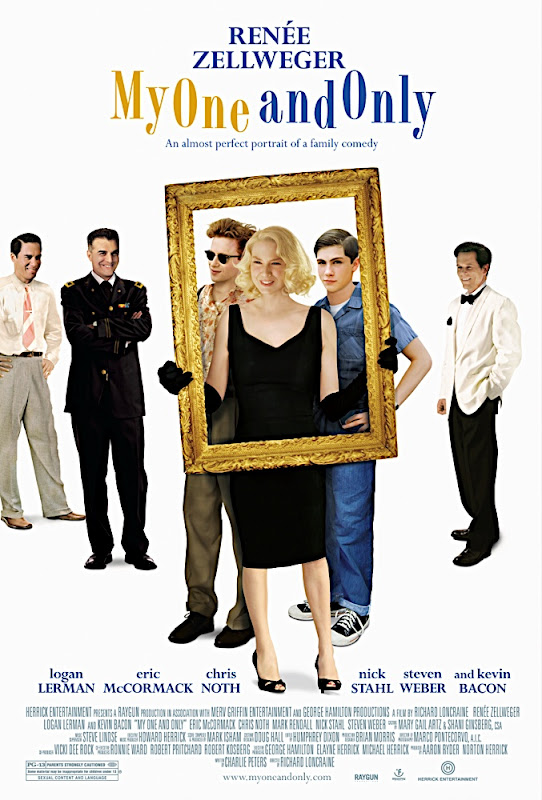
Movie Review: My One and Only (2009)


Now Available on DVD


Delicious
Bookmark this on Delicious
submit to reddit
Print Page

Digg!

MovieBlips: vote it up!

Given My One and Only's highly literary synopsis that made me envision The Prize Winner of Defiance, Ohio combined with a mile a second plot-spoiling trailer that recalled His Girl Friday, I wasn't sure what to expect when I sat down to view Richard Loncraine's film.

Moreover, I was further bewildered by analysis that likened Renée Zellweger's character to “a cousin of Blanche DuBois” in a movie that New York Times film critic Stephen Holden described as one that “aspires to be a contemporary version of a Preston Sturges comedy,” despite the fact that the film was set in 1953. However, I realized much to my delight that the movie works on several levels but in this case, none of the ones Holden addressed. In my view, the movie's success lies in the way that it meanders from comedy to tragedy in a delightful confection as penned by screenwriter Charlie Peters.

In one of Renée Zellweger's strongest turns to date, she channels Katharine Hepburn-- as she confessed in the production notes-- for her role as Ann Devereaux, a wealthy self-obsessed New Yorker who returns from vacation one day earlier than expected only to find her boyish band leader husband Dan (Kevin Bacon) entertaining another woman.


Unwilling to fall to pieces like Tennessee Williams' Streetcar Named Desire damsel in perpetual distress, Blanche DuBois, Ann instead soldiers through the scene in classy Katharine Hepburn mode like Truman Capote's Holly Golightly as if directed by Billy Wilder. For she is a woman who lives by aphorisms, as her son George (3:10 to Yuma's Logan Lerman) explains to the car dealership where the teenager was sent by Ann to purchase them a getaway vehicle. No instead of tears or tantrums, Ann simply zips up the dress of the half-naked floozy and sisterly advises her that the color she's wearing makes her look like a tramp before she jokes that in that case it fits.


Warning her adulterous husband that he shouldn't contradict a woman while in his underwear since it puts him at a great disadvantage, she takes all of the valuables out of their safety deposit box (including a gun and cash, which she replaces with her wedding ring), collects her two teenage boys after first arriving at the wrong school unsure which one they attend, and then hits the road.

Initially Ann seems to be looking for her next meal ticket or husband to provide for her as with her social ease, friendly demeanor, beauty, confidence, and ability to adapt to all situations she has friends and old beaus in all the neighboring northeastern states. Yet Ann has trouble accepting reality a la Holly Golightly that it's not as easy to hunt for a new husband as it was when she was younger and minus two teenage boys.


While there's no shortage of suitors or possibilities as various men come out of the woodwork including fine, brief turns by Chris Noth as an anti-communist military man, Eric McCormack, Steven Weber, and more, Ann quickly realizes that unlike DuBois she's going to have to stop depending on what she foolishly believes is the instant kindness of suitors and get a little more street smart like Tennessee Williams' wily “Maggie the Cat” from Cat on a Hot Tin Roof.

Admittedly it's pretty dicey territory for an actress to tackle playing a mother who places her own needs first as a far more comedic pre-feminist Alice Doesn't Live Here Anymore piece when she selfishly uproots the boys from one location to the next, yet Zellweger is able to bring a quiet dignity to Ann Devereaux.


Throughout the film, we understand that just below the character she puts on for the world, as though she were a woman applying makeup in the mirror to put on her war paint or game face to hide behind, Ann understands that she isn't the ideal mother and that she's just as confused and emotionally in need of growing up as her sons. Yet the difference between Ann and her husband is as we uncover in Kevin Bacon's very little but always memorable screen time, that at the end of the day, she wants to be with her boys and give them the style of life and idea of a two-parent family that society and her experience has always programmed her to idealize. On the other hand and despite his love for his biological son George, her husband is quite content to be a postcard and phone call type of father.


Although narration can be the kiss of death for a movie especially when it's employed in a film as highly literate and sophisticated in its dialogue as this work, it's doubly daring when you consider that My One and Only is rooted in nostalgia. Like the Julianne Moore vehicle The Prize Winner of Defiance, Ohio chronicled a woman's tireless efforts to provide for her family as shared by her child, My One and Only is a fictionalized memoir of actor George Hamilton's true stories about life with his mother in the '50s combined with autobiographical and invented material culled from screenwriter Charlie Peters.

Yet, narration for this film works from the start as the extremely talented Lerman (playing the young George Hamilton) chronicles the adventures in a way that prevents the movie from feeling overly quirky or episodic as their journey on the road continues. Despite this, there are a few structural speed bumps including one usage of narration in a cliched “How I Spent My Summer Vacation” classroom scene that makes the cinematic mistake of repeating information orally that we'd previously seen visually (or in other words, telling us the same thing twice). But aside from a few overly predictable coincidences and offbeat characters who feel a touch too invented, overall it's a surprisingly charming film.


Likewise, it's one that is bolstered by the strength of its believable ensemble cast. While I can't say enough for Lerman, critics definitely aren't kidding when they laud praise onto Zellweger who hasn't been this integral in the success and tone of a film since her triumphant work in Neil LaBute's underrated Nurse Betty.

In a year where we haven't seen enough standout work with strong female leads, Zellweger may indeed receive yet another Oscar nomination as, no stranger to period films given her turns in Cold Mountain, Chicago, Leatherheads, Miss Potter and The Whole Wide World, the Bridget Jones' Diary star is the heart of the film and ensures we don't turn away from it even when we disagree with the actions her character takes. Likewise, she's equally matched and elevated by Lerman, Bacon and other performers including a nice brief portrayal by In the Bedroom actor Nick Stahl as a young blue-collar neighbor who may have been the most sincere man that Ann met in her travels.


However, despite actor Mark Rendall's determination to do more with his stereotypically written effeminate one-note role as Ann's costume loving, cross-stitching son, his character Robbie whose love of movie divas becomes a source for humor a little too often. And unfortunately the usage of Robbie asks viewers to laugh at his “gay ways” instead of with him even if that wasn't most likely Peters' intention. Yet aside from the unfortunate characterization of Robbie which feels at times as anecdotal as the individuals the mom and her sons meet on their journey, My One and Only is a charming work that deserves a wider audience.


Opening in limited release due to its independent background as a movie that survived over a decade of turnaround hell and false starts, Richard Loncraine's witty and heartwarming achievement sets its tone immediately via a terrific credit sequence to establish the time and place. Nicely leading into the season of more serious cinematic awards-bait, My One and Only is one little sleeper that will hopefully awaken a big enough audience to inspire a great word-of-mouth campaign.

A must for fans of Zellweger who've been longing to see her in something with a bit more substance and zest than New in Town, My One and Only will also renew and in a great many cases encourage a whole new level of appreciation for the famously suntanned, Hollywood handsome George Hamilton whose life inspired the picture.


Renée Zellweger


Text ©2009, Film Intuition, LLC; All Rights Reserved. http://www.filmintuition.com
Unauthorized Reproduction or Publication Elsewhere is Strictly Prohibited.

2/14/2009

Blu-ray Review: Friday the 13th (1980) -- Uncut Version


The Original Slices
Its Way Onto Blu-ray


And to think all the filmmakers had originally wanted was to make a family movie about soccer! However, when producer and director Sean S. Cunningham and writer Victor Miller couldn't score a goal when it came to finding a distributor for their soccer movie, they moved to the hottest trend in the late '70s-- the horror movie (in the tradition of The Exorcist, Carrie, Jaws, and Halloween among others).


Aspiring to essentially rip-off the largely successful John Carpenter independent shocker Halloween, Cunningham-- who already had the title in mind-- boldly took out an ad in Variety announcing Friday the 13th with absolutely no idea what the film was going to be about and without one page of the script even written.


It turns out that it was a bluff that paid off-- screenwriter Victor Miller did his homework by watching horror films to understand the basic ingredients and started with a primal idea to address what had scared him as a child since overall, a horror film's purpose is to make one comfortable with fears and conquer them.

Originally deciding that the underlying subtext of their film would be "bad stuff happens, let's look at it, and it'll become less scary," as they note in one of the many Blu-ray's behind-the-scenes featurettes--soon the sort of campfire tale approach was adopted complete with the lessons garnered from Halloween.

Employing the same formula for what they thought would ultimately be a low budget drive-in style shocker with as Cunningham states "de minimis kind of moviemaking" that abandoned any idea of a character study in lieu of the "single minded purpose" of scaring the audience silly with their own cinematic campfire tale--it seems as though everyone involved with arguably the most successful slasher franchise in history had absolutely no idea how popular it was going to become nearly overnight as audiences lined up around the block following the premiere and more films cropped up to copy its success.


As Betsy Palmer a.k.a. the film's shocking villainess Mrs. Voorhees noted, when she was originally offered the role, she turned it down upon hearing the genre with the firm dismissal upon the script read-through that is was a "piece of shit" and "nobody would go see it."

America's sweetheart on Broadway and from the I've Got a Secret game show-- Palmer was the ideal choice to pull the wool over audience's eyes and scare the living daylights out of viewers with her grand entrance late into the movie and when the actress realized she needed a new car in real, she eventually gave into the film and it's all the better for it.

Ultimately plot-less and critically panned-- essentially the cult classic centers on "camp blood" or the more official name Camp Crystal Lake that seems to have been plagued with murder and misfortune ever since a young boy drowned there in 1957 and in 1958, two counselors were murdered.

As the years went on, the New Jersey location was always prevented from reopening by horrific goings on but when a new owner and group of determined teenagers decide they're going to fix it up and relaunch it in 1980, shortly upon their arrival-- as the tagline reads-- "they began to die horribly, one... by one."


Eventually leading to a showdown as the sole survivor-- a wonderful Adrienne King (hired for her talent and unbelievable scream) darts in and out of cabins to hide from the villain-- composer Harry Manfredini's atonal, simple and Jaws reminiscent electronic infused score goes into overtime as we can barely sit still watching the heroine try to do anything to survive.

This of course leads to one of the most memorable surprise endings in horror film history as her character Alice drifts peacefully on Camp Crystal Lake in a seemingly idyllic shot that goes on so long that we're always assuming we'll either begin seeing the credits or finally be shocked and just when we've given up hope, a chilling surprise comes up out of the water and a franchise was born with Jason in the villain's role.


Never intended to become a series due to pure logic's sake as to most central figures involved including Palmer, the director, and writer, he was a deceased boy who'd simply drowned-- nonetheless it's that surprise (inserted to outdo the finale of Carrie) that still gets us today and comes through loud and clear in a dazzling transfer to Blu-ray.

Also upping the notch are the loads of extras included on this uncut version to go along with the re-releases of the other restored versions (including Part III in 3-D, despite my disappointment that this was the only one given the Blu-ray treatment). And while Halloween was the superior film and Jason's antics did grow monotonous over the life of the series--despite a few great twists (and I have yet to see the remake)-- Cunningham's film has actually improved with age.


While there are several factors at play for its success and most incredibly its revolutionary take on the extreme antics of the maternal instinct, a great nostalgic feel (especially when seeing Kevin Bacon and others) along with the realization that despite some of the gruesome effects crafted by Dawn of the Dead makeup effects gore wizard Tom Savini, it's far less exploitative than a number of other slasher films out there today in the torture-porn genre. And ultimately it's the indie underdog spirit of the twenty-eight day shoot and $550,000 budget that makes the result all the more incredible.


Managing to excel at the format of telling a simple B-movie story to the best of their ability and managing to give audiences a tremendous sense of both satisfaction as we live vicariously through our heroine as well as unease with that ending that's been forever etched in my memory-- Friday the 13th will never be a work of art, nor will it ever make the pantheon of horror classics such from Alfred Hitchcock's Psycho to Wes Craven's brilliant Scream, but it is the little movie that started the great big horror blockbuster trend (for better and worse).


And moreover, thanks to the great featurettes including a "Friday the 13th Reunion" (from September 13, 2008) where Adienne King tells a moving story of her own encounter with real-life terror when she had a stalker within weeks of the release in an era when such an event wasn't taken seriously-- this Blu-ray version helps put a stop to some of the rumors of the series and gives the accounts of those involved firsthand.

Truly a family enterprise as Cunningham notes in an interview that his son Noel Cunningham took the franchise in another direction midway through as the two still have a cutting room over the garage in "the house the Jason built" before Friday the 13th become not just "a brand" but a "dependable blue collar horror film," that never deviated from its original set-up (to the delight of fans and to the distaste of critics). And thanks to this Blu-ray, it's been preserved in its glory to look and sound perhaps even better than the low-budget film did on its May 9th debut in 1980.


And perhaps because it's still raking in the green-- maybe now after all this time-- Cuningham and company can finally make that soccer picture after all... although, let's just hope the main character's name isn't Jason.

(Note: Most Images Courtesy of
Paramount Home Entertainment;
Extra Images from Blu-ray.com)