Showing posts with label Shia LaBeouf. Show all posts

1/30/2014

Blu-ray Review: Charlie Countryman (2013)


Now Available to Own   


Photo Slideshow


Bookmark and Share

Original Title: The Necessary Death of Charlie Countryman

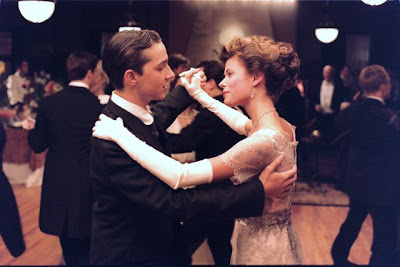
Hallucinatory and hypnotic – there is a masterpiece of a movie to be found in Frederick Bond’s ultraviolent, dark-as-night valentine Charlie Countryman. Unfortunately and no offense to Shia LaBeouf’s no-holds-barred portrayal of the eponymous lead who’d been sleepwalking through life and is now beginning to feel, the most memorable storyline of the entire movie has absolutely nothing to do with the title character.

Instead, told in flashback and voice-over by the always impressive Evan Rachel Wood, we’re filled in on the unexpectedly riveting back-story of her Beauty and the Beast like romance with the horrific underworld gangster Nigel (a terrifying Mads Mikkelsen).

Sidelined by a near-death encounter, Nigel convalesced in a flat above the Bucharest café where Wood’s gifted yet naïve and sheltered cellist played for customers from morning until night. Growing stronger day by day and note by note – Nigel not only found himself healed by the transformative power of her music but also falling in love with the woman whose playing saved his life before he’d ever laid eyes on her.


And (as Wood’s Gabi explains to Charlie) it was only after the two began a whirlwind romance did Gabi realize that although she saved Nigel’s life, by getting involved with Nigel, she’d forever jeopardized her own as once the afterglow wore off, she learned there was nothing beautiful about this particular beast.

Revealed late into Charlie, it’s only once we reach this point of explanation where Gabi tells LaBeouf’s hopelessly smitten American tourist just how on Earth she could’ve ever married a man who stalks and threatens the lives of her as well as anyone who looks at her twice that we realize what had been missing thus far in the film. Charlie Countryman's missing ingredient was anything resembling an actual and involving storyline.


While Bond’s feature filmmaking debut based on the screenplay by Matt Drake had been undeniably interesting for the first hour, it was ultimately salvaged thanks to his background as a commercial director who knows how to milk style over substance for all its worth and keep us watching for the eye candy alone.

Likewise, the meandering approach taken thus far had only proven why you can’t make great films out of books by Beat Generation authors in that they valued artistry and rhythm over structure and storylines.

Saddled with an uneasy hero in the form of LaBeouf’s American in existential crisis (following the death of his mother), Charlie’s main impetus for action in the film is reaction.

Constantly set in motion by outside stimuli (including conversations with two separate ghosts), Charlie is knocked down like a stack of dominoes from frame one and this process is repeated for a majority of the first act as he passively reacts to people, places and situations. It isn’t until he meets Gabi that he decides to make a decision in his own right, even going as far as to admit that he doesn’t “get feelings” very often.


Although LaBeouf commits himself fully to the role, the way his character bounces back from depressive funk to manic screwball in the blink of an eye, it’s almost as if the screenwriter was as uninterested in him as the audience and kept changing his persona stream-of-consciousness style as he wrote to see if Charlie would suddenly “get interesting.”

While thankfully the film and in turn LaBeouf’s character is augmented by a rather ingenious coda that symbolically harks back to the film’s opening imagery, adding a surprisingly deep layer of extra meaning to the circle of life motif and film’s original title of The Necessary Death of Charlie Countryman, unfortunately it doesn’t make up for Charlie's divertingly creative if narratively all-over-the-place first two-thirds.

Nonetheless, Bond utilizes his commercial background to his credit, infusing Charlie Countryman with some infectious moments of true romance and stylistic breaths of fresh air (courtesy of his entire behind-the-scenes team including cinematographer Roman Vasyanov and editor Hughes Winborne) that come to life in this sparkling Blu-ray transfer.


With this in mind, Bond is undoubtedly someone to watch in the future of cinema. Nonetheless I can only hope that he’ll choose a far more solid screenplay and take the longer art-form of feature filmmaking into greater consideration to make a film that truly maximizes its running time rather than just passing time until its next out-of-this-world scene that makes it seem like it’s a group of short films strung together rather than a cohesive long one.

While Charlie is admirable for its artistic achievements alone (including the aforementioned mesmerizing segment that wouldn’t have been out of place in music themed film festival alongside The Red Violin and Three Colors: Blue),unfortunately the least fascinating thing about Charlie Countryman is Charlie Countryman.


While it’s hardly LaBeouf’s fault as Drake’s script is – just like Shakespeare’s Romeo and Juliet – filled with far too many, richer drawn Mercutio-like figures (including scene-stealers Mads Mikkelsen and Til Schweiger), it is interesting how many times they name-drop Robert Redford characters and movies with regard to LaBeouf.

Perhaps covertly apologizing to his fans for the poorly written character, the film-in-film meta-modern reference to the actor’s far more stellar work acting alongside Redford in the recent The Company You Keep provides a great recommendation for LaBeouf enthusiasts wanting to see something that actually makes the most of his talent and charm.

Reminiscent of In Bruges and A Life Less Ordinary, not to mention the tripper sequences of Julie Taymor’s Across the Universe – which also has star Evan Rachel Wood in common – this official Sundance Film Festival selection is now available to rent or own on disc and download.


Text ©2014, Film Intuition, LLC; All Rights Reserved. http://www.filmintuition.com Unauthorized Reproduction or Publication Elsewhere is Strictly Prohibited and in violation of the Digital Millennium Copyright Act.  FTC Disclosure: Per standard professional practice, I may have received a review copy of this title in order to evaluate it for my readers, which had no impact whatsoever on whether or not it received a favorable or unfavorable critique.

6/26/2009

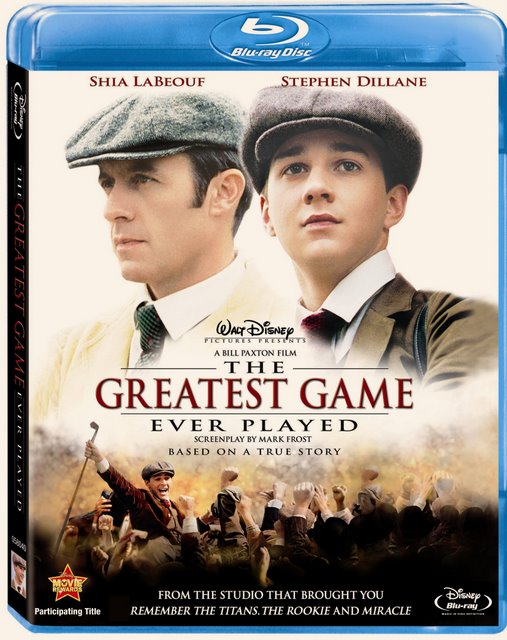
Blu-ray Review: The Greatest Game Ever Played (2005)


New On Blu-ray
(DVD Already Available)


Delicious
Bookmark this on Delicious
submit to reddit
Print Page

Digg!

MovieBlips: vote it up!

I’m just going to go ahead and blame it on Bagger Vance. The only thing worse than watching golf on television is watching a really dull movie about golf. And sure enough, this was precisely the case when I brought my golf-loving grandfather to the theatre in 2000 to see Robert Redford’s The Legend of Bagger Vance and realized that not only was I bored out of my mind but my grandpa had actually fallen asleep while we’d been sitting there in the futile hope that something interesting would happen. And for those of you who suffered the same fate, I think it's safe to say that, man, nothing ever did.


Famously described by Mark Twain as “a good walk spoiled,” I must admit that I’ve never been a fan of traditional golf myself aside from, of course—much like getting a kick out of going with my niece and nephew to Chuck E Cheese to play Skee-Ball and shoot hoops—using every opportunity I could come up with to hit a mini golf location while growing up.

There was just something so satisfying about putting a ball through a paint-chipped ‘70s style Flintstones meets fairy tale land that never quite resonated with me in the official version of the game. Mainly it's because golf always seemed like a stuffy pastime considering that the the sport has been dominated by the privileged, wealthy, and mostly white middle aged male demographic (before of course, Tiger Woods became the notable exception).

After suffering through the mind-numbingly anticlimactic work that was Bagger Vance, I wasn’t exactly up to checking out a 120 minute period film about the sport when actor turned filmmaker Bill Paxton’s The Greatest Game Ever Played hit theatres in 2005. However, at least the 2005 film had the bonus that Vance didn't since Bagger again condescendingly cast a talented African-American actor (Oscar nominee Will Smith) in a stereotypically thankless role of helping white people find their way a la Whoopi in Ghost or Don Cheadle in The Family Man.


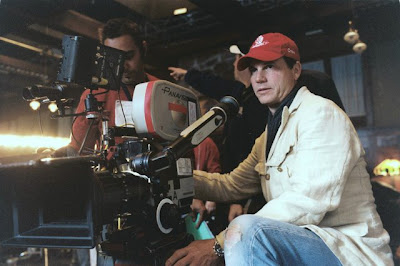
Yet this was definitely not Bill Paxton’s fault as I’d been a huge fan of the risk-taking actor who's consistently and passionately pursued lower budget indie films as well as larger studio works moving from One False Move to Apollo 13 to A Simple Plan before directing the incredibly underrated and intelligent shocker Frailty.


Likewise, I was also impressed by the employment of an old professor’s filmmaking colleague and friend—the talented cinematographer Shane Hurlbut --whose versatility and ability to light up sequences so that they simply popped as he did in HBO’s lauded The Rat Pack led to higher profile pictures sharpening the gorgeous oceanic landscape of Into the Blue, the overlooked rom-com Something New as well as We Are Marshall, Semi-Pro, Swing Vote and most recently Terminator: Salvation.


And now thanks to Walt Disney’s underdog sports themed double release of this film along with Gavin O’Connor’s Miracle onto Blu-ray this month--no doubt to tie in with Father’s Day-- I was finally given the push I needed to take a chance nine years after the Bagger incident had occurred when the studio kindly sent me this film for review.


Still dubious that I’d enjoy a golf movie—even one that starred the [then] up-and-coming charmer Shia LaBeouf who is currently attempting to break box office records this week with the release of Michael Bay’s sequel to the smash hit Transformers-- I’m thrilled to admit just how wrong I was when I became utterly mesmerized by Disney’s film which deservedly earned Paxton’s first studio helmed effort a Heartland Truly Moving Picture Award.


Described by the filmmaker as not just a true story “that everyone could relate to” but also one that is likewise “the first underdog story in American sports"-- his passion to make the movie for the studio that crafts underdog stories better than all the rest (Invincible, Glory Road, Remember the Titans) shines through right from the beginning of the piece.


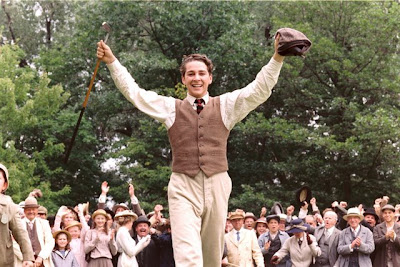
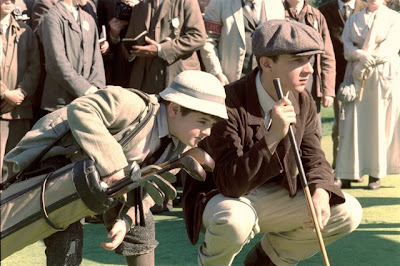
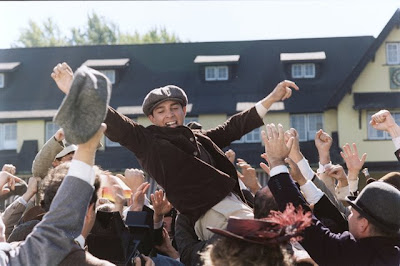
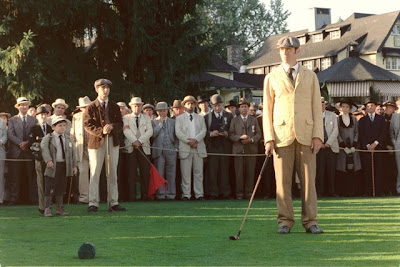
The work which screenwriter Mark Frost adapted from his book chronicles the unlikely match-up of amateur twenty year old golfer Francis Ouimet (LaBeouf) who managed to battle his golfing idol—the British champion often dubbed the game’s best player in Stephen Dillane’s Harry Vardon—for the ultimate victory to win the 1913 U.S. Open Championship.


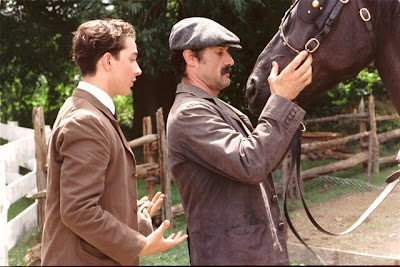
Much like Miracle, which found our young American and relatively inexperienced players psychologically and physically outmatched, LaBeouf’s Francis Ouimet—a former caddie and son of two immigrants—is equally out of his league, trying to better his game by studying the one perfected by Vardon which he’d broken down in his nonfiction work on his golf methodology.


However, while we never got to meet the opposing team or see them as anything other than the opposition in Miracle—the fascinating thing about this film is that Paxton and Frost take the time to fully develop both characters whom we realize have much more in common than one would assume. Moments into the movie we discover that both grew up as poor underdogs near golf courses (or in Vardon’s case being evicted from his property as a child so that a course could go where his home had been) and later they realize that despite being naturally gifted with a club and a ball, they’ll never be respected as “gentlemen” of the game.


The emphasis on class differences and the elitism of some in the field in their treatment of the players as they climb the ranks hoping to be treated as equals makes the nearly one hundred year old story still resonate quite strongly today. Furthermore, it’s even given a great Disney outsider addition when Ouimet hires a fifth grade, ten year old caddie named Eddie (Josh Flitter) who almost manages to steal focus from the entire movie towards his adorable, supportive presence.


Yes, of course there’s a few plot points that feel a bit forced to make certain that the movie completely follows the genre mandated pattern such as Ouimet’s crush on the wealthy club owner’s daughter that’s cast aside when the game begins in addition to a few other minor crises about their struggles to prove themselves worthy and overcome the psychological aspects and feelings of insecurity. However, the filmmakers bravely switch up the typical presentation of these events.


Unafraid of venturing into the fantastical area of magic realism that one has a license to incorporate into filmmaking-- Paxton makes the intriguing, assured and incredibly effective decision to bring their insecurities to life visually via Vardon’s memory of the men in black hats who took over his land as a child when his nerves threaten to overtake him on the golf course.

Equally powerful in his decision to make sure the game never comes off in easy quick shots of the ball flying through the air and a cut to where it lands, in the last almost full hour of the film which brings us right inside the game, Paxton illustrates his commitment to “celebrate” the beauty of golf as a game by bringing in a “sequence conceptual consultant” to film CGI enhanced shots.

Thus he enables us to view golf in an entirely unprecedented way often with a constantly moving camera. Making it just as appealing as a brightly colored mini golf course, the filmmakers use rapid editing and the seamless movement of slow motion to fast motion as we zoom in to see a lady bug on a ball, we feel like we’re soaring through the trees along with the golf ball, and go underneath the tee to watch a swing from a vastly different angle.

In doing so, Paxton, Hurlbut, the technical consultants and his editor Elliott Graham take a "kids in a candy store approach" to cinematic trickery in a technically imaginative style with the decision not to let the 1913 setting pigeonhole them to a classic period production feel.


Although some may have a problem with the anachronisms they infer from the “show-off” style—by pulling out all of the rabbits they can find in the black hats of the men that haunt Vardon--Paxton has set his film apart in a way that not only manages to entertain on a higher level than most by-the-numbers underdog stories but also as a work of art that I feel should be mandatory viewing for film school editing, special effects, and cinematography courses.

And now it's heightened even more so on Blu-ray in the longstanding, typically exceptional Disney tradition of an ultra clear transfer of the film to its full HD 1080 pixels. Further boasting sound that manages to capture everything from the wind blowing leaves on trees to the sound of the ball moving through the air—it’s the best way to experience the picture in tandem with numerous extra features including two separate commentary tracks, a rare news archived video of Ouimet in the ‘60s, and behind-the-scenes footage wherein Paxton thanks every single major crew member by name.


Still, far from just dazzling us with what they can do in a way that LaBeouf likened to Paxton’s decision to shoot it “more like a war film”-- with the use of mini remote controlled looking airplanes attached to cameras and choreographing everything in addition to story-boarding the scenes to break it down again and again-- admirably throughout the film, The Greatest Game Ever Played always remains emotionally satisfying from start to finish.


Much more than just a golf movie and one that honestly manages to top most of the other Disney features from the underdog true sports sagas they’ve become as known for as animation—Paxton’s film is a remarkable hidden gem that’s well worth your time, even if you’re still suffering from post-traumatic Vance disorder.

12/29/2008

New on DVD & Blu-ray for the Week of 12/28/08


Jen's Pick of the Week


Alan Ball's
Independent Spirit Award Nominated
Towelhead


Digg!


* Note: A few of the movies listed below are repeats-- with the holiday season, there were some conflicting ads regarding a few release dates so to keep you fully updated, here are the official titles and reviews (if applicable).

Likewise, as I'm still playing catch-up on my workload, please stay tuned for additional Blu-ray reviews of this week's releases of The Duchess, Ghost, and The Truman Show in the near future.

Days of Thunder (Blu-ray Review)

The Duchess (Blu-ray Review)

Eagle Eye (Blu-ray Review)

Ghost Town (Blu-ray Review)

Surfer, Dude (Blu-ray Review)

Towelhead


Explore The Top Releases
Below on Amazon.com:

Including Some Wonderful Old Favorites
From Universal Studios & Focus Features
Re-Released with "Movie Cash"


12/27/2008

Blu-ray Review: Eagle Eye (2008)


Your Cell Phone Will Never
Look the Same Again


Digg!


One of those edge-of-your seat roller-coaster rides that lost some of its signal strength following the overwhelm of Christopher Nolan's The Dark Knight and Jon Favreau's Iron Man which eclipsed every other action film at the box office-- D.J. Caruso's Eagle Eye has been given the deluxe treatment in a dazzling digital transfer to Blu-ray by DreamWorks and Paramount.

Offering viewers a second chance to get caught up in the ideal format that matches the high-tech paranoia and breakneck pace of the film, I'll tackle this review in two parts-- first addressing the film itself (with movie clips, etc.) by presenting my original theatrical review and then taking on the Blu-ray aspects directly.

I. The Film

Eagle Eye


Director:
D.J. Caruso

Next time your phone rings and it’s just a telemarketer or a public opinion poll, consider yourself lucky. Director D.J. Caruso reteams with his Disturbia leading man Shia LeBeouf for yet another high tech Hitchcockian styled paranoid thriller sure to make one initially suspicious of all incoming calls or texts for at least twenty-four hours after his film Eagle Eye ends.


While that can only come as a pleasant surprise for those frequently over their cell phone minute plans and the parents struggling to intervene in their teenager’s text message addiction, in the world of Eagle Eye (view the trailer), the phone becomes even scarier than it was in Wes Craven’s “the call is coming from inside the house” styled horror trilogy, Scream.

Thanks to our current era of the online banking, the Patriot Act, MySpace, YouTube, Facebook, wiretaps, online tax and vehicle registration, scanned medical charts, traffic cameras, elevator cameras, hidden microphones and GPS navigational systems, now more than ever Orwellian’s Big Brother is watching.

Blending together Tony Scott’s Enemy of the State, Wes Craven’s Scream, Steven Spielberg’s Minority Report, Stanley Kubrick’s 2001: A Space Odyssey, Alfred Hitchcock’s North by Northwest, Jan de Bont’s Speed, and even a conveyor belt homage to Charlie Chaplin’s Modern Times, D.J. Caruso’s fast-paced stunner is by far the most gripping thrill ride of 2008.

Much like David Fincher’s Panic Room, Eagle Eye has a deliciously simplistic set-up that the team of writers milk for all it's worth as regular citizens find themselves in extraordinary circumstances after a mysterious woman with a chillingly calm yet controlling voice (Oscar nominee Julianne Moore) phones two strangers and informs them that they’ve “been activated.”

Activated for what, neither character is entirely sure, however they quickly realize that their lives as well as their loved ones are in overwhelming danger unless they comply with each and every demand she aims their direction whether it’s holding security guards hostage to obtain a top-secret briefcase or fleeing from authorities.

Set in the near future—January of 2009 to be exact and beginning with an introduction right out of the world of Tom Clancy and Jason Bourne—it doesn’t take a rocket scientist to realize they’re being set up as terrorists as part of a vast governmental conspiracy but who authorized the game and how do you request a time-out when you’re not the one calling the shots?

The first victim is the delightful wisecracking slacker Jerry Shaw (LeBeouf, whose ability to charm, flirt, scheme and improvise reminds me of a young Paul Newman). When he isn’t busy being rude to the customers at the Copy Cabana or manipulating his coworkers in a masterful poker bluff, he’s using his charisma like a weapon on a fellow transit passenger or trying to make ends meet with his incessantly late rent.

After he gets word that his patriotic and heroic twin brother, the Air Force officer Ethan Shaw (complete with a genius I.Q.) has perished in a truck accident in Washington D.C., Jerry is stunned to discover upon returning from the funeral that his bank account is well into the six figures and he’s received an alarming number of dangerous packages containing firearms, bomb-making equipment and poison delivered to his apartment. Within seconds, his cell phone rings and Moore’s voice coolly instructs him that he should run as the F.B.I. will be there directly.

Sure that this is all some sort of easy misunderstanding, Jerry ignores the bullying voice and is interrogated for suspected terrorist activity and about his deceased brother by the no-nonsense Joint Terrorism Task Force Agent Thomas Morgan (Billy Bob Thornton). Advised that it’s not the best time to become a terrorist by Morgan (just one of many zingers nailed by Thornton), Jerry continues to plead his case as a quintessentially Hitchcockian innocent man to no avail.

And after Ethan’s old colleague, Zoe Perez (Rosario Dawson) a fellow Air Force officer arrives to find out exactly what’s going on with the situation on behalf of Defense Secretary Callister (The Shield’s Michael Chiklis), Jerry is stunned when the Attorney General faxes in an authorization for him to make a phone call, yet far more concerned when he discovers the voice cutting into his call is none other than Julianne Moore’s. Yet this time, instead of ignoring the stranger’s demands, like Keanu Reeves’ Neo in The Matrix, he accepts her advice to flee from the F.B.I.

“Escape.”


Meanwhile, as Jerry is well into his own plight, we encounter the second victim of the mysterious Moore in the form of the lovely Michelle Monaghan (Made of Honor). A devoted single mother and minimum wage earning paralegal who grudgingly packs off her beloved trumpet playing son for band camp in Washington D.C., on her first night out with the girls, Monaghan’s Rachel Holloman receives a similarly frightening call.

“Rachel Holloman, you’ve been activated.”


While Rachel has the benefit of being out in public and not trapped in a tiny apartment filled with mercenary equipment fitting for a Unabomber, she takes a decidedly different and logical approach by dialing 911 before Moore cuts back into her call and tells her that if she continues to disobey, her son will be killed. And it’s only a matter of time before Jerry and Rachel collide by the demands of the dangerous stranger, being led on a deadly scavenger hunt as they make their way towards a fateful State of the Union address, with Thornton and Dawson’s characters following the entire way.

Car Chase


While it’s filled with intense, nonstop action sequences that continuously top the one before it in a way for which neither actor is unprepared (as LeBeouf had starred in Transformers and Indiana Jones and Monaghan had been cast in Mission Impossible 3), one of the benefits of Eagle Eye’s approach is that it seemingly demands intellectual audience participation as we strive to stay ahead of Moore’s demands along with our heroes. Whether it’s imagining what we would do in a similar situation from just hanging up the phone or merely refusing or trying to change a plan—despite a finale that does involve a major 2001: A Space Odyssey styled suspension of disbelief—every action initiated by Jerry and Rachel seems entirely plausible.

However, one major drawback involves the presentation as similar to Cloverfield, the filming style of a constantly moving camera is hard on the eyes especially when rapid-fire quick cuts that flow far less smoothly than the comparable ones in last year’s Bourne Ultimatum are added into the mix. And additionally, the volume, much like Dark Knight and Iron Man seems as though it could cause hearing loss yet if you pack along ear plugs and make sure you don’t sit too close to the screen, the comfort level for viewing should benefit considerably.

Still, despite this, I must admit that it’s by far my most recommendable blockbuster of the year so far and one sure to appeal to not just Orwellian and Philip K. Dick devotee cyber techies but especially action junkies eager to re-experience the same type of edge-of-your-seat rollercoaster we did more than a decade ago with Jan de Bont’s Speed. And this is ever more the case since, despite the continuous calls to go green, a relatively small number of us ride the bus but nearly everyone and their brother has at least one cell phone. Who will be calling you next? Can you hear me now?


II. Blu-ray


While the theatrical presentation of Caruso's action-packed thriller left viewers with a bit of eyestrain as we struggled to keep up, the transfer to Blu-ray actually improves the film in my opinion as DreamWorks and Paramount continually strive for the highest level of picture and sound, presenting Eagle Eye in 16x9 widescreen 1080p High Definition with 5.1 Dolby TrueHD sound.

Whereas some older films manage to show their age when they make the format change, Eye is hitting Blu at precisely the right time, by including every single extra (aside from the photo gallery) in HD quality and giving viewers-- depending on their set-up-- the chance to tweak the picture to brighten up the predominantly dark color scheme, duplicate the intensity, and-- even without a five speaker and subwoofer wired room-- adjust the crystal clear sound to the right level for their particular comfort.

Including the nearly required favorites of a gag reel, the original theatrical trailer, and deleted scenes, I was particularly drawn in by the various making-of featurettes that take you on location in Washington D.C., on the road, or in the best one, given a full-access pass to "Asymmetrical Warfare: The Making of Eagle Eye."

Offering a nice balance between cast and crew interviews and rockin' stunt set-ups, we discover that essentially Disturbia director D.J. Caruso eyed his film as though it were a studio budget "independent movie," or the type of road film he loved back in the '70s like The French Connection (which he cited as a major inspiration).

With a constantly moving production as the entire cast and crew seldom stayed in the same location for more than two days, he freely admits that the first hour of Eye represented a near live-action video game as the characters (similar to the viewer) never knew exactly where the film was going as neither Jerry and Rachel nor the audience had any choice as their telephone narrator led them from Point A to Point B.

With the original idea for the film being hatched in the mind of American master Steven Spielberg a decade ago-- Eye's director and star LeBeouf marvel at the fact that back in the late '90s, the film would've fallen into the category of science fiction whereas now they realized that Spielberg's vision was not only possible but entirely probable.

As we're increasingly aware that our "digital existence" can be "more prevalent" than our "real one," the filmmakers strived for authenticity in making sure that everything that happens in the film is viable as you can witness in the especially creepy scientific, Orwellian extra "Is My Cell Phone Spying On Me?"

Essentially reuniting with the same community of professionals both behind-the-camera and in-front of the lens that has helped present such modern day action films as Disturbia and Mission Impossible 3, LeBeouf was in ideal hands, being approached with the project from his "father figure" Spielberg even before he'd been handed Indiana Jones.

Relishing at the opportunity to work with Caruso again and joking that by now following Disturbia they have such a fast gesture based shorthand that the men can read each other with the minimum of words, Caruso was equally thrilled to present the former nineteen year old boy as a leading man.

Filmed when he was twenty-one but portraying a twenty-five year old, LeBeouf was teamed with a co-star six years his senior, but after you catch the off-screen chemistry and camaraderie between the adventurous and brainy Michelle Monaghan and LeBeouf, you realize that as unlikely it may seem on paper, it's actually a perfect fit.

Additionally, LeBeouf humbly noted that when he'd heard Monaghan was hired, he realized that most of the work was already done since she's so talented and they're comfortable with each other-- having worked together on Constantine a number of years earlier. Eager to launch headfirst into the increasingly complicated array of stunt-work (using a minimum of CGI as we're both terrified and impressed to discover in the featurettes), LeBeouf joked that given the fact that they did a large majority of their own stunts, it was constantly Monaghan who was pushing him on, running in four inch heels and hurling her body down a DHL conveyor belt, egging him on when he was tired with the teasing, "Why don't you just man up?"

While techies and special effects junkies will love the "how did they do that?" demonstrations including the big rig flip and the dedication to authentic live-action effects and sure enough, aside from the twenty-five minute HD "Asymmetrical Warfare" extra, there's a number of other making-of bonus features to explore, those who were more intrigued by the Enemy of the State styled ethical questions won't want to skip "Is My Cell Phone Spying on Me?" which interviews experts in the field of cyber security and privacy.

In the same turn, it also offers a creepy challenge to viewers that they should devote one entire day to be aware at how many times their photo is snapped and they are caught on a security camera as they go about their routine. Of course, I'd recommend trying this at your own risk and possibly, so that you don't send yourself into a frenzy, you may want to just go ahead and switch off your cell phone (if you can)... if not for the day than at least for the 117 minute running time of Eagle Eye.