Showing posts with label Bradley Cooper. Show all posts
4/01/2014
DVD Review: American Hustle (2013)
More than any other time of the year, award season brings out the critic in all of us as films are held side by side for comparison and ranked in an endless number of ways on an ever-growing number of lists.
And since film press is nothing if not pattern driven as PR firms pitch the same press releases and angles to everyone on their contact list, by the end of each annual award season, audiences inundated by the constant stream of similarly covered news and editorial pieces often feel like opinions announced again and again have become the official word on the matter.
Whether consciously or not, the steady stream of repetition can trick you into thinking you’ve seen something you might not have seen or felt something you might not have felt just because of majority rule and the amount of ink spilled on whatever the topic may be. Of course, in the end, the only opinion that truly matters to you is your own in assessing everything and making up your own mind.
Yet given how successfully opinion is turned into fact in today’s fast-paced world, I couldn’t help but feel that the conman, chameleon-like quick-thinking characters that populate American Hustle would – if set in contemporary Hollywood rather than ‘70s New York – have been absolutely brilliant working in the film industry when it comes to spinning yarns and selling anything they want to earn a buck.
And perhaps part of the reason that Silver Linings Playbook and Three Kings filmmaker David O. Russell was so drawn to the world of Hustle was because it felt so familiar. Of course, that’s in addition to the way the film provides him with a springboard for the themes and motifs that have obsessed him for ages given its tale of multiple love triangles that lie just below the surface of the characters’ existential search for the happiness epitomized by the promise of the American Dream.
Revisiting the same throughline that has dominated his oeuvre from Flirting With Disaster all the way up through Silver Linings that focuses on an internal quest undertaken by a character who hits a metaphorical wall and then needs to figure out how to turn their life around for the better, Russell has achieved the impossible. He’s managed to make the seemingly larger-than-life characters of American Hustle not only endlessly fascinating but surprisingly relatable (if only on the most primal of levels) from start to finish.
Like all other film fans who read far too much award season coverage, I couldn’t believe how much this film was compared to Martin Scorsese’s ode to Wall Street driven hedonistic excess – The Wolf of Wall Street.
While some people focused on both films’ emphasis on con men and colorful characters (not to mention the fact that both pictures were based on true stories – albeit quite loosely in the case of Hustle), others emphasized the Goodfellas meets Boogie Nights ode to glitz and glamour of Russell’s cinematic technique.
Going against popular consensus – despite growing up with a particular fondness for Scorsese whose works I knew inside and out – while I understood the surface level comparisons, the one thing I was totally unprepared for is just how much I preferred Hustle to the overblown exhaustive spectacle that was Wolf.
Additionally it was absolutely thrilling to discover that unlike the interchangeable blow-up doll like women that were used as sex toys for gratuitous scenes of unappealingly animalistic sexcapades in Wolf, Russell has – in once again reteaming not only with his Oscar winning Silver actress Jennifer Lawrence but nominated Fighter star Amy Adams – crafted two fully realized female characters.
Using Adams and Lawrence as muses the way that Scorsese uses DiCaprio, writer/director Russell ensured that the women of Hustle were just as (if not more) powerful, intelligent and fascinating than the male characters who became their marks in love and life via Bradley Cooper’s ambitious yet easily manipulated FBI agent to Christian Bale’s confident conman and the bighearted politician played by Jeremy Renner.
Completely vanishing into their Oscar nominated roles and changing multiple times from start to finish, American Hustle is a master class in acting.
Rewriting Eric Warren Singer’s more procedural, fact based script that centered on the outrageous headline grabbing Abscam scandal to flesh out the characters and infuse the thriller elements with off-the-cuff, fast-moving humor and complicated, multifaceted romance, Russell used his writer’s sensibility to helm what is his most exciting film to date.
The recipient of three Golden Globes including Best Picture (Musical or Comedy), while it would lose all ten of its Oscar nominated categories matching the same fate as Wolf's, it’s my prediction that just like 1997’s overlooked Boogie Nights, Hustle’s reputation will grow stronger than Silver and Fighter’s in the years ahead.
Featuring some of the most quotable dialogue of the year, American Hustle also boasts a virtuoso performance by Amy Adams who plays a woman with so many layers and complex mysteries that in retrospect, I truly believe she had the most difficult role and should’ve been awarded the Oscar for Best Actress over dazzling Blue Jasmine star Cate Blanchett.
Newly transferred to disc to hopefully kickstart a greater appreciation for this American masterpiece, Sony’s high-caliber DVD release comes complete with an Ultraviolet digital copy and featurettes plus additional footage you’re sure to relish on repeat viewings to explore the dizzying highs and lows that coexist in a single scene by characters that grow more intriguing with each passing minute.
Through American Hustle, Russell proves that when it comes to quality filmmaking, you can’t hustle viewers ready to process everything they’ve read during award season on their own terms while watching a movie filled with people that do the same.
Text ©2014, Film Intuition, LLC; All Rights Reserved. http://www.filmintuition.com Unauthorized Reproduction or Publication Elsewhere is Strictly Prohibited and in violation of the Digital Millennium Copyright Act. FTC Disclosure: Per standard professional practice, I may have received a review copy of this title in order to evaluate it for my readers, which had no impact whatsoever on whether or not it received a favorable or unfavorable critique.
3/21/2010
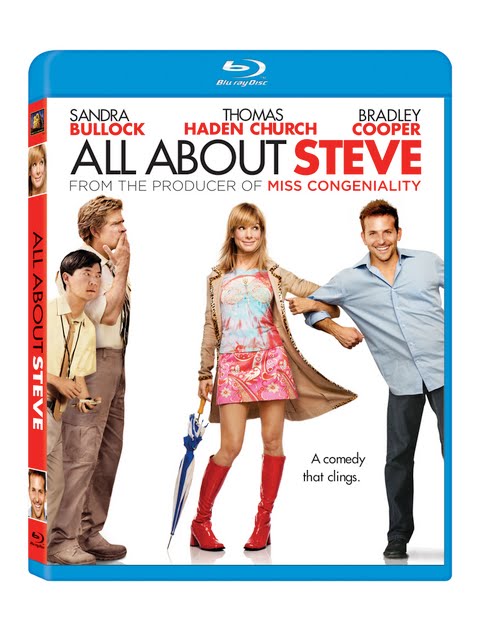
Blu-ray Review: All About Steve (2009)
When she accepted her Razzie award for Worst Performance by an Actress in All About Steve, Sandra Bullock gamely arrived with a red wagon filled with DVDs of the movie, asking people to watch it and really consider if it was truly the worst turn or if perhaps they should rethink it.
And although I certainly can't speak for the Razzie voters, I can speak for myself and I'm brave and bold enough to admit that-- against popular opinion-- I actually thought that the flawed but well-intentioned Steve had a better ratio of laughs per act than Bullock's blockbuster summer smash The Proposal.
Riskily venturing into the now traditionally stage set realm of screwball comedy, All About Steve obviously derived its approach and off-the-wall spirit from Preston Sturges' sillier concept movies such as The Palm Beach Story along with the more ridiculous elements found in Howard Hawks' Bringing Up Baby.
Steve centers on Bullock's compulsively red go-go boot clad, off-the-charts IQ, trivia buff Mary who works as a newspaper “cruciverbalist” aka the crossword puzzle constructor for "The Sacramento Herald." Prone to talking aloud to her hamster Carol and obsessing over every minute detail, the movie introduces us to our lonely and overly literal heroine who longs to create puzzles that are “solvable, entertaining, and sparkle” on a daily basis.
Advised to “be normal” by her boss and forget about her delusions of Will Shortzian grandeur, Mary, whom we already suspect may suffer from something beyond obsessive compulsive disorder such as Asperger's Syndrome (as some critics have noted), finds herself in for a blunt wake-up call by a rude elementary school class.
Less interested in her role in creating crosswords and far more fascinated by the fact that the beautiful but klutzy chatterbox doesn't appear to have anything resembling a social life, it's the insistent judgment of the kids that talk her into not canceling the blind date with a news cameraman that her parents set up for her.
Expecting that he must be a closeted gay guy whose mother is trying to push onto any available woman, Mary dresses down until that is she sees the All-American attractiveness of Bradley Cooper's Steve standing in her entryway. Deciding to ramp it up, she puts on her rightest, clingiest and most see-through ensemble of underwear and little else and before he can form a complete sentence in the car, Mary's stifled sex drive goes into overdrive and she's all over Steve like a pen on one of her puzzles.
Not enjoying her form of random trivia chatter as foreplay, Steve comes up with a half-baked excuse to break the date and then utters the kind brushoff that becomes the kiss of death of telling her he wished she could be on his out-of-state assignment with him but he has to go.
Suffering from the intense heat of the moment that's textbook erotomania, after Mary builds a whole puzzle wherein the contents fit the title of this movie and loses her job, she begins chasing Steve around the United States, erroneously believing that he believes as strongly as she does that they're destined to be together.
While he refuses to lead her on, Steve's associate, the cocky newsman angling for an anchor position (Thomas Hayden Church) pulls Mary aside and tells her that the commitment phobic Steve won't mean anything he tells her and that she needs to be persistent to go get her “Steve on.”
Watching Mary chase after the news van both literally and figuratively from one outrageous news story to the next wherein all share the same common thread of centering on outsiders from a baby born with a third leg to deaf children does test your patience in how you view the film.
Essentially, just like the bystanders on both sides of the third leg issue in the film, Steve has been broken up into two camps. There are those who see the work as a movie about a flat-out crazy woman and others view it as a screwball misfire.
And while I obviously tend to go in the latter direction and acknoweldge that some of the Miss Congeniality and Forces of Nature tactics used by Bullock are weakening with every new film, All About Steve is nowhere near as bad as Speed 2: Cruise Control, The Lake House or Gun Shy. In fact, despite it's uneven tone, it's far more original than yet another “pretend to be my significant other” comedy like the high gloss blah of The Proposal.
Produced by Bullock and indicative of the peculiar and admittedly less than popular taste in some of her material, overall, if you watch Steve in the zany manner in which it was intended as our heroine soon realizes that in all her adventures she's really discovering herself as a human being without the blonde, beautiful pretty boy, I think you'll find yourself surprised to discover how funny the movie really is, even in spite of a few questionable choices.
And likewise, as far as the crazy charge went for Mary herself, she is the opposite of Jim Carrey's dangerous Cable Guy and more in the vein of Stiller's Something About Mary character with a bit of the overly intellectual Big Bang Theory meets Adam analytical, literal, and logical mindset that's unable to separate a man's subtle “get lost” line from an invitation to throw those boots on and join him across the United States.
Presented in a nice high contrast Blu-ray transfer of the film that does an impressive job of balancing the sun-drenched landscapes into a natural blend rather than going for the overly cheery, everything-in-focus phony comedy brightness, the Fox 2-disc edition also comes with a digital portable copy of the movie to laugh along with when you're taking a break from your crossword puzzle on a long commute.
And while overall, Steve would've benefited from a sharper rewrite in defining Mary as anything but a psycho stalker since she very well could've been Fox's second Asperger's character this summer after Adam, luckily even without that, Bullock knows physical screwball comedy inside and out.
In her hands, even something as mundane as forgetting the auto-lock feature and getting caught mid-clench in a seat belt or writing a driver's license number on her arm in case hitchhiking becomes deadly manages to make us remember just how good Bullock is in letting us trust her instincts as an actor to the point that we laugh along whether she's a beauty queen or one hell of a cruciverbalist.
Text ©2010, Film Intuition, LLC; All Rights Reserved. http://www.filmintuition.com
Unauthorized Reproduction or Publication Elsewhere is Strictly Prohibited and in violation of the Digital Millennium Copyright Act.
FTC Disclosure: Per standard professional practice, I received a review copy of this title in order to evaluate it for my readers, which had no impact whatsoever on whether or not it received a favorable or unfavorable critique.
4/13/2009
DVD Review: Yes Man (2008) -- 2-Disc Special Edition
Given the previews and a lot of criticism-- not to mention the overwhelming sense of déjà vu one experiences seeing Jim Carrey back in zany Liar, Liar like form with his newest work Yes Man-- it was easy to assume that the film was conceived in a lazy Hollywood pitch meeting to recycle that phenomenally successful film Carrey made over a decade ago. In Yes Man, we find our negative homebody, sad sack hero Carl turn his life around by answering yes when presented by any possible opportunity.
As you probably remember in Liar, Liar, a birthday wish by his neglected mop-top adorable son makes Carrey's shady lawyer unable to lie over a single day in the course of the Brian Grazer produced, Tom Shadyac hit but no magic is involved in Yes Man as our hero decides to push existentialism out the door, abandoning free will, choice and avoiding bad karma by simply embracing everything he comes across.
About midway through the film, I started realizing that-- had Yes Man been crafted back in the 1960s-- it probably would have been directed by Blake Edwards for a star such as Jerry Lewis or Peter Sellers as the goofy one-gimmick premise is only as strong as the comedic direction by filmmaker Peyton Reed (The Break-Up, Bring it On, Down With Love) as well as the charisma of our lead performer.
And while IMDb reports that initially actor “Jack Black was originally considered for the lead role,” in a film that—if he had done it probably would’ve drawn comparisons to the new age karmic comedy Shallow Hal as opposed to Carrey’s Liar, Liar-- ultimately the interchangeable nature of all of the above is part of the problem. In other words, it just feels all too familiar and seems like it would have been ideal in the bygone era of truly silly “square” turns “hip” comedies like The Nutty Professor or I Love You, Alice B. Toklas.
And this is painfully apparent in its overwhelming sense of “did I already see this?”woes that hit audience members when you couple this with the old standby ingredients including: the presence of Jim Carrey who's done this kind of thing before; Terence Stamp essentially blending the “Mindhead” guru he played in Steve Martin’s thinly disguised lampoon of Scientology in Bowfinger as well as the over-the-top Oscar-nominated turn by real-life Scientologist Tom Cruise in Magnolia; Christopher Guest’s hilarious improvisational genius John Michael Higgins (Best in Show, Waiting for Guffman); and the lovely Zooey Deschanel who’s quickly building a Goldie Hawn like career out of playing carefree, beguiling, yet decidedly contemporary hippie chicks.
However despite all of that, there is nothing familiar about the source material as—instead of as I’d joked watching the first preview—it appeared like it’d be a great idea for a short SNL skit or In Living Color gag back from the days of Carrey as Fire Marshal Bill, instead it was inspired by the autobiographical memoir penned by the Scottish-born humorist and television personality Danny Wallace. In his memoir, Wallace chronicled a full year of what the scribe referred to as his “yescapades,” which were spring-boarded after aremark made by a London bus passenger encouraged Wallace to “say yes more.”
Although Wallace explains in the film’s Warner Brothers production notes, that “it was probably just a casual remark,” instead of simply shrugging it off and returning to his life post-breakup sitting around and playing video games and “not really do[ing] anything,” Wallace decided “it was the best advice -- like every self-help book in the world distilled into three words.”
Charting his various adventures which included buying a car on a whim, flying to Singapore for the weekend, and taking in strange concept bands—it was ultimately Wallace’s “generosity of spirit that informs Danny and his work,” which made the author’s memoir earn an important ally in previous fan—film producer David Heyman (the Harry Potter franchise, The Boy in the Striped Pajamas, I am Legend) who also states that he’d already been intrigued by Wallace’s writing since his debut book Join Me.
Still admittedly appealed by Wallace’s “idea that if you say yes -- if you're open to the possibilities that life throws before you -- then great things will happen,” or as Wallace jokes, “you’re as likely to meet the love of your life at a bad party [or a] good one, but if you said no, you'll never know”—Heyman teamed up with veteran super producer Richard Zanuck (The Sting, Jaws]. Leaning towards the character-based comedy director Peyton Reed who tirelessly worked with the film’s trio of screenwriters including Nicholas Stoller, Jarrad Paul and Andrew Mogul-- soon the seed of the endless possibilities of what could happen if you were inclined to embrace everything rather than run from it proved infectious to the cast and crew. In doing so, Peyton Reed strove to not only transfer “the very British memoir and soon American story set in Los Angeles,” but also attempt to create "a tone in the film which was somewhere between what Jim [Carrey] does comedically and in his more serious work.”
As the humdrum Carl, Carrey begins the film as though he's sleepwalking through life randomly grabbing any given DVD at Blockbuster to spend his evenings avoiding text messages, phone calls, and pleas to hang out with his soon to be married best friend (Alias’ Bradley Cooper). However, Carl is jolted into hyper new age reality after he finds his outlook changed when Higgins’ character forces “Yes Man” literature into the divorced loan officer’s hands and grudgingly brings him to a self-help seminar, led by Stamp’s character Terrence Bundley whom Stamp describes as a man who “is on what’s laughing called the guru circuit...[having] figured out a new angle where people will pay him to inspire them.”
Although he fights Stamp’s insistence that “yes is the new no,” soon he gives into the way of life. While it begins on a rocky note as Carl finds himself serving up a ride, money, and his cell phone to the world’s “most popular homeless guy” who uses up his car’s gas and phone’s battery, soon things start looking up in the newfound “yescapades,” when he meets the quirky, adorable, scooter riding Allison (Zooey Deschanel). Like most Deschanel characters, Allison listens to the beat of a drummer to which only she can hear-- spending her early mornings teaching aspiring photographers how to snap photos while jogging and her nights in a bizarre kitschy rock band Munchhausen by Proxy crooning songs with lyrics like “whore no more.”
Taking advantage of Deschanel’s natural ability as a singer/songwriter, the Yes Man DVD that also boasts a Digital Copy that’s compatible with both Windows Media and iTunes contains extras that focus exclusively on the film’s fictitious band including five music videos in 5.1 audio and a Behind-the-Music like mini-documentary called Future Sounds: Munchhausen by Proxy.
While the colors evident on the DVD transfer of the film seem extraordinarily dulled even when you tweak with the brightness setting, the best extras on the disc for Carrey fanatics are the gag reels, “Downtime on the Set of Yes Man,” and getting a behind-the-scenes view of the actor as he prepares for the film’s numerous physical stunts since his wallflower character Carl begins to take more extreme action as a “yes man.”
And although any change for the previously withdrawn Carl is a positive one in the eyes of his friends, they begin to grow alarmed when they discover the reason for his new sense of joie de vivre. And soon enough the inventive gimmick begins to run out of fuel just like Carl’s vehicle as it becomes a one-man showcase for the freewheeling Jim Carrey, sidelining his terrific supporting cast including Deschanel (who is always a welcome presence but has essentially played this character about five times too often much like Carrey).
The one welcome standout in the film—despite its shameless in-house studio plugs—is the talented New Zealand newcomer Rhys Darby (an actor and comedian) who is laugh-out-loud funny as Carl’s desperate for a friend boss at the savings and loan. Carrey concurred in the press notes, describing Rhys Darby as extolling Peter Sellers like “lunacy behind his eyes” that “just leaps out of the movie,” and he’s definitely right as his character hosts a variety of theme parties like Harry Potter and 300 (both WB features) for Carl and Allison to attend.
While Carrey is always fun to watch and you love some of the antics on principle such as their decision to take the first flight they can out of L.A. and end up in Lincoln, Nebraska—by the time he gets pleasured by an elderly woman, sings a suicidal Luis Guzman off a ledge with his rendition of a Third Eye Blind tune, bungee jumps off a bridge, and rides a Ducati in a crazy final chase—you realize that once again, Yes Man feels a bit like defrosted left-overs, lacking the original tasty seasoning the first time we’d experienced it served up in his other work.
And despite the fact that its 104 minute running time still feels a tad padded and more should’ve been done to build a far more engrossing story to further Carrey’s hope that the goal of the film is “about choosing to join life,” as opposed to holding residency in “the United States of Avoidance” in lieu of a bunch of gags thrown together to try and top the one before it, when it works it’s because of the work of those involved. Additionally, it’s elevated by the fact that every once in awhile, a person just feels like seeking comfort in microwave dinners with entrees that were first popular in the ‘60s on nights we feel like staying in and saying “yes” to a movie rather than jumping off a bridge with a bungee cord.
Subscribe to:
Posts (Atom)