Showing posts with label Musical. Show all posts

5/16/2019

Warner Archive Collection Blu-ray Review: Summer Stock (1950)


Now Available 


Bookmark and Share

Coming right after Gene Kelly and Stanley Donen's groundbreaking experiments with jump cuts and location shooting in On the Town, the last thing that actor, dancer, choreographer, and director Kelly wanted to do in 1950 was make the same old-fashioned Mickey Rooney and Judy Garland style "let's put on a show" musicals that MGM had produced with assembly line efficiency a decade earlier.

But with Mickey Rooney no longer the box office titan he was back in his Andy Hardy days and Kelly's friend and former co-star Judy Garland going through one of the most difficult personal and professional periods of her life, Kelly happily signed onto Summer Stock alongside director Charles Walters to support the actress.


Although producer Joe Pasternak tried to convince Louis B. Mayer to cut his losses and shut down production as Summer ballooned toward an eventual six months shoot, much like Kelly and Walters, Mayer held fast out of loyalty to the woman who had made their studio synonymous with its most successful genre.

And it's a wise decision indeed as, from the film's breathtaking first shot which travels from the exterior of a farmhouse on up into Garland's second floor bedroom where she belts a song to her most famous Stock number "Get Happy," (which has been paid homage to countless times over the years), Summer is much better than its reputation would have you believe.


A delightful yet admittedly thinly plotted trifle, the film finds Garland's headstrong Jane Falbury struggling to keep her late father's failing farm afloat.

When Jane's spoiled kid sister Abigail (Gloria DeHaven) arrives with an entire theater troupe in tow headed up by boyfriend Joe Ross (Kelly), Jane forms an uneasy alliance with the group by agreeing to let them stage their musical in her barn if they'll help out around the farm.

Filling her songs with startling emotion, Garland's vocals are heightened all the more by veteran cinematographer Robert Planck's floating camera that — in one mesmerizing shot — swirls around a romantically conflicted Garland only to reveal Kelly sitting nearby in a scene sure to appeal to fans of Russell Metty's work on Douglas Sirk's 1954 masterpiece Magnificent Obsession.


And it's the surprisingly lush visuals that command a great deal of our attention in this vibrant new Blu-ray transfer from the Warner Archive Collection, which serves up animated shorts and shortcuts to all of the film's songs right from the menu.

Yet while the film is known as a labor of love for Garland, in the end, it's the innovative Kelly that makes Summer Stock one of my favorite underrated musicals.

Unable to shoot with his costar as often as expected as she struggled both onscreen and off, Kelly worked on a handful of numbers sure to make jaws drop, starting with the physically demanding group tap number "Dig-Dig-Dig Dig for Your Dinner," which showcases his athleticism and ups the film's energy level when it needs it the most.


In one of the star's best solo efforts, "You, Wonderful You," the dancer doubles as his own choreographer to create the beat of the song — which will eventually ease into the background —  with only the sounds of his tap shoes, a creaky board, and a discarded newspaper onstage to guide him.

A great wistful Gene Kelly number, "You" is a reprise of an earlier scene with Garland. Beginning casually, much like his performance of "Singin' in the Rain," "You" eases into an awe inspiring middle section where it's clear to see how much joy he's getting out of blowing everyone's minds before he adds in a sentimental Chaplinesque close.


Yet although Kelly's "You, Wonderful You," number might look laid back, it required a painstaking search from the prop department to find a certain set of newspapers published several years earlier to achieve the precise sound and tear needed for perfectionist Kelly's musical execution.

Featuring fun supporting turns by Phil Silvers, Eddie Bracken, and Marjorie Main, while the last act of Summer Stock forgoes the plot by devolving into another great collection of mini numbers for its predictable big show finale, it's easy to overlook the contrivances when you have Kelly and Garland ready to keep things "Wonderful" and "Happy" in two of the strongest musical numbers of their careers.


Text ©2019, Film Intuition, LLC; All Rights Reserved. http://www.filmintuition.com Unauthorized Reproduction or Publication Elsewhere is Strictly Prohibited and in violation of the Digital Millennium Copyright Act.  FTC Disclosure: Per standard professional practice, I may have received a review copy or screener link of this title in order to voluntarily decide to evaluate it for my readers, which had no impact whatsoever on whether or not it received a favorable or unfavorable critique. Cookies Notice: This site incorporates tools (including advertiser partners and widgets) that use cookies and may collect some personal information in order to display ads tailored to you etc. Please be advised that neither Film Intuition nor its site owner has any access to this data beyond general site statistics (geographical region etc.) as your privacy is our main concern.

10/06/2018

DVD Review: Freaky Friday (2018)


Now Available


Bookmark and Share

At a crossroads in their relationship, a mother (Heidi Blickenstaff) and her teenage daughter (Cozi Zuehlsdorff) magically switch places in this, the fourth adaptation of the timeless 1972 children's book Freaky Friday by Mary Rodgers.

From the 1976 Disney classic with Jodie Foster and Barbara Harris (and its well-received 2003 remake starring Jamie Lee Curtis and Lindsay Lohan) to the 1995 small screen cult favorite featuring Shelley Long and Gabby Hoffmann, while the other three Freaky Friday movies played things relatively safely, this translation decided to swing for the creative fences.


Based not only on the Rodgers classic and its previous film incarnations but also the 2016 Disney stage musical Freaky Friday, which was written by Bridget Carpenter (who also scripted this version) as well as music and lyrics by Pulitzer Prize winners Tom Kitt and Brian Yorkey, the Disney Channel's newest original movie is arriving on disc just one month after its premiere.

Heightening the emotional disagreements between the two women with the film's at times epically staged musical numbers, the over caffeinated energy and fast pacing also helps disguise the fact that, with so much going on, Friday is far too chaotic for its own good.

Namely, it's that rarest of occasions when a film suffers not from not enough but rather too much plot, especially given its mere ninety minute running time vs. the length of the original theatrical production.


In addition to the main storyline where the two swap bodies after breaking a collectible hourglass given to them by the family's late husband and father on one of the most challenging days of their lives, the film opts to supersize the action even more.

Having mortgaged their home to start her own catering business, hardworking Katherine Blake (played by Blickenstaff, who originated the role onstage) is being shadowed by a bridal magazine for a cover story about her wedding she planned entirely on her own to the ever supportive Mike (Alex Désert) that's scheduled for the very next day.

Like mother like daughter, Carpenter opts to see and raise the stakes when it comes to Katherine's daughter Ellie's (Zuehlsdorff) plotline as well.


A dramatic sixteen year old sophomore, Ellie is eager to win a competition called The Hunt (which seems to be a cross between a scavenger hunt and the "dare" side of Truth or Dare) in order to, as she explains, "break free of the draconian caste system" of high school.

Set on it, she promises her two best friends that she'll be able to change her mom's mind about the no holds barred overnight game scheduled on the very same night of her mom's rehearsal dinner.

Worried about more than just the game (which turns out to be one of the weakest parts of the film in terms of plot), just like her mom, Ellie's dealing with challenges all her own.


From a younger brother who never fails to get on her nerves (Jason Maybaum) to concerns that Mike is trying to replace her father, as well as an adorably awkward crush on Adam (Ricky He), and the very real possibility that she might fail tenth grade if she's absent one more day, once the switch occurs and these plots collide, things get both increasingly convoluted and confusing.

While some of these plot points wind up making very little sense by the end of Friday and it suffers from an offbeat tone including occasional and out-of-character moments of scatological humor that don't fit in with the rest of the movie, thankfully the film's jubilant choreography (by John Carrafa) and infectious musical numbers distract us enough from having to make heads or tails of it all.

Needless to say, it's a lot for what some might assume is a "little" movie and as over ambitious beats under any day of the week, a great deal of credit is owed to Friday director Steve Carr for its success.


A former music video director and Def Jam album designer turned Paul Blart: Mall Cop helmer, in the film's bravura wedding sequence, Carr seems to be auditioning to direct Mamma Mia 3.

Though hinging the entire film on a weak hourglass gimmick wasn't perhaps the best way for the two to switch places in 2018, Freaky is still sure to delight those willing to look past the film's house of cards like myriad of plot problems that feel like they could collapse at any moment under Friday's weight.


While complexity doesn't seem to appeal as well to fans of simple but fun Disney Channel original movie musicals like The Teen Beach Movie or High School Musical, between this and Disney's Zombies, it's nice to see them try to branch out to works that deal – however briefly – with topical issues ranging from mortgages to remarriage after loss of a parent in Friday.

And even though there's no replacing the original Freaky feature with Jodie Foster, with this movie's first burst of music and lyrics, you realize that – like mother and daughter – they're different yet similar enough to appreciate on their own.


Text ©2018, Film Intuition, LLC; All Rights Reserved. http://www.filmintuition.com Unauthorized Reproduction or Publication Elsewhere is Strictly Prohibited and in violation of the Digital Millennium Copyright Act.  FTC Disclosure: Per standard professional practice, I may have received a review copy or screener link of this title in order to voluntarily decide to evaluate it for my readers, which had no impact whatsoever on whether or not it received a favorable or unfavorable critique. Cookies Notice: This site incorporates tools (including advertiser partners and widgets) that use cookies and may collect some personal information in order to display ads tailored to you etc. Please be advised that neither Film Intuition nor its site owner has any access to this data beyond general site statistics (geographical region etc.) as your privacy is our main concern.

6/15/2018

Movie Review: Hearts Beat Loud (2018)


Now Available


Bookmark and Share

Having flirted with original songs and musical moments in his two previous pictures – perhaps most notably in the moving ensemble dramady more deserving of a bigger audience, I'll See You in My Dreams – writer/director Brett Haley decided to fully embrace the genre that made him fall in love with theatrical storytelling back in high school with this summer's feel great indie, Hearts Beat Loud.

Sure to be a word-of-mouth hit, although it's not a traditional musical in the song and dance sense of the word, much like John Carney's recent works Once, Begin Again, and Sing Street, Hearts Beat Loud is centered on the art of making music.


However, much like taking a song we've heard before and putting it in an entirely new key, the fact the characters in the film are father and daughter as opposed to simply two members of a band sets this effort from Haley and co-writer Marc Basch apart from the pack.

Giving it added urgency, Hearts is set during the last summer that Nick Offerman's widowed father Frank Fisher has to spend with his brainy seventeen year old only daughter, Sam (played by Dope's Kiersey Clemons in a star making role) before she's set to trade Red Hook, New York for med school at UCLA.

More than just a mere hobby, as explained by Haley in the press notes, music is Frank and Sam's preferred “mode of communication.” In impromptu jam sessions, Frank's guitar, Sam's keyboard and the lyrics she scribbles in her journal (the same way her rocker turned record store owner father did before her) allow the two speak “the language they know best.”


An obsessive High Fidelity level music encyclopedia, since Frank is clearly the more enthusiastic of the two, initially we get the sense that Sam might just be indulging her father in his favorite ritual. But once we hear her record and mix the song they'd pieced together like a puzzle, we understand not only how tremendously talented the seemingly introverted overachiever is but also just how much she thrives on a musical outlet because it gives her the opportunity to process thoughts to her father she otherwise might not.

Having met a beautiful aspiring artist (played by American Honey star Sasha Lane), it isn't until Frank helps Sam decipher the lyrics she's written which she sings with such earnest soulfulness that she realizes she's fallen in love.

Enjoying her new summer romance even though she's set to leave in the fall, Sam's future is complicated even more after Frank submits the film's infectious title track to Spotify and it begins to catch on.


While, like Once, Hearts is ultimately light on plot, there's much more going on in the film than meets the eye. Perhaps best epitomized near the beginning of the movie – given that we're first introduced to Sam in a class discussion on medical symptoms of the heart right before she meets her love interest – in addition to showcasing the creative process, in Hearts, Haley pays tribute to the way that life inspires art.

Filled with symbolism, the film makes the most of its character driven plot in big ways as Frank faces a future without Sam and/or his failing record store (both of which Haley and Basch inform us are approximately the same age) or small ones as witnessed in a lovely sequence where Sam learns to ride a bike, move forward, and let go.


Complete with a standout soundtrack, the movie boasts four terrific original songs by its composer Keegan DeWitt, who much like Basch has collaborated with Haley on his last two films which premiered at Sundance, much like Hearts.

One of my favorite films of 2018 so far, Hearts Beat Loud achieves the darn near impossible feat of telling the story of a relationship between parents and teens that's not only positive in its tone but also feels real.


And while a great deal of the credit for that goes to the believable chemistry between its two stars, it's buoyed by great character performances from its supporting players throughout, including Toni Collette as Frank's landlord with romantic potential, Ted Danson as his local bar owning friend, plus Haley's I'll See You in My Dreams leading lady Blythe Danner as Frank's dementia laden mother.

Reminiscent of his Cheers days, as the purveyor of bartender wisdom, Danson steals scenes with ease. And although admittedly some of Danson (as well as Sasha Lane's) quotable lines of advice could qualify as signposting – which in most movies could threaten a viewer's suspension-of-disbelief – the reason Hearts gets away with it is owed as much to its genre as its plot.

At a pivotal crossroads in both of their lives, it's safe to assume that both father and daughter could use some guidance. Plus there's something absolutely musical about the brevity of lines such as "you have to be brave before you can be good." And who knows? Their lines just might end up in a song so good that, as with Hearts you'll find yourself wanting to sing along.


Text ©2018, Film Intuition, LLC; All Rights Reserved. http://www.filmintuition.com Unauthorized Reproduction or Publication Elsewhere is Strictly Prohibited and in violation of the Digital Millennium Copyright Act.  FTC Disclosure: Per standard professional practice, I may have received a review copy or screener link of this title in order to voluntarily decide to evaluate it for my readers, which had no impact whatsoever on whether or not it received a favorable or unfavorable critique. Cookies Notice: This site incorporates tools (including advertiser partners and widgets) that use cookies and may collect some personal information in order to display ads tailored to you etc. Please be advised that neither Film Intuition nor its site owner has any access to this data beyond general site statistics (geographical region etc.) as your privacy is our main concern.

6/08/2018

Warner Archive Collection Blu-ray Review: Seven Brides for Seven Brothers (1954)


Now Available 


Bookmark and Share

Leaping out of the woods of 1850s Oregon Territory and onto Blu-ray with this jam-packed two-disc Warner Archive Collection Special Edition release, Seven Brides for Seven Brothers is an explosion of color, dance, and song.


Though billed as a romantic extravaganza, given the fact that Brides is not only rooted in the Ancient Roman legend “The Rape of the Sabine Women” but also features a Disney World Pirates of the Caribbean ride style sequence where its male leads kidnap a group of sobbing (vs. Sabine) women to be their brides, its legacy as a love story times seven doesn't quite add up.


Still it's an exuberant work of tremendous artistry, especially in the film's thrilling group dance sequences, in which over a dozen professional dancers perform Michael Kidd's daring, athletic, logical setting based choreography involving axes and board beams which were – seven years before West Side Story – stylistically ahead of its time. Even going so far as to inspire some of Johnny Mercer's lyrics, it's Kidd who remains Seven's MVP.

Cranking out dazzling musicals with assembly line speed, in stark contrast to director Vincente Minnelli's Lerner and Loewe vehicle Brigadoon starring Gene Kelly and Cyd Charise which was filming at the same time, MGM Studios considered Stanley Donen's Seven Brides for Seven Brothers to be merely a B level production.


Frequently pulling money out of the film's budget to give to Minnelli's lovely but now largely overlooked romantic musical fantasy, when Seven Brides large cast of characters don't fill cinematographer George J. Folsey's frame, its relatively sparse sets and fake backdrops can be easily recognized, particularly if, like this reviewer, you're making the jump from seeing it on VHS twenty years ago to Blu-ray HD.

Using Ansco Color, the film shot by Folsey in CinemaScope is filled with the equivalent shade range of the 120 count box of Crayola crayons we used to dream about as children. And while all of that color gives Donen's upbeat film enough energy to cause the avalanche we see in the controversial sobbing women sequence onscreen, at home, you may need to flip through your TV menus and adjust the settings to a darker Cinema setting in order to tamp things down from neon poster board hued trees to a more believable Oregon color scheme.


Boasting feature commentary by Stanley Donen, classic trailers, anniversary newsreels, and a documentary hosted by star Howard Keel that includes new interviews with cast members Jane Powell and Jacques d'Amboise, and more, Warner Archive's two-disc set also includes a rarely seen alternate flat (1.77) widescreen version of the movie in 16x9 aspect ratio.

Based on Stephen Vincent Benet's Roman legend inspired short story “The Sobbin' Women,” as sexist and narratively flawed as the film about seven bachelor brothers in need of wives by any means is, Donen's film commands our attention based on the fact that it has so much going on at any one time.


With its catchy songs, jubilant performances, and influential choreography – all of which led to its transition to Broadway musical more than twenty years later – while we might have reservations about the wedding overall, for 102 minutes, Brides offers its guests a wildly entertaining time.


Text ©2018, Film Intuition, LLC; All Rights Reserved. http://www.filmintuition.com Unauthorized Reproduction or Publication Elsewhere is Strictly Prohibited and in violation of the Digital Millennium Copyright Act.  FTC Disclosure: Per standard professional practice, I may have received a review copy or screener link of this title in order to voluntarily decide to evaluate it for my readers, which had no impact whatsoever on whether or not it received a favorable or unfavorable critique. Cookies Notice: This site incorporates tools (including advertiser partners and widgets) that use cookies and may collect some personal information in order to display ads tailored to you etc. Please be advised that neither Film Intuition nor its site owner has any access to this data beyond general site statistics (geographical region etc.) as your privacy is our main concern.

4/23/2018

TV on DVD Review: Disney's Zombies (2018)


Now Available


Bookmark and Share

AKA: Disney Zombies; Disney Z-O-M-B-I-E-S

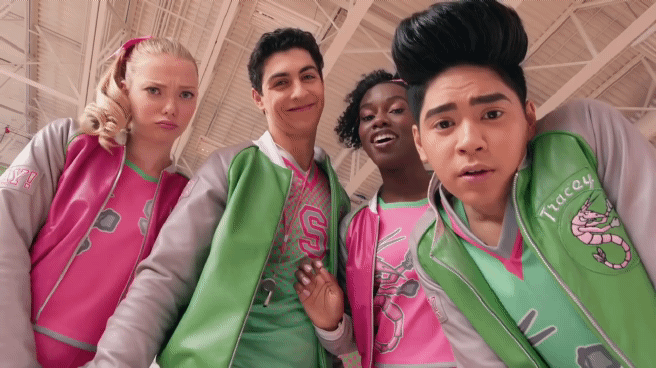
A zombified tale as old as time made trendy for today's junior Walking Dead audiences, the Valentine's week debut of Disney's Zombies marked a gutsy programming decision for a network well-known for its success updating the House of Mouse's popular 1960s bright, beachy, musical romcom formula for youthful twenty-first century audiences.

Based upon Zombies and Cheerleaders, an unaired 2012 Disney Channel pilot from screenwriters David Light and Joseph Raso, the 2018 feature length iteration brought back the two series creators, granting them the chance to infuse their clever concept with an even more contemporary twist.


Taking the idea of a wrong side of the tracks romance to bold new heights, Disney's Zombies opens with a vibrant animated prologue which brings us up to speed. Fifty years ago a power company accident with lime soda whipped up a contaminated haze potent enough to turn some of the residents of the formerly idyllic Seabrook into zombies. Fearing for their lives, those unaffected by the contaminant decided to build a Cold War, Berlin style wall to keep the two groups apart.

Fortunately, with their hunger for brains soothed by electro-pulses delivered throughout the day from a smartwatch dubbed a Z-band, the zombie students of Zombietown (including our charming main character Zed, played by Milo Manheim) are excited to follow through on a recent city council decision to allow zombies to attend school alongside the humans of Seabrook.


When his dream to play for Seabrook High School's football team is dashed by a fearful principal who vows to keep the students separated by segregating the zombies to a dingy basement, Zed decides to break free – thinking if people just met him (as well as his friends) – they would surely see there's little difference between them after all.

Although his optimism is temporarily crushed by a school-wide panic when a student spots Zed and sets off the zombie version of a fire alarm, he gets a second chance at a first impression when he meets a beautiful human in the form of aspiring cheerleader and fellow freshman, Addison (Meg Donnelly).

Taking shelter in the dark, the two engage in friendly banter before they even catch sight of one another (and despite her catching his eye earlier in the film). Yet while Addison's initial defensive response was to punch the tall, cute, green haired zombie on sight as soon as the lights came on, once she comes to her senses, she's just as fast with an apology, realizing that perhaps zombies aren't the horrible people her parents, cousin, and others believe them to be.


Particularly empathetic due to a genetic challenge of her own (which was revealed in an effective Ferris Bueller style introduction that broke the fourth wall in order to endear the characters to the viewer while also make us realize how right they are for one another), although all Addison wants is to be normal, she understands more than most how unfair it is to judge others just for being different.

Though it's not your average tween spin on Beauty and the Beast, you don't have to be a Z-band scientist to see where Disney's Zombies is going. And while it's safe to say that younger audiences are sure to enjoy the TV movie, some of the swing-for-the-fences performances and shout-tastic line delivery might drive away those old enough for iZombie or Disney’s big sister channel, Free Form.

Helmed by longtime Disney Channel veteran Paul Hoen (director of past original movie hits including The Mistle-Tones, Camp Rock 2, and Cheetah Girls: One World) and choreographed by Christopher Scott and Steven Vincent, it’s well-worth putting up with a few cartoonish moments to relish in some of the work's mind-bogglingly impressive song-and-dance sequences.


With echoes of everything from West Side Story to Bring It On and Michael Jackson’s Thriller to the Step Up series all blended together, it’s far more daring in its musical moments than it should've been from a storytelling perspective – missing ample opportunities for mild scares and stronger character development in order to push its topical themes even further.

And although it touches on present day allegory – namely the idea of a wall to keep out a population the “perfectly planned" community of Seabrook finds undesirable – and boldly begins to weave some real world applications into its clever plotline, unfortunately the zombiefied premise becomes increasingly Disneyfied as the movie continues. That isn't to diminish what Light and Raso did, however, as you do have to give them credit for even referencing these ideas at all in what most would consider just a light entertainment.


Given its impressive production design, which teaches film literacy by providing both zombies and human sets, costumes, etc with a specific and strict color palette right from the start before eventually letting the shades run together, it's an outstanding example of true creativity and proof why you can't simply write off these network titles as generic kiddie fare. And in addition to Disney's trademark motion picture level dance sequences, Disney's Zombies boasts a few surprisingly effective songs that surely helped attract nearly three million viewers in its February 16 debut.

Filling the DVD with audition footage, bloopers, deleted scenes, and a few fun zombified extras including a sheet of glow-in-the-dark tattoos, while this musical geek was hoping for more behind-the-scenes extras relating to the film’s audacious themes and choreography, it’ll definitely delight the young zombie fans in your life.

Check Out the Soundtrack


Text ©2018, Film Intuition, LLC; All Rights Reserved. http://www.filmintuition.com Unauthorized Reproduction or Publication Elsewhere is Strictly Prohibited and in violation of the Digital Millennium Copyright Act.  FTC Disclosure: Per standard professional practice, I may have received a review copy or screener link of this title in order to voluntarily decide to evaluate it for my readers, which had no impact whatsoever on whether or not it received a favorable or unfavorable critique.

7/03/2016

Warner Archive Collection DVD Review: The Girl Most Likely (1958)

Longing for the kind of love she sees in the movies (and often disappointed in the real thing), when we first meet Jane Powell's Dodie in the newly released Warner Archive DVD of the 1958 classic The Girl Most Likely, our hopelessly romantic heroine seems much more certain that she'd like a hot dog than a husband.

Of course (and par for the Hollywood course), three proposals and roughly ninety minutes of screen time later, Dodie finds herself singing a different tune – literally – as The Girl Most Likely (To Change Her Mind) in director Mitchell Leisen's Technicolor musical remake of the 1941 black-and-white Ginger Rogers romantic comedy vehicle Tom, Dick and Harry.

Retaining some of the faster-paced original's memorably terrific one-liners, while Girl doesn't play quite as well as the first film from a screwball comedy perspective, it surpasses its predecessor in terms of sheer spectacle alone.

Bolstered by the freedom that goes hand-in-hand with the "let's put on a show" mentality of the anything goes friendly musical genre, you have to commend Girl's creators for not simply settling to make a colorized carbon copy of the original.

And admittedly, although both films rely much too heavily on the use of dream sequences to bring you inside of the confused mind of the romantically challenged Dodie, Girl works its moments of fantasy into the overall storyline far more successfully than 1941's Tom.


Stopping short of turning the original's greatest weakness into the remake's greatest strength, as the last RKO picture produced at the Hollywood studio, Girl's gifted cast and crew went above and beyond in their quest to entertain.

With choreographer Gower Champion as the film's tireless MVP, those on both sides of the camera fill the screen with so much movement, life, excitement, and color that it frequently spills outside of the frame.

Midway through the movie, Girl temporarily abandons the plot for an international variety show approach, using what feels like RKO's entire costume collection in a series of crowd-pleasing (if not exactly cohesive) numbers that pay "It's a Small World" style tribute to one country and/or culture after the next.

Fortunately realizing they have a plot to resolve – much like Powell's indecisive lead – Girl's filmmakers change their mind just in time to get things back on track for a predictably delightful conclusion.

While it still retains a bit of the original's sharp satirical edge, Girl is most effective as a frothy, fun musical film that stands as well on its own as it does as part of an impromptu Warner Archive double feature with the collection's earlier DVD release of Tom, Dick and Harry.

Bookmark and Share

Text ©2016, Film Intuition, LLC; All Rights Reserved. http://www.filmintuition.com Unauthorized Reproduction or Publication Elsewhere is Strictly Prohibited and in violation of the Digital Millennium Copyright Act.  FTC Disclosure: Per standard professional practice, I may have received a review copy of this title in order to voluntarily decide to evaluate it for my readers, which had no impact whatsoever on whether or not it received a favorable or unfavorable critique.

6/03/2016

Movie Review: High Strung (2016)


Having arrived in New York to pursue their passions, a brooding British violinist and beautiful ballet student learn to face the music and dance over the course of this pleasant if admittedly predictable Fame meets Once style musical romance.

Named Ruby after a Balanchine ballet and seemingly destined for a life on the stage, in High Strung, Keenan Kampa’s first year Manhattan Conservatory of the Arts student struggles to dance with her heart instead of her head – similar to the way that Nicholas Galitzine’s busking violinist Johnnie does while composing by ear with the world as his muse.


Nonetheless believing that "dancers dancer no matter what," once the two cross paths in the midst of a robbery that finds Johnnie’s beloved grandfather’s violin stolen, Ruby is more determined than ever before to follow her heart and make things right.

After some early push-and-pull which is vividly brought to life in a terrific tango sequence that gives the film a much-needed shot of adrenaline, Ruby joins forces with the initially reluctant musician to compete for a prize that could pave the way to both of their dreams.


While fans of the well-tread genre know precisely where the film and its characters are headed, fortunately for director Michael Damien (who penned High Strung alongside wife Janeen Damian), few audiences are as loyal or forgiving of flaws as song and dance movie devotee, as this fan can personally attest.

Hindered by blandly written characters and (everything but the dance numbers) by-the-numbers dance picture predictability, although the film’s otherwise talented leads don’t exactly set the screen ablaze with their less than fiery chemistry, the affable cast never fails to give it their all.


Shining its brightest when High Strung’s musical performances take Center Stage, the high in energy yet low in originality movie manages to distract us from the inevitably triumphant conclusion with Viorel Sergovici’s lush cinematography, Nathan Lanier’s stellar score, and Dave Scott’s innovative choreography.

Having graduated to features after helming a series of memorable TV movies and direct-to-disc hits (including a few terrific Flicka sequels), High Strung marks an admirably ambitious undertaking by director Michael Damian.

A refreshingly clean spin on Dirty Dancing-like material safe for the High School Musical or Teen Beach Movie set, while perhaps it’s only mildly successful in its own right, High Strung will undoubtedly to appeal to genre lovers eager to Step Up for another opportunity to Save the Last Dance.

Related Review - High Strung: Free Dance (2019)


Bookmark and Share

Text ©2016, Film Intuition, LLC; All Rights Reserved. http://www.filmintuition.com Unauthorized Reproduction or Publication Elsewhere is Strictly Prohibited and in violation of the Digital Millennium Copyright Act.  FTC Disclosure: Per standard professional practice, I may have received a review copy of this title in order to voluntarily decide to evaluate it for my readers, which had no impact whatsoever on whether or not it received a favorable or unfavorable critique.

6/05/2015

DVD Review – Looney Tunes: Musical Masterpieces (2015)


Now Available to Own   


Photo Slideshow


Although Merrie Melodies most likely began as Warner Brothers Animation's own Looney Tunes styled response to Walt Disney’s Silly Symphony cartoon shorts that dominated the Academy Awards during their triumphant ten year run from 1929 to 1939, WB’s Melodies struck a popular chord with audiences so much so that the series (which began in 1931) lasted until 1969.

Acclaimed one-reel shorts that thusly never ran longer than ten minutes, Warner’s Merrie Melodies define the golden age of animation for the studio.


Daring in their musicality yet familiar in their packaging, the shorts – which starred some of the Looney Tunes most beloved characters (from Bugs Bunny and Elmer Fudd to Porky Pig and Speedy Gonzales) –grew even more celebrated with each passing year.

Frequently serving as their youngest viewer's earliest introduction to the world of classical music, the Merrie Melodies, which also took their cues from (and likewise inspired) the feature length Hollywood musicals they played alongside theatrically, additionally helped pave the way for the rock docs and music videos that would follow.


Breaking cultural barriers, the eighteen animated shorts included in this one disc collection feature everything from jazz and opera to piano concertos and the blues, illustrating the diverse range of the series.

Framing the action as part of a chase in some of their most popular hits (not unlike the way their biggest 1940’s rival, Metro Goldwyn Mayer did with their historic Tom and Jerry releases), the ingeniously crafted Merrie Melodies made each and every genre accessible to viewers of all ages and levels of musical education.


Boldly removing dialogue here and there, such as in a bulk of the revered classic Rabbit of Seville, the master craftsmen working behind the scenes strove to bring the emotion of the music front and center with each successive release.

Yet as entertaining as the diverse titles were, one of Merrie Melodies' greatest achievements was in the way it would routinely drive home the fundamentals of rhythm and tempo right alongside the story's tongue-in-cheek plotlines and occasional lessons about empathy, hard work, respect, and love rolled into the laughs.

Of course, not every offering had a larger moral behind it as we quickly discover in the often heavily censored, violent Ozarks set square dance Hillbilly Hare.


Wisely lessening the shock value of the short, (which like a few others hasn't often seen the light of day as part of the overly crowded archive collection), Hare plays right after the 1957 Chuck Jones helmed masterpiece, What's Opera, Doc? that was selected as the "greatest cartoon ever made" in a 1994 research study voted on by a thousand professionals working in the field of animation.

No stranger to the art form or devising great chases, having directed some of the best Tom and Jerry shorts in MGM history, it's always a thrill to see the Jones classic in all its glory.

One of three Merrie Melodies shorts included in the Library of Congress's National Film Registry along with the Jones directed One Froggy Evening (which happens to be featured on this DVD as well) and Duck Amuck, Elmer Fudd's familiar strains of "Kill the Wabbit" in What's Opera, Doc? are instantly recognizable for generations of viewers.

Although it's missing Duck Amuck as well as the trio of Merrie Melodies that garnered Warner Brothers Academy Awards in the category of Best Original Short, the inclusion of the still heartbreakingly beautiful Nelly's Folly, among other rarities, is a bonus.


Nonetheless, the order of the shorts is a bit awkward in places throughout the lengthy presentation. For, following the intelligent back-to-back listing of two send-ups of Walt Disney's Three Little Pigs made fifteen years apart that involve a shared character, WB’s enjoyable Oscar nominated Rhapsody in Rivets, which plays best as a prequel to Rhapsody Rabbit is positioned eleven tracks after what should technically be its follow-up title.

Boasting optional commentary tracks for the shorts including a few multiple offerings and special features for some of the disc's most iconic works, Musical Masterpieces is a thorough release that will appeal to a wide array of viewers from children to casual fans and cinephiles alike.


And given that this is a phenomenal 133 minute plus introduction to the dying art of animated theatrical shorts, I only hope that this is just the first in a series of Looney Tunes: Musical Masterpieces releases that will make their way to DVD (or better yet, Blu-ray).

Created in the era of the talkie (as silent films merged with the music that was often performed live in movie-houses across the country), the Merrie Melodies collected here serve as an entertaining and informative reminder of just how innovative the field of animation, medium of short film, and particularly the genre of musical movie-making can be.

Bookmark and Share

Text ©2015, Film Intuition, LLC; All Rights Reserved. http://www.filmintuition.com Unauthorized Reproduction or Publication Elsewhere is Strictly Prohibited and in violation of the Digital Millennium Copyright Act.  FTC Disclosure: Per standard professional practice, I may have received a review copy of this title in order to voluntarily decide to evaluate it for my readers, which had no impact whatsoever on whether or not it received a favorable or unfavorable critique.