Showing posts with label Toni Collette. Show all posts

9/03/2020

Netflix Movie Review: I'm Thinking of Ending Things (2020)


Writer-director Charlie Kaufman's “I'm Thinking of Ending Things,” begins with the words “I'm thinking of ending things.” Spoken in voice-over by the unnamed female protagonist (Jessie Buckley) at the center of the surrealist helmer's third feature film, in the lines that follow, we quickly deduce that she's pondering taking not her own life but herself out of her sparks-free relationship with the otherwise nice, unassuming Jake (Jesse Plemons), whom she's dated for seven weeks. 

Resigned to taking a road trip with the man nonetheless, the two embark on an unusual journey home to meet his parents (Toni Collette and David Thewlis) at the farmhouse where he was raised. The couple is as polite as they are awkward with one another. Misreading each other's signals and on different wavelengths about not only their relationship but everything else as well, they have parallel arguments that only occasionally intersect.

Colliding most notably when he cajoles her into sharing one of her poems, Buckley's soulful recitation of the complex, deeply affecting “Bone Dog” by Eva H.D. (which is presented as though she wrote it) is one of the high points of the movie. Touching on certain themes and elements that recur throughout the film, the seductive sequence engages us completely. 

Yet even before Jake responds by saying that he identified with the piece and felt like she was writing it about him, the antennae of any literature majors and film buffs watching is already up, listening and digesting Buckley's words as a bit of self-conscious signposting or foreshadowing about their journey ahead. Knowing this, of course, the erudite Kaufman treats the poem like a tease and one that's as much about their quest to go home to meet his parents as it is just the first of many pieces of art, music, film, literature, culture, and criticism references to eventually follow.

“I'm Thinking of Ending Things” returns once again to the same questions of whether or not we are what we do and/or consume that have plagued Kaufman from the beginning of his career. Evidenced in his brilliant existential screenplays for “Being John Malkovich” when its characters were most themselves in the body of another or the charge that Kate Winslet's manic pixie dream girl in his script for “Eternal Sunshine of the Spotless Mind” relied on hair dye to compose her personality, all of these ideas get filtered into “Ending Things” to positive and negative effect.


Inserting a faux romantic film (fictionally directed by Robert Zemeckis) in the second act of the movie before its plot and characters spill over into the personalities of our young couple, Kaufman goes a bit further later on. Using a more subtle approach in the film's intentionally maddening second half, the pair debate and momentarily seem to embody the leads from “A Woman Under the Influence,” as well as Pauline Kael's review of the Cassavetes classic in a blistering sequence.

A poet in the car who becomes a painter in the house but also a college student studying quantum physics and a waitress, just as the biographical elements of Buckley's “young woman” change in Kaufman's film so does everything else, including the ages of both of our protagonists as well as his enigmatic, affable, yet slightly creepy parents. Then again, I should probably put the word parents in quotations because while we're initially led to believe that Collette and Thewlis are playing the parents of Jake, an argument could also be made that they're not.

In fact, that's the main thrust of this movie overall. We're never quite sure if we're seeing things the way they are or if these are daydreams or shifts backward or forward in time. The latter, we find, is explicitly referenced in the dialogue at one point and taps right back into the issue of quantum physics. 

(Over six hundred words in and I'm probably no closer to describing or making sense of the film that has still stayed with me since I screened it, but moving on...) 

Playing like a magical realism version of “Our Town” as directed by Federico Fellini, “I'm Thinking of Ending Things” is a stream-of-consciousness movie that grows more unwieldy as it continues. Weaving in ballet in just one of a handful of sequences inspired by “Oklahoma,” Charlie Kaufman's film, which was adapted from the acclaimed novel by Iain Reid, is unquestionably enhanced by having seen not only Kaufman's “Synecdoche New York” (which I really didn't like) and “Anomalisa” (which I really did) but the films he wrote for other directors as well.


In my eyes, he's at his best when he lets others – including Spike Jonze and Michel Gondry – interpret his mad artistic visions in such a way that, as dizzying and dense as they are, they become far more universal in scope. Without this vital human filter of another creative mind behind the camera, there's something about Kaufman's work as a director that keeps most mainstream audiences at not just an arm but the state of Oklahoma's length away. 

It's telling that of the three films I've seen that he's made, it's “Anomalisa,” which he shared directorial duties with Duke Johnson, that I liked the best. Perhaps needing that valuable cinematic translator or just someone who can take a look at his work and pare some of it down to only what is absolutely essential, the more he packs into the otherwise mostly excellent “I'm Thinking of Ending Things,” the messier it becomes. Still, as a treatise on relationships, aging, identity, and mortality, Kaufman's latest is far more relatable, in my eyes, than “Synecdoche New York,” which I actually watched again to prepare for this review and was disappointed to see that I still dislike. 

In addition to his many existential obsessions, which manifest in the strangest of ways throughout his work, however, one constant in every single one of Kaufman's films as both a screenwriter and director is that they're brought to life by an extraordinary cast. “I'm Thinking of Ending Things” (which arrives on Netflix on September 4) is no exception to this rule and features dynamic turns by all of its leads, most notably Buckley and Plemons.

A movie you'll undoubtedly want to discuss with others if, that is, you manage to make it all the way through since it was even a challenge for me (and I was hugely on board with it for at least the first 90 minutes), “I'm Thinking of Ending Things” should have ended things a little sooner than its 134-minute running time.

There's an old adage that because we all approach things differently and with our own experiences, attitudes, and backgrounds, that no two of us ever truly “sees” the same film. This movie proves that philosophy true better than any academy essay ever could. At the same time, it also seems to use it as a challenge to not only ensure that we all see something different in the same metatextual heavy text but also reminds us that what we think of something at one time might not be the same belief we have just five minutes later. In the end, it's all a matter of physics after all.  


Text ©2020, Film Intuition, LLC; All Rights Reservedhttps://www.filmintuition.com  Unauthorized Reproduction or Publication Elsewhere is Strictly Prohibited and in violation of the Digital Millennium Copyright Act.  Also, as an Amazon Associate, I earn from qualifying purchases made off my site through ad links. FTC Disclosure: Per standard professional practice, I may have received a review copy or screener link of this title to voluntarily decide to evaluate it for my readers, which had no impact whatsoever on whether or not it received a favorable or unfavorable critique. Cookies Notice: This site incorporates tools (including advertiser partners and widgets) that use cookies and may collect some personal information to display ads tailored to you etc. Please be advised that neither Film Intuition nor its site owner has any access to this data beyond general site statistics (geographical region etc.) as your privacy is our main concern.

2/01/2019

Netflix Movie Review: Velvet Buzzsaw (2019)


Now Playing 


Bookmark and Share

A satirical horror movie set in the modern art world, whether you're looking for a late night thrill or don't mind working a little harder to engage with a film on a deeper level, Velvet Buzzsaw will surely do.

Filled with witty wordplay and morbid metaphors brought vividly to life, in the weird and wonderful multi-layered third work from writer-director Dan Gilroy, even the character names are entertaining.


From Jake Gyllenhaal's taste-making art critic Morf Vandewalt, whose body language, voice, and taste morphs from one scene to the next to Rene Russo's gallery owner Rhodora Haze, whose Lolita-esque last name alludes as much to her younger days as a sexy, hard-living punk rocker (in the titular band) as it does her hazy business ethics, there's a lot here to savor.

Rather than opt for a traditional first person narrative, Gilroy's film takes a cue from Altman's oeuvre with its approach to storytelling. Set at the intersection of art and commerce where creativity is overshadowed by talk of demand, money, and the market, Buzzsaw revolves around a handful of characters who play very different roles in the industry from assistants and installers to artists and museum curators.


Led by Gyllenhaal and Russo (who co-starred in Gilroy's feature filmmaking debut Nightcrawler), Buzzsaw co-stars Toni Colette, John Malkovich, Zawe Ashton, Daveed Diggs, Natalia Dyer, Tom Sturridge, and Billy Magnussen who all seem to delight in Gilroy's mischievous script, which satirizes the commoditization of art in a way that could just as easily apply to film, publishing, or music.

Though undoubtedly anchored by Gyllenhaal's Vanderwalt, who looks like he had the time of his life on this film, Buzzsaw's real breakout turn is Zawe Ashton as Russo's ambitious assistant Josephina, who stumbles onto an apartment filled with art after her elderly neighbor dies with no heirs.


Initially entering the apartment to find and feed his cat, even though the man had left explicit instructions to destroy his art upon his death, Josephina can't resist bringing some to Morf to evaluate.

Fascinated by her discovery, with Morf's ecstatic approval, she teams up with the scheming Rhodora Haze to curate a show, destined to make her a superstar.

Soon after, the deceased Vitril Dease becomes the hottest name in art but as Morf digs into his past for a book and uncovers one disturbing story after another, he realizes a bit too late that the darkness pouring off the canvas and into the lives of those around him, which has resulted in multiple deaths, might be connected to Dease.


Lensed by Robert Elswit, the There Will Be Blood cinematographer makes the most of Gilroy's inventive frames right from the start as we explore a bizarre modern art convention in Miami where certain phrases (either in lights or spoken by an art installation robot) add another layer of foreshadowing and character revelation to the film. Needless to say (and fortunately for Netflix), Velvet Buzzsaw is designed to play even better on repeat viewings when we can take in every element.

Sure to be Netflix's next big post-Bird Box hit, with darkly comedic witticisms, up-to-the-minute satire, and shocking comeuppances performed by its stellar cast, Gilroy replaces the pre-credit shock sequence and familiar jump scares of retro horror fare with something irresistibly, thrillingly new.

Dare I say, I think Morf Vanderwalt would approve.


Text ©2019, Film Intuition, LLC; All Rights Reserved. http://www.filmintuition.com Unauthorized Reproduction or Publication Elsewhere is Strictly Prohibited and in violation of the Digital Millennium Copyright Act.  FTC Disclosure: Per standard professional practice, I may have received a review copy or screener link of this title in order to voluntarily decide to evaluate it for my readers, which had no impact whatsoever on whether or not it received a favorable or unfavorable critique. Cookies Notice: This site incorporates tools (including advertiser partners and widgets) that use cookies and may collect some personal information in order to display ads tailored to you etc. Please be advised that neither Film Intuition nor its site owner has any access to this data beyond general site statistics (geographical region etc.) as your privacy is our main concern.

6/26/2018

Movie Review: The Yellow Birds (2017)


Now Available


Bookmark and Share

Striving to do justice to Iraq veteran Kevin Powers' eponymous 2012 award-winning novel, Blue Caprice director Alexandre Moors anchors his adaptation of The Yellow Birds with lyrical Thin Red Line style voice-over narration and scenes that – like a river – sway back and forth in time.

A solidly made if ultimately underwhelming war picture, although it's elevated by an impressive ensemble of actors, Birds fails to connect us in any real way to a majority of the young soldiers we follow from boot camp into Iraq over the course of the film.


The Achilles Heel of the genre, while at least we get a better sense of the characters than we did in Black Hawk Down –thanks largely in part due to the decision to bring the mothers of our two leads (played by Jennifer Aniston and Toni Collette) into the narrative – just when we begin to bond with the main characters in The Yellow Birds, we unexpectedly move on.

And while these segues provide a very real, stylistic link to the unpredictability of life during wartime, when you combine the narrative shortcomings with the film's mere ninety-five minute running time, it's easy to wonder how much material was left on the cutting room floor or not shot at all due to budget and/or time constraints.


Originally developed by Pete's Dragon writer/director David Lowery who was forced to drop out due to scheduling conflicts, when he first climbed aboard Birds as a replacement director, Moors found himself working not only from a novel but also the script and vision of someone else.

Hoping to remedy that, he hired his Blue Caprice writer R.F.I. Porto to revise Yellow's script, which led to more delays and cast changes. And while as a experienced writer, director, and editor in his own right, Moors was able to find his groove, certain scenes in the film feel muddled enough that you get the impression that they might have worked better in – if not a different movie altogether – than at least a different version of the script or final cut.


Repeatedly moving from past to present throughout to find the soldiers pre-war, in war, and post-war, the film follows the experiences of eighteen year old Daniel Murphy and twenty year old John Bartle (played by Tye Sheridan and Alden Ehrenreich) who become fast friends in boot camp before they're quickly deployed overseas.

And although we know what happens to one of the two characters due to an ill-advised opening narration that must've worked much better in Kevin Powers' novel than it does here, more than just filmic CliffsNotes, The Yellow Birds is still a beautifully rendered and haunting portrait of the way that war changes the men and women who answer the call.

Not nearly as impactful or as cohesive as it wants to be however, unfortunately aside from Murphy, Bartle, and their mothers, the other characters are shortchanged throughout.


At its best when it opts for an understated approach as opposed to a late-introduced, heavy handed baptismal motif that immediately pulls you out of the movie, Birds is nonetheless average overall.

Breaking our heart in two memorable sequences, particularly by way of a bittersweet dance scene which bookends the work, although it doesn't soar for very long, just like real birds, Moors' Yellow Birds dazzles more in the quiet moments than it does during war.


Text ©2018, Film Intuition, LLC; All Rights Reserved. http://www.filmintuition.com Unauthorized Reproduction or Publication Elsewhere is Strictly Prohibited and in violation of the Digital Millennium Copyright Act.  FTC Disclosure: Per standard professional practice, I may have received a review copy or screener link of this title in order to voluntarily decide to evaluate it for my readers, which had no impact whatsoever on whether or not it received a favorable or unfavorable critique. Cookies Notice: This site incorporates tools (including advertiser partners and widgets) that use cookies and may collect some personal information in order to display ads tailored to you etc. Please be advised that neither Film Intuition nor its site owner has any access to this data beyond general site statistics (geographical region etc.) as your privacy is our main concern.

6/15/2018

Movie Review: Hearts Beat Loud (2018)


Now Available


Bookmark and Share

Having flirted with original songs and musical moments in his two previous pictures – perhaps most notably in the moving ensemble dramady more deserving of a bigger audience, I'll See You in My Dreams – writer/director Brett Haley decided to fully embrace the genre that made him fall in love with theatrical storytelling back in high school with this summer's feel great indie, Hearts Beat Loud.

Sure to be a word-of-mouth hit, although it's not a traditional musical in the song and dance sense of the word, much like John Carney's recent works Once, Begin Again, and Sing Street, Hearts Beat Loud is centered on the art of making music.


However, much like taking a song we've heard before and putting it in an entirely new key, the fact the characters in the film are father and daughter as opposed to simply two members of a band sets this effort from Haley and co-writer Marc Basch apart from the pack.

Giving it added urgency, Hearts is set during the last summer that Nick Offerman's widowed father Frank Fisher has to spend with his brainy seventeen year old only daughter, Sam (played by Dope's Kiersey Clemons in a star making role) before she's set to trade Red Hook, New York for med school at UCLA.

More than just a mere hobby, as explained by Haley in the press notes, music is Frank and Sam's preferred “mode of communication.” In impromptu jam sessions, Frank's guitar, Sam's keyboard and the lyrics she scribbles in her journal (the same way her rocker turned record store owner father did before her) allow the two speak “the language they know best.”


An obsessive High Fidelity level music encyclopedia, since Frank is clearly the more enthusiastic of the two, initially we get the sense that Sam might just be indulging her father in his favorite ritual. But once we hear her record and mix the song they'd pieced together like a puzzle, we understand not only how tremendously talented the seemingly introverted overachiever is but also just how much she thrives on a musical outlet because it gives her the opportunity to process thoughts to her father she otherwise might not.

Having met a beautiful aspiring artist (played by American Honey star Sasha Lane), it isn't until Frank helps Sam decipher the lyrics she's written which she sings with such earnest soulfulness that she realizes she's fallen in love.

Enjoying her new summer romance even though she's set to leave in the fall, Sam's future is complicated even more after Frank submits the film's infectious title track to Spotify and it begins to catch on.


While, like Once, Hearts is ultimately light on plot, there's much more going on in the film than meets the eye. Perhaps best epitomized near the beginning of the movie – given that we're first introduced to Sam in a class discussion on medical symptoms of the heart right before she meets her love interest – in addition to showcasing the creative process, in Hearts, Haley pays tribute to the way that life inspires art.

Filled with symbolism, the film makes the most of its character driven plot in big ways as Frank faces a future without Sam and/or his failing record store (both of which Haley and Basch inform us are approximately the same age) or small ones as witnessed in a lovely sequence where Sam learns to ride a bike, move forward, and let go.


Complete with a standout soundtrack, the movie boasts four terrific original songs by its composer Keegan DeWitt, who much like Basch has collaborated with Haley on his last two films which premiered at Sundance, much like Hearts.

One of my favorite films of 2018 so far, Hearts Beat Loud achieves the darn near impossible feat of telling the story of a relationship between parents and teens that's not only positive in its tone but also feels real.


And while a great deal of the credit for that goes to the believable chemistry between its two stars, it's buoyed by great character performances from its supporting players throughout, including Toni Collette as Frank's landlord with romantic potential, Ted Danson as his local bar owning friend, plus Haley's I'll See You in My Dreams leading lady Blythe Danner as Frank's dementia laden mother.

Reminiscent of his Cheers days, as the purveyor of bartender wisdom, Danson steals scenes with ease. And although admittedly some of Danson (as well as Sasha Lane's) quotable lines of advice could qualify as signposting – which in most movies could threaten a viewer's suspension-of-disbelief – the reason Hearts gets away with it is owed as much to its genre as its plot.

At a pivotal crossroads in both of their lives, it's safe to assume that both father and daughter could use some guidance. Plus there's something absolutely musical about the brevity of lines such as "you have to be brave before you can be good." And who knows? Their lines just might end up in a song so good that, as with Hearts you'll find yourself wanting to sing along.


Text ©2018, Film Intuition, LLC; All Rights Reserved. http://www.filmintuition.com Unauthorized Reproduction or Publication Elsewhere is Strictly Prohibited and in violation of the Digital Millennium Copyright Act.  FTC Disclosure: Per standard professional practice, I may have received a review copy or screener link of this title in order to voluntarily decide to evaluate it for my readers, which had no impact whatsoever on whether or not it received a favorable or unfavorable critique. Cookies Notice: This site incorporates tools (including advertiser partners and widgets) that use cookies and may collect some personal information in order to display ads tailored to you etc. Please be advised that neither Film Intuition nor its site owner has any access to this data beyond general site statistics (geographical region etc.) as your privacy is our main concern.

7/03/2016

Film Movement DVD Review: Glassland (2014)


Now Available to Own 


  Photo Slideshow


When thinking of a title for what would eventually become his second feature film, Irish writer/director Gerard Barrett recalled an old saying warning that if you ever crossed the line and committed a crime, you’d spend the rest of your life walking on glass.

But when juxtaposed with “land” as in the Glassland that sums up the film as well as the fictional environment in which Barrett’s work is set, suddenly the title takes on an even greater meaning which not only strengthens his already stellar character driven drama but also makes Glassland that much harder to forget.

Set in the south Dublin town of Tallaght, Ireland and centered on the fractured relationship between a dutiful hardworking adult son struggling to care of an alcoholic mother who spends most of her days and nights drinking herself to death, Glassland paints an initially bleak picture of a country known around the world for its famed pub scene.

Anchored by Jack Reynor’s breakout performance as John in his Sundance Film Festival award winning role, Glassland gradually evolves into a humanistic chamber piece that transcends borders and boundaries while celebrating the complex bond between a mother and her child.


Contrasting John’s desperate plight to sober up his stubborn mom in order to save her life with the way his more apathetic mate’s mother lavishes him with love and affection, Barrett’s cinematic portrait is most poignant when he lets us see all of shades of gray in between extremes of black and white.

And while Glassland drives its message home in a powerful scene where John’s mother (played by the always compelling Toni Collette) breaks apart every glass plate in the house (and breaks her son’s heart in the process), it’s in the quieter, less-showy moments that Barrett pieces together its most effective visual, yet no less visceral poetry.

Knowing this story is more about people than plot, in three scenes that most filmmakers would’ve left on the cutting room floor like shards of glass in Collette’s kitchen, Barrett takes the opportunity to give us an even closer look at his characters’ lives.

From the way that John uses music to bridge the gap between language and emotion when communication fails to the unparalleled joy on the face of his special needs brother as John drives him around and around in circles in a parking lot, we sense how important the illusion of escape is to those whose lives feel out of control.

Refusing to play his character as mere victim or savior, in a staggeringly powerful performance, Reynor not only holds his own with Collette but says more with a look than words, which comes in particularly handy since Glassland is as fast paced as it is frequently quiet.


Working in a variety of subplots that all feel organic, Glassland steers clear of the TV-movie-of-the-week style melodramatic trappings that often go hand-in-hand with titles dealing with alcoholism by making the issue just one fact of John’s complicated life.

At times reminiscent of Cassavetes and Loach, through our lead’s strikingly powerful Neorealist inspired journey, Barrett touches on other contemporary socioeconomic concerns that feel as universal as the central storyline.

Nonetheless, in spite of a rushed final act which leaves us with a few lingering questions and makes us wonder whether the script had followed a more traditional thriller paradigm earlier on, by holding up a mirror to all those that populate Glassland, Barrett’s love for his characters (like John’s love for his mother) shines through – flaws and all.


Bookmark and Share

Text ©2016, Film Intuition, LLC; All Rights Reserved. http://www.filmintuition.com Unauthorized Reproduction or Publication Elsewhere is Strictly Prohibited and in violation of the Digital Millennium Copyright Act.  FTC Disclosure: Per standard professional practice, I may have received a review copy of this title in order to voluntarily decide to evaluate it for my readers, which had no impact whatsoever on whether or not it received a favorable or unfavorable critique.

12/01/2014

DVD Review: Lucky Them (2013)


Now Available to Own   
On DVD and Download


As a scribe myself, I've always been amused by the fact that journalism (or the most glamorous version of it) seems to be a favorite career for the heroines of chick-lit paperbacks and romantic comedies where somehow advice columnists and how-to girls can afford to live a lifestyle worthy of Harper's Bazaar.

Although not technically a romcom, Lucky Them is that rare film centered around a female journalist that not only manages to get the details of the career right but also nails the indie music scene that fuels the events of — and serves as the backdrop for — Megan Griffiths' solidly constructed independent film.

Featuring a stellar turn by Toni Collette as a talented senior writer for a Rolling Stone-like magazine that's been nearly made obsolete thanks to the iTunes driven TMZ world, as the film opens Collette's rock journalist Ellie Klug is given yet another ultimatum by her longtime friend and editor (played by Oliver Platt).


Told she has to reclaim her place at the magazine where content is now driven by commercial ads and clickbait traffic, she's forced to mine her personal life for a story when assigned to track down her Kurt Cobain/Elliott Smith/Jeff Buckley inspired rocker ex Matthew Smith, who'd abandoned her fifteen years earlier without a word.

Whereas half of his fans have been hanging on to the dream that Smith is alive, the rest gave up on that idea years ago after his car was found deserted near a waterfall. Reluctantly journeying after the man who not only broke her heart but also took a piece of it with him when he disappeared, Ellie soon discovers that the search for the truth about Smith may also hold some answers about her own life that she might not be ready to face.

Regularly taking part in casual hook-ups, Ellie often mixes business with pleasure, walking away before things get too serious —  keeping herself cut off from love as though she was involved in a high stakes game of emotional Russian roulette — undoubtedly too scared to put herself out there to be hurt once again.

After footage of what sounds an awful lot like Matthew singing about a blue-eyed love comes to the attention of the magazine, Ellie's sense of purpose only increases.

Almost out of money and swindled by a conman, Ellie reluctantly travels with a rich, straight laced, and brutally honest friend played by Thomas Haden Church who informs her that he'll happily fund her mission if he can record the process to put the skills that he learned in a documentary filmmaking community college course to use.


While Church plays well off Collette as the embodiment of two wrongs that we suspect may eventually and unexpectedly balance each other to make a right, his character is so unhinged and overly confessional that it comes across as slightly gimmicky — as if he's playing him like a filter free adult with a slight personality disorder. And as such, he needlessly pulls focus from the main storyline.

Likewise, while both characters are so well written and likewise embodied by two stellar talents, it's unfortunate that aside for the tale of midlife coming-of-age, the screenwriters didn't really have anywhere for the film's protagonists to go. And at times it feels as though Church could've wandered in from a different movie altogether.

This problem is undeniably magnified after Ellie has a fling early on with an up-and-coming musician (played by The Blacklist's Ryan Eggold), with whom she shares naturally palpable chemistry, especially when contrasted by the offbeat dynamic that's established by our two unlikely travelers in the last half of the picture.


Of course, the decision to let the lead wind up with a younger partner would never have even been questioned if a) the genders had been reversed and b) it would have been a Something's Gotta Give-like studio venture. Thus, it's a shame that the otherwise authentic, easy banter between Collette and Eggold is ignored in favor of seeing the heroine settle down with someone more traditionally suitable in a safe romantic movie cop-out.

Nonetheless it's amiable enough overall that just like Give, we can still overlook Lucky's one disingenuously dissonant note and accept the couple that comes together in time for the closing credits since the rest of the film offers us such strong harmony and a relatable refrain.


A striking achievement, aside from one key flaw, Lucky Them otherwise gets so much right. And much like Allison Anders's Grace of My Heart and Lisa Cholodenko's Laurel Canyon, rising star helmer Megan Griffiths strikes a beautiful chord (in tandem with her always impressive lead), while introducing us to a woman that rocks as well as she rolls out of the way of anything that threatens to ruin her rhythm.

All in all, it's a refreshing change in viewpoint from the go-go girls, groupies, goddess muse girlfriends, and interchangeable gal pals on the road often used as window dressing in most man-made behind-the-music movies of the past. For when it comes to these female-helmed works, to those determined to shake up gender depictions in the world of journalism and rock, we salute you.   

Bookmark and Share

Text ©2014, Film Intuition, LLC; All Rights Reserved. http://www.filmintuition.com Unauthorized Reproduction or Publication Elsewhere is Strictly Prohibited and in violation of the Digital Millennium Copyright Act.  FTC Disclosure: Per standard professional practice, I may have received a review copy of this title in order to voluntarily decide to evaluate it for my readers, which had no impact whatsoever on whether or not it received a favorable or unfavorable critique.

1/15/2014

Blu-ray Review: Enough Said (2013)


Now Available to Own   


Photo Slideshow   


Bookmark and Share

As true in 2014 as it was when when Flannery O’Connor warned us more than sixty years ago in her Southern Gothic short-story shocker turned single woman battle cry that “A Good Man Is Hard to Find,” if O’Connor were still around today, she might just as well write a sequel noting that in the social media age, a good friend is equally hard to find.


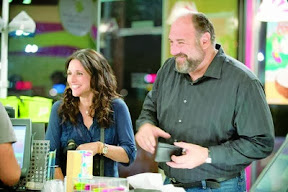
With this truism lurking somewhere in the background of the mind of the divorced Eva (Julia Louis-Dreyfus) as she once again tags along to a party as the third amigo to her married friends Sarah (Toni Collette) and Will (Ben Falcone), the beautiful masseuse is stunned to find two potential new strangers who each might fill the aforementioned roles in the exact same night.

While initially hired by the impressive poet Marianne (Catherine Keener) to massage her aching neck, the two form an easy friendship, bonding over stories of their exes which the neat-freak Marianne is all too eager to share in the form of a laundry list of complaints about her disappointing, overweight ex-husband.


Yet as Marianne’s complaints about her past escalate, Eva’s future romantic prospects change for the better when she begins to date the charming, likeminded TV cultural librarian Albert (the late, amazingly great James Gandolfini).

Though initially uncertain if she feels any attraction towards a man who may not match up with her ideal vision of a mate, Eva is understandably drawn to Albert’s laid-back conversational ease, gentle flirtation and quick sense of humor.


Experiencing that enviable feeling on their first date “like we were old friends already,” Eva grows more attracted to Albert, only to find her initial impressions of the man second-guessed by the alarming realization that he is precisely the “clumsy in bed… sloppy” ex-husband that Marianne is always ranting about.

Caught between her own respect for the new, accomplished friend whose taste and lifestyle she’s completely in awe of and her budding feelings of what might very well be love with Albert, Eva retreats into her own mind, encouraging Marianne to share more with each passing day and then evaluating the information during her time with Albert.


Trapped in a cruel science experiment, while in anyone else’s hands Eva would be considered unconscionably selfish or twisted, in the deft portrayal of Louis-Dreyfus whose inexperience as a dramatic actor is augmented by writer/director Nicole Holofcener’s incredibly articulate, sensitive script, we understand her dilemma from both sides even when we don’t understand why she just doesn’t trust her heart right from the start.

Yet at the same time, we appreciate the complexity of the situation from the point-of-view of a woman who is in an emotionally vulnerable place – not only due to a past divorce but also because her daughter/best friend will soon be leaving her for college and she’s bracing herself for how much heartbreak she can handle.

And even though we hold our breath and hope for the best, we know that there won’t be any shortcuts in her future as whatever way the relationships play out, eventually someone is going to learn the truth and get hurt. Likewise, we respect Holofcener’s ability to let events unfold naturally, without big pop-song fueled emotional breakthroughs that occur during a montage sequence or a lot of unnecessary speechmaking.


In what is easily one of the filmmaker’s strongest works (and that’s saying something as it comes directly off the heels of her previous masterwork Please Give), we’re treated to one of the year’s best and most mature treatments of grown up romantic love that can stand right alongside Richard Linklater’s Before Midnight and Joe Swanberg’s Drinking Buddies.

While admittedly it is a bittersweet success as James Gandolfini finally got the chance to show a sensitive, sweet, sexy side of himself that was always shut away during his typecast Sopranos era, for one of his final works Enough Said is a fitting way for him to be remembered. Additionally, his portrayal of Albert in Holofcener's film makes for a great last half of a Gandolfini Double Feature to go along with his recent turn in David Chase's Not Fade Away as well.

And although his absence is certainly felt in some of the special featurettes included on Fox’s gorgeously transferred Blu-ray disc, thankfully now that this work has been released complete with an Ultraviolet High Definition digital copy of the film, he won’t fade away from memory in this – one of his most watchable performances.


A nice change of pace for Keener as well, who has starred in every single one of Holofcener’s films and usually plays the filmmaker’s alter-ego, Enough Said lets her use her intimidating beauty and confidence to brilliant effect, illuminating the complexities of co-dependency, peer pressure and power struggles that occur in female relationships of all ages.

Nominated for multiple honors this award season, while Enough may not stand a chance opposite some of Hollywood’s biggest studio-backed heavy hitters in snagging an Oscar, it’s a shoo-in to steal your heart. Just be sure to seek it out as Enough Said proves that good films – just like good men and good friends – certainly do exist and even though they’re hard to find, when you do, they’re well worth your time.


Text ©2014, Film Intuition, LLC; All Rights Reserved. http://www.filmintuition.com Unauthorized Reproduction or Publication Elsewhere is Strictly Prohibited and in violation of the Digital Millennium Copyright Act.  FTC Disclosure: Per standard professional practice, I may have received a review copy of this title in order to evaluate it for my readers, which had no impact whatsoever on whether or not it received a favorable or unfavorable critique.

5/29/2009

Blu-ray Review: Changing Lanes (2002)


Now Available on Blu-ray


Already Available on DVD


Delicious
Bookmark this on Delicious
submit to reddit
Print Page

Digg!

MovieBlips: vote it up!

Obviously it’s an understatement to say that life is full of contradictions but an especially challenging one is trying to figure out when to remain still and when to fight back.

It’s a lesson that’s extraordinarily hard to pass on to the next generation—wanting to ensure that they don’t become violent bullies but at the same time (or at least it my point-of-view) reminding them that if they are being struck, it’s definitely okay to stand up for themselves. Provided, that is, that any physical response they make to defend themselves is purely in self defense. But, as we all know when tempers flare-- lines get crossed fast and the victim can become a bully shortly after the first punch is thrown.


Filmmaker Roger Michell’s Changing Lanes—a cinematic representation of an angry moral minefield—raises all of these contradictions and questions shortly after the film begins when two men with completely different backgrounds (both undergoing an overwhelming amount of stress) collide in a traffic accident during the a.m. rush hour on New York’s FDR drive.


Intriguingly, we discover that both men are on their way to settle legal situations. On the one hand we have Samuel L. Jackson as a recovering alcoholic Doyle Gipson who's preparing for his last plea to the family court judge to receive visitation rights to his children. And to balance out the equation, Gipson is matched with Ben Affleck’s smooth-talking yuppie Gavin Banek who is on his way to present an important series of documents in an ethically shady case that’s netted his law firm a ridiculous sum of money.


While it’s Affleck’s speeding Banek that crashes into Gipson, the two begin go through all of the motions they’re supposed to as responsible citizens by trading insurance information and ensuring the other person is okay. However, while Gipson wants to do everything by the book—Banek’s patience wears thin after a few seconds of requisite cordiality before his privileged sense of upper class entitlement and legal ease takes over. After he tries buy off Gipson with a blank check for the damage done to his vehicle, he feels his work is done and-- ignoring Gipson's request for a ride-- Banek leaves the scene of the accident with the thoughtless comment, “better luck next time.”


Although most audience members by now would simply assume that Banek is the villain and Gipson the unlucky hero—both men prove in their subsequent responses over the course of a very long, sinister Good Friday that they’re more than willing to bully and push back. And in doing so, each one ratchets up the level of pain in actions that go well beyond self defense into the realm of deadly serious attacks.

To their credit-- especially since the film is already a bit overly exaggerated and heavy-handed as it is-- filmmaker Michell and his screenwriters Chap Taylor and The Player scribe Michael Tolkin genuinely make an effort to sidestep any major “black and white” racial overtones, aside from one killer scene where Jackson gets the chance to deliver one of his trademark long monologues to two racist strangers while discussing his idea of a perfect Tiger Woods ad.


Yet—and despite the fact that from the earliest scenes the characters are presented on the surface as generic stereotypes (of both “race” and “class”)—Affleck and Jackson bring a great amount of layers to the roles that find them playing decidedly against type. To this end in both the press notes and behind-the-scenes documentaries, the former acknowledged he’d never had the opportunity to really act prior to this film (following Pearl Harbor up with Lanes) and the latter enjoyed the opportunity to play an uncool, unhip square for once.


However, the racial inequities, class struggles, religious symbolism of Good Friday and idea that both men were different levels of ethically ticking time bombs are laced throughout. Although on the surface they appear to have nothing in common—on that particular day when their vehicles and lives intersected and we realize they had an obscene amount to lose, their similar natures come out. As a result, they go into urban warfare using everything at their disposal when Banek tries to manipulate Gipson into giving back an important legal file he accidentally left in his hurried escape from the traffic accident and is too impatient to just meet up and talk things out.


However, life in an untouchable skyscraper gives Banek the edge to seriously destroy at will in an effort to save his career, marriage, and reputation when the file isn’t immediately returned. And although his former lover and colleague (Toni Collette) stars as his “conscience,” she also provides him with the contact information of a man (Dylan Baker) who can speed up the recovery process by taking a white-collar criminal approach to ruining Gipson.


It’s once this particular cyber attack is leveled in destroying Gipson financially that the film (which had already been moving from angry towards ferocious) becomes downright psychopathic and mean-spirited as a sort of twenty-first century version of Falling Down. And accordingly, the men take their frustrations out on each other in the most reprehensible of ways involving frightening Gipson’s children and nearly killing Banek on the road.


At its surface, of course, it's meant to illustrate the lesson that we never know exactly what’s going on in another human being’s life at any given moment. Yet, what started as an ingenious if obviously magnified and slightly dubious thriller of rage-fueled revenge gone wild instead falters given the exaggerated circumstances of the men and consequently turns into an absolutely repugnant depiction of attack and counter-attack run amok.


However, this being said, Lanes was critically lauded upon its initial release for its provocative approach and unabashed depiction of the very worst urges lurking in the hearts of men. Despite this, I feel pretty confident in the assumption that the film would not have been nearly as well received if Michell and his writers hadn’t tacked on a protracted penance filled ending which simply appears out of nowhere like a speeding car as the filmmaker’s attempt to crash some semblance of hope into the narrative.


Bolstered by a brilliant concept and terrific performances—especially by Jackson, Collette, and Sydney Pollack as Affleck’s boss and father in law—the film manages to push well past plausibility and audience empathy for the characters in its grueling final act in its transformations of two ordinary men who become the worst of bullies, never sure if and when they should step back and call a truce or just pummel each other beyond recognition.


And it’s in this strange attempt at marrying these two conclusions after we’ve just experienced one horrific event after another to the point that we no longer care about Banek or Gipson (or honestly 90% of the film’s cast) that made me question the filmmakers motive for Lanes as anything more than just in the end a clunky grown-up version of an after-school special.


Aside from the heavy-handed Good Friday religious symbolism that pervades, the work had enormous potential as a definite morality play set in contemporary America. In fact, seeing the film again now in a world where it seems that every week another citizen goes off the deep end and causes violent chaos in a gory shoot-out, it’s even timelier today than it was in 2002.

However, simplicity instead of exaggeration should’ve been the goal of those involved to try and make the two characters even remotely relatable or worth the investment, in lieu of depositing them in elaborate “schemes” and only-in-Hollywood plot points.


For this is especially the case as it concludes disappointingly with a reaffirmation of the same two stereotypes of the men that had opened the picture rather than making us feel that-- despite the excellent turns of the men portraying them-- Banek and Gipson had really changed all that much after all. Thus, Lane’s “happy ending” is damned in the end because it isn’t genuinely earned in the least as anything over than a convenient screenwriting contrivance.

With the theatrical trailer being the only special feature upgraded to high definition, we’re treated to the familiar yet interesting behind-the-scenes making-of-featurettes the include interviews with the cast and crew, an extended scene and deleted ones. Likewise, it contains a feature length commentary track by the director who-- after Lanes-- moved his career into far creepier territory with the eerie Enduring Love and excellent yet disturbing film The Mother (both of which starred the man who would become James Bond a.k.a. Daniel Craig).


Of particular interest to fellow writers would be the “Writer’s Perspective” extra that includes some insights from Michael Tolkin who was brought into work on the completed screenplay (always a sign that Wonder Boys, The Hours, and No Country for Old Men super producer Scott Rudin knew it was in trouble at the structural stage).


The Blu-ray itself is of excellent quality with first-rate sound throughout in one of the best Paramount soundtracks included on their slate of impressive 5/19 Blu-ray releases (that also included 3 Days of the Condor, Paycheck, Enemy at the Gates, and The Machinist) and a very sharply defined visual presentation that adds extra clarity to some of the tight, boxed-in shots, rapid-cuts, and darkly lit scenes.


Heightening that sense of feeling like a caged claustrophobic victim-- the Blu-ray completely pulls you in with an exceptional transfer of the unique production design and visual style, even if at times you'll have to remind yourself that there's no one you can push back amidst the chaos since after all, it's only just a film.