Showing posts with label James Gandolfini. Show all posts

1/15/2014

Blu-ray Review: Enough Said (2013)


Now Available to Own   


Photo Slideshow   


Bookmark and Share

As true in 2014 as it was when when Flannery O’Connor warned us more than sixty years ago in her Southern Gothic short-story shocker turned single woman battle cry that “A Good Man Is Hard to Find,” if O’Connor were still around today, she might just as well write a sequel noting that in the social media age, a good friend is equally hard to find.


With this truism lurking somewhere in the background of the mind of the divorced Eva (Julia Louis-Dreyfus) as she once again tags along to a party as the third amigo to her married friends Sarah (Toni Collette) and Will (Ben Falcone), the beautiful masseuse is stunned to find two potential new strangers who each might fill the aforementioned roles in the exact same night.

While initially hired by the impressive poet Marianne (Catherine Keener) to massage her aching neck, the two form an easy friendship, bonding over stories of their exes which the neat-freak Marianne is all too eager to share in the form of a laundry list of complaints about her disappointing, overweight ex-husband.


Yet as Marianne’s complaints about her past escalate, Eva’s future romantic prospects change for the better when she begins to date the charming, likeminded TV cultural librarian Albert (the late, amazingly great James Gandolfini).

Though initially uncertain if she feels any attraction towards a man who may not match up with her ideal vision of a mate, Eva is understandably drawn to Albert’s laid-back conversational ease, gentle flirtation and quick sense of humor.


Experiencing that enviable feeling on their first date “like we were old friends already,” Eva grows more attracted to Albert, only to find her initial impressions of the man second-guessed by the alarming realization that he is precisely the “clumsy in bed… sloppy” ex-husband that Marianne is always ranting about.

Caught between her own respect for the new, accomplished friend whose taste and lifestyle she’s completely in awe of and her budding feelings of what might very well be love with Albert, Eva retreats into her own mind, encouraging Marianne to share more with each passing day and then evaluating the information during her time with Albert.


Trapped in a cruel science experiment, while in anyone else’s hands Eva would be considered unconscionably selfish or twisted, in the deft portrayal of Louis-Dreyfus whose inexperience as a dramatic actor is augmented by writer/director Nicole Holofcener’s incredibly articulate, sensitive script, we understand her dilemma from both sides even when we don’t understand why she just doesn’t trust her heart right from the start.

Yet at the same time, we appreciate the complexity of the situation from the point-of-view of a woman who is in an emotionally vulnerable place – not only due to a past divorce but also because her daughter/best friend will soon be leaving her for college and she’s bracing herself for how much heartbreak she can handle.

And even though we hold our breath and hope for the best, we know that there won’t be any shortcuts in her future as whatever way the relationships play out, eventually someone is going to learn the truth and get hurt. Likewise, we respect Holofcener’s ability to let events unfold naturally, without big pop-song fueled emotional breakthroughs that occur during a montage sequence or a lot of unnecessary speechmaking.
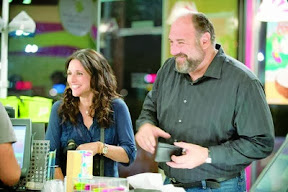
 

In what is easily one of the filmmaker’s strongest works (and that’s saying something as it comes directly off the heels of her previous masterwork Please Give), we’re treated to one of the year’s best and most mature treatments of grown up romantic love that can stand right alongside Richard Linklater’s Before Midnight and Joe Swanberg’s Drinking Buddies.

While admittedly it is a bittersweet success as James Gandolfini finally got the chance to show a sensitive, sweet, sexy side of himself that was always shut away during his typecast Sopranos era, for one of his final works Enough Said is a fitting way for him to be remembered. Additionally, his portrayal of Albert in Holofcener's film makes for a great last half of a Gandolfini Double Feature to go along with his recent turn in David Chase's Not Fade Away as well.

And although his absence is certainly felt in some of the special featurettes included on Fox’s gorgeously transferred Blu-ray disc, thankfully now that this work has been released complete with an Ultraviolet High Definition digital copy of the film, he won’t fade away from memory in this – one of his most watchable performances.


A nice change of pace for Keener as well, who has starred in every single one of Holofcener’s films and usually plays the filmmaker’s alter-ego, Enough Said lets her use her intimidating beauty and confidence to brilliant effect, illuminating the complexities of co-dependency, peer pressure and power struggles that occur in female relationships of all ages.

Nominated for multiple honors this award season, while Enough may not stand a chance opposite some of Hollywood’s biggest studio-backed heavy hitters in snagging an Oscar, it’s a shoo-in to steal your heart. Just be sure to seek it out as Enough Said proves that good films – just like good men and good friends – certainly do exist and even though they’re hard to find, when you do, they’re well worth your time.


Text ©2014, Film Intuition, LLC; All Rights Reserved. http://www.filmintuition.com Unauthorized Reproduction or Publication Elsewhere is Strictly Prohibited and in violation of the Digital Millennium Copyright Act.  FTC Disclosure: Per standard professional practice, I may have received a review copy of this title in order to evaluate it for my readers, which had no impact whatsoever on whether or not it received a favorable or unfavorable critique.

11/25/2013

Blu-ray Review: Violet & Daisy (2011)


Now Available to Own    


Photo Slideshow 


There’s an old adage warning writers that there are no original plots – Shakespeare did ‘em all. Of course, this in itself is a bit of a joke based on how much of the Bard’s output was inspired by previously published works, not to mention the whole debate over whether or not he actually wrote any of his own material or was simply the man who got the credit.

Obviously it’s up to a great writer to make even the oldest and most familiar storylines about love, death, revenge and all of the emotional shades in between seem new again. But with so much content released in so many different ways over the years, authors not only have to contend with stories that have been told a million times before but also with an audience that’s heard ‘em all before as well.


And unfortunately in the case of Precious screenwriter Geoffrey Fletcher’s feature filmmaking debut as both writer and director, anything new that Violet & Daisy tries to serve up is bogged down by the weight of everything that came before it.

What feels like the cinematic emptying of a pop culture recycling bin, Fletcher dreams up an uneasy blend of fairy tales and graphic novels, using hardboiled pulp fiction from the ‘30s and ‘40s to bridge the two genres together and the result is as mind-boggling as you would expect.

The World of Henry Orient by way of The Professional (aka Leon), Fletcher’s introduces us to our two titular teenage assassins doing a Pulp Fiction style walk-and-talk before bringing down men twice their size in a hail of gunfire.


It aims for too-cool-for-school but ultimately leaves us cold, shivering at the emotionally detached celebration of style or substance without giving us any sense as to who the young women behind the bullets actually are and wondering if we’re watching something closer to surrealism or satire than a straightforward storyline.

Unfortunately, it’s a question that never really gets answered, as Fletcher hints at a great number of things and tries to incorporate too many big picture ideas about absentee-parentism, empty consumerism and celebrity worship than he can actually address in the guise of a hit-man (or hit girl) film throughout Violet's intriguing but ultimately unsuccessful eighty-eight minute running time.


Determined to complete their latest kill in order to purchase a signature dress by their favorite singer, the girls (played by Alexis Bledel and Saoirse Ronan) are caught off guard when they interact with their mark (James Gandolfini) and begin to see him as a human rather than a hit.

Augmented by the performances of its leads, Violet is temporarily saved by the late great Gandolfini as a surprisingly friendly would-be victim, who not only seems eager to be assassinated but has made the girls cookies for precisely this occasion.


Though it isn’t too hard to guess why he’s glad death kindly stopped for him, Gandolfini makes the most of his character’s admittedly goofy actions, elevating the simple script with more tenderness than we’ve seen throughout, sublimating the disconnect he has with his own daughter into his final day with the fatherless gum-snapping, gun-toting lost girls that show up at his apartment.

Yet it’s the inauthentic, overly-cutesy characterization of the girls that baffles throughout, interrupting bursts of jarring ultra-violence including jumping on top of bullet-strewn bad guys by awkwardly infantilizing them with tricycle rides and pat-a-cake games that makes Violet & Daisy border on fetishistic camp.


Nowhere near as darkly cynical as Kick Ass to warrant the same level of controversy nor as good at blending quirk with coming-of-age angst as Ghost World – just to name two more films that enter your mind as you watch – though it strives very hard for originality, ultimately Violet feels as synthetic as a pop song sampled from past hits we know by heart.


While The Bling Ring did vapid consumerism among bored teens much better this year, perhaps the greatest tragedy of Violet & Daisy is that buried beneath all of the kitschy madness and self-conscious parody is enough of an idea to have generated a much better movie.

The only thing stopping Fletcher was Fletcher in paring down the script a few more times until he carved out a storyline that could have adequately supported one of his endless ideas… and perhaps a pop culture moratorium that lasted until Violet & Daisy transitioned from script to screen.    


Text ©2013, Film Intuition, LLC; All Rights Reserved. http://www.filmintuition.com Unauthorized Reproduction or Publication Elsewhere is Strictly Prohibited and in violation of the Digital Millennium Copyright Act.  FTC Disclosure: Per standard professional practice, I may have received a review copy of this title in order to evaluate it for my readers, which had no impact whatsoever on whether or not it received a favorable or unfavorable critique.

3/22/2008

Romance & Cigarettes


Director: John Turturro


“There’s a lot of things in this pothole of a life that don’t make sense,” Nick Murder (James Gandolfini) tells his youngest daughter Baby (Mandy Moore) in writer/director John Turturro’s self-described “down and dirty musical love story,” produced by Joel and Ethan Coen, Romance & Cigarettes. Turturro originally had the first inklings of an idea for the film in the 1980’s before beginning to write it when portraying a struggling screenwriter himself in the 90’s in the Coens' Barton Fink and, after directing his two earliest pictures Mac and Illuminata, Turturro finally got the chance to bring this startlingly sexual, overwhelmingly crude, yet undeniably original musical to life.

Despite the production being postponed for nearly two years due to James Gandolfini’s commitment to the HBO series The Sopranos, Turturro spent those years securing the rights to the songs he’d chosen (IMDb) for his trashy firecracker salute to musicals that told the story of blue collar ironworker Nick Murder whose dressmaking wife Kitty (Susan Sarandon) discovers he’s been betraying her as well as bailing on his duty to his three daughters (Mandy Moore, Mary-Louise Parker, and Aida Turturro) by having an affair with the sultry, British, lingerie-selling redheaded harlot Tula (Kate Winslet).

Now dubbed a “whoremaster” by his betrayed wife who runs to church to take her frustration out with a stirring rendition of “Piece of My Heart” along with Eddie Izzard and the rest of the choir, Nick is relegated to the fact that according to him “marriage is combat” and he must fend for himself opposite his wife’s army (the three daughters) even if it means that Kitty will no longer be preparing his dinner. Nick ends up going to extremes to satisfy his "mistress in heat" Tula who we’re introduced to in a laughably over-the-top fire sequence and as Winslet plays the part (visibly having a ball), Tula is a woman whose dialogue is completely made up of foul lines that get even more shocking as she continues on and soon we realize that the relationship isn’t going to last even before she confesses that she “loses interest in a man as soon as he begins to care" about her. However, Turturro’s film busily occupies itself as a musical comedy of “remarriage” as Nick fights to try and win back his wife, who, meanwhile has been fantasizing about her first love Aidan Quinn and seeking revenge on the cheating Nick by conducting her own investigation along with her dangerous cousin Bo (Christopher Walken).

Despite a four star review from Roger Ebert, this Golden Lion nominee from the 2005 Venice Film Festival was labeled “loud and pointlessly crude,” by The Hollywood Reporter’s Ray Bennett (9/7/05) who cleverly summed up Romance & Cigarettes with the observation that “it looks more like something that might have been made by Jesus Quintana, the wild man of the bowling alley he [Turturro] played in The Big Lewbowski.” Definitely film fodder for an acquired taste, I found myself mostly disgusted by the cinematic train-wreck created by the indisputably talented writer/director and cast, even though admittedly it was oddly compelling at times. Ultimately, Romance & Cigarettes is an unnecessarily lewd offering that never failed to inspire genuine interest in the characters who populate each frame other than the initial involuntary shock that forced viewers to pay attention similar to the way that we can’t help but stare at a fire or traffic accident, terrified and drawn in by the twisted beauty but all the while hoping that everyone gets out in one piece.