Showing posts with label Jane Austen. Show all posts
3/06/2014
DVD Review: Austenland (2013)
It’s rare when a movie critiques itself but when Best in Show alumni Jennifer Coolidge states that she thinks that “being creative is a waste of time and money,” she might just have well have broken through the cinematic fourth wall, stepped out of character as another rich, dimwitted but friendly American and addressed the audience to describe exactly what is wrong with Austenland overall.
A complete missed opportunity to do for Jane Austen what Love Actually did for romantic comedies, writer/director Jerusha Hess’s abysmal adaptation of the novel by Shannon Hale (which was likewise co-written for the screen by Hale) never seems to figure out precisely what tone they’re aiming for, let alone the point they’re trying to make.
Despite a cleverly conceived idea that centers around a tourist destination for Jane Austen aficionados (think: Comic Con - Elizabeth Bennet style), where bibliophiles can spend an immersive week in the English countryside of Austen’s novels, Austenland is never able to match that creativity in its tale of our uninspired heroine Jane Hayes (played by the otherwise affable Keri Russell).
So dedicated to the world of Austen that she’s created a room wholly devoted to it (complete with decidedly unliterary wall art that boldly states that Mr. Darcy Rocks), when we meet Jane she’s frustrated by the way that love on paper never seems to live up to the real thing.
At a dead-end in all aspects of her life, while we understand why Hayes would enjoy this sort of Anglophile adult summer camp, we have absolutely no clue why she would assume that a vacation to Jane Land would be the answer to all of her problems.
Needless to say, while she’s purported to be an intelligent bookworm, we can’t imagine a grown woman with an above average IQ voluntarily trading in her life savings for a week of faux-romance with one of the hired actors. (It’s not exactly The Bachelor: The Austen Edition.)
And therein lies one of the biggest dilemmas of the movie as Hess and Hale never can figure out whether they’d like us to relate to and laugh with Jane or be mystified by and laugh at our misguided lead.
Missing the same sort of opportunities embraced by contemporary Austen adaptations from You’ve Got Mail to Bridget Jones’s Diary to Clueless to walk that fine line in tone and do more than just touch on a few plot points here and there, after Jane arrives in Austenland she grows disillusioned with the resort almost instantly.
Spending her time doing seemingly out-of-character things from playing “Hot in Here” on the piano to ignoring the types of seminars and activities that she seemed perfect for in the film’s introduction to the character, Jane opts to bow out of a large amount of the festivities she paid so much money to enjoy.
Reverting to a teenage summer romance, she chooses to dance to ‘80s music and make out with the stable hand (played by Flight of the Conchords's Bret McKenzie) vs. the faux Darcy-like aristocrats the actors around her are portraying.
Essentially suffering from a flip-flopping characterization, acts one and two of Austenland could also be called A Tale of Two Janes as we’re never exactly sure what Russell’s going to do next and why.
Unfortunately, it begins to completely fall apart midway through the second act when the guests and staff collaborate on a romantic play that does nothing more than eat up screen time and make you that much more grateful that Russell has TV's stellar The Americans to fall back on.
However, just when we think all hope is lost, the film nearly manages to redeem itself… once, that is our heroine manages to wise up and get the hell away from Austenland in a surprisingly terrific third act.
Serving up a vastly superior final twenty-minute coda to the nails-on-the-blackboard like cacophony that was the first hour, while it’s hard to imagine that many viewers would still be voluntarily watching at that point thanks to the convenience of the eject button on this recent DVD release, for those that are, Austenland manages to reward your patience.
In fact, the ending is so good that it makes me wonder how great the film could’ve been if all the gimmickry had been tossed out and Hess and Hale had spent less time trying to entertain and (in the manner of Austen) more time devoting itself to embracing the real life of a smart single woman who wants to heighten and make the best of reality, not simply run away from it.
For maybe if they would’ve done that they wouldn’t have lost so much money since the lack of creativity and character pride onscreen translated straight to box office prejudice offscreen by not giving the large global fan base of Austen devotees with high hopes a heroine and film worthy of the name Jane Austen(land).
Text ©2014, Film Intuition, LLC; All Rights Reserved. http://www.filmintuition.com Unauthorized Reproduction or Publication Elsewhere is Strictly Prohibited and in violation of the Digital Millennium Copyright Act. FTC Disclosure: Per standard professional practice, I may have received a review copy of this title in order to evaluate it for my readers, which had no impact whatsoever on whether or not it received a favorable or unfavorable critique.
Labels:
Jane Austen,
Jane Seymour,
Jennifer Coolidge,
Keri Russell,
WIF
2/01/2010
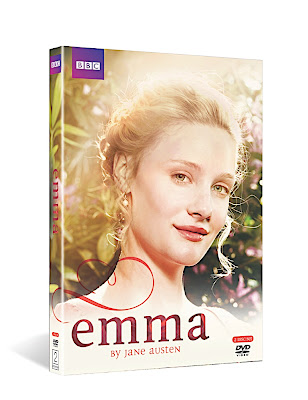
TV on DVD: Emma (2009)
Lest we be considered as foolish as our “lively and mischievous” twenty year old heroine Emma Woodhouse, we realize that traditionally it's a practice quite “badly done” indeed to argue with Mr. George Knightley.
Yet despite the fact that he is among the finest of gentlemen-- if at times even prouder and more prejudiced than Mr. Darcy-- when Knightley marvels that we're all “drawn like magnets” to Emma's Hartfield residence, in reality we're surprised to discover that it's been roughly 15 years since we last visited the house that Austen built.
Regardless of appreciating classical British productions of Emma starring Gwyneth Paltrow in the film and Kate Beckinsale in the A&E television movie or Clueless featuring Alicia Silverstone as a contemporary meddlesome matchmaker, Emma was oddly absent from PBS and BBC line-ups for years.
And given the fact that Austen only crafted six novels, the vanishing act of Emma was noticeable to fans, even though Austen herself acknowledged in her own journals and letters, she was creating what she described as, “a heroine whom no-one but myself will much like.”
Yet, on the surface, Emma Woodhouse has the same strong spirit of Elizabeth Bennet, Fanny Price, and Marianne Dashwood along with other Austen staples including: the obligatory sister yet Emma's is considerably out of the picture; a sympathetic (if overbearing) father; and a villainous male whom in this case is guilty of less serious infractions than revealed in the other works.
However, Emma differs from the very beginning because Austen abandoned her oft-explored territory considering the romantic plight of penniless women who-- similar to Jane Austen-- find themselves on a major detour to the altar because their lack of financial stability, social status, or a sufficient dowry makes them an unsuitable match.
Intriguingly the only Austen title to have been given such a distinction of sharing the same name as the main character, Emma is quite different from the other heroines of Austen or her contemporaries as she's overly carefree, wealthy, idle, comfortable, optimistic, and not lacking anything.
And unlike previous literary efforts, Austen replaces the woes of being sent out on the hunt for an advantageous match with an admirably ambitious plot worthy of Shakespearean comedy. Still admittedly, the tale of a sheltered father's daughter with no aspirations to marry in favor of connecting people like dots in terms of romance may infer that it's a simplistic trifle.
However, as those who've read the novel can attest, on the contrary Emma may indeed possess Austen's most complicated plot. Likewise, it showcases a snappier wit and more inventive structural devices than Sense and Pride which, while being superior, are a bit on the similar and repetitive side.
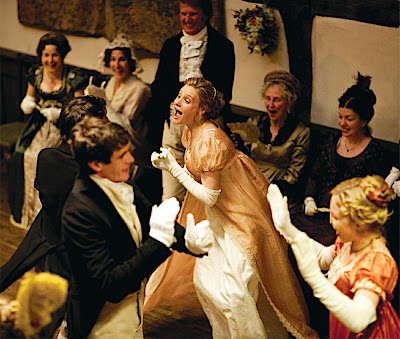
In fact, it is the complexity of the plot-line that makes this complete 4 episode (229 minute) version of the tale from BBC and PBS, the strongest retelling of Emma from page to screen yet. And classically speaking, this 2009 Emma as envisioned by screenwriter Sandy Welch is an Austen addict's dream.
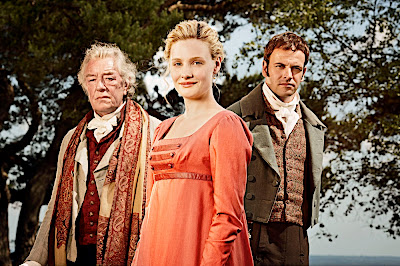
Having previously bewitched viewers with her work in I Capture the Castle and Vanity Fair along with excellent turns in Atonement, Dirty Dancing 2, As You Like It and The Other Man, Romola Garai brings back that same deliciously spunky smile and independent spirit showcased in Castle as her eyes literally sparkle while she concocts her next love match.
Unfortunately in the miniseries' one major shortcoming, the opening serves up important plot details in a series of fast cuts and connections that rival Paul Thomas Anderson's Magnolia meets Pushing Daisies for the sheer amount of data conveyed to the audience in the shortest amount of time possible. While this presentation will undoubtedly confuse newcomers to Emma's Hartfield, luckily it settles into a spirited rhythm as it continues.
However, due to the running time, while the story remains the same, screenwriter Welch and director Jim O'Hanlon ensure that the many characters that move in and around Hartfield all feel as though they're as authentic as if we'd bumped into them a la the heroine in the miniseries, Lost in Austen.
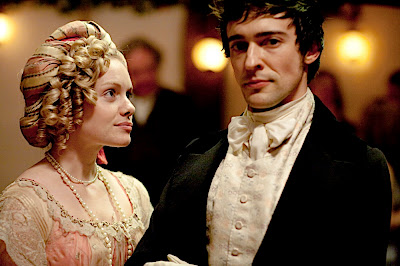
At the same time, we get a better sense of why Emma is seemingly both intelligent and quite silly in designing marriage schemes among her friends because of her sheltered nature. In fact, this time around we could consider Emma slightly codependent in an overprotective yet loving relationship with her best friend and father, played by Michael Gambon that gives off a Say Anything... vibe. Likewise, Welch further addresses the impact of Emma's misguided actions consisting of a prettier yet slightly dimmer Harriet than we normally see, a larger part for the wife of Emma's scorned Mr. Elton, as well as a much more likable spin on Jane Fairfax.
One of the major grievances about Emma from some Austen enthusiasts is in their argument that Knightley was never the man that the scribe's other creations including Pride's Mr. Darcy and Sense's Colonel Brandon were by comparison. In fact, some readers even go as far as to note that when Knightley and Emma fall in love, it's the equivalent of a Shakespearean Taming of the Shrew.
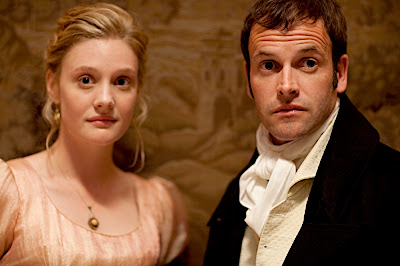
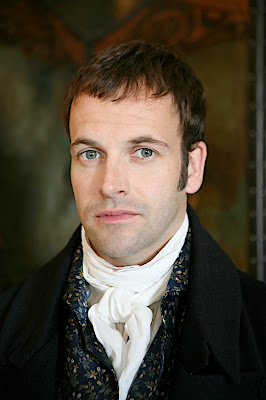
Yet and to his immense credit, as played by the slyly sexy and talented Jonny Lee Miller, we're given a Knightley we haven't encountered so far. Shockingly snobbish in one scene and the very soul of gentlemanly perfection in the next, Miller's ability to underplay the meaning of lines and the slight beats he takes in scenes where she unknowingly wounds his pride as an older man are striking. Through Miller, suddenly, we're able to key into other points-of-view including males in this piece, which is an Austen rarity that I've only ever encountered previously in director Joe Wright's adaptation of Pride and Prejudice.
And while Austen is never taken as seriously as Dickens during award season, Emmy and Golden Globe voters should already set their sights on Garai, Miller, Gambon, screenwriter Welch, director O'Hanlon among others for what is the most thorough and jaw-droppingly lovely presentation of Emma I've seen thus far.
Likewise, it's sure to make you want to revisit the adaptations included in Masterpiece Classics' Jane Austen showcase one year ago including the new feminist spin on Persuasion with Sally Hawkins, a more age-appropriate Sense and Sensibility, and others. To this end and aside from the rushed introduction, my only criticism for this title is that Masterpiece Theatre isn't re-running all of the productions back-to-back now that we have our definitive Emma that you'll be drawn to like Hartfield sized magnets as soon as the first DVD begins.
Text ©2010, Film Intuition, LLC; All Rights Reserved. http://www.filmintuition.com
Unauthorized Reproduction or Publication Elsewhere is Strictly Prohibited and in violation of the Digital Millennium Copyright Act.
FTC Disclosure: Per standard professional practice, I received a review copy of this title in order to evaluate it for my readers, which had no impact whatsoever on whether or not it received a favorable or unfavorable critique.
Labels:
Jane Austen,
TV on DVD
4/13/2009
New on DVD & Blu-ray for the Week of 4/12/09
Jen's Picks of the Week:
Classic:
Pillow Talk: 50th Anniversary Edition
Foreign Flick:
The Pope's Toilet
Miniseries:
Pride and Prejudice [Blu-ray]


New Blu-ray:
Mean Girls
Obscure '80s Release:
Irreconcilable Differences
TV on DVD:
Ruth Rendell: Set 4


Classic:
Pillow Talk: 50th Anniversary Edition
Foreign Flick:
The Pope's Toilet
Miniseries:
Pride and Prejudice [Blu-ray]
New Blu-ray:
Mean Girls
Obscure '80s Release:
Irreconcilable Differences
TV on DVD:
Ruth Rendell: Set 4
Bookmark this on Delicious
Print Page
8 Mile [Blu-ray]
Cranford [Blu-ray]
Dark Matter
House of Saddam
Knot's Landing:
The Complete Second Season
The Last Kiss [Blu-ray]
Lost in Austen
Mary Higgins Clark Collection
Mask of the Ninja
Mean Girls [Blu-ray]
Cranford [Blu-ray]
Dark Matter
House of Saddam
Knot's Landing:
The Complete Second Season
The Last Kiss [Blu-ray]
Lost in Austen
Mary Higgins Clark Collection
Mask of the Ninja
Mean Girls [Blu-ray]
November Son
Paris
Pillow Talk:
50th Anniversary Edition
The Pope's Toilet
Pride and Prejudice [Blu-ray]
The Reader
Ruth Rendell: Set 4
She Fell Among Thieves
The Spirit
Paris
Pillow Talk:
50th Anniversary Edition
The Pope's Toilet
Pride and Prejudice [Blu-ray]
The Reader
Ruth Rendell: Set 4
She Fell Among Thieves
The Spirit
Strange Wilderness [Blu-ray]
Wings: Final Season
Additional New Releases
TV on DVD Review: Lost in Austen (2008)
The Hit UK Miniseries
Hits DVD on 4/14/09
Hits DVD on 4/14/09
When you look in the Yellow Pages at the ads describing the services of local plumbers, I think you'd be hard pressed to find one that could assist you in the removal of Jane Austen's Pride and Prejudice heroine Elizabeth Bennet (Quantum of Solace’s sole bright spot-- Gemma Arterton) who suddenly appears in the bathroom of modern British singleton, Amanda Price (The Black Dahlia and Kinky Boots actress Jemima Rooper).
Normally-- since we’re dealing with literary shenanigans anyway-- I would've advised Amanda to track down the bibliophile super sleuth Thursday Next from Jasper Fforde’s brilliant book series filled with shape-shifting, time-traveling characters of classic literature. However, in the 2008 blockbuster ITV miniseries (which also aired in 2009 on America’s Ovation TV)--Lost in Austen-- screenwriter Guy Andrews and director Dan Zeff wisely avoided the temptation to complicate things even further and instead play off of the insatiable international and overwhelmingly female appetite for all things Jane Austen.

However, Zeff’s Lost in Austen makes for charming, escapist chick-lit like fare that struck such a chord with British viewers that American Beauty, Road to Perdition, Jarhead and Revolutionary Road director Sam Mendes has optioned the miniseries with the intent of producing it as a feature film for Columbia Pictures.
And it's precisely because of Pride’s built-in popularity that made the decision to throw time travel into the mix all the more daring as we’ve already been treated to countless modern interpretations of Pride and Prejudice that include: the granddaddy of them all-- BBC's sublime Colin Firth and Jennifer Ehle ‘90s filmed miniseries where Firth’s pitch perfect take on the unforgettable Mr. Fitzwilliam Darcy which inspired Helen Fielding's Bridget Jones’ Diary (as she based her version of Darcy on Firth himself), Nora Ephron’s Shop Around the Corner and In the Good Old Summertime twist applied to Pride in You’ve Got Mail, Gurinder Chadha’s visual feast Bride and Prejudice, and Joe Wright’s classically stylized Oscar nominated work starring Keira Knightley.
While I originally became acquainted with ITV's critically-acclaimed series upon receiving the first episode in screener form to review for Ovation TV’s romantic, literary based “Tall, Dark and Handsome” week of programming designed to introduce Americans to Lost in Austen as well as the newest Keira Knightley starring version of Dr. Zhivago along with other literary favorites including Like Water for Chocolate--sadly due to a change in my DirecTV service, I lost Ovation and with it my access to the three remaining episodes.
Thankfully, those without Ovation, those who missed it the first time around, or those who simply want to add it to their DVD collection will be thrilled to discover that the good folks at Image Entertainment are serving up the disc conveniently in time for early Mother's Day shopping on April 14.
Restoring the original 1.78:1 widescreen aspect ratio that's enhanced for 16:9 televisions to preserve the lush cinematic sweep of the miniseries which boasts exceptional and filmic production values in a high quality DVD transfer made all the more gorgeous on an up-convert or Blu-ray player-- all four episodes can be screened in one epic viewing on a single disc that truly allows you to get Lost in Austen minus the annoyance of commercials and breaks and installments. Still retaining the original Dolby Digital stereo surround employed in its British debut but with the additional option of subtitles for the deaf and/or hearing impaired, one major bonus for enthusiasts of both Austen and indeed this version of Austen is the 43 minute behind the scenes featurette that chronicled the making of the miniseries.
One must admit however that Jane Austen purists may be a bit disheartened by this modern interpretation that carries Amanda Price’s contemporary, uncouth, and sarcastic sensibilities back in time while she ultimately fills in for Elizabeth who has taken up residence in Amanda’s present day apartment. And in doing so, Amanda has just barely convinced Mr. and Mrs. Bennet that the two “good friends” have swapped places temporarily and due to this warped displacement of centuries, screenwriter Guy Andrews has a great deal of fun in showing the way that injecting someone who “knows the ending” into the narrative of Pride and Prejudice can greatly impact and alter the course of the novel.
Much like the unintentional impact Reese Witherspoon and Toby Maguire have on the citizens of the Leave it to Beaver like show Pleasantville in Gary Ross’s brilliant film, Amanda is only in Longbourn for a few moments before she inadvertently sets into action events, twists, and misunderstandings that change the entire arc of the book she read so often that it was nearly a substitute for an unexciting boyfriend, dull day job, and nonexistent social life.
Of course, she's barely able to contain her excitement given the chance to meet Mr. Darcy (played by Golden Compass star Elliot Cowan) in the flesh but when Mr. Bingley finds himself entranced by the sultry attire and low neckline of what Amanda tries to pass off as clothes suitable for otter hunting in her native Hammersmith—soon her very presence jeopardizes Jane’s relationship with Bingley as well as the fated one between the absent Elizabeth and Mr. Darcy.
Avoiding the opportunity to catch up with Arterton’s iconic Elizabeth as she struggles to exist in modern society a la the Amy Adams charmer Enchanted and instead only catching up with her character for the final thirty minutes, the rest of Lost in Austen wholeheartedly devotes itself—both to its strength and weakness—to the plight Rooper’s Price.
While Rooper tries her best and adds considerable winning charm to the piece—I realized I was only an hour into the work when I discovered that her overly forceful and not entirely sympathetic character began to repel with Andrews’ penned attempts to try far too hard to strike comedic gold by cashing in on the societal contradictions of the two polar opposite time periods.
This is evident in her first twenty-four hours under the Bennet's roof when the filmmakers make the bizarre decision to make Amanda—in stark contrast to the woman we meet at the film’s opening who says that obsessively reading Pride and Prejudice has given her standards—needlessly flashes her feminine area (away from view) following the erroneous assumption that she’s on an adult version of Candid Camera when she wakes up to find Lydia Bennet snuggling with her in the covers.
While Amanda Price’s off-the-wall plight and devotion to the world of Austen help make her endearing, she’s hardly an adequate replacement for Lizzie as Amanda soon kicks one male character in his privates, refers to Caroline Bingley as a “bumface,” constantly berates Wickham with “hands off-- big time” remarks, and sends Mr. Bingley into near alcoholism when she tries to turn him off by implying she’s a lesbian, and inadvertently leads one character into a horrifically bad marriage.
And furthermore, they’ve dulled the personalities of the rest of the ensemble considerably, which is also evident in creative costuming and makeup techniques to let the rest of the cast blend in with the scenery and have Rooper with her blunt shoulder length bob hair cut perpetually straight and down but given typically the best standout dresses including a breathtakingly vivid deep teal blue number that ensures she’s the one our eye follows regardless of the goings-on.
Intriguingly using the tagline of “same story, different centuries” to draw you in, while at its core Lost in Austen stays quite within the confines of the book, it still takes enormous liberties in swapping out plots and characters, sometimes to fascinating effect as Charlotte Lucas becomes a bit more unlikable than you’d assume and we discover that there may be a second side to Wickham’s storyline that we’d never heard, along with one major surprise about Caroline Bingley. One strong asset to bibliophiles is the amount of references to other Austen works with a line that pays homage to Emma and other plot devices and lines straight out of Shakespeare, including one crude observation pulled right from Othello.
Overall, it’s an intriguing exploration into Pride and Prejudice that makes it much more of a whimsical and dark Choose Your Own Adventure as some plotlines grow incredibly peculiar and new couplings are forged that one wouldn’t have dreamed from Austen’s novel that make you wish Thursday Next perhaps had have been involved in lieu of the less than dynamic character Amanda Price.
Ultimately, despite a great affection for some of its various interpretations such as You’ve Got Mail and Bride and Prejudice, I’ll still take the BBC Firth version of the tale over any other remake any day of the week. However, the uneven yet highly spirited and fun Lost in Austen makes a nice escapist Darcy dream for those of us who may have worn out our copies of the book or various versions of the film and are in the mood for something entirely different… like the idea that Elizabeth Bennet may some day just show up in our bathroom (even though I think I’m pretty safe in saying that most of us would’ve preferred Colin Firth).
5/28/2008
Sense & Sensibility (2008)
Director: John AlexanderWhen it comes to the men of Austen, Pride and Prejudice’s Mr. Darcy has always been in a class by himself. Occasionally he's proven far more memorable than some of the scribe’s heroines, yet when critics and devotees turn their attention to Sense and Sensibility, there’s a nearly universal dissatisfaction with the novel’s dull yet loyal Colonel Brandon who nonetheless manages to secure the affections of the young, spirited Marianne Dashwood. Typically-- due to both their similarities in temperament and their estimable age of mid to late thirties-- Brandon is lumped together with Emma’s Mr. Knightley who often scolds the precocious matchmaker with schoolmarm styled dialogue such as “Badly done, Emma. It was badly done, indeed.” Yet despite the fact that Knightley is consistently deemed preferable to Brandon, to me Emma’s beau seems about as sexy as a collections agent (except when portrayed by Jeremy Northam in the ’96 adaptation) and while-- granted-- neither man is in Darcy’s league, Brandon always seemed like my kind of guy. Trying to validate this belief became a much harder case to make in Ang Lee’s stunning ’95 cinematic version penned by Emma Thompson when the ages of nearly every character (save for Kate Winslet’s Marianne Dashwood), were increased and Brandon was portrayed by Alan Rickman a.k.a. the villainous star of Die Hard who thereafter had a recurring role in my childhood nightmares. However, even though he was brought to life by the man who would become Harry Potter’s Snape, there was always something about his chivalry, his obvious affection for Marianne and the fact that, in stark contrast to his usually dour exterior, he seemed to grow more joyful when in close proximity to her positive, passionate demeanor that genuinely touched my heart.
This is augmented considerably in director John Alexander’s gorgeous Masterpiece Theatre miniseries Sense and Sensibility, which recently made both its television and DVD premiere thanks to the good folks of PBS and the BBC. Startlingly sensual from the start as we’re introduced to the story via a love scene-- for a moment, I wondered if screenwriter Andrew Davies (who penned the best Austen adaptation with the BBC Pride and Prejudice miniseries starring Colin Firth) had picked up the right book. Although quickly we’re pushed headfirst into the familiar tale of the serious, practical and protective Elinor Dashwood (The Bank Job’s Hattie Morahan) and the fiery roughly seventeen year old Marianne (Charity Wakefield)-- two close yet decidedly different sisters who along with their mother (Tumbleweeds and Songcatcher star Janet McTeer) and much younger sister Margaret (Lucy Boynton) are left nearly penniless after their father dies and his estate and fortune are left in the hands of their greedy half-brother and his manipulative Lady Macbeth styled wife, aptly named Fanny.
While Fanny takes an instant dislike to the women, her charming brother Edward Ferrars (Dan Stevens) arrives for an overdue visit and proceeds to form an attachment to Elinor that troubles both Fanny and the Dashwoods when the overly polite Edward and soft-spoken Elinor fail to make any concrete plans regarding marriage. Not so subtly kicked out by Fanny, the Dashwoods retreat to the country when they’re offered assistance and a humble cottage from Sir John, a relative of their mother’s whom she’s never met and find themselves instantly welcomed by not only Sir John and his wife but John’s dedicated thirty-five year old friend Colonel Brandon (The Other Boleyn Girl’s David Morrissey).
Admirably and perhaps indicative of the fact that screenwriter Davies is male, we’re given a greater glimpse into the male characters and dynamics in the film as Brandon is positioned more as a kind, unlikely soul mate than his usual label as an old, tired boor. In sharing with Marianne a genuine love of music and books and eagerly surprising her with sheet music, Davies sets the two of them up nicely until the oblivious Marianne who’s mistaken his generosity for friendship turns her attentions to the Austen’s quintessentially sexy bad boy Willoughby (Dominic Cooper from The History Boys and Mamma Mia!). While those familiar with the rascally Willoughby know exactly where this is headed, it’s great fun to watch another reinvention of the classic that invites comparisons to Ang Lee’s sumptuous classic and at the same time also adds more dimension to the tale in its inclusion of more scenes taken directly from the novel that strengthen characters' motivations.
Clocking in at three hours, surprisingly Alexander’s amiable (as Austen would say) adaptation never ceases to impress. While the talented but under-utilized and erroneously cast Hattie Morahan makes a weaker Elinor than Emma Thompson-- and there’s no replacing the Oscar nominated Kate Winslet-- the film’s real revelation comes in the astute portrayal of Charity Wakefield as a more earnest and relatable Marianne who nearly ignites on screen with fevered passion and becomes even stronger when sharing scenes with Cooper (predictably) but even more so when partnered with Morrissey. Granted as someone in the character’s age bracket it pains me to say that the obvious difference in the ages may not benefit the argument that Brandon is the right man for Marianne in the staunchest critics. However, given the benefit of the adaptation’s length and making his character feel more alive and less one dimensional, perhaps even his fiercest detractors will have to admit that when all is said and done, there’s just something about Brandon after all.
In other words, "Nicely done, Davies. It was nicely done indeed."
Subscribe to:
Posts (Atom)