Part of Sony's Martini Movies* Collection
Photo Slideshow


Bookmark this on Delicious

Print Page


The films selected for the third wave of Sony Pictures Home Entertainment's Martini Movies series (see official description in footnote below) didn't really seem to have a single unifying theme until I began writing about them. Honestly, come to think of it, they still don't but at least now I think I've discovered a common thread that you can weave throughout the five titles.
While most people relish in the cup of coffee or piece of pie that goes along with discussing a movie once you've seen it, often critics don't have that luxury as the keyboard seems to be our version of the coffee shop with readers filling in as the other conversationalist.
For just as-- whenever possible-- I prefer to wait at least twenty-four hours to review any film since reactions tend to run to the extreme right after you hit eject or walk outside the theatre, I'm often amazed by the discoveries I make when I write and trying to wrap my head around why these five movies were released together under the Martini Movies banner was indeed a challenge.
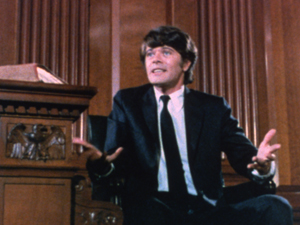
Although all titles were released in the late '60s and early '70s for the first time on DVD by Sony, culling from their old classic Columbia Pictures archive and adding retro packaging plus a martini recipe on every disc, they didn't really seem to be the type of sophisticated fare associated with the beverage nor wild enough for the decade's quintessential Holly Golightly styled cocktail party from Breakfast at Tiffany's.
However, finally today, when working on the fifth review for To Kill a Mockingbird director Robert Mulligan's uneven and cynically toned film The Pursuit of Happiness, it hit me that instead of being movies you'd watch with friends over cocktails, the lead male characters in each and every one seemed to be suffering from a few too many martinis throughout their running time.
Yet instead of being obnoxious, getting booed off the karaoke stage and hitting on anything that moves (although I'm fairly certain The Buttercup Chain might be the exception to the latter), they're overly quiet, apathetic, submissive, and disconnected as events just seem to happen to them instead of having a straightforward goal.
Whether it's Michael Douglas in "ho-hum" mode wondering if he should dodge the draft or disenchanted Gary Lockwood falling for a French woman in an arty strip club while contemplating the draft a la Summertree and Model Shop or stumbling into romantic entanglements with unlikely prospects a la Buttercup and Love and Pain and the Whole Damn Thing, the Martini men never seem to be in active pursuit of anything.
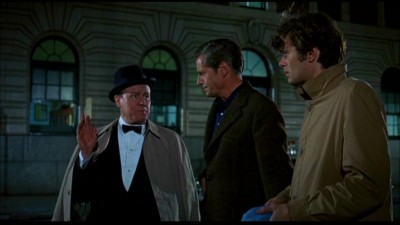
And this is definitely a problem when your film is called The Pursuit of Happiness and we're presented with another one of these slacker heroes. In the movie, former politically active and anti-establishment spouting college student William Popper (Michael Sarazin) has more or less turned his back on political activism in favor of just wrapping up his baccalaureate degree and getting on with life.
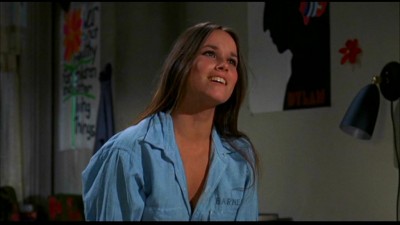
Without any goal or motivation, Popper is an odd fit in his relationship with the beautiful hippie Barbara Hershey who began college as the type of square Popper is when the film starts but has now turned into a one woman Abbie Hoffman. And while we're fairly certain the movie will focus purely on the futility and/or power implications of political activism, the movie simply uses that as a backdrop when plot pursues Popper (instead of the other way around) in the form of an elderly grocery bag carrying jaywalker whom he plows down accidentally in an unforgiving rain.
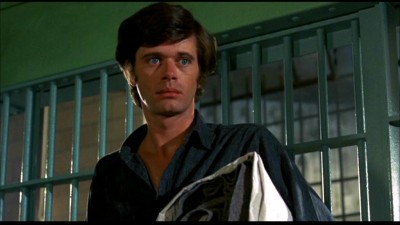
Assuming that the justice system will just deal with her death for the accident that it was, when Popper's attitude, past activism, and unwillingness to avoid visiting the woman's family to apologize are put on trial, the judge throws the book at him. Pretty naive for an activist, I'd say! Yet instead of a prison film, once inside, Popper realizes by this point that he actually does want to pursue happiness and get out of there. This leads to a series of events where he's proactive yet not in ways in which we can truly root since there's some unanswered questions about guilt, his future plans, and the sacrifices others have made for Popper that make the all-too-familiar Randy Newman music and protracted, illogical ending dissatisfying.
Masquerading as a message movie about prejudice towards the counter culture movement, The Pursuit of Happiness earns points for not making everything clear cut but even sans a concrete message, it's still shallow and doesn't seem to offer us a reason or idea as to what it means or why it was made other than to simply preach to the era's choir that in the '60s and '70s "a nervous breakdown" was going on in America (and the rest of the world).
And likewise, although I wasn't fully in Popper's corner by any means and understand it's not mandatory, I feel that Mulligan's Pursuit would have been far more memorable had the film not have been quite as apathetic as our main character since it's one you'll no doubt forget as soon as the final credits roll.
*Note: Just what is a Martini Movie? Sony's statement: "No matter the decade, there's a place where icons, idols and the infamous flock for bottomless martinis and over-the-top trysts. One part top-shelf martini, two parts celluloid history and garnished with a hint of camp. Sit back and take in the scene with Sony Pictures Home Entertainment's Martini Movies." All titles released so far in the collection have never been available previously in the DVD format.
Text ©2009, Film Intuition, LLC; All Rights Reserved. http://www.filmintuition.com
Unauthorized Reproduction or Publication Elsewhere is Strictly Prohibited.
Bookmark this on Delicious
Print Page
The films selected for the third wave of Sony Pictures Home Entertainment's Martini Movies series (see official description in footnote below) didn't really seem to have a single unifying theme until I began writing about them. Honestly, come to think of it, they still don't but at least now I think I've discovered a common thread that you can weave throughout the five titles.
While most people relish in the cup of coffee or piece of pie that goes along with discussing a movie once you've seen it, often critics don't have that luxury as the keyboard seems to be our version of the coffee shop with readers filling in as the other conversationalist.
For just as-- whenever possible-- I prefer to wait at least twenty-four hours to review any film since reactions tend to run to the extreme right after you hit eject or walk outside the theatre, I'm often amazed by the discoveries I make when I write and trying to wrap my head around why these five movies were released together under the Martini Movies banner was indeed a challenge.
Although all titles were released in the late '60s and early '70s for the first time on DVD by Sony, culling from their old classic Columbia Pictures archive and adding retro packaging plus a martini recipe on every disc, they didn't really seem to be the type of sophisticated fare associated with the beverage nor wild enough for the decade's quintessential Holly Golightly styled cocktail party from Breakfast at Tiffany's.
However, finally today, when working on the fifth review for To Kill a Mockingbird director Robert Mulligan's uneven and cynically toned film The Pursuit of Happiness, it hit me that instead of being movies you'd watch with friends over cocktails, the lead male characters in each and every one seemed to be suffering from a few too many martinis throughout their running time.
Yet instead of being obnoxious, getting booed off the karaoke stage and hitting on anything that moves (although I'm fairly certain The Buttercup Chain might be the exception to the latter), they're overly quiet, apathetic, submissive, and disconnected as events just seem to happen to them instead of having a straightforward goal.
Whether it's Michael Douglas in "ho-hum" mode wondering if he should dodge the draft or disenchanted Gary Lockwood falling for a French woman in an arty strip club while contemplating the draft a la Summertree and Model Shop or stumbling into romantic entanglements with unlikely prospects a la Buttercup and Love and Pain and the Whole Damn Thing, the Martini men never seem to be in active pursuit of anything.
And this is definitely a problem when your film is called The Pursuit of Happiness and we're presented with another one of these slacker heroes. In the movie, former politically active and anti-establishment spouting college student William Popper (Michael Sarazin) has more or less turned his back on political activism in favor of just wrapping up his baccalaureate degree and getting on with life.
Without any goal or motivation, Popper is an odd fit in his relationship with the beautiful hippie Barbara Hershey who began college as the type of square Popper is when the film starts but has now turned into a one woman Abbie Hoffman. And while we're fairly certain the movie will focus purely on the futility and/or power implications of political activism, the movie simply uses that as a backdrop when plot pursues Popper (instead of the other way around) in the form of an elderly grocery bag carrying jaywalker whom he plows down accidentally in an unforgiving rain.
Assuming that the justice system will just deal with her death for the accident that it was, when Popper's attitude, past activism, and unwillingness to avoid visiting the woman's family to apologize are put on trial, the judge throws the book at him. Pretty naive for an activist, I'd say! Yet instead of a prison film, once inside, Popper realizes by this point that he actually does want to pursue happiness and get out of there. This leads to a series of events where he's proactive yet not in ways in which we can truly root since there's some unanswered questions about guilt, his future plans, and the sacrifices others have made for Popper that make the all-too-familiar Randy Newman music and protracted, illogical ending dissatisfying.
Masquerading as a message movie about prejudice towards the counter culture movement, The Pursuit of Happiness earns points for not making everything clear cut but even sans a concrete message, it's still shallow and doesn't seem to offer us a reason or idea as to what it means or why it was made other than to simply preach to the era's choir that in the '60s and '70s "a nervous breakdown" was going on in America (and the rest of the world).
And likewise, although I wasn't fully in Popper's corner by any means and understand it's not mandatory, I feel that Mulligan's Pursuit would have been far more memorable had the film not have been quite as apathetic as our main character since it's one you'll no doubt forget as soon as the final credits roll.
*Note: Just what is a Martini Movie? Sony's statement: "No matter the decade, there's a place where icons, idols and the infamous flock for bottomless martinis and over-the-top trysts. One part top-shelf martini, two parts celluloid history and garnished with a hint of camp. Sit back and take in the scene with Sony Pictures Home Entertainment's Martini Movies." All titles released so far in the collection have never been available previously in the DVD format.
Text ©2009, Film Intuition, LLC; All Rights Reserved. http://www.filmintuition.com
Unauthorized Reproduction or Publication Elsewhere is Strictly Prohibited.