Showing posts with label Paul Dano. Show all posts

9/28/2021

Netflix Movie Review: The Guilty (2021)

Arriving 10/1 on Netflix


If you haven’t seen “The Guilty,” you should see “The Guilty.” Let me try this again. If you’ve seen “The Guilty,” you might like “The Guilty.” No, that’s still not quite right. It might help if I tell you that there are two versions of “The Guilty.” There’s the original 2018 Danish film from director Gustav Möller, which was one of the year’s very best movies, and then there’s the new American remake directed by Antoine Fuqua, which debuted last week in theatres in selected cities and will arrive on Netflix on October 1.

Knowing this, I'm sure you can probably guess which of the two pictures I prefer because that's usually the way it goes with remakes of foreign films that frequently lose something vital in the English translation (just like all too often, the book is better than the movie). Of course, there are definite exceptions to this, but in the case of “The Guilty,” it isn't enough just to say that, yes, as predicted, the original version of the film is far superior to the American remake.

Because as a work, it is utterly dependent upon a few major plot revelations that slowly and methodically unfurl over the course of its very stressful roughly ninety-minute running time, since Fuqua's “The Guilty” adheres very closely to Möller's own film, the version you see first might just dictate which one you prefer. 

Set over the course of a very long night in a 911 emergency call center in Los Angeles, as Fuqua's film opens, we meet a police officer who has been temporarily reassigned during an investigation into some sort of conduct violation that we learn more about later on.


In the midst of L.A.'s fire season where the calls are coming in hot and the air is so smoky and polluted that it's exacerbating his asthma something fierce, Jake Gyllenhaal's Joe answers incoming distress calls with the same degree of breathless disdain, cynicism, and entitlement with which he used to patrol the city's streets. Whether it's people requesting help because they took too much speed or were robbed by a hooker (both incidents play out exactly as in the original), Joe counts down the minutes until his hearing the next day, after which he hopes to get off the phones and go back on the beat. However, suddenly, a call comes in that does the unthinkable; it makes Joe not only care but also get very involved.

A woman's (Riley Keough) voice comes in on the line speaking to Joe as though he were her child. But before he disconnects from what he assumes is a wrong number, something in the timbre of her voice stops him. Shaky, tear-filled, and in a state of panic she's trying to hide, when he hears a man (Peter Sarsgaard) ask her who she's talking to, Joe starts piecing together the narrative that she's been abducted by her husband by asking the woman yes or no questions only.

Barely able to sit still in his chair – his jittery hand forever fondling his inhaler because he knows it's only a matter of time before he runs out of breath once again – he becomes a cop again before our eyes. Demanding help from the California Highway Patrol and others who are inundated by fire, crises, and crime calls of their own, Joe tries to route squads to pull over a white van traveling eastbound on the I-10 and also send cars to her home to check on these children that she keeps talking about.

Getting even more frantic when they get disconnected and she doesn't answer the phone, he calls her home to talk to her young daughter who helps Joe fill in a few more blanks. Rather than be the first one out the door from his final shift, he abruptly refuses to leave until he sees this case through to the end. Restrained by legal red tape, jurisdictional issues, and bureaucracy, Joe eventually goes into an isolated room, closes the blinds, and devotes the rest of the film's running time to trying to bring Keough's Emily Lighton home safely.

That old macho rage at a forefront – for reasons both good and bad – he makes a request to his loyal sergeant (voiced by Ethan Hawke) to go and kick some doors in when the more he hears and uncovers about Emily, the more alarmed he becomes. But is he really listening or is he working out his own personal issues with regret as a father in the midst of marital strife? Is he fighting to save Emily or himself?

Both versions of “The Guilty” serve as a reminder that whenever one interacts with emergency services in the form of police, fire, or paramedics, it's on one of the worst days of our lives. Communication, as the works reveal, is at the forefront of our experience, and limits are placed on what gets conveyed, understood, the authority figure's abilities to help (read: not hurt), and whatever they're going through on their own as well.

Where the two works differ greatly is in terms of their approach. Subtle, whittled down, and respectful enough of the audience's intelligence not to give us a lot of overt messages, excuses, spell everything out, or punctuate every new revelation with an intrusive score, Möller's “The Guilty” is masterful in the way it slowly builds to its unbearably tense conclusion. 

In stark contrast, anyone who's seen a film by Antoine Fuqua (“Training Day,” “Southpaw,” “Olympus Has Fallen,” etc.) knows that subtlety is not his strong suit. The new "Guilty" is utterly overstuffed, both with the baggage of Joe and the gravity of America in the present moment. Filled with symbolism, from the fires raging outside and internally in Joe to that damn inhaler, and punctuated with cacophonous sound to drive his points home via a score that “tells” you what and how to feel, "The Guilty" is a lot to absorb without a headache. Also, it's loaded with explanations for behavior that in some ways augment the film by commenting on the problems faced in our country and in others, just play like speechifying sound bites.


Whereas the original film (which Gyllenhaal first saw at Sundance in 2018 and knew immediately he wanted to remake) was content to let the battles within his dynamic main character come to the forefront as needed and often in his micro-expressions or through actor Jakob Cedergren's eyes, the new version makes our lead much more vocal, demonstrative, and unhinged. One of the strongest American actors of his generation, Gyllenhaal is more than up to the task to bring humanity to what is largely a one-man show, save for the remarkable contributions by members of its vocal cast, including Keough, Sarsgaard, Hawke, Paul Dano, and others.

But while the film goes big when it should go little, its tendency to push to the extreme lessens as it continues, when Fuqua, his cinematographer, and editor pull back slightly, and Gyllenhaal dials the bravado down several notches. As someone who grew up around cops, let me be the first to say that they most definitely have a Cop Voice, Cop Manner, and Cop Behavior. And just like when someone gets out of the military, it takes some time for them to leave that behind and just assimilate with the rest of us, Fuqua – who's made many movies dealing with this very thing as both director and producer – understands this well. Gyllenhaal's Joe learns to modulate his voice and behavior the longer he's on the phone with Emily and the film is better for it.

Still, though, the first chunk of his “Guilty,” which was written by “True Detective”'s Nic Pizzolatto (though by their own admission somewhat rewritten by Fuqua and Gyllenhaal), plays like a dropped character and subplot that was edited out of “Training Day.” Far more of an extreme contrast than we truly need as Joe evolves over the course of the movie, as I watched this one, I kept thinking of not only the original Danish production but also Steven Knight's brilliant UK movie “Locke,” from 2013 as well.

Truly a one-man show in terms of actors on the screen, in Knight's film, we see Tom Hardy's character answer a phone call on a drive home that changes everything for him. Something as simple as which direction he's going to go and what he's going to do next has life-altering stakes, and just like in both versions of “The Guilty,” made a few years later, the film's drama comes from his interactions with others whose voices we hear on the other end of his various calls.

Shot in real-time as Hardy made the same drive each night and went through the same emotional drama only a handful of times as if it were a play, both versions of “The Guilty,” were shot similarly. Yet instead of just letting it play out real-time over 90 minutes with Hardy in a car and the cameras ready to go the whole time, both “Guilty” productions were completed in shoots ranging from 11 (Fuqua) to 13 (Möller) days. But by focusing less on manufacturing drama and more on letting it play out on its own, both “Locke” and the original version of “The Guilty” work so much better with far less artifice than the 2021 rendition of the latter.

In the end, of course, Fuqua's film might still be worth watching if you liked Möller's original “Guilty" and are curious what the new incarnation might look like Americanized, with all of these gifted actors, and with the volume turned way, way up. But if you've never pressed play on the original, I'd highly recommend seeing both "Locke" and “The Guilty” before you see “The Guilty,” to see how to tell the story of a man on a phone at a crossroads in his life right.


Buy Me a Coffee at ko-fi.com

Text ©2021, Film Intuition, LLC; All Rights Reserved. https://www.filmintuition.com  Unauthorized Reproduction or Publication Elsewhere is Strictly Prohibited and in violation of the Digital Millennium Copyright Act.  Also, as an Amazon Associate, I earn from qualifying purchases made off my site through ad links. FTC Disclosure: Per standard professional practice, I may have received a review copy or screener link of this title to voluntarily decide to evaluate it for my readers, which had no impact whatsoever on whether or not it received a favorable or unfavorable critique. Cookies Notice: This site incorporates tools (including advertiser partners and widgets) that use cookies and may collect some personal information to display ads tailored to you etc. Please be advised that neither Film Intuition nor its site owner has any access to this data beyond general site statistics (geographical region etc.) as your privacy is our main concern.

9/25/2015

Blu-ray Review: Love & Mercy (2014)


Now Available to Own


AKA: Love and Mercy

Like the waves of the ocean that inspired so many of The Beach Boys' earliest hits, Love & Mercy moves back and forth in time between two of the most pivotal decades in the life of its subject Brian Wilson (played by Paul Dano in the 1960s and John Cusack in the 1980s).

As multilayered as one of Wilson's symphonic Pet Sounds compositions that likewise move between multiple time signatures and keys, Tree of Life producer Bill Pohlad's phenomenal true life tale is a wonderful labor of love.


Experimental but still both palatable and accessible to viewers more accustomed to the traditional extended flashback formula often employed in contemporary biopics, while Love & Mercy may indeed "get around" in its chronology, it never wanders out too far off the deep end, learning a valuable lesson from the overly fragmented Bob Dylan opus I'm Not There which was partially penned by Love co-writer Oren Moverman.

Helping to ease the transitions in time by shooting a majority of the earlier sequences on Super 16 millimeter film, frequent Wes Anderson cinematographer Robert Yeoman infuses his '60s set footage with vibrant, nostalgic golden light to shower Wilson with (as he famously sang) "the warmth of the sun."


And since we're missing a good decade of drama, Yeoman's innovative and impressionistic lensing not only emphasizes the changes in Wilson's life but it also serves as a painterly shortcut for the audience. Inviting us to read between the lines of drama left on the cutting room floor, we're struck by the weight of Wilson's offscreen loss and heartbreak through the stark and sudden shift in both color and camera.

Replacing the brilliant glow of loved ones who'd filled his younger years with harmony, music, laughter, love, and sunlight with the harshness of cool blues and white prescription pill hued overcast light makes us acutely aware of the isolation felt by Wilson under the care of a domineering psychiatrist (played by Paul Giamatti) in the 1980s during one of the bluest periods of his life.


However, even though Love & Mercy is centered on Brian Wilson, the surprising heroine of Pohlad's picture is Wilson's then-girlfriend Melinda Ledbetter (beautifully portrayed by Elizabeth Banks) who helped liberate her future husband from his overly controlling doctor/legal guardian.


From one of Love's earliest scenes where the two meet in a Cadillac showroom to their tentative escape from one of the doctor's spies by diving into the same waves he'd sung about decades before, given the role that love played in liberating Wilson, Mercy is thematically on par with the impressive if more traditionally structured Johnny Cash endeavor Walk the Line.

Featuring one of John Cusack's strongest turns in years, although Love & Mercy plays even better to Brian Wilson devotees (myself included) who have a greater frame of reference for details about the composer's past that are only briefly referenced in the film's dialogue, Pohlad's sensitively drawn portrait nonetheless remains one of the best musical biopics that I have seen in quite some time.


Unlike some genre efforts that get so caught up in the drama that the music nearly becomes an afterthought, the filmmakers behind Love & Mercy allow Wilson's creative process to guide some of the film's most inspiring and memorable sequences.

Rather than focus on music video style montages of screaming fans and tour dates or settle for the "a-ha" light bulb moments of brilliance that gave birth to a hit song, Pohlad and Moverman celebrate all aspects of Wilson's musical genius while presenting the soundtrack of The Beach Boys as a vital part of his biography.


Racing to keep up with the music and voices in his mind (that would later lead to a misdiagnosis of schizophrenia), we travel with the gifted Paul Dano's '60s era Wilson from one studio to the next several times per song and watch in awe as he layers impromptu inventions and multiple "pet sounds" on top of one another to result in an endless harmony.

Trying to turn mistakes into instrumental beauty and dissonant noises into sweet melodies, as masterful as the movie is, in the end perhaps Love & Mercy's greatest feat is the way that it enhances our understanding of Brian Wilson's lush pop music symphonies.


Bookmark and Share

Text ©2015, Film Intuition, LLC; All Rights Reserved. http://www.filmintuition.com Unauthorized Reproduction or Publication Elsewhere is Strictly Prohibited and in violation of the Digital Millennium Copyright Act.  FTC Disclosure: Per standard professional practice, I may have received a review copy of this title in order to voluntarily decide to evaluate it for my readers, which had no impact whatsoever on whether or not it received a favorable or unfavorable critique.

8/14/2009

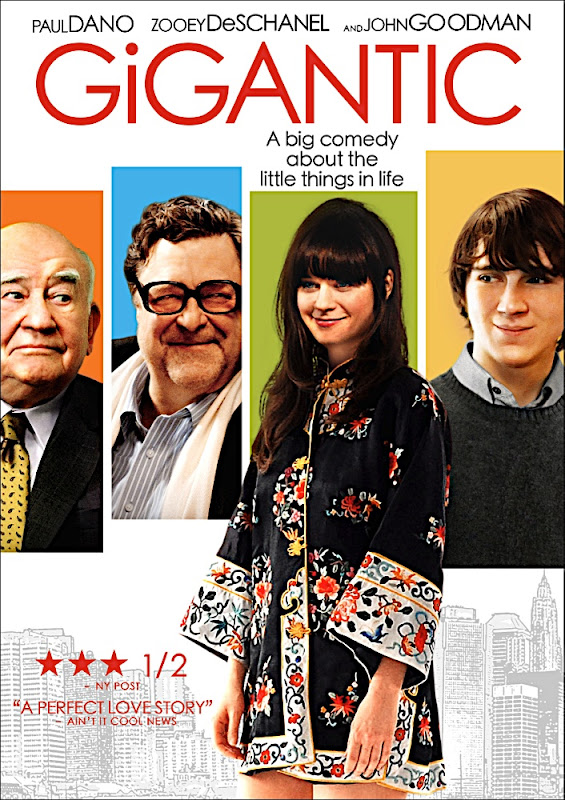
DVD Review: Gigantic (2009)


Now Available on DVD


Photo Slideshow


Delicious
Bookmark this on Delicious
submit to reddit
Print Page

Digg!

MovieBlips: vote it up!

DVD Review & Introduction


In addition to relishing in the opportunity of helping a reader remember the title of a favorite movie that they can't quite recall or sharing recommendations via e-mail, I'm consistently flattered when I'm contacted either by a filmmaker or a PR firm working on behalf of a studio to review a new film.

And it's always a treat, whether it's hearing from a debut filmmaker who's just completed his or her first feature financed on seventeen credit cards or being asked to review a film before its theatrical release since it will only be given a limited run going from one city to another.

Unfortunately, while time has made it difficult to accept all offered titles and at the same time you're never quite sure just exactly what is going to land in your mailbox-- overall, I'm constantly inspired by just how much creativity is out there. And criminally since money talks and movies without that never see the light of day, the result is that work is under appreciated and unavailable to those who don't live in New York or Los Angeles who happen to be free the one week an indie or low-budget work is screened.

As a rule, I always try to approach these films in particular filled with optimism since I'm simply grateful as a fan to see something that wouldn't be shown in a local theatre. Likewise, at the same time if the timing works out and I can fit in the works, I purposely avoid reading too much about them other than the tiniest synopses available and sometimes only view a portion of the trailer to prevent spoilers.

After all and especially in the case of art-house or independent fare, somebody took the time to create something out of thin air and somehow manged to not only complete the work but get it out there without the full power of a large scale marketing campaign behind it complete with product tie-ins or Happy Meal toys. So with this in mind, the least I can do is return the favor and view it as someone who just wants to be led on a unique cinematic journey for two hours.

And that is exactly what Gigantic director Matt Aselton managed to do with this unabashedly absurdist, imaginative and inspired feature filmmaking debut about human relationships that would make the ultimate companion piece to screen as a double feature with actress Zooey Deschanel's big-screen wildly successful Fox Searchlight hit (500) Days of Summer.

After just twenty chaotic minutes of Gigantic, I realized it was the type of movie that-- like Scorsese's After Hours, Jake Kasdan's Zero Effect or Wes Anderson's Bottle Rocket-- I immediately wanted to share with someone else because I had that much confidence in his singular vision. And luckily, Gigantic just kept evolving with each passing scene into something far more ingenious from one moment to the next as it paid homage to previous works but didn't feel derivative in the slightest.


Although it was highly praised by critics, sadly Matt Aselton's film which starred the mesmerizing and chameleon-like Paul Dano never managed to break out to experience the same level of success of other sleeper art films. Yet now that this overlooked work has made its way to disc, I urge you to track it down.

Having had only the screener with which to compare the quality of the DVD, I found it to be equally sharp and crisp in its inventive New Wave meets absurdist color and set design, yet I was extremely disappointed by the bonus features. Despite the fact that I must applaud Vivendi Entertainment for bringing this unique award-winning work from First Independent Pictures to disc in the first place-- the press release promised a plethora of extras including "behind-the-scenes candid interviews with the cast and crew, an alternate ending, deleted scenes, and commentary by director Matt Aselton."

However, the ultimate release delivered only two deleted scenes including one extremely crass conversation on a beach and a kitchen fire along with an alternate version of a fight scene which probably total less than five minutes of new material that's essentially pointless. Likewise, providing viewers with a trailer and stills gallery doesn't quite make up for the fact that with such an intellectually stimulating work, viewers who dig it will sorely miss those promised extras. However, I'm hopeful that eventually enough people will become Gigantic fans that eventually it will earn a second and superior release. Still until then, it's a highly recommended title to add to your collection and one of my picks of the week and on the short list for art films of '09 along with Ms. Deschanel's (500) Days of Summer.

Original Movie Review
Published: May 2009


In his feature filmmaking debut, director Matt Aselton uses absurdism the way that Hitchcock employed the MacGuffin.

And in Hitch's world the MacGuffin may have been "that thing in which the hero is chasing" such as top secret documents in a briefcase or diamonds in a museum, but in the end as Hitchcock and scholars deduced-- it just turns out that it's an inconsequential piece of matter or material that propels his characters into action. Or in other words, we never needed to know what the hero was chasing specifically or what the top secret codes or devices sought after did since we were more than happy to just go along for the ride anyway.

Without over-explaining motives or plot structures, Aselton utilizes the exact same technique repeatedly throughout his intelligent, offbeat, and deliciously weird film Gigantic which hearkens back to his affection for "films and stories in which reality and absurdity cross [paths]" by filling his quirky indie charmer with a surreal series of events he reveals are "just there and you believe it."

The events include for starters the impetus for the screenplay itself as Aselton acknowledged that "when we wrote this movie we knew two things: there would be a nameless assassin hunting the main character and that we'd rather not overtly explain why."

In the film, Paul Dano's meek and sensitive twenty-eight year old Swedish mattress company employee-- Brian Weathersby-- is the last person on the planet that should grab the attention of a nameless and homeless assassin but for reasons unknown, someone's after Brian and whether you feel it's real or surreal or even metaphorical, it's there from the start.

Yet, despite that structural decision-- in the scheme of Gigantic-- this is just all in the periphery, cropping up unexpectedly in between the film's main plot that centers on Brian's long-time goal to adopt a Chinese baby. Obviously as a single man under the age of thirty, he's not the ideal candidate to make that lifelong obsession a reality but having put his name on three waiting lists, he's eager to start building his own family, which we feel stems from the fact that he's the youngest and least successful son (and a "surprise" baby at that) of a father (played by Ed Asner) who'd had him when he was fifty-two.


However, before he readies himself to return from New York City to Vermont for his dad's eightieth birthday (where-- again and quite absurdly-- the Weathersby men get high on mushrooms in a wooded cabin), he meets an entirely different family that changes the course of both the film's plot and his life upon the arrival of the larger-than-life Al Lolly (John Goodman).


A blunt businessman with a bad back-- before Dano's quiet Brian even begins to discuss the details involving a $14,000 Swedish bed that comes with a twenty-five year warranty-- Al fast-talks Brian into free shipping, handling, and delivery.

Arriving later with her father's credit card before she falls into an easy two and a half hour slumber on the grand mattress-- Zooey Deschanel's fairy-tale like entry into the piece as a Sleeping Beauty who despite the name of Harriet is routinely called "Happy" aptly brightens Brian's day considerably.


And, in a nice twist of fate after Brian is told by a coworker that the regular delivery "dude ate bad chicken," it's Brian himself who arrives with the mattress at the Lolly residence. Once there, unexpectedly and again very absurdly he's fast-talked once again by the loud Al and beaming Happy to take the rest of the day off from work and drive them into New York City to see Al's spinal specialist since Al doesn't ride in taxi cabs and Happy refuses to drive in the city.

While Al is told-- for what appears to be the umpteenth time-- that his back is fine and the pain emanates from stress, Happy proves to be just as forward as her father, offering herself up for a quickie in the car with Brian that leads to a budding courtship between the two eccentrics.


While, despite the fact that on the surface, they couldn't be more different as for example, the constantly restless Happy reads ads instead of articles and moves from one passion to the next in stark contrast to Brian's wish for stability in his life in becoming a father-- somehow their relationship works. Or I should say, it's successful at least until life and family intersect in daffy, nonsensical, and unpredictable ways as Gigantic moves to its amiable conclusion.

A true born storyteller-- Matt Aselton who collaborated with his co-writer Adam Nagata-- has inspired a breath of fresh air into American independent filmmaking in a movie that stylistically seems more European than traditional mainstream fare from our country. And in fact, Aselton readily reveals in the film's production notes that he is a major fan of Luis Bunuel's The Discreet Charm of the Bourgeoisie as well as the oeuvre of Jean-Luc Godard and the fingerprints of both men show up from time to time-- although thankfully in a far more linear and accessible fashion.


However, he also cites other maverick American helmers like Hal Ashby, Robert Altman, and David Lynch whose painterly works and ability to think outside the box undoubtedly gave him the confidence to center a work on "what was happening to [his] characters in the present moment they resided."


Continuing on regarding his passion for the absurd-- the (in my view, existential or gently surreal) landscape of Gigantic is used for as he notes "liberating," and spontaneous effect since being in the moment without worrying about what will happen next is "ultimately the only thing that matters."


Along with Discreet Charm, Aselton makes a special mention of Harold and Maude director Hal Ashby's Being There in the film's notes for its similar approach involving "plain characters populating surreal worlds, [with] no need to explain their actions, or the madness that surrounds them." And indeed, there's a definite thematic and tonal link to Ashby's film which-- intriguingly-- also shares a one-degree relative in common with Aselton's Gigantic star Zooey's father Caleb Deschanel having been employed as the irreplaceable cinematographer on the masterful Being There.


While the film is sure to frustrate viewers who prefer the real to the surreal and find greater comfort in having everything neatly resolved-- especially when we're watching There Will Be Blood and Little Miss Sunshine's tremendously affable Dano being beaten to a bloody pulp by an assassin-- amazingly, we continue watching long after frequently rapid questions start cropping into our mind.


And the basis for this is simple-- namely that our enjoyment is augmented by the liberating cinematic approach that leaves everything in the realm of the unexplained MacGuffin as well as the sheer pleasure and uplift of this alternately dark and twisted yet assured, tender and refreshing achievement.

Likewise, I predict that like Spike Jonze, Michel Gondry, Wes Anderson, and Charlie Kaufman, Aselton will be a name we'll hear for a long while based on this debut work alone that also reminded me in tiny ways of the decorative works of Jacques Tati and the later entries in Truffaut's Antoine Doinel series.


Text ©2009, Film Intuition, LLC; All Rights Reserved. http://www.filmintuition.com

Unauthorized Reproduction or Publication Elsewhere is Strictly Prohibited.

5/08/2009

Movie Review: Gigantic (2009)


Fandango - Movie Tickets Online


Delicious
Bookmark this on Delicious
submit to reddit
Print Page

Digg!

In his feature filmmaking debut, director Matt Aselton uses absurdism the way that Hitchcock employed the MacGuffin.

And in Hitch's world the MacGuffin may have been "that thing in which the hero is chasing" such as top secret documents in a briefcase or diamonds in a museum, but in the end as Hitchcock and scholars deduced-- it just turns out that it's an inconsequential piece of matter or material that propels his characters into action. Or in other words, we never needed to know what the hero was chasing specifically or what the top secret codes or devices sought after did since we were more than happy to just go along for the ride anyway.

Without over-explaining motives or plot structures, Aselton utilizes the exact same technique repeatedly throughout his intelligent, offbeat, and deliciously weird film Gigantic which hearkens back to his affection for "films and stories in which reality and absurdity cross [paths]" by filling his quirky indie charmer with a surreal series of events he reveals are "just there and you believe it."

The events include for starters the impetus for the screenplay itself as Aselton acknowledged that "when we wrote this movie we knew two things: there would be a nameless assassin hunting the main character and that we'd rather not overtly explain why."

In the film, Paul Dano's meek and sensitive twenty-eight year old Swedish mattress company employee-- Brian Weathersby-- is the last person on the planet that should grab the attention of a nameless and homeless assassin but for reasons unknown, someone's after Brian and whether you feel it's real or surreal or even metaphorical, it's there from the start.

Yet, despite that structural decision-- in the scheme of Gigantic-- this is just all in the periphery, cropping up unexpectedly in between the film's main plot that centers on Brian's long-time goal to adopt a Chinese baby. Obviously as a single man under the age of thirty, he's not the ideal candidate to make that lifelong obsession a reality but having put his name on three waiting lists, he's eager to start building his own family, which we feel stems from the fact that he's the youngest and least successful son (and a "surprise" baby at that) of a father (played by Ed Asner) who'd had him when he was fifty-two.


However, before he readies himself to return from New York City to Vermont for his dad's eightieth birthday (where-- again and quite absurdly-- the Weathersby men get high on mushrooms in a wooded cabin), he meets an entirely different family that changes the course of both the film's plot and his life upon the arrival of the larger-than-life Al Lolly (John Goodman).


A blunt businessman with a bad back-- before Dano's quiet Brian even begins to discuss the details involving a $14,000 Swedish bed that comes with a twenty-five year warranty-- Al fast-talks Brian into free shipping, handling, and delivery.

Arriving later with her father's credit card before she falls into an easy two and a half hour slumber on the grand mattress-- Zooey Deschanel's fairy-tale like entry into the piece as a Sleeping Beauty who despite the name of Harriet is routinely called "Happy" aptly brightens Brian's day considerably.


And, in a nice twist of fate after Brian is told by a coworker that the regular delivery "dude ate bad chicken," it's Brian himself who arrives with the mattress at the Lolly residence. Once there, unexpectedly and again very absurdly he's fast-talked once again by the loud Al and beaming Happy to take the rest of the day off from work and drive them into New York City to see Al's spinal specialist since Al doesn't ride in taxi cabs and Happy refuses to drive in the city.

While Al is told-- for what appears to be the umpteenth time-- that his back is fine and the pain emanates from stress, Happy proves to be just as forward as her father, offering herself up for a quickie in the car with Brian that leads to a budding courtship between the two eccentrics.


While, despite the fact that on the surface, they couldn't be more different as for example, the constantly restless Happy reads ads instead of articles and moves from one passion to the next in stark contrast to Brian's wish for stability in his life in becoming a father-- somehow their relationship works. Or I should say, it's successful at least until life and family intersect in daffy, nonsensical, and unpredictable ways as Gigantic moves to its amiable conclusion.

A true born storyteller-- Matt Aselton who collaborated with his co-writer Adam Nagata-- has inspired a breath of fresh air into American independent filmmaking in a movie that stylistically seems more European than traditional mainstream fare from our country. And in fact, Aselton readily reveals in the film's production notes that he is a major fan of Luis Bunuel's The Discreet Charm of the Bourgeoisie as well as the oeuvre of Jean-Luc Godard and the fingerprints of both men show up from time to time-- although thankfully in a far more linear and accessible fashion.


However, he also cites other maverick American helmers like Hal Ashby, Robert Altman, and David Lynch whose painterly works and ability to think outside the box undoubtedly gave him the confidence to center a work on "what was happening to [his] characters in the present moment they resided."


Continuing on regarding his passion for the absurd-- the (in my view, existential or gently surreal) landscape of Gigantic is used for as he notes "liberating," and spontaneous effect since being in the moment without worrying about what will happen next is "ultimately the only thing that matters."


Along with Discreet Charm, Aselton makes a special mention of Harold and Maude director Hal Ashby's Being There in the film's notes for its similar approach involving "plain characters populating surreal worlds, [with] no need to explain their actions, or the madness that surrounds them." And indeed, there's a definite thematic and tonal link to Ashby's film which-- intriguingly-- also shares a one-degree relative in common with Aselton's Gigantic star Zooey's father Caleb Deschanel having been employed as the irreplaceable cinematographer on the masterful Being There.


While the film is sure to frustrate viewers who prefer the real to the surreal and find greater comfort in having everything neatly resolved-- especially when we're watching There Will Be Blood and Little Miss Sunshine's tremendously affable Dano being beaten to a bloody pulp by an assassin-- amazingly, we continue watching long after frequently rapid questions start cropping into our mind.


And the basis for this is simple-- namely that our enjoyment is augmented by the liberating cinematic approach that leaves everything in the realm of the unexplained MacGuffin as well as the sheer pleasure and uplift of this alternately dark and twisted yet assured, tender and refreshing achievement.

Likewise, I predict that like Spike Jonze, Michel Gondry, Wes Anderson, and Charlie Kaufman, Aselton will be a name we'll hear for a long while based on this debut work alone that also reminded me in tiny ways of the decorative works of Jacques Tati and the later entries in Truffaut's Antoine Doinel series.


1/07/2007

Little Miss Sunshine (2006)


Directors: Valerie Faris and Jonathan Dayton

In this Sundance sleeper that delighted and attracted audiences with its ingenuity and the fact that they just don’t make enough intelligent comedic films for adults, the popular topics of familial dysfunction and the American road trip are explored to great effect. Caring mother Toni Collete and motivational speaker Greg Kinnear play two New Mexico parents who pack up their family in an old yellow VW bus and head to California in order to make a girl’s beauty pageant aptly titled Little Miss Sunshine. Coming along for the ride are Colette’s brother, the recently depressed gay Proust scholar, who tried to commit suicide after losing his love, job and genius grant; a heroin snorting grandfather recently kicked out of his retirement community where he was the bachelor of the ball; a young girl with beauty queen dreams, and her brother who, in reverence to Frederic Nietzsche, has taken a vow of silence until he becomes an air force pilot. Darkly hilarious and heartfelt, it starts off with eccentric quirks for quirk sake and foul language guaranteed to shock and awe but breaks out from the pack of typical suburban dysfunction tales as the family gets further away from their home. Alan Arkin as the grandfather and Steve Carell, playing against type as the sad-faced melancholic uncle, steal the show-- the jokes are smart, work well, and the film makes you squirm and giggle at the same time. At its heart the film is a family comedy comprised of feel good fun with an underdog “never give up” message hiding in a rated R package.