Showing posts with label Chloe Grace Moretz. Show all posts

1/21/2014

Blu-ray Review: Carrie (2013)


Now Available to Own   


Photo Slideshow  


Bookmark and Share

"What did Carrie White ever do to you?” 

Although it’s always been shelved alongside other tales of teenage torment from Friday the 13th to Halloween, in my eyes, Brian DePalma’s Carrie – just like William Friedkin’s Exorcist – has always had more in common with Greek Tragedy than a true work of horror.

And while a lot of genre works stem from a place of anguish and revenge with an emphasis on the outsider – whether it’s Jason’s grieving mother in Friday or an institutionalized brother in Halloween, those titles always waded more heavily in the pool of horror rather than walking the fine line between horror and tragedy.


What perhaps it comes down to is the issue of choice and free will verses the victimized villains (a la Exorcist and Carrie) who find themselves pushed into supernatural experiences beyond their control. And while one can argue that unlike the possessed young girl in The Exorcist, Carrie does eventually develop some control over her telekinetic powers – as a combination of bullied victim meets superhero origin story – ultimately there’s something undeniably tragic about this girl that leads to her downfall.

The tragedy is undoubtedly multiplied by the innocence of Carrie as a girl out of time and out of step with the rest and likewise as one who never wished harm on others but whose own emotional tidal wave of repeated bullying shoves her into the role of aggressor against her will in a way that’s heartbreaking to behold.


And indeed in former teacher turned author Stephen King’s debut novel, Carrie tells the story of the dangers of bullying in a way that views the problem and the moral lessons of it through a fantastical kaleidoscope of horrifying tragedy.

Though undoubtedly shocking in its day – when pared down to its essence and with the absence of the supernatural, King’s plotline has become much too common four decades later. And given that we live in an era of peer torment on an unprecedented scale where tales of bullying-fueled school-shootings and suicides regularly unfold on the evening news, Carrie has become all the more tragic and timelier today than it was when it was first published in 1974.

As Sue Snell, the good girl who finds herself doing a bad thing states late into the 2013 remake, “you can only push someone so far before they break” and break Carrie does once again in this third adaptation of King’s novel, following DePalma’s 1976 feature as well as 2002’s made-for-television take on the storyline.


The first version to be directed by a woman as well as the first starring an actress precisely the right age of the high school character as opposed to the twenty-somethings that had tackled the part in the past, Boys Don’t Cry filmmaker Kimberly Peirce helms a powerful, contemporary and far more emotionally driven female-centric adaptation than we've previously encountered.

Brought vividly to life by the effective one-two punch epitomized by the two women at the heart of the film in the form of Chloe Grace Moretz and Julianne Moore, Peirce’s Carrie is strengthened by their potent portrayals of the eponymous character and her fiercely protective, religious zealot mother.

As opposed to making their relationship as much of a fear-based power struggle (as a sort of home-based extension of the horrific bullying Carrie White endures at school) that we experienced in DePalma’s original, Peirce’s treatment of their relationship is much more complicated and multi-layered.


For the first time and to this great of an emphasis, we actually see the amount of true love and affection that the two have for each other that they don’t fully know how to reconcile with their protective instincts as such psychologically broken, fragile individuals.

Yet at the same time, we also witness their dynamic from the point-of-view of the mother as well as the daughter, which makes us fully appreciate where they’re coming from as three-dimensional human beings.

While Moore is predictably perfection as her take on Margaret White opens her up so we can see her vulnerabilities and self-loathing as well as her fierce drive to shelter her daughter, Peirce’s film allows offers more insight to other supporting female characters as well.

Addressing the pregnancy of Sue Snell for the first time onscreen, thus making her drive to make amends for her peer-pressure induced poor behavior that much richer – Peirce’s Carrie uses the bond of mother and child and the circle of life as a subtextual throughline for the work from its shocking opener to its devastating finale.

Additionally, 2013’s Carrie gives 13 Going on 30 star Judy Greer a great opportunity to break out of her typecast “best friend” romantic comedy roles. As Carrie’s sympathetic gym teacher who tries to not only get to the bottom of a hellish bout of bullying that occurs in the first act but also attempts to prevent further harm to Carrie for better or worse, we now see her as another variation of a “mother” role in Greer’s nuanced portrayal.


While Peirce’s conceptual take on the arc of Carrie as a sort of superhero origin story does offer the eponymous lead a chance to adapt to her powers in a way that illustrates that the formerly wholly vulnerable girl is coming into her own, the doomed prom payoff never quite makes this spin work on the level she hoped.

Nonetheless, Moretz is a marvel given her impressive physical transformation in the subtle ways she changes from one scene to the next. A fully realized performance evidenced by the evolution of Carrie’s posture, body language and tone of voice, Moretz is convincing not only in her dominant, more feral take on Carrie the telekinetic woman-wronged witch but also in quieter moments as the withdrawn-into-herself victimized girl who wishes she could blend into the lockers and be left alone.


And actually because Moretz is so strong in convincing us of her evolution, it makes it a bit harder in her final showdown to see her as a broken, bullied girl verses a deadly aggressor given how active Moretz is moving her arms and turning the titular character into something more otherworldly than human.

Although Moretz definitely needs a cinematic change of pace as Carrie is yet another super-dark role for this impressive young woman’s already ultra-violent resume (following her onscreen breakthrough turns in the Kick-Ass series and Let Me In), she effectively defies her glamorous old-Hollywood style beauty to make her Carrie a relatable everygirl.

In the end, it’s so similar to DePalma’s classic that it’s hard to argue that remaking Carrie was cinematically necessary since they stayed so true to the original work. However because the few changes that were made fully humanize the supporting players and delve deeper into the heart of the mother/daughter plotline, it works in Peirce’s favor overall.


Yet by hitting us on a different level, this visceral, emotional approach likewise guarantees that Peirce’s Carrie is even more tragic than previous adaptations were before.

While originally ahead of its time given King’s emphasis on bullying, it’s a shame that as it stands now forty years later, kids still haven’t learned a lesson from the traumatic tale of Carrie White. Therefore, it’s that much more important for viewers to understand that as opposed to a horror story where the title character is the villain, the real horror of Carrie is what happens to Carrie White rather than Carrie White herself.

While the thing about movies is that they mean something different to everyone, Peirce has done a superb job of driving this point home by tackling Carrie with the same genuine empathy and humanity evidenced throughout her filmography.

Featuring an alternate ending that plays on the circle of life and bond between mother and child that nonetheless would’ve ended the movie on the wrong emotional note in its depiction of Carrie as villain verses victim, Fox’s stunning Blu-ray transfer also serves up multiple making-of-featurettes, interviews and a fun candid camera tie-in telekinetic prank played on coffee shop regulars. And by including an Ultraviolet digital copy of the film to download or stream, Fox and ScreenGems ensure you’ll be able to take Carrie White with you wherever you go from gym class to the prom.


Text ©2014, Film Intuition, LLC; All Rights Reserved. http://www.filmintuition.com Unauthorized Reproduction or Publication Elsewhere is Strictly Prohibited and in violation of the Digital Millennium Copyright Act.  FTC Disclosure: Per standard professional practice, I may have received a review copy of this title in order to evaluate it for my readers, which had no impact whatsoever on whether or not it received a favorable or unfavorable critique.

7/24/2009

Movie Review: (500) Days of Summer (2009)


View the Photo Slideshow


Now Available to Own


Get the Infectious Soundtrack

& Zooey Deschanel's Album by She & Him


Or Download the Soundtrack from iTunes

Mychael Danna & Rob Simonsen


Delicious
Bookmark this on Delicious
submit to reddit
Print Page

Digg!

MovieBlips: vote it up!

If you were to ask the screenwriters Scott Neustadter and Michael H. Weber why they wrote the amazingly personal and refreshingly relatable, genuinely authentic and male-centric romance (500) Days of Summer--according to Neustadter, "our aim was simple-- tell the story of a relationship, make it real, make it funny, try to make it not suck."

In the production notes for the Fox Searchlight sleeper that's been building momentum since picking up positive buzz and acclaim from the film festival circuit including screening as an Official Selection at the Phoenix Film Festival-- the writers humbly continue on. Noting that they based the screenplay on some of their own heartbreaks, aches, and romantic misadventures-- as
Neustadter shares-- they ultimately aspired to craft something more in the vein of their "heroes Cameron Crowe and Woody Allen" wherein audiences could connect with their particular brand of "boy meets girl" rather than trying to force humor out of "some squirrel attack in the woods."


In setting out to chart on paper and in screenplay form a nonlinear, challenging narrative for audiences used to the traditionally straightforward rom-com fodder we're fed every week (and will see again this week in the benign Ugly Truth), Neustadter explains that the men designed, "an anatomy of a romance [that's] equal parts autobiography and fantasy[;] a pop song in movie form."

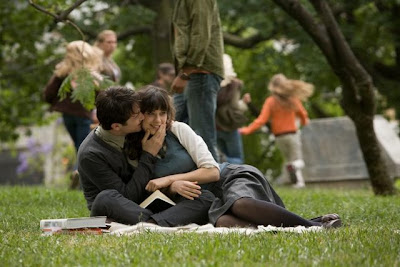
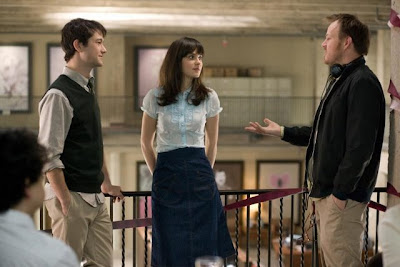
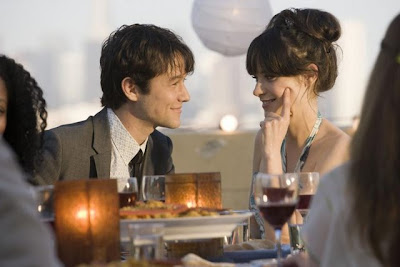
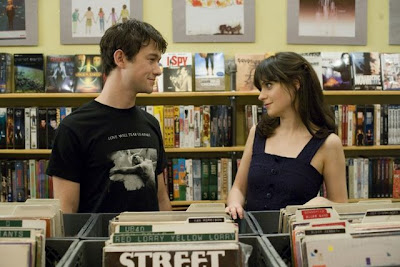
Although the film begins with both the description in narrative form that it "is a story of boy meets girl," we're also presented with the disclaimer that it's "not a love story." This is an intriguing confession since we see what is the definitive beginning of the young couple's initial interaction with one another as Joseph Gordon-Levitt's Tom works for a greeting card company and finds a dull meeting instantly livened up with the beaming promise of the fresh, sunny face as bright as her name-- embodied by the girl dubbed Summer (Zooey Deschanel) who's been employed as the firm's secretary, new to Los Angeles from the Midwest.


While we see the first awkward moments of bonding over pop culture including a mutual affection for the music of The Smiths and other coincidences that Tom reads much more into than Summer-- the writers and our inventive director Marc Webb throw us for a loop by cutting to what very well may be the disintegration of the relationship before it even begins as we move to a devastated Tom breaking dishware in his apartment.

Later we discover that this followed a conversation wherein Summer ditched him in a diner by saying that the two had become like Sid and Nancy (the notorious couple chronicled on film whose relationship ended in stabbing) but only in Summer's view, she was the man who did wielded the knife.


Of course, the writers credit the films of Crowe and Allen and right from the get-go we see allusions to the sing-along happy feel-great moments found in Crowe that can be matched by the emotional downpour of tears in some male angst moments found in his masterworks of Almost Famous (also starring Deschanel) and Say Anything along with Woody Allen's Annie Hall for revealing the spoiler about a breakup (or possible one at least) from the very beginning.


Yet the writers also noted they initially sought nonlinear inspiration from Christopher Nolan's Memento and set out to write a rom-com in that format. Again, everything links up once more as Gordon-Levitt is next gearing up to work for the Memento auteur but (500) Days of Summer is correctly described in the notes as not just a pop song captured on cinema but it also feels like a cinematic collage that's fittingly indicative of its beautiful, eye-catching poster.


Fans of High Fidelity and the writing of Nick Hornby will note that a large majority of the uncharacteristically masculine overly romantic delusions possessed by Tom seem to stem from pop songs. Obviously pop culture is also a culprit as the screenplay notes Tom underwent a horrid misinterpretation of the ending of The Graduate-- which in itself was dissected brilliantly to comedic effect by Chris Eigeman in Whit Stillman's Barcelona.


Likewise, it's also reminiscent of a cheerier and less fantastical version of Charlie Kaufman and Michel Gondry's Eternal Sunshine of the Spotless Mind which subtly revealed that the things that may attract us to someone today may repel us tomorrow, as well as a '60s French New Wave feel from the movies of Jacques Demy like Young Girls of Rochefort and Umbrellas of Cherbourg and Jean-Luc Godard's A Woman Is a Woman and Breathless.


And this seems only fitting for if there's one actress working in the industry today who always seems like she defies a set generation with a Judy Garland '40s like soulful voice, a feminine Audrey Hepburn-esque demeanor, and a taste for the avante garde it would be none other than Zooey Deschanel. Deschanel's work in (500) Days of Summer marks her second quirky indie romance following a supporting turn in the little-seen but highly recommended Gigantic co-starring Paul Dano and John Goodman which hits shelves next month.


Although fans of Deschanel already know that she can sing-- whether it's on film even in small scenes in movies like Jon Favreau's Elf or Julia Stiles' directorial debut short Raving or via her remarkable cult success alongside M. Ward as the female half of the band She & Him so it comes as no surprise to see her cut loose in the movie's karaoke scenes. However, I was pleasantly delighted by the vocal stylings of Gordon-Levitt. Going for Pixies karaoke is brave indeed when he took to the microphone as well but you're truly stunned to see his jubilant energy as he dances it up in a beautiful fantasy sequence choreographed to Hall & Oates to show the invincible power of love.


While in the relationship between the two, Tom's decidedly the one with more to lose as one of my friends had cruelly stated that in any romance one person loves the other one more-- in the case of Summer and Tom-- she makes it clear from the start that she doesn't want to be anyone's girlfriend or anyone's anything. Of course, when you're blinded by your own love and complete conviction that you're soul mates, blindly Tom feels he can love Summer enough for the two of them and that she'll come around eventually and there are moments that-- to anyone else's eyes-- would give off the evidence of pure, unabashed love from her side of the bed as well.


However as the timeline moves throughout the five hundred days of their courtship from bliss to boredom, we're offered that rare gift of looking longer and deeper at young romance in a way that feels amazingly real and likewise may make some couples flinch who aren't rock solid or possibly haven't admitted some true feelings to one another about the pace or course of their relationship. Thus, it make this film a bit dicey for some viewers to tread into without realizing that what you're getting isn't a pre-packaged Sandra Bullock happily-ever-after movie.


Obviously, as the genre dictates--the screenwriters fill it with various quirky friends and/or relatives and this film is no exception as Tom is saddled with a wise beyond her years twelve year old sister Rachel. As played by Chloe Moretz, Rachel curses like Gordon Ramsay and dutifully pedals her bike over late at night to urge her big brother to man up and drink some vodka in a device that feels a bit borrowed from Luke Wilson's precocious younger sister in Bottle Rocket than one that's authentic.


However, whereas some found it a really glaring misstep, I thought it was important to give us a chance to breathe, laugh, and step away from the claustrophobic intensity of love for a minute and likewise gave Gordon-Levitt another actor to play off of and show us his always-increasing range as he continues to impress from one movie to the next.

Whether he's strumming his guitar in his heartbreaking exit of the underrated Stop-Loss, giving a performance in Mysterious Skin that seemed to influence Heath Ledger's even subconsciously in Brokeback Mountain, finding his dreams shattered and unsure of whom to trust in The Lookout or holding his own alongside Oscar nominees like Mickey Rourke and Diane Lane in Killshot (note: I'm the "Jon" quoted on the back)-- in my book, Gordon-Levitt continues to be one of our best kept secrets. In fact on a second viewing of Summer, I realized that the young man who's also set his sights on filmmaking by adapting a great Elmore Leonard piece into a short film starring Carla Gugino and Eric Stoltz (which I'm dying to see... somehow)
could definitely could be in awards consideration for his varied, dynamic performance in Webb's film.


Perfectly matched with Deschanel-- with whom Gordon-Levitt had previously starred in the film Manic-- you immediately fall in love with the two characters and actors both as a couple and separately if you hadn't been fans before and considering that the film has already made a splash with its opening in select markets last week as one of summer's sleepers, I'm thinking we'll see much more of them soon.

Blending music from the past and present to weave a highly personal romantic film for those involved as they note that whenever we fall in love, we do inevitably develop a soundtrack of whatever we're listening to at the time-- it's no wonder that the soundtrack is quickly becoming popular as well. Of course it's helped that the selections are wonderful and even go as far as to include my very favorite track by The Doves in "There Goes the Fear."


Cleverly edited with split frames and camera trickery to keep the old "boy meets girl" story fresh as if the film's wondrous dialogue and premise didn't do it already for us-- while romantic works and especially ones about this particular age group don't necessarily catch on with Academy voters-- as far as screenplays go, Michael H. Weber and Scott Neustadter's (500) Days of Summer is easily the strongest written work of the year so far.


And this is due not only for its creative daring to go against the grain in a genre we know so well and also give us a male's perspective on love but also for doing so in a highly unusual nonlinear way that reminds us that it's never one thing that makes or breaks a relationship and sometimes it's all just there from the beginning like an extraordinary work of writing.


Text ©2009, Film Intuition, LLC; All Rights Reserved. http://www.filmintuition.com

Unauthorized Reproduction or Publication Elsewhere is Strictly Prohibited.