View the Photo Slideshow
Now Available to Own
Get the Infectious Soundtrack
& Zooey Deschanel's Album by She & Him
Or Download the Soundtrack from iTunes

Now Available to Own
Get the Infectious Soundtrack
& Zooey Deschanel's Album by She & Him
Or Download the Soundtrack from iTunes


Bookmark this on Delicious

Print Page


If you were to ask the screenwriters Scott Neustadter and Michael H. Weber why they wrote the amazingly personal and refreshingly relatable, genuinely authentic and male-centric romance (500) Days of Summer--according to Neustadter, "our aim was simple-- tell the story of a relationship, make it real, make it funny, try to make it not suck."
In the production notes for the Fox Searchlight sleeper that's been building momentum since picking up positive buzz and acclaim from the film festival circuit including screening as an Official Selection at the Phoenix Film Festival-- the writers humbly continue on. Noting that they based the screenplay on some of their own heartbreaks, aches, and romantic misadventures-- as Neustadter shares-- they ultimately aspired to craft something more in the vein of their "heroes Cameron Crowe and Woody Allen" wherein audiences could connect with their particular brand of "boy meets girl" rather than trying to force humor out of "some squirrel attack in the woods."
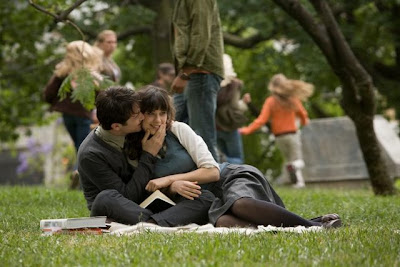
In setting out to chart on paper and in screenplay form a nonlinear, challenging narrative for audiences used to the traditionally straightforward rom-com fodder we're fed every week (and will see again this week in the benign Ugly Truth), Neustadter explains that the men designed, "an anatomy of a romance [that's] equal parts autobiography and fantasy[;] a pop song in movie form."
Although the film begins with both the description in narrative form that it "is a story of boy meets girl," we're also presented with the disclaimer that it's "not a love story." This is an intriguing confession since we see what is the definitive beginning of the young couple's initial interaction with one another as Joseph Gordon-Levitt's Tom works for a greeting card company and finds a dull meeting instantly livened up with the beaming promise of the fresh, sunny face as bright as her name-- embodied by the girl dubbed Summer (Zooey Deschanel) who's been employed as the firm's secretary, new to Los Angeles from the Midwest.

While we see the first awkward moments of bonding over pop culture including a mutual affection for the music of The Smiths and other coincidences that Tom reads much more into than Summer-- the writers and our inventive director Marc Webb throw us for a loop by cutting to what very well may be the disintegration of the relationship before it even begins as we move to a devastated Tom breaking dishware in his apartment.
Later we discover that this followed a conversation wherein Summer ditched him in a diner by saying that the two had become like Sid and Nancy (the notorious couple chronicled on film whose relationship ended in stabbing) but only in Summer's view, she was the man who did wielded the knife.
Of course, the writers credit the films of Crowe and Allen and right from the get-go we see allusions to the sing-along happy feel-great moments found in Crowe that can be matched by the emotional downpour of tears in some male angst moments found in his masterworks of Almost Famous (also starring Deschanel) and Say Anything along with Woody Allen's Annie Hall for revealing the spoiler about a breakup (or possible one at least) from the very beginning.
Yet the writers also noted they initially sought nonlinear inspiration from Christopher Nolan's Memento and set out to write a rom-com in that format. Again, everything links up once more as Gordon-Levitt is next gearing up to work for the Memento auteur but (500) Days of Summer is correctly described in the notes as not just a pop song captured on cinema but it also feels like a cinematic collage that's fittingly indicative of its beautiful, eye-catching poster.
Fans of High Fidelity and the writing of Nick Hornby will note that a large majority of the uncharacteristically masculine overly romantic delusions possessed by Tom seem to stem from pop songs. Obviously pop culture is also a culprit as the screenplay notes Tom underwent a horrid misinterpretation of the ending of The Graduate-- which in itself was dissected brilliantly to comedic effect by Chris Eigeman in Whit Stillman's Barcelona.
Likewise, it's also reminiscent of a cheerier and less fantastical version of Charlie Kaufman and Michel Gondry's Eternal Sunshine of the Spotless Mind which subtly revealed that the things that may attract us to someone today may repel us tomorrow, as well as a '60s French New Wave feel from the movies of Jacques Demy like Young Girls of Rochefort and Umbrellas of Cherbourg and Jean-Luc Godard's A Woman Is a Woman and Breathless.
And this seems only fitting for if there's one actress working in the industry today who always seems like she defies a set generation with a Judy Garland '40s like soulful voice, a feminine Audrey Hepburn-esque demeanor, and a taste for the avante garde it would be none other than Zooey Deschanel. Deschanel's work in (500) Days of Summer marks her second quirky indie romance following a supporting turn in the little-seen but highly recommended Gigantic co-starring Paul Dano and John Goodman which hits shelves next month.
Although fans of Deschanel already know that she can sing-- whether it's on film even in small scenes in movies like Jon Favreau's Elf or Julia Stiles' directorial debut short Raving or via her remarkable cult success alongside M. Ward as the female half of the band She & Him so it comes as no surprise to see her cut loose in the movie's karaoke scenes. However, I was pleasantly delighted by the vocal stylings of Gordon-Levitt. Going for Pixies karaoke is brave indeed when he took to the microphone as well but you're truly stunned to see his jubilant energy as he dances it up in a beautiful fantasy sequence choreographed to Hall & Oates to show the invincible power of love.
While in the relationship between the two, Tom's decidedly the one with more to lose as one of my friends had cruelly stated that in any romance one person loves the other one more-- in the case of Summer and Tom-- she makes it clear from the start that she doesn't want to be anyone's girlfriend or anyone's anything. Of course, when you're blinded by your own love and complete conviction that you're soul mates, blindly Tom feels he can love Summer enough for the two of them and that she'll come around eventually and there are moments that-- to anyone else's eyes-- would give off the evidence of pure, unabashed love from her side of the bed as well.

However as the timeline moves throughout the five hundred days of their courtship from bliss to boredom, we're offered that rare gift of looking longer and deeper at young romance in a way that feels amazingly real and likewise may make some couples flinch who aren't rock solid or possibly haven't admitted some true feelings to one another about the pace or course of their relationship. Thus, it make this film a bit dicey for some viewers to tread into without realizing that what you're getting isn't a pre-packaged Sandra Bullock happily-ever-after movie.
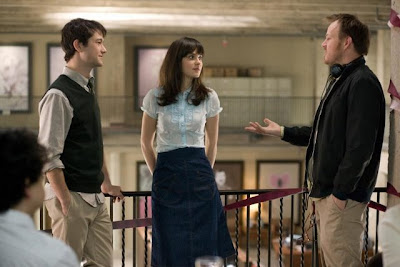
Obviously, as the genre dictates--the screenwriters fill it with various quirky friends and/or relatives and this film is no exception as Tom is saddled with a wise beyond her years twelve year old sister Rachel. As played by Chloe Moretz, Rachel curses like Gordon Ramsay and dutifully pedals her bike over late at night to urge her big brother to man up and drink some vodka in a device that feels a bit borrowed from Luke Wilson's precocious younger sister in Bottle Rocket than one that's authentic.
However, whereas some found it a really glaring misstep, I thought it was important to give us a chance to breathe, laugh, and step away from the claustrophobic intensity of love for a minute and likewise gave Gordon-Levitt another actor to play off of and show us his always-increasing range as he continues to impress from one movie to the next.
Whether he's strumming his guitar in his heartbreaking exit of the underrated Stop-Loss, giving a performance in Mysterious Skin that seemed to influence Heath Ledger's even subconsciously in Brokeback Mountain, finding his dreams shattered and unsure of whom to trust in The Lookout or holding his own alongside Oscar nominees like Mickey Rourke and Diane Lane in Killshot (note: I'm the "Jon" quoted on the back)-- in my book, Gordon-Levitt continues to be one of our best kept secrets. In fact on a second viewing of Summer, I realized that the young man who's also set his sights on filmmaking by adapting a great Elmore Leonard piece into a short film starring Carla Gugino and Eric Stoltz (which I'm dying to see... somehow) could definitely could be in awards consideration for his varied, dynamic performance in Webb's film.
Perfectly matched with Deschanel-- with whom Gordon-Levitt had previously starred in the film Manic-- you immediately fall in love with the two characters and actors both as a couple and separately if you hadn't been fans before and considering that the film has already made a splash with its opening in select markets last week as one of summer's sleepers, I'm thinking we'll see much more of them soon.
Blending music from the past and present to weave a highly personal romantic film for those involved as they note that whenever we fall in love, we do inevitably develop a soundtrack of whatever we're listening to at the time-- it's no wonder that the soundtrack is quickly becoming popular as well. Of course it's helped that the selections are wonderful and even go as far as to include my very favorite track by The Doves in "There Goes the Fear."
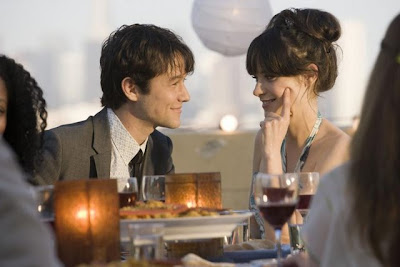
Cleverly edited with split frames and camera trickery to keep the old "boy meets girl" story fresh as if the film's wondrous dialogue and premise didn't do it already for us-- while romantic works and especially ones about this particular age group don't necessarily catch on with Academy voters-- as far as screenplays go, Michael H. Weber and Scott Neustadter's (500) Days of Summer is easily the strongest written work of the year so far.
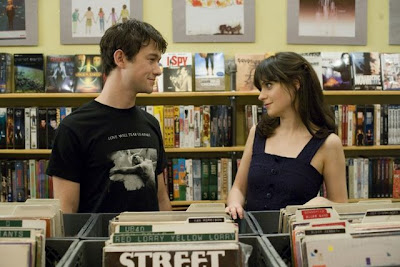
And this is due not only for its creative daring to go against the grain in a genre we know so well and also give us a male's perspective on love but also for doing so in a highly unusual nonlinear way that reminds us that it's never one thing that makes or breaks a relationship and sometimes it's all just there from the beginning like an extraordinary work of writing.

Text ©2009, Film Intuition, LLC; All Rights Reserved. http://www.filmintuition.com
Unauthorized Reproduction or Publication Elsewhere is Strictly Prohibited.


 Winner of the Special Jury Prize for its remarkable ensemble cast and nominated for Sundance’s Grand Jury Prize for Gregg, Choke chronicles Sam Rockwell’s Victor Mancini, a sex addicted con artist who by day works as a historical re-enactor at a tourist trap as “the backbone of Colonial America,” along with his best friend and fellow addict Denny (Brad William Henke) and their far-too-serious boss, played amusingly by Gregg himself. Describing his profession as something like being marooned on Gilligan’s Island meets Groundhog Day in hell, Gregg manages to insert some much needed humor and creativity into what otherwise could have been a far too excruciatingly uncomfortable film
 Victor’s troubled and tragic childhood with the mentally unstable Ida.
 seemed eager to see something sexually stimulating. I was especially awestruck by a prominent critic (who shall remain nameless) who chose thematically obvious surface comparisons to sex-obsessed Woody Allen and juvenile humor of Judd Apatow for his summation of why he disliked Choke. For the record, there was nothing remotely Allen or Apatow-like about it and I doubt those two filmmakers even entered Gregg’s mind during the entire filmmaking process since the entirety of the film seems wholly fitting to the same nihilistic, chaotic, questioning world Fincher acquainted us with in his take on Palahniuk’s Fight Club. And while we do indeed see everything (so much that after awhile, we’re numb to the bizarre acts being performed), it’s all handled in an unapologetic, graphic way devoid of any real human connection to illustrate just how unappealing it would be to have such an addiction in the fist place which is precisely the right approach.