Showing posts with label Foreign Policy. Show all posts

11/02/2018

Movie Review: Viper Club (2018)


Now Playing 


Bookmark and Share

A mother desperately waiting for news about the safety of her son who's in harm's way overseas, Susan Sarandon has played this part before...or so I thought.

Of course with over a hundred and fifty credits to her name as an actress on IMDb, it’d be safe to assume that the Academy Award winner has played everyone before and – like most women over fifty – more than her fair share of mothers.

However, unlike her role as a distraught matriarch waiting to learn whether or not her son might have been killed in a war zone in director Robert Allan Ackerman's compelling if admittedly contrived adaptation of Ellyn Bache's novel Safe Passage, Sarandon's performance in Viper Club is – much like the film itself – quieter and more attuned to the struggles of daily life.


Attempting to illustrate the impact that our foreign policy decisions can have even on non-military personnel right here in the states, while Safe Passage's lofty ambitions get lost in the theatricality of its translation, Viper Club plays like an intimate docudrama as Sarandon tries to keep up a good front during the most harrowing of times.

Having lost touch with her son Andy (Julian Morris) roughly two months ago, hardworking emergency room nurse Helen Sterling (Sarandon) fears she's running out of time and options when she receives a twenty million dollar ransom demand for the freelance video journalist by the terrorists holding him hostage in a war zone overseas.

Overworked, over-stressed, and sworn to secrecy by the FBI and the state department – neither of whom speak to one another and instead ask Helen what the other agency had to say when she takes a long bus ride into New York City from Oneonta, New York to check in – as if reading her mind, they warn the determined single mother that it's against the law to pay the ransom.


Unable to provide her with any information since it's classified, she's urged to stall by negotiating the price down to an amount they never intend to pay. However, flooded by the roller-coaster of memories she's shared with her equally headstrong son (which come to life in flashback form throughout the film), Helen begins to take matters into her own hands.

And once her son's girlfriend (Sheila Vand) puts her in touch with friends of Andy's who belong to an international network of journalists, translators, contractors, and donors called the Viper Club – including fellow journalist Sam (Matt Bomer) and a wealthy socialite (played by Edie Falco) whose own son had been ransomed – they team up in an effort to bring her son home.

Shot in just twenty days, it's here where the film would've turned into a Taken style thriller if it had been made inside the big budget studio system, complete with a rewrite to give Helen a husband and put him in charge of Andy's fate while she frets at home.


Thankfully, screenwriters Jonathan Mastro and Maryam Keshavarz (who also directed) resist the temptation to adhere to genre expectations or cheap theatrics, instead dedicating the film "to international conflict journalists who put themselves in harm's way," in order to bring us the news and made as a "tribute" to those who've lost their lives, as the film's opening credits read.

And with the way the current administration labels the media the enemy of the people, Viper was timely even before the horrific murder of Jamal Khashoggi and the IEDs sent to CNN (and others) by a crazed bomber. But given this recent dangerous escalation both here and abroad for journalists (and even in cases that don't involve ransom), award-winning Iranian-American filmmaker Maryam Keshavarz's film has become that much more vital.


Made with both real sensitivity and a striking degree of authenticity to the point that it's generated criticism by the mother of murdered journalist James Foley who felt that Keshavarz "took" her story and labeled it fiction, while there are certainly enough parallels to be concerning, without knowing more about what went on behind-the-scenes it's hard to judge in that regard.

Shot using a handheld camera to put us in Helen's shoes and stay within her point-of-view, Keshavarz and cinematographer Drew Daniels (using softer 40mm lens often employed by Gordon Willis in the 1970s) keep Helen close to the center of the frame and seldom leave her side for more than a moment.

Giving us a window into a personal nightmare with far-reaching implications, the admittedly confusingly named Viper Club is sure to cause debate about not only what you might do in a similar situation but also the need to protect journalists worldwide.
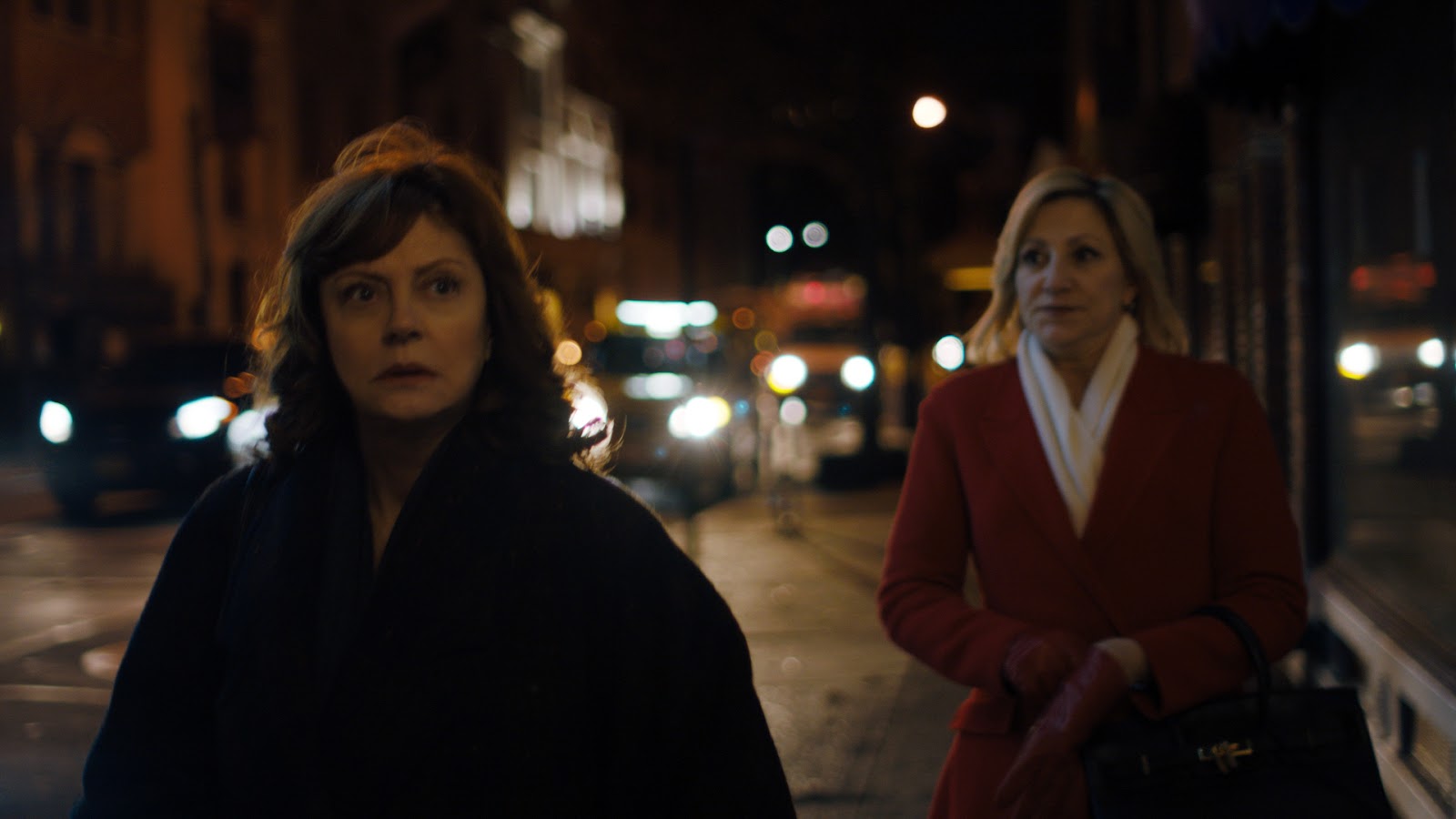

At a time in her career where Sarandon is frequently cast as the go-to mom from The Meddler to A Bad Moms Christmas, it's refreshing to see her given the opportunity to sing once again in more than one key opposite a talented cast of veterans and up-and-comers like scene-stealer Amir Malaklou as an uncertain new ER resident.

From first shot to last, Sarandon's deft ability to call up a wide range of emotion with a minimum of dialogue drives Keshavarz's haunting picture forward as she stands in for all mothers, holding her head up high while doing everything in her power to try and guarantee her son's safe passage home.


Text ©2018, Film Intuition, LLC; All Rights Reserved. http://www.filmintuition.com Unauthorized Reproduction or Publication Elsewhere is Strictly Prohibited and in violation of the Digital Millennium Copyright Act.  FTC Disclosure: Per standard professional practice, I may have received a review copy or screener link of this title in order to voluntarily decide to evaluate it for my readers, which had no impact whatsoever on whether or not it received a favorable or unfavorable critique. Cookies Notice: This site incorporates tools (including advertiser partners and widgets) that use cookies and may collect some personal information in order to display ads tailored to you etc. Please be advised that neither Film Intuition nor its site owner has any access to this data beyond general site statistics (geographical region etc.) as your privacy is our main concern.

6/09/2009

DVD Review: The People's Republic of Capitalism (2008)


NEW:
Acorn Media & Athena Release
A Series of Titles That
Celebrate Lifelong Learning


Shop AcornOnline.com


Delicious
Bookmark this on Delicious
submit to reddit
Print Page

Digg!

MovieBlips: vote it up!

Although I think it's safe to say that the same is true around the world-- given our economic recession and the overwhelming number of jobs lost throughout the United States, everyone you meet here in America has an opinion on outsourcing and our economy.

Yet the double-edged sword aspect about our valuable first amendment which allows for freedom of speech is that it doesn't necessarily go hand-in-hand with knowledge as sometimes these statements regarding legal and illegal migrant workers, outsourcing jobs overseas to India, China and other countries can lead to some pretty divisive and angry language.

Yes, we'd like to keep more jobs in our country... but at the same time we must ask what we ourselves are doing about it via actively thinking about what our choices mean by perhaps refusing to shop at stores that outsource labor, use sweat shops etc.

For example, although it's commonly known that Wal-Mart's low prices are low because of the company's outrageous practices (which you can explore in greater detail in the brilliant documentary Wal-Mart: The High Cost of Low Prices)-- because consumers are in debt from layoffs, we'll continue to shop at such stores, buy products made cheaply in other countries from those whose jobs used to be our own that are now exploited in unsafe conditions for little pay...and so the cycle continues on.


While on the surface, one may not realize how alike China and the United States are in all actuality-- nonetheless economically both countries are as Ted Koppel reveals in the first part of this brilliant four-part documentary "joined at the hip," although our relationship of interdependence and back-and-forth trade-offs of supply and demand is incredibly complicated.

Of course, admittedly it's safe to say that all sides of the issue can't be addressed in this fascinating 176 minute critically acclaimed documentary which aired on the Discovery Channel a year ago in the Koppel on Discovery series, yet the forty-two time Emmy Award Winner Ted Koppel (who is also the recipient of eight prestigious Peabody honors and has been inducted into the Broadcasting Hall of Fame) is precisely the right man for the job to give us an investigative overview.

Now Koppel's The People's Republic of Capitalism has been made available as a two disc set from Athena and Acorn Media as part of Athena's ongoing commitment to promoting lifelong learning through high quality documentary releases. Arriving in a nice slim-packaged 2-disc set, the title also comes complete with a full color twenty page viewer's guide that goes over main factual highlights, further background information about China and the cultural revolution, avenues for further learning, and thoughtful questions to consider to help you digest what is being discussed. Also boasting an exlusive interview with Koppel as well as releasing the documentary on Blu-ray as well, the collection could not be timelier given our econonomic crisis and the way that our economy affects every other country's as well.

To this end, he wisely narrows his scope specifically to the Sichuan Province city of Chongqing (located southwest of Shanghai) that now has a population of thirty million residents.

Throughout the four part documentary which consists of "Joined at the Hip," "MAO-ism to ME-ism," "The Fast Lane," and "It's the Economy, Stupid," Koppel takes an in-depth approach using business model compare and contrast techniques (such as Ethan Allen & Wal-Mart), candid interviews, global impact studies, and research.

Additionally and quite admirably, he manages to incorporate other aspects of Chinese life that immediately we wouldn't have thought to take into consideration by exploring their emerging and deadly relationship with automobiles from a former bicycle culture on their path to becoming a major economic superpower.

Shockingly uncovering that China now has twice as many highway fatalities via four hundred accidents a day and the estimation that they will have more cars on the road than the United States by 2030, Koppel examines the impact this has on not only the lives of those on the road or those working in construction to help support this demand for roads but also how this will detrimentally affect the environment as in China "everything depends on coal" which is cheap but dangerous for miners and devastating to our planet.

Throughout the series, he views the impact capitalism is having on the country with its new advent of governmental corruption and "look the other way policy "to the "illegal" yet widespread practice of prostitution in karaoke bars and brothels (where business deals are decided a la the American strip club).

And moreover, Koppel consistently uses prior issues uncovered as a springboard, following through on them to see the way that one topic leads to several others, thereby constantly reminding us that although it's easy to say something is "good" or "bad," there's so much to consider from an international perspective.

However, despite our vast differences given China's strict one-child policy and the citizens' trust in their government that they're willing to abandon our American style political freedom for what they feel will lead to a far better economic and prosperous future for the country-- an underlying theme throughout is that we both share the same contradictions of corruption, bribery, and exploitation of workers. Of course, this goes even further working in the widening class divide as the rich continue to grow wealthier and aspire to live a life of luxury products and surroundings whereas the poorer "peasant" class find themselves struggling to afford education or find suitable or safe work. Does this sound familiar?

Overall it's amazingly engrossing and quite hard to sum up the all-encompassing documentary that makes it an ideal source of advanced independent lifelong learning or continuing education especially considering the fact that everything transferred to disc resonates so strongly today. And although it will leave you with a far greater understanding of how dependent our economies are on each other and it's especially great to watch and discuss with others-- in the end it made me glad that I'm not in charge of a major corporation or served as a governmental decision maker in the area of trade relations.

However, at the same time-- it does call you to action and make you evaluate your own attitudes and decisions. Of course, while I already avoid Wal-Mart, you (like me) may find yourself thinking twice about not just your attitudes on outsourcing since that's just one small part of the whole chain but also via purchasing specific items from certain stores when you ascertain how every single one of us is impacted around the globe no matter where the item's label states it was manufactured in the first place.