Showing posts with label China. Show all posts

1/15/2020

Movie Review: The Bravest (2019)


A fiery Chinese flag-waving disaster movie inspired by the Xingang Port Oil Spill of 2010, The Bravest serves up intense, eye-catching cinematography and incredible special effects, but sadly, little else for us to connect with from start to finish.

Following an exciting introduction to our two main characters after they battle a blaze at a hotpot restaurant that goes tragically wrong, Fire Brigade Captain Jiang Liwei (Xiaoming Huang) is left disgraced and replaced by his second-in-command Ma Weiguo (Jiang Du). It doesn't take long however, for director Tony Chan to put us in the line of fire once again.


Culling from author Bao'erji Yuanye's book Tears Are the Deepest Water, which was based upon interviews with 188 Chinese firefighters, the film trades Xingang (or Tianjin) for the fictional northern seaport of Bingang, where a pipeline explosion threatens to not only wipe out all eight million of the area's residents but also cause catastrophic effects to the environment. As the spill from the blast reaches nearby tanks of crude oil and chemicals, the firemen get to work, putting life and limb on the line as they try to close the two open valves still flowing toward a large tanker.

More than eager to prove himself, perhaps as both a form of penance for losing a man under his command at the restaurant fire as well as a way to confront his new diagnosis of PTSD (which his supervisor told him made him unsuitable for action), Captain Jiang Liwei grabs a smoke before he jumps to it. Fighting to complete 8,000 manual rotations to seal off the tanker for good so that his men's firefight isn't in vain, as the captain tries to withstand the enveloping flames, the men advance toward the blaze, trying their best to contain it even when their water runs out.


Layering other heroics on top of the captain's —  as is often the case with disaster movies — whenever Chan abandons the fire to follow the captain's family in their quest to leave the port and reach safety, the pace of the film screeches to a dead halt. Treating an asthma inhaler like a gun we see early on that's bound to go off later on, we anticipate one of the melodramatic complications facing the captain's wife and son before they even set out on their journey to get the hell out of Bingang.

From a woman in labor to an engaged firefighter couple whose relationship off the clock is used to try to add more melodramatic significance to the roles they play when they're on the job, Yonggan Yu and Chao Wang's predictable script checks off all of the boxes that we would expect as they aim to humanize the proceedings but The Bravest remains stale. Additionally telegraphing events to come with its loud, insistent, bombastically intrusive score, the film makes it obvious which members of the cast will live or die shortly after they're introduced.


Stopping to fight the fires just long enough to give a few rousing speeches about duty and sacrifice, and using every moment available to insert a meaningful military salute to one another, it's clear that the film's heart is in the right place. Yet just when it lets us in enough to care about a character's plight, we leave the scene and immediately jump to another half-baked, underdeveloped subplot.

Preferring to talk at us rather than to us, by the time we get to a key third act sequence where the fiance of the fire inspector is supposed to keep the water flowing to the fires by diving into the sea, despite wanting him to succeed, it's hard to overlook the fact that we have little to no idea what's really going on. Similarly baffled by the number of times the guys just turn their backs to the fire to chat or the way that we go from a harrowing scene where the pregnant lady's water breaks to suddenly assuming they're okay because we're now in a hospital, between the hopscotching edits and the sparse script, The Bravest needs a serious overhaul.


Obviously inspired by both Ron Howard's seminal Backdraft as well as disaster movies of the Roland Emmerich variety, even though we'd love to be more invested in the goings on, when it comes to the genre, storytelling problems are nothing new. So for this new Chinese film, I'll go ahead and translate. As long as you're not interested in pesky things like who the supporting characters are outside of the two minutes we see them onscreen or what they're doing and why — for its claustrophobic, red hot visuals that bring heat to your TV — The Bravest is thrilling filmmaking from a technical perspective alone.

Watch it Now

Text ©2020, Film Intuition, LLC; All Rights Reservedhttps://www.filmintuition.com  Unauthorized Reproduction or Publication Elsewhere is Strictly Prohibited and in violation of the Digital Millennium Copyright Act.  Also, as an Amazon Associate, I earn from qualifying purchases made off my site through ad links. FTC Disclosure: Per standard professional practice, I may have received a review copy or screener link of this title in order to voluntarily decide to evaluate it for my readers, which had no impact whatsoever on whether or not it received a favorable or unfavorable critique. Cookies Notice: This site incorporates tools (including advertiser partners and widgets) that use cookies and may collect some personal information in order to display ads tailored to you etc. Please be advised that neither Film Intuition nor its site owner has any access to this data beyond general site statistics (geographical region etc.) as your privacy is our main concern.

8/14/2019

Blu-ray Review: Ash is Purest White (2018)


Now Available


If Michelangelo Antonioni had directed a Chinese gangster movie, it might've looked something like Jia Zhangke's Ash is Purest White, in which a romance between a jianghu underworld boss and his loyal girlfriend plays out against the desolate backdrop of 7,700 km of mainland China over a seventeen year period.

Conceived by the filmmaker after looking at deleted scenes from two of his previous pictures which featured his wife and filmic muse Zhao Tao, Zhangke blended together the unconditional love of Zhao's Unknown Pleasures character and the complexity of her Still Life alter ego to create a whole new woman he envisioned coming from his coal mining hometown in northwestern China.


Fittingly, for a film that was crafted from two others, Ash wears its cinematic influences proudly and none more so than through its prominent use of Sally Yeh's theme song from John Woo's 1989 Hong Kong crime classic, The Killer.

Whereas Woo's film focused on a hitman's devotion to Yeh's beautiful singer, whom he accidentally blinded during a job, Ash turns the premise inside out as we watch the protective Qiao (a phenomenal Zhao) risk everything for her love, even after their relationship has ended.

So committed to the handsome, charismatic jianghu boss Bin (Liao Fan) that she fires a gun in public in order to save his life when they're attacked by a rival gang, Qiao emerges from jail half a decade later determined to pick things up exactly where they left off.


With architectural metaphors a la Antonioni, Zhangke tells a second story about the way that time changes not only people but their overall environment. Whether in brief scenes that highlight the collapse of rural towns or by way of a loudspeaker on a ship in the middle of the Three Gorges where we're told that everything we're looking at will be underwater in the same amount of time that Qiao was behind bars, Zhangke cleverly links the plight of his leads to their homeland.

Knowing this, with his usual cinematographer unavailable, Zhangke found the ideal candidate to step in via Eric Gautier, whose breathtaking work with Olivier Assayas, Alain Resnais, Sean Penn, Ang Lee, and especially Walter Salles' The Motorcycle Diaries perfectly illustrates his talent for making the most of the environment. Captured with five different cameras to bring different textures and moods to its seventeen year span from 2001 to 2018, Ash is as much a bittersweet reverie for the land as well as a love gone by and Gautier's visuals convey as much meaning as Zhangke's sparse dialogue throughout.


Anchoring the film whenever it starts to meander, Zhao's mesmerizing chemistry with Liao brings their scenes heartbreakingly to life but none more so than when she realizes once again that she has to be strong for them both and face that their relationship is over . . . even if we know that that's just what they're telling themselves before the film echoes The Killer once again.

As beautiful as it is soulful, best paired not only with Woo but also Antonioni's L'eclisse and Wenders' Paris, Texas, in Zhangke's enigmatic existential romance, two lovers journey towards and away from one another out of the underworld on an unforgettable seventeen year opus home.


Text ©2019, Film Intuition, LLC; All Rights Reserved. https://www.filmintuition.com Unauthorized Reproduction or Publication Elsewhere is Strictly Prohibited and in violation of the Digital Millennium Copyright Act.  FTC Disclosure: Per standard professional practice, I may have received a review copy or screener link of this title in order to voluntarily decide to evaluate it for my readers, which had no impact whatsoever on whether or not it received a favorable or unfavorable critique. Cookies Notice: This site incorporates tools (including advertiser partners and widgets) that use cookies and may collect some personal information in order to display ads tailored to you etc. Please be advised that neither Film Intuition nor its site owner has any access to this data beyond general site statistics (geographical region etc.) as your privacy is our main concern.

6/28/2019

Film Movement Blu-ray Review: Heroes Shed No Tears (1986)


Now Available


Bookmark and Share

Imagine starring in a movie so dangerous that it sends you to the hospital twice in one day. You tell yourself you can't quit because you started acting in your thirties and it's your first crack at a decent lead part so now you're more determined than ever to make the film count. Pushing yourself to the limit, you keep running and keep fighting despite live rounds of machine gunfire going off all around you that burns so hot it scars. And that's when you learn that the studio's decided to shelve the film for two years because they just don't think you're a big enough star.

Now imagine you're a well respected, lower rung director who finally gets the chance to make something besides a farce. Although it's not the gangster picture you've been dreaming of crafting for years, you persuade yourself that a war movie is the next best thing. Diving in to make what you consider your "first real film," you rewrite the script and inject it with a surge of emotion. The studio decides however to lead it astray. Seasoning the film with gratuitous nudity and sex, the new material is so against your principles that you refuse to to be involved and eventually, the absurd scenes are helmed by someone else. Miles away from the movie you hoped it would be, although it thankfully frees you up from your contract with the studio, the final cut is so upsetting that you refuse to ever watch the movie again, let alone discuss it.

Not just a game of What Ifs, there are names behind the respective hypotheticals; it's the story of Heroes Shed No Tears, or more specifically, the two men who worked on the picture and took its new title to heart in the form of leading man Eddy Ko and director John Woo.


Pulled off the dusty shelf at Golden Harvest studio in a rush after the smash success of Woo's subsequent effort A Better Tomorrow (which helped put Hong Kong filmmaking on the international map), Heroes Shed No Tears debuted in theaters four weeks after Tomorrow. Riding the cresting wave of Woo mania, although Tears had been shot under the name of Sunset Warrior, it was quickly given a more action oriented title, most likely with Heroes the victor because, as Asian film authority Grady Hendrix has pointed out, it started with the same Chinese character that A Better Tomorrow did when displayed on a marquee.

Working with a cast and crew that included members who spoke at least three languages that Woo did not — necessitating him to use gestures to convey to his Japanese cameraman the type of shots that he wanted — Heroes is an exploitative trashapalooza of over-the-top violence and laughably ridiculous sex awkwardly thrown into the mix.

It's also a major step down in quality for fans of the director's best work from the era as evidenced in A Better Tomorrow or the cult favorite The Killer. However, for patient viewers, there's enough here that you can still see flickers of the type of poetic filmmaking and cinematic storytelling that would soon become synonymous with his name as Heroes foreshadows the masterpieces he would make in the future.


A men on a mission movie, the film follows a group of specially recruited commandos — led by a crackerjack Eddy Ko — who've been hired by the Thai government. Sent to go after a drug lord (Lam Ching Ying) operating out of the Golden Triangle of Burma, Cambodia, and Thailand, which is responsible for 75% of the illicit drug trade around the globe, the operation goes sideways and Ko's Chan Chung ends up taking the kingpin hostage as they travel through the countryside and try to outrun another horrific group. After an attack at his home nearly took the life of his sister-in-law and young son, Chan Chung brings them along for their own protection, making the war on drugs all the more personal.

By adding in these emotional elements and especially in building up the relationship between Ko and his son — who communicate with one another during times of crisis with only their eyes like a visual Morse Code — Woo ensures that we keep watching long after we've been exposed to multiple scenes sure to make our eyes roll. In fact, the father-son relationship is a strong one, not only because it sets up the film's strongest character arc but it's also a precursor to countless movies he would make that center on a bond or "love story" between two men.


Heavily reliant however on ultraviolence and gore, Heroes feels more like the product of '60s Hammer horror and Spaghetti Westerns mixed with '70s Blaxploitation than it does a traditional war picture. Using slow motion and montage effectively to punctuate a devastating standoff or shocking death, audiences can see Woo experimenting with daring visual technique as he develops his own individual filmmaking arsenal. And to its credit, Heroes is filled with flourishes and effects that Woo would fine tune as he moved into the '90s with Hard Boiled and eventually crossed the pond to make his American debut with Hard Target.

Yet as intriguing as Heroes is for longtime fans of the director (like yours truly), there's a reason why Woo hasn't seen the film in over thirty years that goes well beyond his reputation as a perfectionist who's never satisfied with his own work. Frankly, it's just not that good. Worth watching once, if only on a scholarly level for Woo devotees, although it's easy to get caught up in the plot involving Chung's son, when contrasted with moments of extreme carnage, the amped up emotions in the film's final act give off an air of Mystery Science Theater 3000 worthy camp.


Released onto North American Blu-ray for the first time as part of Film Movement's Classics label, Heroes Shed No Tears has been given a barbed wire sharp 2K restoration that cleans up any remaining traces of live M16 gunfire left in the frame. Of particular interest to film buffs, this edition features an eye-opening interview with Eddy Ko as well as a dynamic Heroes essay by Asian film expert Grady Hendrix that is wonderfully informative.

A movie you're honestly better off renting than owning, much like the film served as a stepping stone for Woo to make stronger fare, hopefully the release of Heroes will inspire Film Movement to seek out other Hong Kong movies that fans definitely won't want to leave on the shelf. And who knows, they could always replicate Golden Harvest's favorite 1986 Woo double feature, thereby making us forget about the lackluster Heroes of today while releasing a brand new restoration of the currently out-of-print A Better Tomorrow.


Text ©2019, Film Intuition, LLC; All Rights Reserved. http://www.filmintuition.com Unauthorized Reproduction or Publication Elsewhere is Strictly Prohibited and in violation of the Digital Millennium Copyright Act.  FTC Disclosure: Per standard professional practice, I may have received a review copy or screener link of this title in order to voluntarily decide to evaluate it for my readers, which had no impact whatsoever on whether or not it received a favorable or unfavorable critique. Cookies Notice: This site incorporates tools (including advertiser partners and widgets) that use cookies and may collect some personal information in order to display ads tailored to you etc. Please be advised that neither Film Intuition nor its site owner has any access to this data beyond general site statistics (geographical region etc.) as your privacy is our main concern.

9/25/2009

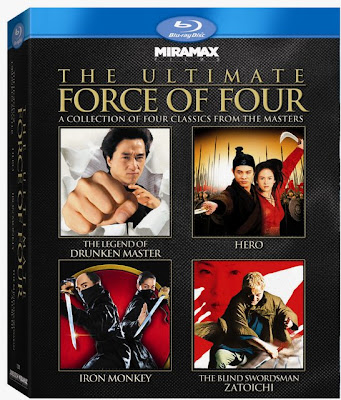
Blu-ray Review: Iron Monkey (1993) -- Ultimate Force of Four Box Set Collection


Part of the New Blu-ray Set


View Photo Slideshow


Delicious
Bookmark this on Delicious
submit to reddit
Print Page

Digg!

MovieBlips: vote it up!

In a society where hospitals dump the homeless on the street when they can't pay their bill and people fall into massive debt, discrimination, and death due to the health care crisis in America, man, is it refreshing to find a doctor we can cheer for in the form of China's Wong Fei Hung.

By embellishing the biography of the real-life late nineteenth and early twentieth century physician, revolutionary, martial artist, and healer Hung to the stuff of folkloric legend as one of China's most enduring and endearing sources for cinematic inspiration, Hung has lived on long past his death in 1924 through the many actors who have portrayed him on TV and film.


The two most notable takes on the grown up heroic Hung were crafted first by Jackie Chan in the Drunken Master films and later by Jet Li via his epic Once Upon a Time in China series. In fact these two films and the character they share have become so famous in their own right that I'd erroneously believed I'd seen Iron Monkey until I sat down and viewed the Blu-ray in preparation for the review to watch an early take of the very same character (actually played by female actress Tsang Sze-man).

Over the years, the tales about the legendary doctor have become much taller, essentially making Hung the Chinese equivalent of Robin Hood, Dr. Syn, The Scarlet Pimpernel, Zorro, and any number of American superheroes. As I settled into the movie, my first impression in translating it to action movie geek-speak was that I'd be viewing The Young Indiana Jones Chronicles as opposed to say, Raiders of the Lost Ark given the fact that our hero is only twelve in this film yet it turned out to be a film that I felt even surpassed Jackie Chan's take on Hung in Drunken Master which suffered from its thin plot and broad humor.


While of course, this isn't a slam on Chan's performance at all since the action choreography in Master is among China's best but as an entire cinematic experience, you just can't duplicate Iron Monkey for both its tremendously swift fight scenes crafted by the now iconic Yuen Wo-Ping (who choreographed Crouching Tiger, The Matrix, and Kill Bill) as well as the film's true beauty.

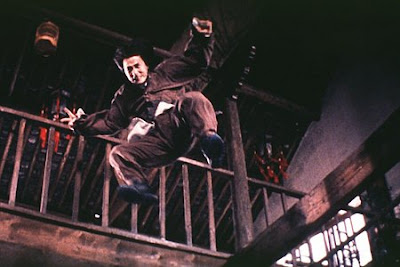
Naturally, it goes without saying that the action scenes are top-notch given the resume of Ping and his supremely unique style of constant motion plus signature movements that augment the strengths of every actor involved. However, I was also thrilled by Monkey's nice blend of the same poetry that would be enhanced in Ang Lee's Oscar winning Tiger seven years later.


Although I could gush continuously about some of the sequences that left me dazzled, one standout begs to be celebrated as it impressively utilized zero violence as the Robin Hood-like physician Dr. Yang (Yu Rong-quong) and his beautiful assistant employ amazing hidden wire-work and magical technique to catch loose office papers that are flying through the air.


It's an important origin story for Hung by illustrating-- as director Quentin Tarantino acknowledged in a behind-the-scenes extra feature introduction-- the powerful role that both Hung's own hardworking honest father (Donnie Yen) and herbalist Dr. Yang would eventually play in his own mythological storyline we've seen unfold for years onscreen.

Traveling the countryside with his ethical physician father who is also a skilled martial artist in his own right (and brilliantly portrayed by the Donnie Yen in some showstopping scenes), the young Hung is held captive by authorities when they erroneously accuse Yen of being the vigilante known as the Iron Monkey who rights wrongs and steals from the haves to drops coins of gold in the laps of the have-nots. When the true Iron Monkey (crime fighting
herbalist Dr. Yang, of course) arrives in his iconic black mask in court just as the judge was about to throw the book at Hung's father, they eventually let him loose with the condition that his son will only be released when the real Monkey is brought to justice.


However, foreshadowing the talented martial artist and innovator he'd later become, the twelve year old manages to stage his own jailbreak and meets up with his father. Through director Ping's stunning choreography and breakneck pace of the brisk eighty-six minute film that never overstays its welcome, we're as invigorated and inspired as Hung is from not just the visual contact high but given the idea that during our current health care crisis, at last (if only on film) we have a physician whom we can truly celebrate.

And again, by ensuring that the storyline will avoid anachronisms in the onscreen mythology of Wong Fei Hung, it's a treat to see the young man realize that the villain they're after may wear black (just like Zorro), but the Iron Monkey transcends what's black and white by standing up for the helpless and concerning himself with the gray area between what is the law and how much of it is worth breaking to ensure basic human rights among the less fortunate.


Making its way to Blu-ray for the first time now in 2009, Iron Monkey had been previously remastered once before in 2001 to help cash in on the Kung Fu craze that hit our shores after the release of Ping's choreography in Crouching Tiger, Hidden Dragon along with the success of Jackie Chan's Legend of Drunken Master which introduced a larger audience to Wong Fei Hung.


And although some of the original flaws of the theatrical print are still there
including several darkly lit shots that benefit from a few adjustments on your TV, with the full power of 1080 pixels behind it, the refreshingly PG-13 rated Monkey still packs a much bigger punch than big budget Hollywood action flicks routinely clogging up space at our local multiplex. Likewise, the sound balance is perfect and it thankfully includes English subtitles and the foreign audio soundtrack.

As the fourth and final feature of a high caliber Blu-ray set from Buena Vista Home Entertainment, Iron Monkey is no doubt one you'll find yourself viewing perhaps more frequently than the other three immensely stylized yet uniquely different works as the title with the biggest potential appeal across all generations, backgrounds, and of course gender since the little fighter to become a national male hero was played by one tough female Kung Fu cookie.

Text ©2009, Film Intuition, LLC; All Rights Reserved. http://www.filmintuition.com

Unauthorized Reproduction or Publication Elsewhere is Strictly Prohibited.

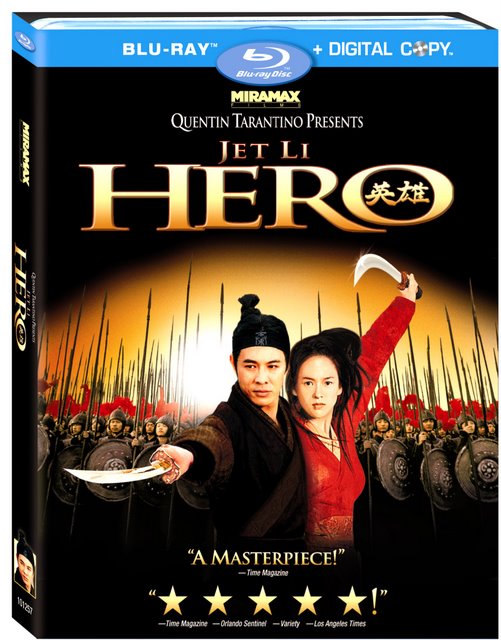
Blu-ray Review: Hero (2002) -- Ultimate Force of Four Box Set Collection


Part of the New Blu-ray Set


View Photo Slideshow


Delicious
Bookmark this on Delicious
submit to reddit
Print Page

Digg!

MovieBlips: vote it up!

As the most prolific and highly respected Chinese Fifth Generation director, Zhang Yimou elevates the craft of filmmaking to the purist form of painterly, poetic art. With a passion for seeking out the most exquisite and emotionally potent shade of a certain color and ensuring the precise sound, cut, and rhythm in any given project he takes on, Zhang Yimou is one of cinema's most innovative and impressive directors.

While Chinese film is largely known for exploring violence and relishing in the martial arts with the tremendously breathless Hong Kong action packed titles Kung Fu fans have been devouring for decades, it took the incredibly patient Yimou roughly two decades to venture into the genre he'd always wanted to explore.


Especially interested in moving beyond the traditional swordplay of martial arts genre pictures and drawn to the "warring states period" of China during the third century B.C., he developed an original story that sought out philosophical and ethical answers regarding just what comprises a hero and worked tirelessly with two screenwriters for twenty-four months before he decided it was acceptable to begin filming.

While most filmmakers seem ready to rush into production with a treatment alone and rewriting the work as they go along when they have a big budget and A-list talent to play with since you're essentially guaranteed box office gold, Yimou has never been the kind of director who will sacrifice style for speed and quality for quantity. And sure enough, even when one of his films isn't quite the finished product viewers may have desired such as in the recent mixed bag of the sumptuous mess Curse of the Golden Flower, we can at the very least sense his singular vision, ambition, and strive for perfection on every level from beginning to end.


Perhaps most famous in America for his collaborations with former muse and romantic partner, Gong Li including Raise the Red Lantern, the daring Yimou has ventured like a true artist back and forth through several periods from sultry film noirs like Ju Dou and Shanghai Triad to politically charged epics like To Live to naturalistic neorealism focused works Not One Less, Riding Alone for Thousands of Miles and The Road Home.

Yet the one recurring theme that shows up again and again in his humanistic films is in the power of human choice and the everyday heroics of people in relation to others whether it's on a small scale or one much larger in scope. Ethical considerations and political implications run throughout his oeuvre and indeed, the period film Hero seems especially timely as a martial arts movie that doubles as an allegorical work, which reflects some recent Chinese infighting over separate states today.

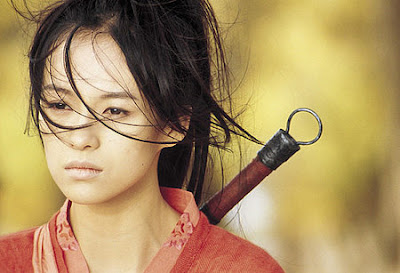
Still, it's an important distinction to point out that the movies themselves are about people first and never place messages over the characters and plot since he shares that it's his belief that, "the objective of any form of art is not political. I am not interested in politics." While in the same page of quotations collected on IMDb he explains further to acknowledge his two most successful films of the 2000s-- Hero and House of Flying Daggers-- as "commercial" pictures and sure enough critics fell all over themselves comparing the movies to Ang Lee's Crouching Tiger, Hidden Dragon especially because they share the actress Zhang Ziyi, they're amazing efforts in their own right and from a visual standpoint alone, much more beautiful than Crouching Tiger.


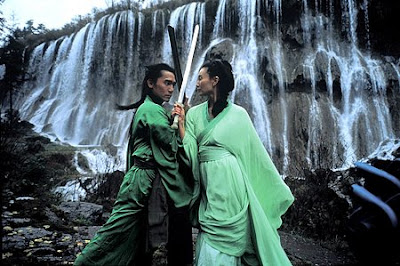
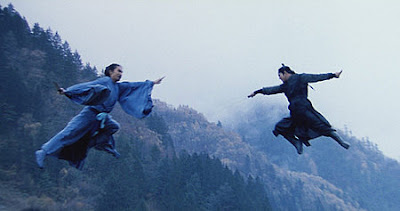
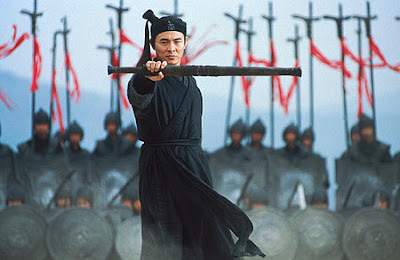
Thankfully, to the joy of viewers, the patient perfectionist Yimou has been reluctant to cheapen his vision with CGI. Preferring to follow the image he sees in his mind, Yimou would only film a high wire fight with Jet Li and Tony Leung flying over a lake with mirror perfect still water. To achieve this effect, he spread out the shooting schedule for three weeks, using the lake for the two hours each day when the water was completely still.


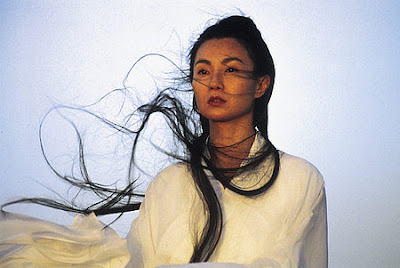
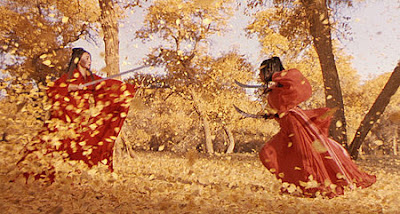
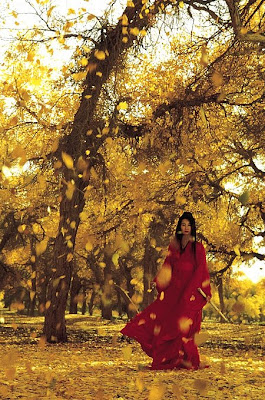
In the same token, he waited for leaves to turn just the right vibrant color of gold and knowing that they would only retain their beauty and shade for three days, he filmed Ziyi and Maggie Cheung's beautiful fight within that breakneck schedule. While doing so, he urged the women not to blink as the leaves were gathered and used again and again along with eye drops due to the wind that blew dirt around in every single take.


These approaches probably seem insane to Western filmmakers as his strive for only the highest quality possible would no doubt have sent most American producers running back to their accountants and actors to their trailers in frustration over giving up control to serve the director's vision. Yet as evidenced throughout the extensive behind the scenes extras on this cinema quality Blu-ray edition of Hero, we discover that his cast and crew feel exactly the same way as Yimou fans do in knowing that he's doing his very best to ensure the movie's sensuous loveliness will imprint directly into your dreamscape.


And that is exactly what's happened to me as I hadn't seen Hero since its 2004 release yet the fight among the golden leaves and the dazzling one over the idyllic blue lake immediately sprang to mind as the film began. Furthermore, my memory of Hero consisted primarily of its overwhelming beauty since its Rashomon style tale keeps doubling back, evolving, and daring you to keep up with its labyrinthine twists.

And honestly the first time I saw Hero, I didn't keep up-- either lost in the beauty so much that I missed a few crucial subtitles or getting a couple of characters mistaken-- finally I just gave into my confusion and watched the movie for its cinematic poetry. Moreover, I was relieved to read that a few critics I greatly admire had a little trouble following not just the thread but the final twenty minutes which I'm still not sure logically works in sync with the rest.

While made in 2002, it took a full two years and the power of Quentin Tarantino to help bring the film to American audiences where it became the first foreign language movie in history to debut at #1 at the United States box office. Thus, when House of Flying Daggers was released the same year from Sony Pictures Classics rather than Miramax and produced in '04 instead of two years prior, I was among the few who preferred Daggers despite its slightly over-the-top Shakespearean inspired demise in the final showdown. However, again proof of the importance of watching movies a second time around as well as a fervent desire that I could have this opportunity more often since I take in so much media that it blurs together from time to time, I've completely changed my stance on Hero with this review.


Not only do I prefer it to the gorgeously impressive Daggers but I'm actually wondering if it is superior to Crouching Tiger due to its daring decision to explore the consequences of violence, power, self vs. country, revenge, the concept of "an eye for an eye," loss of culture, heritage, and the double-edged figurative sword of using war to create peace. However the logic of the final mental chess move made by the men leading us into various extended flashback versions of possible truths still leads viewers into philosophical circles. When presented with the events, those more intrigued by logic will drive themselves batty wondering if a) wouldn't have happened, would b) have happened as the characters find themselves in the third (or c) act or in reality why a and b would've been necessary at all. However, I'm very happy to abandon attempts to over-analyze to experience the surprisingly moving and intoxicating epic which stands among Yimou's very best.


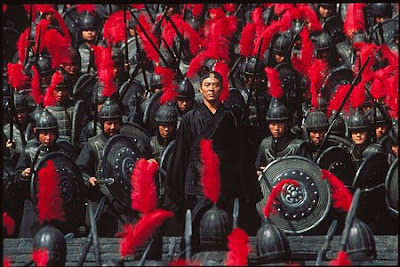
Nominated for an Oscar and Golden Globe as the best foreign film of the year, Jet Li took quite a pay cut in the film which at the time was China's most expensive production ever created. In Hero, he stars as our nameless hero who is honored with a private audience of the King of Qin (Daoming Chen) once he's eliminated the three most ruthless assassins who've come the closest to taking the king's life to prevent his drive to conquer their states and force unification.

Bringing the famous swords of the three killers-- Sky (Donnie Yen), Broken Sword (Tony Leung) and Flying Snow (Maggie Cheung)-- as proof of his victory, Li's character, just referred to as Nameless is asked by the King to recount the success of his battles and is granted permission to take several paces closer to the man for each death.

Taking supreme advantage of film as a "show me" medium, Yimou uses a distinct, unique, and eye-popping color scheme for every single battle which begins with what is considered the "chess fight" or as Li shares a great "tennis" setup as he rematches with Once Upon A Time in China II costar Donnie Yen whom he chose for the part. The stellar sequence which has become a fanboy favorite took two weeks to film involving wire work, black and white photography, and a crisp professional approach.


Continuously topping himself throughout in this amazing collaboration with frequent Wong Kar Wai cinematographer Christopher Doyle, the chess fight is in stark contrast to the passionate and fiery love triangle that occurs between In the Mood for Love stars Leung and Cheung (in Wai's film
lensed by Doyle). In this segment, Nameless exploits their relationship by using the beautiful Zhang Ziyi and Cheung's past as pawns to get the killers off their game.

Employing the familiar and effective rhythms of Crouching Tiger composer Tan Dun who utilized Itzhak Perlman on violin and Kodo drummers, the film grows much more elaborate as it moves from one eye-popping segment to the next which is further complicated when the King sees through the first version of the account by Nameless. After this occurs, we're presented with the second Rashomon-like revision where the costumes, colors, and makeup changes to balance the ever-changing explanation of just what happened and is waiting to happen.


A flawless Blu-ray presentation with extensive extra features including an in-depth Jet Li and Quentin Tarantino interview wherein Li admits that he actually cried after reading the screenplay because of the emotional power packed within the action framework, fans can also relish in storyboards, featurettes, and more.

Overall, the strongest asset to an already solid collection, Hero is a masterful work filled with beauty, sorrow, and a firm commitment to integrity infused entertainment as Yimou reminds that just because something is classified as martial arts, it doesn't have to sacrifice quality or substance. Likewise, Yimou's Hero is sure to please fans of the genre from all interest levels as you can watch it for the superlative fight choreography, majestic photography, or just one more documented example that reminds us why the word "director" is far too weak to be attached to Mr. Zhang Yimou.


Text ©2009, Film Intuition, LLC; All Rights Reserved. http://www.filmintuition.com

Unauthorized Reproduction or Publication Elsewhere is Strictly Prohibited.

Blu-ray Review: The Legend of Drunken Master (1994) -- Ultimate Force of Four Box Set Collection


Part of the New Blu-ray Set


View Photo Slideshow


Delicious
Bookmark this on Delicious
submit to reddit
Print Page

Digg!

MovieBlips: vote it up!

AKA Drunken Master 2

Similar to the way that Supercop is technically Police Story 3, The Legend of Drunken Master is also known as Drunken Master 2 but as fans of Jackie Chan understand very well, the plots and sequels are interchangeable and inconsequential since all we really want to see is the highly choreographed action sequences completed by the brave, talented man who does all of his own stunts.


As he's often pointed out in interviews and/or is often referenced critically-- the films of Jackie Chan and his very persona seem to be indicative of an unlikely lineage of physical comedy, slapstick, and dancer like precision that you can trace back regardless of the genre or country to the boom of silent film stars Buster Keaton and Charlie Chaplin. Those individuals are two of Jackie Chan's idols and indeed Chaplin is even referenced in Shanghai Knights (itself a sequel of Shanghai Noon) in one of his lackluster but successful comedy hybrids that pairs Chan up with highly verbal American costars like Shanghai's Owen Wilson and Rush Hour's Chris Tucker to be the yin to his yang.

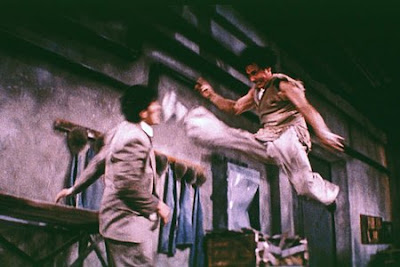
Yet, in a Jackie Chan movie, everything including the props are merely a sidekick since you never know when he'll swing a costar or a lamp, run up a wall or jump on a helicopter risking life and limb to entertain us with his own unique Jackie Chan character. The bottom line is, after breakneck schedules and dozens upon dozens of movies, Chan has become one of those immediately identifiable and lovable character types in the tradition of not just Chaplin and Keaton but The Marx Brothers (Harpo especially), Fred Astaire, Gene Kelly, Lucille Ball, Jacques Tati, Peter Sellers, and Woody Allen whom you're instantly familiar with as soon as he hits the screen.


And although that may have limited him in terms of expanding past his niche, he seems quite content to stay precisely in it by resisting offers to take on films that he's described as in the Dragon Dynasty Supercop interview aren't quintessentially “Jackie Chan movies,” like Zhang Yimou's Hero (one of the other titles in this Ultimate Force of Four Blu-ray set). Yet despite the disappointing quality of a majority of his American titles after he crossed over with Rumble in the Bronx, there's absolutely nobody who can touch him in his given realm.


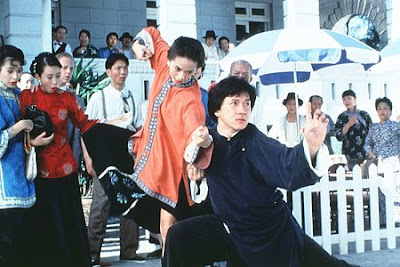
Widely considered one of his top five movies, although due to the fact that he was forty and far too old to reprise the role made some purists prefer the original, 1994's The Legend of Drunken Master took six years to make its way officially across the pond. Of course, due to the overwhelming amount of Jackie Chan and martial arts movie bootlegs, most of us had already seen the film and have lamented that its unparalleled humor and innovative action sequences have started to become watered down over the years in lukewarm films so bad that I've actually fallen asleep in more than a few.


While overall I still think Supercop is his more successful work from a storytelling point of view since this one basically consists of a thrown together plot a bunch of people may have shouted out in a game of charades involving greedy British government workers who stole artifacts, this is still hands down, the best cinematic proof of Chan's incredible skill as a performer and innovative fighter. Although, much like the plot, the humor is laid on way too thick as the concept involves the folkloric fighting style belief that Chan's character becomes more powerful when he drinks liquor by the case which-- aside from some amazing sight gags as Chan swings to and fro like a tree in the wind without falling over-- grows fairly old.


Possibly best presented as a silent movie or with the original language track intact and subtitles, the film unfortunately borders on the obnoxious due to the nails-on-a-blackboard English language dub that takes away from the movie's sheer power to astound with sequences that have yet to be matched and amazingly didn't involve phony tactics, doubles, or computer effects. Despite a few unpleasant sight gags involving the bodily after-effects of drunkenness, the best source of consistent humor in the film is via its biggest scene-stealer in the form of the late great Anita Mui often called the "Madonna of Asia." In the film, Mui portrays Chan's stepmother to whom he's fiercely devoted, making the comedy much more effective due to its unique twist to give a woman in the male-dominated martial arts picture such a memorable role.


Still, admittedly I'm one of the select few who never quite got as an immense kick out of the odd but legendary hybrid of drunken boxing as others including Chan whose argument that it was comedy gold with the director resulted in the helmer walking out. And while I still don't love the drunken boxing set-up, in the end Chan manages to go beyond-- as he notes-- a far more difficult challenge than other roles since he had to move wildly yet still hit marks and by taking the reigns for a showstopping final fight he leads you gasping for air as though you dove drunkenly into hot coals along with him.


Filled with intense hand-to-hand combat and constant slapstick fights, the film speeds mightily along and is at its smoothest when the plot is cast aside and we can just watch Chan take on enough foes to fill his whole village while chugging three wine bottles at once.

Featuring a retro interview with Chan as he discusses the complexity of making the movie and how he felt it was a greater physical challenge to play drunk action than sober action, while the Blu-ray sharpens the DVD release to great effect, I still wish that someday we'll be able to see it without the horribly distracting English dubbing and in the format it was initially released back in Hong Kong.


Text ©2009, Film Intuition, LLC; All Rights Reserved. http://www.filmintuition.com

Unauthorized Reproduction or Publication Elsewhere is Strictly Prohibited.