7/29/2014
Blu-ray Review: Sabotage (2014)
Since I’m usually so focused on the task at hand, typically there are only two reasons I’ll move my eyes from the screen to the clock when I’m viewing a film I’m planning to cover.
Obviously the first reason is the most relatable one of potential boredom as we can’t help but eye the watch on our wrist or the ticking clock on the wall to see not only how much time has gone by but also how much time we have left to endure.
But much more specific to the job – the second reason I find myself sneaking a peek at the advancing numbers on my TV, Blu-ray or computer display is to check the plot points, new inciting incidents, or other obvious remnants of the Syd Field lectured three-act formulaic screenwriting structure that’s been around for decades. For while a good film hooks you regardless, it’s amusing to see just how many writers still follow those age-old rules so closely that you can darn near predict what the clock will read before your eyes even leave the frame.
Every moviegoer can relate to the first conundrum of wondering (at least a few times in their lives) whether they should just walk out of a film or gamble that the boredom will subside. However, as someone who started out writing movies and enjoyed breaking down the expected narrative approach to creatively illustrate everything from the passing of time to employing a constantly shifting point of view (vs. using an extraneous character or overt exposition to tell us the exact same information), the second is a secreenwriter’s habit that I can’t seem to shake.
Yet although I’m normally very open-minded and wholeheartedly stand behind artistic freedom of expression, upon watching David Ayer’s Sabotage, I discovered a third reason to clockwatch.
An accurate title given the way that Ayer seems intent on purposely sabotaging his own film, Sabotage is filled with gruesome visuals that rub salt in the eye of the viewer as well as entire conversations comprised of profanity laced weirdly sexual verbal “dick measuring” where anatomically obsessed scatology and hyper masculine homophobia is king.
Needless to say, among other effects, the biggest impact of such a sabotaged sensory overload is that it overwhelms anything of importance that Ayer was trying to say as a writer as well as a director.
Bringing a script to life that must’ve been typed with venom rather than ink, I actually found myself losing a little respect for the talented cast members who gave in to the promise of a big payday instead of immediately walking right off the set.
Loud, vile, repugnant trash – Ayer managed to do the impossible in turning this ordinarily open-minded viewer into the “content police” wherein absolutely bored by the shots of excrement, disembowelments, and the degradation of its female characters, I began keeping a tally of how much excess Ayer and his co-writer Skip Woods could fit into the film in the margin of my notes.
Alarmingly, I lost track of tally marks within the first half hour and realized that if someone did the same and substituted a shot of liquor for each tally to turn it into a drinking game, they’d be in dire need of an emergency room by the time that Sabotage reached its halfway point.
And it’s a damn shame too for while a friend jumped ship within fifteen minutes and left me to fill her in, I found that against all odds (and their bizarre attempts at self-sabotage), Ayer and Woods had some truly clever twists in store that finally started to reveal themselves in a genuinely surprising penultimate showdown.
While otherwise bookended with revenge genre predictability, the twist before the finale illustrates how much potential Sabotage actually had as a police thriller that had been buried beneath the filthy rubble and squandered somewhere along the way from initial script to final cut.
Unfortunately as it stands, Training Day scribe Ayer’s Sabotage is a mind-numbingly misogynistic, misanthropic, uber-masculine mess. In what has become a through-line in Ayer’s oeuvre of cynical, corruption-heavy portraits of those along the thin blue line that live in a permanent state of gray, Sabotage once again makes every one of its characters seem like degenerate creeps while perpetuating an insulting law-enforcement stereotype that he’d at least started to change in his earlier End of Watch.
Yes, Watch was gritty but more importantly it was still humanistic as a grandly plotted ode to what it truly means to not only protect and serve but live with the constant stress level of adrenaline, caffeine, and the unknown waiting on the other end of each call.
Sadly, this film takes a thousand steps backwards not only simply in its portrayal of anti-heroic leads but mainly because those who populate Sabotage are nowhere near as realistically three-dimensional as the men and women of Watch.
Essentially walking cutouts that would be interchangeable if not for the talented stars embodying each role from Mireille Enos and Terrence Howard to Sam Worthington and Olivia Williams, the film revolves around ethically challenged, mostly militarily trained heavy-hitters who work for the DEA task force that’s run by Arnold Schwarzenegger’s angry widower Breacher Wharton.
After seeing his wife and son slaughtered before his eyes on the video that opens the film and sets the stage for the brutal battles that follow, the aptly named Breacher breaches the rules, ripping off ten million dollars in drug money with his loyal team of diehards after an undercover sting before the loot promptly disappears.
What could’ve been a taut heist film turned thriller as in the aftermath the members of the squad start losing their lives in a series of strange and shockingly graphic slaughters (driving a wedge into the depraved team as they wonder if one of their own is to blame) instead is shortchanged by its emphasis on all the wrong elements.
While one of the ultimate reveals is a humdinger of a misdirect, instead of keeping us on our toes with red-herrings and new revelations, Ayer and Woods are content to focus purely on the blood red attacks derived from the potential promise of green cash rather than a character driven plotline.
Hindered by wooden line reads from Schwarzenegger and a dubiously crafted character for Williams, the chemistry between the two is so embarrassingly absent that Sabotage’s editor Dody Dorn simply cuts a scene in half rather than even attempt to see them romantically connect on a human vs. hardass level.
When you couple this with the men’s insistence to turn Enos into a bizarrely forceful sexual aggressor along with their overreliance on forced locker room talk to establish male camaraderie, Sabotage comes off like a secretly closeted gay guy who laughs a little too loudly at his own juvenile homophobic jokes. And indeed, from Arnold Schwarzenegger's phallic cigar to the boyish haircut of his love interest, it's a borderline parody of Top Gun proportions.
A film that’s better off ignored in favor of watching the minutes tick by on your wristwatch, Ayer’s one-trick Training Day shtick has grown old after a decade of retreads like this work which couldn’t look murkier if the film was actually dragged through the mud.
Instead of Sabotage, opt for another viewing of Ayer’s End of Watch to appreciate the level of talent he is capable of and then follow it up with an old classic work of Film Noir's heist subgenre from those who did it right in The Asphalt Jungle or The Killing or go on a French crime spree with Rififi or Bob Le Flambeur.
Ultimately spending more time to study the good and less time looking at something this bad will then inspire you to contemplate just how good Sabotage could’ve been with a much stronger script.
And rather than continue the sabotage by mindlessly manufacturing more of the same, I can only hope the otherwise gifted Ayer will look to past filmmakers for inspiration instead of focusing only on the films of his own past in order break new ground.
Text ©2014, Film Intuition, LLC; All Rights Reserved. http://www.filmintuition.com Unauthorized Reproduction or Publication Elsewhere is Strictly Prohibited and in violation of the Digital Millennium Copyright Act. FTC Disclosure: Per standard professional practice, I may have received a review copy of this title in order to evaluate it for my readers, which had no impact whatsoever on whether or not it received a favorable or unfavorable critique.
2/26/2010
Movie Review: The Ghost Writer (2010)
Photo Slideshow
Related Reviews:
Frantic
Knife in the Water
Roman Polanski: Wanted & Desired
AKA The Ghost Writer
Since Ewan McGregor's character is as anonymous as his eponymous profession implies, it's fittingly appropriate that the nameless man who introduces himself as “The Ghost” would find himself working on his latest assignment at an isolated seaside home he dubs, “Shangri-la in reverse.”
And although it's the duty of any ghost writer worth his laptop to be discreet and forsake all credit in making the individual he's writing memoirs seem even more extraordinary on paper, in the case of the ghost in filmmaker Roman Polanski's sophisticated new film, McGregor is not merely the second fiddle but rather the second fiddle of a second fiddle in his assignment writing the life of former prime minister Adam Lang (Pierce Brosnan).
The fifth and last interviewee who openly tells Lang's agent (Timothy Hutton) that he-- like everyone else-- doesn't read political memoirs, McGregor's ability to turn things around quickly as evidenced on his curriculum vitae lands him two hundred and fifty thousand dollars for a month's work as a replacement ghost after the first scribe wound up mysteriously dead on the shoreline.
Mugged on the way home by hoodlums who only swipe another manuscript handed to him for a read-through by Lang's agent, McGregor is in for several more shocks when he realizes just how dangerous politics can be. And soon he learns he's only allowed to read the dull autobiography in the privacy of the Lang estate as it's kept under lock key and security code by the woman openly having an affair with the married politician, played by an understated Kim Cattrall.
Yet the simple tweak job turns into a massive overhaul when Brosnan's Tony Blair-like character (and the subject of the book) is threatened by the Hague of being convicted of war crimes in knowingly sending suspects away on “torture flights” following the 9/11 attacks. Hastily, McGregor becomes embroiled in the mess after he lends his professional assistance in writing a statement of denial that makes him an accomplice, should the accusations prove true.
Although McGregor is able to just turn off his moral judgment like a light-switch to work on the book, it becomes increasingly difficult to ignore the evidence and further inconsistencies in Lang's statements and the facts. And his suspicions are both confirmed and aroused after he uncovers documents and a GPS vehicle route left by the original deceased ghost. Additionally, he's lured into a web of seduction, which blossoms in the midst of scandal-induced isolation when he falls into bed with Lang’s wife (Olivia Williams).
Frequently dubbed in the advertising as Polanski's first thriller in over two decades, the film which has just earned the exiled Oscar winning filmmaker the director prize at Berlin is likewise one of the strongest English language mysteries for adults to hit the multiplex in a long time.
Moreover, it proves once again just how in-tune Polanski is with this particular genre, culling techniques and employing-- whether consciously or not-- the same type of imagery, comeuppances, love triangles, mistrust of authority, and startling conclusions that have been the hallmarks of his career from Knife on Water through Chinatown and Frantic.
Again water serves as major visual piece to the psychological puzzle, which has been woven throughout his oeuvre since the beginning. And when you blend the image and connotations of water along with themes of deception, sins of the past, and questions surrounding just who we’re letting into our little worlds, Ghost Writer begins echoing Frantic, Chinatown, Death and the Maiden and others from Polanski’s unique twist on the genre.
To this end, it’s certainly tempting to study the overlaps in his work, whether it's in his acknowledged fondness for Hitchcock and Chandler (which led to the film) or the definite autobiographical elements including a sense of Shangri-la in reverse, the transient nature of luck, persecution, accusation, and death that are blended together to masterful effect in Ghost.
While admittedly it does struggle a bit in the pacing of the work, which you can attribute to the fact that it’s hard to get a handle on the characters, luckily our hero is engaging because of what McGregor naturally brings to the role personality-wise as opposed playing the ghost in the aloof manner one would assume from the profession and original title of The Ghost.
Furthermore the film more than makes up for its shortcomings of a padded second act via some wicked surprises, which is most evident in another one of Polanski’s instantly classic endings that you could line up side-by-side with at least three of his others in terms of similarity and cinematic effectiveness.
One of the best twist-filled mysteries for grown ups since Transsiberian and the foreign film Tell No One, The Ghost Writer is also quite timely as an overt George W. Bush/Tony Blair allegory, based on author Robert Harris’ 2008 “Thriller of the Year” best-selling novel, keeping political minds stimulated almost as much as film buffs’ as the type of purely Polanski film that begs to be seen twice.
Text ©2010, Film Intuition, LLC; All Rights Reserved. http://www.filmintuition.com
Unauthorized Reproduction or Publication Elsewhere is Strictly Prohibited and in violation of the Digital Millennium Copyright Act.
FTC Disclosure: Per standard professional practice, I received a review copy of this title in order to evaluate it for my readers, which had no impact whatsoever on whether or not it received a favorable or unfavorable critique.
8/07/2009
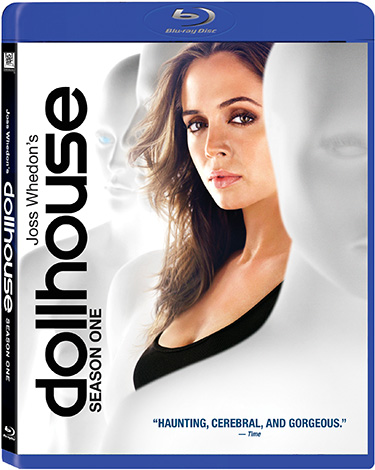
TV on Blu-ray: Dollhouse: Season 1 (2008-2009)
Bookmark this on Delicious
Print Page
Although I must continually applaud Fox for having the guts to recognize the brilliance in the mind of creative storytelling visionary Joss Whedon, his fourth original television series was granted zero favors from the network during its inaugural broadcast.
Given the indisputable beauty of Dollhouse lead actress and producer Eliza Dushku, whose knack for combining sex appeal with soulfulness made her supporting slayer Faith one of the most exciting castmates on Whedon's Buffy and Angel-- Fox took the most predictable approach for their marketing campaign. And to this end, they opted to fixate on lustful titillation rather than intellectual stimulation which was further solidified by an awful time-slot that almost guaranteed the show would either tank or be the type of thing watched by the dateless and/or friendless.
Thus, the channel essentially gave the series the subtextual kiss-of-death of “guilty pleasure trash TV” but much like another unexpected work that drew a steady and loyal following-- Gossip Girl-- the astounding number of viewers programming episodes on their DVR showed networks that audiences were ready for something different.
However instead of adjusting the schedule or doing more to market it to a wider spectrum, Dollhouse was ignored and treated as though it was the type of programming you may not want to admit to others you actually watch. Of course, one outcome of this approach was that it helped fuel media word-of-mouth that all seemed to focus purely on the series as though it was all about sex or the objectification of women... as if we'd forgotten just who the hell Joss Whedon was and how much he'd done for female characters since he was first employed as a staff writer on Roseanne.
Although of course that was just the beginning and well before he introduced the world to female vampire slayers who confronted attackers rather than becoming traditional horror genre victims and created not one but two series from this initial idea without which Alias and several other female-centric action shows may never have gotten off the ground.
Yet Fox's Dollhouse marketing ploy was sadly successfully to those outside of the Whedon Universe who are therefore also unaware that this feminist streak is an inherited trait from not just his mother but the men in his family as well including his father who was a contributing writer for the witty Golden Girls and his grandfather who penned The Donna Reed Show.
And proof of Fox's success to hide the brains of the show in favor of beauty shows up on Blu-ray release for one of the best new shows of last season as it actually contains a quote from New York Post who dubs it “good, dirty fun,” despite the more important and honest praise from Time Magazine on the front cover which applauds the show for its three integral qualities of being “haunting, cerebral, and gorgeous.”
Moreover, by choosing to market the endlessly fascinating and morally complicated Dollhouse as something merely akin to Barberella, the all-important female demographic was ignored since I can't tell you how many intelligent women I spoke with who didn't even want to view it, believing simply from the advertising that the show seemed like it consisted of simply Eliza Dushku portraying a twenty-first century version of a Stepford Wife crossed with one of those sexy bots from the Austin Powers movies.
While admittedly the provocative concept for Dollhouse could've easily been treated in that manner in another's hands, Whedon-- per usual, illustrates that he's a man who enjoys leading us down one path for a brief period of time before suddenly pulling us into an entirely different direction as the series evolves during its twelve aired episodes.
The action centers on an underground, top-secret, elite and amoral lair that programs its stable of male and female “dolls” or to use the series phrase-- “actives”-- to become whatever the high paying clients want them to be whether that may be a midwife for a couple who live on a snowbound mountain, the ideal lover, an art thief, or a negotiator in a complicated kidnap for random case etc.
Underrated, addictive and increasingly complicated-- while on the surface it feels as though we're watching something set in the near future, we're startled to learn that Whedon opted to place the events in present day Los Angeles and he keeps everything eerily relatable by operating under two universal truths or theses. They consist of the following: 1) if you have everything, you will inevitably want something else or something even more extreme and; 2) if technology is discovered that will allow you the ability to program people like computers, we will use it since as we've shown in the past, as soon as the capability for the bomb was there, we took it.
Par for the course for Whedon, you can cite the pop culture influences right off the bat as the Los Angeles branch of the Dollhouse which is run by Adelle DeWitt (Olivia Williams) recruits its "actives" La Femme Nikita style as they surrender their personality for five years by signing a contract. When life has found them either in trouble with the law or facing a situation that's unbelievably dire as we briefly see in the opening of the series was the case of Dushku's character's former self "Caroline," they leave that life behind to become an active.
And essentially it's an organization that DeWitt tries to fool herself and others into believing is one that helps people rather than coolly traffics in human beings who are imprinted with fake personalities to become other people for the right price on selective missions (and garnering extra money when there's extra risk or a file is "flagged"). Of course, this is before the actives return and their memories are wiped clean a la Paycheck with no questions asked about what happened to them while they were away despite the fact that they have handlers.
Obviously it's also inspired by the work of not only Philip K. Dick's science fiction but also such classics as Brave New World and 1984. To this end, it tries to present us with life inside the Dollhouse as a safe-haven of fake, protective bliss as Dushku's Echo sleeps in a pod. However she is as helpless as a young grade school aged child when not on assignment as she fills her time trying to be her best while going from routine medical physicals to swimming laps and painting pictures before she starts becoming more self-aware as the series continues.
This begins to take shape after five introductory standalone episodes in which we become acquainted with the series and those involved. One of the most important people in her life is Echo's new handler, the former ex-cop Boyd Langton (Harry Lennix) who develops a paternal Buffy "watcher-like" attachment to the his vacuous active.
Of course, while her name alone is a nod to Greek mythology yet we quickly realize that Echo is used by an entire technological ucorporation instead of just one male Narcissus-- Whedon cuts loose with mythology of his own in season one's strongest episode "Man on the Street." In doing so, he starts to introduce us to what will become the Dollhouse mythology as well as the backstories of several lead characters. Moreover, the sixth episode challenges viewers throughout with more surprises in forty-two minutes than a typical show unveils during sweeps month.
Knowing that we can only stand to watch Echo and the other actives go from in-charge to submissive slaves for a certain amount of time-- suddenly, the idea of sleeper actives, double agents, corrupt handlers and more revelations hit the show as the underground corporation is nearly brought down. For just as Echo has begun to be struck with some flashbacks of a traumatic shooting inside the Dollhouse, we uncover that someone has been supplying coded messages in dolls and leaking them out as Echo is very, very slowly jolted into the idea that things aren't exactly what they seem.
When this occurs, she finally encounters the star of our simultaneous narrative in the form of the relentless FBI Agent, Paul Ballard (Tahmoh Penikett). An outsider in his department, Ballard becomes the bureau's Mulder and Scully while he attempts to seek information about the Dollhouse which his colleagues all tell him is only a fairy tale.
Yet when he becomes captivated by Caroline and stories about the "pretty lady," again the series references another literary source in the form of Sleeping Beauty as he refuses to quit trying to wake up Dushku's Echo only to discover that the Dollhouse may be a lot closer to him than he ever imagined since instead of big brother--the dolls are watching in Whedon's clever series.
Bringing on board a lot of the same behind-the-scenes writing, directing and producing staff with whom Whedon has collaborated before including Jane Espenson and Tim Minear-- in a few cases, Whedon fans feel as though they're watching a Buffy paradigm episode. Yet by the time "Man on the Street" rolls around, you realize you're completely hooked and wish that Whedon would've had the freedom to have worked with a full season run to develop the mythology in greater detail. However, it's a terrific set that lets viewers get caught up on one of the most overlooked and underrated new series of last year before it kicks off one more time.
Also containing the unaired pilot "Echo" and the thirteenth episode shot for half the budget on video and set in the future to sort of wrap some things up in a post-apocalyptic way in case the show was canceled-- "Echelon One" which screened at this year's Comic-Con-- the Fox Blu-ray three disc set boasts gorgeous picture and sound quality throughout.
However, one major complaint that's been noted by some readers and fans is that once again, the Blu-ray no longer contains a sleeve or any list of episodes informing you which episodes are on which disc. Using the same complicated and difficult to navigate "dice menu" structure employed for the episode selection on the Burn Notice Season 2 Blu-ray set-- while in Dollhouse's case, the quality is on par with their cinematic releases and is simply perfection, it's still tough to view unless you're doing it in marathon form.
To explain, the first disc is bogged down with so many trailers that it's hard to skip over them which makes the fact that you're unable to bookmark your place in the Blu-ray even more frustrating as finally I realized I just had to keep leaving it on pause and relying on the screen-saver to avoid the endless previews.
Yet, making the hassle worth your while aside from obviously the content of the series alone-- the set contains some cast and crew commentary tracks along with of course, the un-aired episodes, and featurettes that lead you deeper into the Dollhouse to a level that's so secure, normally you'd have to be an active with an imprint to gain access.
In my eyes, much more compelling than Whedon's Firefly or the film that followed, Serenity, Dollhouse is a return to the female-centric work he does best that will provoke, seduce, surprise, yet most importantly get you talking about the humanistic implications of what you've just seen all wrapped up in one damn entertaining show. Overall, this is one series that is highly recommended, highly addictive not to mention well worth your time and shelf-space... even if you'll never look at a child's dollhouse the same way again.
Text ©2009, Film Intuition, LLC; All Rights Reserved. http://www.filmintuition.com
Unauthorized Reproduction or Publication Elsewhere is Strictly Prohibited.
11/14/2007
Lucky Break
Director: Peter CattaneoLucky Break has one of those quintessentially creative and delightfully offbeat plot set-ups that have become the staple of excellent British comedies. One of the more popular British directors of the 90’s, Full Monty’s Peter Cattaneo tackles this musical tale about a jail break and a conflicted escapee who falls in love with an attractive prison employee. Match Point and Millions star James Nesbitt makes a charismatic and humorous leading man in his role as Jimmy Hands, who we meet roughly halfway through his sentence for an armed robbery gone awry.
The incompetent but well-meaning Hands is reunited with his bitter former partner in crime, Rudy (Lennie James) who is still predictably sore at having been abandoned by Hands during the mishap. Once inside the lower security prison, Hands realizes he has a lucky break when he uncovers and exploits the hobby of good-natured prison governor Graham Mortimer (Christopher Plummer) who has a passion for musicals.
Hands concocts the plan of staging the warden’s own musical composition in the old chapel next to the prison’s outermost wall and thus begins this funny, clever and compelling tale that finds our leading man having to overcome obstacles including persuading inmates to take part by bribing them with phone cards and being forced to include a fearsome con recently transferred while squaring off with a sadistic guard and becoming attracted to anger management counselor Annabel Sweep (Rushmore's Olivia Williams).
While most critics dismissed this film as a lesser trifle when compared with Full Monty, for my money, it’s even more entertaining and makes for a highly watchable and likable British comedy musical, that's even more fun on repeat viewings.
11/07/2007
Tara Road
Director: Gillies MacKinnon Let’s hope that author Maeve Binchy feels that imitation is the sincerest form of flattery; otherwise, Nancy Meyers could have some serious explaining to do for The Holiday which is frightfully similar to the premise of Binchy’s bestselling Oprah pick Tara Road. Screenwriters Cynthia Cidre and Shane Connaughton adapt the book for director Gillies MacKinnon’s low-key but beautifully shot film about two women who are going through personal crises and agree to swap their homes on both sides of the Atlantic. (I told you it sounded familiar!) Four months after her beloved only fifteen-year-old son dies in a tragic motorcycle accident on his birthday, grieving Connecticut mother Marilyn (Andie MacDowell) finds herself at odds with her husband when she refuses to go with him on a Hawaiian vacation to escape their troubles. Marilyn's life takes a new turn when she receives a chance phone call. Ria (Olivia Williams) is a loyal Irish wife and mother still madly in love with her husband Danny and she finds herself living out one of life’s cruelest clichés when Danny (Iain Glen) announces that he’s leaving his family because his much younger girlfriend is pregnant with his baby. Finding it hard to keep her emotions in check and stop herself from begging the man she still maddeningly loves to change his mind, Ria puts a phone call into Marilyn’s real estate husband only to find herself pleasantly surprised when Marilyn answers the phone and agrees to let Ria exchange homes for the summer. Predictably, lessons are learned and new friends are made when the two strangers begin to draw strength from within that they didn’t even know they had in foreign lands and while it never really persuades us that it’s anything more than a stereotypical “chick flick,” the talented actresses emote well and make it easy for viewers to share in their plight.