Showing posts with label Japan. Show all posts

7/20/2018

Film Movement Movie Review: The Third Murder (2017)


Now Available


Bookmark and Share

Originally an aspiring novelist who skipped class in college to instead go to the movies, so far acclaimed Japanese writer/director Hirokazu Kore-eda's filmography has largely consisted of intimate family and relationship dramas that could best be described as novels on film.

Drawing more upon his love of cinema than fiction, Kore-eda's Film Noir infused legal title The Third Murder marks a bold and (regrettably) largely unsuccessful departure from the fly-on-the-wall docudramas that have become synonymous with his name.


While collaborating with lawyers and legal advisers on his masterful Cannes Film Festival award-winning drama Like Father, Like Son, Kore-eda was struck by the Catch 22 revelation that – in spite of our romantic notions about the law – in the end, the court is there to pass judgment and not determine the truth.

An existential take on our flawed justice system as well as American courtroom dramas and crime pictures of the 1950s in particular, The Third Murder is as fascinating as it is infuriating. Relying on a classic genre hook to grab our attention, Kore-eda introduces us to a cool-headed lawyer who comes to suspect that, despite confessing to murder, his client just might be innocent.


Referencing the events of an entirely different murder case involving the exact same man set thirty years earlier while we're still trying to get our bearings in the present, Murder needlessly confuses viewers to the point that a friend and I actually had to stop the movie twice to try and process just what exactly was going on before we'd reached the end of the first act.

Hoping to supply the film with the genre requisite number of endless twists, each time the lawyer played by Masaharu Fukuyama (who serves as the viewer's surrogate) thinks they've begun to learn the truth about what really happened on the night of the crime, his client (Kôji Yakusho) backtracks and changes his story an infinite number of times.


Growing increasingly ridiculous as it continues, rather than develop his purported Hitchcockian “wrong man” narrative into a successful dramatic thriller that also proves his thesis about the double-edged sword that is the law, Kore-eda appears to lose interest, ultimately throwing everything and the kitchen sink at the screen to see what sticks.

And in the process, the film wastes what could've been a very effective dramatic conflict concerning the lawyer's relationship with his father (Isao Hashizume), who coincidentally served as the judge on his client's case thirty years earlier.

Of course logically, this alone would probably have forced the lawyer off the case for the sake of appearances (if not outright ethics concerns), it's easy to overlook the contrivance since it leads to some powerful moments of debate between the two, which in any other Kore-eda drama would have become the film's central conflict. Recognizing that, The Third Murder switches gears yet again as the writer/director adds a half-baked mystical component to the storyline.


While obviously a magical realist courtroom drama is one way to set his film apart from the dime a dozen legal works which play out on pages and screens every day, Kore-eda flirts with but never fully commits to it on the level of Kieslowski's Three Colors Trilogy, which invited viewers to speculate whether characters had free-will or if everything they did was pre-determined by a higher “judge.”

Ponderous, pretentious, and overly long (by at least twenty minutes), The Third Murder raises far more questions than it offers answers, which could have gone a long way towards proving his point about the shortcomings of a system that decides the rest of a person's life or death in the blink of an eye, had so much of the film not been fashioned like a whodunnit.


Helping keep us interested beyond our sheer narrative curiosity, Murder's strongest selling points lie in its first rate Noir components in the form of Italian composer Ludovico Einaudi’s hauntingly minimalist score and Mikiya Minamoto's mesmerizing cinematography.

Visually inspired by Michael Curtiz's Mildred Pierce and filmed in CinemaScope, Minamoto's inventive juxtaposition of shadow and light yields some absolutely stunning close-ups and richly symbolic shots.


With faces overlapping during key points to link our characters and their plights together, the stellar combination of Einaudi’s score with Minamoto's unique visuals create a fascinating subtext which bolsters Kore-eda's otherwise odd blend of existential philosophy, magical realism, Film Noir, and legal drama.

But with so much going on, rather than enrich the work, most of the the film's individual layers and subplots are spread so thin that all they do is call attention to themselves. A meandering tour of a lot of otherwise great ideas, The Third Murder makes you wish for the first time in Kore-eda's career that instead of a mishmash literary film, he'd written a film-like novel instead.


Text ©2018, Film Intuition, LLC; All Rights Reserved. http://www.filmintuition.com Unauthorized Reproduction or Publication Elsewhere is Strictly Prohibited and in violation of the Digital Millennium Copyright Act.  FTC Disclosure: Per standard professional practice, I may have received a review copy or screener link of this title in order to voluntarily decide to evaluate it for my readers, which had no impact whatsoever on whether or not it received a favorable or unfavorable critique. Cookies Notice: This site incorporates tools (including advertiser partners and widgets) that use cookies and may collect some personal information in order to display ads tailored to you etc. Please be advised that neither Film Intuition nor its site owner has any access to this data beyond general site statistics (geographical region etc.) as your privacy is our main concern.

3/15/2018

Film Movement Movie Review: Oh Lucy! (2017)

Executive produced by Will Ferrell and Adam McKay's Gloria Sanchez Productions – the female-centric sister company to Gary Sanchez Productions – this quirky character driven dramedy centered on a bored middle-aged Japanese woman's impulsive journey to California makes for a downright intriguing double feature with Matt Spicer's fellow 2017 directorial debut Ingrid Goes West.

Comprised of people and places writer/director Atsuko Hirayanagi knows very well, Oh Lucy! is based upon the filmmaker's multiple award-winning 2014 short film by the same name, which served as her MFA thesis at NYU's Tisch School of the Arts.


And while there's a lot to like about the creatively ambitious director's wholly original take on the globetrotting road movie, unfortunately (and again similarly to Ingrid) her tonally uneven first feature starts to run out of gas before we've reached the final act.

Released by Film Movement following its successful run at fests around the globe (including screening as part of International Critics Week at the 2017 Cannes Film Festival), Oh Lucy! is bolstered by Shinobu Terajima's Independent Spirit Award nominated performance as a stuck-in-a-rut office worker inspired to start over by her charismatic English teacher, played by the always affable Josh Hartnett.


Likewise, in a welcome return to the screen, Hartnett fires on all emotional cylinders in an unusual and fascinating turn – serving as the tour guide to American culture for the film's leads as they journey after a runaway relative.

Focusing more on situational humor than audible laughs, Lucy revolves around the role past hurts and betrayals play on the film's familial triangle of lost female souls trying to move forward and find themselves.

As the characters inevitably combust, Lucy heads into darker territory despite the filmmaker's attempt to lessen the impact of the cruel third act twists by (disappointingly) using the film's men as the predominant voices of sanity.

Without offering the viewer more information about our leading lady – which is sorely needed to better understand what seems like a one-note response – Hirayanagi's Lucy moves backwards instead of forwards right along with our often antagonistic protagonist.


Seemingly trying to lighten things up a la genre-similar works such as Stranger Than Paradise and Sideways before it reaches its darkly comic yet foreshadowed ending, Oh Lucy! fails to fully pay off on its unique premise and dynamite second act.

Still in spite of its flaws, the picture remains an uncompromising, thoughtful, and impressively fresh cinematic calling card for its imaginative storyteller, which makes me eager to see what Atsuko Hirayanagi will bring to the screen next.


Text ©2018, Film Intuition, LLC; All Rights Reserved. http://www.filmintuition.com Unauthorized Reproduction or Publication Elsewhere is Strictly Prohibited and in violation of the Digital Millennium Copyright Act. 
FTC Disclosure: Per standard professional practice, I may have received a review copy or screener link of this title in order to voluntarily decide to evaluate it for my readers, which had no impact whatsoever on whether or not it received a favorable or unfavorable critique.

4/08/2015

Movie Review: Kumiko, the Treasure Hunter (2014)


Now Available to Own

Photo Slideshow   


Kumiko, the Treasure Hunter may be based on a true-ish story – not unlike the '90s Coen brothers classic that inspires Kumiko (played by Oscar nominee Rinko Kikuchi) to travel from Japan to North Dakota in search of the movie's fictional buried fortune she's mistaken for factual cold hard cash.

However (and fittingly) just like Fargo, this irresistible oddity hot off the festival circuit from the Zellner brothers is unlike anything you've ever seen.


Mind-boggling from the beginning, Kumiko’s filmmakers place equal importance on their heroine’s quest-driven narrative (of the Don Quixote variety) as they do on the gentle culture clash comedy that occurs when the woman who was already a fish-out-of-water in her own country arrives in a new frozen land filled with friendly people that don't speak her language.

Yet in a testament to the strength of the screenplay from start to finish, some of Kumiko 's most intriguing plot points are established early on in the picture when we get a glimpse of her professional life.


An "over the hill" Office Lady at the age of twenty-nine whose boyfriend, beauty, and baby obsessed cliquish colleagues treat cubicle duty as a hobby on par with getting a 1950s style collegiate "Mrs" degree so they can trade the office for kitchen, the socially awkward Kumiko spends her spare time searching for lost treasure "like a Spanish Conquistador."

Having unearthed a battered old copy of Fargo on VHS in the film's opening scene, Kumiko studies the tape diligently, making a hand-stitched map of Steve Buscemi's onscreen booty.

But after she's busted trying to "borrow" a reference book that contains a map to her destiny at the local library, Kumiko’s search is nearly squashed before it’s begun.


Enchanted by her conviction, resolve, and creativity – not to mention unwilling to be the one to tell her that her mission is futile – the library's loss prevention officer becomes her first ally, quickly ripping out the required page and sending her on her way.

And par for the paradigm, he's just the first of many Joseph Campbell inspired supporting characters – including stellar cameo turns by each Zellner brother – that take on various audience surrogate-like roles for Kumiko during her classical journey to that snowy Fargo fence.

A gender flipped indie Indiana Jones, in Kumiko, the Treasure Hunter, a woman gets to play conquistador instead of settling for the role of conquistador's girlfriend or their romantic reward.


And much like Kumiko, those in even the tiniest roles are given surprising amounts of depth in a work that truly champions the basic good in people as much as Fargo explored the opposite psychological terrain.

But rather than give us a matinee idol, co-writers Nathan and David Zellner – together with actress/producer Kikuchi – opt to center the story around a fully formed and admittedly flawed individual without preface or prejudice.

For while we worriedly watch and wonder where it'll all head, the Zellner brothers wisely avoid defining or assessing Kumiko's mental health, despite offering us a few breadcrumb style context clues here and there that go along with the refreshingly uncynical approach.

Letting us into the storyline initially through her eyes alone before pulling back to reveal the point-of-view of others is a surprisingly bold structural gamble that pays off well.


Viewed in a certain light, one can even go as far as to call the film a feminist allegory in that by escaping the societal pressures of marriage and family, Kumiko shows us that "Office Ladies" can do more than fetch coffee as repeatedly, people bring her a symbolic warm beverage in her new surroundings.

Boasting a playful score that musically echoes its inspirational Fargo source material, that's where most of the similarities end for director David Zellner's heavily symbolic, humanistic film.

A kindred spirit to Amelie, Life is Beautiful or Broken Flowers, the film by the Zellner brothers revels in its status as a creatively spun tall tale.


As such, Kumiko employs its own cinematic language in order to bridge together the Japanese and English dialogue of its characters.

Although the existential film is full of people that cannot understand one another, from start to finish they are nonetheless united by the heroine's inalienable right to find her way in the world by choosing her own adventure.


Adhering to the century's old "down the rabbit hole" quest paradigm that propels the film – like Kumiko – from Point A to Point B as if on a map, the Zellner brothers deftly balance the comic and the tragic throughout.

Never wandering too far away from the recurring theme to stand by your own impossible dream, Kumiko, the Treasure Hunter leads us toward a majestically well-earned resolution that's movie gold.
  

Bookmark and Share


Text ©2014, Film Intuition, LLC; All Rights Reserved. http://www.filmintuition.com Unauthorized Reproduction or Publication Elsewhere is Strictly Prohibited and in violation of the Digital Millennium Copyright Act.  FTC Disclosure: Per standard professional practice, I may have received a review copy of this title in order to voluntarily decide to evaluate it for my readers, which had no impact whatsoever on whether or not it received a favorable or unfavorable critique.

9/25/2009

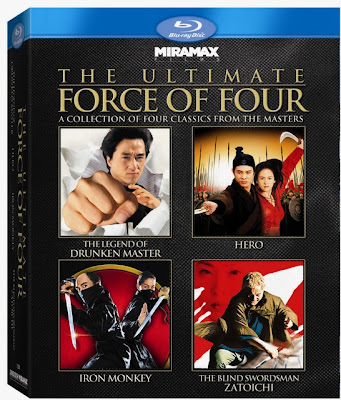
Blu-ray Review: The Blind Swordsman: Zatoichi (2004) -- Ultimate Force of Four Box Set Collection


Part of the New Blu-ray Set


View Photo Slideshow


Delicious
Bookmark this on Delicious
submit to reddit
Print Page

Digg!

MovieBlips: vote it up!

AKA Zatoichi: The Blind Swordsman

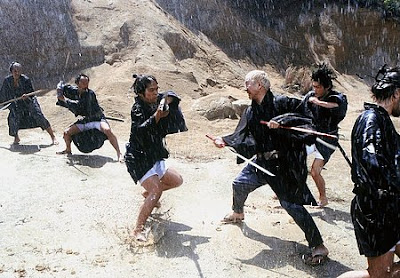
It takes a certain kind of filmmaker to remain undaunted by the fact that the main character of the film they're pouring their heart and soul into has already appeared in over two dozen cinematic and televised installments in Japan's phenomenally successful Zatoichi series. Luckily, Takeshi Kitano is exactly the right filmmaker for such a task.

Instead of staying completely faithful in both his portrayal and adaptation of the blind hero who poses as a masseur by day, gambles by night and slices villains with his cane/sword whenever they stand in his path, writer/director/actor and editor Takeshi Kitano engaged in a cinematic free-for-all.


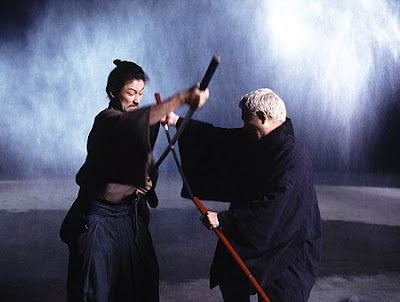
The two main ingredients for the highly potent yet admittedly dizzying work consist of Kitano's ingenious blend of his countryman Akira Kurosawa's Yojimbo and the 1960s Spaghetti Westerns it inspired (when Zatoichi fever was at a major high with the debut film's launch in '62) as filtered with the natural musicality evidenced in the fine-tuned precision of martial arts choreography.

I must grant that it does suffer from Guy Ritchie style overload at the beginning in switching too rapidly from one character's situation to the next and barely giving us time to register who our main ensemble will be aside from Zatoichi. And to this end, I'm still baffled as to the identity of a rival gang that was discussed throughout yet Kitano's wildly original oddity moves from exploitative gore fest to operatic homage.

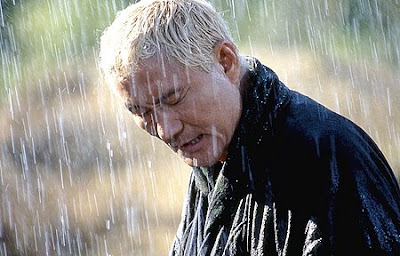
Obviously Zatoichi--played by Kitano with a bizarre choice of shockingly bright dyed white blonde hair-- is our film's heroic anchor as a man whose other four senses have been augmented to the point where he can defeat sighted foes by the dozens in blink-and-you-missed-it slice and dice encounters. Yet, his plight in the film coincides with the emotional, revenge driven quest of two siblings-- one male (in drag) and one female-- who've been masquerading as geisha for the past decade while trying to exact murderous vengeance on the powerful gang who'd massacred their entire family.


Meanwhile, in a thematic overlap about family honor and struggling against debilitating conditions, a wandering Ronin warrior in need of a master accepts a job working as a bodyguard for the community's most notorious gang leader in the hopes of raising enough money to pay for the medical treatment that could save his wife's life.

While it's as confusing as it sounds, Kitano balances the tone very well by segueing easily from pathos to wit throughout the work beginning with the movie's tongue in cheek opener that sets up the stage for the blood that will follow as well as its offbeat humor as men whip out swords too quickly when too close together and accidentally axe someone standing next to them in the process. Moreover, Zatoichi seems to find himself overly amusing as he giggles like a schoolgirl in a way that's indicative of the feel of the Blake Edwards series of Pink Panther movies starring Peter Sellers as Inspector Clouseau (which also kicked off in the '60s).

With an exuberant style, Zatoichi dazzles as a work overall as the entire post-production process turned what could've been a standard samurai picture into a bold, ambient, lyric-free musical masquerading as a not quite as Sweeney Todd like blood bath from which even Baz Luhrmann and Rob Marshall could learn. An expert and daring cutter, Kitano's a hell of an editor and he strengthens the film his cinematographer has captured by tweaking every aspect from workers in a field to the use of weather just so that it becomes a veritable musical number that's intense as any choreographed Fosse influenced production on stage.


Yet somehow and most likely because of some of the more subtle touches laced throughout, the cinematically self-conscious Zatoichi is still not as over-the-top as some of Kitano's Asian contemporary works including Kung Fu Hustle or this year's Bollywood Kung Fu picture Chandni Chowk to China no matter how far he reaches as the film culminates in a Bollywood meets Riverdance (Slumdog Millionaire style) performance as the characters engage in a modern tap dance number.

Moreover, even when the film loses us temporarily due to either confusing presentation or a bizarre technique, Zatoichi stands out more than Hustle or Chandni because our sensitive filmmaker is unafraid to reach for genuine heartrending emotion and treats his characters with dignity instead of as simply punchlines. He does this repeatedly by exploring serious subplots including the M. Butterfly laced Dickensian hybrid of the devastating past of the two kids who stuck together, willing to exploit themselves to survive until they can try to pick up the broken pieces of their interrupted and horrific lives.


Yet while the film is all over the place and its ambition is its downfall at times as again I wasn't quite able to follow him from character A to character B for awhile, I commended his confidence as a filmmaker to trust his audience enough to pour so many genres, anachronisms, and tones into one production. Inventive, dynamic, and unlike anything else in contemporary Japanese cinema-- Zatoichi is even more beautiful on Blu-ray with the enhanced sound of rain and shoes that blend musically into the soundtrack and a flawless visual transfer that relishes as equally in the blood as it does in the scenery and period costuming.

The sole Japanese offering in Buena Vista Home Enterainment's dynamite Ultimate Force of Four Blu-ray box set, Kitano's lauded work earned audience awards at both the Venice and Toronto International Film Festival in the year of its release which was no doubt bolstered by the debut of Quentin Tarantino's Kung Fu rule breaker Kill Bill Vols. 1 & 2.

Zatoichi


Takeshi Kitano


Text ©2009, Film Intuition, LLC; All Rights Reserved. http://www.filmintuition.com

Unauthorized Reproduction or Publication Elsewhere is Strictly Prohibited.

5/26/2009

DVD Review: The Ramen Girl (2008)

An American in Japan:
To Noodles With Love
Arriving on DVD
5/26/09


Related Titles


Delicious
Bookmark this on Delicious
submit to reddit
Print Page

Digg!

MovieBlips: vote it up!

A.K.A. The Ramen girl

Simultaneously able to break your heart (a la Girl Interrupted) and melt it at the exact same time simply by being her free-spirited and spunky self (yes, even in Love and Other Disasters and Uptown Girls)-- it's always been a wonder to me why Brittany Murphy has never managed to become a big box office star.


Yet, in the same token, it's most likely to her benefit and credit that she's that talented of an actress that we often forget that the same (then) girl who learns the joys of shopping in Amy Heckerling's refreshingly sophisticated teen movie Clueless is the same actress who eerily cooed "I'll never tell" to Michael Douglas in Don't Say A Word before the petite pixie stood up to Benicio Del Toro as her abusive married police officer boyfriend in Robert Rodriguez's Sin City.


And now she's adding the role of producer to her resume with this unusual tale from Media 8 Entertainment and Digital Site Corporation that's hitting DVD shelves from Image Entertainment. Murphy-- the woman who once beat out an impressive bevy of A-list stars for the hotly coveted lead role in the now forgotten biopic about Janis Joplin-- crops up this week in the Japanese/American production The Ramen Girl.

Having worked steadily over the years primarily in the independent and offbeat realm and usually in romantic roles that showcase her innate sweetness-- it seems apparent that Murphy obviously latched onto the five-time Emmy nominated television director Robert Allan Ackerman's debut feature film The Ramen Girl for all the right reasons.


Working from newcomer Becca Topol's original screenplay, Ramen takes the framework of a romantic comedy but leaves those two requisite ingredients (of romance and comedy) on the counter in lieu of a female empowerment screenplay. At its core, Topol's Ramen is about a young woman trying to "find" herself after being dumped in Tokyo and it's a fetching Under the Tuscan Sun paradigm that must have appealed to Murphy since it reveals its true nature shortly into a movie that on the surface is decorated like a typical rom-com.


Although the press release describes the film as "Tampopo meets Lost in Translation," and it aims more for drama than the promised "hilarious culture clash" described in the introduction, the film will strike an instantly familiar chord with those who've experienced Like Water for Chocolate, Waitress, Last Holiday, Chocolat, Simply Irresistible, The Mistress of Spices, and Woman on Top.


Unfortunately and despite Murphy's considerable charm, it's nowhere near as successful as Water, Last Holiday, Waitress, Chocolat, and Spices as Topol crafts one of the most unlikable "mentors" in recent memory to serve as the film's anti-Mr. Miyagi in the role that poor Toshiyuki Nishida is saddled with as the angry and often drunk, fond of hitting, ruthless curmudgeon.

When the bright and bubbly Abby journeys to Japan to be with her techie boyfriend Ethan (Gabriel Mann) in a move we soon gather that was more her idea than Ethan's, she's stunned to find herself on the receiving end of a cliched "I'm a traveler," I need space styled break-up.

Leaving her stranded in a strange city where she knows only two of his friends (the obligatory gay guy and a dramatic diva) and can barely make small talk with the aid of a Japanese to English dictionary-- instead of getting on the next plane back to the states, Abby's denial continues. And in a painful to watch series of events, she optimistically continues phoning Ethan until one night, she finds herself strangely drawn into a ramen noodle shop run by the ornery Maezumi (Nishida).

Wandering in after hours and greeted with his angry drunken shouts in Japanese, the fragile Abby breaks down into helpless tears but is soon transformed when Maezumi and his wife serve her his own special bowl of ramen noodles. Ignoring the airline ticket her parents have purchased for her return-- seemingly illogically and still in shock from the departure of Ethan-- Abby begins to return to the ramen shop regularly, helping out when she can until she makes a seemingly impulsive decision that she wants to become a ramen chef to make people smile and laugh the way that the chef does (when he isn't drunk or hitting people that is).

Going as far as to lock Abby out of the restaurant, trying to scare her off with endless countless of dirty dishes to clean, toilet bowls to scrub by hand on her knees, and an increasingly humiliating set of tasks-- the chef is as amazed by Abby's persistence as we are that she remains in the shop.

Topol's script and Ackerman's film starts with potential as an amusingly offbeat tale about a young woman who starts to find her true self in a place where the only thing she's able to translate is emotion and feels that perhaps ramen noodles are far superior to mispronounced phrases and crying jags. However, soon it becomes a patience testing study of just how much punishment Muphy's character will take from a man who regularly hits and rough-handles her.

And similar to a military picture, we gather it's all "part of the training" to see if Abby has what it takes but Topol's attempts to humanize the cruel chef are few and far between making our heroine seem a bit weaker and unheroic in her willingness to continue to serve as a masochistic glutton for punishment.

While perhaps some greater glimpse into her home-life would help us better understand the reason she remains in the shop-- (and indeed on the DVD's extra features, you do catch a phone conversation with her nagging never seen mother that does assist in this process)-- nonetheless, it still makes a trying feature to sit through clocking in at a mere 102 minutes.

Although a minor romantic subplot is added in for good measure and perhaps to try and make us smile every once in awhile-- ultimately by its halfway point, we realize that like a recipe that needs some adjusting, Topol's script wasn't quite ready for the oven by the time Ramen Girl went into production.

And while I do love her premise and much like Love and Other Disasters Murphy is the right choice to elevate weak material-- in the end, Abby's character arc was in desperate need of little more spunk a la Queen Latifah's ambitious yet also emotionally tested foodie in Last Holiday or Keri Russell's spirited turn in Waitress which would've strengthened Ackerman's picture.

Moreover, there's so much wasted potential that-- if strung together tighter and played upon-- would've augmented it considerably in the form of a great "girl power" under-utilized alliance Murphy has with the chef's wife and Tammy Blanchard's dramatic diva. The friendships-- if handled correctly-- could've done for Ramen what the Juliette Binoche, Lena Olin, and Judi Dench friendship did for Chocolat and likewise, Topol's direct magic realist Like Water for Chocolate homage (including one alternate ending) feel like they were so cribbed from Esquivel and Arau's source material that there could be a lawsuit on Topol's hands. But luckily as evidenced in the weak but amusing Sarah Michelle Gellar film Simply Irresistible, the idea of a cook's emotional state somehow passing through to the food and into those who digest it has already been utilized before.

While far from a complete disaster and instead, one of those movies that's so maddeningly close to having been something so special that it's worth exploring on that level alone-- in the end, Ramen reminds women and writers that the addition of a romance or a handsome "prince" isn't an arc that should be used to ever define a main female character.

Gorgeously transferred to digital form for its debut on DVD to the highest of widescreen quality, the disc offers the addition of the film's trailer, the alternate ending (that REALLY gave off a Like Water for Chocolate vibe that would've greatly altered the tone of the movie) and a few deleted scenes. Ultimately, Murphy's first effort as a producer fails to nourish or satisfy the way a delicious bowl of ramen noodles should but it makes great food for thought as we examine the ingredients and imagine the concoction it should've been if the timing had been right before it hit the oven.

Brittany Murphy


10/01/2008

Fist of Legend (1994)


Inspired by Bruce Lee -- in Gordon Chan's film, Martial Arts fans met a new Li... Jet Li.


Earlier in the week, I walked out of a press screening with a group of critics and in our amazing disappointment at a hotly anticipated upcoming film that screened at both Cannes and Toronto (which shall remain nameless), we tried to summarize our disgust in various phrases. “Made me want to kill myself,” was one guy’s take while another said, “pointless; he shouldn’t be allowed to make films,” and this continued on until another critic said, “the only way it would’ve been worse is if it involved Kung Fu."
My jaw-dropped in response and before I knew it, I temporarily forgot about the bleak and jarringly brutal film we’d just witnessed and addressed the dissenter directly. “I love Kung Fu movies,” I gushed and couldn’t believe the disgust leveled my direction-- including some awe over the fact that on the surface as a white, tall, gangly female whose typical wardrobe consists of retro girly dresses and skirts—utter amazement that I could ever appreciate a good old fashioned kung fu smack-down.
However, having attended a predominantly Asian high school, I grew up with the films and while my peers at other schools lusted after Brad Pitt, I obsessed over Hong Kong cinema stars like Chow Yun-Fat.
And while admittedly, yes, some martial arts films (especially the dated classics) are cheesy and man, do I hate it when they overdub the Mandarin or Cantonese dialogue with "Surfer-Dude" styled English but to me, an excellent martial arts film is as bewitching as a breathtaking and highly stylized musical.
Both involve precision, stunning choreography, an overwhelming goal to entertain and most importantly for the medium, to tell the story visually, thrilling its audience and tricking us into thinking for one brief moment that we could dance like Gene Kelly or fight like Jackie Chan.
Chan is a personal favorite, owing a great deal of his success to silent comedians with his energetic and inventive prop styled fights but the overwhelming master of the genre that brought it to our American shores is the man himself, Bruce Lee.
Co-screenwriter and director Gordon Chan paid tribute to Lee with his wildly popular film Fist of Legend, loosely based on Bruce Lee’s classic film The Chinese Connection (also known as Fist of Fury). The film, which as film critic Elvis Mitchell notes on the DVD, “put Jet Li on the map,” provided Li with a showcase to illustrate not only his tremendous athleticism and agility but also his range as an actor as Mitchell continues that his eyes are always illustrating a though and there’s something “kind of hidden about him” in his “countenance.”
Given the deluxe two-disc treatment by the phenomenally dedicated company Dragon Dynasty, Fist of Legend arrives in its amazingly restored widescreen glory available in Cantonese Stereo, Mandarin Stereo, and English Dolby 5.1 sound with English and Spanish subtitles along with an optional feature length commentary by Bey Logan, a Hong Kong Cinema Expert, the film looks better than it ever has before as you can witness in the trailer below.
Fist of Legend: Theatrical Trailer

Far more political and emotionally moving than one would normally expect of traditional martial arts fare, including the clichéd naysayers I referenced above who only dwell on the genre’s weakest links instead of the strongest ones (in which category this film belongs), it’s a historical piece about the Japanese occupation of China. In fact, daringly it tackled racism and prejudice head-on instead of the traditional emphasis on the class system or cultural differences as Mitchell explained.
And likewise, I felt as though it were nearly a martial-arts version of West Side Story as we initially meet Jet Li’s Chinese character Chen Zhen studying in Japan alongside his Japanese sweetheart. Upon learning that his martial arts master back at his former school has been murdered, Li leaves his love and returns to China where he and his allies try to figure out just what exactly happened, all the while trying to reconcile their prejudice regarding the Japanese occupiers as the groups antagonize one another.
When Li is wrongly arrested, his girlfriend willingly ruins her reputation and leaves everything behind to clear his name but now as a Japanese woman living with a Chinese man she’s unable to marry since neither side will perform the ceremony or accept them, tensions increase. Soon, they’re forced to live in the outskirts of the community in a mere hut, reminiscent of the Little Tramp’s situation in Chaplin’s Modern Times.
Although he’s most famous for helping solidify Jackie Chan’s popularity with American audiences with the Rush Hour trilogy, director Brett Ratner is also interviewed on the second Special Features disc, offering an interesting evaluation that since director Gordon Chan illustrated both sides of the conflict in a fair and balanced manner that showed the good and bad, he argued that it’s the one Chinese film that could play equally well “without censorship” in both countries. And honestly, viewing the film now as an adult instead of just an adoring teen who couldn’t wait to see those mesmerizing fight sequences (including the finale which the press release notes was listed as the #5 Best Fight Scene Ever by Rotten Tomatoes), I must admit he’s right.
In fact, I was equally caught up in the politics of the film, the romantic relationship which seemed far more earnest and relatable than actually some of the ones produced in the last few years. As Ratner explained, because Chan’s background was first and foremost as a trained writer, instead of just a martial arts expert or choreographer (which is the usual path to becoming a director in Hong Kong cinema), he was able to approach it on a “mythological” level. Thus, it’s safe to say that by addressing the project this way from the start, I’d argue that Chan ensured that even those who may instinctively feel they’d dislike a typical martial arts film would be nonetheless taken in by it.
Don’t get me wrong and that is not to say that there’s not enough action! For, when you’re dealing with choreographer Yuen Woo-Ping (The Matrix, Crouching Tiger, Kill Bill), you know that the film’s fights will surpass your wildest fantasy. And it definitely is filled with action yet instead of just a few perfunctory scenes for us to “get to the good stuff,” when the men throw-down, it’s actually justified and acting happens as well during those phenomenal sequences, including one where Li voluntarily fights blindfolded.
With a trailer and interview gallery, and deleted scenes-- the second disc is packed with extras including an exclusive and eye-opening director with Gordon Chan, another with “Kung Fu Impresario” Chin Siu-ho, a “School of Hard Knocks” which takes us inside a screen fighting seminar at the renowned Kurata Action School, and others. This being said, while Kung Fu movies can leave one feeling invincible, they should definitely come with the "don't try this at home warning" so please for the love of Pete, don't try to break concrete slabs with your head or use your hands to hammer in nails anytime soon.
And whether you want to watch as a mere fan, eager to rewind or jump to your favorite scenes that no doubt you’ll want to screen again and again (making it a “must own” for fans of the genre rather than a simple “Netflix add”) or you’re an martial arts movie aficionado, no doubt you’ll be equally overwhelmed by this fully loaded set… destined to become legendary just like Fist.