Showing posts with label Legal. Show all posts

7/20/2018

Film Movement Movie Review: The Third Murder (2017)


Now Available


Bookmark and Share

Originally an aspiring novelist who skipped class in college to instead go to the movies, so far acclaimed Japanese writer/director Hirokazu Kore-eda's filmography has largely consisted of intimate family and relationship dramas that could best be described as novels on film.

Drawing more upon his love of cinema than fiction, Kore-eda's Film Noir infused legal title The Third Murder marks a bold and (regrettably) largely unsuccessful departure from the fly-on-the-wall docudramas that have become synonymous with his name.


While collaborating with lawyers and legal advisers on his masterful Cannes Film Festival award-winning drama Like Father, Like Son, Kore-eda was struck by the Catch 22 revelation that – in spite of our romantic notions about the law – in the end, the court is there to pass judgment and not determine the truth.

An existential take on our flawed justice system as well as American courtroom dramas and crime pictures of the 1950s in particular, The Third Murder is as fascinating as it is infuriating. Relying on a classic genre hook to grab our attention, Kore-eda introduces us to a cool-headed lawyer who comes to suspect that, despite confessing to murder, his client just might be innocent.


Referencing the events of an entirely different murder case involving the exact same man set thirty years earlier while we're still trying to get our bearings in the present, Murder needlessly confuses viewers to the point that a friend and I actually had to stop the movie twice to try and process just what exactly was going on before we'd reached the end of the first act.

Hoping to supply the film with the genre requisite number of endless twists, each time the lawyer played by Masaharu Fukuyama (who serves as the viewer's surrogate) thinks they've begun to learn the truth about what really happened on the night of the crime, his client (Kôji Yakusho) backtracks and changes his story an infinite number of times.


Growing increasingly ridiculous as it continues, rather than develop his purported Hitchcockian “wrong man” narrative into a successful dramatic thriller that also proves his thesis about the double-edged sword that is the law, Kore-eda appears to lose interest, ultimately throwing everything and the kitchen sink at the screen to see what sticks.

And in the process, the film wastes what could've been a very effective dramatic conflict concerning the lawyer's relationship with his father (Isao Hashizume), who coincidentally served as the judge on his client's case thirty years earlier.

Of course logically, this alone would probably have forced the lawyer off the case for the sake of appearances (if not outright ethics concerns), it's easy to overlook the contrivance since it leads to some powerful moments of debate between the two, which in any other Kore-eda drama would have become the film's central conflict. Recognizing that, The Third Murder switches gears yet again as the writer/director adds a half-baked mystical component to the storyline.


While obviously a magical realist courtroom drama is one way to set his film apart from the dime a dozen legal works which play out on pages and screens every day, Kore-eda flirts with but never fully commits to it on the level of Kieslowski's Three Colors Trilogy, which invited viewers to speculate whether characters had free-will or if everything they did was pre-determined by a higher “judge.”

Ponderous, pretentious, and overly long (by at least twenty minutes), The Third Murder raises far more questions than it offers answers, which could have gone a long way towards proving his point about the shortcomings of a system that decides the rest of a person's life or death in the blink of an eye, had so much of the film not been fashioned like a whodunnit.


Helping keep us interested beyond our sheer narrative curiosity, Murder's strongest selling points lie in its first rate Noir components in the form of Italian composer Ludovico Einaudi’s hauntingly minimalist score and Mikiya Minamoto's mesmerizing cinematography.

Visually inspired by Michael Curtiz's Mildred Pierce and filmed in CinemaScope, Minamoto's inventive juxtaposition of shadow and light yields some absolutely stunning close-ups and richly symbolic shots.


With faces overlapping during key points to link our characters and their plights together, the stellar combination of Einaudi’s score with Minamoto's unique visuals create a fascinating subtext which bolsters Kore-eda's otherwise odd blend of existential philosophy, magical realism, Film Noir, and legal drama.

But with so much going on, rather than enrich the work, most of the the film's individual layers and subplots are spread so thin that all they do is call attention to themselves. A meandering tour of a lot of otherwise great ideas, The Third Murder makes you wish for the first time in Kore-eda's career that instead of a mishmash literary film, he'd written a film-like novel instead.


Text ©2018, Film Intuition, LLC; All Rights Reserved. http://www.filmintuition.com Unauthorized Reproduction or Publication Elsewhere is Strictly Prohibited and in violation of the Digital Millennium Copyright Act.  FTC Disclosure: Per standard professional practice, I may have received a review copy or screener link of this title in order to voluntarily decide to evaluate it for my readers, which had no impact whatsoever on whether or not it received a favorable or unfavorable critique. Cookies Notice: This site incorporates tools (including advertiser partners and widgets) that use cookies and may collect some personal information in order to display ads tailored to you etc. Please be advised that neither Film Intuition nor its site owner has any access to this data beyond general site statistics (geographical region etc.) as your privacy is our main concern.

5/04/2018

Blu-ray Review: The Insult (2017)


Now Available to Own


Bookmark and Share

Back in high school I served as a peer mediator and while a majority of the issues we dealt with were pretty typical of the setting, once we received a case involving perceived difference of religion which snowballed so spectacularly - including off campus vandalism and violence with others in the community - that during the entire session, we had police on standby right outside the door.

Thankfully nobody was injured but it taught me an early real-world lesson that insults involving religion could escalate with such severity and speed, not just in our history books or on the evening news but even in the suburbs of Minnesota.

But if you transfer the conflict to the Middle East where there's been so much pain, suffering, and unrest involving all religions throughout the region's history, the potential for chaos is magnified to the extent that it wouldn't take more than a mere spark to erupt a volcano with the potential to envelop everyone in its path.


And with the action set in contemporary Beirut, that's precisely the situation in which we find ourselves over the course of director and co-writer Ziad Doueiri's powerful 2017 Oscar nominated Best Foreign Film, The Insult which revolves around an insult between Lebanese Christian Tony (Adel Karam) and Palestinian refugee Yasser (Kamel El Basha) that quickly evolves from words to fists to an all-encompassing lawsuit.

Using the power of cinematic point of view to great effect, The Insult first introduces us to Tony, a married mechanic and small business owner whom we immediately identify with simply because he was the first one onscreen.


So devoted to his faith and the Christian Party that he keeps a photo of the president in the room of his unborn child (much to the chagrin of his expectant wife), we watch stunned when, upon refusing construction foreman Yasser’s polite request for access to fix the drainpipe off his balcony by instead telling them to use the street, Tony destroys their work without a word.

After shouting out an obscenity at Tony, the proud, hard-working Yasser is reminded by his boss that since they’re in their (Christian) neighborhood, “you can’t talk to them like that,” and shortly thereafter, we learn that Tony has demanded an apology.


However the attempt at reconciliation goes horribly wrong when Tony insults Yasser’s religion and people in a horrific way, causing Yasser to throw a punch which ricochets many times over that it leads to the legal case at the heart of the film.

Quickly discovering that this is much bigger than he said/he said, both of the men (as well as their loved ones) are put under a public microscope that examines their pasts, prejudices, and how they got there today and predictably grow to realize that they might have more in common than they'd initially believed.


As the two men's story begins to light up TV screens across Lebanon, the people of Beirut begin taking up the increasingly divisive fight, which winds up leading to the type of chaos and violence sadly all too familiar to viewers in Trump’s America where insults have become official presidential statements and hate crimes have been on the rise.

Emotionally and intellectually thrilling, although admittedly a few of the film's plot twists feel slightly satirical and forced by the time we move into the third act, The Insult is still an extremely timely legal drama that easily adheres to Roger Ebert’s belief that “movies are machines for empathy.”


An extremely impressive work from Doueiri, The Insult would not only be a terrific selection to show high school students studying ethics but it's also sure to cause thrilling post-film discussion, including some from the filmmaker which is included as part of this technically stellar Cohen Media Group Blu-ray release.


Text ©2018, Film Intuition, LLC; All Rights Reserved. http://www.filmintuition.com Unauthorized Reproduction or Publication Elsewhere is Strictly Prohibited and in violation of the Digital Millennium Copyright Act.  FTC Disclosure: Per standard professional practice, I may have received a review copy or screener link of this title in order to voluntarily decide to evaluate it for my readers, which had no impact whatsoever on whether or not it received a favorable or unfavorable critique.

Movie Review: RBG (2018)


Now Available


Bookmark and Share

Like many women who went to college in the 1950, Ruth Bader earned her Mrs. Degree when she married Martin Ginsburg – a man who was as outgoing as she was reserved.

Except, as she tells directors Julie Cohen and Betsy West in the inspiring new biographical documentary RBG, the only difference was, whereas other women suppressed their intelligence to fit in at Cornell, Marty not only cared that she had a brain but without her beloved husband, Supreme Court Justice Ruth Bader Ginsburg might have never become a lawyer.


Further inspired to enter the law after watching the McCarthy hearings on TV – Cohen and West's newly released film chronicles their modest subject's meteoric rise from her early days as one of only nine women admitted to Harvard Law School to her now iconic role on the Supreme Court.

Particularly fascinating in its pre-Justice period, RBG acquaints us with Harvard in an era where the dean asked its female students why they should get to take a man's "spot," before letting us share in Bader Ginsburg's success making the Law Review in her second year, while also caring for not only her toddler but also Marty, who'd been diagnosed with cancer early into their marriage.

Finishing her own work and then typing up her husband's while he underwent chemo, we discover that Ruth Bader Ginsburg's legendarily tireless work ethic of staying up until the wee small hours of the morning (and then sleeping all weekend) began in college. And while it has continued to serve her well today, most viewers question how a mere mortal can do what she's done day in and day out for over sixty years!


Though mere mortal she may not be. Described as "the closest thing to a superhero that I know," by interviewee Gloria Steinem, the film offers a fascinating to look back at some of the landmark equal rights cases that Bader Ginsburg argued in the 1970s Supreme Court, which not only made her name but also gave us some of the rights that we're fighting to hold onto today.


Also documenting Marty's work behind-the-scenes petitioning then President Bill Clinton to name RBG to the court (which he realized he wanted to do within fifteen minutes of meeting her) as well as her relationship with the other justices, and evolving role on the bench from moderate to liberal, RBG provides a terrific overview of a woman that most millennials are likely just getting to know.

Clocking in at a brisk ninety-seven minute running time, this energizing work will undoubtedly play better if you're already familiar with a majority of the political figures interviewed or featured throughout. But at the same time Cohen and West work hard to reach new activists and politically engaged young minds by illustrating the important part that not only RBG but any justice has the potential to play in changing the law of our land for better or worse.


Rounding out the woman as well as the feature to delightful effect, the filmmakers share her passion for the opera and dedication to her family on display in both rare home movies (the best of which celebrate her relationship with the late Marty) as well as fun interviews with close family and friends.

And while even though I'm nerdy enough to have wanted a Ken Burns sized opus that zeroes in on each decade of her life (and especially every one of those ACLU cases she argued), the multiple film festival Audience Award-winning RBG gives us a wonderful opportunity to start rooting for a different kind of superhero this summer.


Text ©2018, Film Intuition, LLC; All Rights Reserved. http://www.filmintuition.com Unauthorized Reproduction or Publication Elsewhere is Strictly Prohibited and in violation of the Digital Millennium Copyright Act.  FTC Disclosure: Per standard professional practice, I may have received a review copy or screener link of this title in order to voluntarily decide to evaluate it for my readers, which had no impact whatsoever on whether or not it received a favorable or unfavorable critique.

7/17/2009

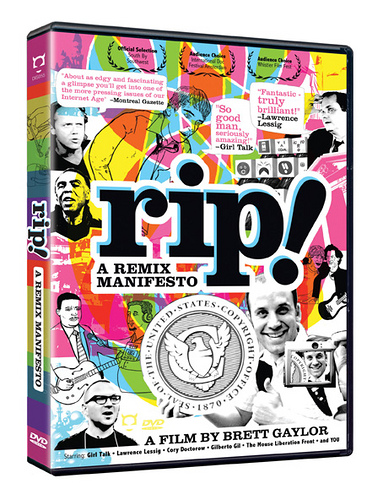
DVD Review: RiP! A Remix Manifesto (2009)


Own It On DVD


Download On iTunes

Rip! A Remix Manifesto

Remix it at OpenSourceCinema

Experience the Music of Girl Talk on MySpace

Get the Music Here


Watch the Trailer


Delicious
Bookmark this on Delicious
submit to reddit
Print Page

Digg!

MovieBlips: vote it up!

This is one of those movies I'm not even sure I should've been allowed to see let alone review...but it's available on Amazon and iTunes so I'll have good company in jail.

For, as I type this, I keep waiting for the door to bust open and the A-Team to file in complete with Mr. T and all his gold chains and--c'mon, let's face it-- as a polite, native midwesterner who trips and apologizes to the sidewalk, I will fold under questioning and confess to crimes I never committed like perhaps marooning all those islanders on Lost which I've never even seen.


Yet, I'm glad I was somehow deemed hip enough (and Erik, thank you, my man) to review this fascinating documentary from The Disinformation Company which has released some other high quality works that the Hollywood mainstream simply doesn't want you to see such as Michael Moore's Slacker Uprising (aka the first movie I saw on my Netflix Roku device), as well as Robert Greenwald's brilliant duo Wal-Mart: The High Cost of Low Price and Outfoxed: Rupert Murdoch's War on Journalism which I discovered as an undergraduate film student.


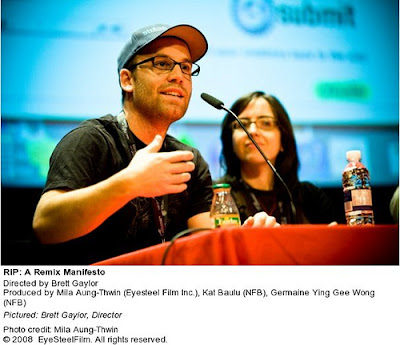
Crafted by a likable and highly energetic yet cautious filmmaker who ensures he never steps on the toes of those he interviews or goes for cheap shots-- Brett Gaylor walks his talk by releasing the film in its entirety completely in open source and DRM free both on the DVD and online via his website.

Born and raised during the dawn and evolution of the internet on a tiny island off the enormous mainland of Canada-- originally he found the world wide web to be a tremendous outlet which allowed him the immediate and unlimited ability to connect with the planet at large.


Yet right around 1998, Gaylor began noticing amidst the era of Shawn Fanning's Napster debacle which kick-started peer-to-peer file sharing and the endless copyright lawsuits that followed-- that suddenly ideas and online creativity were becoming less free and more likely to get you fined, find you without a home, or forced into a squad car.

Further problems ensued, however as the entertainment industry realized that consumers then had the power over the content they'd created to do with what they wished. Of course, that was until they created new red tape in the form of greater rights and fine print for the ownership of content possessed by essentially six major corporations along with of course creating a new lock with "DRM" a.k.a. digital rights management or corporate software which prevented you from adding or ripping the files of a film or album onto your computer.  Yet, when there's a will, there's a way so cyber pirates provided their own key with "vault cracking DRM software" which can land someone five years in the slammer and/or $250,000 for every song they've downloaded.

Now in an era where there have been lawsuits levied against 24,000 Americans who've been forced to settle without guilty pleas even though not a penny of their fine goes to the artists, musicians or filmmakers whose work they've downloaded-- Gaylor has taken a keen interest.  And with this film, he's decided to look at all of it but in an upbeat, fast-paced, humorous way by taking a particular interest in those who have been fighting against the hypocrisy with creativity as their weapon of choice.

In doing so, he cites that remixing has always been practiced since Led Zeppelin took Muddy Waters' "You Need Love" (which actually had come from somewhere else) for "Whole Lotta Love" in the same manner that The Rolling Stones and others have done again and again although of course The Stones sewed Verve for full rights to "Bittersweet Symphony" and sold 'em to a Nike Commercial. Yep, that's just what The Verve meant in the lyrics when they wrote, "you're a slave to money then you die."

Yet, while musicians have always enjoyed "sampling" or remixing each other's notes, as we learn just moments into the movie-- taking even a single note and using it in your work is a copyright infringement issue, which is a major problem for Greg Gillis a.k.a. Girl Talk who works as a biomedical engineer from nine to five. Yet whether or not there's a full moon-- at night he's out on the prowl-- like Clark Kent changing into a booth, the nerdy scientist becomes music's hottest underground mash-up Superman mixing together old Motown classics with Elvis Costello with "Bittersweet Symphony" or whatever music is exploding on the Rolling Stone magazine charts that week.


By sampling 21 songs in 3 minutes, Gaylor argues that if Girl Talk were to make an album, he would owe roughly 4 million dollars in copyright fees for the music he samples and it's fun to watch Marybeth Peters-- an employee at the Office of Copyright who's held the position for 40 years (yet doesn't own a computer in her home) watch footage of Girl Talk sampling one note of a Costello song before her eyes to see the mathematical complexity involved.


Of course she's indeed correct when she notes that you can't argue that the copyright law is hindering someone's creativity if it's based on other people's stuff (and I do think Girl Talk is so gifted that he could probably create his own) but then when you realize the amount of greed involved as Warner Chappell Records makes millions every year on "Happy Birthday" and not a cent in royalties goes to the family of the deceased sisters who wrote it, you wonder if some stuff really should belong "to the people."


And this is especially the case considering that Warner Brothers-- incidentally, one of my very favorite studios!-- has made a mash-up of their own classic work Casablanca and turned it into an anti-piracy ad, thereby ruining one of the best American films of all time for future generations by presenting the next generation with the image of Ingrid Bergman as a DVD copier along with cheesy music instead of "As Time Goes By."


Essentially, the thesis for Girl Talk as an artist and indeed Gaylor's film is simple and it is that basically remixed content turns the consumers into creators; so Gaylor divides his film into those on both sides of his argument of the "copyRIGHT and the copyLEFT."


In tackling mash-ups which also involve video to often hilarious effect as you've seen on YouTube (typically before they're pulled down for copyright violation) or via the ninety extra minutes of footage on this DVD and within the disc that include such state-of-the-art techniques as rotoscoping), Gaylor's journey takes him from Girl Talk who will become legitimately appreciated by the film's end earning a fan in Paris Hilton and performing at Coachella to meeting up with Stanford professor, lawyer and expert Lawrence Lessig.


The man who tried to set all the Napster users free who now travels around the globe (for more than a decade to speak about our "extremist" policy concerning file sharing and copyright)-- Gaylor describes him as a lawyer with a guilty conscience but one who's done a lot about it by writing the Remixer's Manifesto that inspired the film. Namely*: 1) Culture Always Builds on the Past. 2) The Past Always Tries to Control the Future. 3) Out Future is Becoming Less Free. 4) To Build Free Societies, You Must Limit the Control of the Past. (*Source: Lawrence Lessig as quoted in the film)

In addressing the way that the past still has control, Gaylor becomes a member of a group called the Mouse Liberation Front who were sued by Walt Disney Corporation for their "Air Pirates" line of funnies or comics by turning Mickey into a counterculture, darker figure and during this interview wherein the man he speaks with jokes that the house of mouse will sue everybody just for looking at 'em.  Moreover, he discusses the origins of the Disney animation studios and Walt Disney's first efforts in particular by noting the way that Mickey Mouse was often drawn in shorts to tie in with pop-culture like Buster Keaton's Steamboat Bill Jr. or Charlie Chaplin's Modern Times all the way up through their renditions of the classic fairy tales remade again and again, noting that Disney himself was a mash-up artist.


Briefly addressing some of the new strategies to counter the copyright sledgehammer and the big house such as "fair use for free speech" or "creative commons" or "citing sources," there are two portions of Gaylor's documentary that are almost deserving of their own spin-off works in their own right, including the first when he discusses the amount of potential medical cures that could be found if drug companies worked together and why or how it is lawful for some to own plants or land with potential healing powers.

Secondly, in a great segment,
we meet the former Brazilian Minister of Culture Gilberto Gil when Gaylor travels to Brazil by investigating the way that medicine, music, art, culture, and more are all used without fear of "idea ownership" to better their society in a chain reaction of positivity where the country bravely "re-mixed" their own knock-off HIV drug when Brazil wasn't allowed to "break the patent" to help their citizens.

These last few portions of the film have an amazing impact on a larger social issue scale concerning health, safety and foreign policy and while they definitely go in tandem with the arts and culture angle-- I was so riveted by Gaylor's findings that I almost felt like he may have had enough for two films or even a few very hard-hitting short subjects works.

But nonetheless-- RiP! A Remix Manifestio is a film festival favorite, crowd-pleasing, and conversation provoking documentary that was so immediately gripping I had to share it with others of all generations since even at roughly thirty, although the term "remix" was definitely familiar; "mash-up" just made me think of "Monster Mash" or the mash games played by kids in the '80s on school buses. And in the end, Gaylor has made a stunning work that's not only the most entertaining presentation about the copyright issue that's come down the line so far but also one that's so filled with extras, pulsating with the music of Girl Talk that it's energy is infectious. Likewise, its impact is startlingly immediate like a jolt of caffeine or the instant gratification of downloading something awesome like Radiohead's "pay what you want" release of In Rainbows.


Text ©2009, Film Intuition, LLC; All Rights Reserved. http://www.filmintuition.com

Unauthorized Reproduction or Publication Elsewhere is Strictly Prohibited.