Showing posts with label Yuen Woo-ping. Show all posts

12/17/2013

Blu-ray Review: Man of Tai Chi (2013)


Now Available to Own 


Photo Slideshow


They say a writer’s work is never finished and in theory they may be right. With every new draft or read-through comes another irresistible opportunity to tinker with a phrase, tweak the scene order, remove a character altogether or insert a whole new passage that opens up a world of possibilities. But at the same time, there’s a fine line between something that’s been edited well and over-written as both readers and writers are painfully aware.

With the blending of words on a page and a camera, film scripts -- when performed -- play like notes on a page and a piano. Film, like music can be mellifluous in language, harmonious in editing and dissonant in direction, depending upon how heavily it’s performed by the person playing the keys.

And unfortunately, there’s little rhythm – let alone discernible music in the directorial debut of Keanu Reeves as five long years of tinkering with the composition of Michael G. Cooney’s script has resulted in something that feels as wooden as a grand piano but with none of the power or impact.


From the constant changes in tempo that never quite evolve into sequences which hold us in their sway to the scarce yet staccato-like lines of dialogue that strike an all too familiar chord, we’re presented with something we’ve experienced many times before – executed at a much greater level in other "Once Upon a Time in Asia" martial arts opuses of heroes and villains.

While Reeves’ aim is undoubtedly true in a work that derived inspiration from a stuntman friend of the actor’s – Tiger Chen (who plays a fictionalized version of himself) –  the film never manages to invest the audience in the storyline on any level.

Emotionally icy, Man of Tai Chi keeps viewers as removed from the action as the villainous businessman that Keanu Reeves embodies onscreen who often appears seated in front of a television – a spectator in his own right– looking down on the gladiators he’s hired who fight for him and live or die for his amusement alone.


Yet far from a comment on voyeurism, the script begins traditionally enough, presenting itself like a standard genre thriller that John Woo would’ve gravitated to in the late ‘80s as a vehicle for Chow Yun-Fat in its tale of a man “on the inside” who gains access to villains and feeds information to his fellow officers.

However, it never follows through on its intriguing introduction to a female police officer whose informant has been placed in harm’s way while trying to find out the true nature of businessman Reeves’ role in the underground fight scene.


Relegating its police story to mere subplot, Cooney’s decision to ignore the typical genre paradigm would’ve been much more exciting had he built up a compelling enough storyline to take its place but he has nothing to offer viewers that we haven't seen before. He opts for simplicity instead, letting events unfold slowly but with all the surprise of beer commercial.

While simplicity can be refreshing, in Cooney and Reeves’s hands it does its star a disservice, leaving it up to Chen – or to be more accurate the physicality of his fights choreographed by Matrix and Crouching Tiger craftsman Yuen Woo-ping –  to entertain us for its 105 minute running time.

A throwback to Bruce Lee films of the 1970s, Man of Tai Chi relies on character based action from start to finish. A true underdog in the Rocky tradition that easily endears him to the audience, Chen, who works as a Beijing deliveryman, is as dedicated to his master as he is his own parents, working with the elder on his own fusion of Tai Chi with fight style martial arts.


Lured into Reeves’ lair by the vague promise of a job, Chen is placed in a windowless room and pushed to fight (unknowingly for the cameras) in a brutal defensive audition as opposed to a formal interview.

Having easily beaten his opponent and impressed the voyeuristic villain looking for a new gladiator, Chen finds himself caught between two very different worlds as he begins to realize what’s really going on behind the spectacle of televised fights staged by Reeves.

Unfortunately as likable as Tiger Chen is in the film, Reeves leaves us all revved up by Chen’s talent with nowhere for the actor (and character) to go except through its paint-by-numbers plot points until a final confrontation brings our hero face to face and fist to fist with Reeves’ villain.

With everyone and everything else onscreen relegated to window dressing, Man’s flaws become even greater once you strip away the external and focus on the foundation itself, which is fairly easy to do in the film’s forgettable second half where there’s little else to hold our interest after the novelty of the great fight sequences begin to wear off.

Though an obvious must-see for fight fans as even in one of Yuen Woo-ping’s lesser offerings like The Forbidden Kingdom, the action choreographer’s creativity under pressure manages to elevate even the weakest of works, unfortunately there’s little left to recommend Man on any other level.

Perhaps most disturbingly as a fan of Reeves in other films, it’s painful to admit that one of the biggest problems in Reeves’ directorial debut is Reeves himself.

Whether his shockingly bad turn is proof that he benefits from collaboration and does his best work under another’s direction or evidence of the tremendous stress he was under and was unable to switch off all over the other hats he was wearing during production is anyone’s guess.

Likewise, while it’s hard to imagine that he actually intended to turn in such an unbelievably campy performance (because then we'd be facing a much greater problem of taste) -- ultimately in what he essentially fashioned as a two-handed work in its simplicity, it’s his hand that drops the ball passed to him by Chen.


Uttering Cooney’s clichéd lines like a comic book character in need of a thought bubble or caption while occupying his space onscreen compulsively clad in “bad guy black,” the only thing missing from Reeves is a mustache to twirl or a white cat to pet to complete the full “I’ll get you next time, Gadget,” Saturday morning cartoon effect.

Given a stunning transfer to high definition Blu-ray with DTS-HD 5.1 surround sound, the Blu-ray which boasts Reeves and Chen feature commentary is light on bonus features, save for one single behind-the-scenes inclusion on “The Making of Man of Tai Chi.


Particularly inadequate when compared to the other Ping efforts, Keanu Reeves’s labor of love, which was labored over far too long in the script process is also a labor to view.

Likewise, being released around the same time as vastly superior films which focus on the man who trained Bruce Lee makes Man’s simplistic approach as a film that may have been ideal fodder for Bruce Lee if made forty years earlier even more disappointing by comparison.

Moving from its initial, simple melody into something wooden and off-key, Reeves and Cooney take what could’ve been a classic throwback to Bruce Lee and serve up chaotic Tai Chi cacophony until eventually we see beyond what it is and instead what it should be.

Text ©2013, Film Intuition, LLC; All Rights Reserved. http://www.filmintuition.com Unauthorized Reproduction or Publication Elsewhere is Strictly Prohibited and in violation of the Digital Millennium Copyright Act.  FTC Disclosure: Per standard professional practice, I may have received a review copy of this title in order to evaluate it for my readers, which had no impact whatsoever on whether or not it received a favorable or unfavorable critique.

9/25/2009

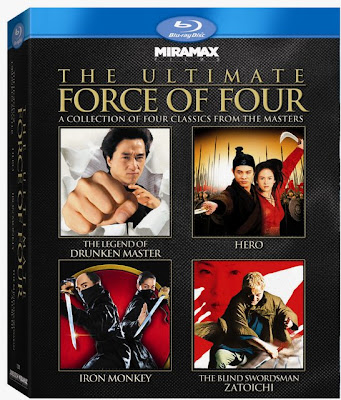
Blu-ray Review: Iron Monkey (1993) -- Ultimate Force of Four Box Set Collection


Part of the New Blu-ray Set


View Photo Slideshow


Delicious
Bookmark this on Delicious
submit to reddit
Print Page

Digg!

MovieBlips: vote it up!

In a society where hospitals dump the homeless on the street when they can't pay their bill and people fall into massive debt, discrimination, and death due to the health care crisis in America, man, is it refreshing to find a doctor we can cheer for in the form of China's Wong Fei Hung.

By embellishing the biography of the real-life late nineteenth and early twentieth century physician, revolutionary, martial artist, and healer Hung to the stuff of folkloric legend as one of China's most enduring and endearing sources for cinematic inspiration, Hung has lived on long past his death in 1924 through the many actors who have portrayed him on TV and film.


The two most notable takes on the grown up heroic Hung were crafted first by Jackie Chan in the Drunken Master films and later by Jet Li via his epic Once Upon a Time in China series. In fact these two films and the character they share have become so famous in their own right that I'd erroneously believed I'd seen Iron Monkey until I sat down and viewed the Blu-ray in preparation for the review to watch an early take of the very same character (actually played by female actress Tsang Sze-man).

Over the years, the tales about the legendary doctor have become much taller, essentially making Hung the Chinese equivalent of Robin Hood, Dr. Syn, The Scarlet Pimpernel, Zorro, and any number of American superheroes. As I settled into the movie, my first impression in translating it to action movie geek-speak was that I'd be viewing The Young Indiana Jones Chronicles as opposed to say, Raiders of the Lost Ark given the fact that our hero is only twelve in this film yet it turned out to be a film that I felt even surpassed Jackie Chan's take on Hung in Drunken Master which suffered from its thin plot and broad humor.


While of course, this isn't a slam on Chan's performance at all since the action choreography in Master is among China's best but as an entire cinematic experience, you just can't duplicate Iron Monkey for both its tremendously swift fight scenes crafted by the now iconic Yuen Wo-Ping (who choreographed Crouching Tiger, The Matrix, and Kill Bill) as well as the film's true beauty.

Naturally, it goes without saying that the action scenes are top-notch given the resume of Ping and his supremely unique style of constant motion plus signature movements that augment the strengths of every actor involved. However, I was also thrilled by Monkey's nice blend of the same poetry that would be enhanced in Ang Lee's Oscar winning Tiger seven years later.


Although I could gush continuously about some of the sequences that left me dazzled, one standout begs to be celebrated as it impressively utilized zero violence as the Robin Hood-like physician Dr. Yang (Yu Rong-quong) and his beautiful assistant employ amazing hidden wire-work and magical technique to catch loose office papers that are flying through the air.


It's an important origin story for Hung by illustrating-- as director Quentin Tarantino acknowledged in a behind-the-scenes extra feature introduction-- the powerful role that both Hung's own hardworking honest father (Donnie Yen) and herbalist Dr. Yang would eventually play in his own mythological storyline we've seen unfold for years onscreen.

Traveling the countryside with his ethical physician father who is also a skilled martial artist in his own right (and brilliantly portrayed by the Donnie Yen in some showstopping scenes), the young Hung is held captive by authorities when they erroneously accuse Yen of being the vigilante known as the Iron Monkey who rights wrongs and steals from the haves to drops coins of gold in the laps of the have-nots. When the true Iron Monkey (crime fighting
herbalist Dr. Yang, of course) arrives in his iconic black mask in court just as the judge was about to throw the book at Hung's father, they eventually let him loose with the condition that his son will only be released when the real Monkey is brought to justice.


However, foreshadowing the talented martial artist and innovator he'd later become, the twelve year old manages to stage his own jailbreak and meets up with his father. Through director Ping's stunning choreography and breakneck pace of the brisk eighty-six minute film that never overstays its welcome, we're as invigorated and inspired as Hung is from not just the visual contact high but given the idea that during our current health care crisis, at last (if only on film) we have a physician whom we can truly celebrate.

And again, by ensuring that the storyline will avoid anachronisms in the onscreen mythology of Wong Fei Hung, it's a treat to see the young man realize that the villain they're after may wear black (just like Zorro), but the Iron Monkey transcends what's black and white by standing up for the helpless and concerning himself with the gray area between what is the law and how much of it is worth breaking to ensure basic human rights among the less fortunate.


Making its way to Blu-ray for the first time now in 2009, Iron Monkey had been previously remastered once before in 2001 to help cash in on the Kung Fu craze that hit our shores after the release of Ping's choreography in Crouching Tiger, Hidden Dragon along with the success of Jackie Chan's Legend of Drunken Master which introduced a larger audience to Wong Fei Hung.


And although some of the original flaws of the theatrical print are still there
including several darkly lit shots that benefit from a few adjustments on your TV, with the full power of 1080 pixels behind it, the refreshingly PG-13 rated Monkey still packs a much bigger punch than big budget Hollywood action flicks routinely clogging up space at our local multiplex. Likewise, the sound balance is perfect and it thankfully includes English subtitles and the foreign audio soundtrack.

As the fourth and final feature of a high caliber Blu-ray set from Buena Vista Home Entertainment, Iron Monkey is no doubt one you'll find yourself viewing perhaps more frequently than the other three immensely stylized yet uniquely different works as the title with the biggest potential appeal across all generations, backgrounds, and of course gender since the little fighter to become a national male hero was played by one tough female Kung Fu cookie.

Text ©2009, Film Intuition, LLC; All Rights Reserved. http://www.filmintuition.com

Unauthorized Reproduction or Publication Elsewhere is Strictly Prohibited.

10/01/2008

Fist of Legend (1994)


Inspired by Bruce Lee -- in Gordon Chan's film, Martial Arts fans met a new Li... Jet Li.


Earlier in the week, I walked out of a press screening with a group of critics and in our amazing disappointment at a hotly anticipated upcoming film that screened at both Cannes and Toronto (which shall remain nameless), we tried to summarize our disgust in various phrases. “Made me want to kill myself,” was one guy’s take while another said, “pointless; he shouldn’t be allowed to make films,” and this continued on until another critic said, “the only way it would’ve been worse is if it involved Kung Fu."
My jaw-dropped in response and before I knew it, I temporarily forgot about the bleak and jarringly brutal film we’d just witnessed and addressed the dissenter directly. “I love Kung Fu movies,” I gushed and couldn’t believe the disgust leveled my direction-- including some awe over the fact that on the surface as a white, tall, gangly female whose typical wardrobe consists of retro girly dresses and skirts—utter amazement that I could ever appreciate a good old fashioned kung fu smack-down.
However, having attended a predominantly Asian high school, I grew up with the films and while my peers at other schools lusted after Brad Pitt, I obsessed over Hong Kong cinema stars like Chow Yun-Fat.
And while admittedly, yes, some martial arts films (especially the dated classics) are cheesy and man, do I hate it when they overdub the Mandarin or Cantonese dialogue with "Surfer-Dude" styled English but to me, an excellent martial arts film is as bewitching as a breathtaking and highly stylized musical.
Both involve precision, stunning choreography, an overwhelming goal to entertain and most importantly for the medium, to tell the story visually, thrilling its audience and tricking us into thinking for one brief moment that we could dance like Gene Kelly or fight like Jackie Chan.
Chan is a personal favorite, owing a great deal of his success to silent comedians with his energetic and inventive prop styled fights but the overwhelming master of the genre that brought it to our American shores is the man himself, Bruce Lee.
Co-screenwriter and director Gordon Chan paid tribute to Lee with his wildly popular film Fist of Legend, loosely based on Bruce Lee’s classic film The Chinese Connection (also known as Fist of Fury). The film, which as film critic Elvis Mitchell notes on the DVD, “put Jet Li on the map,” provided Li with a showcase to illustrate not only his tremendous athleticism and agility but also his range as an actor as Mitchell continues that his eyes are always illustrating a though and there’s something “kind of hidden about him” in his “countenance.”
Given the deluxe two-disc treatment by the phenomenally dedicated company Dragon Dynasty, Fist of Legend arrives in its amazingly restored widescreen glory available in Cantonese Stereo, Mandarin Stereo, and English Dolby 5.1 sound with English and Spanish subtitles along with an optional feature length commentary by Bey Logan, a Hong Kong Cinema Expert, the film looks better than it ever has before as you can witness in the trailer below.
Fist of Legend: Theatrical Trailer

Far more political and emotionally moving than one would normally expect of traditional martial arts fare, including the clichéd naysayers I referenced above who only dwell on the genre’s weakest links instead of the strongest ones (in which category this film belongs), it’s a historical piece about the Japanese occupation of China. In fact, daringly it tackled racism and prejudice head-on instead of the traditional emphasis on the class system or cultural differences as Mitchell explained.
And likewise, I felt as though it were nearly a martial-arts version of West Side Story as we initially meet Jet Li’s Chinese character Chen Zhen studying in Japan alongside his Japanese sweetheart. Upon learning that his martial arts master back at his former school has been murdered, Li leaves his love and returns to China where he and his allies try to figure out just what exactly happened, all the while trying to reconcile their prejudice regarding the Japanese occupiers as the groups antagonize one another.
When Li is wrongly arrested, his girlfriend willingly ruins her reputation and leaves everything behind to clear his name but now as a Japanese woman living with a Chinese man she’s unable to marry since neither side will perform the ceremony or accept them, tensions increase. Soon, they’re forced to live in the outskirts of the community in a mere hut, reminiscent of the Little Tramp’s situation in Chaplin’s Modern Times.
Although he’s most famous for helping solidify Jackie Chan’s popularity with American audiences with the Rush Hour trilogy, director Brett Ratner is also interviewed on the second Special Features disc, offering an interesting evaluation that since director Gordon Chan illustrated both sides of the conflict in a fair and balanced manner that showed the good and bad, he argued that it’s the one Chinese film that could play equally well “without censorship” in both countries. And honestly, viewing the film now as an adult instead of just an adoring teen who couldn’t wait to see those mesmerizing fight sequences (including the finale which the press release notes was listed as the #5 Best Fight Scene Ever by Rotten Tomatoes), I must admit he’s right.
In fact, I was equally caught up in the politics of the film, the romantic relationship which seemed far more earnest and relatable than actually some of the ones produced in the last few years. As Ratner explained, because Chan’s background was first and foremost as a trained writer, instead of just a martial arts expert or choreographer (which is the usual path to becoming a director in Hong Kong cinema), he was able to approach it on a “mythological” level. Thus, it’s safe to say that by addressing the project this way from the start, I’d argue that Chan ensured that even those who may instinctively feel they’d dislike a typical martial arts film would be nonetheless taken in by it.
Don’t get me wrong and that is not to say that there’s not enough action! For, when you’re dealing with choreographer Yuen Woo-Ping (The Matrix, Crouching Tiger, Kill Bill), you know that the film’s fights will surpass your wildest fantasy. And it definitely is filled with action yet instead of just a few perfunctory scenes for us to “get to the good stuff,” when the men throw-down, it’s actually justified and acting happens as well during those phenomenal sequences, including one where Li voluntarily fights blindfolded.
With a trailer and interview gallery, and deleted scenes-- the second disc is packed with extras including an exclusive and eye-opening director with Gordon Chan, another with “Kung Fu Impresario” Chin Siu-ho, a “School of Hard Knocks” which takes us inside a screen fighting seminar at the renowned Kurata Action School, and others. This being said, while Kung Fu movies can leave one feeling invincible, they should definitely come with the "don't try this at home warning" so please for the love of Pete, don't try to break concrete slabs with your head or use your hands to hammer in nails anytime soon.
And whether you want to watch as a mere fan, eager to rewind or jump to your favorite scenes that no doubt you’ll want to screen again and again (making it a “must own” for fans of the genre rather than a simple “Netflix add”) or you’re an martial arts movie aficionado, no doubt you’ll be equally overwhelmed by this fully loaded set… destined to become legendary just like Fist.

6/03/2008

Legend of the Black Scorpion

Alternate Title:
The Banquet
Director:
Xiaogang Feng

“Something is rotten in the state of…” China? Over the years, the timeless plays of William Shakespeare have been transferred to the screen in countless adaptations both classical and radical from Akira Kurosawa’s versions of Macbeth (Throne of Blood) and King Lear (Ran) to Robert Wise and Jerome Robbins’s Oscar winning interpretation of Romeo and Juliet (West Side Story). The overwhelming influence of the Bard’s comedies and tragedies on not only cinema but popular culture in general is incalculable as his lines echo in the mouths of Quentin Tarantino characters, themes dance throughout our big budget period epics and there have been so many incarnations of legendary villains and heroes such as Lady Macbeth, Iago, and Hamlet that it could cause a graduate student meltdown.

And perhaps even more remarkably every once in awhile a filmmaker is bold enough to admit right from the start that they’re interpreting not just any Shakespeare play but his greatest tragedy Hamlet and bolder still is when the filmmaker’s last name isn’t Branagh. In 1996, Kenneth Branagh, my favorite Shakespearean professor, released what would become to academics the ultimate version of Hamlet in his dazzling masterwork clocking in at 242 riveting minutes that never cease to amaze audiences so much that some film critics have even named it one of the greatest achievements in filmmaking of the entire 1990’s. Needless to say, following in Branagh’s footsteps where Hamlet is concerned took considerable moxie and it was a move best made by a filmmaker willing to take a large departure from the text to offer audiences something remarkably different.

With this in mind, I transport you dear readers to China where master martial arts choreographer Yuen Woo-ping (Crouching Tiger, Hidden Dragon, The Matrix, Kill Bill) teamed up with director Xiaogang Feng for their very own adaptation of the Danish prince’s quest for revenge, named the Legend of the Black Scorpion. While admittedly it takes awhile to gain our interest as it annoyingly begins to go into exposition twice orally instead of illustrating things visually, we become quickly aware of the Shakespearean similarities only moments into this visually spectacular award winning film festival favorite, which features the largest set ever constructed in China (IMDb) and was chosen as the official Hong Kong entry for the Best Foreign Language Film category of the Academy Awards.

Obviously inspired by Hamlet, although some critics such as Derek Elley of Variety also drew comparisons to Macbeth, Feng’s film is set during the tumultuous crumbling of the Tang Dynasty in 907 AD as we’re introduced to the film’s version of Hamlet, named Prince Wu Luan (Daniel Wu) in an embarrassingly earnest and awkward opening ballad that’s both as reminiscent and effective of Woody Allen’s usage of a Greek chorus in Mighty Aphrodite. Lovesick and desperately heartbroken, Wu Luan has retreated to study the arts including his love for singing and dancing while still upset that his teacher and emperor father had married his classmate and sweetheart Wan (Memoirs of a Geisha star Ziyi Zhang). When he learns that his father has been killed, all hands seem to point to his power hungry, lustful Uncle Li (You Ge) who soon enough confirms that suspicion by ordering a band of soldiers to execute Wu Luan and planning to first bed and then wed Empress Wan (Ziyi Zhang) to rule by his side. After he predictably escapes the deadly attack, Wu Luan returns to the palace where he’s torn between his affection for his sensuous stepmother who’s even younger than he is, his devoted betrothed the Ophelia like Qing Nu (Xun Zhou) and of course, exact lethal revenge on his murderous uncle, the Emperor Li.

Erroneously advertised as an action picture especially given the martial arts friendly name change from The Banquet as well as Woo-ping’s involvement which finds his jaw-dropping talent given very little opportunity to shine, this gorgeously photographed tragedy shot by award winning cinematographer Li Zhang never manages to draw us in on a level that goes beyond sheer aesthetic appreciation. Partially due to the otherwise excellent Ziyi Zhang who’s far too young for the role that was originally slated for Gong Li or Maggie Cheung (IMDb), even with the part rewritten expressly with this age change in mind, but it’s greatest tragedy isn’t in the film’s scope or in tackling source material from the daunting Shakespeare but in slowing it all to a scorpion’s pace where at roughly half the length of Branagh’s Hamlet, it still feels a good 30 minutes too long. While the Bard’s brainiacs are sure to check it out regardless, honestly it’s time well spent for artists who will undoubtedly find themselves inspired less by the forced, clunky conversation that no doubt suffers in translation and more by the film’s visual poetry in terms of the production design and costuming (both courtesy of Oscar winner Timmy Yip) that’s worthy of Shakespeare himself.

4/11/2008

The Forbidden Kingdom

Director: Rob Minkoff

In Michael Mann’s Heat, audiences felt their breaths catch waiting for Al Pacino and Robert De Niro to converse together onscreen in the diner, each sizing the other man up in a way that feels nearly Shakespearean. In the movies of Nora Ephron, we felt a similar thrill when Tom Hanks fell in love with Meg Ryan and the two began their happily ever after in the sunny, flower-filled Central Park conclusion of You’ve Got Mail. And in the first onscreen pairing of legendary action stars Jet Li and Jackie Chan for director Rob Minkoff’s The Forbidden Kingdom, as soon as Chan stumbles into the same scene as Li and utters, “Do you come here often?” the last thing I wanted for the men was the two to chat or fall in love. Instead, like nearly every other audience member and undoubtedly Chan and Li themselves, I wanted to see them fight. And fight they do in this uneven but gorgeous spectacle before their characters end up on the same side in helping a modern day South Boston teen who, via a pawnshop and a magical Bo Staff that’s propelled him back in time to ancient China, return the staff to its rightful owner, the Monkey King (Li in a second role).

Beginning as a near homage to Back to the Future, the movie opens with Kung Fu movie obsessed Jason (Shia LaBeouf look-alike Michael Angarano) being forced to aid in a robbery by a band of dangerous bullies that goes wrong and hurls him into the past where he soon meets Chan’s Drunken Master inspired Lu Yan, a perpetually wine-chugging fighter specializing in Drunken Fist which he explains is the “secret Kung Fu of the south.” To restore the order of the land, Jason and Yan decide to bring the Bo Staff back to the Monkey King, who the evil Jade War Lord (Collin Chou) has frozen in stone for roughly five hundred years “give or take a few decades,” and on their peril filled journey to the Five Elements Mountain, they find their team increasing with the addition of a beautiful vengeance seeking orphan Golden Sparrow (Yifei Liu) along with the monk Lan Cai He (Jet Li). The characters and indeed plot from Young Guns screenwriter John Fusco (who is currently writing the questionable new version of Seven Samurai), were derived mostly from “Chinese mythology and adventure pulps” as well from the “Chinese epic story Journey to the West [which is] one of the four great classic novels of Chinese literature,” according to IMDb.

When the battles with an evil witch with stark white hair and other dangerous allies of the War Lord become far more treacherous, Back to the Future morphs into The Karate Kid as Yan takes it upon himself to teach Jason how to fight. The introduction of this element not only provides the characters with more plot from scripter Fusco who went through, as IMDb reports five rewrites (some during the film’s shoot) but also gives the film’s producer and fight choreographer the legendary Yuen Woo-Ping (Crouching Tiger, The Matrix trilogy, Kill Bill 1 & 2) a chance to style some of the most thrilling and high flying fight scenes we’ve seen in years which, even when the film becomes self-consciously cheesy, are worth the price of admission alone.

Although it’s hard to fault a film with this much sheer entertainment value for its inability to sit side by side with works like House of Flying Daggers or Crouching Tiger, Hidden Dragon to which, I believe most of the audience was hoping the first collaboration of Li and Chan would compare, for fans of the actors, especially my personal favorite-- the hilarious and charismatic Chan, it’s definitely a treat. And hopefully it’s also one that will lead to even more pairings and possibly a grander cinematic approach, aside from the film's major standout that comes in the form of the jaw-dropping, majestic cinematography by Oscar winning Peter Pau (Crouching Tiger). However, until we get there, The Forbidden Kingdom is a great place to start.