An Introduction
There's an old Hollywood adage that goes, "you make one picture for the studio and one for yourself," and it's one that still resonates today as we see some horrific films starring brilliant actors or helmed by superior directors so that they can eventually see their pet project come to life.
A pro since she was in kindergarten-- perhaps nobody knew this better than Ms. Natalie Wood, especially when she signed an extensive contract with Warner Brothers. Wood was often called Warner royalty and perhaps one of the studio's best loved actresses of that era along with Elizabeth Taylor-- as Wood aged into an even more stunning woman but also an increasingly impressive actress following her great performance opposite James Dean for director Nicholas Ray's
Rebel Without a Cause.
And soon the wildly mature yet still very young Wood became far more business savvy, renegotiating her contract, declining scripts that pigeonholed her into the same "youth" she'd played for years, and giving her more freedom to make one film off the Warner lot each year if she wanted.
Yet, Warner Brothers knew exactly how to play hardball and in the '50s and '60s one of the best coaches in the business was Jack Warner and the company entered into a "one for us, one for you" arrangement by dangling projects she loved like
Splendor in the Grass, Inside Daisy Clover, and
Gypsy in front of her and in exchange requiring she take part in some fluffy forgettable studio work.
In Warner Brothers' brand new
Natalie Wood Collection, which released on February 3rd in a lovely feminine package (despite going for the old fashioned thick DVD cases in lieu of space saving slim disc covers), the company serves up six of Wood's films including the aforementioned three she believed in and three she did to earn them--
Bombers B-52, Cash McCall, and
Sex and the Single Girl. However, that's not to say that they're horrific-- in fact there's something to like in each film and I think most viewers would probably want to watch
Sex and the Single Girl instead of
Inside Daisy Clover any day of the week.
While Natalie fans will be disheartened that
West Side Story, Rebel Without a Cause, Love With the Proper Stranger, This Property is Condemned,
Miracle on 34th Street, and a few others haven't been included, those who've always been interested in the wondrously gifted brunette's career won't want to miss checking out some of the titles that have rarely been shown or released such as
Cash or
Bombers.
As they did with their triumphant
Warner Brothers Romance Classics boxed set which came out at the end of January as well as WB's
Sidney Poitier Collection-- the studio presents the films in DVDs that include the original cinematic poster artwork and also contains a few that have been remastered (
Splendor and
Gypsy) but one of the bonuses of the Wood collection is for those who love Warner's
Looney Tunes as each DVD contains a memorable award-winning and/or beloved cartoon classic.
Although Wood received top billing for
Bombers B-52-- Warner's official celebration of the United States Air Force and the B-52 bomber (as a step up from the B-47)--Wood's role as the daughter of a military career man, Master Sergeant Charles Brennan (Karl Malden) is essentially pushed off to the side. Instead, the plot centers on the rivalry between her father and his much younger boss Colonel Jim Herlihy (Efrem Zimbalist Jr.) which escalates when he begins dating Wood's Lois.
Still angered by what he sensed was a reckless decision made in the Korean War which found one of Brennan's colleagues killed, Brennan-- now set on retiring to finally give his wife and daughter a semblance of a real home away from the base-- finds his position as a airplane technician invaluable when the mighty B-52 arrives.
Using Lois as leverage, he promises to stay on long enough to help with the launch of the Air Force's newest acquisition and invention as long as Herlihy stops dating his daughter but soon enough, predictably, Brennan realizes there may be more to the man he's loathed than he initially assumed.
Although the entire film could run as though it were one of those expensive new "Go Army" of Kid Rock "National Guard" ads so popular today and you can predict every single plot point coming a mile away such as "life threatening situation finds the men having to work together" etc. and again Wood is decidedly short-changed-- an important relationship was forged on the set between Wood and Karl Malden who would again work together in
Gypsy.
Feeling paternal to the young star whom he joked was instantly popular as "there must have been five or six boys around [her] all the time," Malden nonetheless "glimpsed the loneliness underneath Natalie's surface gaiety when he discovered she had never been on a family picnic, and arranged to take her on one." When she latter admitted that the picnic was "one of the happiest days of her life," Malden noted he found the entire situation of the childhood star raised in the limelight "desperately sad" as she was unable to be alone as Suzanne Finstad wrote in
Natasha: The Biography of Natalie Wood (204).
Fitting to the masculine tone of
Bombers, the classic animated short featured as a special bonus on the disc is the cute
Boyhood Daze which finds a precocious boy longing to be a hero by saving his family instead of always being grounded.
Cash McCall
(1960)

A film that constituted as Gavin Lambert argued in
Natalie Wood: A Life, "the first of the studio's 'important plans'" for the star in finding her "something modern" for her new jump in salary and stature resulted in the "168-page first-draft script of
Cash McCall" which Wood reportedly loathed so much that she vowed only to read the scenes in which she would appear (148).
While the film was a commercial success made to "exploit James Garner's television popularity as
Maverick," (Finstad, 216) which found Wood "gritting her teeth through" the film's production-- I was surprised just how good the film actually is-- feeling much more modern and urgent today than perhaps it did in 1960.
Centering on the world of high finance which finds unscrupulous and self-dubbed "vulgar" Cash McCall (Garner) wheeling and dealing by sometimes contributing to the collapse of a business, buying it up and selling it for profit-- the highly complicated plot line filled with double-crosses, back-stabs, and deals made under the table again (like
Bomber) just keeps Wood's Lory blending in near the woodwork as a love interest but on its own is far superior to
Bombers B-52.
In it, Garner is at his fast talking best as he takes over the business run by Lory's father in an increasingly crazy and slightly dubious plan to win over the girl in another adaptation of Cameron Hawley's book
Executive Suite. And while the two share little onscreen chemistry which is evident at first touch as we watch Garner manhandle the lovely Wood by taking her arm and maneuvering her into what's supposed to be seen as romantic airplane kidnap in the vein of
Written on the Wind-- when you ignore the slightly hard to believe romance (despite some witty banter and great facial expressions by Wood as she protests to give him a ride in her car etc.), it may as well be a one-man show for James Garner as he steals the entire picture in a way that makes it seem as though it would've been a natural for a stage adaptation.
Also featuring one of the absolute best Warner Brothers cartoons-- the Oscar nominated
High Note which finds musical notes trying to correctly fill in the sheet music for "The Blue Danube"-- although it may not have been one of Wood's favorites nor a great showcase for her talent, it's one of my favorite pictures in this set and definitely worth a look for those Wood devotees (including myself) who hadn't seen it.
Gypsy(1962)

Although she'd be dubbed in
West Side Story and was the first to admit that she wasn't a dancer or a singer, when the time came to make a play for the part of famed stripper Gypsy Rose Lee, Wood went after it with all she had, reuniting with her
Bomber co-star Karl Malden who was equally nervous about turning the successful Broadway musical (starring Ethel Merman in what would become Rosalind Russell's part) into a Warner Brothers film.
Empathizing with her struggle, Malden said, "It was challenging for
both of us. I'm not a singer and a dancer, she wasn't a singer and a dancer, and we both went at it. She wanted to do it badly, and so did I. It was something we never would have gotten a test for if we hadn't been under contract with Warners, so we said, 'Let's do it,' as Finstad wrote (242).
It turns out that their camaraderie and gamble paid off as they built on the easygoing relationship they had in
Bombers B-52 in a film which finds Malden playing a near surrogate father to Wood's Louise in his excellent supporting role as Herbie, the candy salesman turned artistic director who travels around with Louise, her beautiful sister Baby June, and their monstrous Norma Desmond meets
Mommie Dearest meets
Auntie Mame stage mother Rose (Rosalind Russell-- Auntie Mame herself).
Although it's an overly long musical clocking in at 143 minutes and a good majority of critics have panned it in favor of the stage version and/or Bette Midler's television reinterpretation awhile back-- honestly, it's still a highly effective work. This is thanks largely to Jules Styne and Stephen Sondheim's instantly recognizable score and sing-along classics like "Everything's Coming Up Roses," "Small World," "Some People," and "Let Me Entertain You," as well as a great portrayal by Wood as a child who'd been treated literally as though she was one of the boys, taking a backseat to her adorably blonde Shirley Temple-esque sister Baby June by playing one of the male chorus boys who's never allowed to outshine the star.
When vaudeville begins to go bust in the wake of talking pictures and bookings are few and far between-- performers who've been treated like child slaves by Rose jump ship along with June, forcing Mama Rose to pay attention to the daughter she's always felt was "untalented." Perpetually ignoring Louise and Herbie's pleas to give up on the act and settle down where the two adults can marry and live like a family, Rose pushes on until finally she shoves Louise out into the spotlight as a burlesque stripper.
Essentially playing Mama Rose in the same full-force, hyper-real, mile-a-minute style Russell attacked each and every one of her roles from her most famous as Hildy in Howard Hawks'
His Girl Friday (in a part originally written for a man),
The Women, and
Auntie Mame-- while her attack dog character made director Delmer Daves (
3:10 to Yuma, Parrish, A Summer Place) decline the film since he noted he couldn't "pull for the selfish mother in this story to continually exploit her two daughters," as author Lambert quoted from his memo to the studio, ultimately they found a director fully ready and willing to embrace her abrasive nature.
As Warner's studio assigned screenwriter Leonard Spigelgass shared with the film's eventual director and producer Mervyn LeRoy, also in a memo, "Keep Rose the bitch she is... a funny bitch, occasionally a warm and touching bitch-- but a bitch." Although some critics maintain that Merman would've been the ideal choice-- we'll never quite know how that would've played out-- and while Russell is a whirlwind of energy and seems to take over in numerous scenes, sometimes it was to the detriment of the film's more emotional moments.
For as Malden and Wood privately felt that her over-the-top bravado made it seem as though "she just
pushed-- but you never understood why," ultimately a majority of the blame on the film's hit-and-miss product was assigned to the director Mervyn LeRoy who's static approach to the scenes of master shot, two shot, master shot adds little life to the film (and in Malden's big key scene when he finally walks out on Mama Rose, you'll notice that something bumped into the camera so that it jumps up for a moment and then returns to the static mode, it does indeed call attention to not just the error but also the inattention of the director. Although possibly it was the only good take they had to print, something tells me that LeRoy was a bit nervous about asking Russell for a second take as according to
Paul Mavis of DVD Talk, Russell's "husband owned the film rights to
Gypsy, and his wife came with the package," and by Malden's own admission to Lambert, "LeRoy seemed to spend more time on the phone than directing the picture," (184).
While some of the facts about Mama Rose have been changed as Lambert noted in that Baby June ultimately walked out on the mother at age thirteen instead of the film's sixteen and they did try to soften her at times (182-183), the film nonetheless resonates with Wood fans who know about her own stage mother as even the actress had joked that Russell was essentially playing her very own mother.
As Natalie's sister Lana Wood recalled, "I think she had to come to grips that she was a used child star who missed out on a childhood," in discussing Natalie's affinity for
Gypsy and the way it cut so close to home, elaborating, it echoed, "the resentment toward my mom for all the pushing and long hours and this and that" (243). Similar to
Inside Daisy Clover-- one of perhaps the most personally relatable and slightly autobiographical Wood films ever made-- despite it's flaws, it's a much better film than you may recall and now that it's been newly remastered from Warner's original elements featuring two outtake musical numbers and a Speedy Gonzalez Oscar nominated animated short
The Pied Piper of Guadalupe, it's quite a stunning disc to take in, especially on widescreen televisions.
Inside Daisy Clover(1965)

Although he would later write an excellent biography on Natalie Wood, much earlier Gavin Lambert wrote the novel
Inside Daisy Clover which struck such a chord with Wood that she phoned Lambert to inform him she'd "kill for that part."
"Don't bother," was Lambert's reply, adding that she was "the first choice of everyone concerned," (219) and Wood set about doing her studio obligated picture-- Blake Edwards' ultra expensive and zany
The Great Race with her
Sex and the Single Girl co-star Tony Curtis-- in order to make
Daisy Clover, which Finstad noted she believed "would bring her recognition," (254).
Like
Gypsy, it finds her playing another child star who goes from rags to riches living with her screw-loose mother (
Harold and Maude's Ruth Gordon) in depression era Angel Beach to become "America's Little Valentine" singing and dancing on the silver screen before she's nearly killed by the carnivorous industry of show business. And in doing so, Wood poured everything she had into the highly personal bleak film in a great performance that's matched by that of her costars including the amazing Christopher Plummer and Robert Redford (with whom she would re-team for
This Property is Condemned).
Absolutely convinced that
Clover and
Condemned-- her "two dream projects" of 1965 "would move her away from frothy romantic comedies back to the 'golden world' of [Elia] Kazan and [Nicholas] Ray," (Finstad, 257), ultimately the character of Clover who she hadn't responded to in such a strong way since
Rebel Without a Cause [259] was bogged down by poor cuts and decisions with which she and Redford were both disappointed.
With a few key scenes left on the cutting room floor in the twenty-six minute slice that also eliminated some of Wood's ironic voice-overs she cherished, later she explained to the American Film Institute in a seminar referenced by Lambert that watching the studio's
Clover, "was like cutting out half my performance-- the other side of Daisy," (224). Although it's commentary on the manufacturing of stars whose names are changed, families are hidden, new biographies invented, and orientations shoved back in the closet still seems vital today and Wood is tremendous in it-- it's a tough film to watch.
And moreover, one where despite the instant charm of Robert Redford, we feel as though we're missing out on learning more about his character and while viewing it again for the first time in roughly a decade in preparation for this review, I wondered how intriguing it would've been if instead of Clover, we'd followed his character around for two hours to see the male exploitation by Hollywood that's usually hidden, especially considering his receipt of a Golden Globe for his brave characterization in the film.
Adding life to the downer ending that hits a little too close for comfort as Wood's character contemplates suicide similar to the real life star's numerous "attempts," or suicidal gestures, the Warner release of the DVD also serves up a classic Road Runner cartoon
War and Pieces to help bring a much needed smile to your face.
Sex and the Single Girl(1964)

Fans of the misunderstood satire of '60s rom-coms--
Down With Love-- will want to be sure to track down this hilarious gem that finds Wood starring alongside Tony Curtis (for a second time following
Kings Go Forth and prior to
The Great Race) in the vein of Doris Day/Rock Hudson pictures of misunderstandings, mistaken identities, and a sensual subtext that flirted with the idea of sex without making its stars seem anything less than chaste.
Having invested $200,000 in purchasing the rights to
Cosmopolitan magazine editor Helen Gurley Brown's plot-less bestseller, master author
Catch-22 scribe Joseph Heller was brought in for a script rewrite (Finstad, 249) to spice things up with a zany and unexpected car chase near the end of the film as Lambert noted (202), in this tale of a virginal Dr. Ruth who is targeted by a sleazy journalist in order to expose her as a phony fraud.
Curtis stars as the chauvinistic player who is praised by his editor to "keep up the bad work" and complete "lack of ideals" to continue running a successfully "vile," "monstrous" and "depraved" magazine . In doing so, he borrows the marital woes of his neighbors-- Henry Fonda and Lauren Bacall-- as he poses as Fonda and visits Wood's Dr. Helen Gurley Brown for love advice, only to try and woo her in the process. Joking that as a virgin, it's like "she's been giving flying lessons and hasn't been off the ground"-- of course, Wood's charms being to melt his cold Grinch heart.
And while we all know exactly where the film is headed and Wood considered it one of the contractual obligation pictures she owed the studio (Finstad, 249), it nonetheless revealed as Heller stated Natalie's "natural flair for comedy, something she dismissed" in the hopes to become a more serious dramatic star (Finstad, 252). While Lambert discusses the disagreeable experience of working alongside Curtis-- a man whom she'd felt was "aggressively self important" (202)-- ironically, "later in life, Tony Curtis would say he had better chemistry with Natalie than any other costar, citing his psychotherapy scenes with her in
Sex as 'about the funniest things I've ever seen. It was a wonderful dance. You can't get it better. We never stepped on each other. She always gave me my moments and vice versa," (Finstad, 252). Although from then he goes on to-- perhaps live up to Lambert's assessment by Wood, in revealing his belief that "Natalie and I had to be careful, because we found each other quite attractive...[but] Natlie's boom-booms weren't big enough," (Finstad, 252).
Yet despite the fact that it's impossible to discover Wood's own feelings for Curtis as she'd perished tragically at a young age in a mysterious drowning (that still baffles today), one joke that really works throughout the lively and upbeat picture is Wood's constant comparison of Curtis with his
Some Like It Hot co-star Jack Lemmon, as the three would end up working together in
The Great Race.
Splendor in the Grass(1961)

Contrary to the popular belief that later on real-life couple Warren Beatty and Natalie Wood began a passionate romantic affair (misleading both their significant others') during the filming of Elia Kazan's sensuous coming-of-age film
Splendor in the Grass (which earned its title from a Wordsworth poem in William Inge's script) in reality, the two couldn't stand one another during filming. Moreover, Wood even went as far as to give Beatty "the secret nickname 'Mental Anguish'" as in "Here comes 'Mental Anguish'," until eventually to keep it going, she resorted to changing it to "'M.A'" (Finstad, 223).
While even the film's assistant director went as far to acknowledge that at the time with an "emotional maturity [that was] about thirteen," and that "he was a real pain in the ass," (222) revealing a far more offensive nickname the crew had given Beatty as well-- despite the unhappy feelings the two shared on-set when Wood tried to demand he be kept out of their shared dressing room when she was using it-- one can't deny (just like Wood working with Curtis three times), that she was a consummate professional who made you believe they were red-hot lovers.
From an opening scene by a Kansas waterfall which finds them deep in lip-lock (and the film would become famous for showing the
first French kiss in film history on-screen), the sexual awakening and struggle to come of age beneath the shadow of overbearing parents, class clashes (as Beatty's Bud is rich and Wood's Deenie is poor), and misinformation when it comes to sex-- the film is still a startlingly emotional tour de force that warns how important it is for parents and teenagers to have an open and true dialogue about sex and growing older.
While the feminist in me is a bit appalled by Wood's mental breakdown because she was determined to stay a "good girl" when Bud dumps her because he doesn't want to keep pressuring her into sex and Splendor becomes the quintessential female hysterical melodrama, it still features one of Wood's most naturalistic and effective portrayals most notably in the bathtub breakdown scene that was extremely nerve-wracking for an actress who was deathly afraid of water and putting her head underneath it.
With a three tissue finale and ending that seems to have been recycled in just as an effective manner years later in her friend Robert Redford's smash hit,
The Way We Were, Splendor in the Grass is still one of Wood's best-loved and most critically acclaimed works and sadly, one of the very few in which she was able to fully show off her incredible range and the woman inside the girl instead of the girl or "silly ingenue" the studio wanted to keep her playing for far too long.
Again, adding the Oscar nominated Road Runner classic
Beep Prepared onto the disc as a much needed source of laughter following the devastating drama-- the film itself has never looked quite so beautiful, newly remastered from the original Warner Brothers elements.
While film fanatics will probably want to either purchase this one alone (as this and
Sex will be available as single discs), for true Wood devotees, it's of great interest to take a look at all of the films-- including the ones she hoped would be better like the flawed but promise filled
Gypsy and
Daisy Clover or two of her "obligation pictures" that are actually quite a treat--
Cash McCall and
Sex and the Single Girl.


 ; he wanted to master every one of ‘em in a single picture. And that is exactly what he did throughout his staggeringly successful career, pushing genre conventions to the side to focus on telling human stories – some happy, some sad – and some of Wilder’s best works (such as
  and
and  ), and sardonic showbiz satire (
 ), in the cinematic world of
 .
.


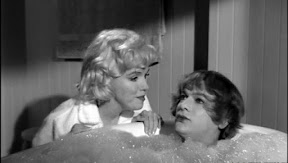
 still feels fresh thanks to the overall fast pace, the men’s hysterically funny near-misses, Monroe’s sultry musical numbers and the oft-quoted, quip-heavy dialogue from
  , for its era,
 described as the “’Frankly, Scarlett, I don’t give a damn,’ of modern comedy.”
 but Monroe's gown still causes jaws to drop in the recent crystal-clear Blu-ray release.