Showing posts with label Billy Wilder. Show all posts

9/27/2019

Blu-ray Review: The Major and the Minor (1942)


Now Available


There's hoping you look younger and then there's hoping you look twelve. And as it turns out, twelve is exactly how old Ginger Rogers — then age thirty — was going for in screenwriter Billy Wilder's American directorial debut, The Major and the Minor.

Tired of being propositioned in one dead end job after another (totaling twenty-five in a single year), and unable to pay the full adult fare for a train ticket home, Rogers loses the makeup, braids her hair, and adjusts her clothes to pass herself off as a child to get the cheaper rate from New York back to Iowa.


Sliding into Ray Milland's private sleeping car when the conductor catches onto her act, Rogers gets more than she bargained for when she begins to fall for the handsome major. Stranded in Indiana after a storm, the Major she calls Uncle Philip brings Susan (Rogers) home to where he's currently working as an instructor at a military academy while waiting to return to active duty.

Though she's stuck living with his fianceé Pamela (Rita Johnson) who grows suspicious of her fiancé's devotion to the startlingly womanly adolescent, the cadets make Susan feel right at home, delighting in her company so much that they actually create a schedule to see who gets to spend time with the "girl" from dawn to dusk.


A May December romantic comedy that plays out under the guise of a Shakespearean style masquerade, while The Major and The Minor has the added risk of what without the pretense would be a love story between an adult and a purported adolescent, the film was a surprising hit at the 1942 box office. Billy Wilder's first time out at bat as a Hollywood director and based upon Edward Childs Carpenter's 1923 play based on the 1921 story by Fannie Kilbourne, Major helped establish some of the main themes and plot devices of mistaken identity that Wilder would revisit throughout his career in films such as Some Like it Hot and Love in the Afternoon.

Playing up their bond as a wholesome uncle-niece or mentor-mentee style relationship while blurring some of the risqué edges in Susan's interactions with the overeager hormonal cadets, while there's absolutely no mistaking Ginger Rogers for a tween, she's utterly dynamite in Major, which was written by Wilder and Charles Brackett with the newly minted Oscar winner in mind.


Responding strongly to the inciting incident at its premise as she'd occasionally posed as a younger child to save fare money as a younger woman when traveling with her mother, in the film that would become one of her personal favorites throughout her career, Rogers stars alongside her real-life mother Lela E. Rogers in a memorable sequence in Major's final act.

Yet where it was Rogers' job to let us in on the joke, Ray Milland nobly avoids the temptation many in his position might've felt to deliver his lines with a wink by instead playing everything on the level. Further lending the work some gravitas, in a role originally intended for Cary Grant that was later spontaneously offered to Milland by Wilder while shouting out of his car at a stoplight, the actor turns in an impressively controlled yet altogether sunny leading man performance.


A great reminder of not only Ginger Rogers' versatility as an actress in all genres beyond musicals but also a fascinating jumping off point from writing to directing by a screenwriter hoping for more control over his scripts, The Major and the Minor has been given a stunningly clear transfer to Blu-ray in this new Arrow release. Arriving shortly after their gorgeous restoration of Hold Back the Dawn, which, like Major, was also penned by Wilder and Brackett, this Arrow edition comes complete with an archival interview with Milland, an hour long radio play with the original leads reprising their roles, as well as a feature length critical commentary, essay, and featurette sure to be of interest to classic film buffs.

Largely overlooked in Wilder's legendary career, The Major and the Minor might be in comparison a minor entry in his enviable filmography but the featherlight romantic comedy still sparkles today, thanks to the jovial turns by its committed leads as well as a trademark Wilder style that's half 1930s screwball and half slightly twisted fairy tale, suitable — Rogers style — for ages twelve and up.


Text ©2019, Film Intuition, LLC; All Rights Reserved. https://www.filmintuition.com Unauthorized Reproduction or Publication Elsewhere is Strictly Prohibited and in violation of the Digital Millennium Copyright Act.  FTC Disclosure: Per standard professional practice, I may have received a review copy or screener link of this title in order to voluntarily decide to evaluate it for my readers, which had no impact whatsoever on whether or not it received a favorable or unfavorable critique. Cookies Notice: This site incorporates tools (including advertiser partners and widgets) that use cookies and may collect some personal information in order to display ads tailored to you etc. Please be advised that neither Film Intuition nor its site owner has any access to this data beyond general site statistics (geographical region etc.) as your privacy is our main concern.

8/05/2019

Blu-ray Review: Hold Back the Dawn (1941)


Stuck in a small Mexican stopover town where the one thing that sets it apart is the fact that it shares a border with the United States, Romanian dancer turned gigolo Georges Iscovescu (Charles Boyer) decides it's time to make a great escape.

Having mapped out a shortcut to the states, Georges opts to seduce his way into American citizenship through a green card marriage to the spinster teacher (played by Olivia de Havilland) he sets out to woo.


Sidelined by car trouble while chaperoning a group of rambunctious boys during a field trip on the fourth of July, the sweet if naive California teacher gets taken in by the smooth talking stranger when he delays her overnight and steers her into a whirlwind romance that ends in a rushed wedding at dawn.

Separated for a few weeks while the papers go through, Emmy Brown (de Havilland) surprises her new husband back in Mexico before he can legally cross the border to end the marriage he orchestrated by filing some papers of his own.

Setting off on a spontaneous road trip, Georges is proof that the fastest way to get to know someone is to travel together as, not too long after they've left, he's startled to find that he's developed a strong attraction to (gasp) his own wife.


Out of respect for perhaps the first woman he doesn't want to love and leave, Georges tries to tamp down his desire by feigning an injury to prevent him from consummating the marriage.

Cranking up the heat, first in a scene where he can't bear to look at Emma perfectly framed in the rear-view mirror, followed by another where — having stripped down and run into the waves — he discovers she's not the schoolmarm he initially thought, Georges realizes he can no longer ignore his heart in Hold Back the Dawn.

Beautifully photographed, the artistry of Oscar nominated cinematographer Leo Tover shines through not only in the aforementioned scenes but also when our leads exchange vows once again in a religious ceremony filled with candles and shadows.


Despite its requisite World War II era flag-waving, Dawn it seems is as romantically optimistic as it is filled with cynical wit. Of course, this tonally sophisticated blend was soon to become a trademark of screenwriter Billy Wilder, who penned the script with Charles Brackett.

Based on Ketti Frings' story, "Memo to a Movie Producer," which later became a novel, while the Hollywood set framing device feels like a bit of a self-serving rah-rah Tinseltown prologue, Wilder and Brackett counter Dawn's protracted artificiality with authenticity, canceling it out in a starkly realistic first act anchored by Boyer's world-weary narration.


A recurring Wilder device, after Boyer used his weight as a star to axe a few scenes helmed by Mitchell Leisen, Hold Back the Dawn became the last script Wilder wrote that he didn't direct. Still, obviously proud of the work, it was Dawn which Wilder shared with Raymond Chandler to give the hard-boiled crime novelist a crash course in crafting screenplays.

It's a timeless film that's timelier than ever today. Boasting an all too important speech about the vital role that new immigrants from all over play in shaping American culture, this border set melodrama takes on added gravitas in 2019 given the Trump administration's xenophobic war on immigrants who have dared to cross the border from Mexico in search of the American dream.


Featuring Paulette Goddard's scene-stealing performance as Georges' dance turned bedroom partner, now that the cover of night has begun to lift on Dawn thanks to Arrow's velvety rich Blu-ray restoration, Mitchell Leisen's overlooked six-time Oscar nominee won't stay hidden for long.


Text ©2019, Film Intuition, LLC; All Rights Reserved. https://www.filmintuition.com Unauthorized Reproduction or Publication Elsewhere is Strictly Prohibited and in violation of the Digital Millennium Copyright Act.  FTC Disclosure: Per standard professional practice, I may have received a review copy or screener link of this title in order to voluntarily decide to evaluate it for my readers, which had no impact whatsoever on whether or not it received a favorable or unfavorable critique. Cookies Notice: This site incorporates tools (including advertiser partners and widgets) that use cookies and may collect some personal information in order to display ads tailored to you etc. Please be advised that neither Film Intuition nor its site owner has any access to this data beyond general site statistics (geographical region etc.) as your privacy is our main concern.

7/21/2011

Blu-ray Review: Some Like It Hot (1959)


Now Available to Own


Mastering every single genre just wasn’t enough for master writer/director Billy Wilder; he wanted to master every one of ‘em in a single picture. And that is exactly what he did throughout his staggeringly successful career, pushing genre conventions to the side to focus on telling human stories – some happy, some sad – and some of Wilder’s best works (such as The Apartment and Love in the Afternoon) were a bit of both, much like life.

Although he managed to help – perhaps accidentally – inspire at least three subgenres of his own as one of American cinema’s unintentional forefathers of firework-banter-filled Film Noir (Double Indemnity), unflinching addiction drama (The Lost Weekend), and sardonic showbiz satire (Sunset Boulevard), in the cinematic world of Billy Wilder, the “story” – not the structure – was the thing and the characters were king.


Needless to say, by the time he began scripting his upcoming ‘59 production alongside longtime collaborator I.A.L. Diamond, Billy Wilder wasn’t going to let a little thing like David O. Selznick telling him, “you cannot combine comedy with murder” stop him from doing just that and more – putting everything and the kitchen sink (character, genre, and plot-wise) – into the Oscar winning classic, Some Like It Hot.


Yet as daring as it was to set the first act of a comedy film against the backdrop of the St. Valentine’s Day Massacre which sends our two musician leads scrambling for new identities and a new location after witnessing the roaring twenties gangland hit, in retrospect, the gunfire in Chicago should’ve been the least of Selznick’s fears about Hot.


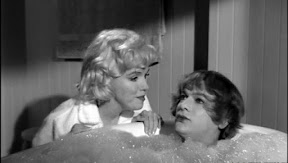
A cross-dressing comedy that’s also a period movie, Jack Lemmon and Tony Curtis ditch the gangsters in favor of drag, seeking solace in stockings as female imposters hiding out in a Florida resort as part of an all-girl band.


And although it opens like an action flick, once George Raft’s gun and grit are replaced by the giggles and gams of Marilyn Monroe, Hot gets a lot of mileage out of double-entendre banter, segueing into a mistaken-identity road movie fueled by flirtatious, freewheeling fun.

Of course predictably, their charade catches up with them to farcical effect when Raft’s Capone-like ‘Spats’ Columbo and his wiseguy cronies head south for winter and find themselves at the exact same resort (with California’s Hotel Del Coronado standing in for the Florida location).


However what was in fact based on a ’51 German remake of a ’35 French film and could’ve also turned into a stagey update of the British classic play Charley’s Aunt still feels fresh thanks to the overall fast pace, the men’s hysterically funny near-misses, Monroe’s sultry musical numbers and the oft-quoted, quip-heavy dialogue from Hot's legendary scribes.

While it isn’t as eye-opening as Tootsie, for its era, Hot effectively plays against gender roles and sexual stereotypes to rather ingenious effect, particularly when Tony Curtis forms a Cary Grant-inspired impotent alter-ego and in a particularly inspired creative twist manages to inspire Monroe to seduce him.


Still, in a priceless romantic subplot that “mirrors” the main one (as if using a carnival funhouse mirror to go for far more daring, subversive-for-the-time laughs), Lemmon and former silent film star Joe E. Brown easily steal the picture away from the rest.

And even though Wilder’s moviemaking career was filled with superlative movie-closing lines, Some Like It Hot sends ‘em screaming in the aisles and out the door, thanks to Brown’s pitch-perfect delivery of the “[I.A.L.] Diamond throwaway” final film line that Cameron Crowe described as the “’Frankly, Scarlett, I don’t give a damn,’ of modern comedy.”


But as scandalous as it was for the subject matter, which found Hot condemned by the Roman Catholic Church’s National Legion of Decency and screened without being approved by the MPAA, it was a cinematic gamble as well, given that due to the green effect of the men’s makeup the film was shot in black-and-white and released in the era of lush Cinemascope, VistaVision, and Technicolor.

Yet while the shadowy cinematography helped soften the makeup lines needed for us to suspend-our-disbelief just enough to "buy" Lemmon and Curtis as men in drag pulled off successfully enough to fool the women onscreen, the smoldering effect that the black-and-white visuals had on Marilyn Monroe caused the screen goddess to sizzle even Hotter.

Oscar winning costume designer Orry-Kelly's nearly-nude, bosom-accentuating, curve-clinging transparent little black dress (along with its flesh-toned twin that photographs nearly white) may not have been as scandalous as the siren's oft-cited skirt-flying subway grate shot captured in Wilder's Seven Year Itch but Monroe's gown still causes jaws to drop in the recent crystal-clear Blu-ray release.


Infectiously entertaining yet impossible to define as a work of any one specific type, although it was named the single greatest American comedy movie of all time by the AFI, upon closer inspection, even that label limits the scope of the film as anything other than a Billy Wilder movie and therefore of its own one-and-only kind.

Some Like It History:
Arthur Miller on Marilyn Monroe*


“Everything she did, she played realistically. I don’t think she knew any other way to play anything – only to tell you the truth. She was always psychologically committed to that person as a person, no matter what the hell it was, rather than as a stock figure. Because the parts she got could easily have been stock figures, which had no other dimension…”

“I thought she had the potential for being a great performer if she were given the right stuff to do. And if you look at the stuff she did do, it’s amazing that she created any impression at all because most of it was very primitive. And the fact that people remember these parts from these films is amazing... She was committed to these parts as though they were real people, not cardboard cutouts.


"Even though the director and author and the rest might have thought they were cutouts and would deal with them that way. The way the two men [Tony Curtis, Jack Lemmon] in Some Like It Hot[1959] felt with their parts; or George Raft with his part. She was real. And therefore she had the potential of being a great comedienne…”

*As Quoted in the “Marilyn Monroe” chapter of Who the Hell’s In It by author Peter Bogdanovich in the 2005 Ballantine Books Trade Paperback Edition of his ’04 work.


Text ©2011, Film Intuition, LLC; All Rights Reserved. http://www.filmintuition.com Unauthorized Reproduction or Publication Elsewhere is Strictly Prohibited and in violation of the Digital Millennium Copyright Act.  
FTC Disclosure: Per standard professional practice, I received a review copy of this title in order to evaluate it for my readers, which had no impact whatsoever on whether or not it received a favorable or unfavorable critique.

12/01/2008

Film Intuition Poll: Billy Wilder's Masterpieces -- The Results

I think it's safe to say that-- given the overwhelming number of diverse classics from which readers selected in pinpointing Billy Wilder's "masterpiece"-- there was no limit to what Wilder could do as a filmmaker.

But how did he do manage to make such a wonderful body of work which topped every single genre? Was it magic? An undeniable gift for creativity? The constant drive to challenge himself from one "picture" to the next?

Perhaps it's all of the above but before we get into the results, here's a little something from Mr. Billy Wilder himself that perhaps gives us a small insight into that genius for filmmaking, which we still celebrate many, many decades later. Or, if not that-- than at the very least words that celebrate his love for writing, craftsmanship, and how to best engage an audience.

From Conversations With Wilder
by Cameron Crowe
(pg. 357)


Wilder's Tips for Writers


1) The audience is fickle.
2) Grab 'em by the throat and never let 'em go.
3) Develop a clean line of action for your leading character.
4) Know where you're going.
5) The more subtle and elegant you are in hiding your plot points, the better you are as a writer.
6) If you have a problem with the third act, the real problem is in the first act.
7) A tip from Lubitsch: Let the audience add up two plus two. They'll love you forever.
8) In doing voice-overs, be careful not to describe what the audience already sees. Add to what they are seeing.
9) The event that occurs at the second-act curtain triggers the end of the movie.
10) The third act must build, build, build in tempo and action until the last event, and then--
11) --that's it. Don't hang around.

So to heed his advice, I'm not hanging around-- here you go:


Billy Wilder's "Masterpieces"
As Determined By Film Intuition Readers


Digg!


1) Double Indemnity

2) Sunset Boulevard

3) TIE: The Apartment; Some Like it Hot

4) The Lost Weekend

5) Love in the Afternoon

6) TIE: The Seven Year Itch; Stalag 17; Witness for the Prosecution

11/21/2008

DVD Review: Sunset Boulevard (1950) -- The Paramount Centennial Collection


Available in a Deluxe 2-Disc Collectible DVD Set
From the Paramount Centennial Collection


Digg!

"This Billy Wilder should be sent back to Germany!
He bites the hand that feeds him!"
- Studio Executive Louis B. Mayer, following Sunset's premiere

"I am Mr. Wilder and why don't you go f**k yourself!"
- Billy Wilder, upon hearing Mayer's comment*

*As quoted from Cameron Crowe's Conversations With Wilder
(pg. 341)

In editors David Thompson and Ian Christie's Scorsese on Scorsese-- referring to a conversation he had with Joe Pesci-- the Oscar winning director notes, "John Ford made Westerns. We make street movies. Let's do that," (pg. 146). And while of course, Martin Scorsese has gone on to do so many other things by exploring comedies, epics, biopics, and even musicals-- like most directors, he's arguably at his best when working with a subject or genre that comes directly from his core. And this is not a singular case as it seems to be a recurring tale for countless directors as nobody crafts a grand scale epic like Ridley Scott, an urban night-filled masterpiece like Michael Mann, or a psychological comedy like Woody Allen.

However, when it comes to trying to define the career of Billy Wilder, I'm not only stumped but in awe. Currently the subject of our latest Film Intuition poll asking you guys to select the filmmaker's masterpiece-- just looking over a majority of titles from Double Indemnity to The Lost Weekend to Sunset Boulevard to Some Like It Hot and Stalag 17-- there isn't a genre he hasn't explored and (in the same turn) mastered.
Is there a greater film noir than Double Indemnity, for example or a funnier cross-dressing picture than Some Like It Hot? A more bittersweet romantic comedy than The Apartment? I'd be hard pressed to find one and on the new gorgeous restoration of his 1950 classic Sunset Boulevard, released as title number 1 in Paramount's newly launched 2-disc DVD sets which comprise their Centennial Collection, one interviewee even goes as far as to joke that Billy Wilder made the greatest movie ever made in every single genre.

While of course, it's an overstatement, just glancing through his credits, one realizes that cinematically he was pretty close to perfection, even when some of his pictures went off course. And certainly there are threads running throughout his films that link together characters and themes that echo one another throughout, but he enjoyed challenging himself with innovative shots and ideas that one doesn't normally think about when the phrase a "Billy Wilder film" is uttered. Mostly it's the lines people remember like "shut up and deal," from The Apartment, or Sunset's "I'm still big, it's the pictures that got small," or "Nobody's perfect" from the end of Some Like It Hot and while upon first, second, and even a third viewing, you find it hard to look past the dynamic presence that is Gloria Swanson as Norma Desmond in Sunset Boulevard (nearly realizing as an afterthought just how incredible William Holden was in that brave and frankly equally reprehensible role), watching it again in its epic glory, I was blown away by some of the breathtaking shots and epic photographic demands being placed on cinematographer John F. Seitz (Double Indemnity, The Lost Weekend).

Consider how incredibly difficult the film's opening shots would've been to construct in that era as we meet our narrator-- the unlucky dead screenwriter (a joke referenced to in Altman's The Player given the industry's lack of respect for their scribes) Joe Gillis (William Holden), floating eerily still, killed by gunfire in the pool of Norma Desmond. And of course, this is before the film goes even further back into the past when the writer is alive and well, hiding out from creditors and those he's indebted to by punching his typewriter keys in a lonely, stale apartment that the camera swoops up into, blowing perfectly past a drape in a great reveal of the writer at work.

Always wild about voice-over narration since according to the DVD's featurette "Sunset Boulevard: The Beginning," it allowed Wilder the chance to unload all of the exposition quickly to delve into the story and also as a satirist, giving him the opportunity to comment on the goings-on-- the film deceptively sets itself up to be about Holden. After all, he's our main character who, unable to sell his recent screenplay seems to have hit rock bottom when he loses an agent in quick succession just before a tire blowout. Yet when the stranded motorist steps inside the nearest mansion on the boulevard, nothing could've prepared either him or the audience for Norma Desmond (Gloria Swanson).

An aging silent movie star who lives like a near recluse, awaiting a call that will never come from Mr. DeMille to get back into the pictures, reading stacks of fan mail, and working on a bloated melodramatic interpretation of Salome-- Desmond first mistakes Gillis for the man who has come to bury her beloved dead chimpanzee but upon discovering his true profession and after he manipulates her for a handout, hires him to do a script rewrite. Of course, instead of a simple doctoring of the work he could hammer out in a day, Desmond settles his debts and asks her trusted butler (Erich Von Stroheim) to move in all of his belongings. Soon the line blurs between the two as he turns into her favorite paid boy toy when Holden crosses ethical boundaries and allows himself to become her own gigolo.

A writer whoring themselves out for work is of course, not a new idea in Hollywood as we hear plenty of tales of artists just "in it for the money" whether it's starring in a cheesy comedy or brainless blockbuster but Sunset Boulevard seems to work on a number of levels. It's as filled with irony and backstabbing as its main competition that year and winner of the Best Picture Oscar, the excellent All About Eve (which again displays a remarkably dark side of show business except this time in the theatre), it's a film that seems to change with each viewing.

On one level Sunset could be labeled a campy horror film, as "operatic" as the Broadway musical, a Hollywood slice of film noir, a dark comedy, a strange ode to the unpredictability of Tinsletown as fame and "another picture" can show up in a number of ways as well as a another cautionary tale about people who try to step over others opportunistically as every character-- even the wholesome writer (Nancy Olson)-- is always scheming on some level. Yet, whichever way you view it, it compels you in such a way that although it's Hollywood he is analyzing, one can see the way that the film holds up today in not just reflecting the eternal battles of deciding whether or not to compromise yourself to make a living (whether artistically, ethically, etc.), negotiating and finding a balance with others, and fighting to get back "up" once you've been downsized, let-go, or are no longer the box office draw you were decades earlier.

Admittedly, a risky film for Wilder to make as even he told Crowe that he "wanted to make things a little harder for myself... to do that thing which never quite works-- a picture about Hollywood," (pg. 47) the film was especially daring in the amount of insider details, lines and situations that hit a little too close to home, and aspiring cinema scholars will relish in the amount of in-depth information available in the 2-disc set from a feature length commentary by On Sunset Boulevard: The Life and Times of Billy Wilder author Ed Sikov on the first disc or the fifteen additional featurettes on the second disc of bonus material.

With rare interview footage featuring its star Gloria Swanson and a look back at every aspect of the film from the score to the location map, a profile on acclaimed costume designer Edith Head, insider details by scholars, media experts, and those involved (including numerous sharp observations by Nancy Olson), a portrait of William Holden that makes a nice companion piece to a thirty minute featurette on the Centennial disc for Sabrina, and more, there's enough food for thought to enrich your viewing experience several times over.

Finally a version of Boulevard that's ready for its close-up in your home DVD library, it's an ultimate celebration of a unique film that one realizes painfully would never be made in quite the same way today (if it were greenlit at all), yet one in which the references and incessant homage show up again and again throughout our culture... much like a majority of other films from the endlessly versatile, label-transcending, and surprising chameleon, Mr. Billy Wilder.