Showing posts with label Patton Oswalt. Show all posts

10/22/2019

TV on DVD Review: Veronica Mars (2019) - Season 1 (aka Season 4)


Now Available


(Ad) 


(FTC Notice: Warner Bros. Home Entertainment provided me with a free copy of the DVD I reviewed in this blog post. The opinions I share are my own.)

Returning to the small screen once again after releasing a fan-funded feature film of the cult favorite series back in 2014 (along with two spin-off novels), upon first glance, the 2019 incarnation of Veronica Mars looks a lot like the original CW series which ran for three seasons in the early aughts. But the further we get into creator Rob Thomas' new eight episode trip to Mars on Hulu, the more we realize that although Veronica might be set once again in the perpetually sunny fictional southern California town of Neptune, the tone of this update is leaner, meaner, and certainly far more noir than it ever was before.

Reflected in the new cover of the theme song, "We Used to Be Friends," sung this time around not by The Dandy Warhols but rather Chrissie Hynde of The Pretenders, the tune we used to know is achier, harder, darker, and lonelier than the tongue-in-cheek original. And played once again by the one and only Kristen Bell, those are all words you could use to describe her titular character Veronica Mars this season as well. At one point asked in earnest if she had been mad after losing her best friend Lilly Kane to murder as a teen, Veronica matter-of-factly replies that she is still mad in a way that says more about her outlook on life than an entire season could.


Most at home in the apartment she shares with Logan (Jason Dorhing), when the Naval intelligence officer isn't off saving the world that is, Veronica's second happy place is the office she shares with her beloved father, Keith (Enrico Colantoni). A sardonic twenty-first century So-Cal noir version of Nancy and Carson Drew, Veronica might have earned a law degree after high school but she pushed that off to the side to instead pick up a license to work alongside her dad at Mars Investigations as a private eye.

Done moonlighting as a detective the way she did when she was back in high school on the UPN turned CW series, now ten years later, she's made it legal as well as official. And it turns out it's just in time for more chaos as —  early into what she calls the month long bacchanalia that is Spring Break in Neptune — a mad bomber has decided to join in the fun while taking out four people at the spectacularly busy Sea Sprite motel in the process.

With Daniel Maloof (Mido Hamada), an up-and-coming congressman hiring Veronica and Keith Mars to figure out who's behind the bombings that maimed his younger brother and murdered his fiance, Veronica finds herself at the center of an incredibly complex case which encompasses all eight episodes of the new season.


Not the only person trying to ID the perpetrator, it seems that bombing survivor and true crime obsessive pizza deliveryman Penn Epner (outstandingly played by Patton Oswalt) is trying to do the exact same thing, as are two hitmen from a Mexican cartel (Clifton Collins Jr. and Frank Gallegos) who've come to take out the person who murdered the nephew of their boss' ex-wife.

Taking a cue from True Grit, complete with a precocious protagonist who shares the same name as the young western heroine from the novel and subsequent film adaptations, as well as her tragic origin story that sets her on her dangerous quest, we meet Matty Ross (nicely brought to life by Izabela Vidovic). Having lost her father in the Sea Sprite bombing, the teenager teams up with Penn — whose online true crime group of "Murderheads" see conspiracy everywhere — along with Veronica and Keith.

A clever way to payoff on the original conceit of the series back in its 2004 launch as a whipsmart teen who — having faced overwhelming misfortune — tries to take control of her life and right some wrongs, Matty's character reminds us of teenage Veronica's strength as a rape survivor longing to find her best friend's killer. As such, the introduction of Matty would itself make for a cool cyclical callback if this was indeed the final season of the series. However, with the advent of so much male dominated TV noir in the 2010s, I cannot stress how refreshing it is to have the feminist Mars back and I certainly hope that it continues.


Rounding out the series' emphasis on badass heroines, small screen MVP Kirby Howell-Baptiste of Killing Eve and Barry, among others, reunites with her co-star from The Good Place, Kristen Bell in a triumphant turn as Nicole, the owner of popular spring bar and/or meat market Comrade Quacks, who befriends Veronica while trying to stave off the push to gentrify Neptune.

Leading the fight on the opposing side is the father of Logan's best friend, Big Dick Casablancas (David Starzyk), who has returned home from jail with a new right hand man in Clyde (the always phenomenal J.K. Simmons) and a mission to buy up properties from struggling Neptune business owners in order to make a future killing.

With no shortage of new characters to investigate, many of our original favorites — including most of the male supporting players, such as Percy Daggs III's Wallace Fennel — find themselves shortchanged by comparison. Yet, although this season is primarily concerned with the plights of both father and daughter Mars, even those two protagonists take a backseat to the main mystery which connects them all and leads Veronica down a twisty, unpredictable path of red herrings and potential leads, including some with links to people from her past.


While humorous bit players like Ken Marino's Vinnie Van Lowe make appearances, the series also welcomes back two of my favorite charismatic supporting characters in the form of PCH biker gang member Eli "Weevil" Navarro (played by Francis Capra) as well as Veronica's former love interest Leo D'Amato (Max Greenfield), who's now working for the FBI.

The new season might begin slowly by reveling too much in the hedonism of spring break but thankfully, by the time we reach the far more noirish second episode, Veronica Mars completely sucks us in. At its best when it devotes itself to the increasingly complicated mystery rather than the comically idiotic beach scene, Thomas struggles to combine the dueling approaches early on. And this narrative unease definitely shows as we weave our way from predatory guys at Comrade Quacks to various groups of spring breakers at the Sea Sprite before the bomb goes off in depictions that feel less suited to a late twenty-something Veronica Mars mystery and more befitting of the character in her high school years.

Testing viewer patience while simultaneously introducing us to individuals who might become more important as the story moves on, while it doesn't do much to help in Rob Thomas' stated goal of moving the series away from its roots as a teen soap opera in order to become a full blown detective show, thankfully, Mars evolves into something closer to the latter as it moves on. Still not forgetting the human side, the series deftly balances out Veronica's inner struggle to put her anger and fear aside to perhaps marry the man she loves, while also worrying about her aging father who's begun to struggle with serious memory loss that he fears might put their lives on the line.


Anchored by strong performances by its cast — especially Bell whose Veronica seems to be even more hardened than she was before — 2019's Veronica Mars is a different and more contemplative spin on the original wisecracking teen detective series. Enhanced by its more cinematic approach, from a sexier reunion of Logan and Veronica (or "LoVe") as the two make love in the first episode followed by a tense, film-worthy shootout in the woods between Veronica and Keith versus the cartel several installments later, when Veronica leans into both its more mature handling as well as its terrain, we are eager as ever to follow.

Ending with an admitted deus ex machina for one character that — thanks to the devastating fate of another — is easier to forgive by comparison, Thomas and company's risky decisions go a long way in helping to propel Veronica Mars down a new path that you can foresee paying off in a potential new season.

Growing far more compelling as the season continues — while still indulging in gallows humor — this grittier incarnation of Mars underwhelmed me at first with its frat party atmosphere before soon becoming so engrossing that I found myself needing to binge watch the final three episodes back-to-back-to-back.


Though best known for its dialogue, Veronica Mars Season 4 (as it was originally billed and/or Season 1 as the DVD dubs it) has as much fun reintroducing us to old supporting players as it does setting the stage for epic action. From meeting our cartel hitman as they listen to Elvis and discuss philosophy as someone bangs for help in their trunk to a Pulp Fiction reminiscent sequence where one character reaches for and considers one weapon after another before opting for a final selection, it makes for one intensely nerve-wracking trip to Mars. With quite the knotty case to unravel over the course of eight hours, although it takes awhile to get going, Veronica Mars season 4 (or 1, depending upon your preference) marks an overall thrilling return to the small screen for one of my favorite television detectives.

As flawed as she is heroic, admittedly it's hard to see Veronica tune out Wallace or be turned on by some of Logan's most self-destructive characteristics in the first half of the new episodes when she's frustrated and/or preoccupied by a case. At the same time, however, it fits our protagonist to a T because of all the trauma that Veronica went through as a teen (and with that version of Logan before he channeled his hypermasculine behavior towards the military). Veronica gets her strength from everything she's endured, after all, which is what makes her the first in line to put everything on the line to seek out the truth and do what's right. And while this season adds a harrowing new tragedy to her life, which has predictably divided fans — including some of whom say they might not watch the series again — Thomas and his co-writers have to be applauded for their commitment to story over solely giving in to what's expected.


While I was initially unprepared for the shock to come until the seventh episode, when it started to telegraph the tragedy a little more openly, watching the season a second time in order to review it, I began to see just how smartly series writers began to drop clues as to where it was ultimately headed as early as the very first episode. Appreciating the way they foreshadowed the jaw-dropping turn of events while also pushing Veronica throughout the season to contemplate her role in Neptune as well as her overall future, it became easier to see what the writers had in store this time around and evaluate it from a narrative perspective . . . while still being heartbroken about "____," of course. Forcing her and us to consider whether or not she's just coasting and undervaluing her talents in Neptune as opposed to taking a cue from Logan and exploring the world beyond her surroundings, this season gives us a lot to think about.

Yet as daring as it might appear to be for Thomas to take such a massive risk, upon closer reflection, this move is completely on par with the shocks of Mars' first two stellar seasons. In spite of our easily nostalgic view of the series while looking back on it with rose colored glasses, Veronica Mars was never the TV equivalent of Gilmore Girls style comfort food. No, instead, just as it was in its 2004 debut, the recently relaunched Mars remains a tough series about an underdog heroine who's made stopping misogynistic rapists, killers, and villains her special mission for life. Rather than just punch them out with a sap glove a la Nicole or tase them as she does a mugger she winds up mugging in return, Veronica puts in the diligent, dangerous work so that eventually, the truth will out. As the song says, "a long time ago, we used to be friends," and it's so good to watch her continue this fight once again. Gifting longtime "marshmallows" with a compelling work of feminist small screen California noir, needless to say, with a season like this to springboard from, I look forward to seeing where in the world Mars will take Neptune's finest private eye next.


Text ©2019, Film Intuition, LLC; All Rights Reserved. https://www.filmintuition.com Unauthorized Reproduction or Publication Elsewhere is Strictly Prohibited and in violation of the Digital Millennium Copyright Act. FTC Disclosure: Per standard professional practice, I may have received a review copy or screener link of this title in order to voluntarily decide to evaluate it for my readers, which had no impact whatsoever on whether or not it received a favorable or unfavorable critique.  Also, as an Amazon Associate, I earn from qualifying purchases made off my site through ad links.  Cookies Notice: This site incorporates tools (including advertiser partners and widgets) that use cookies and may collect some personal information in order to display ads tailored to you etc. Please be advised that neither Film Intuition nor its site owner has any access to this data beyond general site statistics (geographical region etc.) as your privacy is our main concern.

4/29/2014

Blu-ray Review: The Secret Life of Walter Mitty (2013)


Now Available to Own   

  Photo Slideshow   


As a freewheeling celebration of the limitless potential and life-altering power of the imagination, director Ben Stiller’s remake of the classic 1947 eponymous film (adapted from the original story by James Thurber) is one of the most stunningly creative works to come out of the Hollywood studio system since Stranger Than Fiction.

Sublimely lensed by the cinematographer of The Piano (Stuart Dryburgh) with incredible special effects by Soho VFX, The Secret Life of Walter Mitty, which languished in development hell and passed from one helmer to the next for roughly twenty years found its ultimate storytelling team in the form of Pursuit of Happyness scripter Steve Conrad and a top-of-his-game Stiller.

Building off what he’s learned and explored onscreen in his own twenty year directorial career, Stiller crafts what is his most truly cinematic work to date.


A triumph that was lost in the over-crowded shuffle of too many Oscar-bait films filling the multiplexes alongside blockbusters raking in dough during the holiday moviegoing season, Mitty is an underrated dazzler that‘s sure to gain a larger fanbase on this gorgeous Blu-ray disc.

The type of film that plays that much better the second time around, Mitty is especially satisfying to discuss with others while dissecting just how intricately Stiller, Conrad and company managed to weave together so many seemingly disparate threads to craft such a beautiful, humanistic tapestry.


Walking a fine balance between a wholesome old fashioned approach both in the structure and characterization with some truly audacious techniques that (while risky) pay off in a big way, Stiller elevates the deceptively simple story in which he also stars.

As the titular Life Magazine photo department employee, Stiller’s head-in-the-clouds Walter Mitty finds himself actually embarking on the type of adventures he usually only dreams about, urged on by his crush on a lovely coworker (played by Kristen Wiig).


While the heroic journey storyline is often utilized, because Walter is a character who lives out elaborate fantasies in his mind – forever imagining he had the guts to say what he wants or live like he does in his dreams) Stiller uses a bold magical realism laced approach of expressionist filmmaking where for example we’re given the ability to see the things he usually only imagines come to life.

As he gradually dares himself to act as the film continues, Walter’s real life becomes far more extraordinary than his wildest daydream as evidenced by the way he sees Wiig’s face cheering him on at different points along the way including a staggering sequence wherein she sings “Ground Control to Major Tom” and it results into a big veritable leap of faith for Walter.


That leap of faith comes at a pivotal moment, taking the viewer along for the ride as we realize that the more he participates in life, the more we discover that every daydream he’s had foreshadows something that will pay off later in an unexpected way.

Paying homage to the world of mysteries with various clues that help reveal the larger truth – acknowledged aloud first by Wiig when she gives Walter (and by extension us) key wisdom learned in her mystery writing class – Mitty is a marvel.


Using creative storytelling to the absolute fullest and transcending its rigid scripted confines to make a much more layered work, The Secret Life of Walter Mitty should appeal to those who responded to the same blend of old and new, visual and written spinning of a good yarn on display in everything from Amelie to Eternal Sunshine to the Spotless Mind.

A wholly satisfying picture that marks his most inventive work thus far, with Walter Mitty Ben Stiller has done the unthinkable; he’s turned a studio remake into a big budget art movie with multigenerational, universal appeal.

Bookmark and Share

Text ©2014, Film Intuition, LLC; All Rights Reserved. http://www.filmintuition.com Unauthorized Reproduction or Publication Elsewhere is Strictly Prohibited and in violation of the Digital Millennium Copyright Act.  FTC Disclosure: Per standard professional practice, I may have received a review copy of this title in order to evaluate it for my readers, which had no impact whatsoever on whether or not it received a favorable or unfavorable critique.

8/27/2009

Movie Review: Big Fan (2009)


Now Available to Own


Photo Slideshow


View the Trailer


Delicious
Bookmark this on Delicious
submit to reddit
Print Page

Digg!

MovieBlips: vote it up!

Paul Aufiero is a man who desperately wants to be heard. Yet similar to individuals who pretend to listen in conversations while in fact waiting to speak, Paul Aufiero doesn't really care if anyone listens or connects with him in the scheme of things. Likewise, the fact that he chooses sports talk radio as his soapbox and an anonymous moniker of "Paul from Staten Island" is at once both extremely revealing and completely inconsequential.

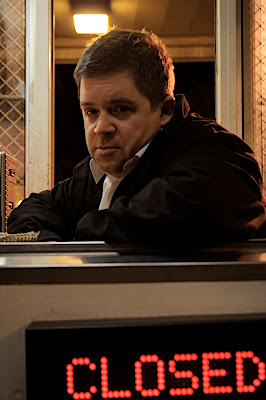
The anonymity is superfluous since Paul Aufiero is basically anonymous in his day-to-day life when the film begins, working in a toll-booth where wealthy creeps in luxury vehicles complain about a five dollar fee before condescendingly joking for him to have fun in his box.


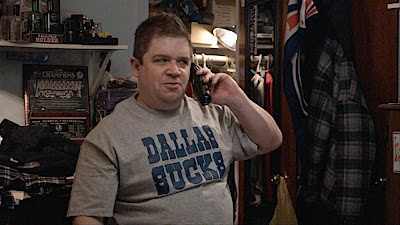
Moreover, even when Paul is literally out of the box, he decides to box himself in as soon as he gets off work by closing the door of his bedroom and delivering the cliche filled speeches he's carefully written out on notebook paper to anyone who happens to be tuning into the local AM sports radio station at two a.m.

While this habit impresses his loyal friend and fellow obsessive devotee of the New York Giants, it keeps his elderly mother on the other side of the wall awake as she and his siblings constantly ask him when he's going to attempt to get a real job, plant roots, and grow out of the fan phase.

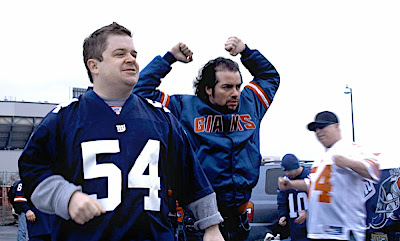
However, the ritual of the unquestionable pledge of allegiance to his team just serves to feed Paul's needs more than anything else to the point where he and his friend drive to the Giants stadium whenever there's a home game to hook their television up to their automobile and watch it from the parking lot.

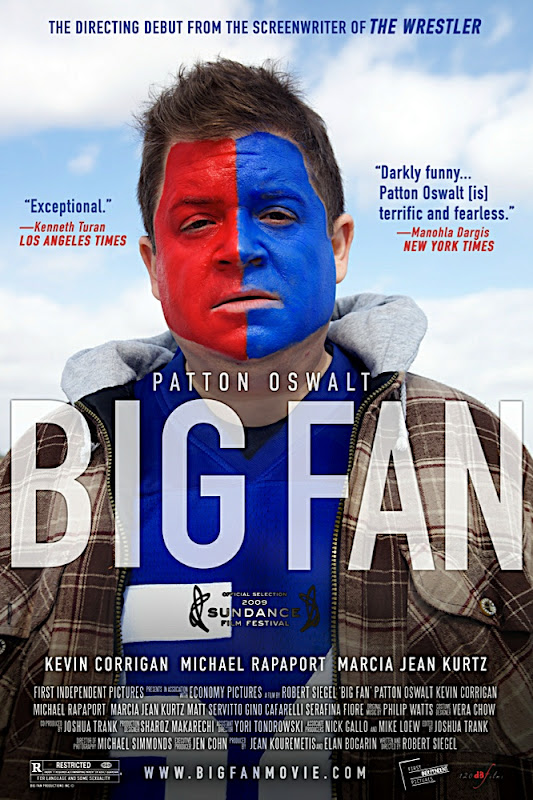
And ultimately while we in turn watch Wrestler screenwriter Robert Siegel's Sundance Film Festival Grand Jury Prize nominated work, we discover that football is beside the point in this cleverly existential indie which seems to have firm roots in what Taxi Driver and Raging Bull screenwriter Paul Schrader once described as "lonely man" cinema.


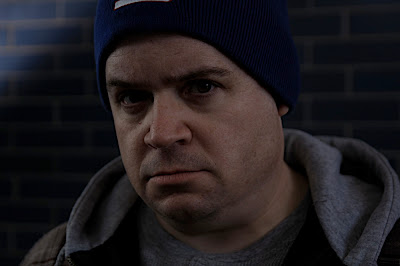
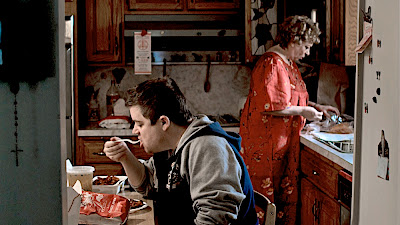
For indeed, in Patton Oswalt's heartbreakingly subtle yet delicately funny humanistic performance as Paul, it's understood that perhaps what our lead clings to more than the Giants or his favorite quarterback (whose poster is hung right by his pillow) is the need to believe in something else. As in engaging in irrational belief, by extension he can then believe in himself... even if it is only for the few precious moments he's granted air time on local radio.


Unwilling to evaluate his irrational dedication to the team since it would then make him have to question himself as well, after Paul comes face to face with the man in his poster and events take an unexpectedly nasty turn, Paul is tested for the rest of the film's total eighty-five minute running time as to just how far his role as a "big fan" will go.


Thrust into the spotlight, Paul is no longer able to just revel in his anonymity and control his own actions on the radio when he's then confronted by family and strangers to act on what has happened to him.


While it's easy to write off the film as being only of interest for sports nuts or football fans, as Siegel admitted to IndieWire, he's first and foremost a fan of Scorsese and '70s antihero works where change is never artificial as he revealed, "My favorite movie genre is gritty, funny, entertaining character studies about loner-misfit types who live in Queens or some other outer borough of New York."


And sure enough when you replace football with any topic as Oswalt shared with The Onion, the film can apply to anyone. To this reviewer, it transformed into an allegory of obsessive behavior and the danger of tunnel vision as repeatedly Paul proves his commitment to his role as a "big fan." Likewise, as a big fan of the aforementioned filmmakers, in his feature filmmaking debut as a director, Siegel who taught himself the nuts and bolts of the cinematic process from Filmmaking for Dummies remains obsessively compelled to the truth and humanity of his '70s inspired screenplay.


A stronger work than Wrestler since it's one that doesn't really follow a traditional three act paradigm by instead consisting of one major plot point (which has been shared far too carelessly in the trailer and numerous reviews), in the end its success is in our complete belief in Paul as a three dimensional human being which is as much of a credit to Siegel as it is to Oswalt.


While it's a film that's sure to frustrate those wanting a more elaborate revenge scenario to occur since there's a pretty heavy Taxi Driver influence running throughout which is even evidenced in the trailer, Siegel never lets you forget that the film is first and foremost one centering on a man who just wants to be heard.

Although it's a basic need that's shared by all of us and one we manage to find endless outlets for in our daily lives in hopefully much healthier ways, in Siegel's movie, you have to dig beyond just the face paint and the jerseys to understand it's about the true heart beating beneath this particular fan onscreen.


Ultimately the tragedy of Paul is that he is only comfortable when he can share something with strangers for two minutes or pin his hopes on more strangers on the field. Furthermore by espousing his own ridiculous dogma, we come to realize that he must believe that by never wavering, he will then have proven to himself that he is here, he is alive and that therefore he matters.

And it's this idea in itself which makes Big Fan seem to move way beyond the arena of football to become a commentary of the times in which we're living. Indeed, despite having more opportunities than just the radio in which to interact, surely every single one of us has felt like an anonymous man in a box at one time or another just wanting to be heard, thereby making Siegel's sleeper film cut a little deeper emotionally than the literal sharp implements utilized in Darren Aronofsky's impressive Wrestler.

Patton Oswalt


Text ©2009, Film Intuition, LLC; All Rights Reserved. http://www.filmintuition.com
Unauthorized Reproduction or Publication Elsewhere is Strictly Prohibited.

9/26/2008

All Roads Lead Home (2008)


Digg!

Director: Dennis Fallon

Although the poster made it look like Flicka 2 with its depiction of a young girl and a beautiful horse, quickly we realized that instead of a contemporary pop friendly soundtrack of girl power songs and Tim McGraw, we have a rather somber tale of a grieving child and a dog named Atticus with plenty of references to Harper Lee’s beloved To Kill a Mockingbird.

And although like My Dog Skip, director Dennis Fallon and writer Douglas Delaney’s International Family Film Festival winner All Roads Lead Home is based on a true story, yet Roads is comprised of the thematically unlikely and none too family friendly storyline about euthanasia and no kill shelters. And far more unsettling, Fallon’s work from Waldo West which aspires to be a “feel-good” drama about euthanasia comes with the ultimate moral that sometimes for animals and humans alike, it’s best to just pull the plug-- but only when absolutely necessary.

While of course, it’s hard to disagree, the well-intentioned but off-putting film begins nicely but in its final act evolves into something far too upsetting for its target audience as we learn the brutal truth surrounding the death of the mother of our twelve year old heroine Belle Lawlor (Vivien Cardone) who perishes in a vehicle accident shortly into the film.

Exquisite cinematography and a nice old-fashioned feel help move the film along in its TV movie like approach as Belle, still coming to grips with the horrific event two years later, has begun growing apathetic in her studies. After a bold prank finds Belle releasing dogs from the pound in order to save them from death, her father-- an animal control officer himself with similar convictions-- decides that it may be best to leave Belle in the care of her cantankerous, hardworking, cowboy grandfather Hank Banyon (Peter Coyote) for an “attitude adjustment.”

However, little does Belle realize that her father Cody (Jason London) is also prone to bending the rules, renting out rooms at Peter Boyle’s old, dilapidated Sky Line Hotel along with other sensitive animal workers like Milo (Patton Oswalt) and a beautiful vet, as they sneak in a “convention of critters” in their own version of a no-kill shelter. As Belle struggles with hard labor and learning the way of life at Banyon Farms, she begins openly questioning the decisions of the workers when it comes to getting rid of weaker members of the litter of pups and has a hard time adjusting to her grandfather’s abrasive personality.

Predictably, the mourning Hank begins to melt, although it takes time when he’s constantly confronted with a living and breathing reminder of his daughter in the pretty, independent minded Belle and we realize that all relatives involved (from Belle to Cody to Hank) need their own time and space to heal on their own terms. And while it’s indeed refreshing to see a film about a grandfather and his granddaughter (since most family films are sort of gender divided as a boy comes of age with his male hero or vice versa), as an adult who even had a problem with some of the content and situations being addressed in this admirable but far too frank message movie, I wondered if children would also be a bit too bothered by its approach and subject matter. Probably best to be previewed by a parent before bringing along the children and also maybe better suited for the PG-13 and up crowd, it’s a high quality if overly long film that is especially memorable considering that it contains the last filmed performance by actor Peter Boyle, to whom the film is dedicated.