
Showing posts with label Medical Issues. Show all posts

6/12/2009

Film Movement DVD Review: In Love We Trust (2007)


Now Available on DVD


Join Film Movement

Film Movement, LLC

Or Rent it From Netflix


Netflix, Inc.


A.K.A. Left Right

With the international success of his Berlin Film Festival award-winning film Beijing Bicycle which was inspired by Vittorio De Sica's 1948 Italian neorealist classic The Bicycle Thieves-- writer/director Xiaoshuai Wang (or Wang Xiaoshuai) became an exciting filmmaker to watch as his next two follow-up features Drifters and Shanghai Dreams screened competitively at the Cannes Film Festival where the latter received the festival's Prix du Jury award.


With Drifters having already been selected for inclusion in America's prestigious DVD-of-the-Month Club Film Movement, the decision to bring another one of the director's works to viewers around the globe not only spoke highly of the organization's confidence in the filmmaker but also further proof that Wang Xiaoshuai is committed to developing quality works that speak to a universal audience.
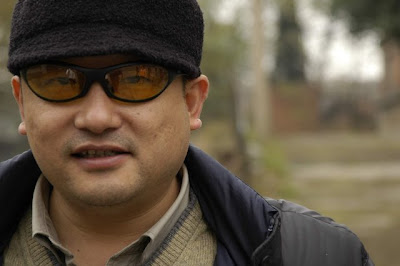


In fact, while some consider the filmmaker more "European" than his fellow Chinese and Asian directors, in the production notes, Wang Xiaoshuai reveals that his goal was simply to tell a story of "a normal, ordinary life that could have taken place in any country" and one that is "above all [about] men and women."



It's an important humanistic goal and one he more than achieves with this incredibly timely and intimate story about a group of four adults who must test the limits of their relationships and address their moral and ethical commitments to themselves and each other in order to try and prevent the death of a five year old girl from Leukemia (which the director noted in the press release is a disease that's becoming "increasingly frequent" in his homeland).

Admittedly to American filmgoers, the release of the film to own on DVD seems to dovetail nicely into the similarly medically themed big screen adaptation of Jodi Picoult's novel My Sister's Keeper from director Nick Cassavetes starring Cameron Diaz and Abigail Breslin. However while even the preview for that film makes you start involuntarily digging around for tissues, Wang Xiaoshuai said he wanted to "avoid the dramatic side of the situation-- the child's illness and possible death" since he dislikes "tears [and instead prefers] profound and hidden emotions" which he made his primary concern with his opus In Love We Trust.


And sure enough, this is exactly what he does in lieu of what would've normally been a two hour tearjerker by introducing us to the five year old Hehe and--confident that her storyline carried with it enough emotional significance-- intriguingly and refreshingly he leaves the medical side out of it in regards to gratuitous scenes of anguish and treatment by instead concentrating on her parents' attempts to give their daughter a fighting chance.

When neither Hehe's mother Mei Zhu (the incredible Liu Weiwei) or her ex-husband Xiao Lu (Zhang Jiayi) prove to be a positive match for bone marrow treatment-- the estranged and happily remarried couple risk the limits of their respective spouses including Mei's incredibly supportive, sweet-natured husband (Cheng Taisheng) who's in fact the only real father that Hehe's ever known as well as Xiao Lu's younger flight attendant wife (Yu Nan).
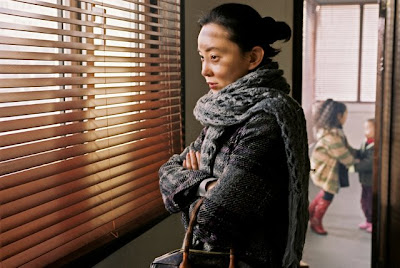


Unwilling to continue feeling powerless, Mei makes the decision to create a new child so that the umbilical cord of a new baby can-- if not cure Hehe-- then give her at least two to five to ten or more years of life since the combination of her blood and her ex-husband's would be the safest match for Hehe.

Yet in order to accomplish this, all four adults must address just what this will mean in terms of their relationships as questions of lies, trust, right, wrong, loyalty, and even infidelity enter the equation as just underneath the surface, they try to avoid the realization that despite whatever is decided, the future for all of them is as fragile and unpredictable as ever.
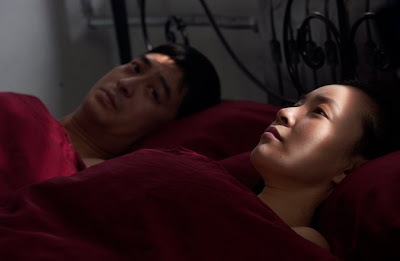


All in all, it's a wondrously complex tale about human dynamics, parental love and just how far one will be willing to go even for the most remote chance to save a life (at least for awhile). Still while nothing is clear-cut in Wang Xiaoshuai's film and his predictable unwillingness to offer a traditional uplifting or resolute conclusion may bother some viewers, it's a brilliant piece of work that hearkens back to the movies made by My Sister's Keeper director Nick Cassavetes' father John Cassavetes and one that similarly plays like a chamber piece.


In his unique refusal to film specific Chinese landmarks and make the surroundings as unremarkable as ever to show the march towards modernity (yet at the same time the idea that with progress comes a lack of real human connection with one another as we become more and more cut off and isolated in our own dramas), Wang Xiaoshuai manages to tell a story that could in fact take place in any area around the globe.

Abandoning the temptation to turn it into a melodrama, a medical crisis picture, or one that serves as a commentary on any social issue in particular (as again he's extremely vague about everything from health care to economics etc.)-- it's the film's simplicity that makes it all the more compelling. Furthermore, it emphasizes the performances of the main quartet of actors (who were deliberately chosen since they weren't "stars" but more reminiscent of "ordinary people") and therefore the results are additionally remarkable.
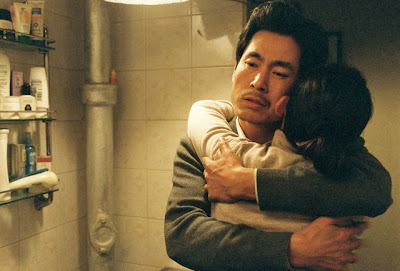


WeiWei's fierce tenacity in her portrayal (akin last month's similarly themed film Under the Bombs about a mother who will do anything to find her son in war torn surroundings) earned her a well-deserved Best Actress Award. Likewise the film itself earned Wang Xiaoshuai another Silver Bear from the Berlin Film Festival for his screenplay as well as a Special Mention Prize of the Ecumenical Jury-- however, overall it's a film that doesn't hit a false note and seems to be enhanced by the collaborative effort of everyone involved as throughout you're invited to view the same situation from four distinctly different points-of-view.


Although the subject matter and the fact that it's arriving only weeks before the similarly themed big budget Hollywood effort My Sister's Keeper may hinder traditional viewer interest, for fans of foreign film and especially those who appreciate intellectually, ethically, and morally stimulating pieces you won't do any better than the superlative In Love We Trust.

10/10/2008

Waltzing Anna


Sadly, not a movie you can dance to.


Digg!

Sitting down to write this review, I feel like an elementary school teacher whose most sensitive and well-meaning pupil has just given me a drawing that I don’t quite understand. I admire the intent and can feel the amount of love that went into the picture but the difference is that unfortunately while one can proudly hang such a project on their refrigerator and rave about it to others, when it comes to filmmaking (since we’re supposed to approach the medium at the professional level), the sweetest of intent can’t save a film that’s so woefully clichéd and poorly executed that it's nearly unwatchable.

Such is the case of Waltzing Anna, which wears its heart on its DVD cover, proudly and nobly proclaiming the truism that “love is the best medicine.” However, you know the film is in trouble early on (in the credit sequence that in fact doubles as a prologue) when the film’s themes are announced by a supporting character loudly to both the lead actor in case he’s forgotten the script he helped write, as well as the audience just in case we can’t be bothered to pay attention to the simplistic plot.

Best suited to a sitcom-styled public service announcement or short film rather than a feature length film which hits DVD shelves on October 14, directors Doug Bollinger and Bx Giongrete’s earnest yet painfully awkward work begins strongly with a premise that seems to have borrowed heavily from the first season of television’s Northern Exposure, the Michael J. Fox comedy Doc Hollywood, and vintage Frank Capra.

Except this time around, we aren’t following the affable Mr. Deeds nor Mr. Smith but co-writer/producer and star Robert Capelli Jr.’s Dr. Charlie Keegan, a Harvard-educated, unethical and shady doctor who is quickly busted for getting rich off running unnecessary tests on his elderly patients and padding his pockets with proceeds from our corporate insurance systems. Although he assumes he’ll be in the clear since it’s his word against his dementia-ridden patients’, the medical board has a decidedly different idea, banishing Keegan for six months to work at a nursing home in upstate New York or else his license will be revoked for good.

Given the current tragic state of our health care system and a majority of Americans who are uninsured or extremely under-insured, held ransom when they’re ill with co-pays and red tape which was chronicled in Michael Moore’s brilliant documentary, Sicko, initially it seemed there was a lot to like about Waltzing Anna just for the premise alone. And while it will definitely strike a chord on that level, unfortunately, the film wanders into ridiculous and predictable territory as the excruciatingly miscast Capelli (whose hair resembles Chris Farley’s after a freak-out in Tommy Boy) rudely scoffs at the idea of changing diapers or working with the overly eccentric and never believable residents of Shady Pines.

Of course, it turns out Shady Pines is just as shady as its name implies when Capelli finds himself striking an amoral alliance with its administrator—a former used-car salesman who plies the same sleazy techniques to his new trade in trying to rake in as much dough as possible. However, staying true to his friend’s announcement over the credits that he needed to heal himself, our selfish doc is surprised to find himself growing a conscience when he becomes emotionally invested in the lives of two patients (wonderfully played by Betsy Palmer and Pat Hingle) and develops an increasing attraction to Shady’s saintly and sole saving grace in the form of the beautiful young Nurse Jill (You Don’t Mess With the Zohan’s Emmanuelle Chriqui).

About as surprising as a Hallmark card and as subtle as a brick through a window, Waltzing Anna begs you to love it and I kept hoping something in the film would sweep me up in its worthwhile tale which is extremely timely given the state of our nation. Yet, much to my dismay aside from a great supporting cast who are included in interviews on the DVD and the charms of Chriqui (whose chemistry with Capelli is even worse than the one she’d shared with Sandler’s Zohan), mostly you wish that the filmmakers had turned this into a much shorter cinematic call to action they could send to senators in place of petitions and letters. Instead—and while far more high quality than a refrigerator drawing-- ultimately Anna simply preaches to the choir of those who not only agree and are completely on their side (like this reviewer) but wholeheartedly wish they would’ve put their talents to better use.

Whether it would’ve been staying with the admittedly SNL-movie-styled beginning to make it a great Sandler-esque or Will Ferrell underdog comedy about a jerk who must reform or simply excelling at making it a beautiful work of nostalgic sentiment, by moving uneasily between low-level comedy (and we’re talking really low) and discovering one’s inner hero, it’s never quite sure the type of film it wants to be. In fact this is even evidenced in the film’s trailer which is the only other special feature included on the disc, which can also be viewed here.

In the end, all we know is-- we’ve not only seen bits and pieces of Waltzing Anna done better before, but like the referenced drawing, we’re not quite sure exactly what it wanted to be. Still, we admire its existence all the same-- even if unlike the drawing, we can’t recommend the film in the least. Note: for a much better film that involves similar themes, be sure to look for the delightful Irish sleeper How About You (from author Maeve Binchy) which-- following its success in the film festival circuit-- will be appearing in theatres in limited release beginning next month.

7/30/2008

Control (2007)


Director:
Anton Corbijn

Last year in Walk Hard: The Dewey Cox Story, the increasingly popular genre of musical biopics was skewered for comedy by John C. Reilly, Judd Apatow and Jake Kasdan. And indeed, in this era of excellent, yet structurally similar works such as Ray and Walk the Line, or just downright experimental musical film portraiture (I’m Not There) that consistently draws both acclaim and Oscar nominations, venturing to make a rock ‘n roll biography has become both predictably dull business and cinematically ambitious all at the same time—or at least that’s the case when it’s done right. And Dutch rock photographer turned filmmaker Anton Corbijn manages to blend both the traditional narrative approach and cinematic artistry of the two aforementioned subgenre types into something uniquely his own, shattering old expectations and releasing and unforgettably searing, intimate, heartbreaking and wholly original work with Control.

Imagine this paradox: a quiet film about rock ‘n roll. Yet, when you consider the subject matter—the tragic tale of soft-spoken, melancholic Joy Division front-man Ian Curtis who took his own life at the tender age of 23, there is no other way to approach the material. Similar to the sound engineering, the decision to film in black and white isn’t artistically pretentious but natural as Corbijn-- who had himself shot some of the most iconic photos of not only the band and Curtis in the late 1970’s and just before the singer’s death on May 18,1980-- realized, as he shared on the DVD featurette, that for a band which released their albums with simple black and white sleeves and had became known to fans via this crisp dual tone photography, releasing the film in color wasn’t even an option. Intriguingly, when principal shooting began, Corbijn realized that using black and white film stock made his work seem far too grainy so he opted to use colored film, which he was able to flip to breathtakingly vivid black and white effect in the development. In the end, the result is a biopic that feels like a vivid document of the given time and place, as Corbijn and his crew filmed in Curtis’s hometown of Macclesfield, England while utilizing as the director noted on the DVD, not only Curtis’s own home but the streets he’d actually walked in his painstakingly accurate portraiture that follows seven years of the troubled musician’s life from age 14-23.

Formerly in cinema, the life of Ian Curtis and the history of the band Joy Division was used as an effective yet underdeveloped, fascinating footnote in Michael Winterbottom’s brilliant film 24 Hour Party People, an exceptional biopic of Granada television personality turned record producer and club owner, Tony Wilson, who helped champion bands of the underground and usher Manchester, England from the era of punk music to new wave. Some of the events of People are echoed here such as Wilson’s devotion to Joy Division, which he believed in so strongly that he actually signed the band to his label Factory Records using his own blood. Interestingly, whereas a majority of Winterbottom’s film was brash, in-your-face and as loudly chaotic as a night in one of Wilson’s clubs, the tone always quieted down when dealing with the character of Ian Curtis, especially before his untimely death and in doing so, American viewers, along with others not as well versed in British punk rock history, and/or those born after the events depicted found themselves longing for more back-story regarding the events.

Thankfully, instead of just using the material as fodder for a salacious tabloid style take from a filmmaker without any personal investment in the subject, photographer turned filmmaker Anton Corbijn made the ideal choice to helm an adaptation of Curtis’s life, having himself been so inspired by listening to the man’s music in Holland in 1979 that he impulsively packed a bag and decided to journey to England to be closer to where the music was made, according to the DVD. Expanding on this, he shared in the disc’s interview that he was close enough to the band for him to know the material and handle it in the right way but not so close that he would’ve been too emotional to be subjective or unable to turn it into a compelling film.

Equally beneficial to the film’s success was the phenomenally fortuitous casting of a relative unknown for the lead role, namely former child actor turned singer, Sam Riley who not only bears an uncanny resemblance to Curtis but given his musical ability, sung all of Joy Division’s songs and—because of his considerable anonymity—gives the film a near documentary feel.

From his earliest days killing time in his room listening to and idolizing glam rocker David Bowie, visiting elderly neighbors in order to raid their medicine cabinets with his best friend, scribbling down poetry and citing Wordsworth from memory, we’re introduced to a gentle, yet troubled Ian Curtis who always seems to feel easiest when alone or in small groups. After he falls in love with and spontaneously marries Debbie (Samantha Morton), his best friend’s girl to whom he states “You’re mine. Irretrievably. And you know it,” Curtis accepts an admirable if admittedly depressing governmental position securing employment for the mentally and physically impaired residents in his community.

Although, at the same legendary, early Sex Pistols concert that Tony Wilson referenced in 24 Hour Party People, the life of Ian Curtis was equally altered when-- high off the anarchic sounds of the punk bands-- he joined up with some mates. Using a rebellious and ironic allusion to the name of the brothel the German soldiers patronized in World War II—Curtis and company formed their own version of Joy Division where he accepted the role of lead singer, forever changing the face of British music.

After a rocky start, signing with Wilson propelled the band and the shy Curtis to stardom much to the chagrin of his humble wife Debbie who realizes that being a musician’s wife—especially when one is still so young—is much more than she bargained for, especially after the birth of their daughter Natalie finds her becoming a near single parent. This is especially taxing when, after his first major gig in London, the formerly healthy Curtis has an epileptic fit on the way home and-- considering the lack of information surrounding the condition in that particular time-- is given nearly half a dozen prescriptions with the medical claim that the doctors are unsure which ones will work and which won’t, as he must now accept life as an epileptic with a treatment best described as “trial and error.”

Perhaps fitting to the hateful adage that good things always happen with bad, while Joy Division becomes an astronomical success with Wilson booking more and more dates on the road, Curtis begins to unravel as the withdrawn, melancholic and solitary youth we first met becomes far moodier and introspective, possibly given the combination of both his new diagnosis or the laundry list of side effects that such powerful drugs can have on a man as they all begin to wreak havoc on his outlook on life.

Contradictions continue as things get unexpectedly sunnier yet infinitely more complicated for Curtis when he meets the beguiling, French Annik Honore (Alexandra Maria Lara), a Belgian embassy employee who becomes taken with the singer at a performance and goes backstage to request an interview with the band as an aspiring journalist. Predictably, the two fall deeply in love. Soon Curtis finds himself leading a double life as a husband and father at home to a wife and daughter he barely knows or with whom he seems to relate anymore and feeling a strong pull towards the woman he feels is his soul mate on the road, as Annik becomes his devoted lover away from home, taking care of him against his wishes when he collapses onstage and becoming his favorite person to just sit with silently when he feels blue (which for Curtis is most of the time). Inevitably, Debbie discovers the betrayal and Curtis grows increasingly cruel and moody, pushing those closest to him away as—in a revealing conversation with Wilson—he begins to mistake love for hate, unsure what he wants in life, and beginning to tire from the breakneck schedule and constant push to perform.

Although viewers know exactly where his life is headed, Corbijn thankfully handles the final days of Curtis’s life with taste, never reveling in the horror of it, and instead just painting a fascinating, frustrating, beautiful, and completely objective portrait of the singer as a young man, never leaping to any conclusions, offering a comforting “bookend” or providing pat solutions as is the custom with many traditional music biopics. Instead, Corbijn and his tremendous lead actor Riley prefer to just let his legacy live on, most likely much like Curtis would’ve wanted with those addictively haunting songs.

Yet, in trying to go beyond the music, after viewing Control, the words and Curtis’s unique delivery of the lyrics of such classics as “She’s Lost Control,” “Isolation” and “Love Will Tear Us Apart,” become far more revealing, making the ironic, sadly deceased lone-wolf Curtis suddenly feel closer to us than ever and more alive all thanks to the filmmakers-- and by turn the audience's decision of having taken the time to walk a mile of his Macclesfield road.