Showing posts with label Kathy Bates. Show all posts

8/15/2009

Blu-ray Review: The Waterboy (1998)


Now Available to Own


Photo Slideshow


Delicious
Bookmark this on Delicious
submit to reddit
Print Page

Digg!

MovieBlips: vote it up!

In the world of film criticism, it seems as though if say you find Adam Sandler funny, you're committing an offense of the highest order. And while you'll never catch me wanting to watch Click, Little Nicky, or even The Waterboy ever again-- overall and flaws aside, I've still found a lot to like in his comedic work in movies such as The Wedding Singer, Anger Management, Billy Madison and You Don't Mess With the Zohan.


Yet it's also on display when he's working alongside other talents in dramatic performances such as in Paul Thomas Anderson's underrated Punch Drunk Love, James L. Brooks' underrated Spanglish and Mike Binder's underrated Reign Over Me. Gee, are we sensing a pattern? Yes, there is a Sandler prejudice and also Adam Sandler is extremely underrated. To this end, it seems as though very few individuals have realized the extent of his talent which goes way beyond the horrific character he created along with his frequent screenwriter Tim Herlihy in director Frank Coraci's The Waterboy.


Moreover, the Sandler influence seems to crop up everywhere from-- I swear-- a similar voice heard in some of Jon Stewart's impressions on The Daily Show to Jimmy Fallon basically trying to become the next generation's Sandler even going as far as to make his best film with Sandler's greatest female costar Drew Barrymore via Fever Pitch.


Yet where Waterboy forgets to incorporate the funny is by failing to successfully blend together the two ingredients that seem to show up repeatedly in the man's various characters whether created by Sandler or others including Binder and Anderson. In other words, the quintessential Sandler character is one that possesses genuine innocent sweetness and a boyish naivete mixed in equal measure with a Warner Brothers Acme stick of dynamite that's ready to explode.

A lot has been written about Sandler's good angel and bad angel schtick as the well-intentioned overgrown juvenile character we've witnessed in Madison, Happy Gilmore or Big Daddy (which co-starred Jon Stewart). Essentially, he seems filled with true sweetness yet he has the capability to move directly into overly violent bully territory within an instant which can honestly alarm viewers.


Whether he's beating up a bathroom in Punch Drunk Love, throwing dodgeballs extremely hard at first graders in Billy Madison, or rough handling any number of people in his films-- in a sense Adam Sandler has taken the classic Laurel and Hardy, Marx Brothers or Three Stooges-like ensemble idea and turned it into one individual.

Basically, when we meet a Sandler character in each successive film, we're never exactly sure whom we're going to encounter as he moves from hugs to hits with frightening speed but one of the reasons it worked better in the aforementioned comedy teams is because they were an ensemble and so it was easier to take when you balanced Harpo with Chico and Laurel with Hardy.

Walking the thin line between physical comedy and downright violence is the task undertaken in The Waterboy when we first encounter Sandler in sugar sweet mode as Bobby Boucher, the overly sheltered, smothered mama's boy still living at home at the age of thirty-one.

Apparently mentally challenged and shy-- he rides his tractor from his cliched Louisiana backwoods bayou swamp home shared with his mother Kathy Bates (a long, long way from her usual Oscar worthy self) to the local university where he delivers high quality water as the football team's official waterboy.
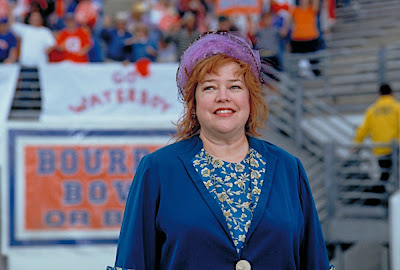


Mercilessly ridiculed with school bus level insults aimed squarely at his disability, when it's the victim Bobby who's accused of distracting the team so much by simply existing as a mentally challenged individual the guys bully to no end, he's fired.

Unwilling to just quit the waterboy gig altogether, Bobby visits a local college whose football team's historic losing streak has made them the laughingstock of ESPN. And much to his shock, he's hired-- obviously for free-- to become the "water distribution engineer" by the formerly great and now frazzled Coach Klein (Henry Winkler).
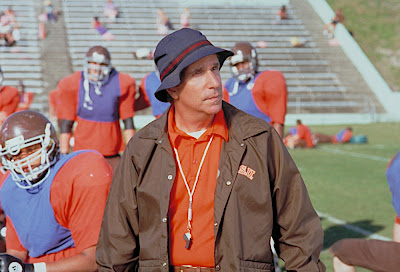


One of the film's only saving graces--Winkler's Coach Klein is the one who tells Bobby at long last that it's okay to stick up for himself. Although when thirty-one years of pent up frustration boils to the surface, Bobby goes berserk, violently knocking the man to the ground in a way that gives Klein the idea that Bobby may be precisely what his team needs to actually win a single game.

Lying to his mama about becoming a football player and college student as well as spending increasing amounts of time with free-spirited recently released jailbird Vicki Vallencourt (Fairuza Balk), Sandler's Bobby Boucher soon becomes the star of the team.
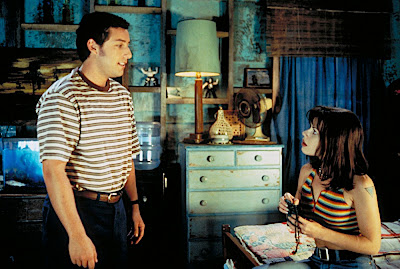


An obvious retread of not just Happy Gilmore but other underdog sports tales-- where Waterboy goes terribly wrong is by constantly resorting to awful gross-out memories and over-the-top violence as the most frequent source for jokes. Likewise in having way too much fun with the stereotypical southern setting as Bates cooks up squirrels and gators, we're never sure if we're laughing with Bobby and the Louisiana community or at them as the same cliches of "retarded" and "redneck" that the film allegedly is trying to prove are shallow and wrong.

Thus, in the end, it's squirm-inducing, uncomfortable humor that feels like a ninety minute live action version of a cartoon created by a few teens understandably tired of being picked on in high school yet seeking creative justice rather than violent justice. I only wish the same could be said for the journey of Bobby Boucher.

However, at the end of the day, there's nothing creative about a film that Sandler and Herlihy could've penned in a single afternoon that is nowhere near as intricate or clever as the brief skits from SNL where Sandler would star in "The Denise Show," play the "Opera Man" or grab a guitar and sing odes to Hanukkah, red sweatshirts, or lunch ladies.

A waste of all involved save for Winkler whose playful performance earned the sole laugh I could muster when screening the work for the second time in eleven years on Blu-ray disc as he illustrates the need to rebel by sharing his inked appreciation for Roy Orbison.

So instead for angry Sandler, your best bet is still seeing him square off opposite Jack Nicholson in Anger Management when the premise works precisely because he's in denial of the rage he repeatedly lunges towards in his films and for sweet Sandler, he'll never top The Wedding Singer which is still one of my favorite '90s romantic comedies.


Boasting zero bonus features since most likely none of the individuals involved felt like reliving the experience-- the Blu-ray from Touchstone Pictures is otherwise top-notch as it was distributed by Walt Disney's Buena Vista Home Entertainment which proves on a weekly basis that they have this format down to an exact science.
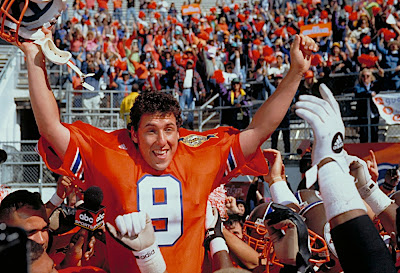


Moreover it duplicates the same experience I'd had viewing the film originally in theatres back in '98 with a clear soundtrack that balances the sound of a roaring crowd and the dialogue well across your speakers that syncs up perfectly with razor sharp picture quality. Yet, given the price-tag of Blu-ray discs, my advice would be to hold off on making the upgrade from DVD to Blu-ray for this feature based on the poor content alone (regardless of its superior quality) in the hopes that eventually, a definitive Sandler set will be put together on Blu-ray that will make the price increase worth the switch.

However, one major hurdle that will no doubt get in the way of this becoming a reality-- as Jack Lemmon's son Chris explained in our recent interview while discussing the complexities of sets regarding his dad's body of work-- is the number of studios that would have to work together and film property that's owned by several different corporations. Although, I'm still optimistic that in the future more cross-promotional efforts will be made since studios have begun to realize the home entertainment boom in lieu of poor box office returns.

Likewise, in a society where so much content is available online, perhaps thinking outside the box for business reasons in sharing material to give fans what they'd want and a reason to shell out money would be one extremely profitable and beneficial way to combat the problems facing the entertainment industry in the new millennium.


Text ©2009, Film Intuition, LLC; All Rights Reserved. http://www.filmintuition.com

Unauthorized Reproduction or Publication Elsewhere is Strictly Prohibited.

6/26/2009

Movie Review: Cheri (2009)


DVD Release Date:
October 20, 2009


View the Trailer

Photo Slideshow


Delicious
Bookmark this on Delicious
submit to reddit
Print Page

Digg!

MovieBlips: vote it up!

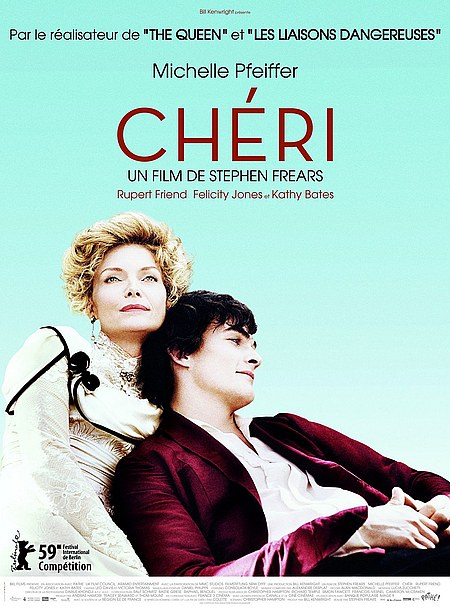
While the trailer for Miramax Film’s Chéri makes the reunion of Dangerous Liaisons director Stephen Frears, screenwriter Christopher Hampton (who also penned Atonement), and actress Michelle Pfeiffer look like an Oscar Wilde style romp set during the height of the Parisian Belle Epoque-- the film itself is more concerned with melancholic introspection than the number of laughs inserted in the succinct preview would lead you to believe.


Fittingly for the literal translation of Belle Epoque’s “beautiful age"-- the film is overflowing with the most sumptuous eye candy in terms of Alan MacDonalds’s intricate production design and the luscious costuming of Consolata Boyle which is captured to its most exquisitely beautiful effect by renowned cinematographer Darius Khondji whose work with Bertolucci, Fincher, Haneke, Jeunet, Polanski and Kar Wai has elevated even partially successful films like My Blueberry Nights just based on the breathtaking visuals alone.


And this is especially important in terms of Chéri which ultimately feels like it’s essentially much ado about nothing. Although par for the course of Frears’ resume of often garnering his actors and especially his leading ladies award nominations or statues a la The Queen, The Grifters, Dangerous Liaisons, Mrs. Henderson Presents etcetera-- Chéri boasts a winningly carefree Michelle Pfeiffer as Léa de Lonval.


One of the most influential and wealthy Parisian courtesans—after the departure of her most recent lover back to his Russian homeland—Léa contemplates retiring from “the business” as she nears the age of fifty. Yet, just when she’s ready to enjoy the life of luxury she can more than afford despite her lack of friends outside her own circle since others judge the way that arguably Belle Epoque’s most liberated and successful women earned their fortunes, she agrees to meet an older colleague she’s never much liked but merely tolerated in the form of Kathy Bates’ gossiping, self-obsessed and manipulative Charlotte Peloux.


Requesting Léa’s assistance to intervene in the meaningless hedonistic pursuits of her nineteen year old “bon vivant” son whom Léa has dubbed Chéri—as soon as Rupert Friend’s bored, personality free slacker meanders outside and sees his beloved near-godmother Léa waiting for him-- his interest is piqued, the sexual tension is palpable and after stealing a kiss from the woman nearly thirty years his senior, he accepts her offer to journey to her country home for a much needed rest.

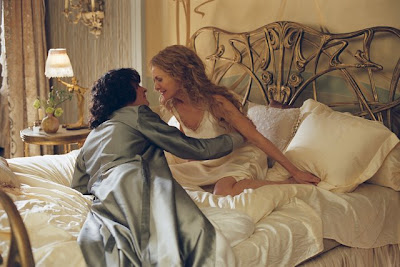
Yet, as a nineteen year old with an out-of-control libido, the two embark on a torrid affair they assume will just be a fling as Léa tries to soothe his ails and return him to Peloux a few weeks later—teasing him from the start that she’s kissed the handsome mouths of men many times over and has never lost control before.


However, something clicks between the two and she finds his lack of direction fascinating as a few weeks turns into six years of what to everyone else appears to be a healthy, attentive romantic relationship despite both Léa and Chéri’s frequent attempts to dismiss it as just another short-lived rendezvous in the course of Léa’s chosen career.

And it’s this endless avoidance to not put their coupling into any specific terms or reveal their feelings that will ultimately lead to their heartbreak and doom when they hear from Peloux who—suddenly with a whim towards wanting grandchildren—has decided she needs Léa to return her son as though he was a present so that he can take part in an arranged marriage.

Going along with what Peloux wants despite a few telling instances where Chéri in particular tries to get Léa to stop bluffing and finally fold that their time together has been more than just a sensuous diversion—it’s from then on when the film’s tone shifts from the opening jovial narration and sexy sharp-witted barbs to a subtle and increasingly tragic rumination of missed opportunities, the nature of age, and the double standard of older women and younger men, until it ends with a literal bang off-screen.


The playful chemistry of the two leads and the film’s gorgeous attention to detail in bringing both of Colette’s novels Chéri and The Last of Chéri to life is made all the more sweeping due to the score created by Painted Veil and Benjamin Button composer Alexandre Desplat.

Yet despite this, I was left cold and unmoved by the lack of a cohesive structure for the second half of the movie which never seemed sure if it wanted to provide a subtle and doom ridden commentary on aging as well as societal attitudes towards both genders as we advance in years or if it wanted to instead fixate more purely on the leads’ impossible love.

And perhaps the problem in the tonal and thematic shifts can be blamed on the fact that two novels are being strung together in a mere one hundred minutes and the splicing together of two separate works makes it feel as though we’ve just heard a record skip or had a channel change unexpectedly on our television.


Overall, aside from the high quality craftsmanship, this misguided Colette adaptation plays best when you view it like you’re taking a trip through a Belle Epoque museum where everything feels lovely and natural (aside from Bates’ misstep in playing Peloux with a certain level of distracting camp better suited to Wilde).

Moreover, it does succeed in terms of relaying the author’s penchant for impressionistic writing but given the wonderful biography of Colette included in the production notes from Miramax Films, it makes you wish that instead of Chéri, the filmmakers would’ve dedicated their time to Hampton’s pet project biopic of the controversial author who would become most well known for penning Gigi.


Since, in addition to not being able to identify with this film’s characters-- or empathize with ones like the titular male lead who is repeatedly described as having no discernible personality--it fails miserably in the attempt to make it relatable or applicable to contemporary life. Thus a look at what made the author tick would’ve been infinitely preferable and more in line with the strengths of the Liaisons trio of Frears, Hampton and Pfeiffer than this particular exercise of Chéri.

6/12/2009

Blu-ray Review: Revolutionary Road (2008)


Now Available on DVD & Blu-ray


Delicious
Bookmark this on Delicious
submit to reddit
Print Page

Digg!

MovieBlips: vote it up!

Much to the dismay of audiences and critics alike, it's become "trendy" -- especially during autumn and winter-- to dish up the most unspeakably bleak cinematic portraits imaginable in the quest for award-winning glory via increasingly pretentious and alienating works of over-the-top dysfunctional devastation.

You know the type-- they're films my friend, colleague and local critic Colin Boyd calls "the Laura Linney" in the tradition of movies such as Smart People, Margot at the Wedding, The Savages, Snow Angels, The Squid and the Whale, and The Tracey Fragments that have become so popular (at least with the people making them) that at least a dozen of these roll into theatres every single year.


And given some of the reviews that circulated last December upon the release of Oscar winning director Sam Mendes' Revolutionary Road some of which likened it to anguish and torture, needless to say-- having just taken in one too many dark works all clamoring for Oscar-- I skipped the press screening and waited for disc.


Yet, although the film--which is based on Richard Yates' classic National Book Award nominated 1961 American novel-- journeys headfirst without a map over the course of two hours in a figurative suburban war zone filled with emotional landmines until it arrives at its heartbreaking destination guaranteed to leave you shell-shocked, I must say I was completely engrossed throughout the entire experience.


Fittingly, as revealed in the DreamWorks, BBC Films, and Paramount Vantage Blu-ray's behind-the-scenes featurette, "Lives of Quiet Desperation: The Making of Revolutionary Road," the film was described as "passion project" for Kate Winslet who is no stranger to incisive explorations into the darkest aspects of male-female romantic relationships in her Academy Award nominated turns in films such as Little Children and Eternal Sunshine of the Spotless Mind.



And while the film is one you must prepare yourself to watch and moreover one that could be quite a dangerous instigator to provoke discontented couples into arguments, it's also one of the most thought-provoking, proactive, painful, yet satisfyingly three dimensional, bizarrely relatable, and articulate works crafted in 2008.


Incredibly brave-- at first the movie begins as though it's a big-budget version of an episode of Matthew Weiner's AMC award-winning original series Mad Men-- yet one set a decade earlier as we encounter the seemingly picture-perfect young couple April (Winslet) and Frank (Leonardo DiCaprio) whom we realize are anything but happy with their lot in life.


Having met at a party when Frank made the aspiring actress April laugh and enchanted her with his tales of being in Paris (albeit in the war), the couple's fire and ice relationship runs as manic and depressive as the moods throughout the most likely bipolar April-- whom we get the sense may have been modeled on both author Yates' dissatisfied aspiring artist mother as well as own Yates' own struggles with bipolar disorder, alcoholism, and nervous breakdowns as revealed in a Blu-ray only extra.


With April fiercely holding onto the belief that she and Frank were secret allies in their fight against conformity and their destiny to share a life that's unlike the others as something special and wonderful-- after she gives birth to two children and they move to suburbia where she's stuck in a gorgeous home with a picture window on Revolutionary Road, she has a hard time accepting her situation as part of the '50s status quo.


While April's emotions run rampant-- she's poised and determined on the outside-- living life as the type of woman who chooses her words carefully in public despite her frequent blow-ups with Frank. Yet, for appearance sake, April tries to be a good neighbor to Kathy Bates (whose son returns from a mental institution and intriguingly seems to be the only one able to see right through the Wheeler facade) as well as a good friend to another couple, subtly relishing in the way her statuesque beauty commands the attention of her best friend's husband.


However while April busily makes an impulsive plan to support her husband until he discovers his true passion by moving them all to Paris, her bright but dissatisfied husband Frank is the more logical one of the two, working at a dull, lifeless job in advertising essentially repeating what he felt was his father's meaningless existence by working at the exact same company.


With a gift for gab and the true ability to charm anyone he meets (especially young secretaries he sleeps with in the city), April sizes up Frank's willingness to ignore his mutual disgust by observing that, "if black could be made into white by talking, you'd be the man for the job."


Still, as hopeless about their relationship and life on Revolutionary Road as she is-- Frank takes April up on her offer and gives in as the two become closer than ever, actively pursuing the idea of revolting against their feeling of being trapped in lives that are too planned out.


Finding the shock of those around them who have succumbed into conformity amusing and not understanding the way that their friends privately judge their decision as unrealistic, juvenile, and in some cases threatening (since they dared to judge the way that most lives were being lived in 1955), things begin improving for the Wheelers until life tempts their decision with a variety of hurdles which they try to ignore until it's much too late.


Effectively, Road's filmmaking team heighten the explosive tension with an overwhelming sense of claustrophobia by mostly filming the Wheelers on location in their home or in tight corners continuously making us see them as caged prisoners-- not so much stuck in suburbia as they are in their own psyches and the realization that they feel like they belong together but have no idea how to make it work. Moreover, in the same turn we discover that they as well have no genuine idea what they actually want out of life themselves together or apart.


Even in a scene that echoes the area of anonymous gray flannel suits as interchangeable men journey into the city day after day to jobs they loathe just to feed their families, the sunlight and open air is framed tight, making DiCaprio simply one of the masses. In fact, visually Mendes (Winslet's husband) only really frees his characters when they take a walk in the woods and throughout he and the talented cinematographer Roger Deakins use as much natural light as possible in an attempt to convey their fragility, confusion, and desperation by depending on tight closeups that reveal flaws which are refreshingly unhidden by makeup or post-production touch-ups.


Overall I feel it's one of those rare and largely misinterpreted films that-- just like Yates' novel may upon first glance be taken as merely "anti-suburban" and as such-- given a viewer who strongly opposes the work, it ultimately reveals more about the individual judging it than the film in a way that perhaps cuts too close to something in their own life.


For, we're defined just as much by what we loathe as what we love and cinema is no exception, but it's much more than just a cynical view of suburbia as it dares to address the attitudes and landscape of both American men and women in what the author always intended to be a political novel. And, as referenced in the production notes--an interview with the now deceased Yates is quoted as he describes his belief that Road is not "anti-suburban" but was written "as an indictment...of a general lust for conformity all over this country...[as] a kind of blind, desperate clinging to safety and security at any price," which he wrote in an attempt to "suggest that the revolutionary road of 1776 had come to something very much like a dead end in the '50s."


While admittedly, given his need to execute this, the Wheelers themselves aren't the easiest characters to warm up to at all yet throughout the film I realized that-- while I didn't approve of them or their actions-- at the very least I could understand them and realize the motivations and emotions behind every decision, thereby making Mendes' film penned by screenwriter Justin Haythe and brilliantly brought to life by the cast seem one hundred percent real and just as meaningful today as it was when Yates' novel first hit the shelves.


Seldom in cinema do you actually feel like you understand a character's wishes and their contradictory actions and even more few and far between are opportunities where we actually get a sense of the characters as real people with thought processes and Revolutionary Road succeeds on all of these levels.


In the end, it's a work that deserved far more awards consideration than it received (aside from Winslet's double Golden Globe accolades for Road and The Reader) and more importantly one that's richly rewarding intellectually despite the fact that it definitely does push a viewer through an emotional battlefield. However, the best thing about Road, aside from realizing that the issues are still there today is that its trip towards the tragic finale is entirely logical given everything that's come before it and not just tacked or executed with the heaviest of paintbrushes a la last year's The Boy in the Striped Pajamas and Snow Angels.


Containing all additional extras on the disc in high definition, the Paramount Home Entertainment release was beautifully transferred to Blu-ray with gorgeous widescreen picture and sound and in fact the sound is so clear that you're quick to learn that composer Thomas Newman's score sounds way too similar to his previous ones for Sam Mendes in American Beauty and Road to Perdition! With stunning quality in the picture that makes all of Deakins' work stand out just as much as it did in Miramax's recent Blu-ray release of No Country for Old Men (which he also shot), we realize just how pitch-perfect the production values were across the board from costuming to art direction. And for this reviewer who failed to RSVP to the theatrical press screening out of fear it was one of those trendy works of dysfunction, I'm happy to report that it was an ideal way to capture the film for the first time at home.


11/23/2008

DVD Review: Fred Claus (2007)

Flying onto DVD & Blu-ray on November 25


Click Here to View the Trailer & Photo Gallery


Digg!

Talk about the ultimate black sheep-- Jan Brady has nothing on Fred Claus. The older brother of the boy who would become St. Nicolas, Fred discovered at a young age that sainthood is a tough act to follow. Driven to rage by being constantly overshadowed by his brother's accomplishments and given an annual reminder of his success with the incessant caroling, holiday displays and more-- Fred (played by Vince Vaughn) decided that since he didn't want to join the family business making toys at the North Pole, he'd move to Chicago and become the polar opposite of his brother Santa (Paul Giamati).


Instead of selflessly delivering goods, Fred becomes a repo-man, taking away flat screen televisions and elaborate presents he sometimes moves directly into his own apartment and delivering monologues to his young neighbor Slam urging him not to "drink the Kool-Aid" that is Christmas by being "a cheerleader for Santa Claus," whom he likens to a megalomaniac embodiment of a shell game con artist. An inconsiderate and absent-minded boyfriend to the lovely British meter maid Wanda (Rachel Weisz taking on a Dickensian, wrong-side-of-London accent), when Fred ends up in the slammer following a hilarious confrontation with a veritable army of Salvation Army santas (that seem to be as stealthy as soldiers), he's forced to call his brother for help.

With St. Nick's wife Annette (Miranda Richardson) trying to convince her "closet-eater" husband to practice tough love which doesn't quite fit the saintly mandate, Santa strikes a deal with his brother offering him financial assistance for an upcoming business venture if he'll come work for the handout at the North Pole. Grudgingly, Fred agrees and predictably, he wreaks endless havoc from taking out his frustration with carols by inspiring an impromptu Elvis Presley dance party to helping a shy Elf (Christopher Guest and Kath and Kim scene stealer John Michael Higgins) make a love connection with the mathematically gifted yet Victoria's Secret styled hot elf (Elizabeth Banks) to getting in a wicked snowball fight with his brother until ultimately the family stages an intervention.


By this point the film which seems to draw a large majority of its humor from taking a cynical view of the holiday with mean-spirited jokes (think Bad Santa-- the PG rated version) begins to grow long-winded, not sure whether or not it's masquerading as a comedy about sibling rivalry a la Will Ferrell and John C. Reilly's Stepbrothers or as a companion piece to the much lighter, brighter, and surprisingly contemporary yet nostalgic Will Ferrell vehicle Elf.


The beautifully packaged DVD and Blu-ray disc from Warner Brothers which offers feature length commentary by its filmmaker David Dobkin also adds more than twenty-five minutes of additional scenes, some of which further shift the story's theme from "naughty" to "nice" as well as the opportunity to view it in either its theatrical widescreen aspect ratio which is enhanced for widescreen televisions or in a formatted full-screen version to fit the standard square shape. Additionally, offering both language and subtitle options for English, Spanish, and French speakers-- one of the true audio highlights in its sharp Dolby Digital 5.1 surround is the movie's terrific soundtrack which contains not just holiday classics but other less-than-predictable songs which make the film much more effective including The Byrds' cover of Bob Dylan's "My Back Pages," although only certain numbers made it onto its incredible companion album you can explore below.


Filled with Vaughn's trademark whirlwind monologues and seemingly spontaneous references and jokes that make even uneven films like The Break-Up work, he elevates it well and the Jingle All the Way meets National Lampoon's Christmas Vacation inspired chaotic chase through the streets early on is a complete joy as is a ridiculously creative and funny meeting for Siblings Anonymous where recovering siblings like Frank Stallone, Roger Clinton, and Stephen Baldwin air their frustrations with their famous brothers. Yet, while that is hands-down one of the most ingenious portions of the film, especially when Stephen nearly comes to blows with Fred Claus until he begins repeating his mantra, "that's not Alec," the jokes and tenor of a film which finds Santa being threatened by a struggling economy when efficiency expert Kevin Spacey arrives all too ready to fire him with a three strikes system, doesn't quite know which audience for which it's playing.

Far too nasty for young children and with jokes such as the "I'm a recovering sibling" scene that are sure to go over their head-- it seems like it's shooting for the demographic Vaughn usually reaches of young men who latched onto his frat-pack comedy alongside Owen Wilson--Wedding Crashers (from Claus director David Dobkin who also directed Vaughn in the darker indie Clay Pigeons). Yet, in its indecision in awkwardly moving from a storybook like opening (similar to Elf which was made by his Swingers pal Jon Favreau) to an angry, embittered tale of family dysfunction that always comes to the front burner during the holidays, it loses some of its focus in an overly long second half.

Additionally, while we know it's Fred's story after all as our narrator reminds us, it is a Christmas movie and unfortunately, wastes its lovable Sideways and American Splendor curmudgeon star Paul Giamatti as a spineless Santa who eats his feelings to such an extent that he's developed acid reflux, insomnia, and problems in the sack. The same goes for the film's other Oscar winners and nominees like Kathy Bates, Miranda Richardson, Rachel Weisz, and Kevin Spacey (who does have one brilliant in-joke about wanting to be Superman as a nod to his Lex Luthor role in the newest Warner Brothers film) who aren't given enough to work with and especially in one plot that is endearing, too little time is spent on the cute John Michael Higgins and Elizabeth Banks subplot.


Yet despite its many, many flaws, and an overwhelming urge to go back into the cutting room and trim away at least fifteen minutes, there's enough good stuff in the film to make it watchable and even memorable but it's muddled by its angry script from Cars and Bolt screenwriter Dan Fogelman (who despite this, deserves ample kudos along with story creator Jessie Nelson for a wonderful premise), that I'm guessing went through too many rewrites which led to such a thematically confusing finished product.

While for fans of Vaughn, like myself, who've been enjoying his career ever since he went to "Vegas, baby, Vegas," even though admittedly he seems to play the same character repeatedly (aside from a few wonderful against-type roles in movies like A Cool, Dry Place and Into the Wild), it's worth a look, especially if you have a thing for holiday movies and it makes a nice companion piece to the superior Elf.

Still unfortunately for Claus, Vaughn definitely said it best when he told Favreau he was "so money [that he didn't] even know it" in Swingers as ultimately, it's Favreau's Elf that in the future is destined to become a new contemporary Christmas classic.


It's Beginning to Look a Lot Like Christmas
(Find Your Favorites Below at Amazon)