
Showing posts with label Jessica Biel. Show all posts

9/28/2009

DVD Review: Easy Virtue (2009)


Now Available


All film buff allegiance to Alfred Hitchcock aside but on an enjoyment scale, the idea of watching a silent version of a Noel Coward play is roughly on par with being presented a single crayon to use for an extraordinarily detailed coloring book. Of course, if the stimuli is interesting enough, you’ll make due with what you have and thus, since in the ‘20s sound wasn’t readily available when Hitch filmed Coward’s 1924 play Easy Virtue four years later in ’28 during his London years, he did so silently.
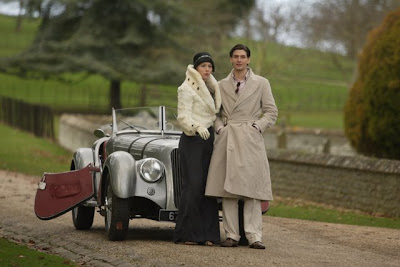

However, I'm sure that those who've read the playwright's work or seen it before will no doubt agree that Coward was a man worth waiting for the new technology to fully appreciate his daring plays which were filled rich witticisms and his penchant for ridiculing social conventions like marriage and child rearing which were filtered-- as in the case of Virtue-- via the culture clash of an American feminist who finds herself in the stuffy England countryside.

And indeed this exceptionally well-made adaptation co-written and directed by Adventures of Priscilla, Queen of the Desert and Eye of the Beholder Australian filmmaker Stephan Elliott is just the right proof one will need to come to that same conclusion. Likely to entertain not just Coward devotees and also those who’ve enjoyed studying all things relating to the Master of Suspense, Elliott's Easy Virtue is doubly fascinating in the latter respect when you consider Hitch's affinity for Coward's work. To explain, by viewing Virtue, it helps retroactively foreshadow the type of unconventional humor that Hitchcock would seek out throughout his eventual career post his own '28 Virtue in films such as The Lady Vanishes, Mr. and Mrs. Smith, The Trouble With Harry and others.


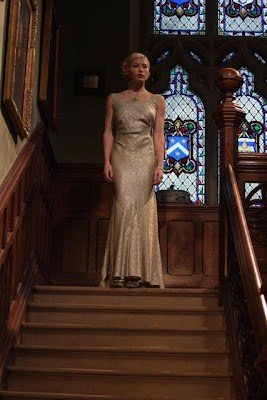
In Jessica Biel's best role and performance since the one that first bewitched many film lovers in The Illusionist, she plays a character we are quick to ascertain is slightly older than Ms. Biel in reality and one whom additionally is much wiser than her years. A widowed feminist race car driver from Detroit who's fresh off the high of winning the Grand Prix, Biel's Larita finds herself caught up in the excitement in Monaco when she waves to a thunderously applauding crowd and her eyes stop on the attentive eyes of the young handsome John (Ben Barnes) whom we gather is more than a little smitten with Larita by the time she appeared before her fans.
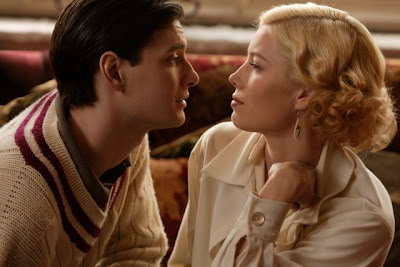

Using the old love-at-first-sight romantic comedy staple of marrying first and discovering each other's backgrounds later, Larita and John visit his dysfunctional family in the English countryside where even before they arrive and as opposed to John's initial adoration, his mother Mrs. Whitaker (Kristin Scott Thomas) is predisposed to loathe the feisty, uncouth American on sight.
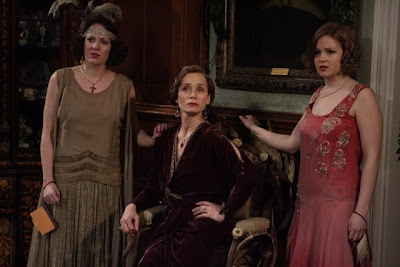

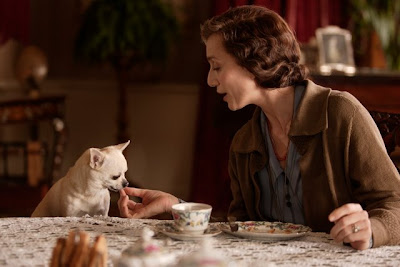
Scott Thomas perfectly embodies an icy wicked witch complete with a "yippy" dog too in the form of a Chihuahua named Poppy whose picture takes up more space in Mrs. Whitaker's home than the portraits of her equally offbeat daughters, Marion (Katherine Parkinson) and Hilda (Kimberley Nixon). Larita-- the new Mrs. Whitaker-- and Scott Thomas' firm main Mrs. Whitaker clash almost right from the start as despite her kind attempts to fit in with her new in-laws, Larita fails at every turn whether mildly due to an uncontrollable allergy to the woman's flowers or majorly by an unfortunate and macabre accident with the dog.


Although John initially tries to stay on his new wife's side, we quickly realize he's still unable to clip the apron strings that bind him to his mother especially when she uses guilt, familial obligation, an old neighbor sweetheart he'd been expected to marry, and financial woes to keep him in line, deftly playing these cards at precisely the right times. As John is too weak, his long-suffering, unhappily married father Jim is too strong for Mrs. Whitaker and Kristen Scott Thomas and Colin Firth fall into an easy banter like the parents in Jane Austen's Pride and Prejudice, no doubt also aided by the fact they'd worked together previously playing a married couple in The English Patient which helped launch both of their careers internationally.
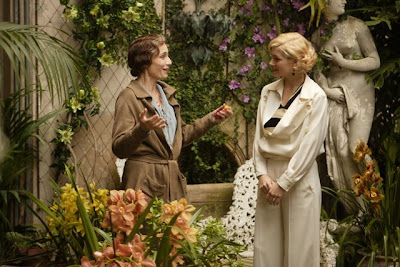

And throughout the obvious culture clash that intriguingly presents the English countryside as even more gossip hungry and cliquish than London since in contrast to the acres of land, the people make it seem as claustrophobic as a rowdy boarding house, Larita finds an important ally via the elder Jim Whitaker. Therefore, soon the two bond over Firth's passion for an old motorcycle he's restoring which reminds Larita of life back in Motor City as well as their pasts that are filled with battle scars when we learn more about Larita's former husband and Jim's survivor guilt as the only man his age still alive in the community after the first World War.
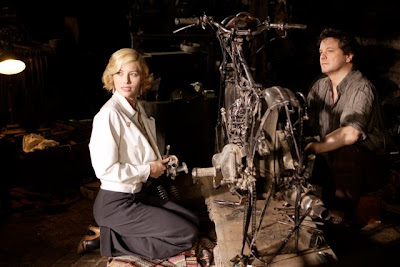

Intelligent and inventive yet still identifiable with modern audiences since Elliott and Sheridan Jobbins ensured their script went beyond Meet the Parents like gags to play up issues to which we can relate today concerning the pasts of Larita and Jim while still not venturing so far from Coward's original source material in the period film that it calls too much attention to itself a la the awkward reinterpretation of Oliver Parker's 2002 Oscar Wilde adaptation of The Importance of Being Earnest.

Nonetheless the decision to incorporate modern songs like "Car Wash" and "Sex Bomb" and orchestrate them in the style of Cole Porter and George and Ira Gershwin struck me as peculiar initially. And although I do feel it's still something of a flaw overall, the saving grace of Elliott's decision was to make sure the music never overpowered the scene by making the film's action our focal point and handling the selections carefully to make sure the period music was far more prominent and echoed in dialogue along with song and dance moments throughout that just felt right.

Moreover, as opposed to staging Moulin Rouge-esque production numbers (aside from the funniest and most unfortunate display of American sarcasm and joke delivery just not translating overseas in a Can-Can crisis), I was stunned to learn after the film ended that Barnes and Biel had actually performed some of the songs on the soundtrack.

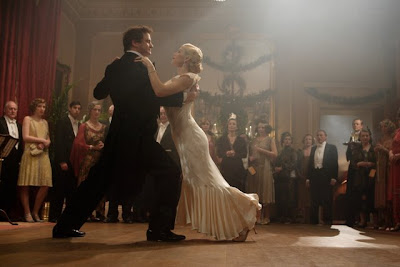
Traditionally, this would've been a major marketing push in a Hollywood production to sell the soundtracks or by placing showstopping sequences in the film yet Elliott underplays the musical accompaniment and the most breathtaking scene of the film isn't even sung as Firth and Biel dance a tango at the end of the picture that replaces Coward's banter with action in telling the story yet still in a way that couldn't have had the same impact in the silent production.

While I'm unsure how the film played overseas, sadly Easy Virtue was a blink-and-you-missed-it release here in the states as it was overpowered by testosterone popcorn movies. However, thankfully given Sony Pictures Classics' beautiful transfer to DVD and Blu-ray, I'm hopeful the work will move beyond appealing to the Coward and Hitchcock crowd and garner more interest on disc. Additionally in the same turn, it's sure to remind admirers of Biel who suffered through Powder Blue along with those who've been unimpressed with her choices since The Illusionist just how much she's capable of as an actress who can walk the dramedy fine line and go toe-to-toe with Firth and quip-to-quip with Scott Thomas.

Text ©2009, Film Intuition, LLC; All Rights Reserved. http://www.filmintuition.com
Unauthorized Reproduction or Publication Elsewhere is Strictly Prohibited.

6/01/2009

Blu-ray Review: Powder Blue (2009)


Now Available on DVD & Blu-ray


With all the '80s musical and dance film remakes either in the works or in pre-release from Fame to Footloose to, yes, Girls Just Want to Have Fun-- Powder Blue is proof that instead of an audition, if they ever decided to remake Flashdance, Jessica Biel could just send the filmmakers a screener of this film from writer/director Timothy Linh Bui.

Of course, aside from Biel's scenes as an exotic dancer which have long been the talk of the sleazier side of the internet (including humiliating leaked photos of Biel topless etc.), those imaginary producers of the possible Flashdance remake would have to endure the rest of the film which simply put is one of the absolute worst movies I've seen in a long, long time. I could just say "end of review" but if you're interested why, go ahead and read on.


For honestly, the thing is-- sadly Biel (whom I first saw in The Illusionist and felt she showed great promise) would've done much better by deciding to show her frankly extremely impressive and athletic skills as a dancer in Flashdance since (unlike that film's talented star Jennifer Beals) she completes all of her own highly stylized routines in this one.

However, in Blue she stars as a single coke-snorting stripper so desperate for companionship she comes on way too strong with every man she meets--nervously talking about Annie Hall for example which any film geek will tell you isn't a good idea. Why the coke and latching onto fantasies of men who will take her to Paris, you ask? Well, the filmmaker is only so pleased to constantly remind you that it's as a way to avoid thinking about her coma-ridden son and missing dog (yes, as if one of those plot-lines wasn't depressing enough).

Obviously, Biel is completely wasted here and to add further insult to insult, she's now been made the subject of online sleaze for believing in a filmmaker so much that she pours hot wax all over her bare chest in a pretentious film that on paper was most likely trying to become the next in a long line of Short Cuts, Crash, 21 Grams, Magnolia, Garden Party, Crossing Over, The Air I Breathe, and dozens of other hopelessly lonely movies about the bleakness of life in La La Land. And as everyone knows we can never have too many of those!

While the film's central premise as promised in the synopsis and on the back of the box is that we're going to encounter "the destinies of four people desperate for connection and redemption," in a way that "movingly chronicles the imperfect lives of people teetering on the edge of despair and the miracles that bring them back," basically throughout its unspeakably mind-numbing 106 minute running time that makes Chariots of Fire and Reds feel like "short films," Bui introduces us to an endless parade of losers. He does this in an attempt to as the filmmaker describes in the making-of-featurette (which I watched both as a critic and as a viewer just simply in shock that this picture had been made in the first place) to create "a study of loneliness in a city of 8 million people."

Inexplicably an obsession of the filmmaker for four years as he struggled to get it made-- even going as far as to live in a seedy motel he'd read about in the paper where failed dreamers and transients who'd ventured to Los Angeles all with the hopes of "becoming somebody" go to rot-- Powder Blue tries its best to dress up the devastation of the piece with religious symbolism and dialogue throughout from the opening frames of the film.


Setting it right around Christmas, Bui makes his "miracle" a bizarre one wherein at least three characters wind up dead. Oh yes, there's a happy present for you and frankly I would've preferred Paul Thomas Anderson's Magnolia style rain of frogs which freaked the hell out of me but did so with style!


And early into the movie we also meet a suicidal Forest Whitaker willing to pay any given stranger 50 grand to shoot him in the heart (most likely for agreeing to produce and star in this film), Ray Liotta as a terminally ill ex-con and a quirky asthmatically shy mortician so unrealistic he's named for the keyboard-- Qwerty (Eddie Redmayne). Oh and I think it goes without saying that Qwerty whose last name is actually Dolittle who has never had a real girlfriend and entertains kids with puppets.


As if that wasn't enough drama, the film also somehow manages to work in creepier subplots and wasted cameos by incredibly talented actors including Lisa Kudrow as a good-natured waitress who-- lonely but still functioning after a divorce-- provides an early romantic possibility for the suicidally depressed and grieving widow Whitaker (whose wife we see in flashbacks was played by the impressive Sanaa Lathan).

Likewise we encounter Kris Kristofferson as another underworld type who always arranges to meet Liotta on a city bus (not exactly something out of the typical wiseguy playbook), a hooker transvestite trying to raise money to undergo surgery to become a woman, and Patrick Swayze as Biel's lecherous strip club boss who-- similar to the girl playing his employee-- would've been much better off in an '80s musical or dance movie remake.

I will grant that it is intriguing indeed on Bui's part to cast Liotta as a soft-spoken against-type character who lets his eyes do most of the talking in a storyline that also involves Biel yet he ruins it as it's also one of the most predictable "gee, how are they related?" connect-the-dots of the wretchedly gritty script and to top it all, the payoff feels like a cheat.


Despite this, the sole bright spot of the film is found in Kudrow who manages to work wonders with her tiny role making us wish she not only was offered more work but that Powder Blue (by the way, I still don't get the title) would've centered around her.

Moreover, by this point I'm seriously questioning Forest Whitaker's motives (along with Liotta's actually) in never finding a role they decide to turn down as they both recently starred in equally bleak ensemble pictures like Whitaker's The Air I Breathe and Liotta's Crossing Over which you know wouldn't have garnered them a big salary at all.

Yet in the case of Powder Blue, mostly you just feel the sorriest for Biel. Not her character mind you as Biel's Rose-Johnny (again with the stupid names) could've disappeared along with the rest and we would've been fine but instead during the film, I felt incredibly badly for the actress herself.


As despite all of the online chatter about her body and beauty including quips about her acting chops by agreeing to appear in some downright silly movies like I Now Pronounce You Chuck and Larry (although to her credit, I wouldn't have turned down a Sandler picture either)-- not to mention the endless gossip fodder surrounding her relationship with Justin Timberlake-- she's a strong onscreen presence. And much like she did given her great yet underwritten role in The Illusionist, she plunges completely into Blue with a fierce dedication and loyalty that makes you painfully aware that she should be offered the chance to prove herself in something far more worthwhile than this film.


Downright ugly and extremely unpleasant (so much so that I'd rather watch a double feature of two other contemporary horrors--Margot at the Wedding and The Savages before I'd ever watch this again), Powder Blue is the type of movie that should come with a prescription for an antidepressant or perhaps a tranquilizer so that you could sleep through its entirety.

Additionally, the work that even seems visually grainy in high-definition despite a strong sound balance goes against its tagline that "hope is found in the darkest places" by proving that it can only be found when you hit eject. Since ultimately, the only thing it makes you want to do is avoid Los Angeles like the plague, any future films by the director, and ask yourself just when filmmakers decided that the only subject to make an independent film about is devastating loneliness, suicide, terminal illness, and/or lost causes. For Bui-- perhaps realizing he'll never have the chance to make another movie-- opted to just go for the 2009 Sophie's Choice Depress-a-thon Award of the Year and put them all in the same film.