Bookmark this on Delicious
  Print Page


In the beginning of his review for Billy Bob Thornton’s amazingly heartfelt southern gothic work
Sling Blade which earned an Academy Award for Best Adapted Screenplay in 1996, Roger Ebert
typed, “If
Forrest Gump had been written by William Faulkner, the result might have been something like
Sling Blade.”
For, in addition to writing some of the great classic American works, Faulkner was according to
More Than Night author James Naremore, a “noir novelist," and Naremore is quick to point out that “some of the classic film noirs are set in the rural south,” (270). To this end, obviously director Charles Laughton's 1955 shocker
The Night of the Hunter starring Robert Mitchum immediately springs to mind and one could argue that the same idea of a man who preys on children is repeated in Thornton's work given the villainous character of Doyle Hargraves.
Yet it had never actually occurred to me to view
Sling Blade within the parameters of film noir until I designed an entire intensive semester on the subject in my undergraduate curriculum and became acquainted with scholars like Naremore and others who had very intriguing interpretations of Thornton's significant
Blade.When viewing it under the noir microscope, James Naremore reveals that although he acknowledges in
More Than Night that the film “was not marketed or reviewed as a noir… it easily could have been,” however he contends that instead it seemed as though it was “originally intended as a sort of regional art movie for the video stores,” (270). Yet, as Naremore continues,
Blade "creates an unusual moral fable, rendered in an austere, sometimes amusingly digressive style,” (272).
In further labeling it as noir-inspired, Naremore shares:
"[Sling Blade] tells an Oedipal story involving murder; it deals with a character who cannot escape his past; and it uses low-key lighting to generate a gothic mood. If nothing else, it shows that familiar motifs of noir can be given new and mildly unorthodox applications. Perhaps for that reason, and perhaps because it was something of a populist movie, it became a surprise hit."
Yet when you consider just how many amazing works that Miramax Studios offered to audiences beginning quietly in the '80s until it reached its ultimate impact in the '90s, the studio and the films that poured out into theatres in any given year began to get taken for granted by movie lovers. Simply put, for those who were serious about movies, any new release from Miramax was immediately placed on the top of our must-see lists, even if every once in awhile they distributed a few vanity projects that celebrated some of their greatest Oscar nominated and award-winning stars and filmmakers.
The success of the studio as far as its respect from both the critical and Academy reception as well as viewers is something that has yet to be repeated by another major studio working within the system today. However, many other companies have tried to fill the massive shoes left behind when brilliant taste-makers yet rumored controversial heads Harvey and Bob Weinstein parted ways with their parent corporation of Walt Disney and walked away from the studio that they named after their own parents. Yet as of this review, no company has come close to achieving both the automatic respect and success of Miramax. And sadly this includes Bob and Harvey's own new label of The Weinstein Company that has quietly released great films but has so far been unable to get them to theatres with the full advertising force of Disney and Buena Vista Home Entertainment behind them.
Aside from bringing amazing foreign works like the
Three Colors Trilogy, Il Postino, Life is Beautiful, and so many other titles to our shores including an important alliance with the UK in releasing
Shakespare in Love, My Left Foot and other Oscar favorites, part of their recipe for reaching fans around the globe was the result of the Weinstein's belief in the power of story and unique visions of those telling them.
Whether they gave Quentin Tarantino the chance he needed to break out with
Pulp Fiction or offered Kevin Smith a shot to introduce the world to his own
Clerks, and helped Gus Van Sant, Matt Damon, and Ben Affleck create a sensation with
Good Will Hunting, they bravely marched towards fare that was decidedly not of the mainstream such as Thornton's masterwork
Sling Blade.
The film that put him on the map had been the actor's passion project for years. Moreover,
Sling Blade is one of those movies that sneaks up on audiences with its deceptive simplicity, its willingness to embrace quiet moments and allow us to contemplate the events along with the characters in a way that makes it both timeless and especially important for viewers to revisit every so often to discover things they may have missed the first time around.
Having initially seen the film in its theatrical run in '96 and once again when I studied it for a thesis I was preparing a few years back on videotape-- it was quite a riveting experience to find myself reminded of the theatre once more via this newly released Miramax Award-Winning Collection Blu-ray edition of the title.
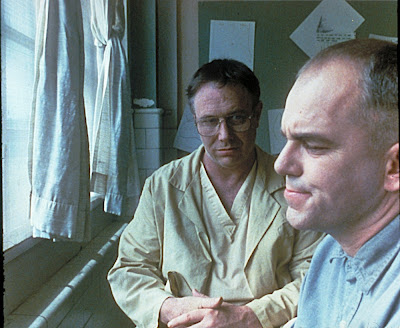
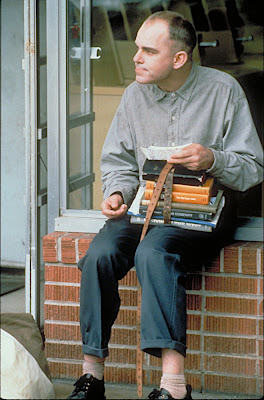
In this moody film, Thornton plays Karl, a mentally challenged man who killed his mother and her lover when he was only twelve years old. After twenty-five years in a state asylum, he is released from government custody and finds the outside world more challenging than the one he’d encountered locked up with rules and order to the point that he actually returns to the familiarity of the asylum hoping they'll take him back.
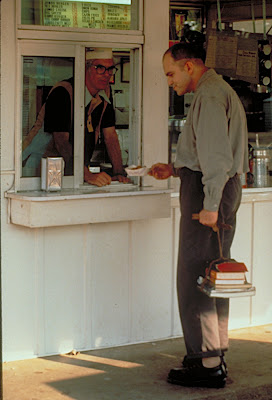
However, and much to Thornton's credit, although the premise alone makes it sound unspeakably grim, the film is surprisingly filled with laughter as Karl tries to rejoin society. To this end, he incorporates several moments that seem to cherish the naturally comedic nature of humanity and interpersonal relationships whether they're permanent or merely casual. And in one example, you can look for fellow indie director Jim Jarmusch as the fast food worker who sells Karl his first “French fried potaters."
As Gary Johnson from
Images Journal Online wrote back when I stumbled on it on '06:
"One of the wonders of Sling Blade is how Thornton manages to take scenes that otherwise might be pathetic and make us laugh. It's a gentle brand of laughter that he evokes because we're not really laughing at Karl; instead, we're laughing at the crazy circumstances that put Karl out in the world again without really preparing him for what he'll find. Thornton also shows the absurdities at work in a world where practically everyone Karl meets talks about wanting to kill someone, where Karl easily outsmarts his "normal" coworker at an engine repair shop, and where Karl easily reads more books than most other people in the movie."
Yet despite the fact that it's seasoned with unexpected smiles and chuckles, an undercurrent of danger persists throughout which Thornton establishes brilliantly from the start in a sort of circular bookend motif that finds Karl going on a journey yet never asking the audience to believe it'll be more than simply temporary despite the fact that our protagonist changes throughout.
In a
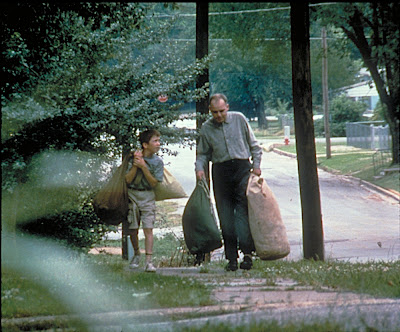
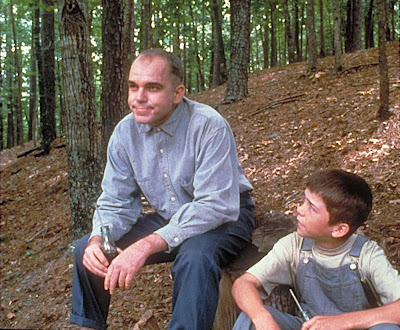
To Kill a Mockingbird Boo Radley like-portrayal (which is ironic considering that "Radley" himself, Mr. Robert Duvall has a cameo), Thornton's endearing Karl befriends a young boy named Frank, acted with startling maturity by Lucas Black.
Quickly we ascertain that Frank’s well-meaning but weak mother is in an abusive relationship with a monster named Doyle, played with menace by Thornton’s friend and country singer Dwight Yoakam. As such, it's the type of plot device that seems to hearken to a cathartic "sins of the past" reenactment of the similar events that had led to Karl's time in the institution when he was a boy.
Given that, aside from Lucas Black (whom Thornton has used every single time he's directed since
Blade), the cast and crew were all people he knew or were a part of his circle of friends and professional colleagues, it's only fitting that the performances seem quite natural. And special mention must be paid to a great understated, compassionate turn by John Ritter as a gay man who along with Karl is an outsider in the community.
Thornton wrote the part specifically for his good friend Ritter and his scenes with Karl are equally important to his with young Lucas Black’s in illustrating the humanity of the character to the audience to endear him to viewers. Obviously this is quite a hurdle since we initially see him in an institution, yet Thornton doesn't want us to believe Karl to be the same type of cliched disabled "gentle giant" who can go too far as was the case in Steinbeck's
Of Mice and Men.
To this end, Thornton takes great pains with the portrayal of Karl in a way that definitely shows and applauds his evolution and ability to interact yet also reminds us now that he knows the effects of violence and idea of choice, that sometimes it is necessary in order to protect others even to the extent of premeditation, whether or not viewers agree with the decision made onscreen.
Likewise in order to “attain the shuffling gait of his character,” (Riley, 81), Thornton put crushed glass in his shoes and his sensitive portrayal of a man with a mental disability earned kudos from the disabled community.
With this in mind, Charles A. Riley II wrote the following in his book
Disability and the Media: Prescriptions for Change:"When it comes to accuracy and understanding the feelings of people with disabilities, the achievement of this film is in part its attention to the feelings of people with disabilities about how they are perceived." (83)
The film, shot in just 24 days with a budget of 1.3 million was inspired by Thornton’s 1994 short
Some Folks Call it a Sling Blade which had originated when legendary director Billy Wilder (
The Apartment, Some Like It Hot) encouraged Thornton to write himself
a showcase for his odd appearance and personality.
And sure enough Wilder's wise advice paid off as based on the strength of Thornton's impressive short that was later developed into a stage play before the film was later made, Miramax purchased the rights
for 10 million after only seeing thirty minutes of footage. Despite Weinstein's demand for Thornton to cut twenty minutes off of the hefty running time,
Blade became a sensation that caused the
One False Move co-writer and actor Thornton to “suddenly [become] transformed into a celebrity,” (Naremore, 73).
An extremely personal film that is now given the ultimate release on Blu-ray with not only a perfected presentation of the low-budget work that clarifies the picture and heightens the sound, at long last Thornton's passion for the material can be appreciated in a plethora of extras that rival the recent release of the Miramax Blu-ray
No Country for Old Men.
It features an in-depth career discussion in
Bravo Profiles: Billy Bob Thornton, a documentary chronicling his path to moviemaking in
Mr. Thornton Goes to Hollywood, several conversations with those involved, on-the-set footage, along with a commentary track and other behind-the-scenes extras. However, perhaps most revealing is the roundtable discussion with Thornton, Yoakam, Mickey Jones, and producer David Bushell since we're treated to the truest insight on the production from those involved.
While the guys kid each other in the roundtable and send praise back and forth for the believable colloquialisms, one of the strongest moments is in dissecting the difficulties of Yoakam's nuanced portrayal which this time around I could finally view minus some of the terror since I knew the story well and appreciate his ridiculousness. And during the conversation the guys have, it's immediately evident that a majority of the contents of the film came from some anecdote or autobiographical event in the life of Thornton or those around him.
Sharing entertaining tales about the politics of life as a teen in garage bands and how the same fights still occur when you're older (as witnessed in the film), Thornton's disdain for pretentious faux art (which again is used in a really bad poetry riff in the movie) and more, it's refreshing to see a group of guys who seem genuinely humble, down-to-Earth, and relatable as opposed to filling a disc with studio supplied electronic press kit fluff.
Although in my mind, the absence of the short that started it all with
Some Folks Call it a Sling Blade is a glaring omission, yet I wonder if perhaps it was a rights issue and couldn't have been part of this disc. Still overall, it's the definitive study of the work from those involved. Likewise it's one that also benefits from some completely candid confessions as the usually quiet Yoakam suddenly becomes a chatterbox in the roundtable, expressing his passion for the film's screenplay and willingness to tackle the many levels of Doyle in a way that went beyond a traditional one-note bad guy approach.
Perpetually repeating his belief-- as indicated in an anecdote that he knew after just twenty seconds of video footage of Lucas Black was the right kid for the role or staying in terrain he knew well-- Thornton informs viewers and the roundtable that when it comes to storytelling and filmmaking, you have to do whatever the hell you feel like doing personally. Following only your instincts, intuition, gut reaction, or the type of visceral effect you have when presented with something, he says that the one thing thing you can never do is worry about the audience or any of the post-production reaction to what you are creating.
It's a worthwhile piece of advice delivered humbly in memorable Thornton fashion. Moreover, whether you look at the film as a gothic piece or noir inspired, it's this type of thinking that would no doubt assist other filmmakers and studios who waste time and energy fixating on trends. Since
Sling Blade stands as one of those quintessential Miramax treasures of plot over pyrotechnics, it's proof that no matter what your story is about or who you are, if you're true to yourself and deliver something authentic and unique, it will reach an audience of those who appreciate the principles of integrity as applied to great art.
Miramax Films
Note: Some of the material used in the review originated in an article published previously on Film Intuition (written by the author in 2006) which can be found
here.
Text ©2009, Film Intuition, LLC; All Rights Reserved. http://www.filmintuition.com Unauthorized Reproduction or Publication Elsewhere is Strictly Prohibited.